Received August 16, 2011 ; Accepted September 26, 2011 Corresponding author: Young Jin Chang
Tel: +82 (51) 629-5915 e-mail: [email protected] 1225-3480/24392
먹이생물에 따른 말백합,
Meretrix petechialis
(Lamarck) 유생의 성장 및 생존김태익, 고창순1, 허영백2, 양문호1, 장영진3
국립수산과학원 남서해수산연구소, 1수산자원사업단, 2남동해수산연구소, 3부경대학교
Growth and Survival of the Hard Clam, Meretrix petechialis (Lamarck) Larvae to Food Organisms
Tae-Ik Kim, Chang Sun Ko1, Young Baek Hur2, Mun Ho Yang1 and Young Jin Chang3 Southwest Sea Fisheries Research Institute, NFRDI, Yeosu 556-823, Korea
1Korea Fisheries Resources Agency, Busan 612-020, Korea
2Southeast Sea Fisheries Research Institute, NFRDI, Tongyeong 619-705, Korea
3Pukyong National University, Busan 608-737, Korea
ABSTRACT
The investigated amounts according to microalgae for stable supply of artificial seed of the hard clam, Meretrix petechialis and also observed the effect according to the repower of the microalgae after the specified period starvation. The stage of specimen used in the test was the D-shaped larva. The microalgae was Chaetoceros calcitrans, Isochrysis galbana and Nannochloris oculata. When the mixture of Chaetoceros calcitrans, Isochrysis galbana and Nannochloris oculata or alone C. calcitrans as food was supplied with 3,000-5,000 cells/ind., it turned to be the most effective. When the food was provided after starvation for some period, the shell length of D-shaped larva was grown to over 192.5 μm at fourth day from the initial feeding. The survival rate tended to be lower, the longer the starvation period.
Key words : Meretrix petechialis, growth, survival, food organisms
서 론
한국에서 말백합을 본격적으로 양성하기 시작한 것은 1960 년대 중반부터이며, 이때부터 양식 생산량이 급격히 증가되어 1970년대 들어와 연간 6,000-9,000톤을 생산했으나 그 이후 대량폐사로 인해 그 생산량은 현저히 줄어들었다. 따라서 말백 합의 자원증대 및 양식을 위해서는 안정적인 종묘 확보가 이루 어져야 하며 이를 위해서는 인공 종묘생산이 필수적이다. 해양 미세조류를 먹이로 섭취하는 조개류는 D형 유생으로 성장하 면서 활발히 먹이를 섭취하기 시작하며, 조개류 유생의 먹이생 물로는 소화가 잘되고 영양가가 높은 부유성 미세조류가 좋다. 조개류 유생의 먹이생물에 대한 성장과 생존 연구는 먹이생
물 종류 (Wilson, 1978; Laing and Verdugo, 1991), 먹이 생물 공급량 (Epifanio and Ewart, 1977; Nell and Wisely, 1984), 유생의 먹이섭취 행동 (His and Seaman, 1992) 그리고 먹이의 선택성 (Wisely and Reid, 1978) 등이 있으며, 국내에서 조개류 유생사육에 관한 연구는 중요 조개류 유생기 먹이와 성장 (Yoo, 1969a)을 시작으로, 홍합, Mytilus coruscus (Yoo, 1969b), 살조개, Protothaca jedoensis (Yoon et al., 2005), 비단가리비, Chlamys farreri (Park et al., 2005), 참굴, Crassostrea gigas (Hur et al., 2010) 등이 있다.
백합류의 먹이생물에 따른 유생사육에 관한 연구는 먹이생 물의 종류와 혼합비율에 따른 백합, Meretrix lusoria의 유생 사육 (上城 等, 1979) 등 일부가 보고되어 있으나, 말백합의 경우 유생사육 시 먹이생물의 적정 공급량과 유생에게 일정기 간 절식 후 먹이생물을 다시 공급함으로써 유생의 성장과 생존 에 대해서 검토한 연구는 없는 실정이다.
본 연구에서는 말백합 유생사육 시 먹이생물의 종류 및 공 급량을 조사하고, 인공 종묘생산시 먹이생물이 부족할 경우에
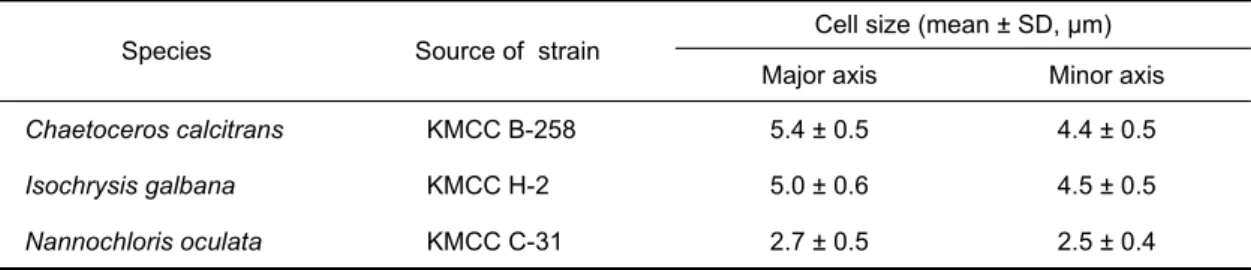
Species Source of strain Cell size (mean ± SD, μm) Major axis Minor axis Chaetoceros calcitrans KMCC B-258 5.4 ± 0.5 4.4 ± 0.5 Isochrysis galbana KMCC H-2 5.0 ± 0.6 4.5 ± 0.5 Nannochloris oculata KMCC C-31 2.7 ± 0.5 2.5 ± 0.4
KMCC: Korea Marine Microalgae Culture Center, B: Bacillariophyceae, H: Haptophyceae, C: Chlorophyceae.
Table 1. Cell size of three microalgal species
대비하여 유생을 일정기간 절식 후 먹이생물 공급에 의한 성장 및 생존율을 조사 분석하였다.
재료 및 방법 1. 실험종
실험에 사용된 말백합은 2003년 전북 김제시 진봉면 심포 리 앞바다에서 생식소 발달단계가 성숙기 및 산란기인 7-9월 에 채집된 각장 58.8±8.2-65.8±8.4 mm, 전중 54.3±29.8- 73.1±28.7 g의 개체들이었다. 성숙된 어미는 공기노출 및 수 온상승 방법을 병행하여 채란 및 수정하였고, 정상적인 발생과 정을 거친 후 D형 유생으로 발생된 개체들을 사용하였다.
2. 먹이생물 종류에 따른 유생의 성장과 생존
먹이생물의 종류에 따른 유생의 성장과 생존율을 조사하기 위하여 4일간 먹이생물 종류를 달리하여 사육실험을 실시하였 다. 사용된 먹이생물은 규조류 (Class Bacillariophyceae) 인 Chaetoceros calcitrans, 착편모조류 (Class: Haptophyceae) 인 Isochrysis galbana, 녹조류 (Class: Chlorophyceae)인 Nannochloris oculata 3종이었다 (Table 1). 이 실험에서 3종 류의 미세조류를 단독으로 공급한 실험구와 3종을 혼합하여 공급한 실험구를 설정하여 성장과 생존율을 비교하였다. 먹이 생물은 hemacytometer를 이용하여 1 mL당 세포수를 계수 한 후 유생이 성장함에 따라 매일 1,000 세포씩 공급량을 증 가시켜 유생 1개체 당 6,000-10,000 세포를 오전과 오후 10 시에 2회 나누어 공급하였다.
실험에 사용된 D형 유생의 크기는 각장 133.1±2.5 μm로 1 L 비이커에 사육수 1 mL당 5개체씩 수용하여 사육하였다.
염분은 1 μm cartridge filter를 사용하여 여과된 해수에 증 류수를 혼합하여 30 psu로 조절하였고, 수온은 water bath 를 이용하여 33℃로 조절하였다. 적절한 수질을 유지하기 위 하여 2일째 사육수를 전량 환수하였으며, 매일 오전 10시에 수온과 염분을 측정하였다. 유생의 성장은 10 mL를 3회 채집 하여 만능투영기 (Nikon V-12) 로 각장과 각고를 1 μm 단 위까지 측정하였고, 생존 개체수를 계수하여 생존율을 분석하
였다. 실험은 2반복으로 실시하였다.
3. 먹이생물 공급량에 따른 유생의 성장과 생존
먹이생물 공급량에 따른 유생의 성장과 생존율을 알아보기 위하여 3일간 먹이생물 공급량을 달리하며 사육실험을 실시하 였다. 실험에 사용한 D형 유생의 크기는 각장 132.7±5.9 μm 였으며, C. calcitrans, I. galbana, N. oculata 3종의 미세조 류를 동일한 세포수로 혼합한 후 사육 0-1, 2, 3일째의 공급량 을 유생 1개체당 250-500-1,000 세포, 1,000-2,000-3,000 세 포, 3,000-4,000-5,000 세포, 5,000-6,000-7,000 세포, 7,000- 8,000-9,000 세포로 구분한 실험구를 설정하여 유생의 성장 및 생존율을 비교 분석하였다. 실험은 3반복으로 실시하였으 며, 그 외 실험조건은 먹이생물 종류별 유생사육에서와 동일하 게 하였다.
4. 먹이생물 절식 기간에 따른 유생의 성장과 생존 유생의 절식실험은 8일간 실시하였다. 1일, 2일, 4일로 나 누어 절식 후 먹이생물을 공급하였고, 먹이생물을 공급하지 않 은 실험구 그리고 절식 없이 당일 먹이생물을 공급한 실험구를 함께 설정하여 유생의 성장과 생존율을 비교 분석하였다. 실험 에 사용한 D형 유생의 크기는 각장 133.1±2.5 μm였다. 먹 이생물은 C. calcitrans, I. galbana, N. oculata로서 초기 D형 유생에게 1개체당 매일 6,000 세포를 공급하였으며, 유 생이 성장함에 따라 공급량을 증가시켜 4일째 10,000 세포를 공급하였다. 실험은 2반복으로 실시하였으며, 그 외 실험조건 은 먹이생물 종류별 유생사육에서와 동일하게 하였다.
5. 통계처리
각 실험 결과로부터 얻어진 모든 측정값들은 평균±표준편 차 (SD) 로 표시하였으며, 측정값들 사이의 유의차 유무는 SPSS (ver. 12) 를 사용하여 95% 신뢰수준에서 ANOVA와 Duncan's multiple range test (Duncan, 1955) 로 검정하 였다.
Microalgae
Elapsed days (mean ± SD, μm) Daily increment of SL (μm)
Initial 1 2 3 4
Isochrysis
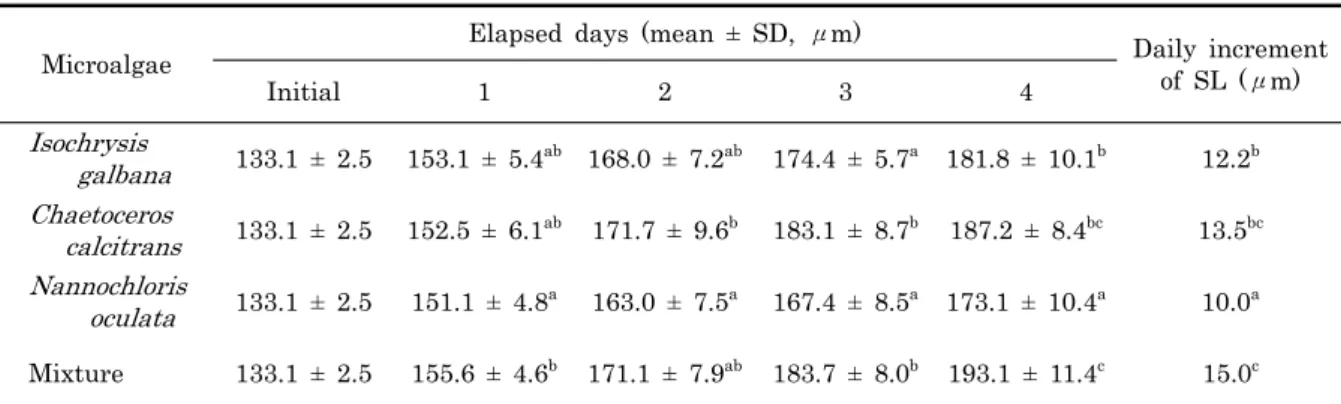
galbana 133.1 ± 2.5 153.1 ± 5.4ab 168.0 ± 7.2ab 174.4 ± 5.7a 181.8 ± 10.1b 12.2b Chaetoceros
calcitrans 133.1 ± 2.5 152.5 ± 6.1ab 171.7 ± 9.6b 183.1 ± 8.7b 187.2 ± 8.4bc 13.5bc Nannochloris
oculata 133.1 ± 2.5 151.1 ± 4.8a 163.0 ± 7.5a 167.4 ± 8.5a 173.1 ± 10.4a 10.0a Mixture 133.1 ± 2.5 155.6 ± 4.6b 171.1 ± 7.9ab 183.7 ± 8.0b 193.1 ± 11.4c 15.0c Values in the same column having different alphabetical superscripts indicate that they are significantly different (P <
0.05).
Table 2. Growth and daily increment of shell length (SL) with species of microalgae of Meretrix petechialis larvae
Microalgae Elapsed days (mean ± SD)
Initial 1 2 3 4
Isochrysis galbana 100 97.0 ± 6.0a 78.0 ± 18.0a 74.0 ± 16.3a 49.7 ± 9.3a Chaetoceros calcitrans 100 100 ± 0.0a 92.0 ± 9.2a 85.3 ± 14.5a 77.7 ± 13.0b Nannochloris oculata 100 91.0 ± 7.6a 90.0 ± 9.5a 87.3 ± 8.9a 78.3 ± 15.7b Mixture 100 93.0 ± 11.5a 88.0 ± 9.8a 87.3 ± 11.1a 80.0 ± 12.2b Values in the same column having different alphabetical superscripts indicate that they are significantly different (P <
0.05).
Table 3. Survival (%) of Meretrix petechialis larvae fed three different and mixed microalgae
결 과
1. 먹이생물의 종류에 따른 유생의 성장과 생존
먹이생물 종류에 따른 유생의 성장을 비교한 결과, C.
calcitrans, I. galbana, N. oculata를 동일비율로 혼합하여 공급한 실험구가 사육 4일째 각장 193.1 ± 11.4 μm, 일간 성장 15.0 μm로 성장이 가장 빨랐으며, 먹이생물 종류를 단 독으로 공급한 실험구 중에서는 C. calcitrans와 I. galbana 를 단독으로 공급한 실험구에서 사육 4일째 각장이 각각 187.2 ± 8.4 μm, 181.8 ± 10.1 μm로 성장하여 일간성장 이 각각 13.5 μm, 12.2 μm였다. 녹조류인 N. oculata를 단독으로 공급한 실험구는 사육 4일째 173.1 ± 10.4 μm, 일간성장 10.0 μm로 성장이 가장 늦었다. 먹이생물 종류에 따른 유생의 성장은 3종의 먹이생물을 혼합한 실험구와 C.
calcitrans의 단독 먹이 실험구 사이에는 유의한 차이가 없었 으나 (P > 0.05), I. galbana와 N. oculata를 단독으로 공급 한 실험구와는 유의한 차이가 있었다 (P < 0.05, Table 2).
생존율은 사육 4일째 I. galbana 실험구에서 49.7%로 다 른 실험구와는 유의한 차이를 보였고 (P < 0.05), 그 외 실험 구의 생존율은 77.7-80.0%로 높은 생존율을 보였으며, 실험구
간에는 유의한 차이가 없었다 (P > 0.05, Table 3).
2. 먹이생물 공급량에 따른 유생의 성장과 생존율
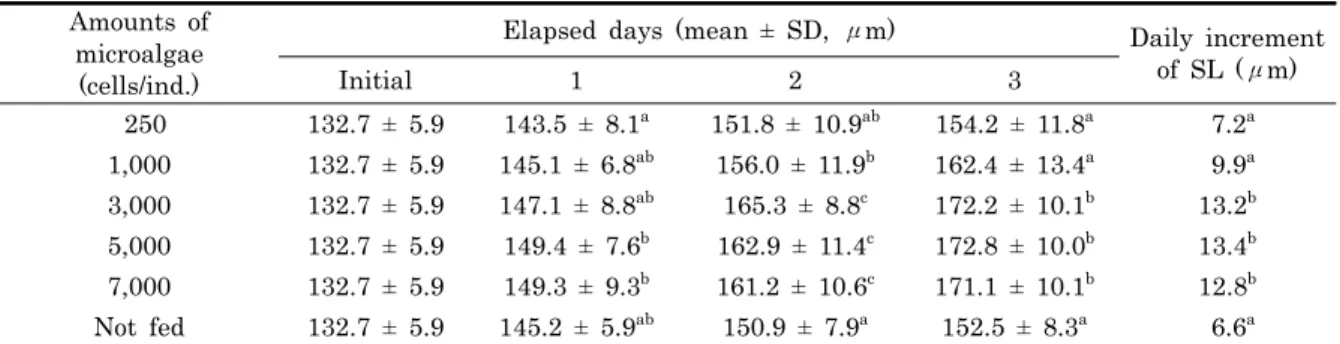
먹이생물 공급량에 따른 유생의 각장 성장은 공급량 250 세 포/개체, 1,000 세포/개체의 실험구에서 사육 3일째 각각 154.2 ± 11.8 μm, 162.4 ± 13.4 μm 크기로 나타나 일간 성장은 각각 7.2 μm, 9.9 μm였다. 공급량 3,000 세포/개체, 5,000 세포/개체와 7,000 세포/개체의 실험구에서는 각장이 각각 172.2 ± 10.1 μm, 172.8 ± 10.0 μm, 171.1 ± 10.1 μm였으며, 일간성장은 각각 13.2 μm, 13.4 μm, 12.8 μm였다. 한편 먹이생물을 공급하지 않은 실험구에서는 각장이 152.5 ± 8.3 μm, 일간성장이 6.6 μm였다. 먹이생 물 공급량에 따른 유생의 각장 성장은 공급량 3,000 세포/개 체, 5,000 세포/개체와 7,000 세포/개체 실험구간에는 유의한 차이가 없었으나 (P > 0.05), 공급량 250 세포/개체, 5,000 세포/개체와 먹이생물을 공급하지 않은 실험구와는 유의한 차 이가 있었다 (P < 0.05, Table 4). 생존율은 사육 3일째 먹 이생물을 공급하지 않은 실험구에서 62.7%로 가장 높았으며, 그 외 실험구의 생존율은 37.8-48.2%로 전실험구에서 생존율 의 유의한 차이가 없었다 (P > 0.05, Table 5).
Amounts of microalgae
(cells/ind.)
Elapsed days (mean ± SD, μm) Daily increment of SL (μm)
Initial 1 2 3
250 132.7 ± 5.9 143.5 ± 8.1a 151.8 ± 10.9ab 154.2 ± 11.8a 7.2a 1,000 132.7 ± 5.9 145.1 ± 6.8ab 156.0 ± 11.9b 162.4 ± 13.4a 9.9a 3,000 132.7 ± 5.9 147.1 ± 8.8ab 165.3 ± 8.8c 172.2 ± 10.1b 13.2b 5,000 132.7 ± 5.9 149.4 ± 7.6b 162.9 ± 11.4c 172.8 ± 10.0b 13.4b 7,000 132.7 ± 5.9 149.3 ± 9.3b 161.2 ± 10.6c 171.1 ± 10.1b 12.8b Not fed 132.7 ± 5.9 145.2 ± 5.9ab 150.9 ± 7.9a 152.5 ± 8.3a 6.6a Values in the same column having different alphabetical superscripts indicate that they are significantly different (P <
0.05).
Table 4. Growth and daily increment of shell length (SL) with different amounts of microalgae of Meretrix petechialis larvae
Amounts of microalgae (cells/ind.)
Elapsed days (mean ± SD)
Initial 1 2 3
250 100 71.3 ± 16.0a 61.3 ± 13.6a 48.2 ± 12.4a
1,000 100 64.7 ± 4.2a 50.7 ± 14.7a 38.2 ± 15.8a
3,000 100 61.3 ± 7.6a 56.0 ± 11.1a 45.3 ± 16.2a
5,000 100 61.3 ± 9.0a 48.0 ± 8.7a 38.4 ± 6.0a
7,000 100 54.0 ± 8.7a 45.3 ± 6.1a 37.8 ± 8.9a
Not fed 100 73.3 ± 5.0a 66.7 ± 6.1a 62.7 ± 6.6a
Values in the same column having different alphabetical superscripts indicate that they are significantly different (P <
0.05).
Table 5. Survival (%) with different amounts of microalgae of Meretrix petechialis larvae
Fig. 1. Growth and daily increment of shell length of Meretrix petechialis larvae by the different starvations.
3. 먹이생물 절식 기간에 따른 유생의 성장과 생존 D형 유생을 일정기간 절식한 후 먹이생물을 공급한 사육실 험에서 유생의 성장과 일간성장을 Fig. 1에 나타내었다. 절식 없이 먹이생물을 매일 공급한 실험구에서 각장의 성장과 일간 성장은 사육 4일째 각장 192.5 ± 11.2 μm의 침착기 유생으 로 성장하였고, 일간성장은 14.9 μm였다. 1일 절식 후 먹이 생물을 공급한 실험구는 먹이생물 공급 후 4일째에 각장 197.3 ± 18.3 μm, 일간성장 12.3 μm, 2일 절식 후 먹이생 물을 공급한 실험구에서는 각장 200.3 ± 17.2 μm, 일간성 장 11.4 μm, 그리고 4일 절식 후 먹이를 공급한 실험구에서 는 각장 199.8 ± 21.4 μm, 일간성장 10.1 μm로 나타났다.
절식 후 먹이생물을 공급한 4일째에는 전실험구에서 침착기 유생으로 성장하였다. 한편 먹이생물을 공급하지 않은 실험구 에서는 사육 8일째 각장 165 ± 9.6 μm, 일간성장 4.0 μm 로 각장 165 μm 크기에서 성장이 정지하였다.
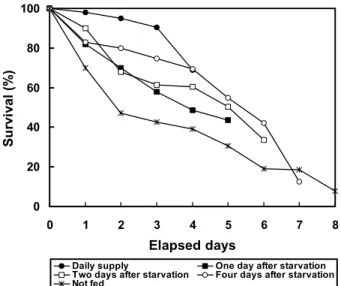
생존율은 먹이생물을 매일 공급한 실험구에서 사육 4일째 69.0%, 1일 절식 후 먹이생물을 공급한 실험구에서 43.6%, 2 일 절식 후 먹이생물을 공급한 실험구에서 33.6%, 4일 절식 후 먹이생물은 공급한 실험구에서 12.6%, 그리고 먹이생물을 전혀 공급하지 않은 실험구에서 7.8%로 나타나 절식 기간이 길수록 생존율이 낮아지는 경향을 보였다 (Fig. 2).
0 20 40 60 80 100
0 1 2 3 4 5 6 7 8
Elapsed days
Survival (%)
Daily supply One day after starvation Two days after starvation Four days after starvation Not fed
Fig. 2. Survival (%) of Meretrix petechialis larvae by five different starvation.
고 찰
조개류는 식물플랑크톤을 여과 섭식하므로 인공종묘생산에 있어 식물플랑크톤의 확보가 매우 중요하며 (Epifanio, 1979), 조개류의 먹이로는 C. calcitrans, Pavlova lutheri, I. galbana가 많이 이용되고 있다 (Delaunay et al., 1992;
Marty et al., 1992). 본 연구에서 사용한 먹이생물은 C.
calcitrans, I. galbana, N. oculata이다. 규조류인 C.
calcitrans의 외부 형태는 직사각형에 가깝고 세포의 모서리 부분에 긴 강모가 있고 운동성은 없으며, 장축의 크기는 5.4 μm이다. 착편모조류에 속하는 I. galbana는 세포의 한쪽 중 간지점에서 긴 편모가 있어 운동성이 있으며, 전체적인 세포형 태는 원형에 가깝고 장축의 크기는 5.0 μm로 단백질과 지방 산 함량이 높아 먹이생물로 가장 널리 이용된다. 녹조류인 N.
oculata는 원형으로 운동성이 없으며, 세포의 장축 크기는 2.7 μm로 가장 작다. 上城 等 (1979) 은 먹이생물 종류에 따 른 백합, Meretrix lusoria 유생의 성장과 생존율을 알아보기 위하여 수온 26.5-28.6℃에서 7일간 사육실험을 하여 C.
calcitrans를 단독으로 공급한 실험구와 C. calcitrans와 Monochrysis lutheri를 4:1, M. lutheri와 C. calcitrans를 4:1, C. calcitrans, M. lutheri, Chlorella sp.를 4:4:1 비율 로 혼합하여 공급한 실험구에서 크기 190 μm 이상의 침착기 혹은 포복기 유생으로 성장하였으며, 생존율은 6.3-18.2%로 보고하였다. 본 연구에서는 C. calcitrans, I. galbana, N.
oculata를 동일비율로 혼합하여 공급한 실험구에서 사육 4일 째 각장 193.1 ± 11.4 μm, C. calcitrans를 단독으로 공급 한 실험구에서 각장 187.2 ± 8.4 μm의 침착기 유생으로 성 장하였으나, N. oculata를 단독으로 공급한 실험구에서는 사
육 4일째 173.1 ± 10.4 μm로 성장이 가장 늦어 먹이로서 효율이 가장 낮았다. 위와 같은 결과로 볼 때 백합과 말백합을 포함한 백합류는 C. calcitrans를 단독으로 그리고 여러 종을 혼합하여 공급하였을 경우 가장 양호한 효율을 나타내는 것으 로 보인다.
유생사육시 먹이생물 공급량이 부족하면 영양 부족으로 성 장에 영향을 미치며, 너무 많이 공급되면 사육환경을 악화시켜 생존율과 성장에 영향을 미치므로 적정한 먹이생물 공급량을 결정하는 것은 중요하다. 본 연구에서는 C. calcitrans, I.
galbana, N. oculata를 혼합하여 공급한 말백합 유생의 일간 성장은 공급량 3,000-7,000 세포/개체에서 12.8-13.2 μm, 1,000 세포/개체에서 9.9 μm, 250 세포/개체에서 7.2 μm 로 나타나, 공급량 1,000 세포/개체 이하는 먹이생물의 부족에 의한 유생 성장의 저해요인으로 작용하였다. 공급량 3,000 세 포/개체 이상에서는 유생의 성장에 유의한 차이가 없어 (P >
0.05), 말백합 유생은 5 개체/mL의 사육밀도에서 먹이생물 공급량은 3,000-7,000 세포/개체가 가장 적합한 것으로 나타 났다. 한편 먹이생물을 공급하지 않은 실험구에서는 일간성장 은 6.6 μm로 가장 늦었지만 생존율은 62.7%로 먹이생물을 공급한 실험구보다 높았다. 이는 먹이생물을 공급한 실험구에 서는 유생의 먹이생물 섭취에 따른 배설물 및 분비물 등으로 초래되는 환경악화가 생존율에 악영향을 미친 것으로 추정된 다.
조개류의 대량 인공종묘생산시 많은 양의 먹이생물이 필요 하며, 실내에서 먹이생물 배양이 부진한 때는 유생에게 먹이를 안정적으로 공급하지 못할 수 있다. 먹이의 준비가 지연되는 경우를 대비하여 초기 D형 유생의 절식 후 재공급 실험을 실 시한 결과, 일정기간 절식 후 먹이생물을 공급한 날로부터 4일 째에 전실험구에서 평균 각장 192.5 μm 이상의 침착기 유생 으로 성장하였으며, 생존율은 절식 기간이 길수록 낮은 경향을 보였다. 8일간 먹이생물을 공급하지 않은 유생은 6일 이후 각 장 165 μm에서 성장이 정지하였으며, 이는 초기에 자체영양 분이 성장에 관여했을 것으로 보인다. 따라서 본 연구결과를 볼 때 인공종묘생산 시 환경변화가 성장과 생존에 미치는 영향 을 최소화하기 위해선 각 유생 단계별 절식에 따른 성장한계시 간을 파악하여 이에 따른 원활한 먹이생물의 공급이 필요할 것 으로 보인다.
요 약
본 연구는 말백합의 안정적인 인공종묘생산을 위해 먹이생 물의 종류 및 공급량을 조사하였고, 일정기간 절식 후 먹이생 물의 재공급에 따른 영향을 관찰하였다. 유생의 먹이생물은 I.
galbana, C. calcitrans, N. oculata를 혼합하거나 단독으로 공급할 경우 C. calcitrans를 D형 유생 1개체당 3,000-5,000
세포를 공급하는 것이 가장 효과적이었다. D형 유생을 일정기 간 절식 후 먹이생물을 공급한 경우 먹이생물을 공급한 시점부 터 4일째에 평균각장 192.5 μm 이상의 침착기 유생으로 성 장하였다. 생존율은 절식기간이 길수록 낮아지는 경향을 보였 다.
REFERENCES
Delaunay, F., Marty, Y., Moal, J. and Samain, J.F. (1992) Growth and lipid class composition of Pecten maximus (L) larvae grown under hatchery conditions. Journal of Experimental Marine Biology and Ecology, 163: 209-219.
Duncan, D.B. (1955) Multiple-range and multiple F test.
Biomerics, 11:1-14.
Epifanio, C.E. (1979) Comparison of yeast and algal diets for bivalve molluscs. Aquaculture, 16: 187-192.
Epifanio, C.E. and Ewart, J. (1977) Maximum ration of four algal diets for the oyster Crassostrea virginica Gmelin. Aquaculture, 11: 13-29.
His, E. and Seaman, M.N.L. (1992) Effects of temporary starvation in the survival and on subsequent feeding and growth of oyster (Crassostrea gigas) larvae. Marine Biology, 114:
277-279.
Hur, Y.B., Kim, T.E., Lee, S.J. and Hur, S.B. (2010) Variations in reserved nutrient consumption and growth of Pacific oyster, Crassostra gigas larvae during starvation. Korean Journal of Fisheries and Aquatic Sciences, 43(5): 489-494. (in Korean)
Kim, B.S., Moon, T.S., Park, K.Y., Jo, P.G. and Kim, M.C. (2010) Study on spawning induction and larvae breeding of the hard clam, Meretrix petechialis (Lamarck). Korean Journal of Malacology, 26(2): 151-156. (in Korean)
Laing, I. and Verdugo, C.G. (1991) Nutritional value of
spray-dried Tetraselmis suecica for juvenile bivalves.
Aquaculture, 92: 207-218.
Marty, Y., Delaunay, F., Moal, J. and Samain, J.F. (1992) Changes in the fatty acid composition of Pecten maximus (L) during larval development. Journal of Experimental Marine Biology and Ecology, 163:
221-234.
Nell, J.A. and Wisely, B. (1984) Experimental feeding of Sydney rock oysters, Saccostrea commercialis Ⅲ.
Food concentration and fattening procedures.
Aquaculture, 37: 197-208.
Park, K.Y., Kim, S.K., Seo, H.C. and Ma, C.W. (2005) Spawning and larval development of the jicon scallop, Chlamys farreri. Journal of Aquaculture, 18(1): 1-6. (in Korean)
Wilson, J.H. (1978) The food value of Phaedactylum tricornutum Bohlin to the larvae of Ostrea edulis and Crassostrea gigas Thunberg. Aquaculture, 13:
313-323.
Wisely, B. and Reid, B.L. (1978) Experimental feeding of Sydney rock oyster (Crassostrea commercialis = Saccostrea cucullata) Ⅰ. Optimum particle sizes and concentrations. Aquaculture, 15: 319-331.
Yoo, S.K. (1969a) Food and growth of the larvae of certain important bivalves. Bulletin of Pusan Fisheries College, 9: 65-87. (in Korean)
Yoo, S.K. (1969b) Culture condition and growth of larvae of the Mytilus coruscus GOLD. The Journal of the Oceanological Society of Korea, 4(1): 36-48.
(in Korean)
Yoon, H.S., Kim, J. and Choi, S.D. (2005) Biological studies on aquaculture for resources enhancement of Protothaca jedoensis Ⅰ. Egg development and larva reared. Journal of Aquaculture, 18(4): 260-266. (in Korean)
上城義信・安東正雄・松本正勝. (1979) ハマグリ人工種苗の成長と その生態に關する二・三の知見. 栽培技硏, 8(1): 1-8.