* This paper was supported by research funds of Chonbuk National University in 2011.
†The First and Corresponding Author:Choi, Nak Hwan(Professor of Chonbuk National University) E-mail:[email protected]
TEL:063-270-2998 FAX:063-270-2985
소비목적과 광고유형이 규제적합성 및 제품평가에 미치는 영향*
Interactive Roles of Consumption Goals and Types of Advertisements on Regulatory Fit and Product Evaluation
최낙환**†․유총***
Nak Hwan Choi**†․Cong Liu***
전북대학교 경영학부 교수**
Professor, Department of Business Administration, Chonbuk National University**
전북대학교 대학원 경영학과 박사과정***
Doctoral Student, Department of Business Administration, Chonbuk National University***
Abstract
Consumers can have impression goals as well as defense goals. Those with impression goals could use social goals or opinions of others in a social context to determine their attitudes, and those with defense goals could maintain their existing attitudes and beliefs. Since people typically approach pleasure and avoid pain, there are two kinds of goal orientations depending on regulatory focus theory. Therefore, marketers could design advertisements for their products on the basis of two types of focus, promotion-focused and prevention-focused advertisements. This study aims to explore how consumers with different consumption goals evaluate an advertised product. The results of this study demonstrate that consumers with impression goals felt much more “right” about the product in a promotion-focused, rather than prevention-focused, advertisement, and those with defense goals, felt much more
“right” about the product in a prevention-focused advertisement. Consumers with impression goals evaluated the product in the promotion-focused advertisement more favorably than in the prevention-focused advertisement, and those with defense goals evaluated the product in the prevention-focused advertisement more favorably.
Keywords : Defense Goal, Impression Goal, Prevention-Focused Advertisement, Product Evaluation, Promotion- Focused Advertisement, Regulatory Fit
요 약
Consumers can have impression goals as well as defense goals. Those with impression goals could use social goals or opinions of others in a social context to determine their attitudes, and those with defense goals could maintain their existing attitudes and beliefs. Since people typically approach pleasure and avoid pain, there are two kinds of goal orientations depending on regulatory focus theory. Therefore, marketers could design advertisements for their products on the basis of two types of focus, promotion-focused and prevention-focused advertisements. This study aims to explore how consumers with different consumption goals evaluate an advertised product. The results
of this study demonstrate that consumers with impression goals felt much more “right” about the product in a promotion-focused, rather than prevention-focused, advertisement, and those with defense goals, felt much more
“right” about the product in a prevention-focused advertisement. Consumers with impression goalsevaluated the product in the promotion-focused advertisement more favorably than in the prevention-focused advertisement, and those with defense goals evaluated the product in the prevention-focused advertisement more favorably.
주제어 : Defense Goal, Impression Goal, Prevention-Focused Advertisement, Product Evaluation, Promotion- Focused Advertisement, Regulatory Fit
1. Introduction
Consumption goals can significantly influence consumers’ motivations. Setting goals helps consumers realize what they need to do and motivates them to take certain actions to attain their goals.
Consumers faced with an attempt to achieve their consumption goals ask themselves, “Will new consumption fulfill what I want?” Agrawal and Maheswaran (2005) suggest that people with defense goals always hold attitudes that support their existing beliefs and, those with impression goalsexpress attitudes that satisfy interpersonal and social goals. People with impression goals are typically motivated to determine their attitudes on the basis of current social goals or opinions of others in a social context. They are more likely to be concerned about satisfying interpersonal goals in expressing a particular judgment in a given social context. By contrast, people with defense goals usually motivate themselves to maintain their own existing attitudes and beliefs. Moreover, they are more likely to discount a heuristic that is inconsistent with their existing beliefs and focus on information consistent with their preferences to reach desired outcomes.
Various studies on regulatory focus suggest that this focus regulates consumers’ attitudes and behaviors toward their goals. People with promotion orientation focus on the realization of their positive goals and desires; hence, they are more sensitive to gains and non-gains, while those with prevention orientation focus on perceiving an absence of unwanted occurrences and maintaining their current status. Therefore, they are more sensitive to loss and non-loss (Crowe and Higgins, 1997).
Goals control actions by regulating what people do to attain them, and they also influence product evaluations.
For example, when a person with defense goals fails to pass an important examination and then goes to a party, he or she may try to regulate his or her behavior by partying less to prevent the failure from being known by other people. Therefore, marketers should consider consumers’ goals when making or designing product advertisements.
To the best of our knowledge, few studies have investigated what types of product advertisement accord with goals. To fill this gap, this paper attempts to identify the interactive roles of consumption goals and types of advertisements on regulatory fit and product evaluations.
2. Theoretical Background and Hypotheses
2.1. Promotion-Focused Advertisements and Prevention-Focused Advertisements
Regulatory focus is based on a person’s particular concerns or interests that guide his or her behaviors. In investigating the effects of regulatory focus, researchers suggest how people with different regulatory foci regulate their attitudes and behaviors toward goals. The literature on regulatory focus indicates that people have one of two foci, which are chronic or sometimes primed by the variety of situations and messages (Crowe and Higgins, 1997; Higgins, 2000). Promotion-oriented individuals focus on the realization of positive goals and desires hence, they are more sensitive to gains and
non-gains. In addition, they view decisions with eagerness and enthusiasm and are willing to take risks their goals are perceived as hopes and ideals that satisfy the need for accomplishment (Crowe and Higgins, 1997).
Prevention-oriented individuals focus on perceiving an absence of unwanted occurrences and maintaining the status quo hence, they are more sensitive to loss and non-loss. Furthermore, they view their decisions vigilantly to limit the chances of making mistakes, and their goals are experienced as responsibilities or “oughts”
that satisfy the need for security. For instance, imagine that there are two students in the same course who are each working to attain an A. The promotion-oriented one typically thinks, “I am trying to get a new score that I have never got before” thus, this student may read material beyond the assigned readings to pursue his or her goal. In contrast, the prevention-oriented one is usually concerned with the risks involved with the exam hence, he or she would be very careful to fulfill all course requirements. The example suggests that the regulatory focus affects the choice of behavior and the psychological process needed to achieve a goal.
Therefore, it is necessary for marketers to design advertisements for their products on the basis of the above two kinds of focus. They should think about the strengths and weaknesses of promotion-focused and prevention-focused advertisements. The former mainly focuses on positive goals and desires in order to satisfy consumers’ needs for accomplishment that is, it emphasizes the “gains” aspect of the target product—
what consumers can gain or get by using the target product to achieve their desired outcomes or goals. The latter type of advertisement mainly focuses on vigilance and security needs to limit the chances of making mistakes that is, it mainly stresses the “non-loss” aspect of the target product—consumers can prevent some unwanted occurrence in order to maintain the status quo.
2.2. Impression and Defense Goals
The heuristic-systematic model proposes a dual-process framework, which explains how behavior can occur in two different ways. Usually, the two processes consist of
both the conscious process, which is controlled, and the unconscious process, which is automatic. In other words, people process information either in a more cognitive way or in a relatively effortless way (Chen et al., 1996).
In addition, one recent study on the dual-process model focuses on impression and defense goals and also suggests that consumers’ consumption goals can influence their message processing (Agrawal and Maheswaran, 2005).
An impression goal refers to the motivation to determine attitudes based on current social goals or the opinions of others in a social context (Chen et al., 1996;
Agrawal and Maheswaran, 2005). That is, people driven by impression goals will be concerned about satisfying interpersonal goals, which could be criteria in judging the interpersonal consequences of expressing a particular judgment in a given social context. For instance, imagine that you have been planning a 10-day vacation to a destination that you have long been hoping to visit. If you go there, you will have a good rest at a hotel, relax fully, and do things you like, such as hiking, scuba diving, and mingling with strangers. You are certain that once you return home, your family, friends, and colleagues will ask you about the vacation. Hence, when choosing the number of things you will do, you may be thinking about your family’s or friends’ opinions. In other words, your consumption decisions (the amount of activities you choose to join in) are subject to the opinions of others (your family and friends) in a social context. In addition, product judgments will be more favorable for positive (vs. negative) outcomes under the impression goals (Agrawal and Maheswaran, 2005).
A defense goal refers to the motivation to maintain existing attitudes and beliefs. Individuals motivated by defense goals prefer selective systematic processing to support their existing beliefs but undermine the information inconsistent with the desired outcomes (Ditto and Lopez, 1992). In other words, they depend on heuristic cues in making judgment, which help them not receive what they view as unwanted, and they discount the heuristic that is inconsistent with their existing beliefs (Rogers and Chaiken, 1997). To clarify, those with defense goals are more likely to selectively focus
on preference-consistent information and counter-argue preference-inconsistent information by using existing knowledge or stimuli (Jain and Maheswaran, 2000).
Different goals may moderate the effect of a heuristic on judgments and play roles in the decision-making process as well. In the process of judgment formation, defense-motivated individuals prefer selective elaboration, and their judgments can be affected by heuristic cues (appeals) that support their existing beliefs and attitudes. Impression-motivated individuals bias their systematic processing and then the heuristic cues bias subsequent outcome-related responses. Therefore, this study focuses on the effects of impression and defense goals on the roles of different advertisements on product evaluations.
2.3. Interactive Effect of Types of
Advertisements and Types of Goals on Regulatory Fit
An impression goal as a certain motivation induced from achieving a current social goal can be the root of forming a promotion orientation, which focuses on eagerness and aspiration to experience hopes or ideals. A defense goal as a kind of motivation for maintaining current attitudes or beliefs can be the source of prevention orientation, which focuses on vigilance to limit the opportunities of making mistakes. Thus, when people with impression goals are exposed to product advertisements mainly focused on promotion, they will be more likely to want to know whether using the advertised products can help them get what they desire or hope for. By contrast, when people with defense goals are exposed to product advertisements focused on prevention, they will be more likely to focus on whether using the advertised products can prevent unwanted problems or mistakes.
Regulatory fit theory suggests that regulatory focus can influence the value of a decision outcome and the way in which a decision is made (Avnet and Higgins, 2006). Individuals with regulatory focus value their decisions more when they use decision strategies that match their regulatory focus (Avnet and Higgins, 2003;
Camacho et al., 2003; Higgins et al., 2003). For instance, the existing literature finds that people offer more money to buy the same book light when the choice strategy they use fits their regulatory goals, as opposed to when it does not fit (Avnet and Higgins, 2003).
Another example shows that people assign a price 40%
higher for the same coffee mug when their choice strategy fits their regulatory goals, as opposed to when it does not fit. According to regulatory fit theory, when people engage in decisions or choices with strategies consistent with their regulatory focus, they “feel right”
about what they are doing.
Thus, we propose a higher level of fit between impression goals and promotion-focused advertisements rather than prevention-focused advertisements, and a higher level of fit between defense goals and prevention-focused advertisements. That is, people with different goals, including impression and defense goals, who are exposed to advertisements with different foci, will perceive the fit between their goals and the advertisements differently. Our hypothesis is expressed as follows:
H1: Consumers with impression goals will perceive a higher level of fit when they are exposed to the product advertisement focused on promotion rather than prevention, and consumers with defense goals will perceive a higher level of fit when they are exposed to the product advertisement focused on prevention rather than promotion.
2.4. Interaction Effect of Types of
Advertisements and Types of Goals on Product Evaluation
Consistent with the hedonic principle, which argues that people typically approach pleasure and avoid pain (Higgins, 1997), Chernev (2004) examines the roles of goal-attribute compatibility on product evaluations and proposes that goal orientation motivates consumer preferences for hedonic and utilitarian attributes. To illustrate, people with promotion focus are more likely to overweigh hedonic attributes rather than utilitarian attributes, whereas people with prevention focus tend to
focus on utilitarian, rather than hedonic, attributes.
Following the same logic, consumers with impression goals are more likely to pay attention to what they can get, which is the “gain” aspect of using a certain advertised product, whereas those with defense goals are more likely to focus on preventing unwanted or undesirable problems or outcomes, which is the
“non-loss” aspect of using a certain advertised product.
Aaker and Lee (2001) also demonstrate that when regulatory orientation is compatible with message content, people are more likely to change their attitudes.
They find that people with promotion focus are more likely to have favorable attitudes toward the appeal promoting energy creation, whereas people with prevention focus tend to have favorable attitudes toward the appeal promising the prevention of unwanted outcomes.
We propose that people with impression goals will have more favorable target product evaluations in the case of the promotion-focused advertisement rather than the prevention-focused advertisement. By contrast, people with defense goals will have more favorable target product evaluations in the case of the prevention-focused advertisement. That is, people with different goals exposed to advertisements with different foci will evaluate the advertisements differently. Our hypothesis is expressed as follows:
H2: Consumers with impression goals will have more favorable product evaluations when they are exposed to the product advertisement focused on promotion rather prevention, and consumers with defense goals will have more favorable product evaluations when they are exposed to the product advertisement focused on prevention.
3. Experimental Design and Measure
3.1. Experimental Design and Development of the Scenario and Advertisements 3.1.1. Experimental Design
Our experiment follows a 2 (impression goal, defense
goal) × 2 (promotion-focused advertisement, prevention- ocused advertisement) between-subject design.
3.1.2. Development of Scenario
We designed a motive-priming task to prime either an impression goal or defense goal. In the scenario, we asked the participants to imagine, “After an important examination, I will join in an MT (to meet with school friends) of my department that I have been long waiting to attend.”
The impression scenario emphasized the need of thinking and acting in accordance with the social situation, such as “I want to express myself to others at the party” and “I hope to look good to others at the party” (Agrawal and Maheswaran, 2005). The impression scenario was described as follows: “Imagine that you have passed an important computer examination and you will join in an MT of you department that you have long been waiting to attend, in order to show your success to others.”
The defense scenario stressed on how to defend oneself or avoid mistakes in public, like “I would like to avoid exposing my shortcomings to other people at the party” and “I do not want to show my deficiencies”
(Agrawal and Maheswaran, 2005). The defense scenario was as follows: “Imagine that you failed an important computer examination however, you joined in a MT of your department that you have long been waiting to attend. But, you want to find some ways to defend yourself and prevent other people from seeing your mistakes.”
3.1.3. Development of Advertisement
We developed two types of advertisements to induce promotion focus and prevention focus respectively, on the basis of Keller (2006). We asked all the respondents to look at a full-page advertisement with a picture of a young woman on the left side of the page with the left half of her face altered to show the negative effects of the sun and the right half of her face altered to show the positive effects of using sunscreen. As shown in the
Appendix, the right side of the page of the advertisement contained a promotion or prevention manipulation.
3.1.4. Pretest and Survey
We translated the original questionnaire written in English into Korean version and conducted a pretest to appraise the extent to which consumers discerned the messages of each scenario and advertisement. We recruited 40 college students to participate in the pretest survey. They were divided into four groups of ten students each. Each group was exposed to only one type of scenario and advertisement, and they reported the characteristics of the scenario and the advertisement. We revised the scenarios and advertisements on the basis of the reports.
We subsequently administered the main survey to 168 undergraduate students from the business administration department of C university. 99 (59.1%) of all participants were male and 69 (40.9%) were female;
participants in the twenties were 163 (96.9%) and participants in the thirties were 5 (3.1%). We assigned them into four groups, each of 42 participants, and asked them to fill out questionnaires with different scenarios and advertisements. We first explained to them the purpose of the study and briefly described it. The participants then answered the questionnaire they were given. The advertisements were printed in vivid color and were thus similar to real newspaper advertisements.
We analyzed 159 questionnaires 9 problematic questionnaires (e.g. incomplete ones) were omitted from the analysis.
3.2. Measures
3.2.1. Impression and Defense Goals
After administering the priming task, we used items to measure self-monitoring tendencies in order to check the state of priming, since the items had characteristics necessary for determining the motivational nature of impression and defense goals (Chen et al., 1996). We manipulated the goal priming on the basis of the scales
from Snyder (1974), in which self-monitoring was measured to classify participants as low and high self-monitors. Similar to individuals with impression goals, high self-monitors (HSMs) are concerned with the contextual relevance of their attitudes rather than the maintenance of their internal values (Snyder, 1974; Johar and Sirgy, 1991; Agrawal and Maheswaran, 2005). Low self-monitors (LSMs), like individuals with defense goals, focus more on the extent to which their actions conform to internal values than on the situational relevance of their opinions (Snyder, 1974 Agrawal and Maheswaran, 2005).
In the process to check goal priming, 25 items were used. For 13 items, a response of “True” indicated high self-monitoring; for the remaining 12, a response of
“False” was the high self-monitoring response. The sum of points obtained across all items on the scale was each participant’s self-monitoring score (Snyder, 1974). In our study, participants were classified as impression-motivated if their scores were closer to 25 and as defense-otivated if their scores were farther from 25.
3.2.2. Promotion Focus and Prevention Focus
One measure was used to check the difference in emphasis between the two types of advertisement. The measure was developed using a 7-point semantic differential scale (promotion-focused (1)–prevention-focused (7)).
We referred to five items to measure promotion appraisal on a seven-point scale (1 = not at all, 7 = a great deal) to reflect the message in an advertisement on the basis of Keller (2006). Additionally, we corrected the items to be appropriated with our study. The items, named by authors as “promotion check”, include “I feel good about taking care of my skin” “I have confidence in using sunscreen in general” “I can use sunscreen in the morning while I am getting dressed” “I have confidence in carrying sunscreen in my bag” and “I am confident that I can take turns reminding my friends to use sunscreen.”
We also referred to five items from Keller (2006) to measure prevention focus and to reflect the message in the advertisement along a seven-point scale (1 = not at
all, 7 = a great deal). In addition, we corrected the items to be appropriated in our study. The items, named by authors as “prevention check”, include “I think I can reduce the threat of skin problems by using sunscreen”
“I think I can prevent sunburns by using sunscreen” “I think I can prevent skin cancer by using sunscreen” “I think I can prevent freckles and age spots by using sunscreen” and “I think I can prevent wrinkles by using sunscreen.”
3.2.3. Regulatory Fit
After the respondents read the scenario and the advertisement for sunscreen, they were asked to rate their experience of “feeling right” about their goals and the product message in the advertisement. Fit was measured through three items based on previous studies (Aaker and Angela, 2006; Avnet et al., 2006; Lee et al., 2010). These items are as follows: “The sunscreen information in the advertisement fits the goal offered in the scenario” “The sunscreen information in the advertisement fits what you pursue in the scenario” and
“The sunscreen information in the advertisement strongly fits what you pursue in the scenario” (1 = not at all, 7
= a great deal).
3.2.4. Product Evaluations
We manipulated the following six items to measure the respondents’ product evaluations: “The sunscreen is very good” “I have a favorable attitude toward the sunscreen” “The sunscreen is in my favor” “The sunscreen is charming” “The sunscreen can satisfy my needs” and “I want to use the sunscreen.” Each statement was rated along a seven-point scale (1 = not at all, 7 = a great deal).
4. Data Analyses and Results
4.1. Manipulation Check
Before testing the hypotheses, we verified how manipulations of the scenario and advertisement, used as
experimental stimuli, were recognized.
First, we verified the manipulations of advertisements used as experimental stimuli. The characteristics of each advertisement were measured on a 7-point scale (promotion-focused (1)–prevention-focused (7)), and an ANOVA confirmed whether there were differences between two advertisements. The results of analysis showed that the stress point of each advertisement was significantly different; that is, the two types of advertisements used as experiment stimuli differed (promotion-focused advertisement = 2.4935 vs.
prevention-focused advertisement = 5.9878; sig = 0.000, p < .05). Then, to reconfirm the types of advertisements used as stimuli, the manipulations of messages about sunscreen used as stimuli of each advertisement were checked. In the case of the promotion-focused advertisement, the mean of each measured item of
“promotion check” was 4.6017. Thus, this advertisement can be viewed as a promotion-focused advertisement.
With respect to the advertisement focused on prevention, the mean of each measured item of “prevention check”
was 5.0203 thus, this advertisement can be viewed as a prevention-focused advertisement.
Second, we checked goal priming by using 25 items.
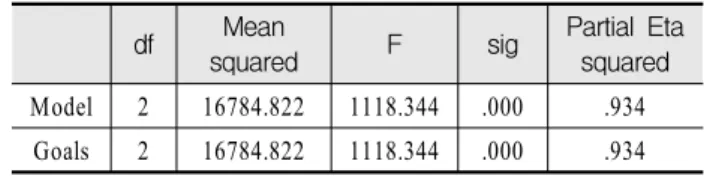
We calculated the self-monitoring scores of all 25 scales for all participants. We carried out an ANOVA to verify the goal-priming effect. As Tables 1 and 2 show, the average of impression goal priming was 15.1625, and the average of defense goal priming was 13.8608; the difference between them was significant (F = 1,118.344, p < .05), and therefore, the goal-priming effect of different scenarios was confirmed. Thus, all participants could be successfully divided into impression-motivated group and defense-motivated group.
Table 1. Difference in participants’ self-monitoring scores in different goal-priming scenarios
Variable: self-monitoring scores
Goal Mean Std. Deviation N
Impression 15.1625 3.90535 80
Defense 13.8608 3.84219 79
Total 14.5157 3.91662 159
Indicators Measurement items Component Evaluation Fitness Evaluation 3
Evaluation 4 Evaluation 2 Evaluation 6 Evaluation 5 Evaluation 1
The sunscreen is in my favor.
The sunscreen is charming.
I have a favorable attitude toward the sunscreen.
I want to use the sunscreen.
The sunscreen can satisfy my needs.
The sunscreen is very good.
.879 .852 .821 .821 .796 .719
- - - - - - Fit 2
Fit 3 Fit 1
The sunscreen information in the advertisement fits what you pursue in the scenario.
The sunscreen information in the advertisement strongly fits what you pursue in the scenario.
The sunscreen information in the advertisement fits the goal offered in the scenario.
- - -
.898 .847 .814 Eigenvalue
% of Variance Cumulative % Cronbach’s α
6.031 67.012 67.012 .938
1.098 12.198 79.209 .898 Table 3. Reliability and Validity of Measurement Variable
Table 2. ANOVA of induced goals in different scenarios of goal priming
Dependent variable: self-monitoring scores
df Mean
squared F sig Partial Eta
squared
Model 2 16784.822 1118.344 .000 .934
Goals 2 16784.822 1118.344 .000 .934
R2 = .934 (adjusted R2 = .934)
4.2 Construct Validity and Reliability
We refined the measures and assessed each variable’s convergent and discriminant validity by using the 159 sample. First, principal component analysis using the Varimax rotating method and Cronbach’s alpha analysis were carried out to check whether all items of the questionnaire of each construct measured the expected concept. The results of the analyses are shown in Table 3. All items for each construct were highly loaded to the component concerned. The Cronbach’s alpha values of product evaluation and fitness were over 0.7, thus confirming the internal consistency among the measurement items.
Items for each construct were summed for averaging.
4.3. Hypothesis Testing
4.3.1. Hypothesis 1
In order to verify the different degrees of fit induced
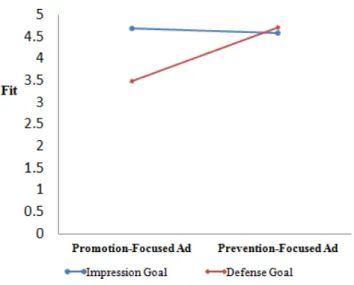
from different goals and different advertisements, an ANOVA was carried out; its results are shown in Figure 1 and Table 4. People with impression goals, rather than defense goals, perceived a greater fit with the promotion-focused advertisement (impression goal = 4.6752 defense goal = 3.4825). However, people with defense goals perceived a greater fit with the prevention-focused advertisement (defense goal = 4.6992, impression goal = 4.5691). The interactive effect of types of goals and types of advertisements on fit was significant (F = 1 6.022, p < .05) as shown in Table 5;
therefore, H1 was supported.
4.3.2. Hypothesis 2
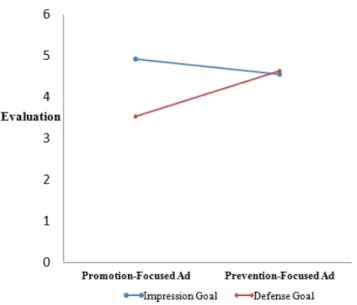
We carried out another ANOVA to verify the differences in evaluations induced from different goals and different advertisements. The results (Figure 2 and Table 6) show that people with impression goals, rather than defense goals, had more favorable evaluations of the product in the promotion-focused advertisement (impression goal = 4.9274 defense goal = 3.5219). With respect to the prevention-focused advertisement, people with defense goals had more favorable evaluations of the product (defense goal = 4.6260 impression goal = 4.5915). Table 7 shows a significant interactive effect (F = 21.583, p <
.05) of types of goals and types of advertisements on product evaluation; therefore, H2 was supported.
Figure 1. Interactive Effects of Fit between Different Advertise-ments and Goals
Advertisement Goal Mean Std. Deviation N
Promotion-Focused Advertisement
Impression 4.6752 1.11210 39
Defense 3.4825 1.08414 38
Total 4.0866 1.24535 77
Prevention-Focused Advertisement
Impression goal 4.5691 1.03345 41
Defense goal 4.6992 .93335 41
Total 4.6341 .98076 82
Total
Impression goal 4.6208 1.06701 80
Defense goal 4.1139 1.17413 79
Total 4.3690 1.14651 159
Table 4. Results of the Analysis of Differences in Fit Dependent variable: fit
df Mean squared F sig Partial Eta squared
Model 4 768.654 708.956 .000 0.948
Goals 1 11.21 10.34 .002 0.063
Advertisements 1 12.245 11.294 .001 0.068
Goals × Ads 1 17.371 16.022 .000 0.094
R2 = .948 (adjusted R2 = .947)
Table 5. Results of the ANOVA on Fit Difference Dependent variable: fit
Figure 2. Interactive Effect of Evaluation of Different Advertise-ments and Goals
Advertisement Goal Mean Std. Deviation N
Promotion-Focused Advertisement
Impression goal 4.9274 1.01581 39
Defense goal 3.5219 .92688 38
Total 4.2338 1.19766 77
Prevention-Focused Advertisement
Impression goal 4.5569 1.06563 41
Defense goal 4.6260 .94852 41
Total 4.5915 1.00313 82
Total
Impression goal 4.7375 1.05168 80
Defense goal 4.0949 1.08495 79
Total 4.4182 1.11265 159
Table 6. Results of the Analysis of Evaluation Differences Dependent variable: product evaluation
df Mean squared F sig Partial Eta squared
Model 4 786.752 800.129 .000 .954
Goals 1 17.727 18.082 .000 .104
Advertisements 1 5.343 5.434 .021 .034
Goals × Ads 1 21.583 21.583 .000 .124
R2 = .232 (adjusted R2 = .222)
Table 7. Results of the ANOVA of Evaluation Differences Dependent variable: product evaluation
5. Summary and Discussion
This study explored why impression-motivated individuals perceived a higher level of fit with the message of the promotion-focused advertisement rather than the prevention-focused advertisement, and why defense-motivated individuals perceived a higher level of fit with the message of the prevention-focused advertisement rather than the promotion-focused advertisement.
Regulatory orientation from physiological needs, emotional states, and social roles manages people’s behaviors (Avnet and Higgins 2006). In this article, we focus on the regulatory orientations arising from the goals to obtain something and the goals to avoid something, and identify the compatibility between consumers’ goal orientation and products they choose.
Consumers feel fit if they select the product compatible with their goal orientation. If consumers experience an
“it-just-feels-right” feeling with the means, they give them a high evaluation. People are more willing to give a higher evaluation to the means when their regulatory focus is compatible with the means they choose.
Consumers’ attitudes toward the product are more favorable and value given to the product is high when they feel regulatory fit (Aaker and Lee 2006).
Unlike previous studies on regulatory focus, which suggest that different regulatory foci influence people’s strategies and feelings to regulate their attitudes and behaviors toward the means which they choose, our study manipulates types of product advertisements to accord with goals and shows that people with different consumption goals have different feelings of “right” on the basis of the types of product advertisement.
Results of this study demonstrate that people with impression goals felt much more “right” about the product when they are exposed to promotion-focused advertisement than when they are exposed to prevention-focused advertisement, while people with defense goals felt much more “right” about the product when they are exposed to prevention-focused advertisement than when they are exposed to promotion-focused advertisement. Moreover, Consumers
with impression goals gave a higher evaluation toward the product in the promotion-focused advertisement than in the prevention-focused advertisement while those with defense goals gave a higher evaluation toward the product in the prevention-focused advertisement.
Theoretical contribution of this study results from its exploration of the interactive effects of types of consumption goals and types of advertisement on regulatory fit and product evaluation.
This study suggests that marketers should design advertisements to induce the feelings of “right” (fit) from the compatibility between advertisements and consumption goals.
Nevertheless, this study has the following limitations.
First, the existing literature suggests that people make their decisions on the basis of either the automatic affective process, called the “lower order” route, or the cognitive process, known as the “higher order.” In this study, however, we emphasize that judgment or evaluation toward the stimulus is influenced by only the cognitive process in other words, it is influenced by consumers’ goals. However, people frequently make judgments or decisions on the basis of affection.
Sometimes, people exposed to a product advertisement evaluate the target product on the basis of not goals but only their feelings. For example, people could have favorable attitudes toward a product in an advertisement only because they like it. Thus, future studies should explore the interactive roles of affective evaluation and rational evaluation processes on product evaluation.
Second, although we asked participants to read two kinds of scenarios to prime either impression or defense goals, some participants are likely to have had both impression and defense goals, in other words, consumers simultaneously can have two kinds of goals or no consumption goals this will have some impact on the results. Therefore, future studies should also manipulate the priming process to go into accuracy of judgment situations.
Third, the target product of the advertisement in this research was limited to sunscreen, a low-involvement product. High-involvement products should therefore be used as well in future replications of the experiment.
Fourth, the sample was limited to students in university. If the data were collected from samples with different demographics, the results might become different. Thus, empirical investigations involving various age and job groups should be conducted in the future.
REFERENCES
Aaker, Jennifer L. & Angela Y. Lee. (2001). ‘I’ Seek Pleasure and ‘We’Avoid Pains: The Role of Self-Regulatory Goals in Information Processing and Persuasion. Journal of Consumer Research, 28(June), 33-49.
Aaker, Jennifer L. & Angela Y. Lee. (2006).
Understanding Regulatory Fit. Journal of Marketing Research, 43(February), 15-19.
Agrawal, Nidhi. & Durairaj Maheswaran. (2005).
Motivated Reasoning in Outcome-Bias Effects.
Journal of Consumer Research, 31(March), 798-805.
Avnet, Tamar. & E. Tory Higgins. (2003). Locomotion, Assessment and Regulatory Fit: Value Transfer from How to What. Journal of Experimental Social Psychology, 39(September), 525–530.
Avnet, Tamar. & E. Tory Higgins. (2006). How Regulatory Fit Affects Value in Consumer Choices and Opinions. Journal of Marketing Research, 43(February), 1-10.
Camacho, Christopher J., E. Tory Higgins., & Lindsay Luger. (2003). Moral Value Transfer from Regulatory Fit: What Feels Right Is Right and What Feels Wrong Is Wrong. Journal of Personality and Social Psychology, 84(March), 498-510.
Chen, Serena, David Shechter., & Shelly Chaiken. (1996).
Getting at the Truth or Getting Along: Accuracy versus Impression Motivated Heuristic and Systematic Processing. Journal of Personality and Social Psychology, 71(August), 262-275.
Chernev, Alexander. (2004). Goal–Attribute Compatibility in Consumer Choice. Journal of Consumer Psychology, 141-150.
Crowe, Ellen. & E. Tory Higgins. (1997). Regulatory Focus and Strategic Inclinations: Promotion and
Prevention in Decision Making. Organizational Behavior and Human Decision Processes, 69(February), 117-132.
Ditto, Peter H. & David F. Lopez. (1992). Motivated Skepticism: Use of Differential Decision Criteria for Preferred and Non-preferred Conclusions. Journal of Personality and Social Psychology, 63(April), 568-584.
Floyd, Donna L., Steven Prentice-Dunn., & Ronald W.
Rogers. (2000). A Meta-Analysis of Research on Protection Motivation Theory. Journal of Applied Social Psychology, 30(2), 407-429.
Higgins, E. Tory. (1997). Beyond Pleasure and Pain.
American Psychologist, 52, 1280-1300.
Higgins, E. Tory. (2000). Making a Good Decision:
Value from Fit. American Psychologist, 55(11), 1217-1230.
Higgins, E. Tory, Lorraine C. Idson, Antonio L. Freitas, Scott Spiegel, & Daniel. C. Molden. (2003). Transfer of Value from Fit. Journal of Personality and Social Psychology, 84(June), 1140-1153.
Jain, Shailendra P. & Durairaj Maheswaran. (2000).
Motivated Reasoning: A Depth of Processing Perspective. Journal of Consumer Research, 26(March), 358-371.
Johar, J. S. (Vic) & M. Joseph Sirgy. (1991). Value Expressive Versus Utilitarian Advertising Appeals:
When and Why to Use Which Appeal. Journal of Advertising, 20(September), 23-34.
Keller, Punam A. (2006). Regulatory Focus and Efficacy of Health Messages. Journal of Consumer Research, 33(June), 109-114.
Lee, Angela Y., Punam A. Keller., & Brian Sternthal.
(2010). Value From Regulatory Construal Fit: The Persuasive Impact of Fit between Consumer Goals and Message Concreteness. Journal of Consumer Research, 36(February), 735-747.
Rogers, Giner-Sorolla. & Shelly Chaiken. (1997).
Selective Use of Heuristic and Systematic Processing under Defense Motivation. Personality and Social Psychology Bulletin, 23(January), 84-97.
Snyder, Mark. (1974). Self-Monitoring of Expressive Behavior. Journal of Personality and Social
Psychology, 30(4), 526-537.
원고접수:2011.12.21 수정접수:2012.02.03 게재확정:2012.02.28
APPENDIX Promotion-Focused Advertisement
Prevention-Focused Advertisement