Yeungnam Univ J Med 2017;34(2):191-199
Long-term clinical outcome of acute myocardial infarction according to the early revascularization method: a comparison of primary percutaneous
coronary interventions and fibrinolysis followed by routine invasive treatment
Hyang Ki Min, Ji Young Park, Jae Woong Choi, Sung Kee Ryu, Seunghwan Kim, Chang Sup Song, Dong Shin Kim, Chi Woo Song, Se Jong Kim, Young Bin Kim
Division of Cardiology, Department of Internal Medicine, Eulji General Hospital, Seoul, Korea
Background: This study was conducted to provide a comparison between the clinical outcomes of primary percutaneous coronary intervention (PCI) and that of fibrinolysis followed by routine invasive treatment in ST elevation myocardial infarction (STEMI).
Methods: A total of 184 consecutive STEMI patients who underwent primary PCI or fibrinolysis followed by a routine invasive therapy were enrolled from 2004 to 2011, and their major adverse cardiovascular events (MACEs) were compared.
Results: Among the 184 patients, 146 patients received primary PCI and 38 patients received fibrinolysis. The baseline clinical characteristics were similar between both groups, except for triglyceride level (68.1±66.62 vs. 141.6±154.3 mg/dL, p=0.007) and high density lipoprotein level (44.6±10.3 vs. 39.5±8.1 mg/dL, p=0.005).
The initial creatine kinase-MB level was higher in the primary PCI group (71.5±114.2 vs. 35.9±59.9 ng/mL, p=0.010). The proportion of pre-thrombolysis in MI 0 to 2 flow lesions (92.9% vs. 73.0%, p<0.001) was higher and glycoprotein IIb/IIIa inhibitors were administered more frequently in the primary PCI group. There was no difference in the 12-month clinical outcomes, including all-cause mortality (9.9% vs. 8.8%, p=0.896), cardiac death (7.8% vs. 5.9%, p=0.845), non-fatal MI (1.4% vs. 2.9%, p=0.539), target lesion revascularization (5.7%
vs. 2.9%, p=0.517), and stroke (0% vs. 0%). The MACEs free survival rate was similar for both groups (odds ratio, 0.792; 95% confidence interval, 0.317-1.980; p=0.618). The clinical outcome of thrombolysis was not in- ferior, even when compared with primary PCI performed within 90 minutes.
Conclusion: Early fibrinolysis with optimal antiplatelet and antithrombotic therapy followed by appropriate invasive procedure would be a comparable alternative to treatment of MI, especially in cases of shorter- symptom-to-door time.
Keywords: Fibrinolysis; Percutaneous coronary intervention; Myocardial infarction
Copyright ©2017 Yeungnam University College of Medicine
This is an Open Access article distributed under the terms of the Creative Commons Attribution Non-Commercial License (http://creative- commons.org/licenses/by-nc/4.0/) which permits unrestricted non-commercial use, distribution, and reproduction in any medium, provided the original work is properly cited.
Received: August 19, 2016, Revised: August 9, 2017 Accepted: August 10, 2017
Corresponding Author: Sung Kee Ryu, Division of Cardio- logy, Department of Internal Medicine, Eulji General Hospital, Eulji University, 14 Hangeolbiseok-Gil, Nowon-gu, Seoul 01830, Korea
Tel: +82-2-970-8671, Fax: +82-2-970-8887 E-mail: [email protected]
*Hyang Ki Min and Ji Young Park equally contributed to this work. First author: Hyang Ki Min and Ji Young Park
INTRODUCTION
Early reperfusion is a key paradigm in the current treat-
ment method for acute phase ST-segment-elevation myocar-
dial infarction (STEMI). Current guidelines recommend pri-
mary percutaneous coronary intervention (PCI) as the pre-
ferred reperfusion strategy over fibrinolytic therapy in STEMI
[1-3]. However, timely primary PCI — as recommended by
the guidelines (door-to-balloon or door-to-instrument time
≤90 minutes) — may not always be available, especially at night. Facilitated PCI is defined as a planned PCI after the administration of medical therapy, such as fibrinolytic therapy or glycoprotein IIb/IIIa (GpIIb/IIIa) inhibitors, and it is sup- posed to be a good alternative to primary PCI, improving the early coronary artery patency with a reduction of thrombotic burden and myocardial salvage [4]. However, according to the Assessment of the Safety and Efficacy of a New Treatment Strategy with Percutaneous Coronary Intervention (ASSENT- 4 PCI) trial and meta-analysis, this method was associated with worse clinical outcome; therefore, planned facilitated PCI after fibrinolysis is not recommended [3,5,6]. Sub-analysis from the ASSENT-4 PCI trial showed that facilitated PCI had better a pre-procedural thrombolysis in myocardial in- farction (TIMI) when compared with the primary PCI group, but stent thrombosis increased in the facilitated PCI group due to prothrombotic condition after thrombolytic therapy [7]. However, implementation of dual antiplatelet therapy, subcutaneous enoxaparin injection, routine thrombus aspira- tion, more fibrin specific fibrinolysis agent, PCI with new ge- neration drug eluting stent, and closing device are expected to change the results. In the real world, routine invasive me- thods such as coronary angiography and PCI are commonly performed on the same day after thrombolysis, even in pati- ents whose symptoms have subsided. Therefore, the present study was conducted to evaluate whether the clinical outcome or lesion-related complications, such as stent thrombosis or restenosis, would be significantly higher in thrombolysis fol- lowed by a routine invasive strategy. Moreover, we analyzed particular clinical circumstances that induce thrombolytic the- rapies that are as effective as primary PCI.
MATERIALS AND METHODS
A total of 184 consecutive acute STEMI patients under- went primary PCI or fibrinolytic therapy with tenecteplase (Metalyze) followed by elective PCI on the same day, between January 2004 and December 2011 at Eulji general hospital.
Of the 184 patients, 146 patients received primary PCI and 38 patients received fibrinolysis. In the primary PCI group, patients who underwent cardiopulmonary resuscitation dur- ing PCI or on admission were excluded.
Patients were eligible for enrollment if they presented with-
in 3 hours of the onset of symptoms, had no evidence of acute STEMI on their qualifying electrocardiogram (at least 2 mm in two contiguous peripheral or precordial leads), and could not undergo primary PCI within 1 hour of the first medical contact. Patients who received tenecteplase along with antiplatelet and anticoagulant therapy underwent coro- nary angiography within 6 to 24 hours of fibrinolysis. Rescue coronary intervention was performed there was less than 50%
ST-segment resolution in the single lead with maximum ele- vation or clinical evidence of failed reperfusion within 90 minutes of fibrinolysis. All patients provided written informed consent.
All patients received a 300 mg aspirin loading dose and a 300 mg to 600 mg clopidogrel loading dose before PCI, followed by daily administration of 75 mg clopidogrel, which was recommended to be continued for at least 1 year. PCI was performed via the femoral approach, and hemostasis of the puncture site was conducted using a closing device. As an antithrombotic therapy for PCI, all patients received 60 mg enoxaparin (Clexane) 60 mg before and after PCI during the hospital stay (within 7 days), and unfractionated heparin 50 U/kg prior to PCI for the first hour. Tenecteplase was ad- ministered in a weight-based dose (30 mg if the weight was 55 to <60 kg, 35 mg if the weight was 60 to <70 kg, 40 mg if the weight was 70 to <80 kg, 45 mg if the weight was 80 to <90 kg, and 50 mg if the weight was ≥90 kg) and was combined with low-molecular-weight enoxaparin (30 mg in- travenous bolus followed by subcutaneous injection of 1 mg per kilogram of body weight [0.75 mg per kilogram for pa- tients ≥75 years of age] every 12 hours) except for patients 75 years of age or older, in whom the intravenous bolus was omitted. In cases with no-reflow or visible thrombi, adjunc- tive GPIs were administered at the discretion of the primary physician.
Diagnostic angiography and PCI were performed through either the femoral or radial artery after the administration of unfractionated heparin (70 U/kg to 100 U/kg). Patients rece- ived unfractionated heparin to maintain the activated clotting time of >250 s during the procedure. Stents were deployed after a prior balloon angioplasty, and the use of cilostazol or glycoprotein inhibitors was left to the discretion of the individual operator.
Rather than utilizing the artheroablative devices, a simple
pre-dilation was performed to obtain an adequate luminal
diameter, which was necessary to accommodate the unex- panded drug eluting stents and their delivery system. Throm- bus aspiration was performed in patients who had visible thrombi or slow distal flow (TIMI 0-2) after ballooning or stenting.
Successful PCI was defined as the achievement of an angio- graphic residual stenosis <30% in the presence of TIMI blood flow grade 3. During the in-hospital period, patients received medical treatment, including beta-blockers, angiotensin conv- er ting enzyme inhibitors or angiotensin II receptor blockers, calcium channel blockers, and statins. After discharge, patients were encouraged to continue the same medication they were receiving in the hospital, except for intravenous or temporary medications.
We compared the major adverse cardiovascular events (MACEs) during a 12-month period between the two groups, which included all-cause mortality, non-fatal reinfarction, tar- get lesion revascularization, and any stroke. We also evaluated their long-term clinical outcomes and survival rates.
All statistical analyses were performed using SPSS 18.0 (SPSS Inc., Chicago, IL, USA) Continuous variables were expressed as the mean±standard deviation and compared using a Stu- dent’s t-test. Cox proportion hazard regression analysis was used to evaluate the survival rate.
Categorical data were expressed as percentages and com- pared using chi-squared statistics or Fisher’s exact test. A p -value of <0.05 was considered statistically significant.
To adjust for potential confounders, propensity score ma- tching analysis was conducted using the logistic regression model, which tested the propensity to have facilitated PCI after fibrinolysis treatment in STEMI patients rather than pri- mary PCI. We tested all available variables that could be of potential relevance; namely, age, sex, symptom to door time, peak troponin T, low density lipoprotein, diabetes mellitus, hypertension, smoking, and left ventricular ejection fraction.
The logistic model by which the propensity score was esti- mated showed the predictive value well (C-static=0.648).
RESULTS
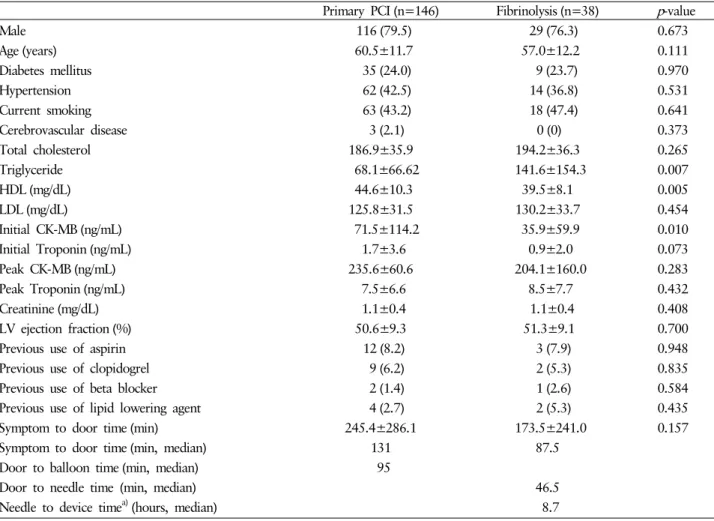
The baseline clinical characteristics showed that age was similar in both groups (60.5±11.7 vs. 57.0±12.2 years, p = 0.111), the initial levels of creatine kinase-MB (CK-MB) were higher in the primary PCI group (71.5±114.2 vs. 35.9±59.9
ng/mL, p =0.010), and triglyceride levels were higher in the fibrinolysis group (68.1±66.6 vs. 141.6±154.3 mg/dL, p = 0.007). Previous medications, including aspirin, clopidogrel, beta blocker, and lipid lowering agents, were similar between groups (Table 1). Angiographic characteristics showed that the pre-TIMI 0 to 2 flow lesion (92.9% vs. 73.0%, p <0.001) and the use of GpIIb/IIIa inhibitors (35.6% vs. 15.8%, p = 0.019) were higher in the primary PCI group. The propor- tion of post-TIMI flow grade 3 was similar between groups (85.3 vs. 94.1%, p =0.17) (Table 2). There was no difference in the 12-month clinical outcome, including all-cause mortality (9.9% vs. 8.8%, p =0.896), cardiac death (7.8% vs. 5.9%, p = 0.845), non-fatal MI (1.4% vs. 2.9%, p =0.539), target lesion revascularization (5.7% vs. 2.9% p =0.517), and stroke (0% vs.
0%) (Table 3). Age (odds ratio [OR], 1.054; 95% confidence interval [CI], 1.003-1.106) and current smoking (OR, 3.954;
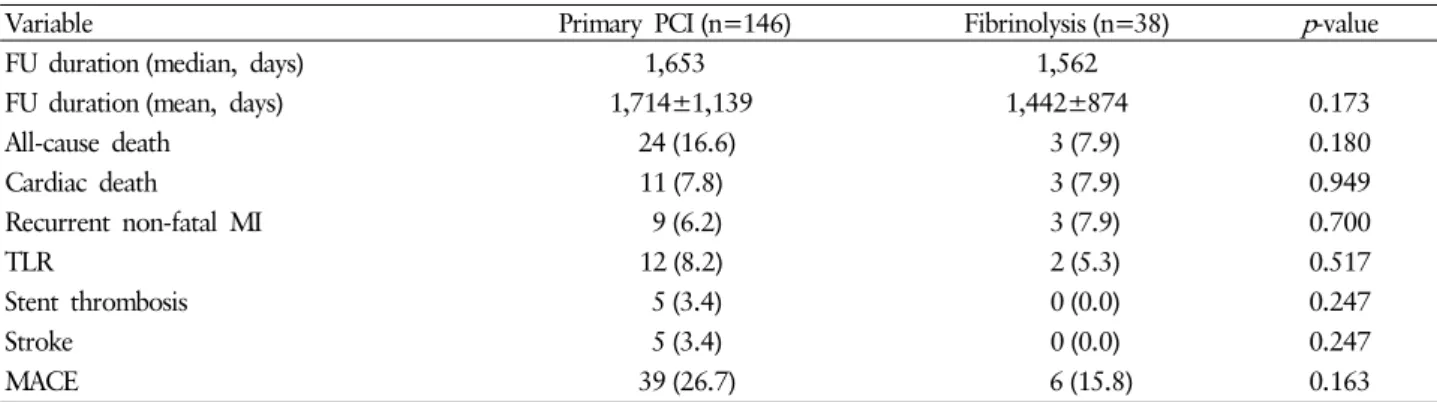
95% CI, 1.085-14.409) were significant independent risk fac- tors for 1-year MACE, but thrombolysis (OR, 0.696; 95% CI, 0.189-2.566) and primary PCI were not, which was in accor- dance with the multiple regression analysis after an adjustment of various clinical factors (Table 4). The median follow-up pe- riod was 1,650 days (1,653 vs. 1,562.5 days), and there was no significant difference in the long-term clinical outcome bet- ween groups (Table 5). Cox proportional multiple regression analysis for MACE free survival, adjusting for other clinical, anatomical, and procedural parameters, also showed no signi- ficant clinical difference between the two groups (Fig. 1, 2).
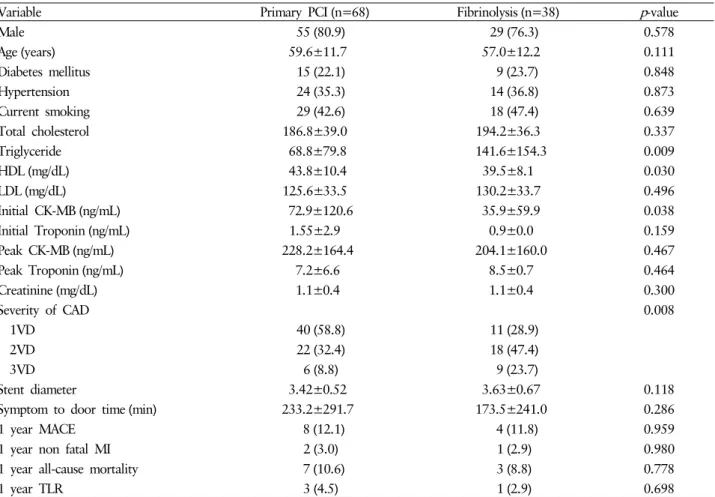
We also analyzed the differences in clinical outcomes be- tween primary PCI with a door to balloon time ≤90 minutes and fibrinolysis followed by coronary angiography. The dif- ference in clinical features was similar to the whole cohort.
There was no significant difference in the clinical features,
except for the initial CK-MB level. In the fibrinolysis group,
symptom-to-door time was shorter without statistical signi-
ficance. Multivariable Cox regression analysis showed that
the facilitated PCI after fibrinolysis had similar incidences
of total death, cardiac death, recurrent non-fatal MI, TLR,
stent thrombosis, and MACEs than primary PCI. The adjus-
ted clinical outcomes at 1 year also showed that the facilitated
PCI after fibrinolysis had similar incidences of total death,
cardiac death, recurrent non-fatal MI, TLR, stent thrombosis,
and MACEs (Table 6). There was no significant difference
in the 1-year clinical outcome (Table 7) or long-term MACE
free survival between groups. The curve comparing the MACE
Table 1. Baseline clinical characteristics
Primary PCI (n=146) Fibrinolysis (n=38) p -value
Male 116 (79.5) 29 (76.3) 0.673
Age (years) 60.5±11.7 57.0±12.2 0.111
Diabetes mellitus 35 (24.0) 9 (23.7) 0.970
Hypertension 62 (42.5) 14 (36.8) 0.531
Current smoking 63 (43.2) 18 (47.4) 0.641
Cerebrovascular disease 3 (2.1) 0 (0) 0.373
Total cholesterol 186.9±35.9 194.2±36.3 0.265
Triglyceride 68.1±66.62 141.6±154.3 0.007
HDL (mg/dL) 44.6±10.3 39.5±8.1 0.005
LDL (mg/dL) 125.8±31.5 130.2±33.7 0.454
Initial CK-MB (ng/mL) 71.5±114.2 35.9±59.9 0.010
Initial Troponin (ng/mL) 1.7±3.6 0.9±2.0 0.073
Peak CK-MB (ng/mL) 235.6±60.6 204.1±160.0 0.283
Peak Troponin (ng/mL) 7.5±6.6 8.5±7.7 0.432
Creatinine (mg/dL) 1.1±0.4 1.1±0.4 0.408
LV ejection fraction (%) 50.6±9.3 51.3±9.1 0.700
Previous use of aspirin 12 (8.2) 3 (7.9) 0.948
Previous use of clopidogrel 9 (6.2) 2 (5.3) 0.835
Previous use of beta blocker 2 (1.4) 1 (2.6) 0.584
Previous use of lipid lowering agent 4 (2.7) 2 (5.3) 0.435
Symptom to door time (min) 245.4±286.1 173.5±241.0 0.157
Symptom to door time (min, median) 131 87.5
Door to balloon time (min, median) 95
Door to needle time (min, median) 46.5
Needle to device time
a)(hours, median) 8.7
Values are presented as mean±standard deviation and number (%).
a)