Introduction
Human has a desire to look beautiful and most of the people want to be attractive. The face is an important part of the body and the jaw and tooth can be major elements to attract the attention of others. The concern for the appearance increases the aesthetic aspect of the face [1]. It is necessary to plan the dental treatment for the patient’s need.
The aesthetic dentistry provide the patient with physical confidence and recover the function of missing tooth [2]. The need for oral health is influenced by the information and knowledge of aesthetic dentistry [3].
The patient tended to be very sensitive to aesthetic aspect [4]. So the aesthetic dentistry must fulfill the need of the patient. High smile line including maxillary first molar is the best appearance [5]. The expectation of the patients is high while the satisfaction of the patients is very low [6]. The higher fee for the dental service and treatment does not satisfy the patients. In comparison to
Original Article Perception and satisfaction of the face and the
need for aesthetic dental treatment in the college students
Seung-Hun Lee
Department of Dental Hygiene, Cheongam College Received: 17 October 2016
Revised: 25 January 2017 Accepted: 7 February 2017
Corresponding Author: Seung-Hun Lee, Department of Dental Hygiene, Cheongam College, #1641, Noksaek-ro, Suncheon, Jeolnam 57997, Korea, Tel: +82-61-740-7382, Fax: +82-61-740-7418, E-mail: [email protected]
ABSTRACT
Objectives: The purpose of the study is to investigate the perception and satisfaction of faces and the need for aesthetic dental treatments in college students. Methods: A self-reported questionnaire was completed by 247 college students in Suncheon from August 29 to September 2, 2016. The questionnaire consisted of satisfaction of face (16 items), perception of the face (7 items), need for aesthetic dental treatment (3 items), and general characteristics of the study subjects (8 items). Tooth shade was measured using a shade guide (VITA classical shade guide, VITA North America, Chicago, USA). Data was analyzed using t test, ANOVA, and post hoc Scheffé test. Results: The students were satisfied with eye, mouth corner, and lip, but they were not satisfied with tooth shade, bilateral symmetry of face, and angle of jaw. The students tended to be concious of perception of others. Their most common tooth shade was orange and yellow. They preferred to have a brighter tooth color. Conclusions: To satisfy the needs of patients, it is important to understand the perception and satisfaction of face and the need for aesthetic dental treatment.
Key Words:
Aesthetic dental treatment, College students, FaceKoreans, the Japanese tend to prefer the retreated side face [7].
There are few study on the aesthetic aspect on the dental treatment satisfaction [1-6], so this study will focus on the evaluation of perception and satisfaction of the face, lips, chin, and tooth shade.
Materials and methods
1. Subjects
The subjects were 247 college students in Suncheon who were selected by convenience sampling. After explanation for purpose of the study, the students were assigned to the study and institutional review board (IRB) was received by Korea National Institute for Bioethics Policy (KoNIBP; P01-201604-21-007).
A self-reported questionnaire was completed by 247 college students in Suncheon on September 2, 2016. Except incomplete 33 answers, data was analyzed by t-test, ANOVA, and post hoc Scheffé test using SPSS 18.0 program (IBM Co., Armonk, NY, USA).
The minimum number of study samples was calculated as 176 using G Power 3.0 program by t-test, 0.05 significance level, power of test 95%, and 0.50 effect size. Assuming elimination by 20%, 247 subjects were participated in the minimum sample size for analysis. The size effect was referenced the results of An [8] that compared the perception of the esthetics face.
2. Methods
The questionnaire was modified and adapted from Seo [6]. The questionnaire consisted of
satisfaction of the face questions (16 items), perception of the face (7 items), needs of the aesthetic
dental treatment (3 items), and general characteristics of the study subjects (8 items). The satisfaction
of the face was measured by Likert 5 point scale, the perception was used 5 or 8 point scale, and
the needs was used 8 point scale. In addition, the tooth shade was measured using a Shade guide
(VITA Classical Shade Guide, VITA North America, Chicago, US). Cronbach’s α was 0.769 for
the internal consistency of survey items.
3. Data analysis
The general characteristics of the study subjects were calculated the frequency, percentage, the satisfaction of the face was computed the mean and standard deviation, and the perception of the face was calculated he frequency and percentage or the mean and standard deviation. In addition, the needs of the aesthetic dental treatment were computed the mean and standard deviation. The data was analyzed using SPSS version 18.0 including t-test, one way ANOVA and post hoc Scheffé test.
Results
1. General characteristics of the study subjects
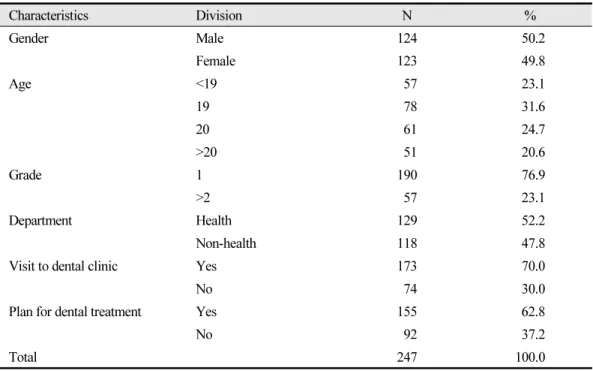
The general characteristics of the study subjects are shown in <Table 1>. It was the conservative dentistry (34.7%), dental examination (24.9%), tooth scaling (15.0%) of 173 respondents visited a dentist during one year that was the chief complaint of the patient. In addition, 13.3% were receiving the orthodontic treatment, and 2.9% were the aesthetic dental treatment. 27.1% were the conservative dentistry, 22.6% were the dental examination, and 17.4% were the orthodontic treatment among 155 respondents who was to plan the dental treatment. Also 14.2% hoped for the aesthetic dental treatment <Table 2>.
Table 1. General characteristics of the study subjects
Characteristics Division N %
Gender Male 124 50.2
Female 123 49.8
Age <19 57 23.1
19 78 31.6
20 61 24.7
>20 51 20.6
Grade 1 190 76.9
>2 57 23.1
Department Health 129 52.2
Non-health 118 47.8
Visit to dental clinic Yes 173 70.0
No 74 30.0
Plan for dental treatment Yes 155 62.8
No 92 37.2
Total 247 100.0
2. Satisfaction of the face
The satisfaction of the face is shown in <Table 3>. The high score parts were the eyes (3.33), the mouth corner (3.26), and the lip (3.25), on the other hand, the tooth shade (2.86), the bilateral symmetry of the front face (2.94), and the jaw angle (2.99) were a low score.
Table 3. Satisfaction of the face (N=247)
Variables Purpose of visit
Mean SD
Front face 3.20 0.91
45° angle face 3.22 0.89
Side face 3.11 0.86
Bilateral symmetry of front face 2.94 0.88
Eys 3.33 0.89
Forehead 3.23 0.85
Nose 3.15 0.92
Cheek 3.17 0.88
Lips 3.25 0.92
Mouth corner 3.26 0.96
Tooth 3.11 0.96
Tooth arrangement 3.07 1.02
Tooth occlusion 3.11 0.99
Tooth shade 2.86 0.90
Chin 3.05 0.88
Jaw angle 2.99 0.98
Total 3.13 0.63
Table 2. Chief complaint and dental treatment plan
Variables Purpose of visit Intention to treatment
N % N %
Dental examination 43 24.9 35 22.6
Scaling 26 15.0 18 11.6
Conservative dentistry 60 34.7 42 27.1
Prosthodontics 11 6.4 9 5.8
Aesthetic restorations 5 2.9 22 14.2
Orthodontics 23 13.3 27 17.4
Preventive dentistry 2 1.2 1 0.6
Oral medicine 3 1.7 1 0.6
Etc. 0 0.0 0 0.0
Total 173 100.0 155 100.0
3. Perception of the face and the need for aesthetic dental treatment
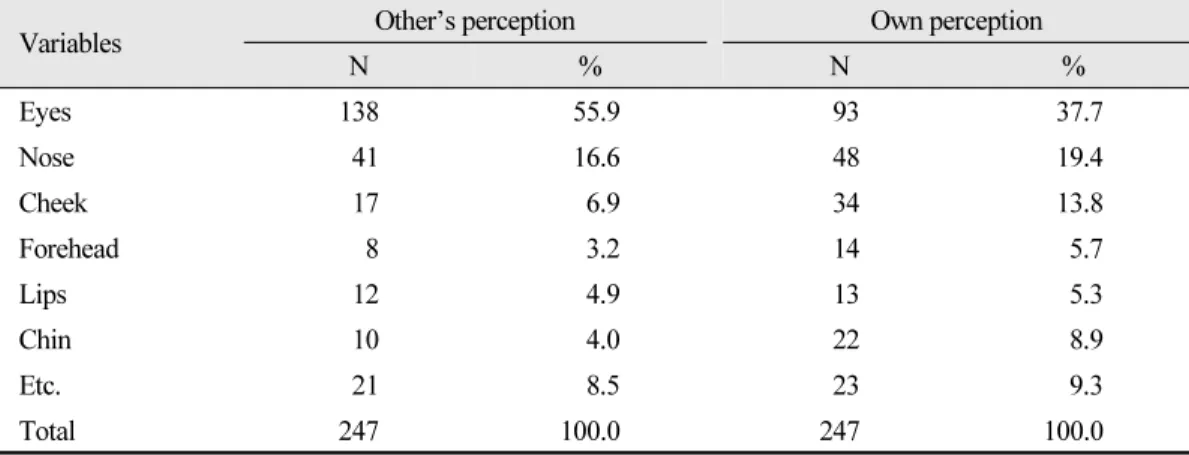
The perception of the face is shown in <Table 4>. The study subjects were more conscious of perception of others (3.43) than themselves (2.92). They were mainly conscious of the eyes and nose when observe themselves and others <Table 5>.
The chin was 3.33 that was the anteroposterior position of the side face, and the lips were 3.23.
The position of the hoped chin was 3.15, and lips were 3.17. they was preferred to a slightly rearward position than a normal values which were the lips and the chin <Table 6>. The major most common tooth shade was orange and yellow, they also hope to them. But they preferred to have a brighter tooth color (1.66) than the brightness of their tooth (2.55)<Table 7>.
Table 4. Facial perception (N=247)
Variables Mean SD
Others’s perception 3.43 1.04
Self-perception 2.92 1.85
Total 3.17 0.70
Table 5. Perception of the face
Variables Other’s perception Own perception
N % N %
Eyes 138 55.9 93 37.7
Nose 41 16.6 48 19.4
Cheek 17 6.9 34 13.8
Forehead 8 3.2 14 5.7
Lips 12 4.9 13 5.3
Chin 10 4.0 22 8.9
Etc. 21 8.5 23 9.3
Total 247 100.0 247 100.0
Table 6. Side face
Variables Self-perception Side face perception
Mean** SD Mean** SD
Chin* 3.33 0.89 3.15 0.91
Lip* 3.23 0.85 3.17 0.87
Total 3.96 1.19 3.74 1.03
*mean of Korean was 4
**Lower score means the rearward jaw
4. Satisfaction and perception of the face, need for the aesthetic dental treatment
It is shown in <Table 8> that is the satisfaction and perception of the face, needs for the aesthetic dental treatment by the general characteristics of the study subjects. The face satisfaction of the male (3.28) was higher than the female (2.98), the female (3.75) was more conscious of perception of others than the male (3.11), and the male (3.10) was more perceive the self-perception than the female (2.75). In addition, the female (3.59) was more posterior the lips than the male (4.09), the female (1.46) preferred to have a brighter tooth color than the male (1.85).
The face satisfaction of 19 years (3.26) and greater than 20 years (3.28) were higher than the less than 19 years, the less than 19 years (3.70) was more conscious of perception of others than the 19 years (3.12), and the 19 years (3.01) and the greater than 20 years (3.37) were more perceive the
Table 7. Tooth shade
Variables Self-perception Tooth shade perception
N % N %
Shade
Orange 121 49.0 103 41.7
Yellow 91 36.8 99 40.1
Gray 20 8.1 27 10.9
Pink 15 6.1 18 7.3
Total 247 100.0 247 100.0
Brightness* (Mean±SD) 2.55 0.99 1.66 0.97
*Lower score means the brighter tooth
Table 8. Satisfaction and perception of the face, the need of the aesthetic dental treatment by characteristics of the study subjects
Characteristics Division N Satisfaction Others’s eyes Self-perception Hoped chin Hoped lip Hoped tooth shade
Mean SD p* Mean SD p* Mean SD p* Mean SD p* Mean SD p* Mean SD p*
Gender Male 124 3.28 0.63 0.01 3.11 1.09 0.01 3.10 1.12 0.02 3.97 1.48 0.82 4.09 1.33 0.01 1.85 0.93 0.01
Female 123 2.98 0.60 3.75 0.88 2.75 1.21 3.93 1.46 3.59 1.15 1.46 0.90
Age <19 57 2.87 0.66 0.01
(b<a, d<a)
3.70 0.99 0.01 (a>b)
2.39 1.16 0.01 (b<a, d<a)
3.68 1.62 0.43 3.58 1.38 0.24 1.19 0.51 0.01 (c>a, d>a)
19 78 3.26 0.77 3.12 1.12 3.01 1.16 4.05 1.52 4.03 1.43 1.58 0.81
20 61 3.07 0.38 3.44 0.90 2.93 1.07 4.08 1.32 3.82 1.11 1.92 1.11
>20 51 3.28 0.51 3.58 1.01 3.37 1.16 3.92 1.38 3.88 0.99 2.00 1.16
Grade 1 190 3.09 0.66 0.09 3.36 1.08 0.06 2.84 1.15 0.05 3.99 1.52 0.41 3.80 1.33 0.34 1.57 0.91 0.01
>2 57 3.25 0.53 3.66 0.85 3.19 1.26 3.81 1.27 3.98 1.02 1.95 1.09
Department Health 129 3.06 0.52 0.08 3.66 0.89 0.01 2.98 1.17 0.39 3.91 1.25 0.65 3.76 1.09 0.28 1.87 1.10 0.01
Non-health 118 3.20 0.73 3.17 1.12 2.86 1.19 3.99 1.68 3.93 1.43 1.43 0.74
Visit to dental clinic
Yes 173 3.18 0.59 0.06 3.44 1.02 0.83 3.00 1.17 0.11 3.88 1.42 0.26 3.76 1.27 0.13 1.66 0.98 0.98
No 74 3.01 0.83 3.41 1.09 2.74 1.20 4.11 1.58 4.03 1.24 1.66 0.94
Plan for dental treatment
Yes 155 3.09 0.58 0.17 3.49 0.87 0.24 2.96 1.18 0.51 3.83 1.41 0.09 3.75 1.22 0.16 1.65 0.98 0.75
No 92 3.20 0.71 3.33 1.27 2.86 1.18 4.15 1.56 3.99 1.33 1.68 0.94