• 검색 결과가 없습니다.

The Design and Study of Virtual Sound Field in Music Production

N/A
N/A
Protected

Academic year: 2021

Share "The Design and Study of Virtual Sound Field in Music Production"

Copied!
9
0
0

로드 중.... (전체 텍스트 보기)

전체 글

(1)

The Design and Study of Virtual Sound Field in Music Production

1)

Yan Wang*

Abstract

n this paper, we propose a thorough solution for adjusting virtual sound field with different kinds of devices and software in preliminary procedure and late stage of music processing. The basic process of music production includes composing, arranging and recording at pre-production stage as well as sound mixing and mastering at post-production stage. At the initial stage of music creation, it should be checked whether the design of virtual sound field, the choice of the tone and the instrument used in the arrangement match the virtual sound field required for the final work. In later recording, mixing and mastering, elaborate adjustments should be done to the virtual sound field. This study also analyzed how to apply the parameter of the effectors to the design and adjustment of the virtual sound field, making it the source of our creation.

▸Keywords: music production; sound field design; sound field adjustment; recording; effector

I. Calibration of Monitoring System

The design and arrangement of the virtual sound field at the preliminary stage and the elaborate adjustment at post-production stage are an important link in the whole process of music production. Due to differences in artistic points of view, actual choice of equipment and technical factors, the result will vary. The design at preliminary stage determines the selection of the specific tone of the arrangement, and also decides all the links in recording and mixing. Although music production has a certain degree of freedom, because of people’s long-term aesthetic habits, there are still rules to follow.

In the actual production process, traditional production concepts should be combined with new ideas in current world to produce a unique aesthetic trend of sound. In a way, each music style, the sound and the sound field are products of the time. Therefore, we should focus on the music style of our works and make fine adjustment to the sound used and the virtual sound field of the whole work.

In music production process, we must first pay attention to the calibration of monitoring system which

includes the monitoring speaker box, the placement of the monitoring speaker box, the location of audiences and the indoor acoustic environment. If there is only a pair of qualified monitoring speakers while there remains serious problems in the acoustic characteristics of the room such as serious standing wave,excessive reverberation, extremely uneven frequency response curve and inappropriate placement of loudspeaker box, accurate monitoring can’t be achieved.

In the selection of monitoring speaker box, we should try to choose high-quality professional monitoring speaker boxes, such as Genelecl031a, Auratones 5C and Yamaha NS 10s. Due to the complexity and uncertainty between the matching of power amplifier and loudspeaker box, most of the producers now choose active monitoring speaker, that is, built-in amplifier speaker, also known as active speaker. Historically, in the early stages of the development of music production, we generally pursue monitoring speakers of the highest quality as much as we can afford.[1] The large-sized main monitoring speakers

∙Author: Yan Wang, Corresponding Author: Yan Wang

*Yan Wang ([email protected]), Dept. of Applied Arts, Kyung Hee University, Korea

∙Received: 2017. 05. 19, Revised: 2017. 05. 30, Accepted: 2017. 06. 23.

(2)

used by many studios and recording studios are of good quality which make producers satisfied when they listen to produced sound. But soon people will find that the works that sound good in the studio and recording studio lose its taste when played in cheap home audio.[2]

A sound engineer once said that if a sound sounds good on Yamaha NSlOs, it will sound well on all speakers.

Soon Yamaha NSlOs had been widely used, although the earliest NS10s series which was launched in the North American market as a HiFi speaker was rated as the worst one! Because of the lack of low frequency, Auratones 5C makes listeners more focused on the balance of middle-and-high frequency instruments which are used to monitor the sound since the existence of low frequency may easily interfere with our middle-and-high frequency monitoring and judgments. Therefore, whether it is at the recording or mixing stage, Yamaha NSlOs can easily and accurately measure the electrical level and timbre of most instruments.[3] So we usually choose Yamaha NS10s or Auratones 5C when recording voices to prevent the masking effect of bass and monitor more accurately.

In the display of the monitoring speakers, there are several issues that we should pay attention to. For example, usually two speakers should be placed in 1/3 part of the room longitudinally and kept in bilateral symmetry, forming an equilateral triangle layout with the monitoring location placed as vertically as possible (except the famous Yamaha NS10s which is placed horizontally). Use shock absorbing material between the speaker and the speaker frame. The speakers shouldn’t be placed near the back wall or in the corner of the wall because this will cause the release of low frequency and lead to band balance errors in the sound field.[4]

Ⅱ. Editing before Sound Field Adjustment

When the arrangement and prerecording are completed, we enter into the mid-editing process, the last process before the mixing phase. It is generally divided into two categories: selection editing and modification editing.

Selection editing refers to the process of selecting audio tracks and audio clips in arrangement and prerecording.

Pick out the best pieces after careful comparison and then merge them into a complete section.

For example, in the recording process, several clips of the lead singer may be recorded in which each recording clip has its own advantages as well as flaws. In selection editing, careful comparison should be done to pick out one track with relatively few flaws as the main track.

Then remove the flawed part (or even a sound) after careful analysis and replace it with a better one (a sound) in other tracks so as to make the edited track as perfect as possible.

Modification editing refers to the revision of the musical instruments (or vocals) that perform (sing) bad.

The most common revision is the revision of vocal intonation. With the appearance of pitch-fixing software like Auto-tune, singers and producers lower the standard for intonation at prerecording stage.[5] Instead, they put more focus on the mood and style of music, as well as the control of tone and sound. We also have to note that it’s tolerable if the pitch is slightly inaccurate but it will be too difficult to record if the sound is definitely wrong.

Because although tuning software can calibrate subtle difference, if the pitch runs totally different, then there will be deviation in the quality of the sound after calibration. After calibration, extremely low voice will appear quite sharp; while high voice will be quite husky and sounds obviously inconsistent with the original sound.

Sometimes it may even sound like a dinosaur or an alien monster and can’t be used.[6][7]

In addition to the correction of the pitch, it is very common to correct the rhythm. For example, vocals in dance music can be powerful when the tempos are strictly followed. Of course, occasional faster vocals than the band are allowed in dance music so as to produce a sense of forward rush. But the “forward rush” should be carefully checked to ensure that the rhythm will be accurate. In the recording of dance music, the phenomenon of uneven rhythm is more common than slow lyric songs, whether it is musicians or singers. This phenomenon also happens in vocal accompaniment where the attack of each sentence, the words with dental like

"S" and "ts" in the middle, the end of each sentence and whether the accompaniments are consistent with the lead singer part should all be carefully edited. After the untidy part is modified, the entire piece of music will become very neat and refined.

Of course, excessive corrections may make the work lack of natural playing feel and become too mechanical.

So some audio engineers are strongly against excessive

(3)

modification and they emphasize the natural feeling of prerecording. For example, to reduce the unnatural feeling, humanized quantification functions are added to some sequencers to create the feeling of real playing. In a word, it is producers that will make overall plan on how to maintain the natural feeling of the performances.

III. Design of Effector Template

For pop music, most people agree that it is not necessary to produce a real space effect. Sometimes, in order to synthesize some nonexistent space or to make the sound more gorgeous, we will make some design and adjustment in violation of the real space to maximize the performance of the work.[8] For example, we often adopt the early reflected sound of a medium room and then superimpose a large steel-plate reverberation. This will give people two kinds of feelings: living in a medium-sized room which is relatively not as narrow as a small room with a certain sense of openness; feeling quite cheerful and excited because of the bright steel-plate reverberation which makes the whole song bright and colorful and improves audiences’ sense of participation.

This may not happen in the real world, so we are actually creating a virtual space that is almost nonexistent in the real world.

For example, a common sound field design template can be: a moderately small three-dimensional room reverberation with the reverberation time below 1s and its early reflection sound making thin sound slightly thicker; a moderately short steel-plate reverberation with the reverberation time of 0.8s, providing a short bright sound to be attached to the acapella; a moderately long steel-plate reverberation with the reverberation time of about 1.2-1.5s, lengthening short percussion music and their duration so that they can be noticed at a smaller volume; a long steel-plate reverberation with the reverberation time of about 2.0s, enlarging the sound volume in the back end of the sound field and decreasing the low frequency of the steel-plate reverberation so that the sound field won’t be blurred; a long hall reverberation with the reverberation time of about 2.8s, adding vocals, piano and string so as to widen the sound field of the work. All these reverberations are generally of low and high cuts to highlight medium-high frequency while

weakening medium-low frequency, so that the work looks bright and smooth. This sound quality is not obtained by adding high frequency to the original sound. The brightness got in a balanced way is usually very cramped and full of pressure while that in reverberation is relaxing and of open sense.

In addition to reverberation and delay effectors, we also add other effectors in the template: such as electric guitar speaker simulator, distortion, pitch effector and exciter, in case of need.

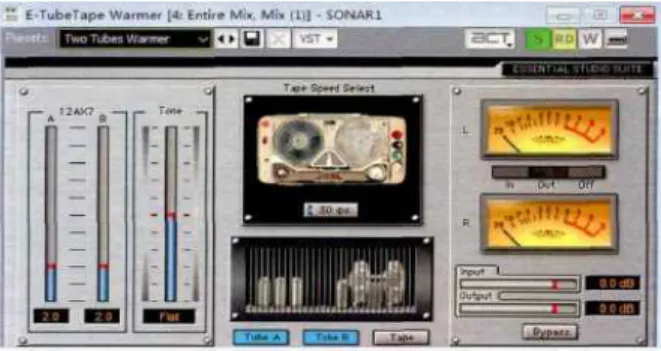
Of course, except for these effectors, we can use pressure limiter, equalizer, tape style simulator and tube saturation simulator of all styles which can be connected in the channel and speed up our adjustment process, greatly improving work efficiency. Sometimes, we can also add channel strip with the commonly used effectors like pressure limiters, equalizers, noise gates and expanders on it to the channel.

Fig. 1. US E-TUBE tape warmer simulation effector

Once the template is adapted (or the circuit is connected), we can roughly mix the work. Pull all the faders down to -10dB and then listen to the music while manually adjusting the level of the faders simultaneously.

After 2 to 3 times of audition and level adjustment, we will soon be clear about the mood, style and feelings of the work, the paragraphs and the problems to be solved.

While auditioning, we also need to divide the audio tracks

into groups, such as drum group, guitar group, vocal

group and other groups. Then when we need to adjust a

track, rather than search the track in a lot of tracks one

by one, we can quickly locate the track, improve work

efficiency and reduce our pressure so that our brain can

be fully devoted into the creation and not be distracted by

trivial technical details.

(4)

IV. Design and Adjustment of Drums

In this way, under the guidance of the mixing plan, we start careful adjustment of the entire work. About 90% of people will start from the drum or vocal. We will mute all the instruments except drum group and check the overall feeling of the drum group, especially the ratio between the super bass and the high pitch of the drum. Generally speaking, in pop music drum controls the speed of the whole song, so we have to ensure the impact of the drum.

There hasn’t to be too much super bass (except Hip-Hop dance music). A bit high pitch is needed to ensure the sound of the drum even under small volume so as to ensure the main rhythm of the song. We usually add an expander (or noise gate) to reduce the intrusion sounds.

The start time is set to 0. 11 ms and the exit time is 80 ms. Then we can get a more natural pure bottom drums.

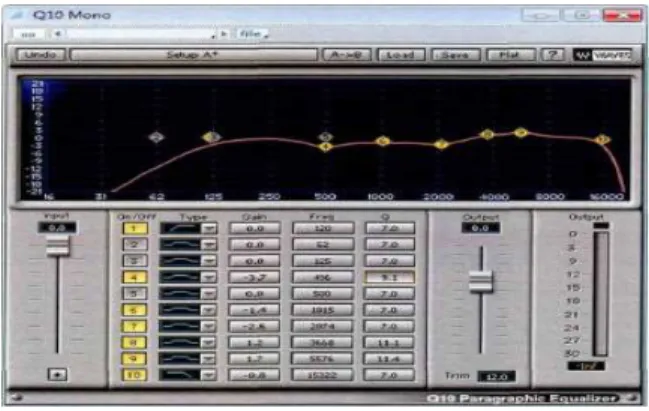
In order to increase the impact of the drum, we can add compressors. For example, we set the starting time to 10ms, the compression ratio to 10: 1 and the compression to 13dB. Equilibrium generally focuses on four important parts: ultra-low frequency part, bass part, alto-voice part and treble part. Ultra-low frequency is not very efficient in pop music thus it should be removed. We usually use low-cut filter to remove the part below 50Hz.

In bass part, in order to remain some space for Bass, an attenuation of ultra-high Q value will be produced at 125Hz so that the overall volume of the bass won’t be too large. In alto-voice part, an attenuation of medium Q value will be made at about 400 Hz (such as 3.9) so that the low frequency of the bottom drum is clear and the submergence is darker while effectively giving way to the base frequency of other instruments so as to fully develop the rich texture of other instruments. The treble part can start at a position among 2KHZ, 3KHZ, 4KHz or 5KHz and slightly increase. For example, we set 7dB and Q = 7 to increase the clarity of the bottom drum so that it will not be submerged in the instruments. Because the bass is prone to be masked by other alto-voice musical instruments. Of course, some of the so-called audio mixing “cheats” will also be used here. For instance, the famous compressor Distressor will quickly strengthen the attack part of the bottom drum to add a little distortion, and reinforce the overtone of the attack, making the sound of the bottom drum bright but not harsh.

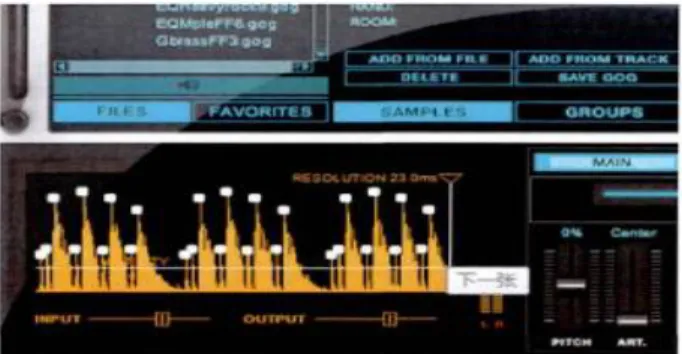
Sometimes drum replacement is also adapted.

Drum-replace, Drumagog5 and other software in Protools

can replace the bad bottom drum with some appropriate bottom drum samples to provide more robust low frequency; or a little ultra-low frequency is added to the original drum in drum replacing way and the volume will depend on the specific circumstances. Under normal circumstances, in the small monitoring speakers, only a slight sense of the sound is enough. We don’t need to hear it particularly obvious. If the sound is very clear in the small monitor speaker, then it will be too loud under normal circumstance. This is only suitable for some occasions where the ultra-low frequency should be reproduced, such as the disco. Of course, it would be better for us to determine the exact size of ultra-low frequency if there are large main monitoring speakers or super-bass audio boxes.

Fig. 2. Drumagog5 drum sampling replacement software

The next step is to deal with the snare drum. It should be noted that if there are two signals picked up by the upward side and the downward side of the snare drum simultaneously, then reverse the signal below, so that the two signals will not produce the feeling of mutual weakening each other. Generally equilibrium and music balance should first be added to the two routs of the snare drum, and then balance the size of these two signals. It should be noted that the signal above is with a bit boring cavity feel, and the signal below is with a brightness of snare.

The characteristic frequency bands of snare drum:

fullness of 240Hz; melodious sense of 5KHz; powerful

80Hz-100Hz; air feeling of 10KHz-16KHz. Therefore,

some frequency bands will be promoted or even

attenuated depending on the style of the music. For

example, in pop music, the sense of power and

melodiousness is needed. So the melodiousness will be

improved to 5KHZ and the sense of power will be

increased to 80HZ-100HZ. To avoid the conflict with

(5)

bottom drum and Bass, low frequency below 80Hz is usually removed. The 240 Hz part will also be slightly reduced to give way to part of the fundamental frequency.

The frequency band of air feeling depends on its relationship with the high frequency percussion. If there is a conflict with the high-frequency percussion, the part above 10KHZ-16KHZ can be removed so as to highlight the slim and bright sense of the high-frequency percussion while lowering its harshness. If there is possible conflict between the frequency and the overtone of instruments like vocals when you continue, then, as appropriate, reduce the 500Hz-lOOOHz part.

Next, some compression and restrictions should be put on the snare drum. Usually, we can make some limitations to the small snare drum. For example, we set limited amount to 6dB so you can balance the different volumes of different paragraphs. Then add compression with compression ratio of 4: 1, the time of establishment as 1ms and exit time as 50ms. The amount of compression should not be too much in case of transient attack loss.

We cans set compression to 7dB. In order to make the compressor perform the same compression amount in different volumes of different paragraphs, the threshold of the compressor can be automatized, that is, slightly lower in the soft section and higher in intense section to ensure that each paragraph has the same amount of compression, small snare drum compressed tone can be produced to the largest extent.[9]

V. Design and Adjustment of Bass

After the adjustment of the sound field of drum group, we will move on to the adjustment of Bass. Since the several strings of Bass are prone to produce inconsistent loudness and there is difference between the loudness of each note, it is necessary to compress and even limit Bass. We can refer to the bottom drum for the compression starting time. Generally, the time should be set to 20-60ms so as to guarantee a certain low-frequency thickness. But the compression should start right after the sound head so that after the low-frequency attack at 20-60ms, Bass’s continuing sound can be compressed to keep the freshness and melodiousness of the whole sound field. Compressor exit time is generally two times the cycle of the bass, such as 50ms, so it will not immediately exit for each cycle and

lead to distortion. Because we are balancing the overall loudness of Bass, rather than the compression of each cycle of Bass sound.[10]

The amount of compression can be measured on a case-by-case basis. Under normal circumstances, 6dB is a moderate amount, but it is not clear enough. If it is adjusted to 10-12dB, the sound of Bass will be clearly highlighted and the process is significantly reduced. If it is more than 12dB, such as 20dB, and with a large compression ratio, such as 10: 1, the sound Bass will sound like a staccato. The sound head is over-highlighted, just like being hit hard. For some music of intense style, such as dance music, it is appropriate.

But for some soothing and tender style, it is not very suitable.

Sometimes there is too much treble in Bass, making its bass shadowed. We should attenuate the high frequency part of Bass to highlight its low frequency. If high frequency is not reduced while increasing the amount of low frequency, the whole song may sound too unnatural.

Because treble has a strong masking effect on the bass, making us unable to concentrate on the bass. The ultra-low frequency (under 60Hz) of Bass is usually removed in pop music because of its low efficiency and replaced by the low frequency part of 60-120HZ. Treble above 120Hz usually determines the positioning of Bass and the adjustment of its size will be decided after the settlement of the 60-120HZ part. At the same time, frequency around 200-700 Hz should be paid enough attention to because it is the base frequency of other instruments where the frequency is usually very crowded.

So the frequency of this part should also be moderately attenuated. After adjustment, the final Bass should remove ultra-low frequency (under 60Hz), retain low frequency (60-120Hz), attenuate medium-and-low frequency (200-700Hz) and contain a small part of the positioning treble (2kHz-5kHz or so).

Of course, the complementary balance with the bottom drum also need to be taken into account at the moment. If a frequency band of the bottom drum (such as 80 Hz) is relatively large, then the Bass of 80Hz is narrowed down to have a larger attenuation of the Q value, so that the bottom drum is not emphasized in the same frequency band as Bass and the band is not excessive.

In general, unless the string is strictly arranged in

advance while arranging, the Bass notes will not be

exactly synchronized with the bottom drum, which will

(6)

make the overall bass unstably strong and weak: when the drum and Bass are played at the same time, the bass becomes louder; but when they are palyed independently, the bass reduces. So the bottom drum and Bass should be on the same line and they are to be compressed or limited with the compression amount of about 6dB, then the overall volume of the bottom drum and Bass is controlled to a stable value. It should be noted that the value of the compressor should be set to the largest when exiting (about 50ms) to prevent harmonic distortion.

Fig. 3. Limit the bottom drum and Bass by binding them together, using waves L1 limiter

VI. Design and Adjustment of Vocals

The dynamics of the vocals are usually very broad.

The soft parts are easily submerged in the band while the strong treble parts are too loud and near the front in the sound field, making audiences feel very uncomfortable.

Because of the most complex resonance and a variety of consonants, vocals are prone to have difficulty in making some words while giving too much emphasis on others.

So before the processing by effectors, we should first process the vocal words one by one, raising light words and attenuating strong words. We have to standardize their loudness from hearing and for strong paragraphs, we can set the loudness 2-3 dB larger. After balancing the loudness of all the words, the vocals are compressed. It should be noted that the envelope of some audio software is behind the effector, such as Sonar, then you need to create a new bus, deliver the enveloped vocals into the bus, and then add all the necessary effectors on the bus.

This way is usually used for dynamic and particularly broad vocals. If the compressor is directly loaded, the strongest part will be excessively compressed while soft

parts can’t be effectively upgraded. If the amount of compression is continuously increased, the tone of the strongest part will be pressed or even destroyed.

A balanced use of human voice is also very important.

We usually attenuate the part under 120Hz which is the sound of the microphone or other noises and will affect the cleanliness of the low frequency produced by bottom drum and Bass. We should also pay attention to the 250Hz part which is the basic part of human voice. The enhancement of the frequency in this part will increase the intensity of human voice and expand the volume of it.

For songs with several instruments, the frequency of them should be attenuated rather than promoted. If the device is very rare or you want to develop a super singer style, the proportion of band should be greatly reduced.

Then the 250Hz part of human voice may be slightly increased as a fill, so that the sound field is solid with this critical frequency band.

The 500Hz-5kHz part of human voice is the overtone part which will affect the feeling and the sense of immediacy of human voice. It will be slightly attenuated by 500Hz-3kHz or so to highlight the high frequency (above 4kHz) overtone, making human voice more powerful. The voice then will have a certain sense of thinness. This way is quite common for sound with multiple instruments. It may seem a bit acute to hear the sound alone, but when all the instruments are filled in, the overall band of the mix will be balanced, rather than a full band of human voice over the whole band. The overall feeling of the audio mix is the most important part. It is the balance and smoothness of the whole sound field rather than the detailed performance of a musical instrument that really matters.

Fig. 4. An example of vocal equilibrium - Q10 software equilibrium of waves

The enhancement of the high frequency (10kHz-12kHz)

(7)

of human voice and the participation of reverberation can make human voice transparent, rounded and full of appeal. This band consists of a variety of consonants produced by the friction in the singer’s throat. If this part is strengthened, the pronunciation and emotion of the singer will be improved. But we need to be careful about the strengthened dental part in this operation. Later, we will use a noise eliminator to eliminate the extra dental.

After equilibrium, noise eliminator should be adopted to control the dental with the general attenuation of l0dB (corresponding to the compression amount of the compressor). If there is not enough or too much compression of dental, the automation function can be played to carefully adjust each dental to get clean and non-harsh soundtrack. The soundtrack after processing will be very powerful. Because the high frequency of non-processed soundtrack will break out from time to time and we have to pull down the entire soundtrack, which makes the soundtrack very weak. After dental treatment, we find that soundtrack can even be pushed up to 5 or 6dB without making harsh sounds!

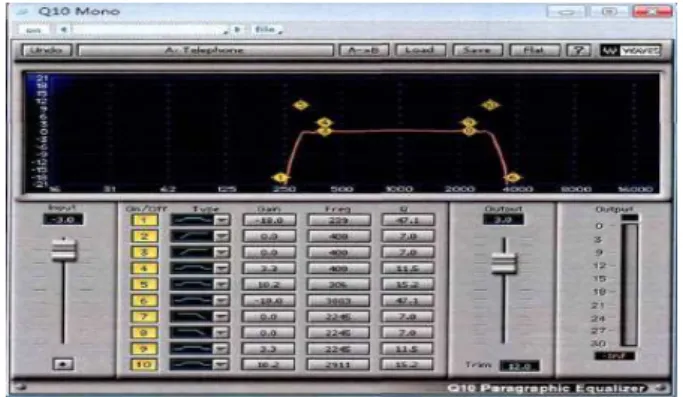
For those repetitive or echoed accompaniment part, it should be slightly lower than the lead singer. There are generally two ways: first, make the part into “phone sound”. That is, conduct high and low cut, leaving only the medium frequency band. The most typical value is:

low cut under l000Hz and high cut above 4000Hz. The frequency of high cut depends on the actual situation and it may be extended to higher values. In principle, the base frequency part of the accompaniment should be largely attenuated and its thickness should be reduced so that they will not interfere with the lead singer. High cut is to reduce the bloom of high frequency and highlight the clearness of lead singer’s lyrics. The first approach is to attenuate most part of the low frequency and enhance the high frequency. For example, if the frequency above 8000Hz is promoted by 8dB, you can get an ethereal and misty tone, with a fascinating mysterious sense. The second approach is to add a larger reverberation and deepen the depth of the sound field.

Fig. 5. Phone-sound processing on the echoed accompaniment part with Q10 of waves

VII. Design and Adjustment of Rhythm and SOLO Instrument

In rhythm part, the most common instruments are acoustic guitar, electric guitar acapella, electric guitar distortion, keyboard and other musical instruments. For electric guitar acapella, its low frequency will generally be removed with low cut frequency of l00Hz, so that the warmth and thickness of its middle-and-low frequency will be retained while not interfering with the clearness of the bass produced by bottom drum and Bass. If there are several instruments, low cut frequency can be improved, with the maximum value up to 1kHz or 2kHz, keeping just a little high-frequency sound. Similarly, high-frequency part can also be attenuated. For example, conduct high cut to frequency above 12kHz to give space to high-frequency percussion.

Keyboard part is similar to electric guitar. Low cut usually happens below 120Hz and it is slightly attenuated by 500Hz. High cut occurs in frequency above 12kHz and then appropriately improve band 1kHz, 2kHz, 3kHz or 4kHz to improve the characteristics of the keyboard.

Compression ratio can be set to 4: 1, with the attack time of 1ms, the exit time of 100ms and the compression amount of about 6dB.

Pop music are often played solo in electric guitar

without the playing of lead singer so there is no

frequency competition with the lead singer. Solo guitar

equilibrium can generally be enhanced by 4kHz or so to

improve the clarity and the sense of immediacy. High cut

can be conducted but it shouldn’t be too HiFi. If the

guitar’s sound is too thin, 250Hz or 500Hz part can be

enhanced. Also, you can slightly enhance band 1kHz,

(8)

2kHz or 3kHz to improve the middle-frequency characteristics of solo guitar performance.

Reverberation and delay may be added to solo guitar performance to make the sound more exciting. Short plate reverberation can improve the characteristics and thickness of the medium frequency and a small amount of long reverberation will strengthen the sense of depth.

Octave notes or quarter notes can be used for delay and sometimes half note is also used. The feedback can be set to zero or be increased. Reverberation makes the solo electric guitar performance highlighted even without too much volume and betters the atmosphere.

Fig. 6. Increase sense of depth with long reverberation using RVerb reverberator of waves

Of course, other effects can also be added to electric guitar solos, such as trim, chorus, or even distortion and other electric guitar speaker simulators. But, for such great modifications, you should take your requirements of the overall sound field design into careful consideration.

At this point, the entire sound field construction is basically completed. We can repeatedly listen to your suggestions and continue to adjust the volume, sound and effects to get better results. In the non-stop adjustment, we will always pay attention to the layering, the audio sense of frequency band, the spatial sense and the sense of distance of the whole sound field.

Ⅷ. Conclusion

This paper presents the basic process of a set of unique virtual sound field design and adjustment, pointing out that in the actual process we should take the traditional basis and combine it with the current era to form a unique sound aesthetic orientation.

In music production process, we must first pay attention to the calibration of monitoring system. It includes the calibration of the monitoring speakers, the placement of the monitoring speakers, the location of audiences and the acoustic environment of the room. The acoustic environment of the room is also an important factor in whether the sound can be accurately reproduced at the time of reproduction.

In arrangement and prerecording, sound field design should be complemented. After the arrangement and prerecording, we enter into the mid-editing process which is divided into two kinds: selection editing and modification editing. Finally, we emphasized that the importance of grasping the unity of the overall sound field is more important than the detailed adjustment of an instrument.

In sound field adjustment, I start from the bottom drum.

The ratio between super bass and high pitch should be carefully adjusted; There shouldn’t be too much super bass (except Hip-Hop dance music); a little treble is needed to ensure that the drum can be clearly heard even played in a small volume and that the main rhythm will not disappear. For the bottom drum, I will add an expander (or noise gate) to remove the intrusion tone; a compressor is adopted to increase the impact; equilibrium is employed to get the wanted sound, focusing on four important parts: the super-low frequency part, the bass part, the alto part and the treble part.

Apply compression, limitation and equilibrium to the snare drums and add the appropriate reverberation. You can also use the natural environmental sound picked up by overhead microphones and room microphones to strengthen the intensity of snare drums.

Then push the overhead microphone track and add hi-hat, the cymbals and all other drums. Generally, I will attenuate the low frequency of the overhead microphone;

take the microphone of the small drum back about 5ms to avoid the weakening of the sound field of the whole drum group caused by the signal of small drum’s headphone ahead of the the main microphone signal.

It is necessary to compress and even limit Bass. The

key part is to balance the overall loudness of Bass. In the

construction of sound field, do not overly pursue the

density of the sound field. Instead, we should keep a

certain degree of relaxation and spatial sense because

when mastering the sound will become more close and

the spatial sense will be compressed. The complementary

(9)

balance with the bottom drum should also be taken into account at this time; a chorus effector or distortion effector can be added; the bottom drum and Bass should be on the same bus and they should be compressed or limited.

In rhythm part, the most common instruments are acoustic guitar, electric guitar acapella, electric guitar distortion, keyboard and other musical instruments.

Acoustic guitar is divided into decomposition chords and sweeping strings; in electric guitar acapella and distortion, high and low cut are carried out. A small amount of reverberation is added so as to make the electric guitar more backward and less prominent in the sound field.

In short, the treatment of the sound field is not arbitrary. After studying widely recognized works, we should analyze, summarize and sort out their rules and characteristics while doing horizontal and vertical comparison so that we can really understand it and play our personal creativity in audio arrangement and effect maintenance. At the end, the entire sound field design can make audiences feel refreshing and unconventional and be more in line with human hearing habits.

In this paper, in addition to the use of common effectors, there is a different point of view that in music production we should take the virtual sound field design of the final music work into consideration rather than just be tangled in a single effector or the details of a music track. Emphasis on the overall sense of mixing is the most important part. The whole sound field should be balanced and smooth and we should not just focus on the performance of an instrument. Then, all the production links can be unified together reasonably and it will be possible to create more exciting and music essence-showing works! In this paper, the author analyzed and explained the procedure of simulating real sound field in mixing and mother tape processing in music production from the point of view of acoustics, interpreted the procedure with psychoacoustics, and put forward following guidance in terms of music production and research: 1. Exploring sound field rules of different types of music; 2. Exploring the characteristic and sound field rules of different types of arrangements, mixing and mother tape processing; 4. Strive to design virtual sound fields in the procedure of composing and arrangement, and follow the principle of designed virtual sound fields in the procedure of mixing and mother tape processing.

REFERENCES

[1] Alan P. Kefauver. Fundamentals of digital audio .A-R Edition,Inc.1999

[2] Andrea Pejrolo DeRosa, Acoustic&Midi Orchetration For The Contemporary Composer, 2007.

[3] Backus, John, The Acoustical Foundations of Music, Second edition, New York:W.W.NORTON & CO., Inc, 1977.

[4] Ballou, Glen, Handbook for Sound Engineers, Third Edition, Oxford: Focal Press,2002.

[5] Bill Gibson. Equalizers> Reverbs &Delays. HAL LEONARD CORPRATION,2002.

[6] Eargle, John, The Microphone Book, Boston: Focal Press, 2001.

[7] Francis Rumsey and Tim McCormick .Sound and Recording :An Introduction .Focal Press.2002.

[8] Glenn D. White. The Audio Dictionary .University of Washington Press.2000.

[9] Davis,Don, and Carolyn Davis, Sound System Engineering, Second Edition, Oxford: Focal Press, 1997.

[10] EWQL Symphonic Orchestra Unofficial User Guide Fina l,2005.

Author

Yan Wang received the B.S. degree in Composing theory technology from Xi'an Conservatory of Music, China. in 2004.

M.S. degree in Musicology from Henan Normal University, China, in 2011, Doctor of Applied Arts from Kyung Hee University in 2016.

Dr. Wang joined the faculty of the College of Music at

Henan Normal University, Henan, China, in 2004. She

is currently an Associate Professor in the College of

Music at Henan Normal University. She is interested in

Composing, Harmonics, Musicology etc.

수치

Fig.  1.  US  E-TUBE  tape  warmer  simulation  effector
Fig.  2.  Drumagog5  drum  sampling  replacement  software
Fig.  4.  An  example  of  vocal  equilibrium  -  Q10  software  equilibrium  of  waves
Fig.  5.  Phone-sound  processing  on  the  echoed  accompaniment  part  with  Q10  of  waves
+2

참조

관련 문서

The stain field associated with a dislocation can in certain cases provide a favorable interaction with the strain field of the martensite nucleus, such that one of the

To this end, prior studies of the type of value, design paradigm and design value were considered, and three types of design value (practical value,

In this architectural design field, the space with new concept and organic space come into sight, escaping from the space concept in the geometric and

(4)the spiral ganglion (5)the auditory nerve fibres.. The Basilar Membrane is a Mechanical Analyzer of Sound Frequency The Basilar Membrane is a Mechanical Analyzer of

- Prove or give a counter-example of the following statement: In three space dimensions and time, given an initial velocity field, there exists a vector velocity and

The seven steps can be organized in order of selecting local cultural resources of Fujian Province, selecting local design prototypes for character

And for the case the entrapment is permitted, this study examines a few academic assumptions on the tolerance field, its theoretical grounds, ways to

- The incompressible continuity and Navier-Stokes equations can be solved for the instantaneous flow field. - However, to accurately simulate the turbulent field, the calculation