Korean J. Mater. Res.
Vol. 26, No. 7 (2016)
363
Synthesis of NaCaLa(MoO
4)
3:Ho
3+/Yb
3+Phosphors via Microwave Sol-Gel Route and Their Upconversion Photoluminescence Properties
Chang Sung Lim
†Department of Advanced Materials Science & Engineering, Hanseo University, Seosan 31962, Republic of Korea (Received March 6, 2016 : Revised June 10, 2016 : Accepted June 13, 2016)
Abstract
NaCaLa1-x(MoO4)3:Ho3+/Yb3+ ternary molybdates with proper doping concentrations of Ho3+ and Yb3+(x = Ho3++ Yb3+, Ho3+ = 0.05 and Yb3+= 0.35, 0.40, 0.45 and 0.50) were successfully synthesized by microwave sol-gel method. Well-crystallized particles formed after heat-treatment at 900oC for 16 h showed a fine and homogeneous morphology with particle sizes of 3-5µm. Under excitation at 980 nm, the UC intensities of the doped samples exhibited strong yellow emissions based on the combination of strong emission bands at 520-nm and 630-nm emission bands in the green and red spectral regions, respectively. The optimal Yb3+:Ho3+ ratios were obtained at 9:1 and 10:1, as indicated by the composition- dependent quenching effect of the Ho3+ ions. The pump power dependence of the upconversion emission intensity and the Commission Internationale de L'Eclairage chromaticity coordinates of the phosphors were evaluated in detail.
Key words
microwave sol-gel, ternary molybdate, yellow phosphors, upconversion, Raman spectroscopy.1. Introduction
Recently, design and synthesis for rare-earth activated photoluminescence particles have attracted considerable attention in their applications, such as fluorescent lamps, cathode ray tubes, solid-state laser, amplifiers for fiber optics communication and new optoelectronic devices, which allow them to overcome many of the current limitations of traditional photoluminescence materials.
1-3)Scheelite- structured compounds belonging to the molybdate family have attracted great attention because of their spectroscopic characteristics and excellent upconversion(UC) photolumi- nescence properties.
4,5)Rare-earth doped molybdate com- pounds possess the tetragonal structure, space group I4
1/ a, and belong to the family of scheelite-type structures.
The trivalent rare-earth ions in the tetragonal phase can be partially substituted by Er
3+, Ho
3+, Tm
3+and Yb
3+ions.
6-8)Among the rare-earth ions, the Ho
3+ion is suitable for converting infrared to visible light through the UC process due to its appropriate electronic energy level configuration.
The Yb
3+ion, as a sensitizer, can be dramatically excited by appropriate incident light source. The Ho
3+and Yb
3+ions co-doping can remarkably enhance the UC efficiency for the frequency shift from infrared to visible range due
to high efficiency of the energy transfer from Yb
3+to Ho
3+.
9-11)For the preparation of the binary molybdate NaLn(MoO
4)
2, several processes have been developed via specific pre- paration processes, including solid-state reactions,
12-15)the sol-gel method,
16,17)the Czochralski method,
18-21)the hydro- thermal method,
22-26)the microwave assisted hydrothermal method,
27)and the pulse laser deposition.
28)Usually, moly- bdates are prepared by a solid-state method that requires high temperatures, a lengthy heating process and sub- sequent grinding, this results in a loss of the emission intensity and an increase in cost. The sol-gel process provides some advantages over the conventional solid- state method, including good homogeneity, low calcination temperature, small particle size and narrow particle size distribution optimal for good luminescent characteristics.
However, the sol-gel process has a disadvantage in that it takes a long time for gelation. Compared with the usual methods, microwave synthesis has the advantages of a very short reaction time, small-size particles, narrow particle size distribution, and high purity of final poly- crystalline samples. Compared with the usual methods, microwave synthesis has advantages of very short reaction time, small-size particles, narrow particle size distribution,
†Corresponding author
E-Mail : [email protected] (C. S. Lim, Hanso Univ.)
©Materials Research Society of Korea, All rights reserved.
This is an Open-Access article distributed under the terms of the Creative Commons Attribution Non-Commercial License (http://creative- commons.org/licenses/by-nc/3.0) which permits unrestricted non-commercial use, distribution, and reproduction in any medium, provided the original work is properly cited.
and high purity of final polycrystalline samples. Micro- wave heating is delivered to the material surface by radiant and/or convection heating, which heat energy is transferred to the bulk of the material via conduction.
29-31)Microwave sol-gel process is a cost-effective method that provides high homogeneity products and can be easily scaled-up, and it is emerging as a viable alternative approach for the quick synthesis of high-quality luminescent materials. It is topical to create new ternary molybdate compounds for realization of UC photoluminescence in the products with such features as well defined mor- phology and stable UC luminescent properties. However, the NaCaLa
1-x(MoO
4)
3:Ho
3+/Yb
3+ternary molybdate phos- phors have not been reported up to now. In this concept, the ternary molybdate NaCaLa
1-x(MoO
4)
3:Ho
3+/Yb
3+phos- phors synthesized by the microwave sol-gel method are reported for the first time.
In this study, the ternary molybdate NaCaLa
1-x(MoO
4)
3: Ho
3+/Yb
3+phosphors with the proper doping concen- trations of Ho
3+and Yb
3+(x = Ho
3++ Yb
3+, Ho
3+= 0.05 and Yb
3+= 0.35, 0.40, 0.45 and 0.50) were successfully pre- pared via the microwave sol-gel route, followed by heat treatment. The synthesized particles were characterized by X-ray diffraction(XRD) and scanning electron micros- copy(SEM). The pump power dependence of the UC emission intensity and Commission Internationale de L'Eclairage(CIE) chromatic coordinates were evaluated in detail. The optical properties were examined comparatively using photoluminescence(PL) emission and Raman spec- troscopy.
2. Experimental Procedure
Precise amounts of Ca(NO
3)
2·4H
2O (99 %, Sigma- Aldrich, USA), Na
2MoO
4·2H
2O (99 %, Sigma-Aldrich, USA), La-(NO
3)
3·6H
2O (99 %, Sigma-Aldrich, USA), (NH
4)
6Mo
7O
24·4H
2O (99 %, Alfa Aesar, USA), Ho(NO
3)
3· 5H
2O (99.9 %, Sigma-Aldrich, USA), Yb(NO
3)
3·5H
2O (99.9
%, Sigma-Aldrich, USA), citric acid (99.5 %, Daejung Chemicals, Korea), NH
4OH (A.R.), ethylene glycol (A.R.) and distilled water were used to prepare NaCaLa(MoO
4)
3, NaCaLa
0.6(MoO
4)
3:Ho
0.05Yb
0.35, NaCaLa
0.55(MoO
4)
3:Ho
0.05- Yb
0.40, NaCaLa
0.50(MoO
4)
3:Ho
0.05Yb
0.45and NaCaLa
0.45(MoO
4)
3:Ho
0.05Yb
0.50. Table 1 shows chemical compos- itions and sample notations of NaCaLa
1-x(MO
4)
3:Yb
3+/
Ho
3+(x = Yb
3++ Ho
3+). The compounds Ca(NO
3)
2, Na
2- MoO
4·2H
2O and (NH
4)
6Mo
7O
24·4H
2O were dissolved in 20 mL of ethylene glycol and 80 mL of 5M NH
4OH under vigorous stirring and heating. Subsequently, La(NO
3)
3· 6H
2O with Ho(NO
3)
3·5H
2O, Yb(NO
3)
3·5H
2O and citric acid (with a molar ratio of citric acid to total metal ions of 2:1) were dissolved in 100 mL of distilled water under vigorous stirring and heating. Then, the solutions were mixed together vigorously and were heated at 80-100
oC.
Finally, highly transparent solutions were obtained and adjusted to pH = 7-8 by the addition of NH
4OH or citric acid. The transparent solutions were placed into a micro- wave oven operating at a frequency of 2.45 GHz with maximum output-power of 1250 W for 30 min. The working cycle of the microwave reaction was controlled very precisely using a regime of 40 s on and 20 s off for 15 min, followed by further treatment of 30 s on and 30 s off for 15 min. The samples were treated with ultrasonic radiation for 10 min to produce light-yellowish transparent sols. After this, the sols were dried at 120
oC in a dry oven to obtain black dried gels. The black dried gels were ground and heat-treated at 900
oC for 16 h at 100
oC intervals between 600-900
oC. Finally, white parti- cles were obtained for pure NaCaLa(MoO
4)
3and pink particles were obtained for the doped compositions.
The crystal structure of the synthesized particles was identified using XRD(D/MAX 2200, Rigaku, Japan). The microstructure and surface morphology of the synthe- sized particles were observed using SEM(JSM-5600, JEOL, Japan). The PL spectra were recorded using a spectrophotometer(Perkin Elmer LS55, UK) at room tem- perature. The pump power dependence of the UC emission intensity was measured at levels of working power from 20 to 110 mW. Raman spectra measurements were per- formed using a LabRam Aramis(Horiba Jobin-Yvon, France) with the spectral resolution of 2 cm
−1. The 514.5- nm line of an Ar ion laser was used as an excitation source; the power on the samples was kept at 0.5 mW level to avoid the sample’s decomposition.
3. Results and Discussion
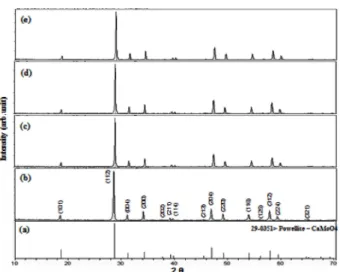
Fig. 1 shows XRD patterns of the (a) JCPDS 29-0351 pattern of powellite CaMoO
4, and the synthesized (b) pure NaCaLa(MoO
4)
3, (c) NaCaLa
0.6(MoO
4)
3:Ho
0.05Yb
0.35,
Table 1. Chemical compositions and sample notations of NaCaLa1-x(MO4)3:Yb3+/Ho3+(x = Yb3++Ho3+).
Samples Yb3+(a) Ho3+(b) x = Yb3++ Ho3+ Yb3+:Ho3+
NaCaLa0.60(MO4)3:Yba/Hob 0.35 0.05 0.40 7:1
NaCaLa0.55(MO4)3:Yba/Hob 0.40 0.05 0.45 8:1
NaCaLa0.50(MO4)3:Yba/Hob 0.45 0.05 0.50 9:1
NaCaLa0.45(MO4)3:Yba/Hob 0.50 0.05 0.55 10:1
(d) NaCaLa
0.55(MoO
4)
3:Ho
0.05Yb
0.40, (e) NaCaLa
0.50(MoO
4)
3: Ho
0.05Yb
0.45, and (f) NaCaLa
0.45(MoO
4)
3:Ho
0.05Yb
0.50parti- cles. In the synthesized samples, almost all XRD peaks were indexed by tetragonal phase with parameters close to the standard data of CaMoO
4(JCPDS 29-0351). The ternary undoped and doped NaCaLa
1-x(Ho,Yb)
x(MoO
4)
3crystallites provide the strongest intensity peaks from the (112), (204), and (312) planes, which are the major peaks of CaMoO
4. Therefore, the synthesized NaCaLa
1-x(MoO
4)
3particles belong to molybdate family and have a scheelite- type structure, with space group I4
1/a. It is observed that the diffraction peaks of the ternary undoped NaCaLa (MoO
4)
3sample in Fig. 1(b) shift slightly to the lower angles, as compared to that of the standard data CaMoO4 (JCPDS 29-0351) shown in Fig. 1(a). It is well known that the relationship of the interplanar space(d
hkl), diffraction angle ( θ) and wavelength of X-ray(λ) is expressed using Bragg equation of 2d
hklsin θ = λ. In pure NaCaLa
(MoO
4)
3crystals, unit cell increase occurs due to the substitution of Na
+(R = 1.18 Å) and La
3+(R = 1.16 Å) ions into the Ca
3+(R = 1.12 Å) sites.
32)According to the Bragg equation, the diffraction peaks shift slightly to lower angles with the increase of d
hklvalues. It can also be observed that the diffraction peaks of the doped samples in Fig. 1(c)-(f) shift to higher angles compared to that of pure NaCaLa(MoO
4)
3sample shown in Fig. 1(b).
In the crystal structure of NaCaLa
1-x(MoO
4)
3, La
3+ion site is supposed to be occupied by Ho
3+and Yb
3+ions with occupations fixed according to the nominal chemical formulas. The defined crystal structure contains MoO
4tetrahedrons coordinated by four (Ca/Na/La/Ho/Yb)O
8square antiprisms through the common O ions. In the doped crystals, the unit cell shrinkage results from the substitution of La
3+ions by Ho
3+and Yb
3+ions. It is assumed that the radii of Ho
3+(R = 1.015 Å) and Yb
3+(R = 0.985 Å) are smaller than that of La
3+(R = 1.16 Å), when the coordination number is CN = 8.
32)Post heat- treatment plays an important role in attempt to establish a well-defined crystallized morphology. To reach a well- defined final morphology, the samples need to be heat treated at 900
oC for 16 h. It is assumed that the Ho
3+/ Yb
3+doping concentrations are acceptable to keep the original structure of NaCaLa(MoO
4)
3.
Fig. 2 provides SEM images of the synthesized (a) NaCaLa
0.6(MoO
4)
3:Ho
0.05Yb
0.35, and (b) NaCaLa
0.50(MoO
4)
3: Ho
0.05Yb
0.45particles. As shown in Fig. 2, it is seen that the as-synthesized sample contain particles with a fine and homogeneous morphology and a characteristic particle size of 3-5 μm. The particles are partly coalesced into agglomerates and this is induced by atom inter-diffusions among the grains at 600-900
oC. Thus, the coalescent particle morphology may be considered as an universal indicator of high chemical homogeneity and structural quality of powder products. The samples show no dis- crepancy in terms of morphological feature. It means that the morphological feature is insensitive to the Ho
3+/Yb
3+doping concentrations. It is noted that the Ho
3+and Yb
3+Fig. 1. X-ray diffraction patterns of the (a) JCPDS 29-0351 pattern of CaMoO4, the synthesized (b) pure NaCaLa(MoO4)3, (c) NaCa- La0.6(MoO4)3:Ho0.05Yb0.35, (d) NaCaLa0.55(MoO4)3:Ho0.05Yb0.40, (e) NaCaLa0.50(MoO4)3:Ho0.05Yb0.45, and (f) NaCaLa0.45(MoO4)3:Ho0.05- Yb0.50 particles.
Fig. 2. Scanning electron microscopy images of the synthesized (a) NaCaLa0.6(MoO4)3:Ho0.05Yb0.35, and (b) NaCaLa0.50(MoO4)3:Ho0.05Yb0.45 particles.
ions can be partially doped into the La
3+sites, and the La
3+ions can be efficiently substituted in the Ca
2+sites.
Consequently, Na
+, La
3+, Ho
3+and Yb
3+ions can be efficiently substituted in the Ca
2+sites in the NaCaLa (MoO
4)
3lattice. The microwave sol-gel method in appli- cation to ternary molybdates provides the energy to synthesize the bulk of the material uniformly, so that fine particles with controlled morphology can be fabricated in a short time period. This suggests that the microwave sol-gel route is suitable for the creation of homogeneous NaCaLa
1-x(MoO
4)
3:Ho
3+/Yb
3+crystallites.
Fig. 3 shows the UC photoluminescence emission spectra of the as-prepared (a) NaCaLa
0.6(MoO
4)
3:Ho
0.05Yb
0.35, (b) NaCaLa
0.55(MoO
4)
3:Ho
0.05Yb
0.40, (c) NaCaLa
0.50(MoO
4)
3: Ho
0.05Yb
0.45, and (d) NaCaLa
0.45(MoO
4)
3:Ho
0.05Yb
0.50excited under 980 nm at room temperature. The UC particles exhibited yellow emissions based on a strong 520-nm emission band in the green region and a strong 630-nm emission band in the red region. The UC intensities of (c) NaCaLa
0.50(MoO
4)
3:Ho
0.05Yb
0.45and (d) NaCaLa
0.45(MoO
4)
3:Ho
0.05Yb
0.50are the highest of other particles.
The strong 520-nm emission band in the green region correspond to the
5S
2/
5F
4→
5I
8transition, while the very strong emission 630-nm band in the red region corres- ponds to the
5F
5→
5I
8transition to the activator where radiation can be emitted. The Ho
3+ion activator is the luminescence center for these UC particles, and the sensitizer Yb
3+effectively enhances the UC luminescence intensity because of the efficient energy transfer from Yb
3+to Ho
3+. As can be seen in Fig. 3, the highest intensities of (c) NaCaLa
0.50(MoO
4)
3:Ho
0.05Yb
0.45and (d) NaCaLa
0.45(MoO
4)
3:Ho
0.05Yb
0.50caused the ratios of Yb
3+: Ho
3+to be 9:1 and 10:1, while the lowest intensity of (a)
NaCaGd
0.6(MoO
4)
3:Ho
0.05Yb
0.35caused the ratio of Yb
3+: Ho
3+to be 7:1. The optimal Yb
3+:Ho
3+ratios provided to be 9:1 and 10:1 induced by the concentration quenching effect of Ho
3+ion. Therefore, the higher content of the Yb
3+ion used as a sensitizer and the lower content of the Ho
3+ion the correct ratios of Yb
3+:Ho
3+(9:1 and 10:1) can remarkably enhance the UC luminescence through efficient energy transfer. The concentration quenching effect can be explained by the energy transfer between nearest Ho
3+and Yb
3+ions. With increase of the Ho
3+and Yb
3+ion concentrations, the distance between Ho
3+and Yb
3+ions decreases, which can promote non-radiative energy transfer via an exchange interaction or multipole- multipole interactions.
33)The logarithmic scale dependence of the UC emission intensities at 520 and 630 nm on the working pump power over the range of 20 to 110 mW in the NaCa- La
0.50(MoO
4)
3:Ho
0.05Yb
0.45sample is shown in Fig. 4. In the UC process, the UC emission intensity is proportional to the slope value n of the irradiation pumping power, where n is the number of pumped photons required to produce UC emission:
34)I ∝ P
n(1)
LnI ∝ nLnP (2)
where the value n is the number of pumped photons required to excite the upper emitting state, I is the UC luminescent intensity and P is the laser pumping power.
As is evident in Fig. 4, the slope value calculations indicate a value of n = 1.95 for the red emission at 630 nm, and a value of n = 1.79 for the green emission at 520 nm. These results show that the UC mechanism of
Fig. 3. The upconversion photoluminescence emission spectra of(a) NaCaLa0.6(MoO4)3:Ho0.05Yb0.35, (b) NaCaLa0.55(MoO4)3:Ho0.05- Yb0.40, (c) NaCaLa0.50(MoO4)3:Ho0.05Yb0.45, and (d) NaCaLa0.45 (MoO4)3:Ho0.05Yb0.50 excited under 980 nm at room temperature.
Fig. 4. Logarithmic scale dependence of the upconversion emission intensity on the pump power in the range from 20 to 110 mW at 520 and 630 nm in the NaCaLa0.50(MoO4)3:Ho0.05Yb0.45 sample.
the green and red emissions can be explained by a two- photon UC process in Ho
+3/Yb
3+co-doped phosphors.
4,9-12)Based on the results of pump power dependence, the known schematic energy level diagrams of Ho
3+(activator) and Yb
3+(sensitizer) ions in the as-prepared NaCaLa
1-x(MoO
4)
3:Ho
3+/Yb
3+samples and the UC mechanisms, which account for the green and red emissions during 980 nm laser excitation, are shown in Fig. 5. The UC emissions are generated by a two photon process through excited state absorption(ESA) and energy transfer(ET).
4,10,12)Initially, the Yb
3+ion sensitizer is excited from the
2F
7/2level to the
2F
5/2level under excitation by 980 nm pumping, and transfers its energy to the Ho
3+ions. Then, the Ho
3+ions are populated from the
5I
8ground state to the
5I
6excited state. This is a phonon-assisted energy transfer process because of the energy mismatch between the
2F
5/2level of Yb
3+and the
5I
6level of Ho
3+. Secondly, the Ho
3+in the
5I
6level is excited to the
5S
2or
5F
4level by the next energy transfer from Yb
3+. In addition, the
5
S
2/
5F
4level of Ho
3+can be populated through excited state absorption. Finally, the green emission around 520 nm, corresponding to the
5S
2/
5F
4→
5I
8transition, takes place. For the red emission, the population of the
5F
5level is generated by two different channels. In one channel, the Ho
3+in the
5S
2/
5F
4level state relaxes non- radiatively to the
5F
5level. Another channel is closely related to the
5I
7level populated by non-radiative relax- ation from the
5I
6excited state. The Ho
3+in the
5I
7level is excited to the
5F
5level by energy transfer from Yb
3+and relaxed to the
5F
5level. Therefore, the red emission around 630 nm corresponds to the
5F
5→
5I
8transition.
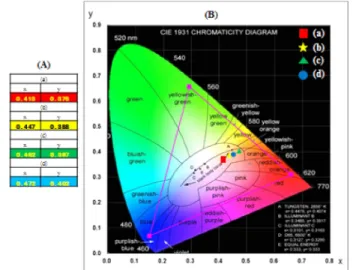
35,36)In Fig. 6, (A) calculated chromaticity coordinates (x, y)
and (B) a CIE chromaticity diagram are shown for the compositions (a) NaCaLa
0.6(MoO
4)
3:Ho
0.05Yb
0.35, (b) Na- CaLa
0.55(MoO
4)
3:Ho
0.05Yb
0.40, (c) NaCaLa
0.50(MoO
4)
3:Ho
0.05- Yb
0.45, and (d) NaCaLa
0.45(MoO
4)
3:Ho
0.05Yb
0.50. The triangle indicates in Fig. 6(B) indicates standard coordinates for blue, green and red colors. The inset in Fig. 6(B) shows the chromaticity points for the samples (a), (b), (c) and (d). The chromaticity coordinates (x, y) are strongly de- pendent on the Ho
3+/Yb
3+concentration ratio. As can be seen in Fig. 6(A), the calculated chromaticity coordinates
Fig. 5. The schematic energy level diagrams of Yb3+ (sensitizer) andEr3+ ions (activator) ions in the NaCaLa1-x(MoO4)3:Ho3+/Yb3+ system and the upconversion mechanisms of the green and red emissions under 980 nm laser excitation.
Fig. 6. (A) Calculated chromaticity coordinates (x, y) values and (B) CIE chromaticity diagram for NaCaLa1-x(MoO4)3:Ho3+/Yb3+
phosphors. The inset shows the emission points for the sample syn- thesized (a) NaCaLa0.6(MoO4)3:Ho0.05Yb0.35, (b) NaCaLa0.55(MoO4)3: Ho0.05Yb0.40, (c) NaCaLa0.50(MoO4)3:Ho0.05Yb0.45, and (d) NaCaLa0.45 (MoO4)3:Ho0.05Yb0.50 particles.
Fig. 7. Raman spectra of the synthesized (a) pure NaCaLa(MoO4)3, (b) NaCaLa0.6(MoO4)3:Ho0.05Yb0.35, (c) NaCaLa0.55(MoO4)3:Ho0.05- Yb0.40, (d) NaCaLa0.50(MoO4)3:Ho0.05Yb0.45, and (e) NaCaLa0.45 (MoO4)3:Ho0.05Yb0.50 particles excited by the 514.5-nm line of an Ar ion laser at 0.5 mW.
x = 0.424 and y = 0.376 for (a) NaCaLa
0.6(MoO
4)
3:Ho
0.05- Yb
0.35, and the values of x = 0.443 and y = 0.389 for (b) NaCaLa
0.55(MoO
4)
3:Ho
0.05Yb
0.40, the values of x = 0.472 and y = 0.397 for (c) NaCaLa
0.50(MoO
4)
3:Ho
0.05Yb
0.45, and the values of x = 0.471 and y = 0.396 for (d) NaCaLa
0.45(MoO
4)
3:Ho
0.05Yb
0.50are corresponding to the standard equal energy point in the CIE diagram shown in Fig.
6(B).
Fig. 7 shows the Raman spectra of the synthesized (a) pure NaCaLa(MoO
4)
3,(b) NaCaLa
0.6(MoO
4)
3:Ho
0.05Yb
0.35, (c) NaCaLa
0.55(MoO
4)
3:Ho
0.05Yb
0.40, (d) NaCaLa
0.50(MoO
4)
3: Ho
0.05Yb
0.45, and (e) NaCaLa
0.45(MoO
4)
3:Ho
0.05Yb
0.50par- ticles excited by the 514.5-nm line of an Ar ion laser at 0.5 mW. The internal modes for the (a) pure NaCaLa (MoO
4)
3particles were detected at 126, 192, 318, 380, 776 and 884 cm
−1. The well-resolved sharp peaks for NaCaLa(MoO
4)
3indicate the high crystallinity of the synthesized particles. The internal vibration mode fre- quencies are dependent on the lattice parameters and on the strength of the partially covalent bond between the cation and the molecular ionic group MoO
4. The Raman spectrum of the NaCaLa(MoO
4)
3crystal in Fig. 7(a) is that of the typical molybdate compounds, and is divided into two parts with a wide empty gap of 400-750 cm
−1.
4,37,38)The highest intensity of the wavenumber band at 884 cm
−1corresponds to stretching vibrations of MoO
4. The stretching vibrations of Mo-O bonds are observed at 776 cm
−1regions. For these stretching vibrations, strong mixing occurs between the Mo-O bonds and the MoO
4. The bands at 318 and 380 cm
−1may have originated from vibrations of the longer Mo-O bonds, which are employed in the formation of the Mo-Mo bridge. The translational vibration motion of the Ca
3+ions is observed at 192 cm
−1, whereas the La
3+translations were located below 180 cm
−1.
39,40)The Raman spectra of the doped particles indicate the very strong and dominant peaks at higher frequencies of 880, 932, 1115, 1190 and 1264 cm
−1and at lower frequencies of 204, 323 and 392 cm
−1. It should be emphasized that the Raman spectra of the doped samples recorded under excitation at 514.5-nm are superimposed due to strong Ho
3+luminescence lines and the concen- tration quenching effect of Ho
3+ions.
41,42)4. Conclusions
NaCaLa
1-x(MoO
4)
3:Ho
3+/Yb
3+ternary molybdates were successfully synthesized via microwave sol-gel route. The well-crystallized particles formed after heat-treatment at 900
oC for 16 h showed the fine and homogeneous morphology with particle sizes of 3-5 μm. Under exci- tation at 980 nm, the doped NaCaLa
1-x(MoO
4)
3:Ho
3+/Yb
3+particles exhibited yellow emissions based on a strong 520-nm emission band in the green region and a very
strong 630-nm emission band in the red region, which were assigned to the
5S
2/
5F
4→
5I
8and
5F
5→
5I
8transitions, respectively. The optimal Yb
3+:Ho
3+ratios was found at 9:1 and 10:1, and was determined to be controlled by the concentration quenching effect of the Ho
3+ion. The slope value calculations indicate a value of n = 1.95 for red emission at 630 nm, and a value of n = 1.79 for green emission at 520 nm. The calculated chromaticity coordinates were found to correspond to the standard equal energy point in the CIE diagram. The Raman spectra of the doped samples recorded under excitation at 514.5-nm are superimposed by strong Ho
3+luminescence lines and strongly affected by the concentration quenching effect of Ho
3+ions. These results can be considered as indicating that these materials have the potential for use as active components in new optoelectronic devices and in luminescent imaging.
Acknowledgments
This research was supported by the Basic Science Re- search Program through the National Research Foundation of Korea(NRF) funded by the Ministry of Education (2015-058813).
References
1. M. V. DaCosta, S. Doughan and U. J. Krull, Anal. Chim.
Acta, 832, 1 (2014).
2. M. Wang, G. Abbineni, A. Clevenger, C. Mao and S. Xu, Nanomed.: Nanotech. Biol. Med., 7, 710 (2011).
3. M. Lin, Y. Zho, S. Wang, M, Liu, Z. Duan, Y. Chen, F.
Li, F. Xu and T. Lu, Biotechnol. Adv., 30, 1551 (2012).
4. C. S. Lim, Mater. Res. Bull., 75, 211 (2016).
5. C. S. Lim, A. Aleksandrovsky, M. Molokeev, A.
Oreshonkov and V. Atuchin, Phys. Chem. Chem. Phys., 17, 19278 (2015).
6. J. Liao, D. Zhou, B. Yang, R. Liu, Q. Zhang and Q.
Zhou, J. Lumin., 134, 533 (2013).
7. J. Sun, Y. Lan, Z. Xia and H. Du, Opt. Mater., 33, 576 (2011).
8. C. Guo, H. K. Yang and J. H. Jeong, J. Lumin., 130, 1390 (2010).
9. Z. Shan, D. Chen, Y. Yu, P. Huang, F. Weng, H. Lin and Y. Wang, Mater. Res. Bull., 45, 1017 (2010).
10. W. Liu, J. Sun, X. Li, J. Zhang, Y. Tian, S. Fu, H.
Zhong, T. Liu, L. Cheng, H. Xia, B. Dong, R. Hua, X.
Zhang and B. Chen, Opt. Mater., 35, 1487 (2013).
11. W. Xu, H. Zhao, Y. Li, L. Zheng, Z. Zhang and W. Cao, Sens. Actuator. B Chem., 188, 1096 (2013).
12. J. Tang, C. Cheng, Y. Chen and Y. Huang, J. Alloys Compd,. 609, 268 (2014).
13. W. Zhang, J. Li, Y. Wang, J. Long and K. Qiu, J. Alloys Compd., 635, 16 (2015).
14. F. Mo, L. Zhou, Q. Pang, F. Gong and Z. Liang, Ceram.
Inter., 38, 6289 (2012).
15. G. Li, S. Lan, L. Li, M. Li, W. Bao, H. Zou, X. Xu and S. Gan, J. Alloys Compd., 513, 145 (2012).
16. J. Liao, H. Huang, H. You, X. Qiu, Y. Li, B. Qui and H.
R. Wen, Mater. Res. Bull., 45, 1145 (2010).
17. F. Cao, L. Li, Y. Tian and X. Wu, Optics Laser Technol., 55, 6 (2014).
18. G. M. Kuz'micheva, D. A. Lis, K. A. Subbotin, V. B.
Rybakov and E. V. Zharikov, J. Cryst. Growth, 275, e1835 (2005).
19. X. Lu, Z. You, J. Li, Z. Zhu, G. Jia, B. Wu and C. Tu, J. Alloys Compd., 458, 462 (2008).
20. X. Li, Z. Lin, L. Zhang and G. Wang, J. Cryst. Growth, 290, 670 (2006).
21. Y. K. Voron'ko, K. A. Subbotin, V. E. Shukshin, D. A.
Lis, S. N. Ushakov, A. V. Popov and E. V. Zharikov, Opt.
Mater., 29, 246 (2009).
22. H. Lin, X. Yan and X. Wang, J. Sol. State. Chem., 204, 266 (2013).
23. G. Li, L. Li, M. Li, W. Bao, Y. Song, S. Gan, H. Zou and X. Xu, J. Alloys Compd., 550, 1 (2013).
24. Y. Huang, L. Zhou, L. Yang and Z. Tang, Opt. Mater., 33, 777 (2011).
25. L. Li, W. Zi, G. Li, S. Lan, G. Ji, S. Gan, H. Zou and X. Xu, J. Sol. State Chem., 191, 175 (2012).
26. Y. Tian, B. Chen, B. Tian, J. Sun, X. Li, J. Zhang, L.
Cheng, H. Zhong, Q. Meng, R. Hua, 407, 2556 (2012).
27. J. Zhang, X. Wang, X. Zhang, X. Zhao and X. Liu, L.
Peng, Inorg. Chem. Commun., 14, 1723 (2011).
28. S. W. Park, B. K. Moon, B. C. Choi, J. H. Jeong, J. S.
Bae and K. H. Kim, Curr. Appl. Phys., 12, S150 (2012).
29. C. S. Lim, Mater. Chem. Phys., 131, 714 (2012).
30. C. S. Lim, Mater. Res. Bull., 47, 4220 (2012).
31. C. S. Lim, Infrared Phys. Technol., 67, 371 (2014).
32. R. D. Shannon, Acta Cryst., A32, 751 (1976).
33. F. Anzel, G. Baldacchini, L. Laversenne and G. Boulon, Opt. Mat., 24, 103(2003).
34. H. Guo, N. Dong, M. Yin, W. Zhang, L. Lou and S. Xia, J. Phys. Chem. B, 108, 19205 (2004).
35. Y. Xu, Y. Wang, L. Shi, L. Xing and X. Tan, Opt. Laser Technol., 54, 50 (2013).
36. X. Li, Q. Nie, S. Dai, T. Xu, L. Lu and X. Zhang, J.
Alloys Compd., 454, 510 (2008).
37. A. A. Savina, V. V. Atuchin, S. F. Solodovnikov, Z. A.
Solodovnikova, A. S. Krylov, E. A. Maximovskiy, M. S.
Molokeev, A. S. Oreshonkov, A. M. Pugachev and E. G.
Khaikina, J. Solid State Chem., 225, 53 (2015).
38. V. V. Atuchin, V. G. Grossman, S. V. Adichtchev, N. V.
Surovtsev, T. A. Gavrilova and B. G. Bazarov, Opt.
Mater., 34, 812 (2012).
39. V. V. Atuchin, O. D. Chimitova, S. V. Adichtchev, J. G.
Bazarov, T. A. Gavrilova, M. S. Molokeev, N. V. Surovtsev and Zh.G. Bazarova, Mater. Lett., 106, 26 (2013).
40. V. V. Atuchin, O. D. Chimitova, T. A. Gavrilova, M. S.
Molokeev, S. J. Kim, N. V. Surovtsev and B. G. Bazarov, J. Cryst. Growth, 318, 683 (2011).
41. C. S. Lim, Infrared Phys. Technol., 76, 353 (2016).
42. C. S. Lim, A. Aleksandrovsky, M. Molokeev, A.
Oreshonkov and V. Atuchin, J. Solid State Chem., 228, 160 (2015).