• 검색 결과가 없습니다.

Prognostic Utility of the Soluble Triggering Receptor Expressed on Myeloid Cells-1 in Patients with Acute Respiratory Distress Syndrome

N/A
N/A
Protected

Academic year: 2021

Share "Prognostic Utility of the Soluble Triggering Receptor Expressed on Myeloid Cells-1 in Patients with Acute Respiratory Distress Syndrome"

Copied!
7
0
0

로드 중.... (전체 텍스트 보기)

전체 글

(1)

Myeloid Cells-1의 예후인자로서의 유용성

1인제대학교 의과대학 일산백병원 내과, 2울산대학교 의과대학 서울아산병원 호흡기내과

허진원

1

, 정 훈

1

, 임채만

2

, 고윤석

2

, 홍상범

2

Prognostic Utility of the Soluble Triggering Receptor Expressed on Myeloid Cells-1 in Patients with Acute Respiratory Distress Syndrome

Jin Won Huh, M.D.

1

, Hoon Jung, M.D.

1

, Chae-Man Lim, M.D.

2

, Younsuck Koh, M.D.

2

, Sang-Bum Hong, M.D.

2

1

Department of Internal Medicine, Ilsan Paik Hospital, Inje University College of Medicine, Goyang,

2

Division of Pulmonary and Critical Care Medicine, Asan Medical Center, University of Ulsan College of Medicine, Seoul, Korea

Background: The triggering receptor expressed on myeloid cells-1 (TREM-1) is an activating receptor that is expressed on the surface of neutrophils and mature monocytes when stimulated with several microbial components, which can amplify the inflammatory response. This study analyzed the prognostic value of the sTREM-1 levels in patients with acute respiratory distress syndrome (ARDS).

Methods: The bronchoalveolar lavage (BAL) fluid and blood was collected prospectively from 32 patients with ARDS, 15 survivors and 17 nonsurvivors. An enzyme-linked immunosorbent assay was performed to measure the sTREM-1. The following data was obtained: APACHE II score, Clinical Pulmonary Infection Score (CPIS), BAL fluid analysis, C-reative protein. Mortality in the ICU was defined as the end point.

Results: The serum sTREM-1 level was significantly higher in the nonsurvivors than survivors (54.3±10.3 pg/ml vs. 22.7±2.3 pg/ml, p<0.05). The sTREM-1 level in the serum, but not in the BAL fluid, was an independent predictor of the ICU mortality (OR: 22.051, 95% CI: 1.780∼273.148, p<0.016), and a cut-off value of ≥33 pg/ml yielded a diagnostic sensitivity of 71% and specificity of 93%.

Conclusion: The serum sTREM-1 level may be a useful predictor of the outcome of ARDS patients. (Tuberc Respir Dis 2008;65:301-307)

Key Words: Acute respiratory distress syndrome, Triggering receptor expressed on myeloid cells-1, Prognosis, Mortality

본 연구는

2005

학년도 인제대학교 학술연구비의 지원에 의해 이루 어진 것임

.

Address for correspondence: Sang-Bum Hong, M.D.

Division of Pulmonary and Critical Care Medicine, Asan Medical Center, College of Medicine, University of Ulsan, 388-1, Pungnap-dong, Songpa-gu, Seoul 138-736, Korea Phone: 82-2-3010-3134, Fax: 82-2-3010-6968

E-mail: [email protected] Received: Aug. 29, 2008 Accepted: Oct. 1, 2008

서 론

급성호흡곤란증후군(acute respiratory distress syn- drome, ARDS)은 중환자 치료에서 여전히 30∼40%의 높은 사망률을 차지하고 대부분의 사망 원인은 다발성 장기부전과 관계가 있다

1

. ARDS는 대량 수혈, 외상, 폐 렴, 패혈증 등 여러 원인으로 폐손상이 유발된 다양한

환자군으로 이루어지고, 지금까지 몇몇 염증성 사이토카 인(IL-6, IL-8)과 응고인자(vWF, PAI-1), 안지오텐신 전환 효소의 유전적 다양성들이 ARDS의 예후와 관련이 있다 고 보고되었다

2,3

.

Triggering receptor expressed on myeloid cells (TREMs)는 면역글로블린의 일종으로 선천성 면역체계의 중요한 역할을 한다

4,5

. TREM-1은 세포외 박테리아, 진균 감염 시 발현이 증가하고 마이코박테리아, 바이러스, 세포 내 박테리아의 감염 시는 상대적으로 약하게 발현된다

5-10

. TREM-1은 활성화된 탐식세포에서 떨어져 나와 체액에서 도 수용성 상태로(soluble form of TREM-1, sTREM-1) 발 견될 수 있으며 기관지폐포세척액에서 sTREM-1의 측정이 기계환기 폐렴의 감별 진단에 유용한 인자임이 보고되었

11,12

. 또한 중증 패혈증 및 패혈증 쇼크 환자의 혈장에서

측정한 sTREM-1의 농도가 환자의 중증도와 관련이 있으

(2)

며 세균성 감염을 감별하는데 도움이 된다고 보고된 바

있다

13,14

. 하지만 대부분의 연구들이 세균성 감염의 감별

진단을 위한 것으로 예후에 관한 연구는 드물다

15

. 본 연구는 급성호흡곤란증후군 환자에서 기관지폐포세 척액과 혈청에서 측정한 sTREM-1의 농도를 비교하고 sTREM-1의 예후 인자로서의 유용성을 알아보고자 한다.

대상 및 방법 1. 대상

2004년 4월부터 2005년 9월까지 임상적으로 급성호흡 곤란증후군의 의심 하에 중환자실로 입원한 18세 이상의 성인을 대상으로 전향적으로 시행되었다. 본 연구는 아 산병원 임상시험위원회의 승인 하에 이루어졌다. 급성호 흡곤란증후군의 진단은 American-European Consensus Conference의 기준에 따른 급성 발생, 저산소증(PaO

2

/ FiO

2

ratio<200), 흉부 X-선상의 양측성 폐침윤, 폐동맥 쐐기압이 18 mmHg 이하로 좌심부전의 증거가 없는 경 우에 해당되었다

16

. 급성호흡곤란증후군 환자들을 원인에 따라 폐성 호흡곤란증후군(pulmonary ARDS, ARDSp)와 폐외성 호흡곤란증후군(extrapulmonary ARDS, ARDSexp) 으로 나누어 분석하였고 중환자실에서 퇴실 시 환자의 사 망 여부에 따라 생존군과 사망군으로 나누어 분석하였다.

2. 방법 1) 검사

양측성 폐침윤의 원인 감별을 위해 기관지폐포세척술이 시행되었다. 기관지폐포세척술은 환자나 환자의 가족에게 서 동의서를 받은 후 시행되었다. 우중엽이나 좌설엽에 기관지내시경을 고정하고 멸균식염수 50 ml를 3번 연속으 로, 총 150 ml를 주입하여 기관지폐포세척술을 시행하였 다. 배액 된 기관지폐포세척액은 세균배양과 세포검사를 위해 사용되고 상층액은 원심분리 후 추후 검사를 위해

−80

o

C에서 보관하였다. 기관지폐포세척액에서 세균배양 은 정량배양이 시행되었고 >10

4

colony-forming units/ml 이상 배양 시 원인균으로 정의하였다

11,12,17

. 같은 날 오전 에 혈액을 채취하여 원심분리 후 혈청만 분리하여 −80

o

C 에서 보관하였다.

2) sTREM-1의 측정

sTREM-1은 DuoSet ELISA kit (R&D Systems, Minnea- polis, MN, USA)

13,14

를 이용하여 측정하였다. Capture an- tibody를 4 μg/ml까지 희석시킨 후 96 wells에 100 μl를

넣고 상온에서 overnight incubation 시켰다. 이후 wash buffer로 3번 세척 후 reagent diluent 300 μl를 첨가한 뒤 1시간 동안 incubation 시켰다. 기관지폐포세척액과 혈 액 100 μl 또는 standard antibody (recombinant human TREM-1)를 첨가하고, 2시간 동안 incubation 시켰다. 3번 세척 후 detection antibody (biotinylated goat anti-hu- man TREM-1) 100 μl을 첨가한 뒤 2시간 동안 incubation 시켰다. horseradish peroxidase-conjugated streptavidin (dilution 1:1000; Bio-Rad)로 다시 incubation 후 sTREM-1 농도를 450 nm에서 측정되는 optical density로 측정하였다. Intra-assay와 inter-assay coefficients of var- iation은 2.8%과 5.2%로 측정되었다.

3. 통계 분석

모든 데이터의 분석은 SPSS version 11.0 (SPSS Inc, Chicago, IL, USA)을 이용하였고 모든 통계값은 평균값±

표준오차로 표기하였다. 두 군 사이의 통계값 비교는 연 속 변수는 Mann-Whitney test, categorical data는 Fisher's exact test를 이용하였다. sTREM-1의 진단적 유용성을 확 인하기 위해 Receiver operating characteristics (ROC) curves를 사용하여 민감도와 특이도가 최대가 되는 점을 구하여 cutoff value 을 정하였다. p value<0.05을 의미 있는 차이로 간주하였다.

결 과 1. 대상 환자군의 특성

연구 기간 동안 총 32명의 환자가 포함되었고 전체 환 자들의 사망률은 53.1% 이었다. 환자군의 특성은 Table 1에 기술하였다. 생존군과 사망군간의 나이, 성별, 중증 도, 기저질환의 유의한 차이는 없었다.

2. sTREM-1의 진단적 가치

전체 환자군에서 sTREM-1의 농도는 기관지폐포세척액 에서 140.6.0±40.0 pg/ml, 혈청에서는 39.5±6.2 pg/ml 로 측정되었다.

기관지폐포세척액에서 측정한 sTREM-1 농도는 생존군

에서 115.1±28.3 pg/ml, 사망군에서 163.1±71.7 pg/ml

로 두 군간의 유의한 차이는 없었다(Table 2). 그러나 동

시에 측정한 혈청 내의 sTREM-1의 농도는 생존군에서

22.7±2.3 pg/ml로 사망군에서 54.3±10.3 pg/ml과 유의

한 차이를 보였다(p=0.007). 혈청 sTREM-1의 농도는 기

(3)

Survivors (n=15)

Nonsurvivors (n=17) Age, years

Sex, M:F

APACHE II score at entry Etiology (ARDSp/ARDSexp), No Pneumonia

Co-morbidities, No Malignancy

Chronic heart disease Chronic lung disease Chronic liver disease

Systemic lupus erythematosus Neurologic disease

Acquired immunodeficiency syndrome

Duration of mechanical ventilation, days

Length of ICU stay, days Cause of death, No

Septic shock with multiorgan failure

Respiratory failure

57.7±4.1 9:6 18.6±1.5

9:6 9 3 2 1 1 1 1 18.4±9.5 23.9±11.1

56.5±3.3 14:3 21.1±1.4

14:3 14

5 1 1 2 1 2 1 11.9±2.3 17.2±2.8

11 6 Data are presented as means±SE.

APACHE: acute physiologic and chronic health evaluation; ARDS:

acute respiratory distress syndrome; ARDSp: pulmonary ARDS;

ARDSexp: extrapulmonary ARDS; ICU: intensive care unit.

Table 1. Baseline characteristics of patients with ARDS

Survivors (n=15)

Nonsurvivors (n=17) Clinical pulmonary infection score

C-reactive protein, mg/dl BAL fluid findings, % Neutrophils

Alveolar macrophages Lymphocytes Eosinophils

sTREM-1, pg/ml (serum) sTREM-1, pg/ml (BAL)

7.1±0.6 13.9±2.2 58.9±9.4 28.5±8.3 5.8±1.0 8.3±7.3 22.7±2.3 115.1±28.3

7.7±0.4 17.5±4.1 50.1±8.5 27.0±7.5 15.1±4.9 9.3±5.2 54.3±10.3*

163.1±71.7 Data are presented as means±SEM.

*p<0.05.

Table 2. Laboratory data of patients with ARDS Figure 1. Concentration of sTREM-1 in BAL fluid and se- rum of patients with ARDS. (A) All patients. (B) Pulmonary ARDS.

관지폐포세척액의 sTREM-1의 농도와 양의 상관관계를 보 였으나(r=0.637, p=0.000) (Figure 1A), 다른 감염의 지표 들인 적혈구침강속도나 C-반응성단백질과는 상관관계를 보이지 않았다.

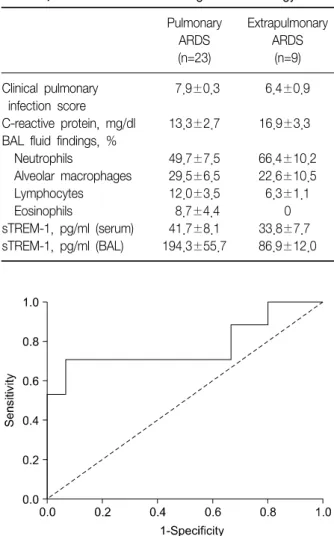
원인에 따른 분류 시 폐성 호흡곤란증후군과 폐외성 호 흡곤란증후군 간의 혈청 또는 기관지폐포세척액에서 측 정한 sTREM-1 의 농도의 차이는 없었다(Table 3). 또한 폐성 호흡곤란증후군에서는 혈청과 기관지폐포세척액과 양의 상관관계 (r=0.692, p=0.000)을 보였지만 폐외성 호 흡곤란증후군은 상관관계(r=−0.586, p=0.097)를 보이지 않았다(Figure 1B).

생존 여부를 판단하는 예후인자로서의 혈청 내 sTREM-1

의 농도를 ROC curve 를 이용하여 분석 시 ROC curve

하의 지역은 0.776 (95% CI: 0.606-0.947, p<0.05)이었다

(Figure 2). sTREM-1 cutoff 값은 33 pg/ml이였고 민감도

와 특이도는 각각 71.0%와 93.0%이었다. 또한 혈청 내

sTREM-1의 농도를 33 pg/ml 기준으로 분류 시 중환자실

사망의 독립적인 예후인자(OR: 22.051, 95% CI: 1.780∼

(4)

Pulmonary ARDS (n=23)

Extrapulmonary ARDS

(n=9) Clinical pulmonary

infection score C-reactive protein, mg/dl BAL fluid findings, % Neutrophils

Alveolar macrophages Lymphocytes Eosinophils

sTREM-1, pg/ml (serum) sTREM-1, pg/ml (BAL)

7.9±0.3 13.3±2.7 49.7±7.5 29.5±6.5 12.0±3.5 8.7±4.4 41.7±8.1 194.3±55.7

6.4±0.9 16.9±3.3 66.4±10.2 22.6±10.5 6.3±1.1

0 33.8±7.7 86.9±12.0

Table 3. sTREM-1 level according to the etiology

Figure 2. Receiver operating characteristics curve for cut-off levels of soluble triggering receptor expressed on myeloid cells (sTREM-1) for prognostic factor. Areas un- der the ROC curve were 0.776 (95% CI, 0.606-0.947, p<0.05) for serum sTREM-1.

Predictor Odds

ratio 95% CI p-value

Serum sTREM-1 level ≥33 pg/ml

White blood cell count Neutrophil count in BAL fluid>60%

22.051 1.000 0.239

1.780∼273.146 1.000∼1.000 0.029∼1.990

0.016 0.416 0.185
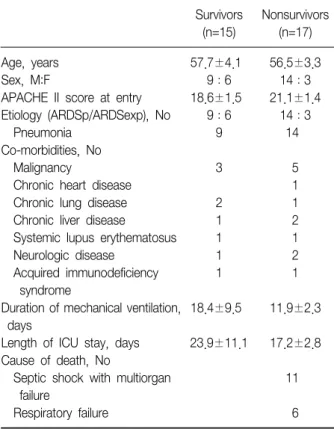
Table 4. Multiple logistic-regression analysis of prognostic factors

273.146, p=0.016)이었다(Table 4).

고 찰

본 연구에서 혈청 sTREM-1의 농도가 급성호흡곤란증 후군 환자의 예후인자로서 유용한 지표임을 확인하였다.

하지만 기관지폐포세척액에서 측정한 sTREM-1의 농도는 예후와 상관관계가 없었다.

혈청 및 기관지폐포세척액에서 sTREM-1의 차이에 대 한 설명을 하기는 어렵다. 급성호흡곤란증후군은 여러 가 지 원인에 의한 급성 폐손상과 전신적 염증 반응으로 다발 성 장기부전을 유발하는 증후군으로 폐 혈관내피세포와

상피세포의 손상에 호중구와 여러 염증성 사이토카인들 이 중요한 역할을 한다

18

. 이런 전신적인 염증 반응에서 가장 중요한 세포인 호중구는 자유기, 염증 매개체, 프로 테아제 등을 생성하여 세포 손상을 유발하여 급성폐손상 의 발생에 중요한 역할은 한다

19,20

. TREM-1은 백혈구, 단 핵구, 폐포대식세포 등의 세포 수용체로 발견되었으며 감 염에 대한 염증 반응시 중요한 역할을 하는 것으로 알려져 있다

7

. 그래서 혈청에서 sTREM-1의 증가 및 중증도와 연 관성이 있음을 설명할 수 있겠다. 급성호흡곤란증후군을 가진 환자의 기관지폐포세척액이나 조직에서 다량의 호 중구의 침윤을 관찰할 수 있으며

19

, 내독소나 과립구-대식 세포집락자극인자(GM-CSF)들은 호중구의 세포자멸사를 지연시키는 것으로 보고되었다

21,22

. 하지만 기관지폐포세 척액에서의 sTREM-1의 농도는 세균성 폐렴에 비해서 낮 음을 보여주며, 중증도와 연관성을 보여주지 못했다. 즉 호중구 활성화에 차이가 있음을 확인할 수 있었다. 향후 전신 및 국소 반응에서의 sTREM-1의 농도 차이에 대한 기전 연구가 필요할 것이다.

기존의 여러 연구들에서 기관지폐포세척액이나 혈장에 서의 sTREM-1의 농도를 측정하여 감염 여부를 진단할 수 있는 지표로서의 유용성을 확인하였다

23-25

. 최근에는 패혈 증 환자들에서 sTREM-1의 농도가 예후와 관련이 있으며 IL-10과 같은 항염증 작용을 가지고 알려져 있다고 보고되

었으며

23,26,27

, 기계환기폐렴이나 지역사회폐렴 환자에서

도 진단 당시의 높은 sTREM-1의 농도가 나쁜 예후와 관련 이 있다고 보고되었다

15,28

. 저자들은 호중구가 활성화되면 TREM-1의 발현이 증가하고 염증반응이 심해지므로, 호흡 곤란증후군 환자의 폐포 내에서 호중구의 활성화가 일어 나면서 염증반응의 증폭에 의한 전신염증반응이 심해질 수록 TREM-1의 수용성 상태인 혈청 내의 sTREM-1의 농 도도 증가할 수 있다고 생각하고 연구를 진행하였다.

본 연구에서 혈청 내 sTREM-1 농도의 cut-off 값을 33

(5)

pg/ml 이상으로 했을 때 급성호흡곤란증후군의 중환자 실 사망률의 예측인자였고 민감도와 특이도는 각각 71.0%와 93.0%이었다. 그리고 기관지폐포세척액과 혈청 에서 각각 측정한 sTREM-1의 농도가 서로 상관관계를 보이기는 하였으나 기관지폐포세척액의 sTREM-1의 농도 단독으로는 예후 인자로써의 의미가 없었다. 이것은 폐 포 내에서의 호중구 활성도만을 반영하는 기관지폐포세 척액의 sTREM-1 농도보다는 혈청 내의 sTREM-1의 증가 된 농도가 증폭된 전신 염증 반응과 다발성 장기부전을 반영할 수 있기 때문에 예후인자로써의 의미가 있을 수 있다는 것을 반영한다. 하지만 sTREM-1은 패혈증 모델에 서 높은 농도로 존재 시 증폭된 염증 반응을 음성되먹임 억제(negative feedback inhibition)할 수 있으므로 호흡 곤란증후군에서도 연속적인 농도 변화와 다른 염증성 사 이토카인들과의 관계를 확인할 필요가 있겠다

8

.

폐손상의 원인에 따라 폐성과 폐외성으로 나누어 sTREM-1 농도를 비교했을 때에는 기관지폐포세척액 이 나 혈청 모두에서 두 군간의 차이는 없었다. 다만, 폐성 호흡곤란증후군에서는 기관지폐포세포세척액과 혈청 내 sTREM-1의 농도가 서로 양의 상관관계를 보였으나 폐외 성 호흡곤란증후군에서는 폐손상이 직접적인 손상보다 는 이차적 손상에 의한 변화 때문인지 서로 상관관계를 보이지는 않았다. 폐손상의 기전을 고려 시

29

폐성 호흡 곤란증후군은 폐포의 대식세포와 호중구가 먼저 자극되 면서 발생하는 폐내 염증 반응의 정도가 전신 염증 반응 의 정도를 결정하는데 비해 폐외성 호흡곤란증후군의 경우, 체순환을 통해 들어온 염증성 인자들이 폐혈관 내 피세포를 먼저 자극하고 폐포 내 호중구를 침윤시키므 로 폐내 국소반응이 전신 반응의 결과물일수 있겠다.

본 연구는 포함된 환자군의 수가 적어서 혈청 sTREM-1 의 농도를 이용한 예후인자 분석 시 신뢰구간이 넓은 경향 을 보였고 예민도(sensitivity)도 낮게 측정되었다. 하지만 급성호흡곤란증후군 환자의 예후 인자로 혈청 내 sTREM-1의 가능성을 보여준 연구로 향후 더 많은 수의 환자를 대상으로 한다면 예후인자로서 sTREM-1의 유용성 을 확립할 수 있을 것이다.

요 약

연구배경: Triggering receptor expressed on myeloid cells-1 (TREM-1)은 호중구와 단핵구의 표면에 표현되는 수용체로 호중구가 자극되면 표면에서 떨어져 수용체인

sTREM-1으로 존재하며 염증반응을 증폭시킨다. 본 연구 는 호중구의 활성화가 중요한 병인인 급성호흡곤란증후 군 환자의 기관지폐포세척액과 혈청에서 측정한 sTREM-1 의 농도가 예후인자로서 유용성이 있는지 확인하고자 시 행되었다.

방 법: 32명의 급성호흡곤란증후군 환자가 포함되었고 이 중 15명이 생존군, 17명이 사망군으로 분류되었다. 중 증도 지표로 APACHE II score, Clinical Pulmonary Infection Score (CPIS)를 측정하였고, 기관지폐포세척액 과 혈청에서 sTREM-1 농도를 측정하였고 중환자실 사망 여부를 확인하였다.

결 과: 진단 시 급성호흡곤란증후군 환자의 혈청 내 sTREM-1의 농도는 사망군에서 생존군 보다 유의하게 상 승되어 있었으나 (54.3±10.3 pg/ml vs. 22.7±2.3 pg/ml, p<0.05) 기관지폐포세척액 내의 sTREM-1의 농도는 차 이가 없었다. 혈청 내 sTREM-1의 농도는 급성호흡곤란증 후군 환자의 예후를 예측할 수 있는 독립적인 인자(OR:

22.051, 95% CI: 1.780∼273.146, p=0.016)이었고, 33 pg/ml 경계로 분류 시 중환자실 사망률을 예측하는데 71%의 민감도와 93%의 특이도를 보였다.

결 론: 급성호흡곤란증후군 환자의 진단 당시 측정한 혈청 sTREM-1의 농도는 중요한 예후 인자로서 유용성이 있을 것으로 생각된다.

참 고 문 헌

1. Abel SJ, Finney SJ, Brett SJ, Keogh BF, Morgan CJ, Evans TW. Reduced mortality in association with the acute respiratory distress syndrome (ARDS). Thorax 1998;53:292-4.

2. Ware LB. Prognostic determinants of acute respiratory distress syndrome in adults: impact on clinical trial design. Crit Care Med 2005;33:S217-22.

3. Adamzik M, Frey U, Sixt S, Knemeyer L, Beiderlinden M, Peters J, et al. ACE I/D but not AGT (-6)A/G poly- morphism is a risk factor for mortality in ARDS. Eur Respir J 2007;29:482-8.

4. Zhang P, Summer WR, Bagby GJ, Nelson S. Innate im- munity and pulmonary host defense. Immunol Rev 2000;173:39-51.

5. Bouchon A, Dietrich J, Colonna M. Cutting edge: in- flammatory responses can be triggered by TREM-1, a novel receptor expressed on neutrophils and monocytes.

J Immunol 2000;164:4991-5.

6. Colonna M, Facchetti F. TREM-1 (triggering receptor

(6)

expressed on myeloid cells): a new player in acute in- flammatory responses. J Infect Dis 2003;187 Suppl 2:S397-401.

7. Bleharski JR, Kiessler V, Buonsanti C, Sieling PA, Stenger S, Colonna M, et al. A role for triggering re- ceptor expressed on myeloid cells-1 in host defense during the early-induced and adaptive phases of the immune response. J Immunol 2003;170:3812-8.

8. Bouchon A, Facchetti F, Weigand MA, Colonna M.

TREM-1 amplifies inflammation and is a crucial media- tor of septic shock. Nature 2001;410:1103-7.

9. Nathan C, Ding A. TREM-1: a new regulator of innate immunity in sepsis syndrome. Nat Med 2001;7:530-2.

10. Cohen J. TREM-1 in sepsis. Lancet 2001;358:776-8.

11. Kollef MH, Bock KR, Richards RD, Hearns ML. The safety and diagnostic accuracy of minibronchoalveolar lavage in patients with suspected ventilator-associated pneumonia. Ann Intern Med 1995;122:743-8.

12. Souweine B, Veber B, Bedos JP, Gachot B, Dombret MC, Regnier B, et al. Diagnostic accuracy of protected specimen brush and bronchoalveolar lavage in nosoco- mial pneumonia: impact of previous antimicrobial treatments. Crit Care Med 1998;26:236-44.

13. Determann RM, Millo JL, Gibot S, Korevaar JC, Vroom MB, van der Poll T, et al. Serial changes in soluble trigger- ing receptor expressed on myeloid cells in the lung dur- ing development of ventilator-associated pneumonia.

Intensive Care Med 2005;31:1495-500.

14. Horonenko G, Hoyt JC, Robbins RA, Singarajah CU, Umar A, Pattengill J, et al. Soluble triggering receptor expressed on myeloid cell-1 is increased in patients with ventilator-associated pneumonia: a preliminary report. Chest 2007;132:58-63.

15. Tejera A, Santolaria F, Diez ML, Aleman-Valls MR, Gonzalez-Reimers E, Martinez-Riera A, et al. Prognosis of community acquired pneumonia (CAP): value of trig- gering receptor expressed on myeloid cells-1 (TREM-1) and other mediators of the inflammatory response.

Cytokine 2007;38:117-23.

16. Artigas A, Bernard GR, Carlet J, Dreyfuss D, Gattinoni L, Hudson L, et al. The American-European Consensus Conference on ARDS, part 2: Ventilatory, pharmaco- logic, supportive therapy, study design strategies, and issues related to recovery and remodeling. Acute respi- ratory distress syndrome. Am J Respir Crit Care Med 1998;157:1332-47.

17. Michel F, Franceschini B, Berger P, Arnal JM, Gainnier M, Sainty JM, et al. Early antibiotic treatment for BAL-con- firmed ventilator-associated pneumonia: a role for routine

endotracheal aspirate cultures. Chest 2005;127:589-97.

18. Bellingan GJ. The pulmonary physician in critical care

* 6: the pathogenesis of ALI/ARDS. Thorax 2002;57:540-6.

19. Weiland JE, Davis WB, Holter JF, Mohammed JR, Dorinsky PM, Gadek JE. Lung neutrophils in the adult respiratory distress syndrome: clinical and pathophysio- logic significance. Am Rev Respir Dis 1986;133:218-25.

20. Chollet-Martin S, Jourdain B, Gibert C, Elbim C, Chastre J, Gougerot-Pocidalo MA. Interactions between neu- trophils and cytokines in blood and alveolar spaces dur- ing ARDS. Am J Respir Crit Care Med 1996;154:594-601.

21. Kurt-Jones EA, Mandell L, Whitney C, Padgett A, Gosselin K, Newburger PE, et al. Role of toll-like re- ceptor 2 (TLR2) in neutrophil activation: GM-CSF en- hances TLR2 expression and TLR2-mediated interleukin 8 responses in neutrophils. Blood 2002;100:1860-8.

22. Dibbert B, Weber M, Nikolaizik WH, Vogt P, Schoni MH, Blaser K, et al. Cytokine-mediated Bax deficiency and consequent delayed neutrophil apoptosis: a general mechanism to accumulate effector cells in inflammation.

Proc Natl Acad Sci U S A 1999;96:13330-5.

23. Gibot S, Kolopp-Sarda MN, Bene MC, Cravoisy A, Levy B, Faure GC, et al. Plasma level of a triggering receptor expressed on myeloid cells-1: its diagnostic accuracy in patients with suspected sepsis. Ann Intern Med 2004;

141:9-15.

24. Gibot S, Cravoisy A, Levy B, Bene MC, Faure G, Bollaert PE. Soluble triggering receptor expressed on myeloid cells and the diagnosis of pneumonia. N Engl J Med 2004;350:451-8.

25. Huh JW, Lim CM, Koh Y, Oh YM, Shim TS, Lee SD, et al. Diagnostic utility of the soluble triggering re- ceptor expressed on myeloid cells-1 in bronchoalveolar lavage fluid from patients with bilateral lung infiltrates.

Crit Care 2008;12:R6.

26. Gibot S, Cravoisy A, Kolopp-Sarda MN, Bene MC, Faure G, Bollaert PE, et al. Time-course of sTREM (soluble triggering receptor expressed on myeloid cells)-1, pro- calcitonin, and C-reactive protein plasma concentrations during sepsis. Crit Care Med 2005;33:792-6.

27. Giamarellos-Bourboulis EJ, Zakynthinos S, Baziaka F, Papadomichelakis E, Virtzili S, Koutoukas P, et al.

Soluble triggering receptor expressed on myeloid cells 1 as an anti-inflammatory mediator in sepsis. Intensive Care Med 2006;32:237-43.

28. Routsi C, Giamarellos-Bourboulis EJ, Antonopoulou A,

Kollias S, Siasiakou S, Koronaios A, et al. Does soluble

triggering receptor expressed on myeloid cells-1 play

any role in the pathogenesis of septic shock? Clin Exp

(7)

Immunol 2005;142:62-7.

29. Pelosi P, D'Onofrio D, Chiumello D, Paolo S, Chiara G, Capelozzi VL, et al. Pulmonary and extrapulmonary

acute respiratory distress syndrome are different. Eur

Respir J Suppl 2003;42:48s-56s.

수치

Table  1.  Baseline  characteristics  of  patients  with  ARDS
Figure  2.  Receiver  operating  characteristics  curve  for  cut-off levels of soluble triggering receptor expressed on myeloid cells (sTREM-1) for  prognostic factor

참조

관련 문서

In addition, isorhamnetin or N-acetyl-1-cysteine (NAC) inhibited over-expressed HIF-1a in HEK293 cells, which implied anti-oxidant activity of isorhamnetin

Gene set enrichment analysis (GSEA) of differentially expressed genes(DEGs) on human gingival fibroblast (HGF) cells in pullulan + NaF-PVA tape

In the analysis of soluble solids, the treatment group with material grains and the combined groups of glutinous millet and barley appeared high, and

Frequency and clinical significance of the expression of the multidrug resistance proteins MDR1/P-glycoprotein, MRP1, and LRP in acute myeloid leukemia: a

Activating mutation in the tyrosine kinase JAK2 in polycythemia vera, essential thrombocythemia and myeloid metaplasia with myelofibrosis.. A gain-of-function

4 > Effects of Taro on COX-2 expression and iNOS expression(hot water) in human thyroid cancer cells. The cells were pretreated for 48hours with either

Serum uric acid levels and risk for vascular disease in patients with metabolic syndrome... Prevalence if the metabolic syndrome in a Turkish

Figure.11 1 1 1.The cell growth, soluble glucan producti .The cell growth, soluble glucan producti .The cell growth, soluble glucan producti .The cell growth, soluble glucan