• 검색 결과가 없습니다.

Studies on Color Fastness of Machine-Made Hanji for the Long-Term Storage of Public Records

N/A
N/A
Protected

Academic year: 2021

Share "Studies on Color Fastness of Machine-Made Hanji for the Long-Term Storage of Public Records"

Copied!
10
0
0

로드 중.... (전체 텍스트 보기)

전체 글

(1)

공공기록물 장기보존용 기계한지의 색상 안정성 연구

정소윤·백소라

1

·김형진

접수일(2019년 7월 16일), 수정일(2019년 8월 5일), 채택일(2019년 8월 8일)

Studies on Color Fastness of Machine-Made Hanji for the Long-Term Storage of Public Records

So-Yoon Jung, So-Ra Back

1

and Hyoung-Jin Kim

Received July 16, 2019; Received in revised form August 5, 2019; Accepted August 8, 2019

ABSTRACT

Most conservation papers used for the management of domestic records are mainly imported products, which are made of chemical, mechanical, and recycled pulps with various types of organic and inorganic additives. In this study, different colors as per their importance and conservation period were applied to machine-made Hanji papers used for the long-term storage of the public records. In addition, the stabilities of the different colors from the selected pigments for conservation paper products were analyzed.

Additionally, the optimal conditions of adding pigments and additives on colored Hanji paper made from Dak pulp (80%) and SwBKP (20%) for use in conservation were examined.

As a result, yellow, blue, white and black pigments showed low color transferability, while gray colored Hanji paper made from mixing white and black pigments showed excellent color fastness. Meanwhile, the colored Hanji paper made with red pigments showed high transferability and poor color fastness. Hanji paper without any pigments also showed transferability and color fastness, but inferior to that produced with red pigments.

Therefore, the study concludes by affirming that the mixed compositions, which consist of yellow, blue and black, with no red pigment but high whiteness and low chrome would be ideal on the machine-made Hanji paper for the long-term storage of public records.

Keywords: Machine-made Hanji, public document, long term storage, pigment, dyes, coloration fastness

Printed in Korea http://dx.doi.org/10.7584/JKTAPPI.2019.08.51.4.51

• 국민대학교 문화재보존학과(Department of Conservation of Cultural Heritage, Kookmin University, Seoul, 02707, Republic of Korea) 1 국민대학교 임산생명공학과(Department of Forest Products & Biotechnology, Kookmin University, Seoul, 02707, Republic of Korea)

† 교신저자(Corresponding Author): E-mail: [email protected]

(2)

1. 서 론

우리나라는 공공기록물 관리에 관한 법률[법률 제 14613호, 2017. 3. 21., 일부개정], 정부산하공공기관 기 록물관리 지침[국가기록원지침, 2016. 1. 7., 제정] 및 대 통령기록물 관리에 관한 법률[법률 제10009호, 2010. 2.

4., 일부개정] 등에 따라 기록물의 범위가 크게 확대되었 으며, 또한 대량의 기록물을 보존, 보관하기 위한 시스템 구축이 체계화되었다. 기록물을 보존, 보관하기 위해서 는 기록물 자체의 보관 환경도 중요하지만 기록물을 포 장하고 외부의 유해환경으로부터 일차적으로 막아주는 보존상자, 폴더, 표지, 봉투와 같은 보존용품의 특성도 매우 중요하다.

1-4)

국내에서 기록물 관리에 사용하는 대부분의 보존용지 및 보존용품은 목재펄프 기반의 수입 제품이 주종을 이 루고 있다. 또한 화학펄프, 기계펄프 및 재생펄프 등의 섬유 원료 등도 사용되고 있으며 다양한 종류의 유, 무기 첨가제들도 포함되어 있다. 기록물의 장기보존 특성에 있어 검증되지 않은 원료의 사용과 제조공정에 따라 제조 된 보존용품은 기록물의 장기보존 및 관리에 있어 문제 점을 야기할 수도 있다. 따라서 세계기록유산을 다수 보유 하고 있는 우리나라는 기록보존 국가로서의 세계적 위상 을 높이기 위한 우리 고유의 보존용품을 개발할 필요가 있다. 이에 국가적으로 상징성을 유지하는 재질 및 디자 인을 적용한 보존용품 시생산 연구가 수행된 바 있다.

이전 연구에서는 한국 고유의 문화적 특성을 갖춘 공공 기록물의 보존용품을 모델링하였으며, 한지 소재의 장점을 적용하기 위해 닥섬유 기반의 보존용품을 개발하였다.

이를 위해 파일럿 초지기를 이용하여 국내산 닥섬유 80%와 SwBKP 20%를 혼합한 기계한지를 시험생산하 였다.

5)

닥섬유를 사용하여 개발한 문서표지의 화학적 특성으 로서 섬유의 분자량 및 중합도가 높았으며, 섬유장이 긴 닥나무 인피섬유로 제조했기 때문에 목재펄프를 사용한 보존용품보다 물리적 강도와 보존성이 우수한 결과를 나 타냈다.

6-8)

그러나 이들 보존용품은 단일 색상으로만 제조했기 때문에 그 자체로서는 보존문서의 특성을 구분 하기는 어려웠다. 따라서 보존용품의 색상을 달리하여 제조할 경우 기록물의 특성, 중요도 및 보존 기간에 따라 다르게 적용할 경우 문서의 보존과 관리가 보다 수월해 질 것으로 기대된다.

현재 시판되고 있는 색한지의 경우 합성 화학염료와 매 염제를 사용하고 있어서 시간 경과 및 보존환경 조건에 따라 색지의 원색이 변색 또는 퇴색될 수도 있다. 또한 환경조건에 따라 색지로부터 표지 내부의 기록물에 이염 이 야기 될 가능성도 존재한다. 따라서 천연계 또는 합성 염료 및 안료를 엄격하게 선정하고, 이들의 채색 안정성 연구를 통해 문서표지용 기계한지

9-11)

에 적용하고자 하 였다.

본 연구에서는 공공기록물의 특성, 중요도 및 보존 기 간에 따라 한국적 고유 색채를 적용하여 기록물의 종류 별·등급별 관리에 있어 효율성을 향상시키고자 장기보 존용 기계한지에 채색 특성을 적용하였으며, 제지용 안 료의 선정 및 적용에 따른 채색 안정성을 분석하였다.

이러한 조건으로서 닥섬유 80%와 SwBKP 20%를 혼합 한 보존용 색지 제조를 설계하였으며, 제지용 안료와 화학 첨가제를 탐색하여 보존용품으로서의 기본 요건을 검토

하였다.

12,13)

또한 공공기록 장기보존 문서표지용 기계한

지에 적합한 채색 기술 및 안정성을 확보하고자 안료의 이염 특성 및 견뢰도 분석을 통해 기계한지 제조에 적용 할 최적 안료를 선정하였다.

14-20)

2. 재료 및 방법

2.1 공시 재료

2.1.1 섬유 원료

본 연구에서는 장기보존용 기계한지를 제조하기 위해 섬유 원료로서 국내 A사에서 분양받은 수입 닥섬유와 침 엽수표백크라프트 펄프(SwBKP)를 사용하였으며, 원지 제조 시 혼합 비율은 80%:20%로 설정하였다.

특히 증해 및 표백이 완료된 수입 닥섬유의 경우 시트

제조에 따른 수지반점이 발생할 가능성이 크므로 저농도

의 알칼리를 이용하여 정련 처리하여 섬유에 함유된 불

순물을 제거하였다. 정련 처리는 수입 닥섬유를 칼 비터

를 사용하여 고해한 후 환비터로 해리를 실시하는 동시

에 수산화나트륨(NaOH, DAEJUNG, Korea)으로 활성

알칼리(active alkali) 농도 5% 조건에서 전건섬유 대비

0.01%를 첨가하였으며, 정련 처리 후 물로 세척하여 사용

하였다.

(3)

2.1.2 안료 및 기타 첨가제

기계 색한지 제조에 사용한 안료 및 기타 첨가제의 종류 및 특성을 Table 1에 나타냈다.

2.2 실험 방법

2.2.1 안료 배합조건에 따른 채색한지 제조

기계 색한지 제조를 위한 선행 연구로서 수초지를 활용 한 주·부원료의 특성을 분석하였다. 수입 닥섬유 80%와 SwBKP 20%를 혼합한 섬유 원료에 적색, 황색, 청색, 흑색, 백색 계열의 안료를 사용하여 단색 또는 혼색으로 조합하였으며 평량 80 g/m

2

의 색상에 따른 수초지를 제조하였다. 수초지를 제조하기 위한 주·부원료의 첨가 조건은 Table 2와 같다.

2.2.2 채색한지의 색 분석

안료 배합조건을 달리하여 제조한 수초지의 색상을 분석 하기 위해 Elrepho(L&W, Sweden)를 사용하여 L

*

, a

*

, b

*

value를 측정하였으며, Spectrophotometer(CM-2500d, KONICA MINOLTA, Japan)를 사용하여 R, G, B 및

Munsell 값을 측정하였다.

2.2.3 채색한지의 보존문서로의 색 전이 특성 분석

장기보존용 기계 색한지에 보관된 기록물의 색 전이 가 능성을 평가하기 위해 color & dye bleed/transfer (NARA) 시험과 견 이염성 실험을 하였다.

Color & dye bleed/transfer 시험은 색상별 수초지의 적정량을 증류수 또는 에탄올에 48h 동안 침지한 후 UV-vis(UV-Visible Spectroscope, Korea)를 사용하 여 색 용출 여부를 판단하였다. 또 다른 이염성 분석으로 물에 대한 color fastness(AATCC Test Method 107- 2002)를 실시하였다. 견에 대한 이염성 실험으로 색한지 의 이염성 분석과 동일한 방법을 적용하여 이염 분석을 실시하였으며, 실험 과정을 Fig. 1에 나타냈다.

수분에 의한 color fastness 시험 전·후의 여과지에 대 한 L

*

, a

*

, b

*

value를 측정하여 Eq. 1에 따라 △E를 산 출하였다.

∆ = E ( L L

0

1

)

2

+ ( aa ) + ( b b − )

0 1 2

0 1 2

[1]

Table 2. Conditions of chemical additives

Fibers Mulberry 80%+SwBKP (550 mL-CSF) 20%

Additives

Fixing agent Mirafix 700A liq. 3% on pigment

Pigment Mixing pigment liq. 3% on weight of oven dried pulp Filler GCC 6% on weight of oven dried pulp

Dispersing agent PAM 2% on weight of oven dried pulp Sizing agent AKD 1% on weight of oven dried pulp Table 1. Characteristics of additives

Additives Con., % Maker

Fixing agent Mirafix 700A liq. 40

M Co., Korea Pigment

Mirarene Red B liq. 15.4

Mirarene Yellow GS liq. 15.4 Mirarene Blue HS liq. 45 Mirarene White TO liq. 50 Mirarene Black NCN liq. 30

Filler GCC - O Co., Korea

Deaeration agent - - S Co., Korea

Dispersing agent PAM - S Co., Korea

Sizing agent AKD 100 L Co., Korea

(4)

where,

L

0

, a

0

, b

0

: L

*

, a

*

, b

*

value of filter paper before color fastness test

L

1

, a

1

, b

1

: L

*

, a

*

, b

*

value of filter paper after color fastness test

2.2.4 채색 수초지의 견뢰도 분석

기록물 장기보존용 기계 색한지의 견뢰도를 분석하고 자 UV-illuminator를 사용하여 30h, 60h 동안 UV 열 화를 실시하였다. UV 열화에 사용된 램프는 주로 플라스 틱, 도료, 고무 등의 내구성 실험 및 감별, 조사 등에 이 용되는 UV-B(280-315 nm) 램프와 자외선(306 nm) 램프를 사용하였다. 이후 기계 색한지의 L

*

, a

*

, b

*

value 를 측정하여 Eq. 1에 따라 UV 열화 전후의 △E를 계산 하였다.

3. 결과 및 고찰

3.1 안료 배합에 따른 채색 한지의 색 정보

선정한 안료를 사용하여 단색 또는 혼색으로 색 조합 하여 제작한 색상별 수초지의 색 정보를 측정하였으며, 그 결과를 Tables 3-6에 나타냈다. Table 3의 결과에서 와 같이 red 안료에 yellow 안료의 첨가량을 증가할수록 먼셀 표색계 색상환 기준으로 빨강(R)에서 주황(YR)으 로 변했으며, 명도는 높아지고, 채도는 낮아지는 경향을

보였다. 반면 red 안료에 유색 안료가 아닌 black 안료의 첨가량을 늘릴수록 색상은 검은색에 가깝게 변했고, 명 도와 채도는 낮아지는 경향을 보였다. 이와 마찬가지로 각 색상 종류별 안료 배합조건에 따라 유색 안료를 혼합 할 경우 색상은 먼셀 표색계 색상환 기준으로 변하며, 명 도는 높아지고 채도가 낮아지는 경향을 나타냈다. Gray 안료나 black 안료를 혼합하면 색상은 무채색에 가까워 지며, 명도와 채도는 낮아지는 경향을 보였다.

3.2 채색 수초지의 색상에 따른 이염 특성

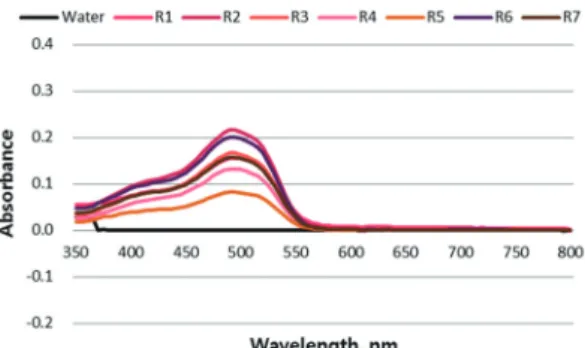
채색 수초지를 색상에 따라 증류수에 48h 동안 용출 분석을 하였으며, 그 결과를 Figs. 2-5에 나타냈으며, 에탄올 용출한 결과는 Figs. 6-9에 나타냈다. 안료 적용 에 따른 수초지의 이염 특성을 분석한 결과, 증류수 조건 보다 에탄올 조건에서 더 많은 용출이 발생하였으며, 전반적으로 용출 용매와 관계없이 red 계열과 violet 계 열의 색상에서 이염 특성이 높게 나타났다. 즉 red 안료 혼합 시 이염 특성이 높은 것으로 판단되었다.

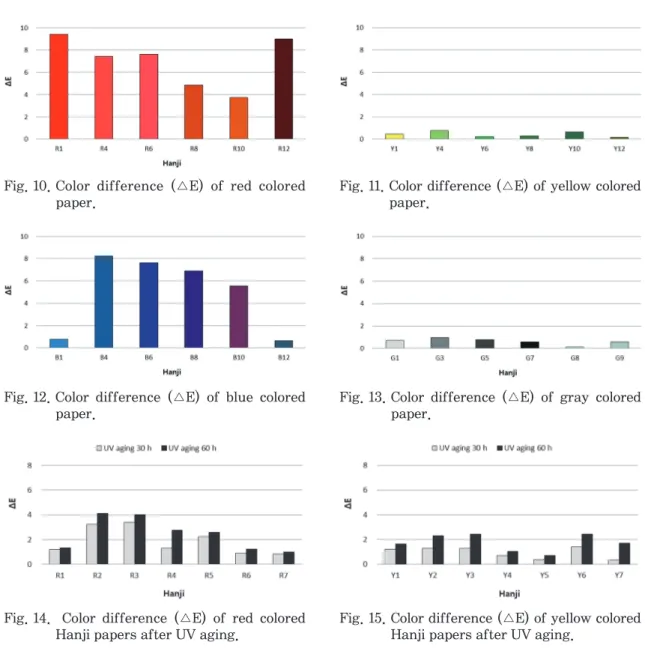
물에 대한 color fastness 시험 결과를 Figs. 10-13에

나타냈다. Fig. 10과 Fig. 11에서와 같이 red 계열의 안

료를 적용하여 한지를 제조할 경우 색한지에 의한 기록

물로의 이염 가능성이 높으며, yellow 계열의 안료를 적

용할 경우 이염 가능성은 낮은 것으로 판단된다. 또한,

Fig. 12에서와 같이 100%의 blue 안료로만 초지한 B1

조건과 blue 안료와 black 안료를 혼합하여 초지한 B6

조건과 겹친 여과지의 △E 값은 yellow 계열 안료와

Fig. 1. Testing methodology for color fastness to water.

(5)

Table 3. Coloration of machine-made Hanji papers by red type colors

Color Color mixing condition L

*

, a

*

, b

*

R, G, B Munsell HV/C

Red 100%

50.64 0.21

8.95RP 4.51/12.06

45.23 1.14

4.44 0.84

Red 80%+Yellow 20%

50.93 0.21

1.90R 4.53/11.56

42.63 1.12

11.03 0.97

Red 60%+Yellow 40%

53.47 0.19

4.50R 4.77/10.98

40.01 1.02

17.27 1.05

Red 40%+Yellow 60%

55.81 0.16

7.25R 5.07/10.73

37.64 0.92

23.79 1.11

Red 20%+Yellow 80%

63.03 0.11

0.95YR 5.86/9.77

29.86 0.69

32.48 1.05

Red 80%+Black 20%

34.98 1.06

0.10R 2.21/4.34

11.94 1.62

0.06 1.37

Red 40%+Black 60%

31.29 1.53

3.45R 1.57/0.98

2.69 1.75

0.58 1.68

Table 4. Coloration of machine-made Hanji papers by yellow type colors

Color Color mixing condition L

*

, a

*

, b

*

R, G, B Munsell HV/C

Yellow 100%

89.78 0.06

6.65Y 8.84/11.52

-9.10 0.11

N/A 1.03

Yellow 80%+Blue 20%

64.55 0.60

8.20GY 6.09/6.71

-25.92 0.37

27.59 0.93

Yellow 60%+Blue 40%

49.00 1.06

1.25G 4.30/7.29

-23.32 0.66

17.14 1.27

Yellow 40%+Blue 60%

46.14 1.18

6.05G 3.92/5.98

-23.00 0.77

5.95 1.11

Yellow 20%+Blue 80%

45.12 1.19

6.55BG 3.82/4.57

-15.00 0.84

-5.06 0.91

Yellow 80%+Black 20%

49.30 0.85

0.30GY 4.23/3.66

-5.77 0.85

18.87 1.30

Yellow 40%+Black 60%

36.57 1.33

1.55GY 2.52/1.23

-1.60 1.32

3.64 1.46

(6)

Table 5. Coloration of machine-made Hanji papers by blue type colors

Color Color mixing condition L

*

, a

*

, b

*

R, G, B Munsell HV/C

Blue 100%

49.25 1.05

4.35PB 4.35/9.27

2.56 0.82

-32.88 0.45

Blue 80%+Red 20%

41.87 1.17

6.65PB 3.33/5.97

5.65 1.08

-20.24 0.72

Blue 60%+Red 40%

35.45 1.26

9.80PB 2.49/5.95

9.95 1.39

-16.64 0.92

Blue 40%+Red 60%

36.81 1.10

5.80P 2.49/5.66

13.31 1.47

-12.02 1.01

Blue 20%+Red 80%

38.77 0.80

1.05RP 3.16/6.23

19.81 1.31

-8.52 0.91

Blue 80%+Black 20%

40.43 1.20

9.45B 3.16/1.49

-1.56 1.10

-4.65 1.05

Blue 40%+Black 60%

32.41 1.59

9.60B 1.82/0.45

-0.28 1.55

-0.88 1.53

Table 6. Coloration of machine-made Hanji papers by gray type colors

Color Color mixing condition L

*

, a

*

, b

*

R, G, B Munsell HV/C

Not addition

96.35 0.10

9.70Y 9.01/0.17

-0.67 0.11

4.24 0.12

White 95%+Black 5%

61.67 0.55

9.80YR 5.80/0.18

0.12 0.56

1.08 0.57

White 80%+Black 20%

42.71 1.05

8.20YR 3.46/0.11

0.26 1.06

0.49 1.07

White 40%+Black 60%

34.14 1.42

5.75YR 2.21/0.11

0.16 1.44

0.39 1.45

Black 100%

31.81 1.61

2.10YR 1.62/0.08

0.10 1.62

0.20 1.62

White 96%+Blue 3%

+Black 1%

72.26 0.41

9.65B 6.97/2.39

-3.68 0.34

-7.10 0.31

White 90%+Blue 5%

+Black 5%

59.19 0.63

8.60B 5.54/1.06

-1.84 0.58

-3.05 0.57

(7)

Fig. 3. Absorbance differences of extracts from yellow colored paper by distilled water.

Fig. 2. Absorbance differences of extracts from red colored paper by distilled water.

Fig. 5. Absorbance differences of extracts from gray colored paper by distilled water.

Fig. 4. Absorbance differences of extracts from blue colored paper by distilled water.

Fig. 6. Absorbance differences of extracts from

red colored paper by ethanol. Fig. 7. Absorbance differences of extracts from yellow colored paper by ethanol.

Fig. 8. Absorbance differences of extracts from

blue colored paper by ethanol. Fig. 9. Absorbance differences of gray colored

paper by ethanol.

(8)

유사한 결과를 나타냈다. 반면에 blue 안료에 red 안료 를 혼합하여 초지한 B2, B3, B4 및 B5 조건과 겹친 여과 지의 △E는 red 계열 안료의 결과와 유사하게 나타났다.

White 안료에 black 안료를 혼합하여 초지한 G1, G2, G3 및 G4 조건과 whtie, black, blue를 적절하게 혼합 하여 초지한 G5, G6 조건은 안료의 이염성이 낮은 것으 로 판단되었다(Fig. 13). 즉, red 안료 혼합 시 이염성이 높은 것을 확인할 수 있었다.

3.3 색상에 따른 수초지의 견뢰도 특성

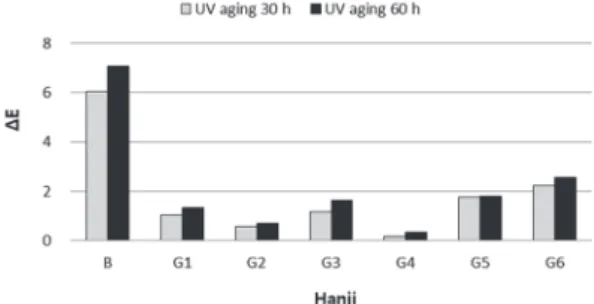
UV 열화에 의한 채색 색상별 수초지의 견뢰도를 분석 한 결과를 Figs. 14-17에 나타냈다. 결과에서와 같이 red 계열의 안료를 적용한 수초지의 견뢰도가 가장 낮았 으며, yellow, blue 계열의 △E는 유사한 결과를 보였 다. 반면 gray 계열의 수초지 견뢰도는 다른 안료에 비해 높은 안정성을 지니는 것으로 판단되었다. Fig. 17에 나타 낸 B 시료는 안료를 적용하지 않은 수초지이며, UV 열화 후 △E의 안료를 적용한 수초지에 비해 많은 색 변화를 나타냈다.

Fig. 14. Color difference (△E) of red colored Hanji papers after UV aging.

Fig. 15. Color difference (△E) of yellow colored Hanji papers after UV aging.

Fig. 10. Color difference (△E) of red colored paper.

Fig. 11. Color difference (△E) of yellow colored paper.

Fig. 12. Color difference (△E) of blue colored paper.

Fig. 13. Color difference (△E) of gray colored

paper.

(9)

4. 결 론

보존문서의 종류 및 특성별 분류, 보존, 보관을 위한 기 록문서의 장기보존용 채색한지 소재의 보존용품을 제조 하기 위해 이염 특성은 낮고 견뢰도가 우수한 기계한지를 제조하고자 다양한 색의 안료 적용 조건을 탐색하였으며, 그 결과는 다음과 같다.

1. Yellow, blue, white, black 색상의 안료는 이염성이 낮았으며, 견뢰도는 white와 black을 혼합하여 초지한 gray 계열의 색한지가 가장 우수한 특성을 나타냈다.

2. Red 계열 안료를 적용한 색한지는 이염 특성은 높았 으며, 상대적으로 견뢰성도 낮았다.

3. 색을 적용하지 않은 한지의 견뢰도는 red 계열의 색한지보다 낮게 나타났다.

4. 기록물 장기보존용 기계한지에 색상을 적용할 경우 red 계열의 안료는 혼합하지 않는 것이 타당하다고 판단되며, 상대적으로 특정 색을 디자인할 경우 yellow, blue, black 안료를 색 조합하여 명도가 높 고 채도가 낮은 yellow, gray 계열을 적용하는 것이 바람직하다고 판단된다.

사 사

본 연구는 2016년도 안전행정부 국가기록원의 기록보 존기술 연구개발 사업의 일환으로 ‘문서표지용 기계한지

채색 적합성 평가’ 사업에서 연구비 지원을 받아 수행하 였습니다.

Literature Cited

1. Shon, H. K., Investigation and improvement of the preservation environment for paper records, Journal of Korean Library and Infor- mation Science Society 31(3):213-241 (2000).

2. Seo, Y. B., Development of corrugated boxboard for conservation of document archive, R&D Project Report, Chungnam University Industry Academic Cooperation Foundation, TRKO201100006132 (2009).

3. Kim, J. J., Kim, Y. W., Jung, S. Y., and Seo, Y. B., Study on aging characteristics and development of archives preservation box, Proceeding Spring Conference of the Korea TAPPI, pp.193-199 (2009).

4. Lim, Y. J., Actual condition in a important records of preservation box: Focused on national archives of Korea, Master’s Thesis, Joong-bu University (2009).

5. Kim, H. J., Development of long-term conser- vational machine-made Hanji for archives management, R&D Project Report, Kookmin University Industry Academic Cooperation Foundation (2016).

6. Jeong, S. H., A study on manufacturing tech- Fig. 16. Color difference (△E) of blue colored

Hanji papers after UV aging.

Fig. 17. Color difference (△E) of gray colored

Hanji papers after UV aging.

(10)

nologies and excellence of Korean traditional paper, Journal of Cultural Heritage Studies 48(1):96-131 (2015).

7. Memon, A., Ithisoponakul, S., Pramoonmak, S., Lawsuriyonta, M., Leenoi, D., and Passadee, N., A development of laminating mulberry paper by biodegradable films, Energy Procedia 9:598-604 (2011).

8. Jung, S. Y., The study about the preservation of the paper of mulberry, Journal of Korean Society of Archives and Records Management 4(2):1-22 (2004).

9. Kang, H. J., Kwon, O. H., Kim, J. G., Kim, Y.

U., and Jung, W. Y., Physical properties of the thin paper based of machine-made Hanji of fiber, Proceeding Spring Conference of the Korea TAPPI, p. 69 (2014).

10. Kwon, O. H. and Kim, H. C., Studies on phys- ical properties and printability of machine- made Hanji made by different contents of paper mulberry, Journal of Korea TAPPI 44(2):1-7 (2012).

11. Kwon, O. H., and Kim, H. C., Preservation and printability property of machine-made Hanji by different contents of paper mulberry, Journal of Korea TAPPI 45(3):1-8 (2013).

12. Lim, G. H. and Choi, T. H., The effects of the cutting length of paper mulberry bast fiber on pulping and Hanji properties(I) -White bast of Korea grown paper mulberry-, Journal of Korea TAPPI 40(2):57-64 (2008).

13. Lee, S. H. and Choi, T. H., Development of high viscosity pulping method for Korean paper(Ⅰ) -Atmospheric pressure pulping

characteristics of paper mulberry white bast-, Journal of Korea TAPPI 42(2):57-65 (2011).

14. Lee, J. H., Kwang, M. H., Lee, K. B., and Lee, Y., Characterization of natural dyes and tra- ditional Korean silk fabric by surface ana- lytical techniques, Journal of Materials 6(5):2007-2025 (2013).

15. Manpreet, K. and Sangita, S., Dyeing of silk with Rosa centifolia: An eco-friendly approach, Internation Conference on inter Disciplinary Research in Engineering and Technology, New Delhi, India, Vol. 1, pp. 43-46 (2015).

16. Yoon, S. R. and Kim, H. J., Manufacturing of color Hanji using bast fibers stained dyed by two reactive dyes, Journal of Korea TAPPI 34(4):44-50 (2002).

17. Kim, G. H. and Lim, H. A., Properties of Hanji with natural pigment dyeing for use as a fash- ion material, The Research Journal of the Costume Culture 22(2):339-345 (2014).

18. Yoo, S. I., Cho, Y. K., and Choi, T. H., Dyeing of chemically modified Hanji with natural dyes, Proceeding of Fall Conference of the Korea TAPPI, pp. 243-249 (2011).

19. Yoo, S. I., Park K. M., and Choi T. H., Effect of goldthread and silver nitrate on colors and permanence of Hanji, Proceeding of Fall Conference of the Korea TAPPI, pp. 223-228 pp.223-228 (2012).

20. Choi, T. H., Lee S. H., Shin E. J., and Oh S.

K., Reproduction technology development of

traditional Korean paper, Proceeding of Spring

Conference of the Korea TAPPI, pp. 204-209

(2008).

수치

Table 2. Conditions of chemical additives
Table 4. Coloration of machine-made Hanji papers by yellow type colors
Table 6. Coloration of machine-made Hanji papers by gray type colors
Fig. 5.  Absorbance differences of extracts from  gray colored paper by distilled water.
+3

참조

관련 문서

 IR color (Yellow filter used to eliminate blue and create IR color (or false-color infrared) of 05-1.0 m, or green, red, and IR).  4 bands (blue, green,

• 6 DIMMs: Supports six (6) modules inserted into four drak gray slots and one pair of black slots as three pairs of Quad-channel memory configurations. Install the modules

white 아메리우카나 ameaucaina black 아메리우카나 ameraucana 나고야 Nagoya - 코친 Cochin.. 레그혼 leghorn rhode island

I examine the ways in which slavery damages human sensibility while destroying everyday lives of both black and white people such as Sethe, protagonist of

As a result of performing a compound exercise of spinning and Zumba for 8 weeks, the change in α-amylase showed a significant difference in the exercise group (p<.01), and

Therefore, this research is trying to deal with investigation on color status and problem of usage of color status on street furnitures installed in city

As the results from this study, it proved the usefulness of color psychological counseling through the effect of color stimuli on brain waves to

Because a car black box device saves information about situations that occur while a car in question with the on-board black box travels to allow analysis of car accidents