Copigments 처리에 의한 검정콩 안토시아닌 추출물의 저장 안정성
지영미1․김민영1․이상훈1․장귀영1․윤나라1․김은희1․김경미2․이준수1․정헌상1
1충북대학교 식품생명공학과
2농촌진흥청 국립농업과학원
Storage Stability of Anthocyanin Extracted from Black Bean (Glycine max Merrill.) with Copigments Treatment
Yeong Mi Ji1, Min Young Kim1, Sang Hoon Lee1, Gwi Yeong Jang1, Nara Yoon1, Eun Hee Kim1, Kyung Mi Kim2, Junsoo Lee1, and Heon Sang Jeong1
1Department of Food Science and Biotechnology, Chungbuk National University
2Department of Agrofood Resources, National Academy of Agricultural Science, Rural Development Administration
ABSTRACT Effects of copigments (succinic acid, Cu2+, ascorbic acid, sucrose, and pH) on stability of anthocyanin extracted from black beans (Glycine max Merrill.) were investigated during storage for 8 days at 4 and 40°C. Succinic acid improved stability of anthocyanin by 7∼15% compared to the non-treatment group at 40°C. Cu2+ maintained stability of anthocyanin by about 100% for 8 days at 4°C. Ascorbic acid reduced stability of anthocyanin by 64∼72%
of non-treatment at 40°C. Sucrose treatment did not significantly affect stability compared to the control. The lower pH improved stability of anthocyanin. Stability at pH 1 was improved by 81∼87% compared to that at pH 7. These results show that temperature, organic acid, and pH were effective in improving storage stability of anthocyanin from black beans.
Key words: black bean, anthocyanin, storage stability, copigmentation
Received 3 March 2016; Accepted 3 June 2016
Corresponding author: Heon Sang Jeong, Department of Food Science and Biotechnology, Chungbuk National University, Cheongju, Chungbuk 28644, Korea
E-mail: [email protected], Phone: +82-43-261-2570
서 론
안토시아닌은 식물체의 적색, 자색 및 청색을 나타내는 수용성 flavonoid계 색소로 자연계에 다양한 종류와 많은 양이 존재하며, 적자색의 천연색소로서 합성색소를 대체할 수 있는 잠재력이 가장 높은 적색색소이다(1). 그러나 안토 시아닌은 구조적으로 매우 불안정한 oxonium 화합물로서 (2,3) 조리, 가공 및 저장조건에서의 불안정성(4) 때문에 색 소로의 이용에 많은 문제를 안고 있다. 안토시아닌 색소의 안정성에 영향을 미치는 인자로는 pH, 온도, 유기산, ascor- bic acid, 당류, 금속이온과 copigment 등이 있으며, 안토시 아닌 색소를 천연 식용색소로 이용하기 위해서는 안토시아 닌 색소에 미치는 인자들의 영향을 규명하는 것이 필요하다 (5).
Copigmentation은 안토시아닌 색소에 tannins, flavo- noids, polyphenols, alkaloids 및 amino acids 등을 첨가하 여 안토시아닌 분자가 이들과 함께 복합체를 이루어 색소를
안정화하는 방법이다(6). Copigmentation이 되면 안토시아 닌이 물 분자에 의해 수화되는 것을 막아주게 되는데, 이것 은 copigment와 물 분자가 경쟁적으로 flavylium 양이온 주위에 존재하기 때문이다(7). 가장 효과적인 copigment는 평면구조에 π-전자가 많은 구조를 가지고 있으며, 쌍극자- 쌍극자 상호작용과 수소결합을 할 수 있어 안토시아닌과 복 합체를 형성하였을 때 안토시아닌의 안정성과 색을 증진할 수 있다(8). 최근 안토시아닌 색소 안정성을 증진하기 위한 방안으로 유기산을 이용해 pH를 낮추거나(9) 금속염을 첨 가하는 방법(10), copigmentation에 의한 방법(11) 등의 연 구가 보고되었다.
본 연구에서는 적색 천연 색소원인 검정콩으로부터 안토 시아닌 색소를 추출하여 새로운 천연 식용 색소원으로 개발 하기 위한 연구의 일환으로 검정콩 색소의 안정성에 영향을 미치는 유기산(succinic acid), 금속이온(Cu2+), ascorbic acid, 당(sucrose) 및 pH에 대한 영향을 조사하였다.
재료 및 방법
실험재료
본 연구에 사용한 검정콩은 청자 3호(Glycine max Mer- rill.)로서 농촌진흥청에서 분양받아 사용하였다. 검정콩은
4°C
4°C (+Succinic acid) 40°C
40°C (+Succinic acid)
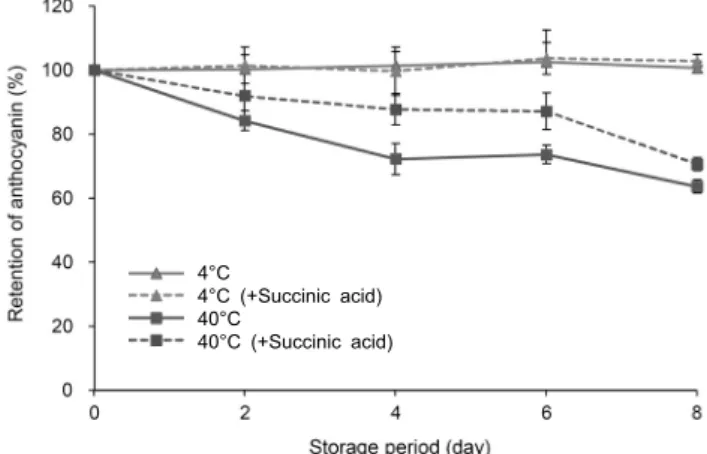
Fig. 1. Effect of succinic acid (0.5 M) on the stability of antho- cyanin extracts from black bean during storage for 8 days at 4 and 40°C.
분쇄기(Micro hammer cutter mill type-3, Culatti AG, Zurich, Switzerland)를 사용하여 80 mesh 이하로 분쇄한 후 -20°C에서 보관하면서 시료로 사용하였다.
안토시아닌 추출
검정콩에 함유된 안토시아닌 색소를 추출하기 위하여 시 료 중량 대비 30배량의 0.3% HCl을 첨가한 80% 메탄올 (v/v)을 첨가하여 25°C에서 1시간 동안 3회 반복하여 초음 파 추출(Ultrasonic Cleaner SD-350H, Seong Dong, Se- oul, Korea)한 후 2,220×g에서 원심분리(Centrifuge un- ion 55R, Hanil, Incheon, Korea) 한 다음 여과(Advantec No. 2, Toyo Roshi Kaisha, Ltd., Tokyo, Japan)하여 100 mL로 정용 후 시료로 사용하였다.
안토시아닌 색소액 제조
안토시아닌 추출물을 Macllvaine buffer(0.1 M citric acid+0.2 M Na2HPO4)와 혼합하여 안토시아닌 색소액을 제조하여 안정성을 평가하였다.
유기산, 금속이온, ascorbic acid, 당류, pH에 의한 안정 성 평가
유기산이 안토시아닌 색소의 안정성에 미치는 영향을 살 펴보기 위하여 Macllvaine buffer(pH 3.0)로 만든 조색소액 에 succinic acid는 0.5 M, Cu2+는 0.5 M, ascorbic acid는 50 mg%, sucrose는 0.5 M이 되도록 첨가하였고, pH는 1, 3, 5 및 7로 조정한 후 4°C와 40°C에서 8일 동안 보관하면 서 pH differential method로 안토시아닌 함량을 측정하여 잔존율을 나타내었다.
안토시아닌 함량 측정
총안토시아닌 함량은 pH differential method(12)를 변 형하여 시료 0.5 mL에 0.025 M potassium chloride buf- fer(pH 1.0)와 0.4 M sodium acetate buffer(pH 4.5)를 각각 0.5 mL 첨가하여 반응시키고, 510 nm와 700 nm에서 각각 흡광도를 측정하여 흡광도(A)를 구한 다음 아래 식에 의하여 총안토시아닌 함량을 측정하였다.
Total anthocyanin content (mg/L)=A×MW×DF×103 MA A: absorbance=(A510-A700)pH 1.0-(A510-A700)pH 4.5 MW (molecular weight of cyanidin-3-glucoside)=449.2
g/mol
DF: dilution factor
MA (molar extinction coefficient of cyanidin-3-gluco- side)=26,900
통계분석
통계분석은 SPSS 통계프로그램(Statistical Package for
the Social Science, Ver. 12.0, SPSS Inc., Chicago, IL, USA)을 이용하여 각 측정군의 평균과 표준편차를 산출하고 처리조건에 따른 유의차를 one-way ANOVA(analysis of variance)로 분석한 후 신뢰구간 P<0.05에서 Duncan's multiple range test를 실시하였다.
결과 및 고찰
유기산의 영향
검정콩 안토시아닌 색소용액에 succinic acid를 0.5 M 첨가한 후 4°C와 40°C에서 저장하면서 안토시아닌 색소의 저장 안정성을 측정한 결과는 Fig. 1과 같다. 유기산을 첨가 한 경우 pH가 2.41이었으며, pH 3.0인 무첨가구에 비해 저 장기간에 따라 안정성이 향상되었다. 4°C에서는 무처리구 와 succinic acid 첨가구가 모두 잔존율이 약 100%로 매우 안정적이어서 저장기간별 큰 차이는 나타나지 않았다. 40°C 에서는 succinic acid 첨가에 따른 안토시아닌 저장 안정성 효과가 뚜렷하게 나타나 succinic acid 첨가구가 6일차까지 약 87%를 유지하였으나 무처리구는 약 74%를 나타내었으 며, 8일차에 무처리구와 succinic acid 첨가구에서 각각 64 및 71%의 잔존율을 나타내어 유기산 첨가구에서 높은 안정 성을 나타내었다. 유기산의 첨가에 의해 안토시아닌 저장 안정성이 높아지는 이유는 조색소액이 유기산의 첨가에 의 한 pH의 저하가 주요한 원인으로 작용하는 것으로 생각된다 (13).
금속이온의 영향
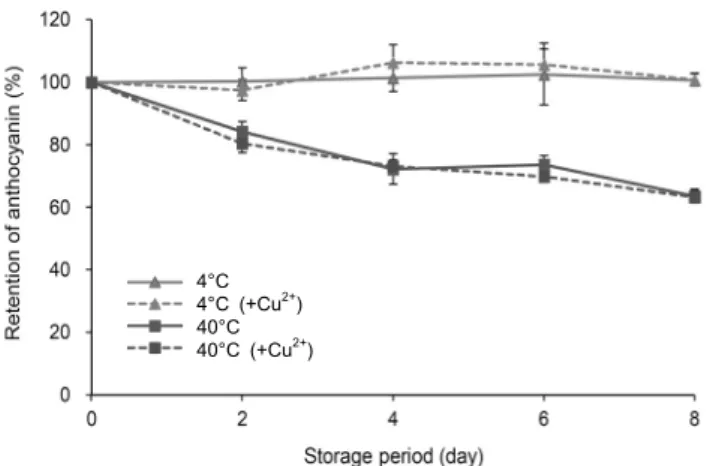
검정콩 안토시아닌 색소용액에 Cu2+를 0.5 M 첨가한 후 4°C와 40°C에서 저장하면서 안토시아닌 색소의 저장 안정 성을 조사한 결과는 Fig. 2와 같다. 4°C에서 안토시아닌 색 소 잔존율은 8일차까지 매우 안정적이어서 저장기간별 큰 차이는 나타나지 않았다. 40°C에서는 Cu2+ 첨가구와 비첨가 구의 잔존율이 감소하였고 두 처리구가 모두 유사한 잔존율
4°C 4°C (+Cu2+) 40°C 40°C (+Cu2+)
Fig. 2. Effect of Cu2+ (0.5 M) on the stability of anthocyanin extracts from black bean during storage for 8 days at 4 and 40°C.
4°C
4°C (+ascorbic acid) 40°C
40°C (+ascorbic acid)
Fig. 3. Effect of ascorbic acid (50 mg%) on the stability of anthocyanin extracts from black bean during storage for 8 days at 4 and 40°C.
4°C
4°C (+sucrose) 40°C
40°C (+sucrose)
Fig. 4. Effect of sucrose (0.5 M) on the stability of anthocyanin extracts from black bean during storage for 8 days at 4 and 40°C.
을 나타내었다. 일반적으로 안토시아닌 색소는 각종 금속이 온과 반응하여 착화합물(metalo-anthocyanin)을 형성한다 고 알려져 있는데(14), 이는 Yoon 등(15)의 연구에서 Cu2+
첨가 후 안토시아닌의 저장 안정성이 향상되었다는 결과와 상기 금속염으로 처리한 딸기 퓨레가 적색으로 보존되었다 는 결과가 보고되었지만(16) 본 연구에서는 뚜렷한 효과가 나타나지 않았다.
Ascorbic acid의 영향
Ascorbic acid가 검정콩 안토시아닌 색소의 안정성에 미 치는 영향을 조사하기 위하여 ascorbic acid를 0.5 M 첨가 한 후 4°C와 40°C에서 저장하면서 안토시아닌 색소의 저장 안정성을 조사한 결과는 Fig. 3과 같다. 4°C와 40°C에서 모두 ascorbic acid의 첨가구가 안토시아닌 색소 잔존율이 더 많이 감소하였으며, 4°C에서는 4일차까지 ascorbic acid 의 첨가구와 비첨가구가 모두 안정적이었으나 6일차부터 ascorbic acid 첨가구의 잔존율이 감소하여 8일차에 약 83%로 감소하는 경향을 나타내었다. 또한 40°C에서는 as-
corbic acid 첨가구에서 2일차에 잔존율이 비처리구(약 84%)에 비하여 약 19%로 현저히 감소하였으며, 6일차에 약 1% 잔존율을 보이다가 8일차에 잔존율이 0%가 되는 것 을 알 수 있었다. 반면 ascorbic acid를 첨가하지 않은 처리 구에서는 8일차까지 약 64%를 유지하였다. Ascorbic acid 의 첨가에 의해 안토시아닌의 안정성이 떨어지는 현상은 Sondheimer와 Kertesz(17)의 연구에서 ascorbic acid의 호기산화가 잘 일어날 수 있는 조건에서 안토시아닌의 안정 성이 감소한다고 한 결과와 일치하였으며, Markaris 등(18) 도 안토시아닌 색소의 안정성에 대하여 ascorbic acid와 산 소가 영향을 미친다는 것을 입증하여 이를 방지하기 위해서 는 산소와의 반응을 최소화하는 것이 필요하리라 판단된다 (19).
당류의 영향
당류가 검정콩 안토시아닌 색소의 안정성에 미치는 영향 을 조사하기 위하여 sucrose를 0.5 M 첨가한 후 4°C와 40°C에서 저장하면서 안토시아닌 색소의 저장 안정성을 조 사한 결과는 Fig. 4와 같다. Sucrose를 첨가하여 8일간 저장 하는 동안 검정콩의 안토시아닌 색소 강도는 무첨가구와 비 교할 때 색소의 안정성에 큰 변화를 나타내지 않았다. 4°C에 서는 sucrose 첨가구와 비첨가구 모두 8일차까지 안정적이 어서 저장기간별 큰 차이는 나타나지 않았다. 40°C에서는 6일차까지 sucrose 첨가구 잔존율이 약 80%로 비첨가구 (약 74%)보다 약간 높은 잔존율을 보였으나 8일차에 잔존율 이 약 58%로 무처리구(약 64%)보다 낮은 잔존율을 나타내 었다. 당에 대한 안토시아닌 색소의 안정성은 당의 농도와 종류에 따라 영향을 받는 것으로 알려져 있으며 당의 농도가 증가함에 따라 안토시아닌 색소의 안정성이 감소하는 경향 을 보인다(20). 이는 Park 등(21)의 딸기잼의 안토시아닌 색소가 당에 의해 크게 안정화되지 않는다는 연구 결과와 Lee 등(13)의 당류에 의한 농색화 현상이 없었다는 결과와 일치하는 결과였다.
pH 1 pH 3 pH 5 pH 7
A
pH 1 pH 3 pH 5 pH 7
B
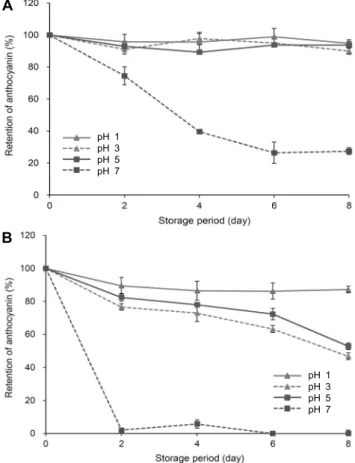
Fig. 5. Effect of different pH (1∼7) on the stability of anthocya- nin extracts from black bean during storage for 8 days at 4 and 40°C. (A) storage at 4°C, (B) storage at 40°C.
pH의 영향
검정콩 안토시아닌 색소의 안정성에 대한 pH의 영향을 Fig. 5에 나타내었다. 안토시아닌 색소액의 pH를 조정한 후 함량 변화를 분석한 결과 4°C에서는 pH 5 이하 범위에서 8일 후 잔존율이 약 90%였으나 pH 7에서는 잔존율이 2일 차에 약 74%, 4일차에 약 40%까지 감소하였으며, 8일차에 약 27%로 저장시간이 경과함에 따라 급속하게 감소하였다.
40°C에서는 4°C에서보다 pH에 따른 변화가 현저히 나타났 으며, pH 1에서 8일차까지 잔존율이 약 87%였으나 pH 7에 서는 2일차에 약 2%로 현저하게 감소하여 pH가 낮을수록 잔존율이 높았다. 이러한 결과는 Park 등(22)이 보고한 pH 가 낮을수록 색도가 높고 안정하였으며 pH가 높아질수록 색소 파괴가 많아지고 색소 잔존율이 낮아진다는 결과와 일 치하였다. pH가 높아짐에 따라 색소가 변화되는 원인은 안 토시아닌 색소의 전형적인 패턴으로 pH가 낮은 용액에서는 flavylium 양이온으로 존재하여 안정적으로 진한 적색을 나 타내나 pH가 높아질수록 flavylium 양이온이 양자를 잃고 무색의 carbinol pseudobase를 형성하기 때문으로 보고되 었다(23). 또한, Shim 등(19)이 보고한 pH가 중성에 가까워 질수록 색소의 안정성이 감소했다는 보고와도 일치하였다.
이러한 결과를 통해 pH가 안토시아닌 안정성에 가장 큰 영 향을 미치는 것으로 생각된다.
요 약
검정콩의 안토시아닌 색소의 안정성에 대한 유기산(suc- cinic acid), 금속이온(Cu2+), ascorbic acid, 당류(sucrose) 및 pH의 영향을 4°C 및 40°C에서 저장기간별로 살펴보았 다. 모든 처리구에서 4°C는 copigment 처리 여부에 관계없 이 안정하였지만 40°C에서는 copigment 처리구가 안정하 였다. Succinic acid 처리는 40°C에서 무처리에 비해 7~
15% 안정성이 향상되었다. Cu2+ 처리는 안토시아닌 색소와 반응하여 안정화에 효과가 있었으며, 4°C에서는 저장 8일차 까지 100%로 유지되었다. Ascorbic acid 처리는 안정성을 저하했으며 40°C에서는 무처리에 비해 64~72% 감소하였 다. Sucrose 처리는 무처리에 비하여 효과가 작았으며 온도 가 높을수록 안정성이 감소하였다. pH는 낮을수록 안정성이 증가하였으며 4°C에 비하여 40°C가 낮았다. 특히 pH 7에서 는 급격히 감소하였다. 이러한 결과로부터 검정콩 안토시아 닌 색소 저장 안정성 향상을 위해서는 온도, 유기산 및 pH 조절이 효과적이라고 판단된다.
감사의 글
본 연구는 농촌진흥청 연구비지원(과제번호: PJ010913 2015)에 의해 수행되었으며 이에 감사드립니다.
REFERENCES
1. Chung KW, Joo YH, Lee DJ. 2004. Content and color dif- ference of anthocyanin by different storage periods in seed coats of black soybean [Glycine max (L.) Merr.]. Korean J Intl Agri 16: 196-199.
2. Francis FJ, Markakis PC. 1989. Food colorants: Anthocya- nins. Crit Rev Food Sci Nutr 28: 273-314.
3. Jackman RL, Yada RY, Tung MA, Speers RA. 1987. Antho- cyanins as food colorants-A review. J Food Biochem 11:
201-247.
4. Brouillard R, Markakis P. 1982. Stability of anthocyanins in foods. In Anthocyanins as Food Colors. Markakis P, ed.
Academic Press, New York, NY, USA. p 163-180.
5. Reyes LF, Cisneros-Zevallos L. 2007. Degradation kinetics and colour of anthocyanins in aqueous extracts of purple- and red-flesh potatoes (Solanum tuberosum L.). Food Chem 100: 885-894.
6. Mazza G, Brouillard R. 1987. Recent developments in the stabilization of anthocyanins in food products. Food Chem 25: 207-225.
7. Brouillard R, Dangles O. 1994. Anthocyanin molecular in- teractions: the first step in the formation of new pigments during wine aging?. Food Chem 51: 365-371.
8. Hendry GAF, Houghton JD. 1996. Copigmentation. In Nat- ural Food Colorants. Hendry GAF, Houghton JD, eds. Chap- man and Hall, Glasgow, UK. p 267-270.
9. Gauche C, Malagoli EDS, Bordignon Luiz MT. 2010. Effect of pH on the copigmentation of anthocyanins from Cabernet Sauvignon grape extracts with organic acids. Sci Agric 67:
41-46.
10. Timberlake CF, Bridle P. 1982. Distribution of anthocyanins
in food plants. In Anthocyanins as Food Colors. Markakis P, ed. Academic Press, New York, NY, USA. p 125-162.
11. Rein M. 2005. Copigmentation reactions and color stability of berry anthocyanins. Academic Dissertation. University of Helsinki, Helsinki, Finland.
12. Lee J, Durst RW, Wrolstad RE. 2005. Determination of total monomeric anthocyanin pigment content of fruit juices, bev- erages, natural colorants, and wines by the pH differential method: collaborative study. J AOAC Int 88: 1269-1278.
13. Lee LS, Rhim JW, Kim SJ, Chung BC. 1996. Study on the stability of anthocyanin pigment extracted from purple sweet potato. Korean J Food Sci Technol 28: 352-359.
14. Kim HS, Ahn SY. 1978. Studies on the formation of antho- cyanin metal complex. J Korean Agric Chem Soc 21: 22-30.
15. Yoon JM, Cho MH, Hahn TR, Paik YS, Yoon HH. 1997.
Physicochemical stability of anthocyanins from a Korean pigmented rice variety as natural food colorants. Korean J Food Sci Technol 29: 211-217.
16. Wrolstad RE, Erlandson JA. 1973. Effect of metal ions on the color of strawberry puree. J Food Sci 38: 460-463.
17. Sondheimer E, Kertesz ZI. 1952. The kinetics of the oxida- tion of strawberry anthocyanin by hydrogen peroxide. J
Food Sci 17: 288-298.
18. Markaris P, Livingston GE, Fellers CR. 1957. Quantitative aspects of strawberry of pigment degradation. J Food Sci 22: 117-130.
19. Shim KH, Kang KS, Choi JS, Seo KI, Moon JS. 1994. Iso- lation and stability of anthocyanin pigments in grape peels.
J Korean Soc Food Nutr 23: 279-286.
20. Hwang ES, Ki KN. 2013. Stability of the anthocyanin pig- ment extracted from aronia (Aronia melancocarpa). Korean J Food Sci Technol 45: 416-421.
21. Park SJ, Lee JH, Rhim JH, Kwon KS, Jang HG, Yu M. 1994.
The change of anthocyanin and spreadmeter value of straw- berry jam by heating and preservation. Korean J Food Sci Technol 26: 365-369.
22. Park HJ, Jeon TW, Lee SH, Cho YS, Cho SM, Chang KS.
2004. Studies on characteristics and stability of anthocyanin pigment extracted from Korean purple-fleshed potatoes. J Korean Soc Food Sci Nutr 33: 1544-1551.
23. Bassa LA, Francis FJ. 1987. Stability of anthocyanins from sweet potatoes in a model beverage. J Food Sci 52: 1753- 1754.