Printed in the Republic of Korea DOI 10.5012/jkcs.2011.55.3.392
4- 치환된 벤조산 2합체에서의 수소 결합 상호작용에 대한 이론적 연구
Alireza Salimi Beni* Alireza Najafi Chermahini*, and Hashem Sharghi† Department of Chemistry, Faculty of Science, Yasouj University, Yasouj, 75918-74831 Iran
†Department of Chemistry, Faculty of Science, Shiraz University, Shiraz, Iran (접수 2010. 12. 28; 수정 2011. 3. 19; 게재확정 2011. 4. 18)
Theoretical Studies of Hydrogen Bond Interactions in 4-Substituted Benzoic Acids Dimers
Alireza Salimi Beni* Alireza Najafi Chermahini*, and Hashem Sharghi† Department of Chemistry, Faculty of Science, Yasouj University, Yasouj, 75918-74831 Iran
†Department of Chemistry, Faculty of Science, Shiraz University, Shiraz, Iran. *E-Mail: [email protected] (Received December 28, 2011; Revised March 19, 2011; Accepted April 18, 2011)
요 약. 벤조산 유도체(NH2, OH, H, F, Cl, CN, NO, NO2) 의 두 형태를 6-311++G(d,p) 바탕 집합을 이용하여 MP2, DFT 및 HF 수준으로 연구하였으며, cis이성 질체가 더 안정하였다. 벤조산의 수소 결합 형성은 안정화 에너지를 이용하여 추 산하였으며, 이합체에 대한 수소결합 에너지 계산치는 고리에서 협동 상호작용이 일어남을 보여주었다. 페닐 고리로 전자 를 밀어내는 그룹(ERG)은 더 안정한 수소 결합이 형성하였다. 이합체에서 O-H 결합의 적색이동은 -565.3에서 -589.3 cm-1 범위였 으며, 상호 작용의 특성은 NBO 분석을 이용하여 연구하였다.
주제어: 수소 결합, 벤조산, 치환 효과, NBO 분석, DFT, MP2, HF
ABSTRACT. Two conformations of benzoic acid derivatives (NH2, OH, H, F, Cl, CN, NO, NO2) have been investigated at MP2, DFT and HF level using the 6-311++G(d,p) basis set. It was found that the cis isomers are more stable. Hydrogen bond- ing formation of benzoic acids has been estimated from stabilization energies. The calculated hydrogen-bonding energies of dimers showed a cooperative interaction in the cyclic ones. It was found that an electron-releasing group (ERG) into the phe- nyl rings resulted in the formation of more stable hydrogen bonding. Red shift of O–H bond was found from -565.3 to -589.3 for dimers. The natural bond orbital (NBO) analysis was applied to characterize nature of the interaction.
Keywords: Hydrogen bonding, Benzoic acid, Substituted effect, NBO analysis, DFT, MP2, HF
INTRODUCTION
Hydrogen bonds constitute a very interesting class of intermolecular interactions, which are of extreme impor- tance in many fields of chemistry and molecular biology.
The hydrogen bonding concept is a fundamental key to understand chemical structures, enzyme catalysis, mate- rial properties, self assembly phenomena, and functions of molecular and biological devices and machines.1-3 It is well known that carboxylic acids form, in the gas phase and solution, cyclic dimer structure with two very strong O–H…O=C hydrogen bonds. Several experimental stud- ies such as IR spectroscopy,4,5 NMR spectroscopy,6-8 X-ray crystallography,9-11 microwave spectroscopy12 vapor-den- sity measurements13 and thermal conductivity measure- ments14 indicate that carboxylic acids form hydrogen- bonded cyclic dimers. In addition the characterization of
the hydrogen bonding interaction between carboxylic acids has been studied by a lot of theoretical calculations.15-20 The three types of H-bonding interactions which are most often discussed in the literature are weak, moderate, and strong.21 In the X-H…Y that X is proton donor and Y is proton acceptor, the hydrogen bonding maybe evalu- ated geometrically by increase of X-H bond length and decrease of H…Y distance. In addition hydrogen bond angle for strong hydrogen bonds ranges from 170-180 degree. For the moderate and weak hydrogen bonds the angle is greater than 130 and 90 degree respectively.22 Energetically the strength of the strong hydrogen bonding interactions varies from 4.0 to 40.0 kcal/mol. For the mod- erate and weak H-bonds, the strengths vary from 4-15 to 1-4 kcal/mol, respectively.21-23
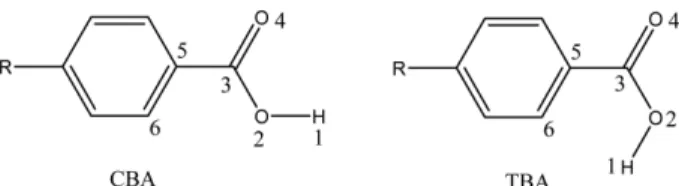
The monomers of carboxylic acids may be found in two forms: cis and trans (Fig. 1). In the cis conformer the car-
boxylic hydrogen atom pointing toward the carbonyl group, while in the trans conformer the two pointing away from each other.
The derivatives of benzoic acid are widely used in sev- eral applications, such as miticides, contrast media in urology, cholocystographic examinations and in the man- ufacture of pharmaceuticals. It also finds application in dyes, in curing tobacco, in preserving fruits juice, in many esters, as a mordant in cloth printing and as a reference standard in volumetric analysis. Benzoic acid derivatives also play a useful role in mosquito control by maintaining the vector population at a minimum level.24 Benzoic acid is used as antifungal agents for superficial fungus infec- tion of skin. Together with salicylic acids in ointments, it is also used for the treatment of ring worm in dogs and other species.25 They form cyclic dimers, with two hydro- gen bonds acting as a bridge between the monomers. The cyclic dimers thus formed can undergo double proton transfer and has been a subject of interest for many decades, partly because they can serve as prototypes for DNA base pairs.
To the best of our knowledge, systematic study of hydro- gen bonding of 4-substituted benzoic acids have not been reported. Therefore, the present investigation was under- taken to study on the effect of substituents on strength of hydrogen bond of these molecules completely.
COMPUTATIONAL METHODS
In order to study the molecular properties of benzoic acids quantum mechanical calculations have been per- formed at different levels of theory, namely at Hartree- Fock (HF) level,26-28 at second-order Møller-Plesset (MP2) perturbation theory level29 and at the density-functional theory (DFT) level30 using 6-311++G(d,p) basis set. DFT results were obtained using Becke’s three parameter exchange functional along with the Lee, Yang and Parr correlation functional (B3LYP).31,32 The calculations were performed on a Pentium IV workstation, at 3.0 GHz, running the Gaussian 9833 package. For dimers of benzoic acid, it was assumed that two molecules are linked through two
equivalent hydrogen bonds and that the dimers are cen- trosymmetric; that is, there is an inversion center between the linked species. All the equilibrium isomers without imaginary frequency correspond to the minimum points on the potential surface. The uncorrected interaction ener- gies were obtained by subtracting the energy of two fully optimized monomers from the energy of the dimer:
(1) Where EA, EB and EA-B are the electronic energies of first benzoic acid molecule, second one and the dimer, respec- tively. The zero-point vibrational energy (ZPVE) correc- tions are applied in the present work based on following equations:
(2) Where EA(ZPVE), EB(ZPVE) and EA-B(ZPVE) are the sum of electronic and zero-point energies of first and second ben- zoic acid and aggregated system, respectively. To correct the basis set superposition error (BSSE), the counterpoise (CP) method is employed34 as followed:
(3) Where and show calculated energies of acid A and B with their geometries in the AB complex using the basis function of the complex AB, respectively.
Finally the corrected interaction energies Eint(corr), was calculated by addition of Eint(ZPVE) and Eint(BSSE) to inter- action energy term (eq. 1):
(4) The vibrational frequencies were computed for the opti- mized geometries of monomers and dimers of BAs. The harmonic frequency shift of the O-H stretching mode in the dimers, νO-H, was estimated by the following equa- tion:
(5) The natural bond orbital (NBO) analysis was used to understand better the nature of the corresponding inter- molecular interactions.35
RESULTS AND DISCUSSION Monomers
Energy: The structure and numbering of two conform- ers of benzoic acid (BA) to presented in Fig. 1. For ben- zoic acid two conformations for the OH-group have been
Eint=EA B– –(EA+EB)
Eint ZPVE( )=EA B ZPVE– ( )–EA ZPVE( )–EB ZPVE( )
Eint BSSE( )=EA B– –EA′AB–EB′AB EA′AB EB′AB
Eint corr( )=Eint+Eint ZPVE( )+Eint BSSE( )
∆νO H– =νO H Dimer– ( )–νO H Monomer– ( )
Fig. 1. Cis and trans forms of benzoic acid monomers: R=H, OH, NH2, F, Cl, CN, NO, NO2.
considered, the adopted nomenclatures are CBA and TBA for cis and trans of hydrogen with carbonyl group respectively (See Fig. 1).
The results of calculated total energies of CBAs, rela- tive stabilities and dipole moments of benzoic acid and its derivatives presented in Table 1. Based on HF calcula- tions it is clear that TBAs are more unstable than CBAs in the range of 8.08-8.81 kcal/mol. The results of Table 1 show that the DFT and MP2 calculation are not much dif- ferent from HF results so DFT and MP2 methods predict that CBAs are more stable than TBAs in the range of 6.81 -7.54 kcal/mol and 5.98 -7.05 kcal/mol, respectively. The less stability of TBAs may be explained by van der Waals interaction between hydrogen of hydroxyl group and hydro- gen of phenyl ring in the ortho position.
Dipole moment is the first derivative of the energy with respect to an applied electric field and is the measure of the asymmetry in the molecular charge distribution. The calculated total dipole moments for certain benzoic acids are given in Table 1 predicts that dipole moments of TBAs are more than CBAs. Therefore it is predicted that in the polar solvents the population of trans isomers is favor.
Geometry: The geometric parameters of isolated ben- zoic acid monomers calculated at the HF, B3LYP and MP2 levels using 6-311++G(d,p) basis set are presented in the Table 2.
The effect of replacing hydrogen of ring in the para with other groups on the geometrical parameters can be com- pared with benzoic acid. For example in the CBA the bond lengths of C=O (r34) and C-C (r35) is 1.2092 and 1.4865 Å at B3LYP level, respectively. It was found that electron donating groups (such as NH2 and OH) cause an increase in C=O bond length and decrease in C3-C5 and
O-H bond lengths while electron withdrawing groups (such as NO2) decrease C=O and increase C-C bond lengths. For instance C=O bond length calculated at DFT/
6-311++G(d,p) level increased by 0.0027, and 0.0013 Å for NH2, and OH groups and C-C bond length decreased by 0.0121 and 0.0075 Å for NH2 and OH groups, respec- tively. This can be explained by direct resonance of elec- tron releasing groups with carboxyl group. In addition C=O bond length in TBAs is shorter than CBAs and C-C bond length in CBAs are shorter than TBAs. This can be explained by the fact that CBAs phenyl ring and a car- boxyl group are basically in the same plane thus in CBAs there is a direct resonance interaction between the 4-sub- stituent group and carboxyl group, but in TBAs, carboxyl group placed out of the plane of the molecule and reso- nance in TBAs is poor.
It is notable that O2-C3-C5-C6 dihedral angle calcu- lated by DFT method was found near zero for CBAs but for TBAs was found in the range of 17.68-25.7 degree.
Interestingly dihedral angle for benzoic acid with electron donating groups such as NH2 was found less than benzoic acid with electron withdrawing group. This difference can be explained again by direct resonance of electron releas- ing groups.
Dimers
Energy: Interaction energies were calculated for the 4- substituted benzoic acid dimers taking in to account the energy difference between the monomers and the com- plexes. The interaction energies were corrected for both ZPVE and BSSE (basis set superposition error) differ- ences.
Based on HF and DFT calculations it is clear that Table 1. Calculated total energies, relative stabilities and dipole moments of 4-substituetd benzoic acids at HF, DFT and MP2 levels using 6-311++G (d,p) basis set
R NH2 OH H F Cl CN NO NO2
HF Cis µ 3.72 3.42 2.22 1.54 1.57 3.73 2.78 4.07
Etot -473.487542 -493.320411 -418.434923 -517.316295 -877.35806 -510.186306 -547.108605 -621.958659
Trans µ 6.56 6.05 5.25 3.80 3.69 2.65 3.11 2.72
Ec-Et -8.35 -8.63 -8.08 -8.71 -8.60 -8.81 -8.49 -8.80
DFT Cis µ 4.15 3.35 2.13 1.37 1.37 3.50 3.07 3.77
Etot -476.328602 -496.197699 -420.94825 -520.217166 -880.570800 -513.212287 -550.27327 -625.50838
Trans µ 6.95 5.97 5.05 3.64 3.65 2.43 2.74 2.47
Ec-Et -6.98 -7.24 -6.81 -7.35 -7.31 -7.54 -7.34 -7.54
MP2 Cis µ 3.77 3.43 2.36 1.52 1.51 3.65 2.93 4.06
Etot -475.015792 -494.864746 -419.781784 -518.859669 -878.841959 -511.818863 -548.814559 -623.887028
Trans µ 6.63 6.09 5.51 3.86 3.96 2.54 3.13 2.61
Ec-Et -6.23 -6.29 -5.98 -6.50 -6.44 -6.87 -6.64 -7.05
Total energies in Hartree, relative stabilities in kcal/mol, dipole moments in Debye
because of hydrogen bonding, aggregation of benzoic acid monomers is an exothermic process. It was found that the benzoic acid dimers with electron donating groups are slightly more stable than benzoic acid dimers with elec-
tron withdrawing groups. The range of hydrogen bonding energies was found as 13.41-14.01 kcal/mol and 16.00- 16.54 kcal/mol calculated by HF and DFT methods, respectively. With inclusions of ZPVE and BSSE correc- Table 2. Some optimized geometric parameters of two cis and trans of 4-substituted benzoic acids at HF, DFT and MP2 levels using 6- 311++G (d,p) basis set
Method R NH2 OH H F Cl CN NO NO2
HF
Cis
r12a 0.9453 0.9455 0.9456 0.9457 0.9458 0.9461 0.9460 0.9462
r34 1.1879 1.1866 1.1854 1.1854 1.1848 1.1833 1.1835 1.1827
r35 1.4770 1.4804 1.4881 1.4854 1.4878 1.4929 1.4932 1.4949
θ123b 108.1 108.2 108.3 108.4 108.4 108.7 108.6 108.7
θ234 121.4 121.7 121.9 122.0 122.2 122.6 122.5 122.7
θ356 122.5 122.2 121.8 122.0 122.0 121.7 121.6 121.6
Φ2356b 0.07 0.00 0.01 -0.02 0.01 0.00 -0.04 0.01
Trans
r12 0.9404 0.9405 0.9409 0.9408 0.941 0.9413 0.9413 0.9414
r34 1.1803 1.1791 1.1782 1.1782 1.1777 1.1765 1.1766 1.1760
r35 1.4912 1.4932 1.5003 1.4984 1.5002 1.5042 1.5043 1.5055
θ123 112.2 112.3 112.2 112.4 112.4 112.6 112.5 112.7
θ234 119.8 120.0 120.3 120.3 120.4 120.8 120.7 120.9
θ356 123.7 123.4 122.6 123.0 122.9 122.4 122.3 122.3
Φ2356 20.01 21.83 24.94 23.48 24.33 27.00 27.60 28.23
DFT Cis
r12 0.9680 0.9681 0.9683 0.9684 0.9685 0.9687 0.9687 0.9688
r34 1.2119 1.2105 1.2092 1.209 1.2089 1.2074 1.2073 1.207
r35 1.4744 1.479 1.4865 1.4843 1.4855 1.4904 1.492 1.492
θ123 106.2 106.5 106.6 106.7 106.8 107.0 107.0 107.1
θ234 121.3 121.6 121.8 121.9 122.0 122.5 122.5 122.6
θ356 122.6 122.3 122.0 122.1 122.2 122.0 121.8 121.9
Φ2356 0.10 0.00 0.00 0.00 0.00 0.00 -0.01 0.00
Trans
r12 0.9638 0.9641 0.9645 0.9643 0.9644 0.9646 0.9648 0.9647
1.2039 1.2026 1.2016 1.2015 1.2014 1.2003 1.2003 1.1999
1.4895 1.4942 1.5002 1.4987 1.4995 1.5034 1.5043 1.5049
110.5 110.6 110.6 110.8 110.9 111.1 111.0 111.1
r34 119.1 119.4 119.7 119.7 119.8 120.1 120.2 120.2
r35 123.9 123.5 122.9 123.2 123.2 122.9 122.5 122.7
θ123 17.68 20.18 22.69 21.95 21.89 24.44 26.45 25.70
MP2 Cis
r12 0.9679 0.9680 0.9681 0.9682 0.9682 0.9684 0.9685 0.9686
r34 1.2141 1.2133 1.213 1.2128 1.2129 1.2123 1.2124 1.2124
r35 1.4828 1.4849 1.4897 1.4883 1.4885 1.4916 1.4921 1.4912
θ123 105.2 105.4 105.5 105.6 105.6 105.9 105.8 105.9
θ234 122.2 122.4 122.5 122.6 122.7 123.1 123.0 123.2
θ356 122.3 122.1 121.9 122.0 122.1 121.9 121.8 121.9
Φ2356 1.01 0.00 0.03 -0.01 0.00 -0.03 0.00 -8.32
Trans
r12 0.9641 0.9641 0.9643 0.9641 0.9642 0.9643 0.9643 0.9642
r34 1.2073 1.2068 1.2066 1.2064 1.2065 1.2061 1.2062 1.2063
r35 1.4939 1.4958 1.4992 1.4984 1.4985 1.501 1.5011 1.5009
θ123 108.1 108.2 108.3 108.5 108.5 108.8 108.7 108.9
θ234 120.2 120.4 120.5 120.6 120.6 120.9 120.8 120.8
θ356 122.7 122.6 122.2 122.4 122.5 122.3 122.1 122.3
Φ2356 29.09 28.99 30.77 30.29 29.13 31.09 32.09 31.07
aBond lengths in Å, bbond angles and dihedral angles in degree
tions the order of stabilities dose not changed and stabil- ities change to 11.30-11.91 and 14.27-14.85 kcal/mol calculated by HF and DFT methods, respectively. Now we consider effect of substituents on variation of hydro- gen-bonding strength. Interestingly the results of our work which presented in Table 3 showed that the total hydro- gen-bonding energy of benzoic acids enforced by intro- duction of ERG’s. The order of strength of hydrogen bonding in the dimers with different substituents are OH>F>NH2>Cl>H>NO>CN>NO2 and OH>F>Cl>NH2>
H>CN>NO>NO2 calculated by HF and DFT methods, respectively. As you can see a stronger ERG is slightly effective for enforcement of the hydrogen bond in the ben- zoic acid dimers. In this case the difference between hydrogen bonding of 4-OH substituted benzoic acid as the most stable benzoic acid dimer and 4-NO2 substituted benzoic acid as the least stable one was found 0.60 and
0.54 kcal mol-1 for HF and DFT calculated methods, respectively. Because of Centro symmetric structure of dimers the calculated total dipole moments for certain benzoic acid dimers predict that all dipole moments of dimers are near zero (see Table 3).
Geometry: The energy difference method can be used only to evaluate the overall hydrogen-bonding energy of the two H-bonded systems. Identifying the strength of each individual H-bond using this procedure is impossi- ble. The strength of a localized H-bond (X-H...Y) maybe found from the shortening of dH...Y (Y=O, N or F), the elongation of dX–H and the red shifts of υXH; all of these indirect parameters are easily calculated from the HF and DFT optimized results for dimers and related monomers.
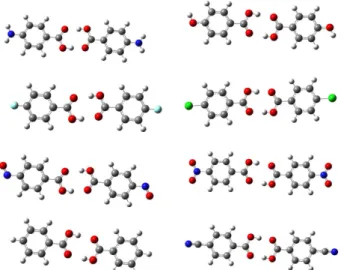
In the Fig. 3 the optimized structure of 4- substiuted benzoic acid dimers are presented. In addition the results of selected optimized structural parameters of monomers Fig. 2. The dihedral angle changes (Φ2356) of TBAs with change of 4-substituted. The groups from left to right are NH2, OH, H, F, Cl, CN, NO, NO2.
Table 3. Calculated interaction energies, and corrected interaction energies of 4-substituetd benzoic acids dimers at HF and DFT levels using 6-311++G (d,p) basis set
R NH2 OH H F Cl CN NO NO2
HF Eint -13.88 -14.01 -13.79 -13.94 -13.77 -13.47 -13.59 -13.41
Eint (ZPVE) 1.34 1.29 1.32 1.29 1.27 1.33 1.32 1.31
Eint (BSSE) 0.79 0.85 0.81 0.86 0.78 0.74 0.80 0.78
Eint (corr) -11.75 -11.91 -11.65 -11.79 -11.73 -11.40 -11.47 -11.30
DFT Eint -16.33 -16.54 -16.35 -16.46 -16.34 -16.1 -16.08 -16.00
Eint (ZPVE) 1.00 0.90 1.00 0.92 0.93 0.97 0.99 0.94
Eint (BSSE) 0.77 0.79 0.79 0.84 0.76 0.75 0.78 0.78
Eint (corr) -14.56 -14.85 -14.55 -14.71 -14.65 -14.37 -14.30 -14.27 Hydrogen bonding energies in kcal/mol
and dimers of 4-substituted benzoic acid derivatives are collected in Table 4.
The comparisons of selected geometries in monomers show a correlation between them and nature of substitu- ent on position 4. The comparison between the geometry parameters of the monomers and dimers shows that the association of two monomeric molecules into a dimer causes substantial changes in the bond lengths and angles.
These perceptible differences are due to the effect of hydrogen bonding between the O and H atoms of the monomeric species. As expected, the O–H bond length increases with hydrogen bonding (See Table 4).
A close look at the Table 4 reveals that for O–H bond lengths, the largest increase in bond length relative to their monomers is 0.0151 Å for NH2 diminishing to 0.0137 for NO2 at HF/6-311++G(d, p) level (for comparison see Table
4). Note that the increases O–H bond lengths are propor- tional to electron donating power of substituents. In addi- tion with going from electron releasing groups to electron withdrawing ones a regular increase in hydrogen-bonding length of O4'…H1 from 1.8143 Å and 1.6593 Å for NH2 to 1.8271 Å and 1.6633 Å for NO2 observed at HF and DFT methods, respectively.
From Table 4 it can be observed that the bond length C=O are increased in all 4-substituted benzoic acid dimers due to hydrogen bonding, as compared to those in free benzic acid monomers. The calculated hydrogen-bond lengths, C=O…H1, decreased from 1.8271 Å and 1.6633 Å for 4-nitro benzoic acid to 1.8143 Å and 1.6593 Å for 4-amino benzoic acid calculated at HF and DFT levels, respectively. It should be noted that all dimers was found to be planar and dihedral angles are near zero.
Vibration analysis: Changes were observed in the cal- culated vibrational spectrum of benzoic acids going from monomers to dimers and they may confirm the results which obtained on the basis of the calculated hydrogen- bonding energies. For all of the dimers, the elongation of O–H bonds resulting in red shift of stretching vibrational frequencies.
The vibrational frequencies of selected bonds in the hydrogen bonding region of monomers and dimers of benzoic acids using B3LYP/6-311++G(d, p) are collected in Table 5. The B3LYP-calculated frequencies were scaled by a scaling factor of 0.958.36 As you can see due to the participation of the O–H bond in hydrogen bonding υ (O–
H) in dimers show a negative shift. If we have a close look at the Table 5, it is obvious with going from electron with- drawing groups to electron donating ones an irregular increasing of red shift was observed. The highest red shift Fig. 3. The optimized structure of 4-substiuted benzoic acid dim-
mers.
Table 4. Selected structural dataa for the intermolecular hydrogen-bonded benzoic acid dimers
R NH2 OH H F Cl CN NO NO2
HF
r14’a 1.8143 1.8161 1.8212 1.8201 1.8208 1.8262 1.8263 1.8271
r12 0.9604 0.9603 0.9600 0.9601 0.9601 0.9599 0.9599 0.9599
r34 1.2025 1.2013 1.1998 1.200 1.1994 1.1978 1.1979 1.1972
r23 1.3078 1.307 1.3054 1.3053 1.3046 1.303 1.3034 1.3024
r35 1.4764 1.4796 1.4875 1.4842 1.4868 1.4919 1.4923 1.4937
Φ4’123b 0.0 0.0 0.1 0.1 0.0 0.0 0.0 0.0
DFT
r14’a 1.6593 1.6602 1.664 1.6617 1.6628 1.6645 1.6659 1.6633
r12 1.0001 1.0002 0.9998 1.0001 0.9998 0.9998 0.9996 1.0001
r34 1.2331 1.2316 1.2301 1.2303 1.2298 1.2285 1.2282 1.2280
r23 1.3262 1.3243 1.3224 1.3223 1.322 1.32 1.3199 1.319
r35 1.4743 1.4788 1.4861 1.4836 1.4847 1.4894 1.491 1.4912
Φ4’123b 0.0 -0.1 0.0 0.0 0.0 0.0 0.0 0.0
aAll bond lengths are in Å.
bdihedral angles in degree.
was found 589.3 cm-1, which obtained for NH2, substi- tuted dimer. These are evidences for the substantial hydrogen bonds in cooperativity in structures with NH2 substituents.
NOB analysis: Since the hydrogen bond properties is sometimes evaluated by charge distributions; for the bet- ter understanding of the problem, we considered the atomic charges for the included atoms. The natural population analysis was used to investigate substituent effect on charge changes which arise from the driving forces of hydrogen bond formation in dimers of benzoic acids. The calculated charge distributions for all dimers resulted from hydrogen bonding are presented in Table 6. It can be observed that, due to complexation, hydrogen atoms involv- ing in hydrogen bonding gain more positive charges, the oxygen atoms which are acting as hydrogen acceptor, gain more negative charges and charges on the oxygen atoms that acting as hydrogen donor diminished as compared with monomers.
To estimate more precisely the nature of proper hydro- gen bonds, we have performed detailed NBO analysis.
The nature of the intermolecular hydrogen bonds was ana- lyzed with the framework of the NBO procedure. Table 7 compiles some of the significant donor–acceptor interac- tions and their second-order perturbation energies, E(2) calculated at B3LYP/6-311++ G(d,p) level of theory. In the NBO analysis of hydrogen bond system, the charge transfer between the lone pairs of proton acceptor and anti bonding orbitals of the proton donor is the most important.
The analysis of NBO data show that all dimers possess
two equivalent strong hydrogen bonds, and their second- order perturbation energies for interaction are in range of 20.74-21.76 kcal/mol. As a whole, the results of NBO analysis indicate that the intermolecular interactions in dimers with electron releasing groups are stronger than those dimers with electron withdrawing ones. Also ben- zoic acid dimer with NO substituent has the weakest hydrogen bonding and with NH2 has the most strong hydrogen bonding.
CONCLUSIONS
On the basis of the calculated results, we have made the following conclusions:
a) The results of calculated total energies of benzoic acid monomers indicate that cis benzoic acids are more stable than trans benzoic acids.
b) The presence of substitutions at position 4 of benzoic acid dimers slightly influences the power of hydrogen bonding. With going from electron withdrawing substit- uents to electron releasing ones the strength of hydrogen bonding increases.
c) The hydrogen bond lengths, the distances between dimers and collinear angles also support the results which obtained upon binding energy values. Because of the charge density increase in the antibonding orbital of the O–H bond and the electron density delocalization, the O–
H bond lengthening and therefore concomitant decrease in stretching vibrational frequency are observed.
Table 5. Selected calculated stretching vibrational frequencies (cm-1) and changes (cm-1) in the IR frequencies from monomers to dimers using B3LYP/6-311++G(d, p)
R NH2 OH H F Cl CN NO NO2
υO-H 3775.7 3774.6 3772.5 3772.5 3771.2 3769.3 3768.7 3768.7
υC=O 1773.2 1779.9 1785.0 1786.3 1786.2 1792.3 1791.3 1794.2
∆υOH -589.3 -586.3 -574.7 -579.6 -575.8 -569.5 -565.3 -572.5
∆υC=O 54.7 55.3 54.6 56.0 54.6 55.8 54.3 55.2
Table 6. Selected NBO charges for the most stable monomers and dimers at B3LYP/6-31++G(d,p) level of theory
R NH2 OH H F Cl CN NO NO2
H1 0.483 0.485 0.485 0.487 0.487 0.490 0.490 0.490
O4 -0.616 -0.607 -0.600 -0.600 -0.597 -0.587 -0.585 -0.584
∆q H 0.030 0.029 0.029 0.027 0.027 0.025 0.025 0.025
∆q O -0.069 -0.072 -0.073 -0.074 -0.074 -0.082 -0.077 -0.078
Table 7. Selected second-order perturbation energies, E(2) calculated at 3LYP/6-311++G(d,p) for benzoic acid dimers in the gaseous phase
R NH2 OH H F Cl CN NO NO2
LP (1) O4→σ*O2H1 8.76 8.76 8.71 8.79 8.77 8.78 8.77 8.84
LP (2) O4→σ*O2H1 21.76 21.61 21.21 21.35 21.20 20.77 20.74 20.86
The second-order perturbation energies E(2) from the NBO energetic analysis are given in kcal/mol
d) In general, the results of NBO analysis indicate that the intermolecular interactions in the each dimer with going to more electron donating substituents, strength of hydro- gen bonding in benzoic acid dimers slightly increase.
Acknowledgment. We gratefully acknowledge the sup- port this work by the Yasouj University (YU).
REFERENCES
1. Scheiner, S. Hydrogen Bonding; Oxford University Press:
New York, 1997.
2. Jeffery, G. A. Introduction to Hydrogen Bonding; Oxford University Press: New York, 1997.
3. Hobza, P.; Havlas, Z. Chem. Rev. 2000, 100, 4253.
4. Genin, F.; Quiles, F.; Burneau A. Phys. Chem. Chem. Phys.
2001, 3, 932.
5. Emmeluth, C.; Suhm, M. A. Phys. Chem. Chem. Phys.
2003, 5, 3094.
6. Goldman, M. A.; Emerson, M. T. J. Phys. Chem. 1973, 77, 2295.
7. Lumbroso-Bader, N.; Coupry, C.; Baron, D.; Clague, D.
H.; Govil, G. J. Magnetic Resonance. 1969, 17, 386.
8. Yoshida, N. J. Phys. Chem. 1982, 86, 1785.
9. Stricter, F. J.; Templeton, D. H.; Scheuerman, R. F.; Sass, R. L. Acta Crysrallogr. 1962, 15, 1233.
10. Kanters, J. A.; Kroon, J. Acta Crysrallogr. 1972, 828, 1946.
11. Albinati, A.; Rouse, K. D.; Thomas, M. W. Acta Crys- tallogr., Sect, B: Struct. Crystallogr. Crystal Chem. 1978, 34, 2188.
12. (a) Van Eijck, B. P; Brandts, P., Maas, J. P. M. Journal of Molecular Structure. 1978, 44, 1. (b) Van Eijck, B. P.;
Ván Der Plaats G Van Rogn PH; Journal of Molecular Structure. 1972, 11, 67.
13. (a) Taylor, M. D. J. Am. Chem. Soc. 1951, 73, 315. (b) Karle, J.; Brockway, L. O. J. Am. Chem. Soc. 1944, 66, 574.
14. Frurip, D. J.; Curtiss, L. A.; Blander, M. J. J. Am. Chem.
Soc. 1980, 102, 2610.
15. Aquino, A. J. A.; Tunega, D.; Haberhauer, G.; Gerzabek, M. H. Lischka, H. J. Phys. Chem. 2002, 106, 1862.
16. Turi, L. J. Phys. Chem. 1996, 100, 11285.
17. Wolfs, I.; Desseyn, H. O. J. Mol. Struct. (Theochem.) 1996, 81, 360.
18. Lewandowski, H.; Koglin, E.; Meier, R. J. Vibrational Spectroscopy 2005, 39, 15.
19. Chocholousova, J.; Vacek, J.; Hobza, P. J. Phys. Chem.
2003, 107, 3086.
20. Turi, L.; Dannenberg, J. J. J. Phys. Chem. 1993, 97, 12197.
21. Grabowski, S. J. Hydrogen Bonding-New Insights; Spriger:
2006.
22. (a) Jeffrey, G. A.; Saenger, W. Hydrogen bonding in bio- logical systems, Spriger-Verlag: Berlin, 1991. (b) Hadzi, D.
Theoretical Treatments of Hydrogen Bonding; John Wiley
& Sons: Chichester, New York, Weinheim, Brisbane, Sin- gapore, Toronto, 1997.
23. Steiner, T. Angew. Chem. Int. Ed. 2002, 41, 48.
24. Minatchy, S.; Mathew, N. Ind. J. Chem. 1998, 37B, 1066.
25. Mani, P. Ph. D.; Thesis Pondicherry University, 2004, p107.
26. Hartree, R. Proc. Camb. Philos. Soc. 1927, 24, 89.
27. Fock, V. Z. Phys. 1930, 61, 126.
28. Slater, J. C. Phys. Rev. 1930, 35, 210.
29. Møller, C.; Plesset, M. S. Phys. Rev. 1934, 46, 618.
30. Parr, R. G.; Yang, W. Density-Functional Theory of Atoms and Molecules, Oxford University Press: New York, 1994.
31. Lee, C.; Yang, W.; Parr, R. G. Phys. Rev. 1988, B 37, 785.
32. Becke, A. D. J. Chem. Phys. 1993, 98, 1372.
33. Frisch, M. J. et al., GAUSSIAN 98, Revision A.11, Gaus- sian Inc., Pittsburgh, PA, 1998.
34. Boys, S. F.; Bernadari, F. Mol. Phys. 1970, 19, 553. (b) Boys, S. F.; Bernardi, F. Reprinted in Mol Phys. 2002, 100, 65.
35. Glendening, E. D.; Badenhoop, J. K.; Reed, A. E.; Car- penter, J. E.; Weinhold, F. NBO Version 3.1 Theoretical Chemistry Institute University of Wisconsin: Madison.
36. Wysokin´ ski, R.; Michalska, D.; Bien´ko, D.C.; Ilakiamani, S.; Sundaraganesan, N.; Ramalingam, K. Journal of Molec- ular Structure. 2006, 791, 70.