PGHN
Original Article
Significance of Perianal Lesion in Pediatric Crohn Disease
Won Seok Jin, Ji Hyoung Park, Kyung In Lim, Hann Tchah, and Eell Ryoo
Department of Pediatrics, Gachon University Gil Medical Center, Incheon, Korea
Purpose: Despite the increasing incidence of pediatric Crohn disease (CD) in Korea, data on the characteristics of perianal lesions are scarce. Therefore, we aimed to investigate the characteristics of pediatric CD with accompany- ing perianal lesions in Korea.
Methods: We retrospectively reviewed the medical records of children (age ≤18 years) with confirmed CD at Gachon University Gil Medical Center between 2000 and 2014. Patients were classified into two groups based on the presence or absence of any perianal lesions including skin tags. Additional analysis was performed according to the presence or absence of perianal perforating lesions.
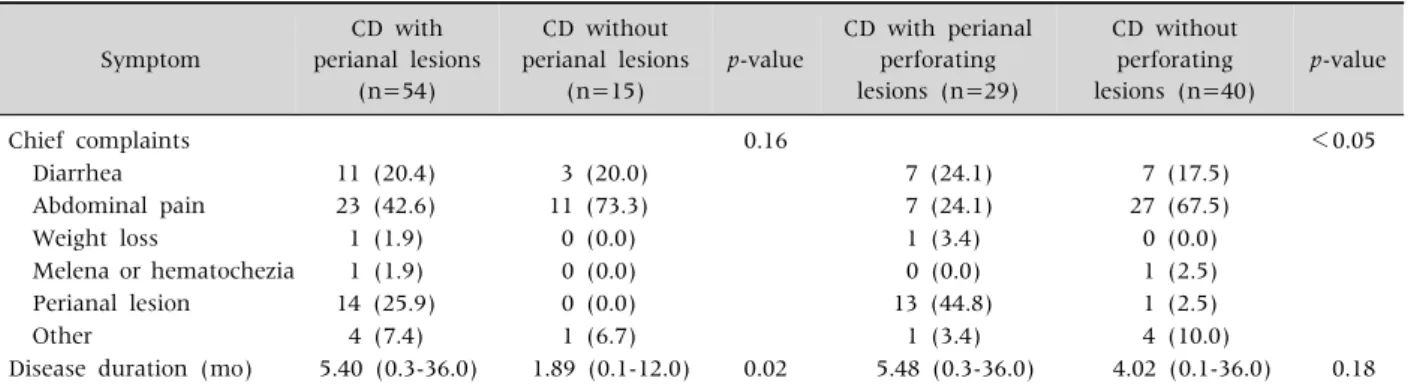
Results: Among the 69 CD children (mean age, 15.4 years) include in the analysis, 54 (78.3%) had a perianal lesion and 29 (42.0%) had a perianal perforating lesion. The median duration of chief complaints was longer in pediatric CD with any accompanying perianal lesions (5.40 months vs. 1.89 months, p=0.02), while there was no difference between pediatric CD with and without perianal perforating lesions (5.48 months vs. 4.02 months, p=0.18). Perianal symptoms preceded gastrointestinal symptoms in 13 of 29 (44.8%) patients with perianal perforating lesions.
Conclusions: CD should be suspected in children with perianal lesions, even in circumstances when gastrointestinal symptoms are absent.
Key Words: Crohn disease, Perianal lesions, Child
Received:August 29, 2017, Revised:October 13, 2017, Accepted:January 17, 2018
Corresponding author: Eell Ryoo, Division of Pediatric Gastroenterology, Hepatology and Nutrition, Department of Pediatrics, Gachon University College of Medicine, 21 Namdong-daero 774beon-gil, Namdong-gu, Incheon 21565, Korea. Tel: +82-32-460-8382, Fax: +82-32-460-2362, E-mail:
Copyright ⓒ 2018 by The Korean Society of Pediatric Gastroenterology, Hepatology and Nutrition
This is an openaccess article distributed under the terms of the Creative Commons Attribution NonCommercial License (http://creativecommons.org/licenses/by-nc/4.0/) which permits unrestricted noncommercial use, distribution, and reproduction in any medium, provided the original work is properly cited.
INTRODUCTION
Crohn disease (CD) is characterized by inflamma- tory mucosal lesions that affect all regions of the gas- trointestinal (GI) tract [1]. Primary perianal lesions are caused by bowel inflammation, and include su- perficial rupture, anal ulcers, and lymphedema [2,3].
Fistulas and abscesses are primary lesions. Anal
stenosis is associated with primary or secondary per- ianal lesions, and is a long-term consequence of in- flammation [2]. Perianal CD can be classified as fis- tulizing or non-fistulizing [4]. Fistula and abscesses are commonly reported among adults with perianal CD [5,6]. Reports on pediatric perianal CD are rela- tively rare, and are mostly regarding the clinical progress and treatment of perianal lesions [2,7].
The incidence of perianal fistula varies depending on the location of CD, but can increase by up to 92%
if colorectal lesions are included in the assessment of occurrence [8]. In addition, perianal fistulas can be detected as the first sign of CD before other symp- toms develop. Indeed, perianal fistulas can form years before CD symptoms or pathological changes occur [9,10].
A number of studies have reported high incidence rates of anal stenosis and anal ulcers among patients with CD [6,11]. In a study including children and adolescents, 41 of 276 patients diagnosed with CD showed perianal lesions within 30 days after diagnosis. These patients had abscesses, fissures, and skin tags in addition to fistulas [2,7].
In Korea, the incidence of pediatric CD is gradually increasing [12]. However, there is scarcity of data on perianal lesions in Korean children with CD. Thus, in this study, we aimed to investigate the character- istics of pediatric CD with accompanying perianal lesions.
MATERIALS AND METHODS
Subjects and methods
The study protocol was approved by the Institutio- nal Review Boards of Gachon University Gil Medical Center (IRB number GAIRB2017-237).
Of the 76 patients diagnosed with CD at Gachon University Gil Medical Center between January 2000 and December 2014, 5 patients without available GI endoscopic findings, and 2 patients whose diagnoses werelater changed to ulcerative colitis were excluded.
The remaining 69 pediatric and adolescent patients (age ≤18 years) were retrospectively analyzed.
We reviewed the medical records of the patients including, abdominopelvic computed tomography images, colonoscopic findings, wireless capsule en- doscopic findings, and histopathology. The follow- ing demographic and clinical information was col- lected: sex, height, weight, chief complaint, presence of associated symptoms, and presence of perianal lesions. Laboratory findings, such ascomplete blood cell count, erythrocyte sedimentation rate, C-re-
active protein, and albumin, were extracted. We used physical exams and colonoscopy to confirm perianal lesions.The location and behavior of CD were evaluated using the Montreal classification.
Perianal perforating lesions included fistula and ab- scesses [5,6]. We also included skin tags along with fistulas and abscesses as perianal lesions [2-4,7,12].
Comparison of clinicodemographic characteristics between groups was conducted in two separate analyses. In the first analysis, patients were divided into two groups according to the presence or absence of perianal lesions. In the second analysis, they were divided according to the presence or absence of per- ianal perforating lesions.
Statistical analysis
Either the chi-squared test or Fisher’s exact test was used for categorical variables, and the Mann- Whitney U-test or Student’s t-test were used to com- pare continuous variables. All statistical analyses and calculations were performed using IBM SPSS Statistics for Windows ver. 21.0 (IBM Co., Armonk, NY, USA). The level of statistical significance was set at p<0.05.
RESULTS
Among the 69 patients with CD (mean age, 15.4 years), 51 (73.9%) were male, 54 had CD with peria- nal lesions (78.3%) and 29 had perianal perforating lesions (42.0%). No significant differences in the demographic characteristics were found between the two groups. No significant differences in location were found between the groups having CD with and without perianal lesions, as well as between the groups having CD with and without perianal perfo- rating lesions (Table 1).
Abdominal pain was the most common chief com- plaint at the time of diagnosis. Other symptoms in- cluded perianal pain, anal discharge, weight loss, and general weakness. The median symptom dura- tion in CD patients with perianal lesion was longer than in patients without perianal lesions. However, no significant differences in median symptom dura-
Table 1.Baseline Characteristics of Subjects Characteristic
CD with perianal lesions
(n=54)
CD without perianal lesions
(n=15)
p-value
CD with perianal perforating lesions (n=29)
CD without perforating lesions (n=40)
p-value
Sex (male) 39 (72.2) 12 (80.0) 0.74 25 (86.2) 26 (65.0) 0.05
Height Z-score 0.05±0.86 −0.17±1.42 0.58 0.25±0.78 −0.18±1.11 0.76
Weight Z-score 0.10±1.03 −0.36±0.83 0.12 0.34±1.06 −0.25±0.89 0.14
Growth delay 11 (20.4) 2 (13.3) 0.72 3 (10.3) 10 (25.0) 0.12
Montreal disease location 0.16 0.38
L1, terminal ileum 24 (44.4) 4 (26.7) 12 (41.4) 16 (40.0)
L2, colon 11 (20.4) 2 (13.3) 7 (24.1) 6 (15.0)
L3, ileocolon 19 (35.2) 8 (53.3) 10 (34.5) 17 (42.5)
L4, upper gastrointestinal only* 0 (0.0) 1 (6.7) 0 (0.0) 1 (2.5)
Perianal lesion
Skin tag 17 (31.5) 0 (0.0) 5 (17.2) 17 (42.5)
Fissure 8 (14.8) 0 (0.0) 8 (27.5) 8 (20.0)
Fistula 13 (24.1) 0 (0.0) 13 (44.8) 0 (0.0)
Abscess 7 (13.0) 0 (0.0) 7 (24.1) 0 (0.0)
Mixed 9 (16.7) 0 (0.0) 9 (31.0) 0 (0.0)
Values are presented as number (%) or mean±standard deviation.
CD: Crohn disease.
*Crohn disease was diagnosed with wireless capsule endoscopy.
Table 2. Comparison of Symptoms between Groups Symptom
CD with perianal lesions
(n=54)
CD without perianal lesions
(n=15)
p-value
CD with perianal perforating lesions (n=29)
CD without perforating lesions (n=40)
p-value
Chief complaints 0.16 <0.05
Diarrhea 11 (20.4) 3 (20.0) 7 (24.1) 7 (17.5)
Abdominal pain 23 (42.6) 11 (73.3) 7 (24.1) 27 (67.5)
Weight loss 1 (1.9) 0 (0.0) 1 (3.4) 0 (0.0)
Melena or hematochezia 1 (1.9) 0 (0.0) 0 (0.0) 1 (2.5)
Perianal lesion 14 (25.9) 0 (0.0) 13 (44.8) 1 (2.5)
Other 4 (7.4) 1 (6.7) 1 (3.4) 4 (10.0)
Disease duration (mo) 5.40 (0.3-36.0) 1.89 (0.1-12.0) 0.02 5.48 (0.3-36.0) 4.02 (0.1-36.0) 0.18 Values are presented as number (%) or median (range).
tion were found between CD with and without peria- nal perforating lesions. All patients had abdominal symptoms upon diagnosis. Perianal symptoms were observed to preceded GI symptoms in 13 of 29 (44.8%) patients with perianal perforating lesions and the median duration was 14 months (Table 2).
DISCUSSION
We did not find any significant factors of pediatric CD with perianal lesion, but found that perianal
symptoms preceded abdominal symptoms in ap- proximately half of the children with perianal perfo- rating lesions and that median duration of chief complaints was longer in pediatric CD patients with accompanying perianal lesions.
In previous studies, perianal lesions of CD in- cluded only perianal fistula and abscess [5,6,8-10].
However, we also considered skin tags along with fistulas and abscesses to be perianal lesions [2-4,7,12].
The proportion of CD patients with perianal lesions, including skin tag, was high compared with in-
cidence rates reported in other studies [2,7,12].
The most common initial symptoms of CD are nonspecific: chronic abdominal pain, diarrhea, and failure to gain weight [13-15]. Abdominal pain in particular is a typical complaint among children and adolescents [16]. However, perianal fistulas can be detected as the first sign of CD before other symp- toms and may form years before CD symptoms or pathological changes occur, as reported in other studies [9,10]. Forty-five percent of the patients de- veloped a perianal fistula before, or at the time of, the diagnosis of CD in a study of CD in Western adults [10]. In a study of CD patients in Korean adults, per- ianal fistulas were present before or at diagnosis of CD in 36.7% of patients, and were the initial pre- sentation of CD in 15.8% of patients [17]. We also found that there were many cases in which perianal symptoms predicted GI symptom development.
Perianal symptoms that precede typical GI symp- toms may be an interesting topic for future investig- ations.
A demographic study reported a mean time of 12 months from symptom onset to diagnosis of in Korean adults, but a recent national cohort study re- ported a mean time of 5 months [18,19]. This trend could easily be observed in a study that classified co- horts of patients with CD according to the year of their diagnosis. The mean time until diagnosis was significantly different between cohorts: 24 months for cohorts diagnosed in 1981-2000 and 14 months for those diagnosed in 2006-2012 [20]. The median time from symptom onset to diagnosis among Korean children was 18 months in 1992, and 7.1 months in 2010 [11,21]. In the present study, the median durations were shorter compared with those reported in previous studies [18]. The shorter time from symptom onset to diagnosis may be the result of advanced diagnostic techniques and increased awareness of CD with perianal lesions. In this study, the median duration of chief complaint was longer in children having CD with perianal lesions than those without perianal lesions. However, when patients were divided according to the presence or absence of perianal perforating lesions, no significant differ-
ence in symptom duration was observed. Further re- search is needed to understand the implications of this finding.
The proportion of patients with perianal skin tags in this study was relatively high compared to 21% to 34%, as reported in previous studies [11,22]. Therefore, not only careful examination for perianal lesions in- cluding skin tags but also suspicion of CD and sub- sequent evaluation is required. Further investigation is required on whether the incidence of perianal le- sions is truly higher in children than adults among patients with CD, as well as the reason for the high incidence.
This study has some limitations. First, a relatively small number of patients were included in this retro- spective study. Second, identification of perianal le- sions was done only by inspection and colonoscopy.
Third, although colonoscopies were conducted in all the patients, the majority were not fully evaluated throughout the entire GI tract. Due to these limi- tations, the data from this study should be interpreted with caution. Future prospective, large-scale, mul- ti-center research is required to better reveal the characteristics of perianal lesions and its association with other clinicodemographic factors.
In conclusion, perianal symptoms preceded ab- dominal symptoms in approximately half of the chil- dren with perianal perforating lesions. This finding suggests that careful attention is required in children with perianal lesions, regardless of GI symptoms.
REFERENCES
1. Fakhoury M, Negrulj R, Mooranian A, Al-Salami H.
Inflammatory bowel disease: clinical aspects and treatments. J Inflamm Res 2014;7:113-20.
2. Bouguen G, Siproudhis L, Bretagne JF, Bigard MA, Peyrin-Biroulet L. Nonfistulizing perianal Crohn's dis- ease: clinical features, epidemiology, and treatment.
Inflamm Bowel Dis 2010;16:1431-42.
3. Ingle SB, Loftus EV Jr. The natural history of perianal Crohn's disease. Dig Liver Dis 2007;39:963-9.
4. Peyrin-Biroulet L, Loftus EV Jr, Tremaine WJ, Harmsen WS, Zinsmeister AR, Sandborn WJ. Perianal Crohn's disease findings other than fistulas in a pop- ulation-based cohort. Inflamm Bowel Dis 2012;18:43-8.
5. Nielsen OH, Rogler G, Hahnloser D, Thomsen OØ.
Diagnosis and management of fistulizing Crohn's disease. Nat Clin Pract Gastroenterol Hepatol 2009;6:
92-106.
6. Keighley MR, Allan RN. Current status and influence of operation on perianal Crohn's disease. Int J Colorectal Dis 1986;1:104-7.
7. Keljo DJ, Markowitz J, Langton C, Lerer T, Bousvaros A, Carvalho R, et al. Course and treatment of perianal disease in children newly diagnosed with Crohn's disease. Inflamm Bowel Dis 2009;15:383-7.
8. Hellers G, Bergstrand O, Ewerth S, Holmström B.
Occurrence and outcome after primary treatment of anal fistulae in Crohn's disease. Gut 1980;21:525-7.
9. Van Assche G, Dignass A, Reinisch W, van der Woude CJ, Sturm A, De Vos M, et al. The second European evi- dence-based Consensus on the diagnosis and manage- ment of Crohn's disease: special situations. J Crohns Colitis 2010;4:63-101.
10. Schwartz DA, Loftus EV Jr, Tremaine WJ, Panaccione R, Harmsen WS, Zinsmeister AR, et al. The natural his- tory of fistulizing Crohn's disease in Olmsted County, Minnesota. Gastroenterology 2002;122:875-80.
11. Siproudhis L, Mortaji A, Mary JY, Juguet F, Bretagne JF, Gosselin M. Anal lesions: any significant prognosis in Crohn's disease? Eur J Gastroenterol Hepatol 1997;
9:239-43.
12. Kim BJ, Song SM, Kim KM, Lee YJ, Rhee KW, Jang JY, et al. Characteristics and trends in the incidence of in- flammatory bowel disease in Korean children: a sin- gle-center experience. Dig Dis Sci 2010;55:1989-95.
13. Kelsen J, Baldassano RN. Inflammatory bowel disease:
the difference between children and adults. Inflamm Bowel Dis 2008;14 Suppl 2:S9-11.
14. Sawczenko A, Sandhu BK. Presenting features of in- flammatory bowel disease in Great Britain and Ireland.
Arch Dis Child 2003;88:995-1000.
15. Kugathasan S, Judd RH, Hoffmann RG, Heikenen J, Telega G, Khan F, et al. Epidemiologic and clinical char- acteristics of children with newly diagnosed in- flammatory bowel disease in Wisconsin: a statewide population-based study. J Pediatr 2003;143:525-31.
16. Bufler P, Gross M, Uhlig HH. Recurrent abdominal pain in childhood. Dtsch Arztebl Int 2011;108:295-304.
17. Ye BD, Yang SK, Cho YK, Park SH, Yang DH, Yoon SM, et al. Clinical features and long-term prognosis of Crohn's disease in Korea. Scand J Gastroenterol 2010;
45:1178-85.
18. Ye BD, Han DS, Youn EJ, Lee JH, Cheon JH, Kim HS, et al. The clinical features and prognosis of Crohn's dis- ease: a Korean multicenter nationwide cohort study. J Dly Sci 2014;8:S315.
19. Yang SK, Yun S, Kim JH, Park JY, Kim HY, Kim YH, et al. Epidemiology of inflammatory bowel disease in the Songpa-Kangdong district, Seoul, Korea, 1986-2005:
a KASID study. Inflamm Bowel Dis 2008;14:542-9.
20. Park SH, Yang SK, Park SK, Kim JW, Yang DH, Jung KW, et al. Long-term prognosis of Crohn's disease and its temporal change between 1981 and 2012: a hospi- tal-based cohort study from Korea. Inflamm Bowel Dis 2014;20:488-94.
21. Korelitz BI. Anal skin tags: an overlooked indicator of Crohn's disease. J Clin Gastroenterol 2010;44:151-2.
22. Lee YA, Chun P, Hwang EH, Mun SW, Lee YJ, Park JH.
Clinical features and extraintestinal manifestations of Crohn disease in children. Pediatr Gastroenterol Hepatol Nutr 2016;19:236-42.