Retrieval of Legal Information Through Discovery Layers:
A Case Study Related to Indian Law Libraries
Open Access
Accepted date: September 16, 2016 Received date: March 20, 2016
*Corresponding Author: Shivpal Singh Kushwah Deputy Librarian
National Law Institute University (NLIU) Kerwa Dam Road, Bhopal (MP) India-462044 Email: [email protected]
All JISTaP content is Open Access, meaning it is accessible online to everyone, without fee and authors’ permission. All JISTaP content is published and distributed under the terms of the Creative Commons Attribution License (http:/ creativecommons. org/licenses/by/3.0/). Under this license, authors reserve the copyright for their content; however, they permit anyone to unrestrictedly use, distribute, and reproduce the content in any medium as far as the original authors and source are cited. For any reuse, redistribution, or reproduction of a work, users must clarify the license terms under which the work was produced.
ABSTRACT
Purpose. The purpose of this paper is to analyze and evaluate discovery layer search tools for retrieval of legal infor-mation in Indian law libraries. This paper covers current practices in legal inforinfor-mation retrieval with special refer-ence to Indian academic law libraries, and analyses its importance in the domain of law.
Design/Methodology/Approach. A web survey and observational study method are used to collect the data. Data related to the discovery tools were collected using email and further discussion held with the discovery layer/ tool /product developers and their representatives.
Findings. Results show that most of the Indian law libraries are subscribing to bundles of legal information resourc-es such as Hein Online, JSTOR, LexisNexis Academic, Manupatra, Wresourc-estlaw India, SCC web, AIR Online (CDROM), and so on. International legal and academic resources are compatible with discovery tools because they support vari-ous standards related to online publishing and dissemination such as OAI/PMH, Open URL, MARC21, and Z39.50, but Indian legal resources such as Manupatra, Air, and SCC are not compatible with the discovery layers.
The central index is one of the important components in a discovery search interface, and discovery layer services/tools could be useful for Indian law libraries also if they can include multiple legal and academic resources in their central index. But present practices and observations reveal that discovery layers are not providing facility to cover legal infor-mation resources. Therefore, in the present form, discovery tools are not very useful; they are an incomplete and half solution for Indian libraries because all available Indian legal resources available in the law libraries are not covered. Originality/Value. Very limited research or published literature is available in the area of discovery layers and their compatibility with legal information resources.
Keywords: Information retrieval, Discovery tools, Academic law libraries India
Shivpal Singh Kushwah *
National Law Institute University (NLIU) Kerwa Dam Road, Bhopal (MP) India Email: [email protected]
Ritu Singh
Bundelkhand University Jhansi (UP) India
E-mail: [email protected]
1. INTRODUCTION
Discovery layers, link resolvers, and federated search tools have significantly added to a paradigm shift in the process of information retrieval and provided a way to access information in a quick and easy man-ner. Technology has transformed users’ information retrieval and information seeking behaviour, and increased the value of information resources by pro-viding deeper understanding (Craigle, 2011). Users can have a structured, well-defined search experience, and faster response and results ranked by relevancy, like a “google” (Pinkas et al., 2014). In many cases, the search and retrieval approach of the user depends on search expertise and understanding of the use of in-formation resources. Legal inin-formation resources are quite different in nature, and they can be categorised as primary and secondary. Primary legal information resources include cases, rules, statutes, and adminis-trative regulations. Secondary information resources in law include commentary on the law, summarised information with comments and opinions on primary information, and other secondary information sources such as reviews, indexes, bibliographies, and so on. Le-gal information is also available in various formats, i.e. print, online, and offline (CDROMs, etc.) that could be another criterion of legal information resource cat-egorisation.
Various types and formats of information resources have their own complexity, due to their own methods and mechanism for retrieval of information (Gross & Sheridan, 2011). Computerised information retrieval has emerged as a tool/medium to navigate, search, retrieve, and store information in ICT (Information and Communication Technology) environments. The information retrieval process requires method, tricks, and tips for effective searching and retrieval of knowledge. Books and law reports are also considered the most important information resource in legal in-formation domain (Thanuskodi, 2009). Users of legal information need to utilise the advantages of the glob-al spread of legglob-al information to supplement locglob-al con-tent; therefore local and international legal informa-tion resources are useful. Legal informainforma-tion users from the very beginning gave preference to a system which would grant access to the authentic text of the legal sources, the text as formed by the agency within the
legal system authorised to issue such sources, such as the statutes adopted by parliament, regulations issued by the government, or case law by the decisions of the courts, in addition to the other information sources (Bing, 2010). Recent developments in publishing tech-nology have introduced various kinds of information databases, electronic formats, and publications in an online and offline environment, which has resulted in a proliferation of electronic resources alongside the traditional print collection. Many qualitative infor-mation resources are available on the Internet under public domain and under open access categories (Gross & Sheridan, 2011).
To retrieve a wealth of legal information, various kinds of information sources need to be consulted; this consultation of information resources and retrieval of desired information from sources is called legal research. Legal information research/search includes steps that begin with identification, analysis of the problem, and completes or concludes at the end of the results of the investigation. Search interfaces can play a pivotal role in the process of effective and systemat-ic search and retrieval of information from multiple information resources (Saha, 2010). Observation of current practices in the legal information retrieval process adopted by libraries and the legal academic community shows that users need to search and re-trieve information from different types of information resources one by one; this requires multiple queries to be executed using different search interfaces to retrieve information from different databases available in the libraries. This entire process of retrieval needs time and a systematic search approach, but by using discov-ery search layers the library can facilitate for users a single search interface for retrieving information from multiple available databases. That can help them to save their time and can avoid search complications.
2. DISCOVERY LAYERS
added navigation features such as result ranking and integration. Many prominent service providers have developed their own search layers solutions for re-trieving information. For libraries the discovery layer is an innovative marketing device to promote library resources, and to ensure information visibility during the search and retrieval process (Shapiro, 2014). Meth-ods related to retrieving information from multiple databases are in a transition phase, moving towards a resource discovery-oriented destination from simple individual database specific searches. Using a discov-ery layer all available resources in the library can be integrated for information retrieval purposes. Law library collections are unique and widely categorised; they include primary legal material (historic and cur-rent related to all jurisdictions, i.e. local, national, and international statutes), case law, and current secondary material related to allied areas of law. If we compare academic law libraries with other academic libraries, it can be stated that law libraries are not similar with other libraries in the context of purposes, organisation of collections, management of services, and availability of information resources and their use (Levor, 2004). Indian academic law libraries are supporting and providing access to supplement scholarly content for legal teaching and research for their users (Theresa & Jerome, 2010). They are catering to the academic and research needs of the institution by providing on-de-mand scholarly information using databases such as LexisNexis, Westlaw, SCC, Manupatra, AIR, and free online resources, in addition to traditionally available printed resources such as books, journals, and law re-ports. Library OPAC (Online Public Access Catalogue) is also playing an important role in the dissemination of information resources (print and electronic) which are acquired and subscribed to by the library.
Access to desired information quickly from mul-tiple information resources is a complex process in a traditional environment. Therefore, online catalogues, discovery layers, federated search interfaces, link re-solvers, and other related tools are becoming the pop-ular alternative. Federated search and discovery tool services are one of the most important developments in this juncture to help users. Discovery layers/search interfaces are useful for finding the first point of infor-mation retrieval, but for in-depth inforinfor-mation retrieval users need to search individual information resources,
using their individual database oriented search inter-face. In other words availability of information can be maximised using integrated multiple database oriented search interfaces (Campbell, 2010). This means a sin-gle query will retrieve information from all available materials in the library, including e-journals and news-papers, and free open access resources and retrieved search results can be presented in a single list (Gross & Sheridan, 2011). In the early phase of development discovery tools emerged as a tool for federated search-es with the integration of Web 2.0 and social network-ing feature. Later on, in the year 2009 this concept emerged as discovery services when Serials Solutions announced their “Unified Discovery Service,” i.e. Sum-mon. This development is further closely followed by the EBSCO Discovery Service, and other similar open source products have also contributed in this direction such as Vufind, Blacklight, and the eXtensible Catalog toolkit to provide an integrated search facility. An inte-grated search interface in the form of discovery layers could be an additional feature for navigating available resources in an effective and easy way (Gross & Sheri-dan, 2011).
(Gibson, Goddard, & Gordon, 2009).
Federated searching has some limitations, such as lack of relevancy-ranked results and inability to elim-inate duplicate records, and so retrieves very limited information. On the other hand discovery layers are independent from the specific types of information resources which are available in the library such as library OPAC, online databases, and full texts in pub-lishers’ search interfaces for retrieving e-books and e-journals. Discovery layers provide many features that we call next generation catalogues. The aim of a discovery search interface is to integrate all possible library resources using a single interface. Gross and Sheridan (2011) mention that several commercial dis-covery products are appearing in the market, and they can be considered favourable compared with federated search interfaces because of their fast result-oriented nature, but they do not provide live updated infor-mation because they do not work in a real time envi-ronment. A discovery product consists of an interface that direct user queries toward the library resources as well as other information resources (Breeding, 2010). Another product in this context is the “link resolver” that supplements discovery tool searching; it is based on the openURL standard and includes metadata that works between a “source,” where a user begins their search process, and a “target,” where the user would like to proceed for retrieval of information. Examples include Ex Libris’ SFX link resolver, Serials Solutions’ 360 Link, and so on (CARLI, n.d.).
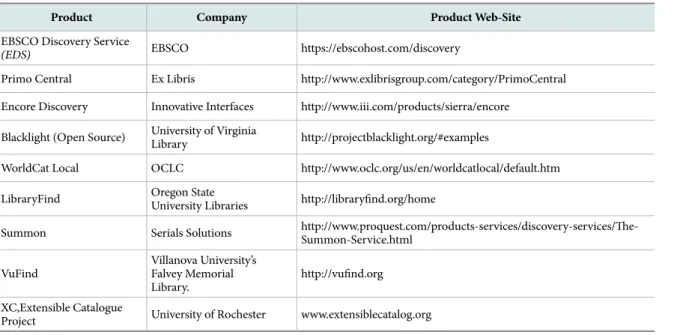
The discovery tool emerged among products that provide integrated access to books, journal articles, and other library holdings (Caplan, 2012). Some of the prominently available discovery search interfaces are mentioned in Table 1.
Discovery layers are now providing an alternate of a common gateway for retrieval of information in the library, and are gaining importance day by day among the user community. But it is the ground reality that academic libraries, where they are using discovery lay-ers, are still providing access to their resources through their legacy library catalogue and through database specific searches (Hofmann & Yang, 2012). This shows that the discovery solutions are not a complete alter-nate because they cannot replace the OPAC. Users are still using multiple database oriented search options in addition to discovery layer searching. All the library
resources are not covered in discovery layers; this re-veals that discovery layers do not index and cover all the library resources. Selection of the right discovery software for use in the library will be a difficult task, for it depends on a multitude of tangential factors (“Software Selection Methodology,” n.d.). If a library would like to implement discovery layers, they need to evaluate discovery solutions keeping in view selection criteria, pros and cons, coverage, and features (“Soft-ware Selection Methodology,” n.d.). Discovery tool search interfaces are fast and pre-indexed, providing quick retrieval of results, and some of the discovery tool products crawl local websites also. On the other side, federated search interfacing is an interface which works in a real-time environment and takes time in retrieving information. Georgas (2013) mentioned that library users always prefer fast retrieval, explaining why discovery layers are playing an important role in this direction by providing single windows access that saves users time in retrieval of information, but they are not comprehensive like federated search, and do not index everything. Conventional federated search engines are using connectors, a kind of software pro-grams to connect individual databases, while discov-ery layers are using an entirely different approach for content retrieval by extracting data and building their own internal central index (Yang & Wagner, 2010). Hoeppner (2012) and Balaji Babu & Krishnamurthy (2013) mention that discovery interfaces combined with integrated library solutions can provide the be-low-mentioned features and advantages:
• Discovery layers provide a single window interface to search multiple library databases / resources. • Integrated web-accessible online public access cat-alogues (OPACs). • Provides connection to full text via direct links and through OpenURL. • End users can organize, save, and export search results. • Provides Web 2.0 enabled features for social net-working tagging, RSS feeds, etc., that helps in en-hancing user experience in information retrieval. Web 2.0 features with customized search interfaces on library websites allows searching library resourc-es using search engine optimization techniquresourc-es. • Allows end users to personalize their user accounts
Table 1. Prominent Discovery Layers
Product Company Product Web-Site
EBSCO Discovery Service
(EDS) EBSCO https://ebscohost.com/discovery
Primo Central Ex Libris http://www.exlibrisgroup.com/category/PrimoCentral Encore Discovery Innovative Interfaces http://www.iii.com/products/sierra/encore
Blacklight (Open Source) University of Virginia Library http://projectblacklight.org/#examples
WorldCat Local OCLC http://www.oclc.org/us/en/worldcatlocal/default.htm LibraryFind Oregon State University Libraries http://libraryfind.org/home
Summon Serials Solutions http://www.proquest.com/products-services/discovery-services/The-Summon-Service.html
VuFind Villanova University’s Falvey Memorial
Library. http://vufind.org
XC,Extensible Catalogue
Project University of Rochester www.extensiblecatalog.org
• Allows the library to customize its interface. • Provides relevancy-based searched results.
• Allows users to search within the search, which can narrow results according to specific categories. • Results can be ordered in sequence of contributors,
date ranges, and so on.
• Provides options to refine search queries.
• Mobile accessible features such as text alerts, SMS reference, library applications for mobile phones, mobile OPACs, and so on.
• Personalized service features including mail deliv-ery alerts, print, save, export and e-mail functions, and so on.
3. STANDARDS
There are various protocols and standards related to information retrieval which will be applicable for discovery layers, to harvest content from web-based resources, and also to establish compatibility between the resources by implementing common metadata har-vesting protocols and practices. Therefore, organisations working towards the development of common prac-tices relating to information retrieval and management
Transmission Standard, LOCKSS (Lots of Copies Keeps Stuff Safe), and OAI-PMH, commonly implemented in digital repositories, that allows sending an HTTP request to a data provider and in response returns an XML-encoded data stream containing the metadata for a specific collection of objects. Compatibility with vari-ous protocols and implementation of standards will help keep system / discovery tools interoperable (Bharathy, Vastrad, & Kumar, 2011).
4. METHOD
In this paper, an effort is made to assess the use and importance of discovery solutions for academic law libraries in India. A survey of the top seven law library websites as mentioned below is conducted to know the availability and use of various subscribed information resources.
1. National Law School of India University (NLSIU), Bangalore
2. National Academy of Legal Studies and Research (NALSAR), Hyderabad
3. NLIU National Law Institute University (NLIU), Bhopal
4. West Bengal National University of Juridical Sci-ences (WBNUJS), Kolkata
5. National Law University (NLUJ), Jodhpur
6. Hidayatullah National Law University (HNLU), Raipur
7. Gujarat National Law University (GNLU), Gandhi-nagar
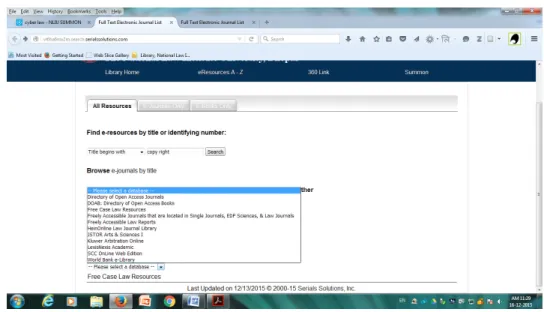
A trial access of discovery products was implemented, available online resource compatibility with discovery solutions was assessed, and observations were made during the trial access period provided by the discovery layers service provider. Further discussion was held with the representatives of discovery layer service providers, and related published literature was also consulted to know the compatibility of discovery layers with legal information resources. ProQuest web scale discovery Summon has responded in detail, and they have also extended their trial access on the campus at http://nliu. summon.serialssolutions.com. Based on trial access, re-source compatibility was tested and represented in Fig. 1.
In addition to trial access, an email was sent to the
discovery service providers to know the below-men-tioned details with reference to access and integration of resources for providing single windows search.
1. The possibility of integration of the below men-tioned information resources with discovery tools. a) Library OPAC, based on KOHA
b) Subscribed Electronic Resources: AIR Online (CDROM)
CLA (Corporate Law Advisor) database CMIE online Economic database EJURIX
Executive Chartered Secretary (CDROM) HeinOnline
JSTOR Kluwer Arbitration LexisNexis Academic Manupatra
Patents & Trade Marks Cases (CDROM) Sage Journals
SCC web
Supreme Court Cases Full Text Online (CDROM)
Taxmann Taxation Database WestLaw India
World Bank E-Library database
5. DISCUSSION AND FINDINGS
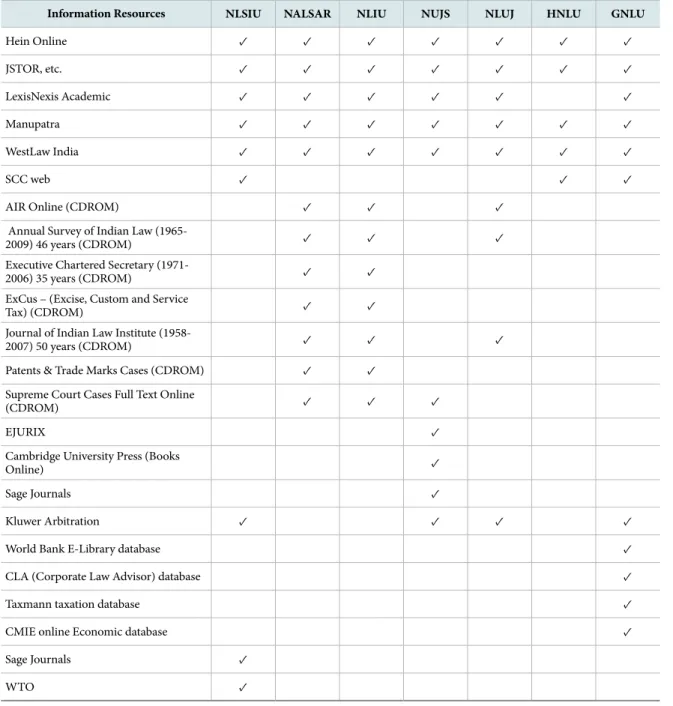
The discovery layers search interface allows a user to search multiple databases using single interfaces, and arranges output results received from various databas-es, indexed and presented to the end user in a single set of results. Based on the survey, information has been collected with reference to online databases sub-scribed to by the law university libraries represented in Table 2. There are some common databases subscribed to by law libraries, and they can be considered as im-portant databases for legal research. Any researcher who would like to search law and allied areas needs to consult the below-mentioned databases to complete their legal information search.
Database SCC Online, Manupatra, West Law India, and AIR are identified as an important resource as they cover common content related to case law. Shri-vastava, SriShri-vastava, Khare, and Pai (2012) discuss and
evaluate access to legal research and mention that there are four important legal databases in India, namely SCC Online, Manupatra, West Law India, and Lexis India. Many of these resources are also recommended by the Bar Council of India (2008). All of these data-bases are being used frequently by the legal fraternity for retrieval of case law. Rai (n.d.) compared format and coverage of the databases in her presentation and mentions that these databases cover judgments of the Supreme Court, all high courts, tribunals, and the Privy Council, and also provide access to Central and State Acts, circulars, bills, ordinances, e-books, and e-journals. There are important public domain sources for case law and State and Central Acts such as JUDIS, COURTNIC, and India Code.
Table 2 also shows that Hein Online, JSTOR, and Lexis Nexis Academic are also some other important databases commonly subscribed to by the law univer-sities; these databases cover research articles related to law and allied areas. Most of the law school libraries are subscribing to commercial online services/elec-tronic databases as an important information resource along with print resources for their users; this revealed that these databases are important for legal informa-tion retrieval, as almost all the libraries of Indian law universities are using them.
Current information retrieval practice in law librar-ies shows that users are consulting databases to search and retrieve information using database specific search interfaces, and this takes lots of time and effort. Users are consulting the library OPAC for books available in the library, and online and CDROM databases for elec-tronic information. Catalogues and library OPACs are playing an important role in connecting users with the available print resources in the library, whereas other databases provide online access or supplemental avail-able print resources. The individual resources need to be searched through their search interfaces separately. This consumes time, as the single query needs to be executed repeatedly on all of the databases for retriev-ing desired information. Users of the library need to be well aware of various database specific search tech-niques for effective information retrieval.
Table 2. Databases Subscribed by Law Universities (National Law Schools) in India
Information Resources NLSIU NALSAR NLIU NUJS NLUJ HNLU GNLU
Hein Online ✓ ✓ ✓ ✓ ✓ ✓ ✓ JSTOR, etc. ✓ ✓ ✓ ✓ ✓ ✓ ✓ LexisNexis Academic ✓ ✓ ✓ ✓ ✓ ✓ Manupatra ✓ ✓ ✓ ✓ ✓ ✓ ✓ WestLaw India ✓ ✓ ✓ ✓ ✓ ✓ ✓ SCC web ✓ ✓ ✓
AIR Online (CDROM) ✓ ✓ ✓
Annual Survey of Indian Law
(1965-2009) 46 years (CDROM) ✓ ✓ ✓
Executive Chartered Secretary
(1971-2006) 35 years (CDROM) ✓ ✓
ExCus – (Excise, Custom and Service
Tax) (CDROM) ✓ ✓
Journal of Indian Law Institute
(1958-2007) 50 years (CDROM) ✓ ✓ ✓
Patents & Trade Marks Cases (CDROM) ✓ ✓
Supreme Court Cases Full Text Online
(CDROM) ✓ ✓ ✓
EJURIX ✓
Cambridge University Press (Books
Online) ✓
Sage Journals ✓
Kluwer Arbitration ✓ ✓ ✓ ✓
World Bank E-Library database ✓
CLA (Corporate Law Advisor) database ✓
Taxmann taxation database ✓
CMIE online Economic database ✓
Sage Journals ✓
solutions because database developers do not allow their data to be indexed in a central index of the dis-covery solutions. Legal databases do not adhere to the standards of information retrieval such an open URL, OAIPMH, etc. Therefore, legal information products are not supporting interoperability related standards and protocols; therefore, information databases avail-able in the area of law are not compatible with discov-ery layer products. The discovdiscov-ery layers search inter-face allows a user to search multiple databases using single interfaces, and arranges output results received from various databases, indexed and presented to the end user in a single set of results.
Compatibility is an important aspect of providing a single window search through the discovery layer. The single window search will be very important in the domain of law also where users of information desire necessary information within a limited time span. The discovery layer is a kind of method which can play a pivotal role, and therefore the compatibility aspects of discovery layers with Indian legal resourc-es was checked, keeping in view available featurresourc-es in discovery layers like coverage of central index, rele-vancy ranking, customizability, the export capability to bibliographic management software, authentication flexibility, ease of implementation, and ongoing main-tenance.
Table 3 represents various databases which are subscribed to by Indian law libraries with their com-patibility of discovery search tools. Users cannot search Indian cases and other important legal infor-mation available in the above-mentioned databases through discovery layers, because of the unavailability of contents in a discovery tool central index system. Published literature and discussions with the vendors revealed that the central index of the discovery tool system does not index metadata related to Indian legal resources. Legal databases such as Manupatra, AIR, and SCC do not share their metadata with discovery service providers. A survey conducted by AALL’s On-line Bibliographic Services Special Interest Section (OBSSIS) and Technical Services Special Interest Sec-tion (TS-SIS) shows that internaSec-tional content avail-able in Hein Online, LexisNexis, and Westlaw supports online discovery layers (Craigle, 2011). Therefore, it can be assumed that the articles available in Hein On-line, LexisNexis, and Westlaw can be searched and
re-trieved using a discovery layer. In this regard, an email was sent to the discovery tool service providers or their representatives; in response Summon mentioned that legal resources which are not indexed in their system can be further linked to Summon for searching through the Summon link resolver.
1. SCC web 2. AIR Online
3. Annual Survey of Indian Law (1965-2009) 46 years (CDROM)
4. Executive Chartered Secretary (1971-2006) 35 years (CDROM)
5. ExCus – (Excise, Custom, and Service Tax) (CDROM)
6. Journal of Indian Law Institute (1958-2007) 50 years (CDROM)
7. Patents & Trade Marks Cases (CDROM)
8. Supreme Court Cases Full Text Online (CDROM) 9. EJURIX
10. CLA (Corporate Law Advisor) database 11. Taxmann taxation database
12. CMIE online Economic database
Discovery tool products are usually deployed along-side or as an outright replacement to a traditional online public access catalogue (OPAC); on the other hand, software developers working for library LMS have also gone out of their way to develop next gener-ation catalogues. The latest available integrated search interfaces in the form of library OPAC are enriched with more user oriented Web 2.0 enabled features. Li-brary management software such as Ex Libris, Primo, III’s Encore, and VTLS’ Visualizer are a few examples in this category. In India, discovery layers are not very popular among the libraries, including law libraries, but internationally law libraries are providing an inter-face for searching the library OPAC/catalogue through discovery layers.
Table 3. Resource (Subscribed Databases) Compatibility with Discovery Layers
Resources Subscribed by Law Schools Resource Compatibility with discovery layers
AIR Online (CDROM) Not compatible
CLA (Corporate Law Advisor) database Not compatible
CMIE online Economic database Not compatible
EJURIX Not compatible
Executive Chartered Secretary (1971-2006) 35 years (CDROM) Not compatible
HeinOnline ✓
JSTOR, etc. ✓
Kluwer Arbitration ✓
LexisNexis Academic ✓
Manupatra Not compatible
Patents & Trade Marks Cases (CDROM) Not compatible
Sage Journals ✓
SCC web Not compatible
Supreme Court Cases Full Text Online (CDROM) Not compatible
Taxmann Taxation Database Not compatible
WestLaw India Yes
World Bank E-Library database ✓
WTO ✓
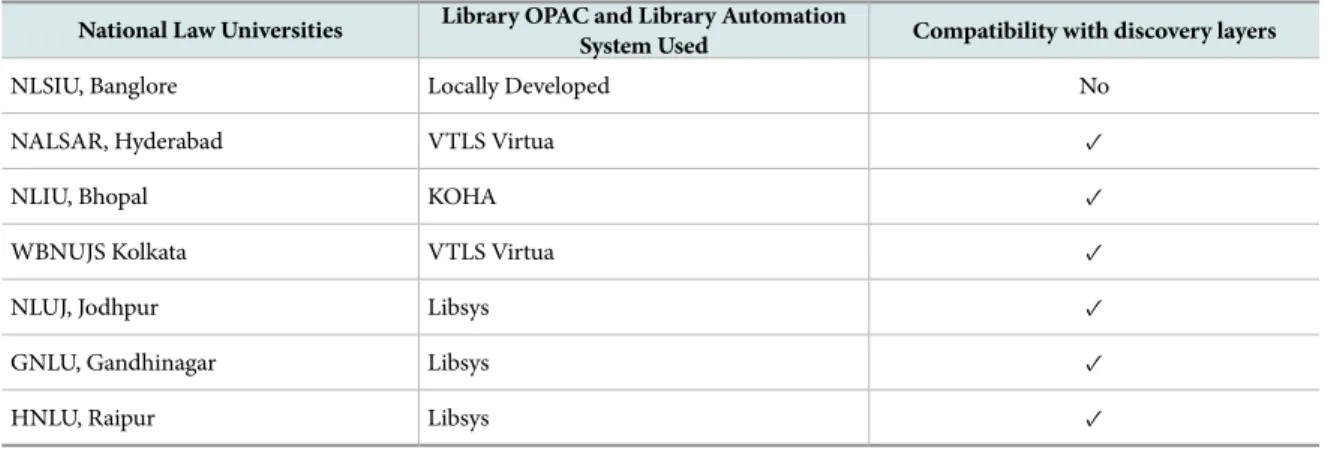
Table 4. Library Softwares Compatibility with Discovery Layers
National Law Universities Library OPAC and Library Automation System Used Compatibility with discovery layers
NLSIU, Banglore Locally Developed No
NALSAR, Hyderabad VTLS Virtua ✓
NLIU, Bhopal KOHA ✓
WBNUJS Kolkata VTLS Virtua ✓
NLUJ, Jodhpur Libsys ✓
GNLU, Gandhinagar Libsys ✓
the libraries from outside India have already integrated VuFind’s interface with KOHA. Vufind is an open source discovery tool solution; it provides unified OPAC 2.0 based characteristics. MARC compliant OPAC records, digital items available in digital library systems, institu-tional repository resources, third party library collec-tions, and subscribed resources can be integrated with it. VuFind is completely modular, allows libraries to use either a basic configuration or all the components, and it supports interoperability and content integration with product such as Primo Central, EbscoHost, Summon and WorldCat (“VuFind,” 2015).
Law libraries need to identify appropriate selection criteria for choosing discovery layers, which can cover maximum resources. Chickering and Yang (2014) sug-gested a list of criteria for the purpose of the evaluation discovery layers; the criteria need to be used for software selection related to discovery layers. Law is a knowledge driven discipline, where information is a very important commodity and professionals working in this disci-pline as lawyers, academicians, and researchers want to keep themselves up-to-date with related information. Therefore, technology developers have introduced legal databases to obtain legal information for law profession-als. Library users have to search multiple electronic re-sources as part of their legal research; various databases available in the area of law and allied subjects have their own style of search and retrieval (Sloan, 2009). Infor-mation researchers should have possible bibliographic control in a related domain/ subject area, and they should not inadvertently miss any relevant resource. Discovery tool products can play an important role in this regard. Users from the area of law and allied areas need to be well aware about the process of information retrieval and kinds of information available in a partic-ular database. Primary legal information such as case law is available under public domain categories, due to the fact that many aggregators are providing access to legal information resources through their products. But this multiplicity creates confusion for the users of legal information resources to retrieve information. Duplicate or similar kinds of content in a range of databases, and similar or same articles/books, are indexed and bundled in multiple online products. The possible solution could be single window access to the information resources through discovery solutions.
6. CONCLUSION
Ideally, libraries can maximise resource usage by in-tegrating multiple resources in a single window, single search mechanism. Users of the library will be happy if they can retrieve desired information using a single search query/single search box/single search interface, as it will save their time. The discovery layers can facili-tate this feature, but unfortunately not all legal database developers have made available their content for integra-tion with discovery layer soluintegra-tions. Lack of database cov-erage and integration with metadata, OAI/PMH, Dublin core, and MARC, and interoperability with existing content repositories are some issues related to discovery layers that minimise their usage in law libraries. Com-patibility of discovery layer with subscribed resources available in law libraries shows that case law resources are one of the most important resources for retrieval of primary information in the area of law. But unfortu-nately they are not covered by any of the discovery tool service provider. In this situation, law libraries can avail only half solutions from the discovery layers for their users. Although library OPACs and other important international resources can be integrated with discovery solutions, discovery layers are not of much use in the present context in Indian law libraries.
Some of our observations and findings can generalise that:
• Local and international databases are incompatible with the central index of the discovery tool solutions; this means they will not be accessible through dis-covery tool solutions.
• All databases are not developed around the OpenURL and other interoperable standards; due to this they cannot be integrated with the discovery layers as well as with the link resolving services to access full text.
da-tabases need to adhere to the standards of information retrieval; that will allow integration with discovery inter-faces.
REFERENCES
Balaji Babu, P., & Krishnamurthy, M. (2013). Library automation to resource discovery: A review of emerging challenges. The Electronic Library, 31(4), 433–451.
Bharathy, J., Vastrad, G., & Kumar, P. D. (2011). Fed-erated search and discovery tools. Retrieved from http://ir.inflibnet.ac.in/handle/1944/1599.
Bing, J. (2010). Let there be lite: A brief history of legal information retrieval. European Journal of Law and Technology, 1(1). Retrieved from http://ejlt.org/arti-cle/view/15.
Breeding, M. (2010). Library technology guides: Dis-covery products. Retrieved from http://librarytech-nology.org/discovery.
Breeding, M. (2015). The future of library resource dis-covery: A white paper commissioned by the NISO Discovery to Delivery (D2D) Topic Committee. NISO.
Campbell, D. (2010). Library discovery services – A bet-ter way to find what you’re looking for. Retrieved from http://exchanges.wiley.com/blog/2010/12/22/ library-discovery-services-a-better-way-to-find-what-youre-looking-for.
Caplan, P. (2012). On discovery tools, OPACs and the motion of library language. Library Hi Tech, 30(1), 108–115.
Chickering, F. W., & Yang, S. Q. (2014). Evaluation and comparison of discovery tools: An update. Informa-tion Technology and Libraries, 33(2), 5–30. http:// doi.org/10.6017/ital.v33i2.3471.
Craigle, V. (2011). Discovery layers in law libraries. AALL Spectrum, 7. Retrieved from http://www.aall- net.org/mm/Publications/spectrum/archives/Vol-16/No-3/discovery-layers.pdf.
Das, A. K. (2015). Information retrieval and search pro-cess in web-scale discovery tools. E-Library Science Research Journal, 3(8). Retrieved from http://www. lsrj.in/ArticleDetails.aspx?id=501.
Exploring usability enhancements in W3C Process - slide “Usability - ISO 9241 definition” (n.d.).
Retrieved May 6, 2016, from https://www. w3.org/2002/Talks/0104-usabilityprocess/slide3-0. html.
Georgas, H. (2013). Google vs. the library: Student pref-erences and perceptions when doing research using Google and a federated search tool. Portal: Libraries and the Academy, 13(2), 165–185.
Gibson, I., Goddard, L., & Gordon, S. (2009). One box to search them all: Implementing federated search at an academic library. Library Hi Tech, 27(1), 118– 133. http://doi.org/10.1108/07378830910942973. Goodsett, M. (2014). Discovery search tools: A
compar-ative study. Reference Reviews, 28(6), 2–8.
Gross, J. M., & Sheridan, L. L. (2011). Web scale discovery: The user experience. New Li-brary World, 112(5/6), 236–247. http://doi. org/10.1108/03074801111136275.
Hoeppner, A. (2012). The ins and outs of evaluating web-scale discovery services. Computers in Librar-ies, 32(3), 6.
Hofmann, M. A., & Yang, S. Q. (2012). “Discovering” what’s changed: A revisit of the OPACs of 260 aca-demic libraries. Library Hi Tech, 30(2), 253–274. Levor, R. (2004). The unique role of academic law
librar-ies. Marketing Toolkit Task Force, AALL Academic Law Libraries Special Interest Section’s Marketing Toolkit for Academic Law Libraries. Retrieved from http://eduscapes.com/marketing/articles/unique_ role.pdf.
NISO ODI (2014). Open Discovery Initiative - National Information Standards Organization. Retrieved from http://www.niso.org/workrooms/odi.
Pinkas, M. M., Baglivo, M. D., Klein, I. R., Brown, E., Harris, R., & Gerhart, B. (2014). Selecting and implementing a discovery tool: The University of Maryland Health Sciences and Human Services Li-brary experience. Journal of Electronic Resources in Medical Libraries, 11(1), 1–12.
Pope, B. M. (2009). NELLCO’s universal search solu-tion: A report on a NASIG 2009 conference session. Collaborative Librarianship 1(4), 148–150.
Principles of website usability | 5 key principles of good website usability (2013, March 26). Retrieved from https://blog.crazyegg.com/2013/03/26/princi-ples-website-usability.
http://www.carli.illinois.edu/prod-ucts-services.
Rai, P. (n. d.). Access to Indian legal information in dig-ital environment: A comparative study of electronic commercial databases and public domain resourc-es in law. Retrieved from www.aallnet.org/gm-node/41427.aspx.
Saha, T. K. (2010). Textbook on legal methods, legal systems & research. New Delhi: Universal Law Pub-lishing. Retrieved from http://books.google.co.in/ books?hl=en&lr=&id=cOUpZcAfZWoC&oi=f- nd&pg=PR5&dq=Textbook+on+Legal+Meth- ods,+Legal+Systems+%26+Research&ots=z0I- u69D8Q3&sig=w2KBHAPDXINxkbcXQDAG-FqIuoE0.
Shapiro, S. D. (2014). Discovery tools as electronic billboards to market your library. Library Hi Tech News, 31(10), 10–12.
Shrivastava, R. K., Srivastava, M., Khare, B. B., & Pai, G. (2012). Computer assisted legal research with spe-cial reference to Indian legal contents: Retrospect and prospect. In R. Singh, S. D. Rao, P. Rai, & A. Singh (Eds.), Access to legal information & research in digital age (p. 49). New Delhi: NLUD. Retrieved from http://www.nludelhi.ac.in/download/publica- tion/2015/Access%20to%20LEgal%20Informatio-na%20and%20Research%20in%20Digital%20Age. pdf#page=56.
Sloan, A. E. (2009). Basic legal research: Tools and strat-egies (4th ed). New York: Wolters Kluwer Law & Business; Aspen Publishers.
Software selection methodology for library discovery layer systems (n. d.). Retrieved July 14, 2015, from https://foss4lib.org/book/export/html/4779. Thanuskodi, S. (2009). Information-seeking behavior of
law faculty at Central Law College, Salem. Library Philosophy and Practice (e-journal). Retrieved from http://digitalcommons.unl.edu/libphilprac/282. The Bar Council of India. (2008). Education Rules 2008.
Delhi: The Bar Council of India. Retrieved from http://www.barcouncilofindia.org/about/legal-edu-cation/education-rules-2008.
Theresa, A. U., & Jerome, I. O. (2010). The role of digital library in law research. International Journal of Li-brary and Information Science, 2(6), 108–113. Tredwell, S. (2013, November 6). The problem with
discovery tools and law firm libraries – Slaw. Slaw
Canada’s Online Legal Magazine. Retrieved from http://www.slaw.ca/2013/11/06/the-problem-with-discovery-tools-and-law-firm-libraries.
Usable (n. d.). Merriam-Webster Dictionary. Retrieved May 6, 2016, from http://www.merriam-webster. com/dictionary/usable.
VuFind - Search. Discover. Share. (2015). Retrieved August 7, 2015, from http://vufind-org.github.io/ vufind.
Yang, S. Q., & Wagner, K. (2010). Evaluating and com-paring discovery tools: How close are we towards next generation catalog? Library Hi Tech, 28(4), 690–709.