ISSN 2234-3806 • eISSN 2234-3814
88 www.annlabmed.org https://doi.org/10.3343/alm.2020.40.1.88 Ann Lab Med 2020;40:88-91
https://doi.org/10.3343/alm.2020.40.1.88
Letter to the Editor
Diagnostic Immunology
Relationship of Circulating Cytomegalovirus Levels Obtained Through Antigenemia Testing and
Quantitative PCR Differs Between Children and Adults
Sooin Choi , M.D.1, Yae-Jean Kim , M.D.2, Keon Hee Yoo , M.D.2, Ki Woong Sung , M.D.2, Hong Hoe Koo , M.D.2, Suk Jin Kim , M.D.3, Jun Ho Jang , M.D.3, Kihyun Kim , M.D.3, Chul Won Jung , M.D.3, Hee-Jae Huh , M.D.4, and Eun-Suk Kang , M.D.4
1Department of Laboratory Medicine, Soonchunhyang University Hospital Cheonan, Soonchunhyang University College of Medicine, Cheonan, Korea;
2Department of Pediatrics, Samsung Medical Center, Sungkyunkwan University School of Medicine, Seoul, Korea; 3Division of Hematology-Oncology, Samsung Medical Center, Sungkyunkwan University School of Medicine, Seoul, Korea; 4Department of Laboratory Medicine and Genetics, Samsung Medical Center, Sungkyunkwan University School of Medicine, Seoul, Korea
Dear Editor,
Cytomegalovirus (CMV) infection is a major complication in pa- tients who undergo hematopoietic stem cell transplantation (HSCT); thus, surveillance of CMV infection or reactivation is widely performed to prevent disease progression. Although the CMV antigenemia test has long been used for CMV detection [1], it has several limitations such as a requirement for fresh blood samples, subjective interpretation, and reduced feasibility in neutropenic patients [2]. Recently, CMV quantitative (Q)-PCR has emerged as an alternative to antigenemia testing [3]. Nev- ertheless, there is no universal threshold of circulating DNA val- ues for initiating antiviral therapy in HSCT patients. In addition, the DNA values used to reflect the clinical course may vary among patients because of different therapeutic interventions and age effects. This is the first report to evaluate the relation- ship of the results of the CMV antigenemia testing and Q-PCR in different age groups of patients undergoing HSCT and to show the impact of age on this relationship. Our results may be useful to establish appropriate threshold values for pediatric and adult patients in similar clinical conditions.
The antigenemia testing (CINA Kit system, Argene Biosoft, Varilhes, France) and Q-PCR (Real-Q CMV DNA quantification kit, BioSewoom, Seoul, Korea) using EDTA-treated whole blood derived DNA (MagNa Pure 96 DNA and Viral NA small volume kit, Roche, Manheim, Germany) were performed simultaneously in HSCT patients to monitor CMV infection at Samsung Medical Center, Seoul, Korea, from June 2016 to December 2017. Ret- rospective data (2,474 results) were collected from 75 children and 173 adults. The DNA value was generated in standardized units of IU/mL. This study was approved by the Institutional Re- view Board of Samsung Medical Center (IRB No. SMC 2018- 04-056-001), and informed consent was waived.
The relationship between the results of the antigenemia test- ing and Q-PCR was analyzed by Deming regression analysis;
P <0.05 was considered statistically significant. After excluding DNA values outside the linear range or without associated CMV antigenemia results, 516 results were included. The threshold DNA values corresponding to multiple CMV antigenemia values that are considered significant for a clinical decision at our insti- tute were calculated. Youden index were determined through
Received: April 2, 2019 Revision received: May 5, 2019 Accepted: July 11, 2019
Corresponding author: Eun-Suk Kang, M.D.
Department of Laboratory Medicine and Genetics, Samsung Medical Center, Sungkyunkwan University School of Medicine, 81 Irwon-ro, Gangnam-gu, Seoul 06351, Korea
Tel: +82-2-3410-2703, Fax: +82-2-3410-2719, E-mail: [email protected]
© Korean Society for Laboratory Medicine
This is an Open Access article distributed under the terms of the Creative Commons Attribution Non-Commercial License (http://creativecommons.org/licenses/by-nc/4.0) which permits unrestricted non-commercial use, distribution, and reproduction in any medium, provided the original work is properly cited.
1 / 1 CROSSMARK_logo_3_Test
2017-03-16 https://crossmark-cdn.crossref.org/widget/v2.0/logos/CROSSMARK_Color_square.svg
Choi S, et al.
CMV antigenemia and Q-PCR
https://doi.org/10.3343/alm.2020.40.1.88 www.annlabmed.org 89
ROC curve analysis after excluding the upper 5% and lower 5%
of DNA values, using SAS version 9.4 (SAS Institute Inc., Cary, NC, USA).
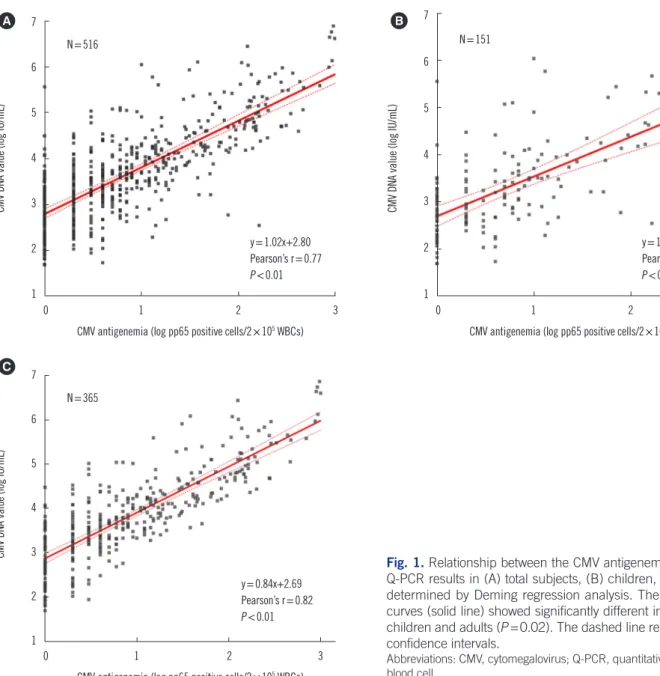
The linear regression curves were analyzed using 516 results with significantly different intercepts in the child and adult groups (P =0.02, Fig. 1). The predicted threshold values of CMV DNA that corresponded to clinically significant CMV antigenemia lev- els of 1, 5, 10, 15, 20, and 25 positive cells/2×105 white blood cells (WBCs) were 158, 316, 316, 1,122, 1,413, and 1,413 IU/
mL in children, and 158, 1,995, 2,512, 4,467, 4,467, and 6,310 IU/mL in adults, respectively. The proposed optimal thresholds of DNA values and their ability to predict the corresponding CMV
antigenemia levels are presented in Table 1.
Children and adults tend to differ significantly in physiology, metabolic state, physical size, body fluid compartments, and immune responses [4]. Thus, CMV replication kinetics evalu- ated by different targets (i.e., DNA or antigens) are likely to also differ according to age. Compared with adults, we found that children have significantly lower DNA values over a wide range of CMV antigenemia levels, including clinically significant levels.
Several studies have suggested various threshold DNA values for clinical decision-making depending on the sample used (whole blood [5, 8, 10], plasma [3, 6], and cells [9]) and type of trans- plant (HSCT [6-10] and solid organ transplantation (SOT) [3, 6,
Fig. 1. Relationship between the CMV antigenemia and CMV DNA Q-PCR results in (A) total subjects, (B) children, and (C) adults as determined by Deming regression analysis. The linear regression curves (solid line) showed significantly different intercepts between children and adults (P =0.02). The dashed line represents the 95%
confidence intervals.
Abbreviations: CMV, cytomegalovirus; Q-PCR, quantitative PCR; WBC, white blood cell.
7 6 5 4 3 2
1
0 1 2 3
CMV antigenemia (log pp65 positive cells/2×105 WBCs)
CMV DNA value (log IU/mL)
y=1.02x+2.80 Pearson’s r=0.77 P <0.01 N=516
A 7
6
5 4
3 2
1
0 1 2 3
CMV antigenemia (log pp65 positive cells/2×105 WBCs)
CMV DNA value (log IU/mL)
y=1.04x+2.87 Pearson’s r=0.62 P <0.01 N=151
B
7 6 5 4 3 2
1
0 1 2 3
CMV antigenemia (log pp65 positive cells/2×105 WBCs)
CMV DNA value (log IU/mL)
y=0.84x+2.69 Pearson’s r=0.82 P <0.01 N=365
C
Choi S, et al.
CMV antigenemia and Q-PCR
90 www.annlabmed.org https://doi.org/10.3343/alm.2020.40.1.88 7]). SOT recipients tended to have higher DNA values than HSCT
recipients [6, 7]. Boaretti, et al. [1] suggested 2,275 IU/mL as the threshold DNA value comparable to a CMV antigenemia level of 20 positive cells/2 ×105 WBCs, which differs strikingly from the 4,467 IU/mL threshold we determined. This difference could be due to variations in the sample type (plasma vs whole blood) or clinical conditions (SOT vs HSCT). These issues need to be further validated by standardization of the sample type for CMV Q-PCR analysis in different patient groups, and eventually by correlation with clinical course or outcome.
In conclusion, we found that relationships of CMV Q-PCR and CMV antigenemia test results differ significantly between chil- dren and adults who have undergone HSCT. Thus, threshold DNA values might need to be adjusted according to patient char- acteristics, to optimize anti-CMV therapeutic efficacy and im- prove the clinical outcome.
Acknowledgements
We thank Kyunga Kim and Heejin Yoo from Statistics and Data Center, Research Institute for Future Medicine, Samsung Medi- cal Center, for statistical support.
Author Contributions
ESK conceived the study; SC and ESK conducted the research described; SC performed the statistical analysis; all authors con-
tributed to writing the final manuscript. All authors have accepted their responsibility for the entire content of this manuscript and approved submission.
Conflict of Interest
None declared.
Research Funding
None declared.
ORCID
Sooin Choi https://orcid.org/0000-0003-4746-4809 Yae-Jean Kim https://orcid.org/0000-0002-8367-3424 Keon Hee Yoo https://orcid.org/0000-0002-5980-7912 Ki Woong Sung https://orcid.org/0000-0001-5989-4772 Hong Hoe Koo https://orcid.org/0000-0001-8082-1412 Suk Jin Kim https://orcid.org/0000-0002-2776-4401 Jun Ho Jang https://orcid.org/0000-0001-7423-4676 Kihyun Kim https://orcid.org/0000-0002-5878-8895 Chul Won Jung https://orcid.org/0000-0002-5474-6807 Hee-Jae Huh https://orcid.org/0000-0001-8999-7561 Eun-Suk Kang https://orcid.org/0000-0001-6386-6520 Table 1. Performance of predicted optimal threshold values of CMV DNA measured by quantitative PCR corresponding to each value of CMV antigenemia in children and adult
Patient group Patients, N
(Results, N) Median age,
year (IQR) CMV antigenemia
(/2×105 WBCs) Optimal CMV DNA
threshold (IU/mL)* Sensitivity (%)
(95% CI) Specificity (%) (95% CI)
Children (<18 years) 75 (746) 8 (5–12) 1 150 85.8 (79.6–90.4) 84.4 (81.3–87.1)
5 300 98.6 (92.5–99.8) 82.6 (79.6–85.3)
10 300 97.7 (87.9–99.6) 79.2 (76.1–82.1)
15 1,100 90.0 (74.4–96.5) 89.8 (87.4–91.8)
20 1,400 92.0 (75.0–97.8) 91.0 (88.7–92.9)
25 1,400 91.3 (73.2–97.6) 90.7 (88.4–92.6)
Adults (≥18 years) 173 (1,728) 48 (36–57) 1 150 92.9 (89.8–95.1) 84.2 (82.2–86.1)
5 2,000 95.6 (91.8–97.7) 91.7 (90.2–93.0)
10 2,500 98.7 (95.2–99.6) 91.0 (89.4–92.3)
15 4,500 96.7 (91.9–98.7) 92.9 (91.5–94.1)
20 4,500 98.0 (93.1–99.5) 91.9 (90.5–93.1)
25 6,300 97.9 (92.7–99.4) 93.6 (92.3–94.7)
*Estimated Youden Index through ROC curve analysis.
Abbreviations: CMV, cytomegalovirus; IQR, interquartile range; WBC, white blood cells; CI, confidence interval.
Choi S, et al.
CMV antigenemia and Q-PCR
https://doi.org/10.3343/alm.2020.40.1.88 www.annlabmed.org 91
REFERENCES
1. Caliendo AM, St George K, Kao SY, Allega J, Tan BH, LaFontaine R, et al. Comparison of quantitative cytomegalovirus (CMV) PCR in plasma and CMV antigenemia assay: clinical utility of the prototype AMPLICOR CMV MONITOR test in transplant recipients. J Clin Microbiol 2000;38:
2122-7.
2. Bontant T, Sedlacek P, Balduzzi A, Gaspar B, Cesaro S, Einsele H, et al.
Survey of CMV management in pediatric allogeneic HSCT programs, on behalf of the inborn errors, infectious diseases and pediatric diseases working parties of EBMT. Bone Marrow Transplant 2014;49:276-9.
3. Boaretti M, Sorrentino A, Zantedeschi C, Forni A, Boschiero L, Fontana R. Quantification of cytomegalovirus DNA by a fully automated real-time PCR for early diagnosis and monitoring of active viral infection in solid organ transplant recipients. J Clin Virol 2013;56:124-8.
4. Tahmasebi H, Higgins V, Fung AWS, Truong D, White-Al Habeeb NMA, Adeli K. Pediatric reference intervals for biochemical markers: gaps and challenges, recent national initiatives and future perspectives. EJIFCC 2017;28:43-63.
5. Li H, Dummer JS, Estes WR, Meng S, Wright PF, Tang YW. Measure- ment of human cytomegalovirus loads by quantitative real-time PCR for monitoring clinical intervention in transplant recipients. J Clin Microbiol
2003;41:187-91.
6. Kalpoe JS, Kroes AC, de Jong MD, Schinkel J, de Brouwer CS, Beers- ma MF, et al. Validation of clinical application of cytomegalovirus plas- ma DNA load measurement and definition of treatment criteria by anal- ysis of correlation to antigen detection. J Clin Microbiol 2004;42:1498- 504.
7. Cariani E, Pollara CP, Valloncini B, Perandin F, Bonfanti C, Manca N.
Relationship between pp65 antigenemia levels and real-time quantita- tive DNA PCR for human cytomegalovirus (HCMV) management in im- munocompromised patients. BMC Infect Dis 2007;7:138.
8. Choi SM, Lee DG, Lim J, Park SH, Choi JH, Yoo JH, et al. Comparison of quantitative cytomegalovirus real-time PCR in whole blood and pp65 antigenemia assay: clinical utility of CMV real-time PCR in hematopoiet- ic stem cell transplant recipients. J Korean Med Sci 2009;24:571-8.
9. Peres RM, Costa CR, Andrade PD, Bonon SH, Albuquerque DM, de Oliveira C, et al. Surveillance of active human cytomegalovirus infection in hematopoietic stem cell transplantation (HLA sibling identical donor):
search for optimal cutoff value by real-time PCR. BMC Infect Dis 2010;
10:147.
10. Kwon S, Jung BK, Ko SY, Lee CK, Cho Y. Comparison of quantitation of cytomegalovirus DNA by real-time PCR in whole blood with the cyto- megalovirus antigenemia assay. Ann Lab Med 2015;35:99-104.