H Akbas, et al
88 Ann Dermatol
Received January 3, 2013, Revised February 3, 2013, Accepted for publication February 20, 2013
Corresponding author: Halit Akbas, Department of Medical Biology, Medical Faculty, University of Harran, Yenişehir Terleşkesi Sanliurfa 63300, Turkey. Tel: 90-414-3183127, Fax: 90-414-3183192, E-mail:
This is an Open Access article distributed under the terms of the Creative Commons Attribution Non-Commercial License (http://
creativecommons.org/licenses/by-nc/3.0) which permits unrestricted non-commercial use, distribution, and reproduction in any medium, provided the original work is properly cited.
Ann Dermatol Vol. 26, No. 1, 2014 http://dx.doi.org/10.5021/ad.2014.26.1.88
ORIGINAL ARTICLE
Lack of Association between PTPN22 Gene +1858 C>T Polymorphism and Susceptibility to Generalized Vitiligo in a Turkish Population
Halit Akbas, Selma Bakar Dertlioglu1, Fuat Dilmec, Ahmet Engin Atay2
Department of Medical Biology, Medical Faculty, University of Harran, Sanliurfa,
1Department of Dermatology, Medical Faculty, University of Firat, Elazıg,
2Department of Internal Medicine, Bagcilar Education and Research, İstanbul, Turkey
Background: Vitiligo is an autoimmune polygenic disorder characterized by loss of pigmentation due to melanocyte destruction. The PTPN22 gene +1858 C>T single nucle- otide polymorphism (rs2476601) has been shown to be associated with various autoimmune disorders. Objective:
The aim of this study was to investigate whether the PTPN22 gene +1858 C>T single nucleotide polymorphism is associated with susceptibility to generalized vitiligo in a Turkish population. Methods: One hundred and seven pa- tients with generalized vitiligo, and one hundred and twelve gender-, age-, and ethnic-matched controls were enrolled in the study. Genotyping was done by polymerase chain reaction- restriction fragment length polymorphism. Results:
The PTPN22 +1858 C>T genotype and allele frequencies of the generalized vitiligo patients did not differ significantly from those of healthy controls. Conclusion: We found no association between the PTPN22 +1858 C>T gene poly- morphism and vitiligo susceptibility in Turkish generalized- vitiligo patients. (Ann Dermatol 26(1) 88∼91, 2014) -Keywords-
Polymerase chain reaction-restriction fragment length polymorphism, PTPN22 gene, Vitiligo
INTRODUCTION
Vitiligo is an acquired hypomelanotic skin disorder cha- racterized by circumscribed depigmented macules resul- ting from the loss of functional melanocytes from the cutaneous epidermis. Familial aggregation of vitiligo is common and usually occurs in non-Mendelian patterns, which suggests a polygenic, multifactorial mode of inhe- ritance. Several genes such as PTPN22, MHC, CTLA4, NALP1, IL1-RN, AIS1, AIS2, AIS3, and CD4 which are also involved in autoimmunity, have been implicated in the pathogenesis of vitiligo1-3. The PTPN22 gene is located on chromosome 1p13 and encodes the lymphoid protein tyrosine phosphatase (LYP). LYP acts as a suppressor of T-cell activation and interacts with C-terminal Src kinase (CSK) which is involved in signal transduction of T-cell activation and inhibition of T-cell overactivity4-6. The PTPN22 gene 1858 C>T functional polymorphism is strongly associated with a group of autoimmune disorders including vitiligo7. The 1858 T allele of the PTPN22 gene results in hyper-responsive T cells, and patients carrying this allele have a higher risk of developing autoimmune disorders.
Controversy surrounds reports on the association between vitiligo and the PTPN22 +1858 C>T polymorphism in different ethnic groups. Three separate studies conducted in English, Romanian, and English-North American popu- lations determined an association between generalized vitiligo and the PTPN22 C>T single nucleotide polymor- phism7-9. In contrast, Laddha et al.10 and Alkhateeb et al.11 found no significant association between the PTPN22 1858 C>T polymorphism and generalized vitiligo in Gujarat Indian and Jordanian populations, respectively.
The objective of this study was to determine a possible
PTPN22 Gene Polymorphism and Vitiligo
Vol. 26, No. 1, 2014 89 Fig. 1. Polymerase chain reaction-restriction fragment length polymorphism analysis of the PTPN22 gene 1858 C/T polymor- phism obtained by 2% agarose gel electrophoresis. Lane M shows 100∼1,500 bp DNA ladder (Bio Basic Inc.). Lanes 1, 2 and 3 show subjects with homozygous alleles (C/C) with one intact band. Lanes 4, 5 and 6 show subjects with heterozygous alleles (C/T) showing digestion of the 400 bp product into 238 bp and 162 bp bands. No subject with homozygous allele (T/T) was observed.
association between the PTPN22 1858 C>T gene polymorphism and generalized vitiligo susceptibility in a Turkish population.
MATERIALS AND METHODS
One hundred and seven patients (53 male and 54 female) who were diagnosed with generalized vitiligo and fol- lowed up in the Department of Dermatology, Medical School of Harran University were enrolled in the study.
One hundred and twelve (57 male and 55 female) sex-, age-, and ethnic-matched subjects without any clinical evidence of vitiligo or any other autoimmune disorders were enrolled as control subjects. The study was approved by Harran University Medical Faculty Ethics Committee and was conducted according to the Declaration of Helsinki of 1975. All participants were informed about the nature of the study, and written informed consent was obtained.
Genomic DNA was extracted from peripheral blood leucocytes using a standard salting out procedure, as described by Miller et al.12. Polymerase chain reaction (PCR)-restriction fragment length polymorphism (RFLP) assays were used to determine the +1858 C>T single nucleotide polymorphism (rs2476601) of the PTPN22gene as previously described10,13. PCR amplification was gene- rated using the following oligonucleotide primers: forward 5'-GCCTCAATGAACTCCTCAA-3' and reverse 5'- CCTCC- TGGGTTTGTACCTTA - 3' (product of 400 bp).
To amplify the region containing the +1858 C>T poly- morphism of exon 14 of the PTPN22 gene, the PCR reaction was carried out in a 10 μl reaction volume containing 1×PCR buffer, 2 mM MgCl2, 0.2 mM each deoxynucleotide triphosphate (dNTPs; Fermentas, St.
Leon-Rot, Germany), 40 ng of DNA, 0.2 μM of each primer (Bio Basic Inc., Markham, ON, Canada), and 0.5 unit of Taq DNA Polymerase (Fermentas). The PCR con- ditions were: 3 minutes of initial denaturation at 94oC, followed by 30 cycles at 95oC for 30 seconds, 30 seconds at 60oC for annealing, and 30 seconds at 72oC for extension, followed by 5 minutes at 72oC for final ex- tension. The PCR products were 400 bp.
For the RFLP analysis, PCR-amplified products were digested with XcmI for 14 hours at 37oC (New England Biolabs, Hertfordshire, UK). Anamplicon with ahomo- zygous TT allele of PTPN22 was cleaved by XcmI, yielding 238 and 162 bp fragments, whereas anamplicon with a homozygous CC allele remained uncut, yielding a 400 bp band. An amplicon with a heterozygous CT allele yielded three fragments of 400, 238, and 162 bp in length. The digested products were separated on a 2%
agarose gel along with a 100 to 1,500 bp DNA ladder (Bio Basic Inc.). Ethidium bromide-stained gels were visualized under ultraviolet light using the Alpha Imager System (AlphaInnotech, San Leandro, CA, USA) (Fig. 1).
Statistical analysis
Data are reported as means±standard deviation, and statistical analyses were performed using the SPSS Sta- tistical package, version 11.5 for Windows (SPSS Inc., Chicago, IL, USA). The normality of distribution was evaluated by the Kolmogorov-Smirnov test, and the normally distributed data were analyzed by Student’s t-test. Genotype distributions and allele frequencies of the PTPN22 gene 1858 C>T polymorphism were analyzed with the chi-square test. All the statistical tests were two-sided, and a p-value<0.05 was considered to be statistically significant.
RESULTS
One hundred and seven patients with generalized vitiligo comprised of 54 females and 53 males and 112 unrelated healthy individuals comprised of 55 females and 57 males, with no autoimmune disease from the same geographical region of Turkey were enrolled in the study.
The mean ages of the patients and the control groups were 27.42±14.15 and 28.38±14.41, respectively. No statis- tically significant difference in age or gender distribution was observed between the patient and the control groups (p>0.05). The demographic characteristics of the study group are shown in Table 1.
The genotype distributions and allele frequencies of the PTPN22 +1858 C>T polymorphism in the generalized
H Akbas, et al
90 Ann Dermatol
Characteristic Patient group Control group p-value Age (yr) 27.42±14.15 28.38±14.41 >0.05
Sex (female/male) 54/53 55/57 >0.05
Values are presented as mean±standard deviation or number only.
Table 1. Demographic characteristics of the study group
PTPN22+1858 C/T Patient group (n=107) Control group (n=112) OR 95% CI p-value Genotype
CC 102 (95) 105 (94) 1
CT 5 (5) 7 (6) 0.73 0.22∼2.39 0.60
TT - -
Allele
C 209 (98) 217 (97) 1
T 5 (2) 7 (3) 0.74 0.23∼2.37 0.61
Values are presented as number (%). OR: odds ratio, CI: confidence interval.
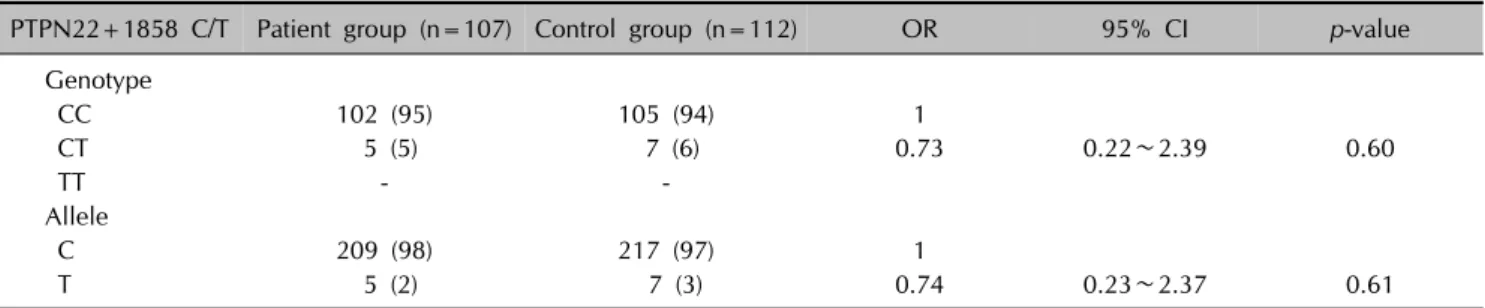
Table 2. Genotype distributions and allele frequencies of PTPN22 +1858 C/T polymorphism in vitiligo patients and healthy control vitiligo patients and healthy controls are shown in Table 2.
The genotype frequencies of the PTPN22 +1858 C>T polymorphism were assessed in Hardy-Weinberg equili- brium in both the patients and healthy controls. The frequency of the CC and CT genotypes were 95% (102) and 5% (5) in the generalized vitiligo patients, respec- tively, and 94% (105) and 6% (7) in the healthy controls, respectively. There was no statistically significant diffe- rence between the generalized vitiligo patients and heal- thy controls according to the frequency of the heterozy- gote genotype (odds ratio [OR]: 0.73, 95% confidence interval [CI]: 0.22 to 2.39, p=0.60). The homozygote genotype (TT) was absent in both the generalized vitiligo patients and healthy controls. In addition, there was no significant difference between the patient and control groups with respect to allele frequencies (C or T). The frequencies of the polymorphic T allele were 2% and 3%
in the patient and the control groups, respectively (OR:
0.74, 95% CI: 0.23 to 2.37, p=0.61).
DISCUSSION
Vitiligo has a polygenic and multifactorial background resulting from a complex interaction of environmental, immunological, and genetic factors. Recently, polymor- phisms of a number of genes known to be involved in the development of autoimmune diseases have been impli- cated in susceptibility to vitiligo1-3. Since Bottini et al.14 first introduced a novel functional polymorphism in the PTPN22 gene, an increasing number of studies have linked autoimmune diseases with the PTPN22 1858 C>T
polymorphism such as type I diabetes mellitus, auto- immune thyroid diseases, systemic lupus erythematosus, and rheumatoid arthritis15-17.
The PTPN22 gene encodes LYP, which is known to be involved in the control of T-cell activation. Under normal conditions, the LYP enzyme functions as a ‘negative regulator’ of T-cell activation and prevents overactivity of immune cells by interacting with CSK which is involved in signal transduction of T-cell activation.
The PTPN22 1858T variant results in substitution ofar- ginine with tryptophan, which has been shown to reduce the binding of LYP to CSK in vitro14. Decreased interaction between LYP and CSK has been suggested to inhibit the down-regulation of T-cell activation. Thus, T-cells without the LYP-CSK complex are more prone to be overactive and, consequently, more ready to evoke an autoimmune response. As a result, the PTPN22 1858 C>T poly- morphism is thought to play a role in the pathogenesis of autoimmune diseases14-17.
In light of the autoimmune nature of vitiligo, Cantón et al.7 performed a study in an English population of 165 patients with generalized vitiligo and 304 healthy controls and identified an association between generalized vitiligo and the PTPN22 C>T single nucleotide polymorphism.
Laberge et al.8 and LaBerge et al.9 also identified an association between generalized vitiligo and the PTPN22 gene C>T single nucleotide polymorphism in both Romanian (65 Romanian patients with generalized vitiligo and 111 control subjects) and English-North American populations (126 families with multiple cases of generalized vitiligo) However, Laddha et al.10 found no significant association between the PTPN22 1858 C>T polymorphism and generalized vitiligo in 126 Gujarat Indian patients with generalized vitiligo and 140 healthy controls. Similarly, Alkhateeb et al.11 concluded that there is no significant correlation between the PTPN22 1858 C>T polymorphism and vitiligo in a Jordanian population consisting of 55 patients with generalized vitiligo and 85 healthy controls. Our results suggest that this single
PTPN22 Gene Polymorphism and Vitiligo
Vol. 26, No. 1, 2014 91 nucleotide polymorphism is not associated with gene-
ralized vitiligo in Turkish patients. This was the first study to investigate the association of the PTPN22 +1858 C>T single nucleotide polymorphism in genetic susceptibility to generalized vitiligo in the Turkish population.
Previous studies have established the association between the PTPN22 1858 C>T gene polymorphism and gene- ralized vitiligo in European and North American Cauca- sian populations7-9. These studies showed that the frequen- cies of the polymorphic (T) allele changed from 10.8% to 14.5% in vitiligo patients and from 4.1% to 8.6% in healthy controls in Caucasians. However, the results of studies of Asian populations found that the PTPN22 1858 C>T gene polymorphism is not associated with vitiligo. In our study, the allelic frequency of the mutant (T) allele in patients with vitiligo and healthy controls (2% and 3%, respectively) was lower than that in Caucasian popula- tions. Similar to our results, in Gujarat Indian and Jor- danian populations, the frequencies of the mutant (T) allele (0.79% and 2.14% in vitiligo patients and 2.14%
and 2.9% in healthy controls, respectively) were lower than those of Caucasian populations (25). Furthermore, the homozygote (TT) genotype was absent in both gene- ralized vitiligo patients and healthy controls in our study, as well as in the studies of Laddha et al.10 and Alkhateeb et al.11. These different findings on the frequencies of this polymorphism among Asian and Caucasian populations are attributed to ethnic differences.
PTPN22 may act via different pathways to evoke auto- immunity. Identification of novel genes that are associated with autoimmunity in patients with vitiligo and their exact role in the development of autoimmunity would be of great benefit. Genotyping of vitiligo patients will help identify those at higher risk of autoimmune disorders at an earlier stage of the disease. Furthermore, this would help to determine appropriate therapeutic and prophylactic approaches. Additional molecular studies with a large number of individuals from different ethnical populations are required for a better understanding of the relationship between autoimmunity and vitiligo.
REFERENCES
1. Spritz RA. The genetics of generalized vitiligo and asso- ciated autoimmune diseases. Pigment Cell Res 2007;20:
271-278.
2. Pehlivan S, Ozkinay F, Alper S, Onay H, Yuksel E, Pehlivan M, et al. Association between IL4 (-590), ACE (I)/(D), CCR5 (Delta32), CTLA4 (+49) and IL1-RN (VNTR in intron 2) gene polymorphisms and vitiligo. Eur J Dermatol 2009;19:126- 128.
3. Zamani M, Tabatabaiefar MA, Mosayyebi S, Mashaghi A,
Mansouri P. Possible association of the CD4 gene poly- morphism with vitiligo in an Iranian population. Clin Exp Dermatol 2010;35:521-524.
4. Smyth D, Cooper JD, Collins JE, Heward JM, Franklyn JA, Howson JM, et al. Replication of an association between the lymphoid tyrosine phosphatase locus (LYP/PTPN22) with type 1 diabetes, and evidence for its role as a general autoimmunity locus. Diabetes 2004;53:3020-3023.
5. Hill RJ, Zozulya S, Lu YL, Ward K, Gishizky M, Jallal B. The lymphoid protein tyrosine phosphatase Lyp interacts with the adaptor molecule Grb2 and functions as a negative regulator of T-cell activation. Exp Hematol 2002;30:237- 244.
6. Cloutier JF, Veillette A. Cooperative inhibition of T-cell antigen receptor signaling by a complex between a kinase and a phosphatase. J Exp Med 1999;189:111-121.
7. Cantón I, Akhtar S, Gavalas NG, Gawkrodger DJ, Blomhoff A, Watson PF, et al. A single-nucleotide polymorphism in the gene encoding lymphoid protein tyrosine phosphatase (PTPN22) confers susceptibility to generalised vitiligo.
Genes Immun 2005;6:584-587.
8. Laberge GS, Birlea SA, Fain PR, Spritz RA. The PTPN22- 1858C>T (R620W) functional polymorphism is associated with generalized vitiligo in the Romanian population.
Pigment Cell Melanoma Res 2008;21:206-208.
9. LaBerge GS, Bennett DC, Fain PR, Spritz RA. PTPN22 is genetically associated with risk of generalized vitiligo, but CTLA4 is not. J Invest Dermatol 2008;128:1757-1762.
10. Laddha NC, Dwivedi M, Shajil EM, Prajapati H, Marfatia YS, Begum R. Association of PTPN22 1858C/T polymorphism with vitiligo susceptibility in Gujarat population. J Dermatol Sci 2008;49:260-262.
11. Alkhateeb A, Qarqaz F, Al-Sabah J, Al Rashaideh T. Clinical characteristics and PTPN22 1858C/T variant analysis in Jordanian Arab vitiligo patients. Mol Diagn Ther 2010;14:
179-184.
12. Miller SA, Dykes DD, Polesky HF. A simple salting out procedure for extracting DNA from human nucleated cells.
Nucleic Acids Res 1988;16:1215.
13. Majorczyk E, Jasek M, Płoski R, Wagner M, Kosior A, Pawlik A, et al. Association of PTPN22 single nucleotide poly- morphism with rheumatoid arthritis but not with allergic asthma. Eur J Hum Genet 2007;15:1043-1048.
14. Bottini N, Musumeci L, Alonso A, Rahmouni S, Nika K, Rostamkhani M, et al. A functional variant of lymphoid tyrosine phosphatase is associated with type I diabetes. Nat Genet 2004;36:337-338.
15. Peng H, Zhou M, Xu WD, Xu K, Zhai Y, Li R, et al.
Association of PTPN22 C1858T polymorphism and type 1 diabetes: a meta-analysis. Immunol Invest 2012;41:484-496.
16. Luo L, Cai B, Liu F, Hu X, Wang L. Association of Protein Tyrosine Phosphatase Nonreceptor 22 (PTPN22) C1858T gene polymorphism with susceptibility to autoimmune thyroid diseases: a meta-analysis. Endocr J 2012;59:439-445.
17. Eliopoulos E, Zervou MI, Andreou A, Dimopoulou K, Cosmidis N, Voloudakis G, et al. Association of the PTPN22 R620W polymorphism with increased risk for SLE in the genetically homogeneous population of Crete. Lupus 2011;20:501-506.