INTRODUCTION
Gastric cancer occurs with a high incidence in Asia and is one of the leading causes of cancer deaths worldwide. Al- though it is well known that environmental factors such as dietary habit and Helicobacter pylori infection are associated with the risk of gastric cancer, host genetic factors may be one of the critical factors in gastric carcinogenesis.
Cell to cell adhesion plays a critical role in the development and maintenance of complex differentiated epithelial tissues and structures in multicellular organisms. Interference with cell attachment, independence of growth control, and increased migration have long been implicated during the neoplastic process (1, 2). The cadherins constitute a large family of cell membrane glycoproteins involved in the calcium-dependent cell-cell adhesion molecules (3). The human E-cadherin, so called CDH1, the major cadherin molecule expressed by epi- thelial cells, maps to chromosome 16q22 (4) and serves as the prime mediator of epithelial cell adhesion through homotypic interactions of its extracellular domain. There are overwhe- lming genetic data to support the role of E-cadherin as a tu- mor invasion suppressor in epithelial cells. Structural abnor- malities and loss of expression of the E-cadherin were shown
to disrupt E-cadherin-mediated intercellular adhesion and are frequently associated with high tumor grade, infiltrative gro- wth, and lymph node metastasis in a variety of human malig- nancies, including diffuse-type gastric cancer, hepatocellular carcinomas and lobular carcinomas of the breast (5-8). It has also been shown that loss of E-cadherin expression in a trans- genic mouse model is associated with the development of inva- sive carcinoma from well differentiated adenoma (9).
Interestingly, nucleotide variations in DNA sequence, espe- cially in promoter and protein encoding region of a gene, are very important to the function and transcriptional efficiency of the gene (10, 11). The E-cadherin gene encoding E-cadherin is highly polymorphic, and several diallelic polymorphisms have been reported. Three of these are in the promoter region at positions -347, -163, and -160 numbering from the tran- scription start site, representing G→GA, T→△T, and C→A transversion, respectively (11, 12). Recently, it has been report- ed that the polymorphism, located -160 upstream from the E-cadherin transcription site, showed different transcription- al binding strength and the transcriptional activity in vitro (11). Thus, the A allele promoter variant was regarded as a potential genetic marker that can identify those individuals at higher risk of gastric cancer. Furthermore, E-cadherin pro-
Won Sang Park, Yong Gu Cho, Jik Young Park, Chang Jae Kim, Jong Heun Lee, Hong Sug Kim, Jong Woo Lee, Young Hwa Song, Cho Hyun Park*, Yong Kyu Park�, Su Young Kim, Suk Woo Nam, Sug Hyung Lee, Nam Jin Yoo, Jung Young Lee
Departments of Pathology, Surgery*and Biostatistics�, College of Medicine, The Catholic University of Korea, Seoul, Korea
Address for correspondence Jung Young Lee, M.D.
Department of Pathology, College of Medicine, The Catholic University of Korea, 505 Banpo-dong, Seocho-gu, Seoul 137-701, Korea
Tel : +82.2-590-1190, Fax : +82.2-537-6586 E-mail : [email protected]
*This work was supported by Korea Research Foundation Grant (2001-041-F00060).
501 J Korean Med Sci 2003; 18: 501-4
ISSN 1011-8934
Copyright � The Korean Academy of Medical Sciences
A Single Nucleotide Polymorphism in the E-cadherin Gene Promoter -160 is Not Associated with Risk of Korean Gastric Cancer
Recently, the -160 C/A polymorphism, located within the regulatory region of E- cadherin promoter, has been shown to influence E-cadherin transcription by alter- ing transcription factor binding. We examined the effect of this polymorphism on risk of gastric cancer and on histological classification of intestinal- and diffuse-type gastric cancer in 146 normal healthy individuals and 292 Korean gastric cancer patients. Genomic DNA samples were examined by polymerase chain reaction (PCR)-single strand conformational polymorphism (SSCP)-sequencing and con- firmed by restriction fragment length polymorphism (RFLP). Unexpectedly, there was no significant difference in the genotype frequencies of the polymorphism be- tween normal control and gastric cancer patients ( 2test, p=0.433). The estimated odd ratio of C/C to A/A genotype in gastric cancer cases was 1.07 (95% confidence interval, 0.396-2.870). We also found no evidence for differences in risk for the in- testinal- and diffuse-type gastric cancer. These results suggest that the -160 C/A polymorphism of the E-cadherin has no direct effect on the risk of Korean gastric cancer development and on its histological classification.
Key Words : Cadherins; Polymorphism, Single Nucleotide; Stomach Neoplasms; Disease Susceptibility
Received : 4 February 2003 Accepted : 1 April 2003
502 W.S. Park, Y.G. Cho, J.Y, Park, et al.
moter polymorphism at position -160 has been associated with an increased susceptibility to sporadic diffuse-type gas- tric cancer (13). However, It has been reported that the A allele was suggested to be protective against gastric cancer in Tai- wanese (14) and that the -160 promoter polymorphism is not associated with risk of gastric cancer (15). Thus, it is worth- while to investigate the genotype specific risk of -160 pro- moter polymorphism in Korean gastric cancer patients. In the present study, we examined the effect of this polymorphism on risk of gastric cancer and on histological classification of intestinal- and diffuse-type gastric cancer in Korean.
MATERIAL AND METHODS Samples
A total of 292 paraffin-embedded sporadic gastric carcino- ma specimens were obtained from College of Medicine, the Catholic University of Korea. No patient had a family histo- ry of gastric cancer. Hematoxylin & eosin (H&E)- stained his- tological sections were reviewed in each case. Gastric carcino- mas were classified according to the Lauren’s criteria (16): 165 carcinomas were of the intestinal-type and 127 tumors of the diffuse-type. In addition, 146 healthy individuals were also included as normal controls in this study.
DNA extraction
Normal gastric mucosa or lymphocytes were selectively pro- cured from H&E-stained slides using a 30 G1/2 hypodermic needle (Becton Dickinson, Franklin Lake, NJ). DNA extrac- tion was performed by a modified single step DNA extraction method, as described previously (17).
Allelic analysis
The allele frequencies of -160 promoter polymorphism of E-cadherin gene were analyzed by polymerase chain reaction (PCR)-single strand conformational polymorphism (SSCP) analysis. Genomic DNAs were amplified with the primer cov- ering the promoter region of the E-cadherin. The primer se- quences were as follows; forward primer, 5′-ATCAGAAC- CGTGCAGGTCCCATAA-3′and reverse, 5′-GTTCACC- TGCCGGCCACAG-3′. Each PCR was performed under standard conditions in a 10 L reaction mixture containing 1 L of template DNA, 0.5 M of each primer, 0.2 M of each deoxynucleotide triphosphate, 1.5 M MgCl2, 0.4 unit of Taq polymerase, 0.5 Ci of [32P] dCTP (Amersham, Buckingham- shire, U.K.), and 1 L of 10× buffer. The reaction mixture was denatured for 1 min at 94℃ and incubated for 30 cycles (denaturing for 40 sec at 94℃, annealing for 40 sec at 60℃, and extending for 40 sec at 72℃). Final extension was con- tinued for 5 min at 72℃. After amplification, PCR products
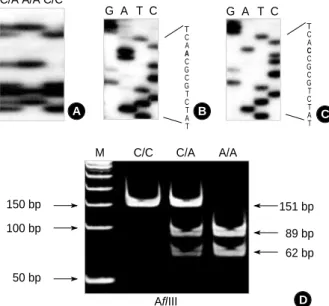
were denatured for 5 min at 95℃ at 1:1 dilution of sample buffer containing 98% formamide/5 mmol/L NaOH and were loaded onto a SSCP gel (FMC Mutation Detection Enhance- ment system; Intermountain Scientific, Kaysville, UT, U.S.A.) with 10% glycerol. Samples were electrophoresed at 8 W at room temperature overnight. After electrophoresis, the gels were transferred to 3 mm Whatman paper and dried, and au- toradiography was performed with Kodak X-OMAT film (Eastman Kodak, Rochester, NY, U.S.A.) (Fig. 1A). For the detection of allele sequence, DNA bands were cut out from the dried gel, and reamplified for 30 cycles using the same primer set. Sequencing of the PCR products was carried out using the cyclic sequencing kit (Perkin-Elmer, Foster City, CA, U.S.A.) according to the manufacturer’s recommendation (Fig. 1B, C). We also performed PCR-restriction fragment length polymorphism (RFLP) to confirm the PCR-SSCP re- sults. After amplification with the same primer set, the PCR products were digested with 5 U of restriction enzyme HphI or AflIII at 37℃ for 16 hr. The C allele had an HphI recogni- tion site, whereas the A allele created an AflIII site. DNA fragments then were eletrophoresed on a 10% polyacrylamide gel (Fig. 1D).
Statistical analysis
The chi-square test for association was used to test difference of the genotype frequencies between normal controls and gas- tric cancer patients, and between two histologic types. The
T C A A C G C G T C T A T
C/A A/A C/C
G A T C
M C/C C/A A/A
AflIII
151 bp 89 bp 62 bp G A T C
T C A C C G C G T C T A T
150 bp 100 bp
50 bp
A B C
D
Fig. 1.Genotype analysis at -160 promoter polymorphic site of E- cadherin by SSCP-sequencing and RFLP. SSCP band patterns of heterozygote with C/A and homozygote with A/A and C/C (A); Se- quencing showing homozygotes with A/A (B) and C/C (C); the PCR products were digested with AflIII restriction endonuclease. If the recognition site was present, amplified DNA (151 bp in size) pro- duced two fragments, 89 bp and 62 bp (D).
CDH1 Polymorphism in Korean Gastric Cancer 503
genotype specific risks were estimated as odds ratios with asso- ciated 95% confidence interval (CI).
RESULTS
The genotype frequencies at -160 promoter polymorphism of E-cadherin in Korean gastric cancer cases and controls are summarized in Table 1. The frequency of genotype C/C was 58.2%, C/A was 37.7%, and A/A was 4.1% in normal healthy individuals, showing that C allele is more common than A allele in Korean population. Interestingly, there was no sig- nificant difference in the frequency of genotypes between con- trol and gastric cancer patients, indicating no associations be- tween the E-cadherin specific genotype and gastric cancer in Korean ( 2test, p=0.433). In addition, we could not find any evidence for significant differences between intestinal- and diffuse-type gastric cancers ( 2test, p=0.196). Statistically, there was also no significant difference between intestinal-type gastric cancers and normal controls ( 2test, p=0.142) and be- tween diffuse-type and controls ( 2test, p=0.989).
Genotype specific risks are shown in Table 2. The estimated odds ratio of A/A to C/C genotype in gastric cancer was 1.066 (95% CI, 0.396-2.870) and the odd ratio in diffuse histologic type was 0.944 (95% CI, 0.277-3.221). The odd ratio of A allele to C allele in diffuse-type gastric cancer was 0.972 (95% CI, 0.650-1.452).
In addition, we found the T deletion polymorphism at -163 promoter of E-cadherin in 3 of 146 healthy individuals and 2 of 292 gastric cancer cases, respectively.
DISCUSSION
Many common diseases in humans, especially cancer, are not
caused by one genetic variation within a single gene, but are determined by complex interactions among multiple genes, environmental and lifestyle factors. Genetic factors confer sus- ceptibility or resistance to a disease and influence the severity or progression of disease. Host factors, including polymor- phism at the genes involved in tumorigenesis, may partly ex- plain the difference in individual susceptibility of cancer occur- rence (18). Single nucleotide polymorphisms (SNPs) are com- mon DNA sequence variations among individuals. They pro- mise to significantly advance our ability to understand and treat human disease, including cancer. SNP profiles that are characteristic of a variety of cancers will be established and pro- vide fundamental understanding of many cancers, thus pro- viding new therapeutic targets.
Development of malignant tumors is in part characterized by the ability of a tumor cell to overcome cell-cell adhesion and to invade surrounding tissue. E-cadherin, the main adhe- sion molecule of epithelia, has been implicated in carcinogen- esis because it is frequently lost in human epithelial cancers.
Recently, Li et al. (11) characterized a C/A polymorphism lo- cated 160 upstream from the E-cadherin transcription start site and found the A-allele to have reduced transcriptional activ- ity of the C-allele in vitro. Thus, A-type promoter variant may be regarded as a candidate cancer susceptibility polymorphism.
However, recent epidemiological studies failed to demonstrate a correlation between the E-cadherin promoter variant and breast (19) or colorectal cancer (20) or gastric cancer (15). In the present study, there is no significant difference in the E- cadherin -160 promoter genotype between normal healthy individuals and gastric cancer patients (Table 1). Therefore, it is likely that -160 promoter polymorphism of the E-cad- herin gene may not be associated with risk for gastric cancer among Koreans and that this allele variation should not be a genetic marker to identify those individuals at higher risk for gastric cancer.
Subject Total C/C C/A A/A 2(df=2) p-value*
Control 146 85 (58.2%) 55 (37.7%) 6 (4.1%)
Gastric cancer� 292 186 (63.7%) 92 (31.5%) 14 (4.8%) 1.674 0.433
Intestinal 165 111 (67.3%) 45 (27.3%) 9 (5.4%) 3.903 0.142
Diffuse 127 75 (59.1%) 47 (37.0%) 5 (3.9%) 0.021 0.989
*, p-value compared with normal control; �, intestinal- and diffuse-type.
Table 1.Genotype frequencies at -160 promoter polymorphic site of E-cadherin gene in healthy individuals and gastric cancer patients
Subject Genotype at -160 promoter of E-cadherin
C/A A/A A allele
Gastric cancer� 0.764 (0.502-1.165) 1.066 (0.396-2.870) 0.869 (0.619-1.219)
Intestinal 0.627 (0.386-1.017) 1.149 (0.394-3.352) 0.792 (0.538-1.167)
Diffuse 0.968 (0.589-1.594) 0.944 (0.277-3.221) 0.972 (0.650-1.452)
*, compared with common homozygote (C/C); �, intestinal- and diffuse-type.
Table 2.Genotype specific risks with odd ratio and 95% confidence interval*
504 W.S. Park, Y.G. Cho, J.Y, Park, et al.
Histologically, gastric cancer can be divided into intestinal and diffuse subtypes according to the presence of glandular structure formation by tumor cells. Interestingly, the genotyp- ing data in the Italian group showed an association between the promoter -160A allele and an increased risk of sporadic diffuse-type gastric cancer (13). When we tried to determine whether this polymorphism is important with respect to the different histologic types of gastric cancer, we did not observe any impact of E-cadherin genotype on histologic type, suggest- ing that the presence of A allele in heterozygote C/A and ho- mozygote A/A genotype did not affect the expression of E-cad- herin protein. Several reasons may account for this discrepancy.
The influence of a susceptibility gene on disease risk may de- pend on environmental factors and lifestyles. The different fre- quency of H. pylori infection and different genetic background between Italian and Korean populations may to some extent explain the different risk estimates associated with the -160 variant. In addition, no direct correlation between mRNA ex- pression and protein level by post-transcriptional regulation may help us understand this discrepancy (21).
A genetic marker has to be relevant to the pathogenesis of the disease in question and to occur at a sufficiently high fre- quency to make its screening worthwhile. Since our data indi- cate that -160 promoter polymorphism of the E-cadherin gene is not sufficient to form the basis of a screening program for Korean gastric cancer, addition of other relevant markers is essential in refining this genetic strategy. In addition, a rigor- ous case-control study on a large scale is mandatory to elucidate the relationship between E-cadherin genotype and gastric cancer risk.
REFERENCE
1. Takeichi M. Cadherin cell adhesion receptors as a morphogenetic regulator. Science 1991; 251: 1451-5.
2. Pignatelli M, Vessey CJ. Adhesion molecules: novel molecular tools in tumor pathology. Hum Pathol 1994; 25: 849-56.
3. Takeichi M. The cadherins: cell-cell adhesion molecules controlling animal morphogenesis. Development 1988; 102: 639-55.
4. Behrens J, Mareel MM, Van Roy FM, Birchmeier W. Dissecting tu- mor cell invasion: epithelial cells acquire invasive properties after the loss of uvomorulin-mediated cell-cell adhesion. J Cell Biol 1989; 108:
2435-47.
5. Berx G, Becker KF, Hofler H, van Roy F. Mutations of the human E-cadherin (CDH1) gene. Hum Mutat 1998; 12: 226-37.
6. Guilford P, Hopkins J, Harraway J, McLeod M, McLeod N, Harawira P, Taite H, Scoular R, Miller A, Reeve AE. E-cadherin germline muta- tions in familial gastric cancer. Nature 1998; 392: 402-5.
7. Matsumura T, Makino R, Mitamura K. Frequent down-regulation of E-cadherin by genetic and epigenetic changes in the malignant pro-
gression of hepatocellular carcinomas. Clin Cancer Res 2001; 7:
594-9.
8. Droufakou S, Deshmane V, Roylance R, Hanby A, Tomlinson I, Hart IR. Multiple ways of silencing E-cadherin gene expression in lobular carcinoma of the breast. Int J Cancer 2001; 92: 404-8.
9. Perl AK, Wilgenbus P, Dahl U, Semb H, Christofori G. A causal role for E-cadherin in the transition from adenoma to carcinoma. Nature 1998; 392: 190-3.
10. Taylor JG, Choi EH, Foster CB, Chanock SJ. Using genetic variation to study human disease. Trends Mol Med 2001; 7: 507-12.
11. Li LC, Chui RM, Sasaki M, Nakajima K, Perinchery G, Au HC, Nojima D, Carroll P, Dahiya R. A single nucleotide polymorphism in the E-cadherin gene promoter alters transcriptional activities. Can- cer Res 2000; 60: 873-6.
12. Nakamura A, Shimazaki T, Kaneko K, Shibata M, Matsumura T, Nagai M, Makino R, Mitamura K. Characterization of DNA poly- morphisms in the E-cadherin gene (CDH1) promoter region. Mutat Res 2002; 502: 19-24.
13. Humar B, Graziano F, Cascinu S, Catalano V, Ruzzo AM, Magnani M, Toro T, Burchill T, Futschik ME, Merriman T, Guilford P. Asso- ciation of CDH1 haplotypes with susceptibility to sporadic diffuse gastric cancer. Oncogene 2002; 21: 8192-5.
14. Wu MS, Huang SP, Chang YT, Lin MT, Shun CT, Chang MC, Wang HP, Chen CJ, Lin JT. Association of the -160 C →A pro- moter polymorphism of E-cadherin gene with gastric carcinoma risk. Cancer 2002; 94: 1443-8.
15. Pharoah PD, Oliveira C, Machado JC, Keller G, Vogelsang H, Laux H, Becker KF, Hahn H, Paproski SM, Brown LA, Caldas C, Huntsman D. CDH1 c-160a promotor polymorphism is not associated with risk of stomach cancer. Int J Cancer 2002; 101: 196-7.
16. Lauren P. The two main histological types of gastric carcinoma. Diffuse and so-called intestinal type carcinoma: an attempt at histoclinical classification. Acta Pathol Microbiol Scand 1965; 64: 31-49.
17. Lee JY, Dong SM, Kim SY, Yoo NJ, Lee SH, Park WS. A simple, pre- cise and economical microdissection technique for analysis of genom- ic DNA from archival tissue sections. Virchows Arch 1998; 433:
305-9.
18. Perera FP, Weinstein IB. Molecular epidemiology: recent advances and future directions. Carcinogenesis 2000; 21: 517-24.
19. Lei H, Sjoberg-Margolin S, Salahshor S, Werelius B, Jandakova E, Hemminki K, Lindblom A, Vorechovsky I. CDH1 mutations are pre- sentin both ductal and lobular breast cancer, but promoter allelic variants show no detectable breast cancer risk. Int J Cancer 2002; 98:
199-204.
20. Porter TR, Richards FM, Houlston RS, Evans DG, Jankowski JA, Macdonald F, Norbury G, Payne SJ, Fisher SA, Tomlinson I, Maher ER. Contribution of cyclin d1 (CCND1) and E-cadherin (CDH1) polymorphisms to familial and sporadic colorectal cancer. Oncogene 2002; 21: 1928-33.
21. Anderson L, Seilhamer J. A comparison of selected mRNA and pro- tein abundances in human liver. Electrophoresis 1997; 18: 533-7.