• 검색 결과가 없습니다.

Successful Management of Spontaneous Intraperitoneal Hemorrhage Occurred after Superior Mesenteric Artery Stenting

N/A
N/A
Protected

Academic year: 2021

Share "Successful Management of Spontaneous Intraperitoneal Hemorrhage Occurred after Superior Mesenteric Artery Stenting"

Copied!
5
0
0

로드 중.... (전체 텍스트 보기)

전체 글

(1)

Received August 3, 2018; revised October 9, 2018; accepted October 27, 2018.

Corresponding author: Seung-Woon Rha, Cardiovascular Center, Korea University Guro Hospital, 148 Gurodong-ro, Guro-gu, Seoul 08308, Korea. E-mail:

[email protected]

Copyright Ⓒ 2018 The Korean Academy of Clinical Geriatrics

This is an open access article distributed under the term s of the Creative Com m ons Attribution Non-Com m ercial License (http://creativecom m ons.org/licenses/by-nc/4.0) which perm its unrestricted non-com m ercial use, distribution, and reproduction in any m edium , provided the original work is properly cited.

Successful Management of Spontaneous Intraperitoneal Hemorrhage Occurred after Superior Mesenteric Artery Stenting

Ji-Young Park

1

, Seung-Woon Rha

2

1

Division of Cardiology, Department of Internal Medicine, Nowon Eulji Medical Center, Eulji University, Seoul, Korea;

2
Cardiovascular Center, Korea University Guro Hospital, Seoul, Korea

Percutaneous transluminal angioplasty (PTA) is the current standard treatment for chronic mesenteric ischemia (CMI) in the elderly patients with advancement of atherosclerosis. PTA is associated with lower morbidity and mortality rates compared to surgical repair, a traditional treatment among the elderly with CMI. We present a case of spontaneous intraperitoneal hemorrhage after successful endovascular repair of severe superior mesenteric artery stenosis. We performed a selective coil embolization procedure and achieved successful control of spontaneous hemorrhage.

Key Words: Hemorrhage, Mesenteric ischemia, Transluminal angioplasty

INTRODUCTION

Chronic mesenteric ischemia (CMI) is difficult to diagnose clinically because of insidious symptoms and is associated with significant morbidity. CMI is related to atherosclerotic disease, and occurs mainly in patients aged 50 and 70 years.

Surgical repair was a traditional treatment, but was related to significant mortality and morbidity. Recently, endovascular therapy by percutaneous transluminal angioplasty (PTA) in- cluding balloon dilatation and stenting has been reported with comparable success rates and minimal complications as com- pared with surgical repair [1]. In elderly patients, athero- sclerosis of the lesion is more severe than younger patients, it is difficult to perform the procedure, and bleeding complica- tions are more likely to occur during the procedure.

Therefore, more attention should be paid during the proce- dure in elderly patients. Short term complications associated with PTA are puncture site hematomas, pseudo-aneurysm and vessel dissection, and the representative long term com- plication of endovascular therapy is restenosis. However, spontaneous intraperitoneal hemorrhage in the treated vascular territory following PTA in CMI has rarely reported.

Therefore, we present a case of spontaneous hemorrhage oc- curred in elderly patient following successful PTA of superior mesenteric artery (SMA) which required treatment with coil embolization and achieved successful outcomes.

CASE REPORT

A 69-year old male presented with bilateral foot pain due

(2)

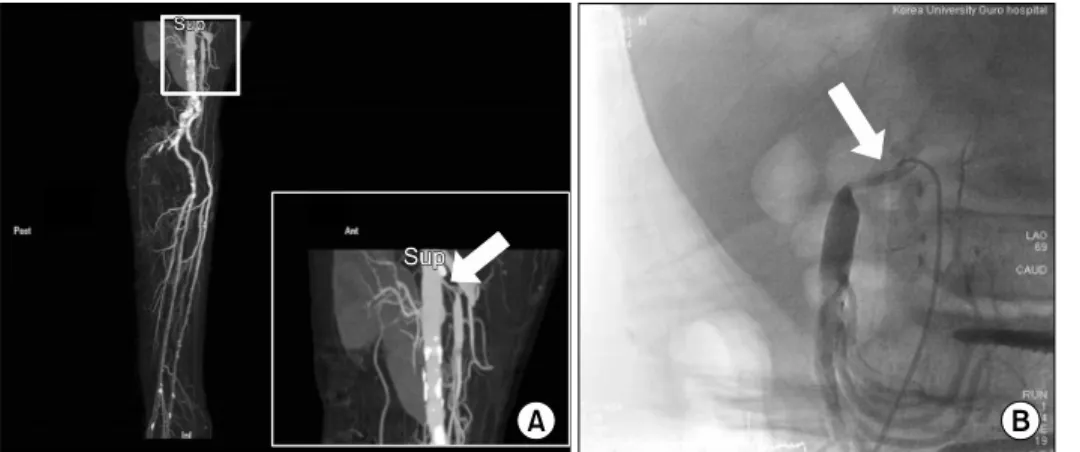
Figure 1. Severe stenosis in proximal superior mesenteric artery in lower extremity computed tomography (A) and superior mesenteric artery diagnostic an- giography (B). Arrow indicates severe stenotic lesion in proximal superior mesenteric artery.

history of atrial fibrillation with medication and 20 pack years of cigarette smoking, but no history of diabetes mellitus and hypertension. In baseline laboratory findings, his white blood cell count was 8,700/mL, platelet count was 387,000/mL, he- moglobin was 10.9 g/dL, and creatinine was 0.61 mg/dL.

Lower extremity computed tomography (CT) angiography was planned to screen for overall peripheral artery disease, which showed atherosclerotic change with calcification from abdominal aorta to iliac artery, diffuse narrowing of bilateral superficial femoral artery, occlusion of right anterior tibial ar- tery, and severe stenosis of proximal SMA (Figure 1A). We found that the patients has suffered from poor oral intake for several years and had medications including antacid and gas- tro-interstinal motility drugs due to abdominal discomfort.

Selective PTA of SMA was planned to resolve those symptoms. The baseline echocardiogram showed that there was no regional wall motion abnormality with normal left ventricular ejection fraction. The patient did not complain of typical chest pain, but the patient was high risk group of car- diovascular disease. Therefore, we performed coronary angio- gram (CAG) to check up cardiovascular disease. A right femoral approach was done with 8Fr 5 cm short guiding sheath and the elective CAG for screening showed mild dif- fuse atherosclerosis without significant stenosis in left anterior descending artery, left circumflex artery, and right coronary artery. We underwent selective SMA angiography by 5F JR catheter and there was a significant tubular stenosis in the proximal portion of the SMA (Figure 1B). As for the anti- platelet regimen, 200 mg of aspirin and 30 mg of clopidogrel

was administrated intra-arterially. For SMA intervention, 8Fr JR4 guiding catheter was placed via 5 cm 8F short sheath in right femoral artery. Selective wiring was done using 0.014-inch Runthrough wire (Terumo, Tokyo, Japan) and predilatation was performed with Amia 6×20 mm (Cordis, USA). After predilatation, residual stenosis was approximately 55 to 60%. Wire was exchanged from 014 to 035 soft long Terumo wire and Genesis 9×40 mm balloon expandable stent (Cordis Europe, The Netherlands) was successfully de- ployed without immediate complication. After stenting, the patient’s condition was well and hemodynamically stable.

Final routine SMA angiography was performed to check the flow from SMA to distal branch to ileum. However, there was a contrast leakage in the far distal branch of SMA, sug- gesting perforation and bleeding into pelvic cavity. Although we confirmed the perforation of SMA distal branch, there was no evidence of iatrogenic bleeding such as wire induced perforation. Mean a while, despite of blood pressure was 124/83 mmHg, heart rate was increased to 122 beats per mi- nute, and patient complained of severe lower abdominal pain.

We quickly performed low pressure prolonged balloon occlu-

sion just proximal to the target branch using 2×15 mm

Tamarin balloon (Natec, Republic of Mauritius) for 1 minute

to control the bleeding, but there was tiny residual leakage in

the target branch. Post balloon angiography showed that

complete hemostasis was not achieved. Therefore, after wire

has changed to 0.018-inch long wire with microcatheter, se-

lective multiple coil embolization was done using Tornado

microcoils (three 4×2 mm, one 6×2 mm, Cook,

(3)

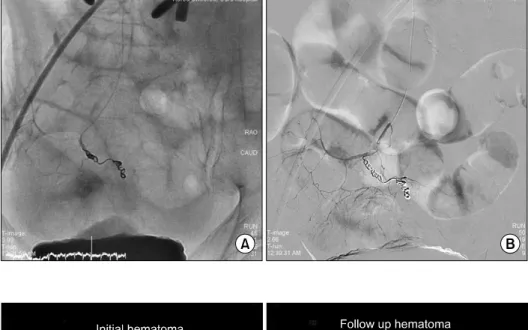
Figure 2. Selective multiple coil embolization using Tornado micro coils (A). Successful coil embo- lization and complete hemostasis was confirmed by digital subtr- action angiography image (B).

Figure 3. Abdominal computed tomography showed decreased hemoperitoneum at 1 week follow up computed tomography angio- graphy (A, immediate after the percutaneous transluminal angio- plasty, B, follow up computed tomography image). White arrow indicates focal hematoma in pelvic cavity.

Bloomington, USA) to control the bleeding. Complete hemo- stasis was confirmed by digital subtraction angiography (DSA) image and there was no evidence of further ex- travasations of contrast from the target branch (Figure 2).

The patient became hemodynamically stable and initial hemo- globin dropped from 10.9 g/dL to 8.5 g/dL after the procedure. After transfusion, hemoglobin level was restored from 8.5 g/dL to 11.6 g/dL. After 1 weak later, we checked the follow up abdominal CT which showed remarkably de- creased hemoperitoneum as compared with the immediate post PTA CT angiography image (Figure 3).

DISCUSSION

PTA as a treatment for CMI was firstly reported by Uflacker et al. and Furrer et al. in 1980, and a substantial

experience demonstrating the safety and efficacy of PTA has been accumulated [2,3]. Nowadays, PTA is an established treatment option for patients with CMI and is associated with low morbidity and mortality rates [4,5]. However, there are contraindications of PTA in CMI; suspected acute bowel is- chemia, bowel necrosis, extrinsic compression as the cause of stenosis, extensive disease involving the origin of major secon- dary branches, visual angiographic evidence of intraluminal thrombus or cardiac source emboli, and history of bleeding diathesis or coagulopathy [6]. Minimal complications of PTA of CMI such as puncture site hematomas, pseudoa- neurysm formation and vessel dissection have been reported [7]. However, the spontaneous intra-abdominal bleeding could occur after PTA, which can be a serious complication that could impact on the patient’s hemodynamic stability.

In the present case, there are possible explanations for

(4)

bleeding by iatrogenic injury to distal branches likely to be induced by hydrophilic guide wire. However, bleeding loca- tion was too far to reach by the wire, and review of every stage of the procedure suggested that this was unlikely as care was taken to visualize the tip of the guide wire at all times during the procedure and the tip never reached to this far distal peripheral location of hemorrhage. Second, sponta- neous hemorrhage would have occurred due to high dose an- ticoagulation or antiplatelet agents. It has been rarely re- ported, and can be a very fatal complication which is needed to have active treatment such as surgical repair or coil embolization. Spontaneous intraperitoneal bleeding might be related to overdose antithrombotic agents and antiplatelet agents such as aspirin and clopidogrel during the aftercare of PTA. Matsi and Manninen evaluated complications of PTA and there were 5% (21/410) major complications and 0.5%

(2/410) which of them promoted by an overdose infusion of heparin after PTA [8]. Quint et al. have shown hematomas to be distant from the femoral puncture site and suggested that anticoagulant therapy might be related to hematoma rath- er than the vessel puncture itself [9]. In the present case, antiplatelet dosage was not so high and a total 3000 IU un- fractionated heparin was administrated intra-arterially, which is not enough to cause the severe bleeding complications.

Third, spontaneous bleeding would have occurred by sudden increase of distal flow after opening up the culprit lesion.

This is thought to be the most possible cause of bleeding in this particular patient and so called ‘reperfusion hemorrhage’

could occur the following PTA of CMI.

Reperfusion hemorrhage following chronic ischemia has been described in the cerebral circulation as a complication of revascularization. Cerebral hyperperfusion syndrome could oc- cur after carotid endarterectomy or angioplasty and stenting.

The incidence of cerebral hyperperfusion syndrome has been reported as 3.1% after carotid endarterectomy and 6.8% after carotid stenting [10]. It is theorized that the capillary bed beyond the stenosis is prone to the bleeding after restoration of blood flow because of the impaired autoregulation.

Similarly, spontaneous hemorrhage may occur following re- canalization of chronic significant mesenteric artery stenosis.

and effectively when the unexpected intra-abdominal hemor- rhage would occur following SMA intervention. Balloon occlu- sion at proximal of the target branch and selective arterial embolization with microcoils can be considered to treat un- expected intra-abdominal hemorrhage occurred during periph- eral intervention because it was difficult to control the in- tra-abdominal bleeding vessel surgically [11]. Velmahos et al.

had reported that arterial embolization is a highly effective and safe technique with high success rate to control intra-ab- dominal bleeding and there were only five embolization re- lated complication, all of which were self limiting control [12].

The appropriate medical treatment is also very important in this situation. Immediate administration of massive fluid infusion and blood transfusion is needed to stabilize the pa- tient’s hemodynamic instability. Immediate diagnosis through CT scan is also very important to minimize complication and rapid recovery. In the present case, we confirmed the com- plete hemostasis with immediate DSA image and CT scan, and there was no further extravassation. After a week, follow up CT scan showed the reduced hemoperitoneum as com- pared with prior CT scan.

In conclusion, recently, PTA is more widely used to treat

CMI. However, the spontaneous intra-abdominal bleeding

could occur following PTA, which can be a serious complica-

tion that could impact on the patient’s prognosis. Therefore,

when the reperfusion hemorrhage is suspicious following suc-

cessful PTA for CMI, clinician’s attendance and proper deci-

sion for immediate accurate diagnosis and management would

be important and crucial for the best clinical outcomes. The

appropriate of diagnosis with DSA image and CT scan is

important as well. The immediate balloon occlusion as the

bridge therapy for complete hemostasis at the target branch

and subsequent selective arterial embolization with micro coils

should be considered as the first priority because it may be

difficult to control the intra-abdominal bleeding vessel

surgically.

(5)

CONFLICTS OF INTEREST

No potential conflict of interest relevant to this article was reported.

REFERENCES

1. Moore M, McSweeney S, Fulton G, Buckley J, Maher M, Guiney M. Reperfusion hemorrhage following superior mesen- teric artery stenting. Cardiovasc Intervent Radiol 2008;31 suppl 2:S57-61.

2. Uflacker R, Goldany MA, Constant S. Resolution of mesen- teric angina with percutaneous transluminal angioplasty of a superior mesenteric artery stenosis using a balloon catheter.

Gastrointest Radiol 1980;5:367-9.

3. Furrer J, Gruntzig A, Kugelmeier J, Goebel N. Treatment of abdominal angina with percutaneous dilatation of an arteria mesenterica superior stenosis. Preliminary communication.

Cardiovasc Intervent Radiol 1980;3:43-4.

4. Silva JA, White CJ, Collins TJ, Jenkins JS, Andry ME, Reilly JP, et al. Endovascular therapy for chronic mesenteric ischemia. J Am Coll Cardiol 2006;47:944-50.

5. Landis MS, Rajan DK, Simons ME, Hayeems EB, Kachura JR, Sniderman KW. Percutaneous management of chronic

mesenteric ischemia: outcomes after intervention. J Vasc Interv Radiol 2005;16:1319-25.

6. Hohenwalter EJ. Chronic mesenteric ischemia: diagnosis and treatment. Semin Intervent Radiol 2009;26:345-51.

7. Chahid T, Alfidja AT, Biard M, Ravel A, Garcier JM, Boyer L. Endovascular treatment of chronic mesenteric ischemia: re- sults in 14 patients. Cardiovasc Intervent Radiol 2004;27:

637-42.

8. Matsi PJ, Manninen HI. Complications of lower-limb percu- taneous transluminal angioplasty: a prospective analysis of 410 procedures on 295 consecutive patients. Cardiovasc Intervent Radiol 1998;21:361-6.

9. Quint LE, Holland D, Korobkin M, Cascade PN. Role of femoral vessel catheterization and altered hemostasis in the de- velopment of extraperitoneal hematomas: CT study in 44 patients. AJR Am J Roentgenol 1993;160:855-8.

10. Coutts SB, Hill MD, Hu WY. Hyperperfusion syndrome: to- ward a stricter definition. Neurosurgery 2003;53:1053.

11. Velmahos GC, Chahwan S, Hanks SE, Murray JA, Berne TV, Asensio J, et al. Angiographic embolization of bilateral in- ternal iliac arteries to control life-threatening hemorrhage after blunt trauma to the pelvis. Am Surg 2000;66:858-62.

12. Velmahos GC, Toutouzas KG, Vassiliu P, Sarkisyan G, Chan

LS, Hanks SH, et al. A prospective study on the safety and

efficacy of angiographic embolization for pelvic and visceral

injuries. J Trauma 2002;53:303-8.

수치

Figure 1. Severe stenosis in  proximal superior mesenteric  artery in lower extremity computed tomography (A) and superior  mesenteric artery diagnostic  an-giography (B)
Figure 2. Selective multiple coil  embolization using Tornado micro  coils (A). Successful coil  embo-lization and complete hemostasis  was confirmed by digital  subtr-action angiography image (B).

참조

관련 문서

Concentration of soil residual endosulfan-sulfate with days after treatment of endosulfan in different soils

The locations of aneurysms were middle cerebral artery in 15 patients, cerebral artery in 15 patients, cerebral artery in 15 patients, cerebral artery in

The average position of the posterior superior alveolar artery, the wall thickness of the lateral wall, and the average volume of the maxillary sinus will

Typical trace of pacemaker potentials in current clamping mode (A) and spontaneous inward pacemaker currents in voltage clamping mode at a holding potential of -70 mV

Transaxial CT image of T11 vertebral body shows superior articular processes of T11 are seen without their normal articulation with T10 inferior

After first field tests, we expect electric passenger drones or eVTOL aircraft (short for electric vertical take-off and landing) to start providing commercial mobility

1 John Owen, Justification by Faith Alone, in The Works of John Owen, ed. John Bolt, trans. Scott Clark, "Do This and Live: Christ's Active Obedience as the

Natural history of OA: Progressive cartilage loss, subchondral