<연구논문> Fashion & Text. Res. J.
Vol. 19, No. 1, pp.79-89(2017) https://doi.org/10.5805/SFTI.2017.19.1.79
79
The Subjective Hand and Preferences Evaluation of Artificial Leather by Use
Eui Kyung Roh and Kyung Wha Oh
1)†Dept. of Clothing & Textiles, Chonbuk National University: Jeonju, Korea
1)
Dept. of Fashion Design, Chung-Ang University: Seoul, Korea
Abstract : Sensory attributes and preferences that contribute to consumer satisfaction with artificial leather were mea- sured by subjective evaluation, and subjective hand and preferences were analyzed in relation to its use. Using tactile and visual senses, 50 experts in fashion and textile industry evaluated leathers classified into two categories, suede and poly- urethane coated, according to different manufacturing methods. They answered questions on subjective hand and pref- erences of different artificial leathers of various fashion items (jackets, purses, bags, shoes, boots, furniture, etc.), using specific adjectives to describe the hand properties. As a result, it was found that the subjective hand properties of artificial leathers were related to ‘Thickness’, ‘Fullness/softness’, ‘Surface contour’, ‘Stickiness’, and ‘Elasticity’. The leather type from different manufacturing methods influenced their perceived hand and preferences relating to use. By use, different hands were preferred. The preferences for jackets and furniture of suede type leathers were related to their surface prop- erties, whereas the preferences for items of the other type of leathers were associated with their resilience. On the other hand, in the case of polyurethane coated leathers, the preferences for jackets were significantly affected by their thickness, while those for the other items were influenced by their resilience and surface properties.
Key words : artificial leather, subjective hand, preference, fashion items
1. Introduction
Environmental movement and animal protection groups have boycotted products from animal leather manufacturers and use of leather goods, with Europe leading the way. As an alternative to animal leather, artificial leather has led to a revolution in the global markets. Artificial leather has many merits, some of which include:
excellent durability, easy care and finish, mass production capa- bility, lightness in weight, soft touch, anti-hydrolysis, weather- proofness, and availability of various colors.
For these reasons, artificial leather has gained popularity and consumers have begun to prefer bags, shoes, sofas, car interiors, and clothing made out of it. The market for artificial leather in sports goods has increased 10-15% every year. Recently, the use of artificial leather in cases and bags for IT products, such as tablet PCs and smart phones, has increased enormously. Such a surge in demand for artificial leather was expected because it added benefits in fashion items, sports equipments, and car interiors not found in
those made from genuine leather (“Baiksan, Hyundai Motor”, 2011; Lee et al., 1998).
The tactile sensation of fabrics, or the fabric hand, is related to comfort, style, and appearance of clothing. As the fabric hand is closely related to consumer demand, many studies have investi- gated definitions and assessments of this concept (Barker &
Scheininger, 1982; Ellis, & Garnsworthy, 1980; Kawabata, 1980;
Vaughan & Kim, 1975; Winakor et al., 1980; Wrobel & Lanhen- hove, 2012), as well as preferences for certain fabrics. Various anal- ysis methods and tools have been developed to evaluate the fabric hand and predict consumer needs by means of the related physical and mechanical properties of the material (Jhanji et al., 2016; Joen et al., 2010; Khanna et al., 2015; Kwon, 2010; Philippe et al., 2004;
Roh & Ryu, 2007; Roh et al., 2013; Strazdienė et al., 2003). Car- dello et al. (2003) predicted handle and comfort of military clothing fabric from sensory and instrumental data using the comfort affec- tive labeled magnitude (CALM) scale. Yick et al. (1996) demon- strated the relationship between judges’ preferences and mechanical parameters of fabric and compared with mechanical properties by the ‘Kawabata Evaluation System for fabrics’ (KES-F) and the
‘Fabric Assurance by Simple Testing’ (FAST) instruments. Ozcelik et al. (2008) defined an equation for the objective estimation of shirting fabric using subjective evaluation values. Miller (2002) introduced quad analysis to rank order subjective properties. Ryu and Roh (2010) analyzed the relative importance of laundry deter-
†Corresponding author; Kyung Wha Oh Tel. +82-2-820-5381, Fax. +82-2-826-4243 E-mail: [email protected]
©
2017 (by) the authors. This article is an open access article distributed
under the terms and conditions of the Creative Commons Attribution
license (http://creativecommons.org/licenses/by/3.0/), which permits unre-
stricted use, distribution, and reproduction in any medium, provided the
original work is properly cited.
gent ingredients for preference and the subjective hand of washed fabrics using a conjoint analysis. Yu et al. (2011) developed an improved fuzzy neural network (FNN)-based fabric hand predic- tion model, which was capable of carrying out fabric hand pre- dictions by the nearest neighbor algorithm.
Many studies have focused on the fabric hand of clothing. How- ever, there have been few studies on the hand of artificial leather, and those that have been conducted have focused on its manufac- turing method and evaluation of its physical properties (Jung et al., 2007; Kim, 2005; Lee & Shim, 2006; Roh & Oh, 2014; Seul et al., 2005; White, 1989). Shin and Lee (1999) and Lee and Shin (2000) evaluated the hand of artificial leather and clothing preferences and developed a prediction equation of the leather using KES-FB. Shin and Kim (2000)’s study focused on physical and mechanical prop- erties of artificial suede using KES equipment.
Besides apparel, the influence of accessories in fashion has
grown significantly. This is because accessories, such as shoes and bags, do not simply serve a practical function and decoration in fashion; they are used in fashion coordination appropriate for place and occasion. Despite the wide range of uses of artificial leather, there have been few subjective and objective evaluations of its var- ious uses. The preferred hand may differ in its use. It is necessary to understand the relationship between the subjective hand and the preferences by use. Because consumer’s preference for leather by use is significantly related to the subjective hand of leather. The market survey data on consumer preferences can provide manu- facturers and retailers valuable information about product devel- opment and sales.
Therefore, this study aims to evaluate the subjective hand and preferences, and to analyze the relationship between the subjective hand and preferences for artificial leather by use through a survey.
An additional goal is to provide basic information that can be used
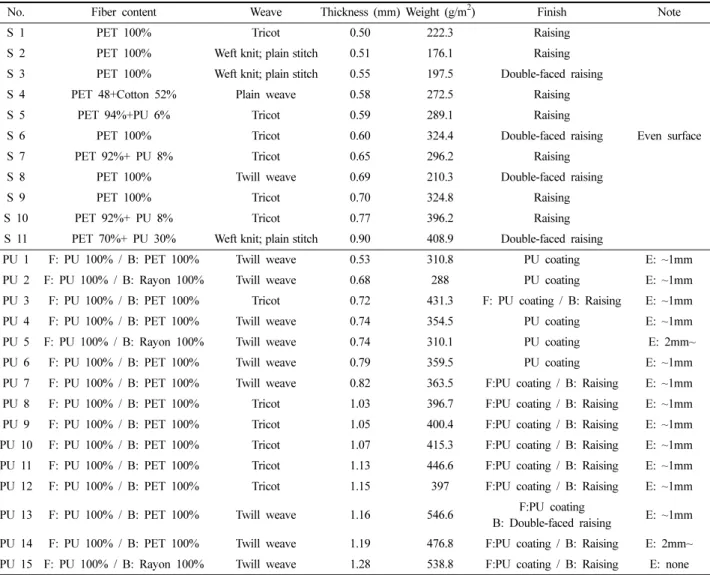
Table 1. Characteristics of artificial leathers
No. Fiber content Weave Thickness (mm) Weight (g/m2) Finish Note
S 1 PET 100% Tricot 0.50 222.3 Raising
Even surface
S 2 PET 100% Weft knit; plain stitch 0.51 176.1 Raising
S 3 PET 100% Weft knit; plain stitch 0.55 197.5 Double-faced raising
S 4 PET 48+Cotton 52% Plain weave 0.58 272.5 Raising
S 5 PET 94%+PU 6% Tricot 0.59 289.1 Raising
S 6 PET 100% Tricot 0.60 324.4 Double-faced raising
S 7 PET 92%+ PU 8% Tricot 0.65 296.2 Raising
S 8 PET 100% Twill weave 0.69 210.3 Double-faced raising
S 9 PET 100% Tricot 0.70 324.8 Raising
S 10 PET 92%+ PU 8% Tricot 0.77 396.2 Raising
S 11 PET 70%+ PU 30% Weft knit; plain stitch 0.90 408.9 Double-faced raising
PU 1 F: PU 100% / B: PET 100% Twill weave 0.53 310.8 PU coating E: ~1mm
PU 2 F: PU 100% / B: Rayon 100% Twill weave 0.68 288 PU coating E: ~1mm
PU 3 F: PU 100% / B: PET 100% Tricot 0.72 431.3 F: PU coating / B: Raising E: ~1mm
PU 4 F: PU 100% / B: PET 100% Twill weave 0.74 354.5 PU coating E: ~1mm
PU 5 F: PU 100% / B: Rayon 100% Twill weave 0.74 310.1 PU coating E: 2mm~
PU 6 F: PU 100% / B: PET 100% Twill weave 0.79 359.5 PU coating E: ~1mm
PU 7 F: PU 100% / B: PET 100% Twill weave 0.82 363.5 F:PU coating / B: Raising E: ~1mm
PU 8 F: PU 100% / B: PET 100% Tricot 1.03 396.7 F:PU coating / B: Raising E: ~1mm
PU 9 F: PU 100% / B: PET 100% Tricot 1.05 400.4 F:PU coating / B: Raising E: ~1mm
PU 10 F: PU 100% / B: PET 100% Tricot 1.07 415.3 F:PU coating / B: Raising E: ~1mm
PU 11 F: PU 100% / B: PET 100% Tricot 1.13 446.6 F:PU coating / B: Raising E: ~1mm
PU 12 F: PU 100% / B: PET 100% Tricot 1.15 397 F:PU coating / B: Raising E: ~1mm
PU 13 F: PU 100% / B: PET 100% Twill weave 1.16 546.6 F:PU coating
B: Double-faced raising E: ~1mm PU 14 F: PU 100% / B: PET 100% Twill weave 1.19 476.8 F:PU coating / B: Raising E: 2mm~
PU 15 F: PU 100% / B: Rayon 100% Twill weave 1.28 538.8 F:PU coating / B: Raising E: none
Note. S: Suede, PU: Polyurethane coated leather, PET: polyester, F: Face side, B; Back side, E: Embossing
to determine how to best utilize artificial leather by fashion items.
2. Method
2.1. Artificial leather
Artificial leathers used for various fashion items in the market were selected (Table 1). Black artificial leathers were used to min- imize the effect of color. Two types of artificial leathers were eval- uated: suede (S) and polyurethane coated leather (PU).
2.2. Subjective hand and preference evaluation
The tests were conducted using a questionnaire consisting of 26 adjectives relating to the hand that had been selected based on pre- liminary tests and preceding research for subjective hand evalua- tion (Roh & Ryu, 2007; Ryu & Roh, 2010; Shin & Lee, 1999), and preferences for fashion items such as jackets, purses, bags, shoes,
boots, and furniture. A semantic differential scale was used, with 7 denoting strongly agree and 1 denoting strongly disagree.
50 participants took part in this test and each respondent assessed eight or nine leathers selected randomly among 26 leathers. Each leather was evaluated by 15 participants in this test; they included graduate students in the areas of fashion design and merchandisers of clothing companies, as well as fabric designers and fiber researchers. With rubbing, pressing, bending, grabbing, hanging, and pulling on both sides of the artificial leathers, each respondent assessed the leathers which are 30 ×30cm sized patches, using tac- tile and visual senses. The tests conducted from November 14, 2011, to December 16, 2011.
Factor analysis, frequency analysis, ANOVA, Duncan’s multiple range test, correlation analysis, and multiple regression analysis were carried out using SPSS 12.0 for windows.
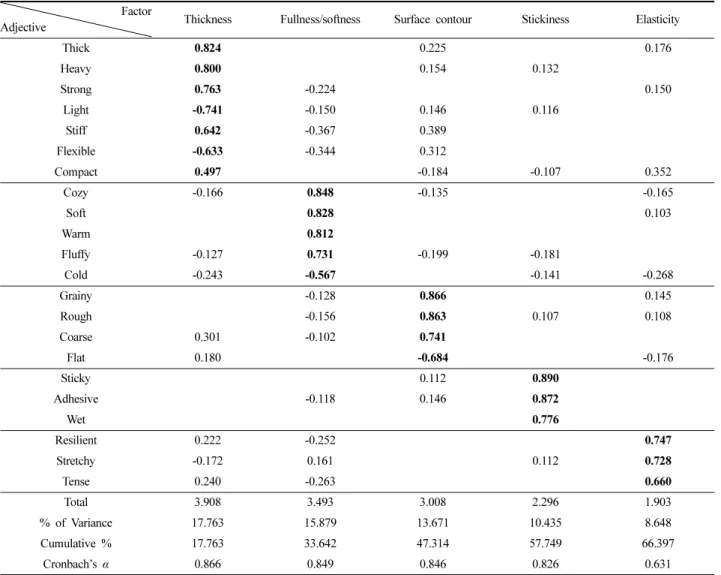
Table 2. Factor analysis of subjective hand for two types of artificial leathers Factor
Adjective Thickness Fullness/softness Surface contour Stickiness Elasticity
Thick 0.824 0.225 0.176
Heavy 0.800 0.154 0.132
Strong 0.763 -0.224 0.150
Light -0.741 -0.150 0.146 0.116
Stiff 0.642 -0.367 0.389
Flexible -0.633 -0.344 0.312
Compact 0.497 -0.184 -0.107 0.352
Cozy -0.166 0.848 -0.135 -0.165
Soft 0.828 0.103
Warm 0.812
Fluffy -0.127 0.731 -0.199 -0.181
Cold -0.243 -0.567 -0.141 -0.268
Grainy -0.128 0.866 0.145
Rough -0.156 0.863 0.107 0.108
Coarse 0.301 -0.102 0.741
Flat 0.180 -0.684 -0.176
Sticky 0.112 0.890
Adhesive -0.118 0.146 0.872
Wet 0.776
Resilient 0.222 -0.252 0.747
Stretchy -0.172 0.161 0.112 0.728
Tense 0.240 -0.263 0.660
Total 3.908 3.493 3.008 2.296 1.903
% of Variance 17.763 15.879 13.671 10.435 8.648
Cumulative % 17.763 33.642 47.314 57.749 66.397
Cronbach’s α 0.866 0.849 0.846 0.826 0.631
Note. The adjectives that described each hand factor expressed in bold strokes
3. Result and discussion
3.1. Subjective hand factors
To extract factors that account for less subjective hand of arti- ficial leather, factor analysis was conducted using principal com- ponent analysis and Varimax rotation. The results of the factor analysis are shown in Table 2. In these results, which accounted for 66.40% of the variance in the data, the hand of leather was found to illustrate ‘Thickness’, ‘Fullness/softness’, ‘Surface contour’, ‘Stick- iness’, and ‘Elasticity’. Four adjectives were removed by reliability analysis. All values of Cronbach’s α for the hand factors were above 0.63, and there was internal consistency. The results sug- gested that ‘Thickness’ is derived from a feeling of thickness, strength, and stiffness, ‘Fullness/softness’ is associated with feel- ings such as FUKURAMI by Kawabata (Kawabata, 1980) and is derived from a sense of bulkiness, richness, and warmth, and ‘Sur- face contour’ signifies the divergence of the surface from flatness and is related to the roughness of the surface. ‘Stickiness’ defines adhesive and sticky sensations when the artificial leather is touched, and ‘Elasticity’ denotes a springy property when com- pressed, and suggests firmness and resilience. Our results are quite similar to those of Shin and Lee (1999) who reported five factors affecting the subjective hand in artificial leather for clothing: sur- face property, stretchiness, thickness and weight, thermal property, and stickiness and clinginess. This suggests that the subjective hand factors are appropriate for artificial leather. The factor scores of hand were used in following analysis.
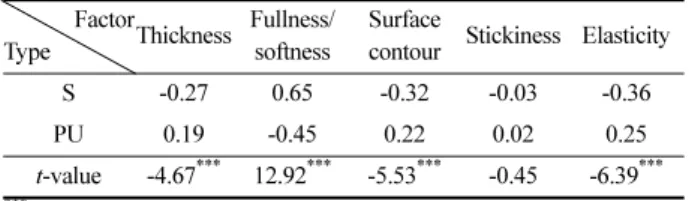
3.2. Subjective hand and preferences for artificial leather We analyzed the difference in the subjective hands between two types of artificial leathers (Table 3). There were significant differ- ences in hand factor values between the leather types, except
‘Stickiness’. The ‘Fullness/softness’ of suede type leathers were perceived to be softest compared with PU type. In general, the arti- ficial suede goes through many processes to provide the surface similar to natural suede. In a series of manufacturing processes, fabrics, knits, or nonwovens are relaxed, dried, heat treated, and followed by buffing and brushing. The naps made through these processes increase the sense of softness, warmness, and volume when suede is touched against the skin (Shin & Kim, 2000). On the other hand, the ‘Thickness’, the ‘Surface contour’, and the ‘Elas- ticity’ in PU type leathers were conscious properties. For PU type leathers, polyurethane resin, capable of periodic micro-porous, is applied by wet-process on the fabrics, knits, or nonwovens to form a two or three layer structure. Because various surface treatments are performed, the sense of thickness, unevenness, elasticity seems to increase (Shin & Kim, 2000).
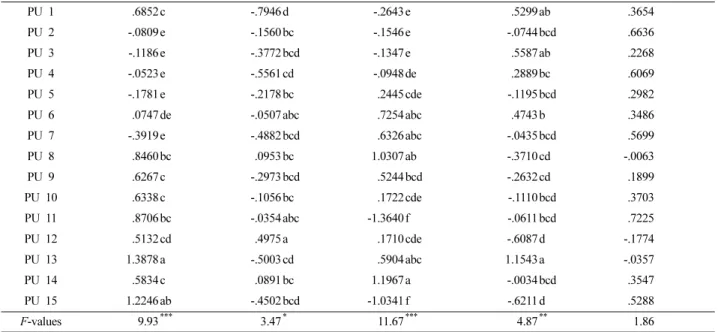
To analyze the difference in the subjective hand factors between the leathers, ANOVA and Duncan's multiple rage test were con- ducted (Table 4). The results showed that there were significant dif- ferences among suede type leathers for ‘Thickness’, and ‘Surface contour’. The ‘Thickness’ for S 6 was strongly perceived, whereas
‘Thickness’ of perception for S 1, 3, 7 those were thin and light, was lower. As the plain weave has unevenness feeling by many cross marks, ‘Surface contour’ was strongly perceived for suede type leathers that used plain weave in the base fabric. Whereas the
Table 3. Comparison of subjective hand between two leather typesFactor
Type Thickness Fullness/
softness
Surface
contour Stickiness Elasticity
S -0.27 0.65 -0.32 -0.03 -0.36
PU 0.19 -0.45 0.22 0.02 0.25
t-value -4.67*** 12.92*** -5.53*** -0.45 -6.39***
***
p<.001, S: Suede, PU: Polyurethane coated leather
Table 4. The differences of the subjective factors between artificial leathers
Thickness Fullness/softness Surface contour Stickiness Elasticity
S1 -1.0704 e .7689 -.4613 cd .1839 .1159
S2 -.7356 de .5521 -1.0682 d .1264 -.6145
S3 -.9637 e .9344 -.8074 cd -.4925 -.0410
S4 .3487 ab .1940 1.1103 a -.1210 -.1776
S5 -.2501 cd .7957 -.5258 cd .0095 -.3441
S6 .5627 a .4680 -.6171 cd -.1805 -.2192
S7 -.8359 e .9157 .1764 b -.1611 -.6355
S8 .1926 abc .8162 -.3997 bc -.0664 -.5485
S9 .3257 abc .6603 -.4057 bc -.0678 -.5362
S10 -.1169 bc .7472 -.2351 bc .1656 -.6867
S11 .3909 ab 1.2326 -.7142 cd -.0571 -.3917
F-values 10.32*** 2.78 8.70*** .72 1.81
planeness feeling was perceived for suede type leathers those were thin, light and used plain stitch. On the other hand, no difference among suede type leathers was observed in ‘Fullness/softness’,
‘Stickiness’, and ‘Elasticity’. This seems to be due to the sense of softness, warmness, and volume in raising fabric.
Significant differences among PU type leathers were observed in
‘Thickness’, ‘Fullness/softness’, ‘Surface contour’, and ‘Sticki- ness’. ‘Thickness’ for leathers, those were thin and light, was lower. While the leathers, those were thick or heavy, were per- ceived as ‘Thickness’. ‘Fullness/softness’ was less perceived by the leathers those had twill weave and were light, whereas ‘Fullness/
softness’ was perceived when the leathers had tricot and was thick.
The results mean that ‘Fullness/softness’ of leathers were related to their base fabric and their thickness. The leathers with big emboss- ing were perceived as ‘Surface contour’, whereas the leathers had small or no embossing, were less perceived as ‘Surface contour’.
This result showed that embossing depth and gloss as well as embossing size in their surface affected the perception of ‘Surface contour’. This seems to result from degree of gloss and finishing agent. As this study focused on commercial artificial leather, the effects of those were not analyzed. Therefore future study on the surface properties of artificial leather such as embossing and gloss are required.
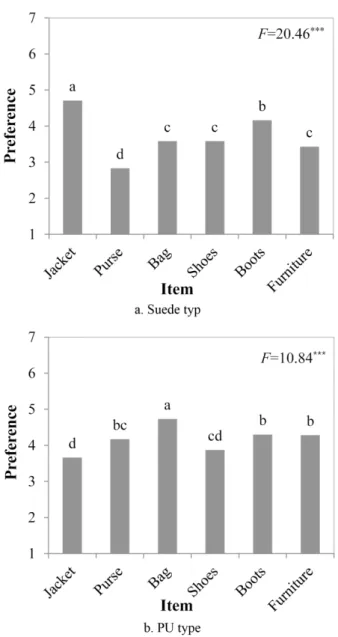
As shown in Table 5, there were a significant differences in pref- erences between two leather types by fashion items. Suede type was preferred leather for jackets to PU type leathers. On the other
hand, PU type was more favorable leather for purses, bags and fur- niture than suede type. Fig. 1 also presents that there were signif- icant differences in preferences between two leather types by use. It is obvious that jacket made of suede type was the most preferable, but there was no marked preferences for purses made of suede type. In contrast, PU type was the least suitable leather for jackets.
Whereas people considered that PU type was the most suitable leather for bags. The flexibility of the leathers affects the hand and the preferences by use.
Overall results suggest that the leather type must be taken into account, especially in developing an artificial leather product for use. The differences in subjective hands between different leather types may have a significant effect on preferences for different fashion items, since the perceived subjective hand and preferences for fashion items were different distinctly by leather types. There- fore, the correlations between hand factors and preferences for fashion items were studied.
Table 4. The differences of the subjective factors between artificial leathers (continued)
PU 1 .6852 c -.7946 d -.2643 e .5299 ab .3654
PU 2 -.0809 e -.1560 bc -.1546 e -.0744 bcd .6636
PU 3 -.1186 e -.3772 bcd -.1347 e .5587 ab .2268
PU 4 -.0523 e -.5561 cd -.0948 de .2889 bc .6069
PU 5 -.1781 e -.2178 bc .2445 cde -.1195 bcd .2982
PU 6 .0747 de -.0507 abc .7254 abc .4743 b .3486
PU 7 -.3919 e -.4882 bcd .6326 abc -.0435 bcd .5699
PU 8 .8460 bc .0953 bc 1.0307 ab -.3710 cd -.0063
PU 9 .6267 c -.2973 bcd .5244 bcd -.2632 cd .1899
PU 10 .6338 c -.1056 bc .1722 cde -.1110 bcd .3703
PU 11 .8706 bc -.0354 abc -1.3640 f -.0611 bcd .7225
PU 12 .5132 cd .4975 a .1710 cde -.6087 d -.1774
PU 13 1.3878 a -.5003 cd .5904 abc 1.1543 a -.0357
PU 14 .5834 c .0891 bc 1.1967 a -.0034 bcd .3547
PU 15 1.2246 ab -.4502 bcd -1.0341 f -.6211 d .5288
F-values 9.93*** 3.47* 11.67*** 4.87** 1.86
Note.
*p<.05,
**p<.01,
***p<.001, S: Suede, PU: Polyurethane coated leather, Significantly different groups classified by Duncan's multiple range test were noted with a, b, c, d, e in which ‘a’ shows the highest value and ‘e’ shows the lowest value.
Table 5. Comparison of preferences between two leather types by fashion items
Item
Type Jacket Purse Bag Shoes Boots Furniture
Suede 4.71 2.83 3.58 3.58 4.16 3.43
PU 3.66 4.17 4.73 3.87 4.30 4.28
t-value 6.43*** -7.57*** -6.73*** -0.77 -1.65 -3.55**
**
p<.01
, ***p<.001
3.3. Correlations between the subjective hand and the preferences
Table 6 reports the correlation coefficients of the suede type between the subjective hand and the preferences for fashion items.
These results indicate that there were a positive correlation between jackets preference and ‘Fullness/softness’, and a negative correla- tion between jackets preference and ‘Surface contour’. In other words, the suede with greater sense of volume and smoothness was more preferred. The preferences for purses and bags had a positive correlation with the ‘Elasticity’ indicating that the suede with larger elasticity was preferred for purses and bags. The preferences for shoes had a positive correlation with ‘Thickness’, and the prefer- ences for boots had a positive correlation with the sense of ‘Thick- ness’ and ‘Fullness/softness’: preferences for shoes was associated with ‘Thickness’, while boots preferences were related to ‘Thick- ness’ and ‘Fullness/softness’. In addition, the preference for fur- niture had a positive correlation with ‘Fullness/softness’, and a negative correlation with ‘Surface contour’. This results indicate that the smoother the surface was and the greater the bulkiness was, the greater the preference for furniture. It is assumed that the pref- erences for jackets or furniture, which have frequent contact with human bodies, were related to the surface feature caused by the naps of suede. On the other hand, purses, bags, shoes, and boots, which are to exposed to outside forces consistently, was more related to ‘Thickness’ and ‘Elasticity’ rather than the ‘Surface con- tour’. In general, when ultrafine fiber is used for artificial suede, the writing effect as well as flexibility can be formed however, the finer of ultrafine fiber creates in a lower resistance (Kim et al., 1990).
From these results, it can be speculated that for apparels and fur- niture, the use of ultrafine fiber suede is desirable, whereas the use of ultrafine fiber for other products have no effect on the prefer- ences.
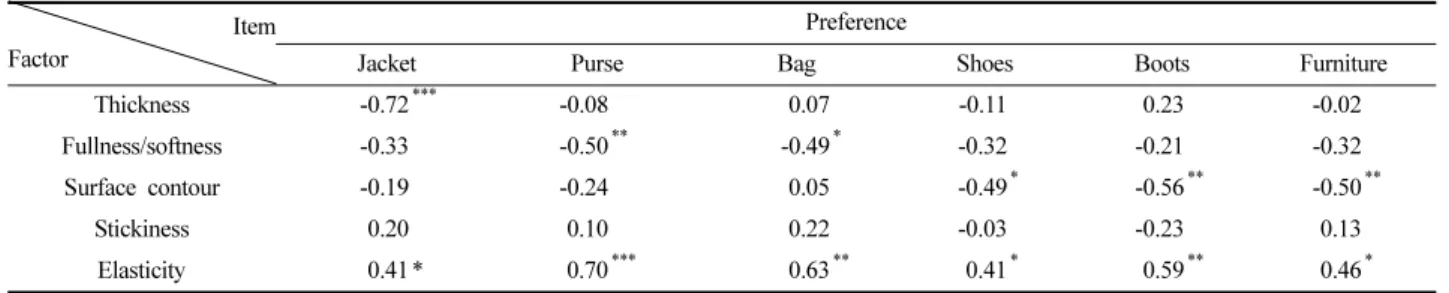
Table 7 shows correlation between the hand factors and the pref- erences for PU type by fashion items. Overall results show that the greater the ‘Elasticity’ of the artificial leather was, the greater the preferences for its use in purses, bags, shoes, boots, and furniture as well as jackets. It indicates that the ‘Elasticity’ is a key factor for
Fig. 1. The difference in the preferences for artificial leather by fashionitems; ***p<.001, Significantly different groups classified by Duncan's multiple range test were noted with a, b, c, d in which ‘a’ shows the highest value and ‘d’ shows the lowest value.
Table 6. Correlation between the hand factors and the preferences for suede type by fashion items Item
Factor
Preferences
Jacket Purse Bag Shoes Boots Furniture
Thickness -0.37 0.39 0.10 0.73** 0.69** -0.27
Fullness/softness 0.73** -0.20 0.00 0.06 0.51* 0.53*
Surface contour -0.48* 0.16 0.17 -0.10 0.08 -0.72**
Stickiness -0.32 -0.42 -0.39 -0.11 -0.03 0.38
Elasticity 0.12 0.84*** 0.64** 0.22 0.34 -0.38
*
p<.05,
**p<.01,
***p<.001
preferred leather. In general, artificial leather has less elasticity than genuine leather and it is less flexible (Kim et al., 1990). For such a reason, the preferences for all PU type products seem to be closely related to the resilience of artificial leather.
The preference for jackets of PU-type leathers had a negative relationship with its ‘Thickness’ and had a positive relationship with the ‘Elasticity’. It indicates that the thinner the leather was and the greater the ‘Elasticity’ was, the greater the preferences for jack- ets. However, there was no significant relationship between pref-
erences for jackets and the other hand factors such as ‘Fullness/
softness’, and ‘Stickiness’. Furthermore, the preferences for thin artificial leather in clothing should be due to the activity by the expansibility and the fitted silhouette. However, other products except jackets did not have a significant correlation with their thickness. These results suggest that ‘Thickness’ is critical for products that are put into something. A decrease in the ‘Fullness/
softness’ resulted in an increase in preferences for use in purse and bag, and a decrease in the ‘Surface contour’ resulted in a decrease
Table 7. Correlation between the hand factor and the preferences of PU type by fashion itemsItem Factor
Preference
Jacket Purse Bag Shoes Boots Furniture
Thickness -0.72*** -0.08 0.07 -0.11 0.23 -0.02
Fullness/softness -0.33 -0.50** -0.49* -0.32 -0.21 -0.32
Surface contour -0.19 -0.24 0.05 -0.49* -0.56** -0.50**
Stickiness 0.20 0.10 0.22 -0.03 -0.23 0.13
Elasticity 0.41 * 0.70*** 0.63** 0.41* 0.59** 0.46*
*
p<.05,
**p<.01,
***p<.001
Table 8. Effects of the subjective hand factors of suede type on the preferences for fashion items Dependent
variable Step Independent variables
Regression coefficients
Standardized regression
coefficients t-value Tolerance VIF F Adj. R2
Jacket preference
1 Constant 4.454 17.614*** 11.071** 0.372
Fullness/softness 1.923 0.639 3.327* 1 1
Regression equation Jackets preference=3.962+1.073*Fullness/softness, D.W=1.957 Purse
preference
1 Constant 3.501 21.386*** 16.597** 0.661
Elasticity 1.524 0.839 4.074** 1 1
Regression equation Purses preference=3.501+1.524*Elasticity, D.W=1.871 Bag
preference
1 Constant 4.230 19.788*** 7.294* 0.344
Elasticity 1.397 0.631 2.701* 1 1
Regression equation Bags preference=4.230+1.397*Elasticity, D.W=2.797
Shoes preference
1 Constant 3.817 56.996*** 18.657** 0.509
Thickness 0.436 0.734 4.319** 1 1
2 Constant 4.066 43.823*** 20.294*** 0.694
Thickness 0.511 0.860 6.160*** 0.923 1.083
Elasticity 0.608 0.456 3.265** 0.923 1.083
Regression equation Shoes preference=4.066+0.511*Thickness+0.608*Elasticity, D.W=2.275
Boots preference
1 Constant 4.419 42.615*** 11.065** 0.372
Thickness 0.520 0.639 3.326** 1 1
2 Constant 3.417 14.001*** 20.786*** 0.700
Thickness 0.562 0.692 5.181*** 0.992 1.008
Fullness/softness 1.291 0.573 4.295** 0.992 1.008
Regression equation Boots preference=3.417+0.562*Thickness+1.291*Fullness/softness, D.W=1.942 Furniture
preference
1 Constant 3.196 18.932*** 7.494* 0.448
Surface contour -0.650 -0.719 -2.738* 1 1
Regression equation Furniture preference=3.196-0.650*Surface contour, D.W=1.442
*
p<.05,
**p<.01,
***p<.001
in the preferences for use in shoes, boots and furniture that are in contact with the body.
3.4. Effect of subjective hand factor on the preferences for fashion items
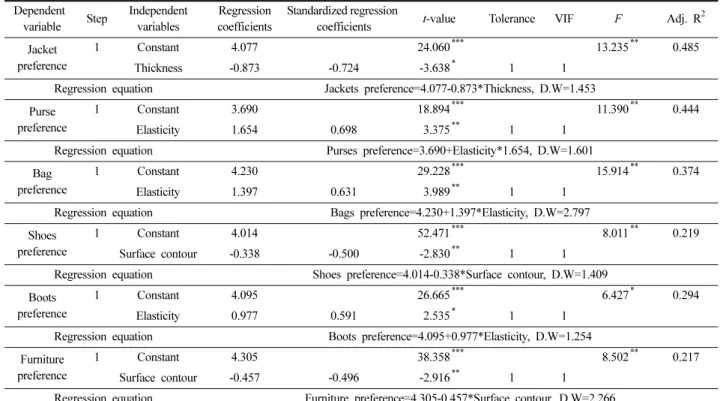
To confirm the effects of subjective hands of suede and PU types on the preferences for fashion items, multiple linear regression analysis (step-wise) were performed additionally and the results are shown in Table 8 and Table 9. A total of 12 regression models were derived. The results of Dubin-Watson test, tolerance and VIF show that there was no autocorrelation and multicollinearity in the mod- els. These mean that all models are appropriate.
As shown in Table 8, only ‘Fullness/softness’ of suede type was found to have a significant effect on the preferences for jackets, indicating that the preferences increased as the volume and softness increases. Unlike correlation data shown in Table 6, the preferences explained by ‘Surface contour’ were removed. This means that the preferences for jackets can be predicted by only ‘Fullness/softness’
of suede. On the other hand, ‘Elasticity’ of suede had a positive influence on the preferences for purses and bags; ‘Thickness’ and
‘Elasticity’ had a positive effect on the preferences for shoes;
‘Thickness’ and ‘Fullness/ softness’ showed positive effect on the preferences for boots, their surface properties had an effect on the preferences for use in furniture. The results indicate that softer
leathers were preferred for jackets. However suede type leathers that have better dimensional stability were preferred for purses and bags, and those with thickness were preferred for shoes and boots, and those with smooth surface were preferred for furniture.
On the other hand, the sense of thickness of PU type had a neg- ative effect on the preferences for jackets; ‘Elasticity’ had a positive effect on the preferences for wallets, bags, and boots; ‘Surface con- tour’ had a negative effect on the preferences for shoes and fur- niture (Table 9). The results show that lighter leathers were preferred for jackets. However the PU type leathers that have better dimensional stability were preferred for purses, bags, and boots, and those with smooth surface were preferred for shoes, and fur- niture.
As mentioned above, there were subtle differences between cor- relation results and regression results. However, by using multiple linear regression analysis can be to select a good set of predictor variables from these hand factors related the preference; that is, to separate the more important variables from those that may not be necessary in the preference.
3.5. Positioning for subjective hand and fashion items To infer the positioning of artificial leather, the correlation coef- ficients standardized z-score and the euclid distance were calcu- lated. MDS analysis was conducted using the PROXSCAL
Table 9. Effects of the subjective hand factor of PU type on the preference for fashion items Dependent
variable Step Independent variables
Regression coefficients
Standardized regression
coefficients t-value Tolerance VIF F Adj. R2
Jacket preference
1 Constant 4.077 24.060*** 13.235** 0.485
Thickness -0.873 -0.724 -3.638* 1 1
Regression equation Jackets preference=4.077-0.873*Thickness, D.W=1.453 Purse
preference
1 Constant 3.690 18.894*** 11.390** 0.444
Elasticity 1.654 0.698 3.375** 1 1
Regression equation Purses preference=3.690+Elasticity*1.654, D.W=1.601 Bag
preference
1 Constant 4.230 29.228*** 15.914** 0.374
Elasticity 1.397 0.631 3.989** 1 1
Regression equation Bags preference=4.230+1.397*Elasticity, D.W=2.797 Shoes
preference
1 Constant 4.014 52.471*** 8.011** 0.219
Surface contour -0.338 -0.500 -2.830** 1 1
Regression equation Shoes preference=4.014-0.338*Surface contour, D.W=1.409 Boots
preference
1 Constant 4.095 26.665*** 6.427* 0.294
Elasticity 0.977 0.591 2.535* 1 1
Regression equation Boots preference=4.095+0.977*Elasticity, D.W=1.254 Furniture
preference
1 Constant 4.305 38.358*** 8.502** 0.217
Surface contour -0.457 -0.496 -2.916** 1 1
Regression equation Furniture preference=4.305-0.457*Surface contour, D.W=2.266
*
p<.05,
**p<.01,
***p<.001
technique for producing most of the positioning. To explain the positioning of leathers, factor analysis (principal component, Vari- max rotation) was carried out using six kinds of preferences and five hand factors. The factor loading is similar to the regression coefficient in linear regression analysis. The factor number “two”
was used to interpret the axis for each dimension. The factor loadings on the hand factors and the preferences represent the correlations between the variables and the two factors (new axes). The coefficient of congruence in MDS close to 1 indicates a goodness of fit.
These results show that the positioning of artificial leather fit the data well. Fig. 2-a shows the MDS by suede type. Through the fac- tor analysis, the first factor (x-axis) was marked by high loadings on the purses, the bags, the shoes, and the boots preferences and
‘Elasticity’ and ‘Stickiness’, the second factor (y-axis) was marked by high loadings on preferences for jacket and furniture, ‘Fullness/
softness’, ‘Surface contour’, and ‘Thickness’ factors. The first fac- tor is generally more highly correlated with the variables than the second factor. As we noted earlier, these results suggest that ‘Elas- ticity’ is critical for products that are frequently exposed to contact with outside forces and that a soft feeling is most important for suede type that is in contact with the body. There was a + value in the x-axis, suggesting that the suede type leathers were very resil- ient and denoted the preferences for use in purses and bags. In con- trast, the suede type leathers had a - value, indicating that the
leathers were not springy, sticky, and were not favored for use in purses and bag. For example, it seems that S 3 was very resilient and favored for use in purses and bags and that S 4 was not soft and not favored for use in jacket and furniture. Likewise, the x-axis was resilience in related to the springy-limp parameters input, and the y- axis explained compressibility with soft-hard parameters.
The positions for PU type, shown in Fig. 2-b, differed sharply from those for suede. The first factor (x-axis) was marked by high loadings on the purse, bags, shoes, and furniture preferences, and
‘Elasticity’, ‘Surface contour’, the second factor (y-axis) was marked by high loadings on preferences for jackets, ‘Thickness’, and ‘Stickiness’. The first and the second factor were associated with a hand factor for ‘Fullness/softness’. The x-axis explained the resilience of the springy-limp variable, and the y-axis explained the thickness of the thick-thin variable. In other words, the x-axis was connected to the non-clothing preferences, and the y-axis is related to the preference for jackets.
These results suggest that there was a large difference between
the MDS for suede and for PU type and that there were differences
between the required subjective hands for the artificial leather
types. That is, the preferences of suede type leathers for jackets and
furniture were related to surface properties, whereas the prefer-
ences for the other items were associated with its resilience. On the
other hand, in case of PU-type leathers, the preference for jackets
Fig. 2. Positioning of the hand factors, the preferences and the artificial leathers.was significantly affected by their thickness, while those for the other items were influenced by their resilience and surface prop- erties. Therefore, in developing artificial suede, the influence of resilience for clothing and the furniture and the influence of com- pressibility for the other items must be taken into account. In addi- tion, for PU-type clothes, the thickness of artificial leather has to be considered. For non-clothing items, the resilience of leathers has to be considered.
4. Conclusion
This study has shown that the evaluation scale for the hand of artificial leather was drawn by subjective evaluation and provided the sought-after information that the subjective hand of artificial leather can play an important role in preferences by use.
Five subjective hand factors described the characteristics of leather: ‘Thickness’, ‘Fullness/softness’, ‘Surface contour’, ‘Stick- iness’, and ‘Elasticity’. The leather type associated with its man- ufacturing method was relevant for the subjective hands, which dictated preferences regarding the leather’s use. ‘Fullness/softness’
was the most valued variable for suede type, and ‘Thickness’ and
‘Elasticity’ were the most valued parameters for PU type leathers.
Suede was preferred for jackets than for boots, bags, shoes, fur- niture, and purses. On the other hand, bags made of PU type were favored, whereas jackets made of PU type were less favored. The surface properties of suede type affect the preferences for jackets and furniture: the warm nature of suede was favored for jackets, smoothness of that for furniture, however, preferences for purses and bags were associated with ‘Elasticity’, and those for shoes and boots, with ‘Thickness’. Whereas the thin nature of PU type was preferred for jackets, ‘Elasticity’ of that for purses, bags and boots, and the smoothness of that for shoes and furniture.
In this study, the complex relationship between the hands and preferences was visualized by a two-dimensional graph. The MDS of suede and PU-type were explained by different axes. This means that each hand of each leather type illustrates the importance of that particular property. The x-axis denotes the resilience and the y-axis, the compressibility of suede. The ‘Fullness/softness’ of suede is very important for products that are in contact with the body, and its resilience is critical for products in contact with external forces. For PU-type leathers, non-clothing and clothing preferences are related to its resilience and thickness, respectively.
Thus, preferred hands depend on the type of leather and its product use, and this must be considered in product development.
Based on the results of this research, it is necessary to make arti- ficial leather to meet consumer needs. However, quantitative anal- ysis is required in order to apply the results to a development plan
for artificial leather. Further research is currently underway to determine physical properties of artificial leather, and the data col- lected here can be used to predict physical properties that affect preferences by use.
Acknowledgements
This work was supported by the National Research Foundation of Korea grant funded by the Korea government (NRF- 2014R1A1A3049867).
References
‘Baiksan, Hyundai Motor take charge of car for North America export’.
(2012, July 22). The Korea Economic Daily. Retrieved August 9, 2012, http://www.hankyung.com/news/app/newsview.php?aid=2012 072244991
Barker, R. L., & Scheininger, M. M. (1982). Predicting the hand of nonwoven fabrics from simple laboratory measurements. Textile Research Journal, 52(10), 615-620. doi:10.1177/004051758205201002
Cardello, V. A., Winterhalter, C., & Schutz, G. H. (2003). Predicting the handle and comfort of military clothing fabrics from sensory and instrumental data: Development and application of new psychophysical methods. Textile Research Journal, 73(3), 221- 237. doi:10.1177/004051750307300306
Ellis, B. C., & Garnsworthy, R. K. (1980). A review of techniques for the assessment of hand. Textile Research Journal, 50(4), 231-238.
doi:10.1177/004051758005000406
Jhanji, Y., Kothari, V. K., & Gupta, D. (2016). Development and comparison of artificial neural network and statistical model for prediction of thermo-physiological properties of polyester-cotton plated fabrics. Fashion and Textiles, 3(1), 19. doi:10.1186/s40691- 016-0071-z
Joen, Y. H., Koo, J. G., Jeong, W. Y., & An, S. K. (2010). Changes on the abrasion and mechanical properties of warp knitted fabric for footwear with softeners and heat treatments. Fashion & Textile Research Journal, 12(4), 494-499. doi:10.5805/KSCI.2010.12.4.494 Jung, H. J., Chang, S. H., & Shim, H. J. (2007). A study on the
processing characteristics of artificial suede primary fabrics using sea-island type microfibers. Textile Science and Engineering, 44(1), 38-46.
Kawabata, S. (1980). The standardization and analysis of hand evaluation (2nd ed.). Osaka: The hand evaluation and standardization committee, The Textile Machinery Society of Japan.
Khanna, S., Sharma, S., & Chakraborty, J. N. (2015). Performance assessment of fragrance finished cotton with cyclodextrin assisted anchoring hosts. Fashion and Textiles, 2(1), 19. doi:10.1186/
s40691-015-0042-9
Kim, J. Y., Woo, J. Y., & Kim. S. (1990). Development of non-woven artificial leather. Textile Science and Engineering, 27(3), 21-28.
Kim, K. S. (2005). Manufacturing and characterization of artificial suede made from split type fine fibers in wet process. Textile Science and Engineering, 42(1), 48-53.
Kwon, Y. A. (2010). The effects of water-absorbent softner treatment on
the end-use properties of polyester knitted fabrics. Fashion & Textile Research Journal, 12(5), 676-682. doi:10.5805/KSCI.2010.12.5.676 Lee, J. S., & Shin, H. W. (2000). The sense of touch of man-made leather. Journal of the Korean Society of Clothing and Textiles, 24(2), 277-285.
Lee, J. U., Lee, H. J., & Cho, H. (1998). The situation and prospect of manufacturing technology of man-made suede. The Korean Society of Dyers and Finishers, 10(1), 51-56.
Lee, M. S., & Shim, H. J. (2006). A study on the mechanical properties of spunlace nonwoven fabrics using directly spun microfibers.
Textile Science and Engineering, 43(1), 46-52.
Miller, R. W. (2002). Subjective property characterization by "Quad"
analysis: An efficient method for conducting paired comparisons.
Textile Research Journal, 72(12), 1041-1051. doi:10.1177/0040517 50207201202
Ozcelik, G., Supuren, G., Gulumser, T., & Tarakcioglu, I. (2008). A study on subjective and objective evaluation of the handle properties of shirt fabrics. Fibres & Textiles in Eastern Europe, 16(3), 56-62.
Philippe, F., Schacher, L., Adolphe, D., & Dacremont, C. (2004).
Tactile feeling: Sensory analysis applied to textile goods. Textile Research Journal, 74(12), 1066-1072. doi:10.1177/0040517504074 01207
Roh, E. K., & Oh, K. W. (2014). Subjective hand and physical properties of tricot based artificial suede according to raising finish. Fashion & Textile Research Journal, 16(1), 153-159.
doi:10.5805/SFTI.2014.16.1.153
Roh, E. K., & Ryu, H. S. (2007). Effects of fiber contents and loop length of weft knit on subjective texture and preference: Using SEM. Journal of the Korean Society of Clothing and Textiles, 31(7), 1128-1138. doi:10.5850/JKSCT.2007.31.7.1128
Roh, E. K., Oh, K. W., & Kim, S. H. (2013). Classification of synthetic polyurethane leather by mechanical properties according to consumers' preference for fashion items. Fibers and Polymers, 14(10), 1731-1738. doi:10.1007/s12221-013-1731-x
Ryu, H. S., & Roh, E. K. (2010). Preference and subjective evaluation of washed fabric hand using conjoint analysis. Textile Research
Journal, 80(20), 2167-2175. doi:10.1177/0040517510376270 Seul, S. D., Lim, J. M., Ha, S. H., & Kim, Y. H. (2005). Adhesion
enhancement of polyurethane coated leather and polyurethane foam with plasma treatment. Korean Journal of Chemical Engineering, 22(5), 745-749.
Shin, H. W., & Lee, J. S. (1999). The sense of touch and preference of man-made leather -Subjective evaluation-. Journal of the Korean Society of Clothing and Textiles, 23(4), 541-550.
Shin, K. I., & Kim, J. J. (2000). A study on the handle and texture of artificial suede. Journal of the Korean Society of Clothing and Textiles, 24(1), 128-137.
Strazdienė, E., Martiši[ubar]tė, G., Gutauskasa, M., & Papreckienė, L.
(2003). Textile hand: A new method for textile objective evaluation. Journal of the Textile Institute, 94(3-4), 245-255.
doi:10.1080/00405000308630613
Vaughan, E. A., & Kim, C. J. (1975). Definition and assessment of fabric hand. Proceedings of National Technical Conference of AATCC, pp. 66-77.
White, C. F. (1989). Wet-formed nonwoven webs from high- performance fibers. Tappi Journal, 72(12), 109-118.
Winakor, G., Kim, C. J., & Wolins, L. (1980). Fabric hand: Tactile sensory assessment. Textile Research Journal, 50(10), 601-610.
doi:10.1177/004051758005001005
Wrobel, I. L., & Lanhenhove, L. V. (2012). The hand of textiles - definitions, achievements, perspectives- a Review. Textile Research Journal, 82(14), 1457-1468. doi:10.1177/0040517512438126 Yick, K. L., Cheng, K. P. S., Dhingra, R. C., & How, Y. L. (1996).
Comparison of mechanical properties of shirting materials measured on the KES-F and FAST instruments. Textile Research Journal, 66(10), 622-633. doi:10.1177/004051759606601003 Yu, Y., Hui, C. L., Choi, T. M., & Ng, S. F. (2011). A new approach
for fabric hand prediction with a nearest neighbor algorithm - Based feature selection scheme. Textile Research Journal, 81(6), 574-584. doi:10.1177/0040517510387208
(Received 11 December 2016; 1st Revised 28 December 2016;
2nd Revised 6 January 2017; Accepted 31 January 2017)