Effects of Peroxides on the Properties of Reclaimed Polypropylene/Waste Ground Rubber Tire Composites Prepared by a Twin Screw Extrusion
Seonggil Kim, Minji Lee, Hyeongsu Lee, Hobin Jeong, Yuri Park, Kwang-Hwan Jhee, and Daesuk Bang
†School of Science and Engineering of Chemical Materials, Kumoh National Institute of Technology,
Yangho-Dong, Gumi, Gyeongbuk 730-701, Korea
(Received November 2, 2015, Revised November 12, 2015, Accepted November 17, 2015)
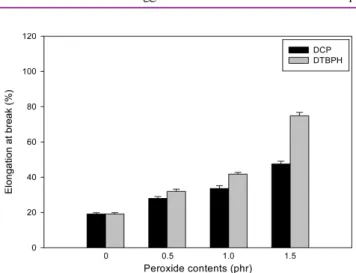
Abstract: In this study, the reclaimed polypropylene (RPP) and waste ground rubber tire (WGRT) were used to simulate the thermoplastic vulcanizate (TPV) for cost reduction and resources recycling. Also, we examined the effects of dicumyl peroxide (DCP) and 2,5-dimethyl-2,5-di-(tert-butylperoxy)-hexane (DTBPH) as peroxide type cross-linking agents to enhance the properties of TPV’s. The components of RPP and WGRT were fixed at 30 and 70 wt%, and DCP and DTBPH were added in the concentrations from 0.5 to 1.5 phr, respectively. RPP/WGRT composites with different contents of DCP and DTBPH were prepared by a modular intermeshing co-rotating twin screw extruder. The Young’s modulus of composites were decreased with increasing peroxides contents. On the other hand, tensile strength, elongation at break, and impact strength of the composites were increased with peroxide contents. We also confirmed that interfacial adhesion between RPP and WGRT was considerably improved by adding the peroxides. Taken together, DTBPH added RPP/WGRT composites exhibited better mechanical properties rather than those of DCP added composites.
Keywords: reclaimed polypropylene, waste ground rubber tire, modular intermeshing co-rotating twin screw extruder, per- oxide
Introduction
산업의 발전은 우리에게 풍요롭고, 편리한 삶을 영위할 수 있도록 해주지만 심각한 환경오염 문제도 가져온다. 우리나 라의 경우에 그 어떤 나라보다도 빠른 산업발전을 이루었으 나, 이에 따라 매년 많은 양의 폐기물이 쏟아져 나오는 실정 이다. 이러한 폐기물이 가져오는 다양한 문제의 해결을 위하 여 폐기물의 처리방법에 대한 연구가 절실하다.
대표적인 폐기물 중 하나인 폐타이어의 경우, 국내 자동차 산업의 성장에 따라 발생량이 크게 증가하고 있다. 이러한 문 제를 해결하기 위한 처리방법은 파쇄를 통한 인조잔디용 고 무 칩, 건축용 방음재 등의 가공이용, 소각 또는 파생연료 등 의 열 이용, 매립 등이 있다. 그러나 이러한 처리방법은 이용 분야의 한계문제와 더불어 토양, 수질, 대기오염 및 매립지 부 족 등과 같은 문제의 원인이 되므로 경제적, 환경적인 문제해 결을 위한 다양한 연구의 진행이 필요한 실정이다.
폐타이어를 재활용하는 여러 방법 중에 대두되고 있는 방 법으로 미분쇄를 통하여 섬유, 철심 등을 제거한 폐타이어 고 무 분말(Waste Ground Rubber Tire, WGRT)을 제조한 뒤 이를 열가소성 고분자와 혼합한 복합체를 제조하는 것이 있다.
1-4이러한 고분자/폐타이어 복합체 제조는 기존의 TPV(Thermo- plastic vulcanizate) 에 고무상으로 첨가되는 EPDM(Ethylene Propylene Diene Monomer) 대신 폐타이어 고무분말을 사용 하는 것으로 환경문제와 재료의 원가 절감에 따른 경제적 문 제도 해결할 수 있는 방안이 된다.
그러나, 이러한 TPV 제조 시 EPDM이나 폐타이어 고무 분 말의 사용은 이미 생산단계에서 황 등의 가교제에 의해 분자 구조가 가교되어 있어 가공이 쉽지 않으며, 구성 성분간의 상 용성이 없어 고무의 함량이 증가할수록 인장 특성 등의 물리 적 특성이 좋지 않다. 따라서 이러한 문제를 해결하기 위해 고 분자에 말레산 무수물이 그라프트 된 PP-g-MA, SEBS-g-MA, EPDM-g-MA 와 같은 상용화제
5-9를 이용하거나 탈황제, 초음 파, 미생물, 전자빔을 이용한 고무 분말의 탈황,
10-15그리고 peroxide 나 sulfur 등의 첨가를 통한 동적 가교
16-18에 관한 다 양한 연구가 진행되고 있다. 그러나 폐타이어를 활용한 TPV 복합소재 연구의 대부분은 폐타이어 고무 분말의 함량이 낮 거나 폐플라스틱을 활용한 연구가 부족하여 폐타이어 고무 분 말의 고함량화와 더불어 폐플라스틱을 이용한 연구의 진행이 필요한 상황이다.
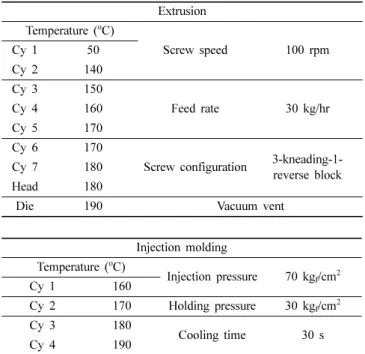
본 연구의 목적은 폐자원의 재활용 증대를 목적으로 모듈 라 치합형 동방향회전 이축 스크류식 압출기를 사용하여 연 속적으로 재생 폴리프로필렌(Reclaimed polypropylene, RPP)/
†