Introduction
Although there have been a number of advertisements, newspaper articles, and internet sites 1-2) assessing relationships between Sasang typology and occupation based on personality traits and physical traits, few evidence-based studies about those relationships have been reported: Yoon & Kal 3) have found the chara- cteristics of those who worked for the manufa-
received : 25 October 2007
received in revised from : 26 October 2007 accepted : 15 November 2007
Correspondence to : Han Chae
Pusan National University School of Oriental Medicine 30 Jangjeon-Dong, Geumjeong-Gu, Busan, 609-735 Korea (Tel : +82-51-510-7377 / Fax : +82-51-510-7377 Email [email protected])
This work was supported for two years by a Pusan National University Research Grant
Analysis of the Relationships Between Sasang Typology, Holland's Vocational Typology, and Myers-Brigg's Types Among
Undergraduate Students at the College of Oriental Medicine
Soo-Jin Lee 1 , Suzanne-H. Park 2 , Jung-Hyeok Im 3 , Ye-Sul Sin 3 , Hyon-Il Ha 3 , Sang-Woo Shin 4 , Young-Kyu Kwon 5 , Han Chae 4
1
Dept. of Psychology, Yonsei University, Seoul, Korea
2
Dept. of Psychiatry, NYU-Bellevue Hospital Center, NY, NY
3
College of Oriental Medicine, Daegu Haany University, Daegu, Korea
4
School of Oriental Medicine, Pusan National University, Busan, Korea
5
Dept. of Physiology, College of Oriental Medicine, Daegu Haany University, Daegu, Korea Original Article
Objectives : The present study investigated the integrative relationships between Sasang typology, Holland's vocational typology, and Myers-Briggs type.
Methods : The sample was composed of 83 sophomores at the College of Oriental Medicine, Daegu Hanny University (56 men, 27 women; ages 19 to 39, mean age ± S. D. = 24.38 ± 5.28) and was carried out with the QSCC II, Holland inventory, and MBTI. SPSS 12.0 was employed for statistical analyses.
Results : The Sasang types of the subjects were as followed: 21 Soyangin (10 men, 11 women) (25.3 %), 20 Taeumin (18 men, 2 women) (24.1 %), and 42 Soeumin (28 men, 14 women) (50.6 %). There were no significant differences in the mean scores of Realistic, Investigative, Artistic, Social, Enterprising, or Conventional scale between the 3 Sasang types,but in the mean scores of Realistic, Investigative, and Artistic scale between the 4 MBTI combinations (Sensing-Thinking, Sensing-Feeling, Intuition-Thinking, and Intuition-Feeling type): F (3, 73) = 3.11, p < .05 in Realistic scale, F (2, 73) = 3.70, p < .05 in Investigative scale, and F (2, 73) = 5.60, p < .01 in Artistic scale.
Conclusions : The present study discovered that the first preference for vocational aptitude of undergraduate students at the College of Oriental Medicinewas Investigative and the second preference was Artistic, which fitted Holland's vocational codes as Investigative/Artistic or Investigative/Social scale. The personality traits underlying Sasang typology play an important factor in making career decisions.
Key Words : Sasang constitution, Holland vocational typology, MBTI, personality traits
cturing industry based on Sasang typology and Sul and Kim 4) have uncovered a link between Sasang typology and occupational aptitude using KIPAT and KAT-A. Therefore it is premature to generalize relationships between Sasang types and vocational types due to the paucity of relationship studies between them. In the present study, we aimed to match the charac- teristics of Sasang types to vocational types based on Holland's theory.
Holland's six dimensional vocational model 5) is premised on a match between individuals and occupations. He proposed that a good match between a person's interest and occupational type is the critical concept underlying career satisfaction and longevity. Holland referred to this matching process as person-environment congruence or fit. This concept has transcended the vocational psychology field, and is now the dominant model underlying theories of organ-
Vocational type
Attribute Realistic Investigative Artistic Social Enterprising Conventional
Requires
Manual and mechanical competencies, interaction with machines, tools, and objects
Analytical, technical, scientific, and verbal competencies
Innovation or creative ability, emotionally expressive interaction with others
Interpersonal competencies, skill in mentoring, treating, healing, or teaching others
Skills in persuasion or manipulation of others
Clerical skills, skills in meeting precise standards for performance
Demands and rewards the display of
Conforming behavior, practical accomplishment
Skepticism and persistence in problem solving, documentation of new knowledge, understanding or solution of problems
Imagination in literary, artistic or musical accomplishment
Empathy, humanitarianis m, sociability, friendliness
Initiative in the pursuit of financial or material accomplishment
; dominance;
self-confidence
Organizational ability, conformity, dependability
Values or personal styles allowed expression
Practical, productive and concrete values
Acquisition of knowledge through scholarship or investigation
Unconventional ideas or manners, aesthetic values
Concern for the welfare of others
Acquisitive or power-oriented style, responsibility
Conventional outlook and concern for orderliness and routine
Occupations and other
environments involve
Concrete, practical activity; use of machines, tools, materials
Analytical or intellectual activity aimed at trouble-shooting or creation and use of knowledge
Creative work in music, writing, performance, sculpture, or unstructured intellectual endeavors
Working with others in a helpful or facilitating way
Selling, leading, manipulating others to attain personal or organizational goals
Working with things, numbers, or machines to meet predictable organizational demands or specified standards Representative
occupations
Carpenter, truck driver
Psychologist, microbiologist
Musician, interior designer
Counselor, clergy member
Lawyer, retail store manager
Production editor, bookkeeper Source: Adapted from the Dictionary of Holland Occupational Codes, Third Edition, by Gary D. Gottfredson, Ph. D., and John L. Holland, Ph. D., 1982, 1989, 1997 by Psychological Assessment Resources, Inc.
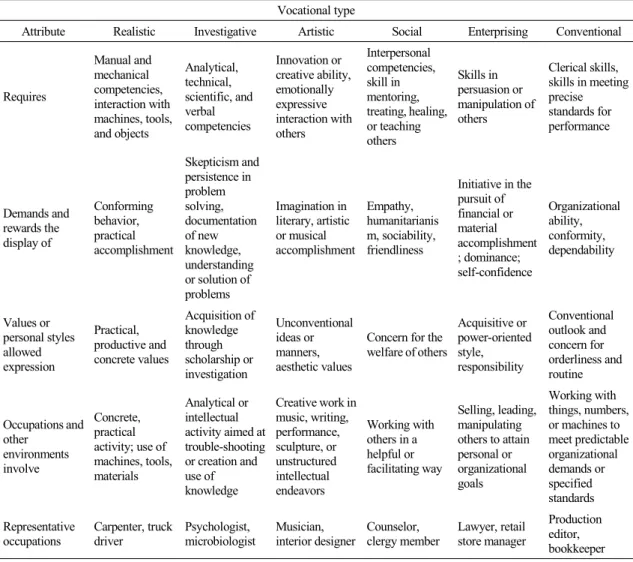
Table 1. A Brief Description of the Holland Vocational Typology
izational behavior 6) .
Holland identified six personality types or themes that represent characteristics of the work environment, personality traits, and interests of working people: Realistic, Investigative, Artistic, Social, Enterprising and Conventional or RIASEC, respectively. Table 1 shows the brief description of the Holland's 6 vocational types.
There are quite a few correlation studies between Holland aptitude test and MBTI 7) as well as between Questionnaire for Sasang Constitution Classification II (QSCC II) and Myers-Briggs Type Indicator (MBTI) 8,9) .
Myers-Briggs type theory is that people tend to have differential preferences for certain modes of coping and developing, which they have to exercise in order to do well and feel well in their work and life situations. She suggested that individuals fall into four dichotomous personality types (Introversion/Extroversion, Sensing/Intuition, Thinking/Feeling, and Judging/
Perceiving). She also maintained that Sensing/
Intuition and Thinking/Feeling combinations are the most important factors for career choices:
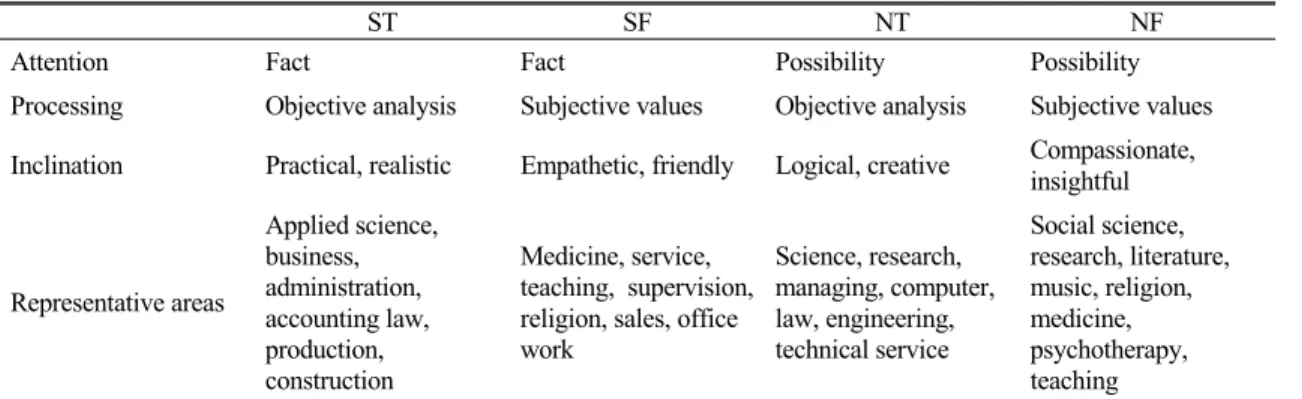
Sensing-Thinking (ST), Sensing-Feeling (SF), Intuition-Thinking (NT), Intuition-Feeling (NF).
Table 2 shows the characteristics of such com-
binations.
Park and Kang 7) found that the Introversion preference of MBTI was significantly positively correlated to the Conventional scale, and negat- ively correlated to the Artistic and Enterprising scales of vocational preference inventory. Five of Holland's scales (Realistic, Investigative, Artistic, Social, and Conventional, except Enter- prising) showed significant differences in Jung's four psychological functions: ST, SF, NT, NF.
In the Artistic scale, NT and NF combinations were more common than any other MBTI combination: NT and ST in the Investigative scale, ST and SF in the Conventional scale, SF in the Social scale, and NT and ST in the Realistic scale.
Chae and his colleagues 8) substantiated that the Soyangin was more extroverted than the Taeumin, who in turn was more extroverted than the Soeumin, and the Soeumin was found to be more judging than both the Soyangin and the Taeumin using Myers-Briggs Type Indicator (MBTI).
Choi and her colleagues 9) discovered that the Soeumin showed more preference for Introversion, the Taeumin for Sensing and the Soyangin for Intuition and Perceiving.
ST SF NT NF
Attention Fact Fact Possibility Possibility
Processing Objective analysis Subjective values Objective analysis Subjective values Inclination Practical, realistic Empathetic, friendly Logical, creative Compassionate,
insightful
Representative areas
Applied science, business, administration, accounting law, production, construction
Medicine, service, teaching, supervision, religion, sales, office work
Science, research, managing, computer, law, engineering, technical service
Social science, research, literature, music, religion, medicine, psychotherapy, teaching ST: Sensing-Thinking, SF: Sensing-Feeling, NT: Intuition-Thinking, NF: Intuition-Feeling,
Table 2. Characteristics of the 4 MBTI Combinations
The purpose of the present study is to investigate the integrative relationships between Sasang typology, Holland's vocational typology, and MBTI and to shed light on the generalization of relationships of Sasang type and vocational type.
Methods
1. Participants
The sample was composed of 83 sophomores at the College of Oriental Medicine of Daegu Hanny University aged 19 to 39 (56 men, 27 women; mean age ± S. D. = 24.38 ± 5.28). All participants gave oral consent for the full asses- sments.
2. Instruments 1) QSCC II.
QSCC II is a Sasang typology-based inventory, which was developed by the Department of Sasang Medicine at Kyung Hee Medical Center (Seoul, Korea) in 1993 10) and revised in 1996 11) , and has been used in clinical studies. The revised edition is based on 1366 subjects (668 males, 678 females). Ages ranged from 10 to 60 years and 68
% of subjects had educational levels over 12 years. It has been also validated using 265 subjects from the Department of Sasang Constitutional Medicine or Oriental Medicine &
Western Medicine Cooperative Health Exam- ination Center, Kyung Hee University Medical Center. The QSCC II is composed of 121 forced-choice items. The internal consistency (Cronbach a) of this inventory is as follows:
Taeyangin is .57, Soyangin is .57, Taeumin is .59, and Soeumin is .63.
The Sasang type of an individual was deter- mined following two procedures. First, the raw
scores for the Sasang types were acquired with the QSCC II. After standardizing the raw scores based on their age and gender-specific norms, these scores were computed into discriminants to differentiate the Sasang types of individuals.
A paper-and-pencil self-report form of the QSCC II was used, and the Sasang type was determined using PC-based software (Win QSCC II 99 version; Ssord Medicom & Ssord OMS, Seoul, Korea).
2) Holland inventory
The Holland aptitude test in Korea was developed by Ahn 12) in 1996 and based on the Self-Directed Search 13) . Its contents consist of personality, activity preference, competency, values, occupation, and global evaluation and its reliability is .92-.94 in Realistic scale, .90-.93 in Investigative scale, .91-.94 in Artistic scale, .90-.92 in Social Scale, .89-.92 in Enterprising scale, and .84-.89 in Conventional scale. The form used in the present study was occupation preference test S type, which is based on Holland's theory, from the Korea Employment Information Service, the government internet site for those seeking information for careers and jobs. The raw scores of RIASEC were used for the analysis in the present study and the Holland type of an individual was determined by the highest raw score of each RIASEC scores.
3) MBTI.
The MBTI is a paper-and-pencil self-report
form composed of 95 forced-choice items first
developed by Meyers and Briggs and translated
into Korean by Sim 14) . It is a psychometric
instrument designed to assess normal personality
traits 15) . This inventory has been geared toward
assessing differences that result from the way
people perceive information and how they prefer to use that information 16) . The MBTI individual categorical dimensions (i.e., Extroversion/Intro- version) were also presented as standardized continuous preference scores (i.e., below 100 is Extroversion and above 100 is Introversion).
The continuous preference scores of ST, SF, NT, and NF were used for the analysis in the present study.
3. Data Analysis
The relationships between Sasang typology and Holland typology were analyzed first: the Sasang type and the raw scores of each of Holland's RIASEC scales. Next, the relati- onships between Myers-Briggs type and Holland typology were analyzed: the continuous preference scores of ST, SF, NT, and NF and the raw scores of each of Holland's RIASEC scalesin order to find the underlying personality characteristics relating to Sasang type and vocational type. The statistical analyses here were conducted using SPSS 12.0 (SPSS Inc., Chicago, IL).
Results
1. Sasang typology and Holland typology The Sasang types of the subjects were 21 Soyangin (10 men, 11 women) (25.3 %), 20 Taeumin (18 men, 2 women) (24.1 %), and 42 Soeumin (28 men, 14 women) (50.6 %).
The vocational scales of the subjects were 6 Realistic scale (7.2 % 1 Soyangin, 3 Taeumin, and 2 Soeumin), 31 Investigative scale (37.3 % 8 Soyangin, 7 Taeumin, and 16 Soeumin), 16 Artistic scale (19.3 % 3 Soyangin, 3 Taeumin, and 10 Soeumin), 13 Social scale (15.7 % 2 Soyangin, 3 Taeumin, and 8 Soeumin), 5 Enterp- rising scale (6.0 % 4 Soyangin and 1 Taeumin), and 6 Conventional scale (7.2 % 1 Soyangin, 2 Taeumin, and 3 Soeumin). There were 5 Investi- gative/Social scale (6.0 %) and 1 Investigative/
Enterprising scale (1.2 %), which means they scored the highest score of Investigative/Social scale and Investigative/Enterprising scale at the same time, respectively. The 5 Investigative/
Social scale comprised 1 Soyangin, 1 Taeumin and 3 Soeumin and the 1 Investigative/ Enterp- rising scale was Soyangin. The values of mean and frequency of 5 Investigative/Social and 1 Investigative/ Enterprising scale were excluded in the present analyses to avoid the distortion of data and therefore the values of 77 subjects were included in the present analyses. Table 3 shows the mean scores of RIASEC scale for each Sasang type.
Age did not differ significantly (F (2, 71) = 1.98, p > .05) between Sasang types but gender ratio did differ significantly between Sasang types ( (2, N=77) = 7.71, p < .05). The previous Holland typology studies did not divide subjects based on gender and therefore we did not distinguish the participants based on the gender.
R I A S E C
So-Yang (N=19) 22.47±10.70 38.68±9.12 30.37±14.85 33.11±8.41 29.84±11.62 28.89±12.44
Tae-Eum (N=19) 28.68±11.96 35.21±11.28 24.32±12.49 26.21±10.73 23.89±14.22 24.21±13.37
So-Eum (N=39) 22.59±11.32 36.13±11.02 27.00±14.74 29.67±11.41 22.62±11.51 27.97±11.32
Table 3. Mean Scores of the RIASEC Scale for Each Sasang Type
There was significant difference in the frequency of R, I, A, S, and C scale in Soeumin ( (4, N=39) = 16.51, p < .01), but the frequency of R, I, A, S, E, or C scale in Soyangin and Taeumin did not differ significantly: (5, N=
19) = 11.00, p > .05 and (5, N=19) = 6.58, p >
.01, respectively.
There were no significant differences in the mean scores of R, I, A, S, E, or C scale between the 3 Sasang types: F (2, 74) = 2.10, p > .05 in Realistic scale, F (2, 74) = .56, p > .05 in Investigative scale, F (2, 74) = .86, p > .05 in Artistic scale, F (2, 74) = 2.02, p > .05 in Social scale, F (2, 74) = 2.28, p >.05 in Enterprising scale, and F (2, 74) = .84, p > .05 in Conventional scale.
2. Myers-Briggs type and Holland typology The Myers-Briggs types of the subjects were 34 Sensing-Thinking (ST) type (44.2 %), 18 Sensing-Feeling (SF) type (23.4 %), 16 Intuition- Thinking (NT) type (20.8 %), and 9 Intuition- Feeling (NF) type (11.7 %).
The vocational scales of the subjects were Realistic scale (5 ST type and 1 SF), 31 Investigative scale (14 ST type, 2 SF type, 11 NT type, and 4 NF type), 16 Artistic scale (3 ST type, 7 SF type, 3 NT type, and 3 NF type), 13 Social scale (5 ST type, 5 SF type, 1 NT type, and 2 NF type), 5 Enterprising scale (3 ST type,
1 SF type, and 1 NT type), and 6 Conventional scale (4 ST type and 2 SF type). The 5 Investigative/Social scale comprised 2 ST type, 1 SF type, 1 NT type, and 1 NF type and the 1 Investigative/Enterprising scale was ST type.
Table 4 showed the mean scores of RIASEC scale for ST, SF, NT, and NF combinations.
Age and gender ratio did not differ signif- icantly between MBTI combinations: F (3, 70) = .69, p > .05 and (3, N=77) = 2.40, p > .05, respectively.
There was significant difference in the frequency of R, I, A, S, E, and C scale in ST type and NT type ( (5, N=34) = 15.41, p < .01 and ( (5, N=16) = 17.00, p < .01, respectively), but the frequency of R, I, A, S, E, or C scale in SF type and NF type did not differ significantly: ( (5, N=18) = 10.00, p > .05 and (5, N=9) = .67, p > .05, respectively.
There were significant differences in the mean scores of R, I, and A scale between the 4 MBTI combinations: F (3, 73) = 3.11, p < .05 in Realistic scale, F (2, 73) = 3.70, p < .05 in Investigative scale, and F (2, 73) = 5.60, p < .01 in Artistic scale. Tukey's post hoc test was performed: SF and NF were significantly different in Realistic scale, NT and SF were significantly different in Investigative scale, and ST and SF as well as ST and NF were significantly different in Artistic scale.
R I A S E C
ST (N=34) 22.50±11.22 35.18±9.76 20.47±12.73 27.41±11.35 23.38±12.20 29.26±12.05 SF (N=18) 20.11±11.85 31.89±9.85 33.28±12.72 33.50±9.60 23.11±9.71 26.89±11.73 NT (N=16) 27.19±8.86 41.44±9.88 30.06±13.11 29.56±11.57 28.31±15.33 26.38±12.63 NF (N=9) 32.33±12.19 42.22±12.00 35.11±14.02 30.67±7.67 26.56±13.26 22.11±12.29 S/N: Sensing/Intuition, T/F: Thinking/Feeling
ST: Sensing-Thinking, SF: Sensing-Feeling, NT: Intuition-Thinking, NF: Intuition-Feeling,
Table 4. Mean Scores of the RIASEC Scale for Each S/N and T/F MBTI Combination
Table 5 shows the correlations between Myers- Briggs types and RIASEC scales and their results were as follows: Extroversion/Introversion was correlated with in I, S, and E, Sensing/
Intuition was correlated with R, I, and A, Thinking/
Feeling was correlated with A, and Judging/
Perceiving was correlated with R, I, and A.
Namely, vocational types were able to be diff- erentiated by MBTI types rather than by Sasang types, suggesting underlying personality traits did play an important role in career decisions.
Discussion
The purpose of the present study was to find out the characteristics relating Sasang types to vocational types and the result was that personality traits are a more important factor than Sasang type itself to influence making a career decision. The present study also confirmed that Sasang type could be distinctively and reliably classified by a modern personality theory 8,12) , suggesting that if you want to improve the success rate of your career, you had better utilize the individual personality traits information underlying Sasang typology. The present study also displayed the fact that the first preference for vocational aptitude of undergr- aduate students at College of Oriental Medicine was Investigative and the second preference was Artistic, which fitted Holland's vocational codes
as Investigative/Artistic or Investigative/Social scale. However, for more detailed and infor- mative conclusion, you are advised to look up information about psychological traits as well as physical traits. The concept of Holland inventory that fits between self and environment matters matches that of the Sasang typology emphasizing the harmony in social life and developing one's character 18) .
Further research will be necessary to elaborate on the fact that correlations between MBTI and Sasang typology should consider essential characteristics such as Sensing/Intuition and Thinking/Feeling types, which seem more directly related to occupation and personality inventory than Extroversion/Introversion and Judging/
Perceiving types. Such integrative attempts of MBTI and Sasang typology would embrace the Sasang typology as more comprehensive medicine.
Finally, we must discuss the limitations of the present study and the implications for further research. First, the classification of Sasang type should be produced from various assessments based on physical, pathological, psychological, and pharmaceutical characteristics. The Sasang type of the present study was drawn only from the QSCC II self-report, therefore further studies should consider the various informants for the diagnosis of Sasang types.
Second, the small sample size makes it difficult to divide subjects by sex and two-digit occup-
R I A S E C
EI -.062 -.291
*-.160 -.348
**-.577
***-.088
SN .296
*.419
***.308
**-.047 .122 -.127
TF -.006 -.179 .319
**.162 -.027 -.134
JP .282
*.257
*.232
*.057 .158 -.170
*