ABSTRACT
Background: Disseminated intravascular coagulation (DIC) contributes to poor outcome in the early phase of trauma. We aimed to analyze and compare the prognostic performances of the International Society on Thrombosis and Hemostasis (ISTH) and the Korean Society on Thrombosis and Hemostasis (KSTH) scores in the early phase of trauma.
Methods: Receiver operating characteristics analysis was used to examine the prognostic performance of both scores, and multivariate analysis was used to estimate the prognostic impact of the ISTH and KSTH scores in the early phase of trauma. The primary outcome was 24-hour mortality and the secondary outcome was massive transfusion.
Results: Of 1,229 patients included in the study, the 24-hour mortality rate was 7.6% (n = 93), and 8.1% (n = 99) of patients who received massive transfusions. The area under the curves (AUCs) of the KSTH and ISTH scores for 24-hour mortality were 0.784 (95% confidence interval [CI], 0.760–0.807) and 0.744 (95% CI, 0.718–0.768), respectively. The AUC of KSTH and ISTH scores for massive transfusion were 0.758 (95% CI, 0.734–0.782) and 0.646 (95%
CI, 0.619–0.673), respectively. The AUCs of the KSTH score was significantly different from those of the ISTH score. Overt DIC according to KSTH criteria only, was independently associated with 24-hour mortality (odds ratio [OR], 2.630; 95% CI, 1.456–4.752). Only the KSTH score was independently associated with massive transfusion (OR, 1.563; 95% CI, 1.182–2.068).
Conclusion: The KSTH score demonstrates a better prognostic performance for outcomes than the ISTH score in the early phase of trauma.
Keywords: Trauma; Prognosis; Disseminated Intravascular Coagulation; Scoring
INTRODUCTION
In the emergency department (ED), trauma is a major cause of death.1,2 Half of deaths due to trauma occur within 24 hours of admission.3 Among the several causes of death in the early phase of trauma, exsanguination is as prominent as central nervous system injury.4 It has been reported that 16%–44% of patients with trauma developed disseminated intravascular coagulation (DIC) on ED arrival, depending on the diagnostic criteria.5,6 DIC increases proinflammatory cytokines, inhibits the anticoagulant pathway, and sustains a systemic
Original Article
Received: Jul 12, 2017 Accepted: Oct 15, 2017 Address for Correspondence:
Dong Hun Lee, MD
Department of Emergency Medicine, Chonnam National University Hospital, 42 Jebong-ro, Dong-gu, Gwangju 61469, Republic of Korea.
E-mail: [email protected]
© 2018 The Korean Academy of Medical Sciences.
This is an Open Access article distributed under the terms of the Creative Commons Attribution Non-Commercial License (https://
creativecommons.org/licenses/by-nc/4.0/) which permits unrestricted non-commercial use, distribution, and reproduction in any medium, provided the original work is properly cited.
ORCID iDs Hong Sug Kim
https://orcid.org/0000-0002-4779-603X Dong Hun Lee
https://orcid.org/0000-0003-3612-3443 Byung Kook Lee
https://orcid.org/0000-0003-3571-9448 Yong Soo Cho
https://orcid.org/0000-0001-8306-2298 Disclosure
The authors have no potential conflicts of interest to disclose.
Author Contributions
Conceptualization: Lee DH. Data curation: Lee DH, Cho YS. Formal analysis: Lee BK. Writing - original draft: Kim HS, Lee DH.
Hong Sug Kim , Dong Hun Lee , Byung Kook Lee , and Yong Soo Cho
Department of Emergency Medicine, Chonnam National University Hospital, Gwangju, Korea
Prognostic Performance Evaluation of the International Society on Thrombosis and Hemostasis and the Korean Society on Thrombosis and Hemostasis Scores in the Early Phase of Trauma
Emergency &
Critical Care Medicine
inflammatory response in trauma.7 Patients with DIC had a higher risk for mortality and received more transfusions than those with non-DIC in the early phase of trauma.6 DIC at early phase of trauma continues into the late phase of trauma, eventually leading to multiple organ dysfunction syndrome.6,7 Therefore, early diagnosis of DIC and rapid intervention for DIC patients is important to decrease mortality in the early phase of trauma.
For a diagnosis of DIC, the International Society on Thrombosis and Hemostasis (ISTH) score is the most frequently used diagnostic criteria.8 The ISTH score facilitates an accurate diagnosis of DIC in trauma, and DIC diagnosed by ISTH has been associated with mortality or massive transfusions in trauma.9 The Korean Society on Thrombosis and Hemostasis (KSTH) score has also been useful in diagnosing DIC in critically ill patients.10 In patients with complicated sepsis, the KSTH score showed a good prognostic performance for intensive care unit (ICU) mortality.11 However, most previous studies have focused on the relationships between the two scoring systems and prognosis in critically ill patients, whereas comparative prognostic performance analysis of these two scoring systems regarding trauma patients has been lacking.
In the present study, we aimed to analyze and compare the prognostic performances of the ISTH and KSTH scores in the early phase of trauma.
METHODS
Study design and population
We performed a retrospective observational study involving patients with severe trauma, at Chonnam National University Hospital, Gwangju, Korea, admitted between January 2012 and December 2015. Severe trauma was defined as having an injury severity score (ISS) greater than 16.12 The following exclusion criteria were applied: age less than 18 years; lack of DIC laboratory tests (platelet counts, activated partial thromboplastin time [aPTT], prothrombin time, fibrinogen level, fibrin/fibrinogen degradation product [FDP] level, and D-dimer level) within 1 hour of admission; specific trauma mechanisms, such as drowning or hanging;
cardiac arrest following trauma; conditions resulting in coagulation abnormalities, such as hematologic malignancy, pregnancy, severe hepatic dysfunction, and current use of anticoagulant agents; and missing data.
Data collection
The following variables were obtained for each patient: age, sex, mechanism of trauma, time interval from accident to arrival at our ED, systolic arterial blood pressure (mmHg) on admission, respiratory rate on admission, initial Glasgow Coma Scale (GCS) data, laboratory data on admission (pH, PaCO2, base excess, white blood cell count, hemoglobin, platelet count, aPTT, international normalized ratio of prothrombin time [PT-INR], fibrinogen level, FDP level, and D-dimer level), amounts of transfusion packed red blood cells (PRCs), fresh frozen plasma (FFP), and platelet concentrates (PCs) during the first 24 hours after trauma, and 24-hour mortality.
The revised trauma score (RTS) was calculated based on vital signs and the GCS. The Abbreviated Injury Scale (AIS) score and ISS were calculated on arrival. Massive transfusion was defined as transfusion of ≥ 10 units PRC from initial presentation in the ED to 24 hours after arrival. The ISTH and KSTH scores were calculated based on the data collected on admission. The primary outcome was 24-hour mortality and the secondary outcome was massive transfusion.
Statistical analysis
Continuous variables did not satisfy the normality test and are presented as median values with interquartile ranges (IQRs). Categorical variables are presented as frequencies and percentages. Differences between the two groups were tested using the Mann-Whitney U-test for continuous variables. The Fisher's exact test or χ2 test was used for comparison of categorical variables, as appropriate.
Receiver operating characteristics (ROCs) analysis was performed to examine the prognostic performance of the ISTH and KSTH scores for 24-hour mortality and massive transfusion. The comparison of dependent ROC curves was performed using the DeLong et al.'s method.13 Multivariate analysis was used to estimate the prognostic impact of the ISTH and KSTH scores for 24-hour mortality and massive transfusion, after adjusting for relevant covariates.
Then, the relationships between all measured independent variables and 24-hour mortality or massive transfusion were analyzed using a stepwise logistic regression analysis. The aPTT or fibrinogen level as continuous variables was entered at step 1. Step 2 included categorical variables for the aPTT and fibrinogen level. The aPTT was categorized as < 5 seconds and ≥ 5 seconds, defined according to the KSTH score.14 The fibrinogen level was categorized as
< 1.0, 1.0–1.5, and > 1.5 g/L, defined according to the KSTH and ISTH scores.14 All variables with a P value less than 0.1 on univariate analysis were included in the logistic regression.
Backward selection was used to achieve the final model.
Data were analyzed using PASW/SPSS™ software, version 18 (IBM Inc., Chicago, IL, USA).
The ROC curves were calculated and compared using MedCalc version 16.1 (MedCalc Software bvba, Ostend, Belgium). A two-sided significance level of 0.05 was used for statistical significance.
Ethics statement
The present study protocol was reviewed and approved by the Institutional Review Board of Chonnam National University College of Medicine (Reg. No. CNUH-2017-177). Informed consent was waived due to the retrospective nature of the study by the board.
RESULTS
Patient selection and characteristics
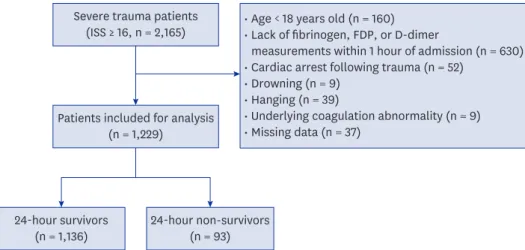
There were 2,165 severe trauma patients identified during the study period who met the inclusion criteria. Based on the exclusion criteria, 1,229 patients were finally included in this study (Fig. 1). There were 891 (72.6%) male patients and the median age was 57.0 years (45.0–
70.0 years). The 24-hour mortality was 7.6% (n = 93). Massive transfusion was performed on 99 (8.1%) patients.
Comparison of baseline and clinical characteristics between survivors and non-survivors
There were significant differences between the survivor and non-survivor groups in RTS and ISS values. Patients in the survivor group were younger, had higher levels of hemoglobin and bicarbonate, and had arrived at our ED significantly later after an accident than those in the non-survivor group. The fibrinogen level was significantly lower, while FDP and D-dimer levels were significantly higher in the non-survivor group (Table 1). The ISTH scores (3.0
• Age < 18 years old (n = 160)
• Lack of fibrinogen, FDP, or D-dimer
measurements within 1 hour of admission (n = 630)
• Cardiac arrest following trauma (n = 52)
• Drowning (n = 9)
• Hanging (n = 39)
• Underlying coagulation abnormality (n = 9)
• Missing data (n = 37) Severe trauma patients
(ISS ≥ 16, n = 2,165)
Patients included for analysis (n = 1,229)
24-hour survivors
(n = 1,136) 24-hour non-survivors (n = 93)
Fig. 1. Schematic diagram showing the number of patients with severe trauma included in the present study.
ISS = injury severity score, FDP = fibrin/fibrinogen degradation product.
Table 1. Comparison of baseline characteristics according to 24-hour mortality
Variables All patients (n = 1,229) Survivors (n = 1,136) Deceased within 24-hr (n = 93) P value
Age, yr 57 (45–70) 57 (45–69) 68 (45–76.5) < 0.001
Male 891 (72.6) 827 (72.9) 64 (69.6) 0.495
Mechanism of trauma 0.506
Blunt 1,197 (97.4) 1,104 (97.2) 93 (100)
Penetrating 22 (1.8) 22 (1.9) 0 (0)
Burn 10 (0.8) 10 (0.9) 0 (0)
Time from accident to ED visit 180 (60–300) 180 (60–300) 120 (60–180) < 0.001
ISS 22 (17–26) 22 (17–25) 29 (24.25–38) < 0.001
RTS 7.8408 (6.3756–7.8408) 7.8408 (6.3756–7.8408) 4.5020 (3.3610–6.3756) < 0.001
GCS 15 (10–15) 15 (12–15) 6 (3–13.5) < 0.001
Systolic BP, mmHg 110 (80–130) 110 (90–130) 80 (50–105) < 0.001
Respiratory rate, /min 20 (20–22) 20 (20–22) 20 (20–22) 0.709
Arterial blood gas analyses
pH 7.391 (7.34–7.43) 7.395 (7.347–7.430) 7.308 (7.182–7.395) < 0.001
PaCO2, mmHg 35.7 (31.95–39.15) 35.7 (32–39.1) 33.4 (25.5–39.75) 0.005
Base excess −3.2 (−7.1, −0.6) −2.9 (−6.6, −0.4) −9.3 (−15.3, −4.0) < 0.001
Laboratory tests
White blood cell count, ×109/L 13.6 (10.1–18.15) 13.5 (10.1–18.1) 14.2 (10.6–19.7) 0.378
Hemoglobin, g/dL 11.9 (10.1–13.5) 12.1 (10.3–13.6) 10.3 (7.85–12) < 0.001
Platelet count, ×109/L 189 (150–233) 191 (151.25–236) 163 (122.5–209.5) < 0.001
aPTT, sec 31.4 (27.8–37.2) 30.9 (27.6–35.8) 47.8 (36.5–85.1) < 0.001
PT-INR 1.11 (1.03–1.25) 1.10 (1.03–1.22) 1.37 (1.22–1.92) < 0.001
Fibrinogen, mg/dL 188.8 (135.7–238.5) 192.7 (145.8–239.8) 107.9 (56.7–152.8) < 0.001
FDP, mg/L 71.4 (26.05–155.65) 64.4 (24.1–139.6) 184.6 (138.7–428.1) < 0.001
D-dimer, mg/L 23.24 (5.91–35.2) 20.56 (5.3–35.2) 35.20 (35.2–35.2) < 0.001
Massive transfusion, unit 99 (8.1) 78 (6.9) 21 (22.6) < 0.001
PRC 2 (0–4) 1 (0–4) 5 (1.5–8) < 0.001
FFP 0 (0–2) 0 (0–2) 2 (0–4) < 0.001
PC 0 (0–0) 0 (0–0) 0 (0–0) 0.931
KSTH score 1 (1–2) 1 (1–2) 2 (2–3) < 0.001
ISTH score 3 (2–3) 3 (2–3) 3 (3–4) < 0.001
Values are presented as median (IQRs) or number (%).
ED = emergency department, ISS = injury severity score, RTS = revised trauma score, GCS = Glasgow Coma Scale, BP = blood pressure, aPTT = activated partial thromboplastin time, PT-INR = international normalized ratio of prothrombin time, FDP = fibrin/fibrinogen degradation product, PRC = packed red blood cell, FFP = fresh frozen plasma, PC = platelet concentrate, KSTH = Korean Society on Thrombosis and Hemostasis, ISTH = International Society on Thrombosis and Hemostasis, IQR = interquartile range.
[2.0–3.0] vs. 3.0 [3.0–4.0]; P < 0.001) and the KSTH scores (1.0 [1.0–2.0] vs. 2.0 [2.0–3.0]; P
< 0.001) were significantly lower in the survivor group (Table 1).
Prognostic performance of the KSTH and ISTH scores for 24-hour mortality and massive transfusion
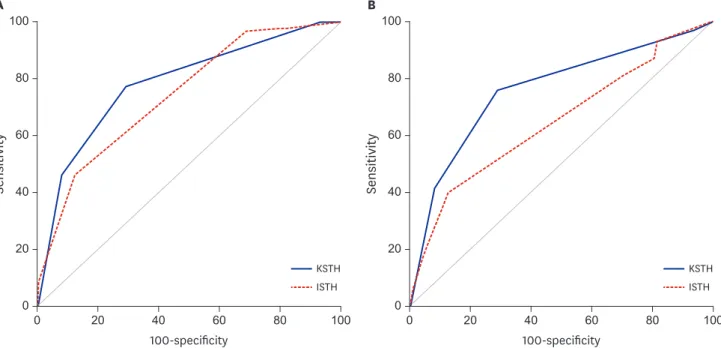
The area under the curves (AUC) for the KSTH and ISTH scores in predicting 24-hour mortality were 0.784 (95% confidence interval [CI], 0.760–0.807) and 0.744 (95% CI, 0.718–
0.768), respectively. The AUC of the KSTH score was significantly different from the AUC of the ISTH score in predicting 24-hour mortality (P = 0.033) (Fig. 2A).
The AUC for the KSTH and ISTH scores in predicting massive transfusion were 0.758 (95%
CI, 0.734–0.782) and 0.646 (95% CI, 0.619–0.673), respectively. The AUC for the KSTH scores was significantly different from the AUC for the ISTH scores in predicting massive transfusion (P < 0.001) (Fig. 2B).
Multivariate analysis of the KSTH and ISTH scores for 24-hour mortality and massive transfusion
Table 2 shows multivariate analysis of the KSTH and ISTH scores for 24-hour mortality and massive transfusion. After adjustment for confounders, both the KSTH and ISTH scores were associated with 24-hour mortality (KSTH score: odds ratio [OR], 1.753; 95% CI, 1.332–2.307; ISTH score: OR, 1.536; 95% CI, 1.193–1.978). Overt DIC, according to KSTH criteria only, was independently associated with 24-hour mortality (OR, 2.630; 95% CI, 1.456–4.752). Additionally, only the KSTH score was independently associated with massive transfusion (OR, 1.563; 95% CI, 1.182–2.068). Overt DIC, according to KSTH criteria, was also independently associated with massive transfusion (OR, 2.279; 95% CI, 1.277–4.068).
0 20 40 60 80 100
0 100
80
60
40
20
Sensitivity
100-specificity
KSTH ISTH
0 20 40 60 80 100
0 100
80
60
40
20
Sensitivity
100-specificity
KSTH ISTH
A B
Fig. 2. ROC analyses of KSTH and ISTH scores. (A) ROCs for 24-hour mortality. The AUC of KSTH and ISTH scores for 24-hour mortality were 0.784 (95% CI, 0.760–0.807), and 0.744 (95% CI, 0.718–0.768). (B) ROCs for massive transfusion. The AUC of KSTH and ISTH scores for massive transfusion were 0.758 (95% CI, 0.734–0.782), and 0.646 (95% CI, 0.619–0.673), respectively. The AUCs of the KSTH score was significantly different from those of the ISTH score.
ROC = receiver operating characteristic, KSTH = Korean Society on Thrombosis and Hemostasis, ISTH = International Society on Thrombosis and Hemostasis, AUC
= area under the curve, CI = confidence interval.
Association between aPTT or fibrinogen and 24-hour mortality or massive transfusion
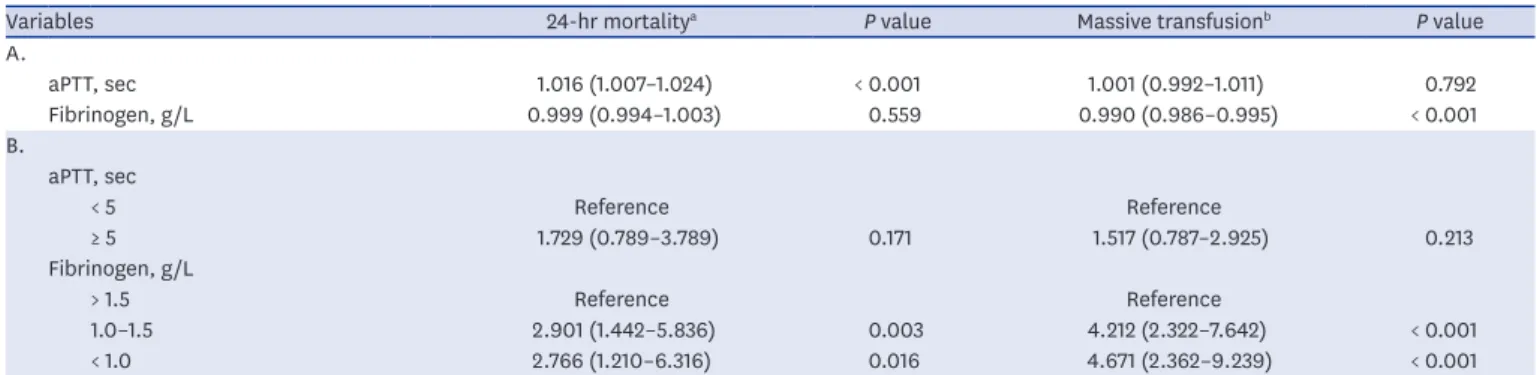
APTT as a continuous variable was independently associated with 24-hour mortality (OR, 1.016; 95% CI, 1.007–1.024). However, aPTT as a categorical variable was not associated with 24-hour mortality. Furthermore, aPTTs as continuous or categorical variables were not associated with massive transfusion (Table 3).
The fibrinogen level as a continuous variable was not associated with 24-hour mortality in multivariable analysis (Table 3). However, when the fibrinogen level was categorized, fibrinogen levels < 1 g/L (OR, 2.766; 95% CI, 1.210–6.316) and 1.0–1.5 g/L (OR, 2.901; 95% CI, 1.442–5.836) were independently associated with 24-hour mortality, compared to fibrinogen levels > 1.5 g/L. In addition, fibrinogen levels < 1 g/L (OR, 4.671; 95% CI, 2.362–9.239) and 1.0–1.5 g/L (OR, 4.212; 95% CI, 2.322–7.642) were independently associated with massive transfusion, compared to fibrinogen levels > 1.5 g/L.
DISCUSSION
In the present study, the KSTH score showed a higher performance than the ISTH score in predicting 24-hour mortality and massive transfusion in severe trauma. Overt DIC, according to KSTH criteria only, was independently associated with 24-hour mortality in severe trauma.
Table 3. Multivariate analysis of aPTT and fibrinogen level in prediction of 24-hour mortality or massive transfusion
Variables 24-hr mortalitya P value Massive transfusionb P value
A.
aPTT, sec 1.016 (1.007–1.024) < 0.001 1.001 (0.992–1.011) 0.792
Fibrinogen, g/L 0.999 (0.994–1.003) 0.559 0.990 (0.986–0.995) < 0.001
B.
aPTT, sec
< 5 Reference Reference
≥ 5 1.729 (0.789–3.789) 0.171 1.517 (0.787–2.925) 0.213
Fibrinogen, g/L
> 1.5 Reference Reference
1.0–1.5 2.901 (1.442–5.836) 0.003 4.212 (2.322–7.642) < 0.001
< 1.0 2.766 (1.210–6.316) 0.016 4.671 (2.362–9.239) < 0.001
Values are presented as OR (95% CI). A, multivariate analysis of aPTT and fibrinogen level as continuous variables; B, multivariate analysis of aPTT and fibrinogen level as categorized variables.
aPTT = activated partial thromboplastin time, OR = odds ratio, CI = confidence interval, ED = emergency department, ISS = injury severity score, RTS = revised trauma score, PT-INR = international normalized ratio of prothrombin time, FDP = fibrin/fibrinogen degradation product.
aAdjusted for age, time from accident to ED visit, ISS, RTS, PaCO2, base excess, hemoglobin, platelet count, PT-INR, FDP, and D-dimer; bAdjusted for mechanism of trauma, time from accident to ED visit, ISS, RTS, pH, PaCO2, base excess, hemoglobin, platelet count, PT-INR, FDP, and D-dimer.
Table 2. Multivariate analysis of KSTH and ISTH scores in prediction of 24-hour mortality or massive transfusion
Variables 24-hr mortalitya P value Massive transfusionb P value
A.
KSTH scores (per 1 unit) 1.753 (1.332–2.307) < 0.001 1.563 (1.182–2.068) 0.002
ISTH scores (per 1 unit) 1.536 (1.193–1.978) < 0.001 0.942 (0.784–1.132) 0.526
B.
Overt DIC according to KSTH criteria 2.630 (1.456–4.752) < 0.001 2.279 (1.277–4.068) 0.005
Overt DIC according to ISTH criteria 1.151 (0.462–2.865) 0.763 0.739 (0.308–1.775) 0.499
Values are presented as OR (95% CI). A, multivariate analysis of KSTH scores and ISTH scores; B, multivariate analysis of overt DIC according to KSTH criteria and ISTH criteria.
KSTH = Korean Society on Thrombosis and Hemostasis, ISTH = International Society on Thrombosis and Hemostasis, OR = odds ratio, CI = confidence interval, DIC = disseminated intravascular coagulation, ED = emergency department, ISS = injury severity score, RTS = revised trauma score.
aAdjusted for age, time from accident to ED visit, ISS, RTS, PaCO2, base excess, and hemoglobin; bAdjusted for mechanism of trauma, time from accident to ED visit, ISS, RTS, pH, PaCO2, base excess, and hemoglobin.
Furthermore, the KSTH score was independently associated with massive transfusion in severe trauma.
The ISS standardizes the severity of trauma as an anatomical finding.12 Several studies have shown that the ISS value has been associated with mortality in trauma patients.3,15 In a previous study, the ISS value was higher in patients who died within the first 24 hours than in survivors, which is consistent with this study.3 However, the ISS value of that study was higher than in our study, and we consider that the proportion of non-survivors with severe head injury was high in that previous study.3 Another scoring system is the RTS, created by physiologic findings based on GCS, respiratory rate, and systolic blood pressure.16 Orhon et al.15 demonstrated that RTS values of survivors were higher than in non-survivors, which is similar to the present study.
In this study, patients with a penetrating injury were more massively transfused than those with a blunt injury in multivariate analysis (OR, 5.821; 95% CI, 1.932–17.538). In one retrospective study in which 91% of patients had penetrating injuries, damage to the inferior vena cava and aorta that could cause massive bleeding occurred in 58%.17 In the same study, hemorrhagic shock was the most common cause of death.17 Another study showed that penetrating injury was related to severe hypovolemic shock, and required early surgical bleeding control.18 Our study showed that the ISTH score on admission was associated with specific outcomes in early phase of trauma. Hayakawa et al.6 showed that overt DIC diagnosed by ISTH criteria led to higher mortality and received more transfusion than non-DIC, similar to the present study. In one retrospective study, non-survivors had a higher ISTH score and more overt DIC diagnosed by the ISTH score than survivors.9 On the other hand, the ISTH score showed poor sensitivity in predicting mortality in critically ill patients,19 which we considered, was related to the ISTH score being focused on the fibrinolysis associated with thrombocytopenia.
Furthermore, in trauma, platelet counts remain at a moderate level during the first 24 hours, after which they decrease rapidly.7 Therefore, the ISTH score may be less effective for the prediction of mortality in early phase of trauma.
The KSTH score was first proposed in 1993 and is used for diagnosis of DIC in Korea.10 Although the KSTH score is not internationally accepted, it provides a clearer diagnosis of DIC, compared to the ISTH score.10,20 Two retrospective studies have reported that concordance rates between the KSTH score and the ISTH score were between 84.7%
and 89.5%.10,20 In patients with sepsis, the KSTH score on day 1 after admission was independently significantly associated with overall ICU mortality.11 In addition, the KSTH score may be easier to use because it has no weighted score, in contrast to the ISTH score.14 In the present study, the platelet count was independently associated with 24-hour mortality in trauma. Several studies have shown that a low platelet count can be associated with specific outcomes in trauma.21,22 McQuilten et al.21 demonstrated that a platelet count < 100 × 109/L was associated with in-hospital mortality more often than a platelet count > 150 × 109/L in severe trauma. In one retrospective multicenter study, the platelet count was lower in patients who had died within 24 hours or who had received massive transfusion than in those not in these categories.22 In the same study, the platelet count was maintained above 100 × 109/L in the early phase of trauma, which is similar to the present study.22 In the KSTH and ISTH scores, the cut-off value of platelet count is 100 × 109/L.14 Therefore, we postulate that the platelet count of these two scores is too low to be appropriate for prognosis in early phase of trauma.
Many studies have revealed that D-dimer levels of fibrin degradation product can be associated with outcome in trauma.9,22 Sawamura et al.9 showed that the D-dimer level was higher in non-survivors than in survivors in the early phase of trauma. In one retrospective study, a high D-dimer level on admission was associated with 24-hour mortality or a requirement for massive transfusion.22 However, the D-dimer levels presented by two studies9,22 were higher than 1 or 5 mg/L of the D-dimer level suggested by the KSTH or ISTH score, respectively.14 We consider that a high D-dimer level reflects the hyper-fibrinolytic state of trauma, unlike other medical conditions.
In this study, when aPTT was categorized as < 5 seconds and ≥ 5 seconds, aPTT was not associated with 24-hour mortality in multivariate analysis. Furthermore, aPTT was not independently associated with massive transfusion in trauma. In one study, aPTT showed 50% sensitivity to coagulopathy in acute trauma.23 The authors considered that factor VIII, as an acute phase reactant, was high in acute trauma and that aPTT may be shortened by elevated factor VIII activity.23 In the same study, 70% of patients with a false negative aPTT showed elevated factor VIII activity.23
In the present study, multivariate analysis revealed that a fibrinogen level ≤ 1.5 g/L was an independent predictor for mortality. Several studies have also shown that fibrinogen levels
≤ 1.5 g/L are associated with a poorer outcome in trauma.5,21 Hayakawa et al.5 showed that the development of DIC is associated with a fibrinogen level ≤ 1.5 g/L, and that massive transfusions are performed more often in the DIC group.McQuilten et al.21 demonstrated that a fibrinogen level ≤ 1.5 g/L is associated with increased in-hospital mortality, massive transfusion, and longer time in ICU.
In the KSTH score, the cut-off value of the fibrinogen level is 1.5 g/L and the proportion of the fibrinogen level is 25% of the total score.14 On the other hand, in the ISTH score, the cut-off value of the fibrinogen level is 1.0 g/L and the proportion of the fibrinogen level is 12.5% of total score.14 Therefore, the KSTH score gives more weight to the fibrinogen level than the ISTH score. Furthermore, the ISTH score does not consider the severity of patients with fibrinogen levels of 1.0–1.5 g/L. In this matter, the KSTH score estimates the severity of trauma more accurately than the ISTH score.
The present study has several limitations. First, it was retrospective and single centered, implying the need for further studies including larger sample sizes, multiple centers, and a prospective design to assess generalizability and causation rather than associations. Second, 630 patients with severe trauma were excluded because DIC laboratory tests were not completed within 1 hour of admission. The reasons for this included delayed blood sampling due to resuscitation, re-sampling due to hemolysis, and the relative high cost of coagulation biomarkers. Third, ED arrival was significantly later for the survivor group than for the non- survivor group. We assumed that patients with more severe conditions were transferred more promptly to the ED. Finally, we could not ascertain mortality in patients who were transferred to another hospital within 24 hours after arrival, so the overall 24-hour mortality from trauma figures may have been less accurate.
In conclusion, the KSTH score has a better prognostic performance for outcome than the ISTH score in the early phase of trauma. Further prospective study would be required to confirm the results of the present study.
REFERENCES
1. Vanbrabant P, Dhondt E, Sabbe M. What do we know about patients dying in the emergency department?
Resuscitation 2004;60(2):163-70.
PUBMED | CROSSREF
2. Ugare GU, Ndifon W, Bassey IA, Oyo-Ita AE, Egba RN, Asuquo M, et al. Epidemiology of death in the emergency department of a tertiary health centre south-south of Nigeria. Afr Health Sci 2012;12(4):530-7.
PUBMED
3. Lefering R, Paffrath T, Bouamra O, Coats TJ, Woodford M, Jenks T, et al. Epidemiology of in-hospital trauma deaths. Eur J Trauma Emerg Surg 2012;38(1):3-9.
PUBMED | CROSSREF
4. Evans JA, van Wessem KJ, McDougall D, Lee KA, Lyons T, Balogh ZJ. Epidemiology of traumatic deaths:
comprehensive population-based assessment. World J Surg 2010;34(1):158-63.
PUBMED | CROSSREF
5. Hayakawa M, Gando S, Ono Y, Wada T, Yanagida Y, Sawamura A. Fibrinogen level deteriorates before other routine coagulation parameters and massive transfusion in the early phase of severe trauma: a retrospective observational study. Semin Thromb Hemost 2015;41(1):35-42.
PUBMED | CROSSREF
6. Hayakawa M, Sawamura A, Gando S, Kubota N, Uegaki S, Shimojima H, et al. Disseminated intravascular coagulation at an early phase of trauma is associated with consumption coagulopathy and excessive fibrinolysis both by plasmin and neutrophil elastase. Surgery 2011;149(2):221-30.
PUBMED | CROSSREF
7. Gando S. Disseminated intravascular coagulation in trauma patients. Semin Thromb Hemost 2001;27(6):585-92.
PUBMED | CROSSREF
8. Bakhtiari K, Meijers JC, de Jonge E, Levi M. Prospective validation of the International Society of Thrombosis and Haemostasis scoring system for disseminated intravascular coagulation. Crit Care Med 2004;32(12):2416-21.
PUBMED | CROSSREF
9. Sawamura A, Hayakawa M, Gando S, Kubota N, Sugano M, Wada T, et al. Disseminated intravascular coagulation with a fibrinolytic phenotype at an early phase of trauma predicts mortality. Thromb Res 2009;124(5):608-13.
PUBMED | CROSSREF
10. Lee JH, Song JW, Song KS. Diagnosis of overt disseminated intravascular coagulation: a comparative study using criteria from the International Society versus the Korean Society on Thrombosis and Hemostasis. Yonsei Med J 2007;48(4):595-600.
PUBMED | CROSSREF
11. Ha SO, Park SH, Hong SB, Jang S. Performance evaluation of five different disseminated intravascular coagulation (DIC) diagnostic criteria for predicting mortality in patients with complicated sepsis. J Korean Med Sci 2016;31(11):1838-45.
PUBMED | CROSSREF
12. Baker SP, O'Neill B, Haddon W Jr, Long WB. The injury severity score: a method for describing patients with multiple injuries and evaluating emergency care. J Trauma 1974;14(3):187-96.
PUBMED | CROSSREF
13. DeLong ER, DeLong DM, Clarke-Pearson DL. Comparing the areas under two or more correlated receiver operating characteristic curves: a nonparametric approach. Biometrics 1988;44(3):837-45.
PUBMED | CROSSREF
14. Di Nisio M, Baudo F, Cosmi B, D'Angelo A, De Gasperi A, Malato A, et al. Diagnosis and treatment of disseminated intravascular coagulation: guidelines of the Italian Society for Haemostasis and Thrombosis (SISET). Thromb Res 2012;129(5):e177-84.
PUBMED | CROSSREF
15. Orhon R, Eren SH, Karadayı S, Korkmaz I, Coşkun A, Eren M, et al. Comparison of trauma scores for predicting mortality and morbidity on trauma patients. Ulus Travma Acil Cerrahi Derg 2014;20(4):258-64.
PUBMED | CROSSREF
16. Champion HR, Sacco WJ, Copes WS, Gann DS, Gennarelli TA, Flanagan ME. A revision of the trauma score. J Trauma 1989;29(5):623-9.
PUBMED | CROSSREF
17. Jackson MR, Olson DW, Beckett WC Jr, Olsen SB, Robertson FM. Abdominal vascular trauma: a review of 106 injuries. Am Surg 1992;58(10):622-6.
PUBMED
18. Johnson JW, Gracias VH, Schwab CW, Reilly PM, Kauder DR, Shapiro MB, et al. Evolution in damage control for exsanguinating penetrating abdominal injury. J Trauma 2001;51(2):261-9.
PUBMED | CROSSREF
19. Takemitsu T, Wada H, Hatada T, Ohmori Y, Ishikura K, Takeda T, et al. Prospective evaluation of three different diagnostic criteria for disseminated intravascular coagulation. Thromb Haemost 2011;105(1):40-4.
PUBMED | CROSSREF
20. Han KC, Kim SH, Lee SJ, Kim DH, Ko EH, Jang MJ, et al. Comparison between diagnostic criteria for disseminated intravascular coagulation (DIC) of the International Society on Thrombosis and Hemostasis (ISTH) and the Korean Society on Thrombosis and Hemostasis (KSTH). Korean J Hematol 2004;39(4):223-7.
21. McQuilten ZK, Wood EM, Bailey M, Cameron PA, Cooper DJ. Fibrinogen is an independent predictor of mortality in major trauma patients: a five-year statewide cohort study. Injury 2017;48(5):1074-81.
PUBMED | CROSSREF
22. Hayakawa M, Maekawa K, Kushimoto S, Kato H, Sasaki J, Ogura H, et al. High D-dimer levels predict a poor outcome in patients with severe trauma, even with high fibrinogen levels on arrival: a multicenter retrospective study. Shock 2016;45(3):308-14.
PUBMED | CROSSREF
23. Yuan S, Ferrell C, Chandler WL. Comparing the prothrombin time INR versus the APTT to evaluate the coagulopathy of acute trauma. Thromb Res 2007;120(1):29-37.
PUBMED | CROSSREF