INTRODUCTION
Bisphenol A (BPA) is a xenoestrogen and found in toys, drink- ing containers, dental sealants, water pipes, and food contain- ers, including those with infant formula.1-6 The primary route of exposure to BPA is through oral intake, but exposure can also occur via dermal contact or through inhalation.3 BPA has been detected at higher concentrations in children than in adults, a finding that has been explained by children’s greater food in- take in proportion to body weight or variances in metabolism.7,8 Reports of a relationship between BPA exposure and asthma- related consequences have been restricted to case reports of occupational asthma, especially among workers exposed to BPA in epoxy resins.9,10 The actual pathogenesis of BPA metabo- lism and related allergic disease remains to be clarified. Increas-
ing evidence suggests that BPA-induced damage results in oxi- dative stress within the targeted cells.11 Disturbed oxidative ho- meostasis, through either in direct or indirect functional path- ways, including mitochondrial function,12 modulation of anti- oxidant enzymes, and increased thiobarbituric acid reactive substances, can be seen in the brain, kidney, and testis of mice exposed to BPA throughout the embryonic/fetal route.13 Allergy Asthma Immunol Res. 2018 March;10(2):172-179.
https://doi.org/10.4168/aair.2018.10.2.172 pISSN 2092-7355 • eISSN 2092-7363
Interactions Between Bisphenol A Exposure and GSTP1 Polymorphisms in Childhood Asthma
Tien-Jen Lin,
1,2,3Wilfried J.J. Karmaus,
4Mei-Lien Chen,
5Jiin-Chyr Hsu,
6I-Jen Wang
7,8,9*
1Department of Neurosurgery, Wan Fang Hospital, Taipei Medical University, Taipei, Taiwan
2Graduate Institute of Sports Science, College of Exercise and Health Sciences, National Taiwan Sport University, Taoyuan City, Taiwan
3Graduate Institute of Injury Prevention and Control, Taipei Medical University, Taipei, Taiwan
4Division of Epidemiology, Biostatistics, and Environmental Health, School of Public Health, University of Memphis, Memphis, TN, USA
5Institute of Environmental and Occupational Health Sciences, National Yang Ming University, Taipei, Taiwan
6Department of Internal Medicine, Taipei Hospital, Ministry of Health and Welfare, Taipei, Taiwan
7Department of Pediatrics, Taipei Hospital, Ministry of Health and Welfare, Taipei, Taiwan
8School of Medicine, National Yang Ming University, Taipei, Taiwan
9College of Public Health, China Medical University, Taichung, Taiwan
This is an Open Access article distributed under the terms of the Creative Commons Attribution Non-Commercial License (http://creativecommons.org/licenses/by-nc/4.0/) which permits unrestricted non-commercial use, distribution, and reproduction in any medium, provided the original work is properly cited.
Purpose: Bisphenol A (BPA) exposure may increase the risk of asthma. Genetic polymorphisms of oxidative stress-related genes, glutathione S- transferases (GSTM1, GSTP1), manganese superoxide dismutase, catalase, myeloperoxidase, and microsomal epoxide hydrolase may be related to BPA exposure. The aim is to evaluate whether oxidative stress genes modulates associations of BPA exposure with asthma. Methods: We con- ducted a case-control study comprised of 126 asthmatic children and 327 controls. Urine Bisphenol A glucuronide (BPAG) levels were measured by ultra-performance liquid chromatography/tandem mass spectrometry, and genetic variants were analyzed by a TaqMan assay. Information on asth- ma and environmental exposure was collected. Analyses of variance and logistic regressions were performed to determine the association of geno- types and urine BPAG levels with asthma. Results: BPAG levels were significantly associated with asthma (adjusted odds ratio [aOR], 1.29 per log unit increase in concentration; 95% confidence interval [CI], 1.081.55). Compared to the GG genotype, children with a GSTP1 AA genotype had high- er urine BPAG concentrations (geometric mean [standard error], 12.72 [4.16] vs 11.42 [2.82]; P=0.036). In children with high BPAG, the GSTP1 AA genotype was related to a higher odds of asthma than the GG genotype (aOR, 4.84; 95% CI, 1.0223.06). Conclusions: GSTP1 variants are associat- ed with urine BPA metabolite levels. Oxidative stress genes may modulate the effect of BPA exposure on asthma.
Key Words: Bisphenol A; GSTP1; genotype; asthma
Correspondence to: I-Jen Wang, MD, PhD, Department of Pediatrics, Taipei Hospital, Ministry of Health and Welfare, #127, Suyuan Road, Hsinchuang District, New Taipei City 24213, Taiwan.
Tel: +886-2-2276-5566 (ext. 2532); Fax: +886-2-2998-8028;
E-mail: [email protected]
Received: October 17, 2017; Revised: December 20, 2017;
Accepted; December 31, 2017
•There are no financial or other issues that might lead to conflict of interest.
Prenatal exposure to BPA, followed by postnatal allergic sensi- tization and challenges, is considered to promote the develop- ment of experimental allergic asthma.14 An association between increased odds ratio (OR) of a child developing wheeze before age 3 years and high (>2.2 μg/g creatinine) maternal urinary BPA concentrations in gestational week 16 has been reported by Spanier et al.15 Donohue et al.16 performed the first cohort study to report an association between postnatal urinary BPA concentrations and asthma in young children. They found that urinary BPA concentrations at ages 3, 5, and 7 years were asso- ciated with asthma assessed between 5 to 12 years of age. We also previously reported that early-life BPA exposure may in- crease the risk of atopic disorders.17 These findings add to the suspicion that environmental exposure to BPA might be associ- ated with adverse respiratory outcomes in early childhood and may contribute to the risk of developing asthma in later life.
Airflow limitation and airway remodeling in asthma can re- sult from an imbalance in redox systems favoring an oxidative environment.18 Glutathione S-transferase (GST) is thought to be involved in detoxification of BPA metabolites and reactive oxygen species (ROS).19 Several studies have also demonstrated that GST polymorphisms are associated with certain inflamma- tory diseases, including asthma.20 SOD2 rs4880, EPHX1 rs2740171, and GSTP1 rs1695 variants were also found to be highly associ- ated with diisocyanate-induced asthma.21 This association with isocyanate-induced asthma supports the hypothesis that ge- netic variability within antioxidant defense systems may pro- vide an environmental mechanism for developing asthma.21 In addition, related to other exposures, GSTM1 null and GSTP1 Il- e105Val genotypes have been described to be associated with increased susceptibility to diesel exhaust particles (DEPs) and ozone exposure.22,23 Finally, the SOD2 Ala allele has been report- ed to be linked to childhood asthma.24
Therefore, we tested a possible association between exposure to BPA and genes involved in oxidative ROS in a case-control study on asthma. First, in a screening step we will evaluate whe- ther genetic polymorphisms of oxidative stress markers, GSTM1, GSTP1, SOD2, catalase (CAT), myeloperoxidase (MPO), and EPHX1 are related to a higher urine concentration of BPA me- tabolites. Second, for identified oxidative stress genes we will determine whether these modify the association of BPA expo- sure with asthma.
MATERIALS AND METHODS Study population
We conducted a case-control study comprised of 126 asth- matic children and 327 controls. Three control subjects were matched to each case subject by date of enrollment (within 3 months) if both had urine specimens and oral scrapes. All of the children were part of the Childhood Environment and Al- lergic diseases Study (CEAS) cohort recruited in 2010.25 Full en-
rollment in the study required the completion of BPA exposure monitoring of urine BPA metabolite levels and genotyping. At age 3 years, BPA metabolites were measured in urine samples, and genotyping was based on buccal cell samples. Parents were interviewed using a standardized questionnaire regarding ba- sic demographics, birth history, parental age and education levels, family income, parental history of allergic diseases, du- ration of breast feeding, and environmental exposures of the child. Information about asthma was also collected. Written in- formed consent was obtained from all parents. Taipei Hospi- tal’s Institutional Review Board approved the study protocol (TH-IRB-0014-0011), which complied with the principles of the Helsinki Declaration.
Questionnaire survey
An International Study of Asthma and Allergies in Childhood (ISAAC) questionnaire was used for collecting data on the chil- dren’s allergic symptoms and information on duration of breast- feeding, number of older siblings, furry pets, carpets, or incens- ing at home, fungi at house walls, and tobacco smoke exposure were collected. The parents also answered a standardized ques- tionnaire for basic demographics, birth history, parental history of allergic diseases, and family income.
Case definition
Asthma was determined by pediatric allergists based at least on one of the following 3 criteria: 1) recurrence of at least 2 of the 3 symptoms: cough, wheeze, and shortness of breath with- in the previous 12 months without having a cold, 2) physician’s diagnosis of asthma with ongoing treatment, and 3) response to treatment with β2-agonists or inhaled corticosteroids.26 Pa- tients visiting the clinic without fulfilling the above criteria were defined as controls.
Laboratory methods Exposure monitoring
First mid-stream urine in the morning was collected from chil- dren at 3 years of age and stored at -20°C until analysis. The urine samples were processed by solid-phase extraction. BPA metabolite (bisphenol A glucuronide [BPAG]) concentrations were determined using ultra-performance liquid chromatogra- phy/tandem mass spectrometry (UPLC-MS/MS) with isotope- dilution techniques as described elsewhere.27 The limit of de- tection (LOD) was 1.61 ng/mL. For concentrations below the detection limit, a value of half the LOD was assigned. All results involved duplicate analysis. Urine creatinine levels were ana- lyzed by enzymatic assay (Cayman Chemical, Ann Arbor, MI, USA).28 In all analyses, we adjusted for urine creatinine levels.
Genotyping
Genomic DNA was extracted from oral epithelial cells using a Gentra Purgene DNA Buccal Cell Kit (QIAGEN Sciences, Ger-
mantown, MD, USA). Candidate genes were selected based on their functional role in oxidative stress and inflammation. Quick- SNP version 1.1 (Carlsbad, CA, USA) was used to select 9 tag single nucleotide polymorphisms (SNPs) within the candidate genes that had a minor allele frequency (MAF) >5% and an r2>
0.8 in Asian populations.29 The GSTM1, GSTP1 (rs1695), SOD2 (rs5746136), SOD2 (rs4880), CAT (rs769218), MPO (rs2071409), EPHX1 (rs1051740), and EPHX1 (rs2740171) polymorphisms (Supplementary Table 1), selected from hot spots of Asian pop- ulations on the National Center for Biotechnology information (NCBI) website, were analyzed by TaqMan SNP Genotyping Assay (ABI, Foster City, CA, USA) as described elsewhere.30 In addition, a deletion (null-mutation) of the GSTM1 gene was an- alyzed. All samples were measured using the same assay in du- plicate to reduce the influence of unavoidable inter-assay vari- ances. To control for errors and technical problems in genotyp- ing, derived genotype frequencies were compared with the ex- pected allelic population equilibrium based on the Hardy-Wein- berg equilibrium test. Incomplete data missing at least 1 of 2 SNPs were excluded, and then individual haplotypes were esti- mated from genotype data.
Statistical analysis
Baseline characteristics of the case and control subjects were
compared using the 2-sample t test for continuous variables or χ2 tests for categorical variables. Differences in geometric means of BPA metabolite concentrations (BPAG) among different gen- otypes were analyzed using the analysis of covariance (ANCO- VA) test. To correct the skewed distribution of BPAG, the vari- able is log-transformed (LnBPAG) or geometric means are pre- sented. To study the potentially modifying effect of oxidative stress genes, we analyze genotypes in asthma cases and con- trols. To estimate associations of genetic variants with asthma, ORs with 95% confidence intervals (CIs) were calculated by lo- gistic regression. We determined whether one of the oxidative stress genes had an effect on the distribution of BPAG. To analyze combined effects of BPAG and genes, we then focus on those genes that affected the BPAG distribution in children. Since BPAG concentration seems to depend on oxidative stress genotypes, we were not allowed to simply test the interaction of BPAG with the oxidative stress genotypes, as unbiased assessments of in- teraction need to be based on 2 independent variables.31 To re- move the dependency, we first regressed the BPAG levels on the oxidative stress genotypes and estimated the residuals of the BPAG concentration that is not explained by oxidative stress genotypes. Then, we tested the interaction of the BPAG residu- als with the oxidative stress genes on asthma. The interactive effect was estimated only in the presence of statistically signifi-
Table 1. Characteristics of the study population
Variables Total Cases Controls P value
Total No. 453 126 327
Mother
Maternal age (year) 29.40±4.35 29.61±4.08 29.31±4.45 0.55
Maternal education
High school and below 268 (59.2) 72 (67.9) 196 (69.5) 0.76
College and above 120 (26.5) 34 (32.1) 86 (30.5)
Maternal history of atopy (yes) 126 (27.8) 46 (36.5) 80 (24.5) 0.002*
Children
Sex (male) 261 (57.6) 76 (60.3) 185 (56.6) 0.47
Birth weight (g) 3,120.45±440.46 3,075.9 (381.79) 3,135.0 (461.56) 0.25
Premature birth (<37 weeks) 353 (77.9) 91 (72.2) 262 (80.1) 0.99
Environmental factors
Older siblings (≥2) 67 (14.8) 16 (12.7) 51 (15.6) 0.63
Breast feeding (yes) 292 (64.5) 75 (59.5) 217 (66.4) 0.41
Pet raising (yes) 70 (15.5) 21 (16.7) 49 (15.0) 0.51
ETS exposure (yes) 186 (41.1) 59 (46.8) 127 (38.8) 0.02*
Family income per year (US dollars)
<20,000 110 (31.3) 25 (29.4) 85 (32.0) 0.80
20,000-50,000 213 (60.7) 52 (61.2) 161 (60.5)
>50,000 28 (8.0) 8 (9.4) 20 (7.5)
Data are shown as number (%) or mean±SD. Some numbers do not add up to total number because of missing values.
ETS, environmental tobacco smoke; SD, standard deviation.
*P<0.05.
cant interaction term (Pinteraction≤0.05) as follows:
OR= exp [β1×gene1+β2×residuals of the covariate2+β3× (gene×residuals of the covariate2)]
In all asthma models, potential confounders from literature reviews, such as gender, premature birth, maternal age and ed- ucation, maternal history of atopy, family income, duration of breast feeding, number of older siblings, pet raising, environ- mental tobacco smoke (ETS) exposure, use of carpets at home, and fungi on house walls were taken into consideration. We ad- justed for those confounders that resulted in a 10% change in point estimates when removed from the model. All hypothesis testing was 2-sided at a significance level of 0.05 and was per- formed with SAS software version 9.1 (SAS Institute, Cary, NC, USA).
RESULTS
Data on the family and environmental characteristics of the cases and controls revealed no significant differences between the 2 groups, with the exception of maternal history of atopy and ETS exposure (Table 1). Distribution of BPAG levels are shown in Supplementary Table 2.
BPAG levels and asthma
The BPAG levels between asthma and controls was (geometric mean [standard error {SE}] 14.70 [1.07] vs 10.93 [1.12], P=0.019).
Asthma was associated with the BPAG urine concentration (aOR, 1.29 per log unit increase in concentration; 95% CI, 1.08-1.55) (Table 2).
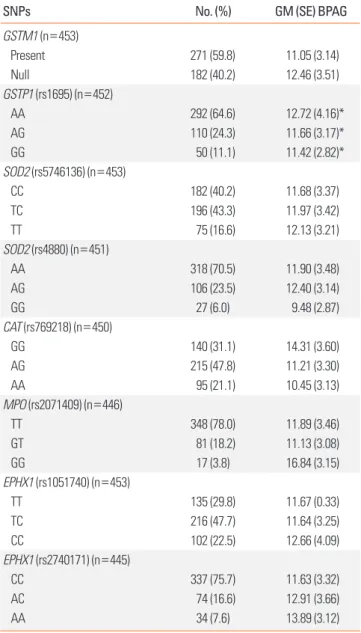
The association of BPAG levels with different genotypes Children with the GSTP1 AA genotype had higher BPAG lev- els than GG carriers after adjusting for urine creatinine, age, gen- der, maternal history of atopy, and ETS exposure (geometric mean [SE] 12.72 [4.16] vs 11.42 [2.82]; P=0.036) (Table 3). No other oxidative stress gene affected the distribution of BPAG.
The association of different genotypes with asthma
Significant differences in genotype frequency were found be- tween asthma cases and controls for GSTP1 (rs1695), SOD2 (rs5746136), and EPHX1 (rs2740171) polymorphisms. GSTP1 AA, SOD2 TT, and EPHX1 AA genotypes were associated with a
Table 2. Association of urine BPAG levels (ng/mL) with asthma
Variables* LnBPAG†
Asthma crude OR (95% CI) 1.21 (1.03-1.43)
Asthma aOR (95% CI) 1.29 (1.08-1.55)
BPAG, bisphenol A glucuronide; OR, odds ratio; CI, confidence interval; aOR, ad- justed odds ratio; ETS, environmental tobacco smoke.
*Adjusted for urine creatinine, age, gender, maternal history of atopy, maternal education, and ETS exposure; †P<0.05.
Table 3. Association of urine BPAG levels (ng/mL) with genotypes
SNPs No. (%) GM (SE) BPAG
GSTM1 (n=453)
Present 271 (59.8) 11.05 (3.14)
Null 182 (40.2) 12.46 (3.51)
GSTP1 (rs1695) (n=452)
AA 292 (64.6) 12.72 (4.16)*
AG 110 (24.3) 11.66 (3.17)*
GG 50 (11.1) 11.42 (2.82)*
SOD2 (rs5746136) (n=453)
CC 182 (40.2) 11.68 (3.37)
TC 196 (43.3) 11.97 (3.42)
TT 75 (16.6) 12.13 (3.21)
SOD2 (rs4880) (n=451)
AA 318 (70.5) 11.90 (3.48)
AG 106 (23.5) 12.40 (3.14)
GG 27 (6.0) 9.48 (2.87)
CAT (rs769218) (n=450)
GG 140 (31.1) 14.31 (3.60)
AG 215 (47.8) 11.21 (3.30)
AA 95 (21.1) 10.45 (3.13)
MPO (rs2071409) (n=446)
TT 348 (78.0) 11.89 (3.46)
GT 81 (18.2) 11.13 (3.08)
GG 17 (3.8) 16.84 (3.15)
EPHX1 (rs1051740) (n=453)
TT 135 (29.8) 11.67 (0.33)
TC 216 (47.7) 11.64 (3.25)
CC 102 (22.5) 12.66 (4.09)
EPHX1 (rs2740171) (n=445)
CC 337 (75.7) 11.63 (3.32)
AC 74 (16.6) 12.91 (3.66)
AA 34 (7.6) 13.89 (3.12)
Stands for the single significantly higher concentration compared to the other genotype.
GM, geometric mean; SE, standard error; BPAG, bisphenol A glucuronide; SNP, single-nucleotide polymorphism.
*P<0.05.
higher risk of asthma with an aOR (95% CI) of 3.00 (1.23-7.33), 2.78 (1.54-5.02), and 2.07 (1.00-4.24), compared with the GG, CC, and CC genotypes, respectively (Supplementary Table 3).
The association of genotypes and asthma stratified by BPAG levels
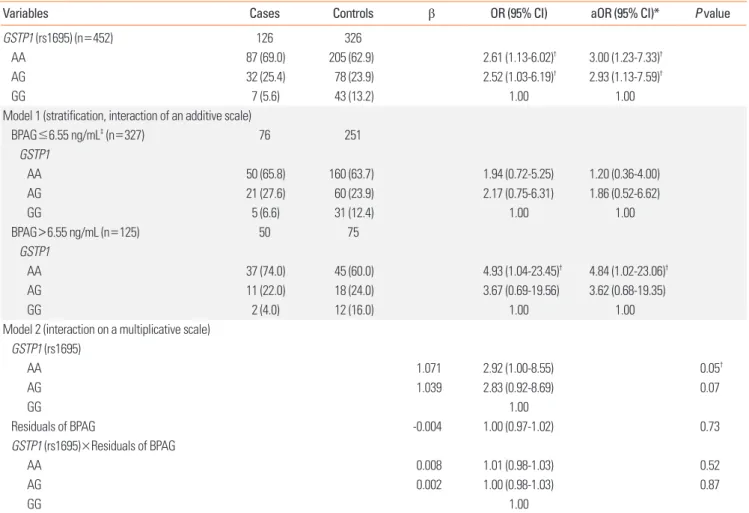
We further investigated the association of genotypes and asth- ma stratified by median BPAG levels. However, in this analysis we focused on GSTP1, since the genetic polymorphism of this gene was only associated with BPAG levels. In children with high BPAG level ≥6.55 ng/mL, the GSTP1 AA genotype was related
to a higher odds of asthma than GG genotype (aOR, 4.84; 95%
CI, 1.02-23.06) (Table 4). In children with BPAG level <6.55 ng/
mL, there was no statistical significance.
The combined effects of BPAG levels and genotypes on asthma Further, since BPAG urine concentrations differ among geno- types of GSTP1, to analyze combined effects we focused on the interplay of GSTP1 and BPAG with asthma. Table 4 shows that the adverse effects of BPA exposure are largely restricted to chil- dren carrying the GSTP1 AA genotype with higher BPAG levels.
Residuals were estimated by subtracting the effect estimated for GSTP1 (rs1695). This was necessary, since the independence criterion for combined effects requires that gene and environ- mental effects are not associated, which they were, as shown above. Further, since GSTP1 was associated with asthma and BPAG levels differ among genotypes of GSTP1 (Table 3), we fo- cused on the interplay of GSTP1 and BPAG levels with asthma.
Before we can estimate whether there is an interaction between GSTP1 and BPAG resulting in a higher odds of having asthma, we needed to estimate the part of BPAG that is not explained by GSTP1 (the residuals). Then, we tested the interaction of the BPAG residuals with GSTP1 gene on asthma. Table 4 shows that the residual of BPAG in interaction with GSTP1 statistically sig- nificantly increases the odds of asthma. To further demonstrate this effect in a simpler model, we stratified the BPAG median levels. In addition, we controlled for known confounding fac- tors, such as urine creatinine, age, gender, maternal history of atopy, maternal education, and ETS exposure. In the stratified analysis (Table 4, upper part, stratified by the median of BPAG levels), we can see that among the cases with lower BPAG levels (≤6.55 ng/mL) there are 65.8% with the GSTP1 AA genotype, similarly among the controls (63.7%). However, among cases with higher BPAG levels (>6.55 ng/mL), there are 74.0% with the GSTP1 AA genotype, but only 60.0% in the controls (OR, 4.84).
Table 4. The combined effects of BPAG levels and genotypes on asthma. The additive interaction of GSTP1 genotype identified by stratification and BPAG median levels and the multiplicative interaction effect of the GSTP1 gene and BPAG residuals on asthma
Variables Cases Controls β OR (95% CI) aOR (95% CI)* P value
GSTP1 (rs1695) (n=452) 126 326
AA 87 (69.0) 205 (62.9) 2.61 (1.13-6.02)† 3.00 (1.23-7.33)†
AG 32 (25.4) 78 (23.9) 2.52 (1.03-6.19)† 2.93 (1.13-7.59)†
GG 7 (5.6) 43 (13.2) 1.00 1.00
Model 1 (stratification, interaction of an additive scale)
BPAG≤6.55 ng/mL‡ (n=327) 76 251
GSTP1
AA 50 (65.8) 160 (63.7) 1.94 (0.72-5.25) 1.20 (0.36-4.00)
AG 21 (27.6) 60 (23.9) 2.17 (0.75-6.31) 1.86 (0.52-6.62)
GG 5 (6.6) 31 (12.4) 1.00 1.00
BPAG>6.55 ng/mL (n=125) 50 75
GSTP1
AA 37 (74.0) 45 (60.0) 4.93 (1.04-23.45)† 4.84 (1.02-23.06)†
AG 11 (22.0) 18 (24.0) 3.67 (0.69-19.56) 3.62 (0.68-19.35)
GG 2 (4.0) 12 (16.0) 1.00 1.00
Model 2 (interaction on a multiplicative scale) GSTP1 (rs1695)
AA 1.071 2.92 (1.00-8.55) 0.05†
AG 1.039 2.83 (0.92-8.69) 0.07
GG 1.00
Residuals of BPAG -0.004 1.00 (0.97-1.02) 0.73
GSTP1 (rs1695)×Residuals of BPAG
AA 0.008 1.01 (0.98-1.03) 0.52
AG 0.002 1.00 (0.98-1.03) 0.87
GG 1.00
Data are shown as number (%). Model 1 is GSTP1 (rs1695) for BPAG<6.55 ng/mL and/or ≥6.55 ng/mL, and model 2 is GSTP1 (rs1695)+residuals of BPAG+GSTP1 (rs1695)×residuals of BPAG.
BPAG, bisphenol A glucuronide; OR, odds ratio; CI, confidence interval; aOR, adjusted odds ratio.
*Adjusted for urine creatinine, age, gender, maternal history of atopy, maternal education, and environmental tobacco smoke exposure; †P<0.05; ‡6.55 ng/mL is the median.
From the lower half of Table 4, addressing the interaction on a multiplicative level, it is obvious that the OR for an individual with asthma is 2.92 times higher when both BPAG residual lev- els are higher and the child has a GSTP1 AA genotype. The in- teraction term on a multiplicative level is not statistically signifi- cant. However, additive interaction, determined by stratifica- tion, provides a better idea of the public health importance of this combined effect (OR, 4.84).
DISCUSSION
In this case-control study, we found an association between GSTP1 AA genetic variants in asthmatic patients and higher urine BPA metabolite concentrations. To the best of our knowl- edge, the associations between oxidative stress genotypes and urine BPA metabolite levels in children with asthma have not been studied before. We found that children with GSTP1 AA genotypes and higher urine BPA metabolite levels had 4.84-fold higher susceptibility to asthma. This finding supports our hy- pothesis that—assuming the GSTP1 gene participates in detoxi- fication of BPA metabolites—the polymorphism of genes cod- ing for GSTP1 may affect individual differences in urinary ex- cretion of BPAG. Although a number of other studies supported a combined effect of BPA metabolites and GSTP1 polymorphi- sms,26 our findings need to be replicated in future studies, since we tested multiple oxidative stress genes and did not adjust for multiple testing in our case-control study. In addition, it is nec- essary to improve our understanding of the possible connec- tion between exposure to environmental BPA, oxidative stress, and GSTP1 polymorphism in the process of developing asthma.
Our findings add to the body of findings supporting an associ- ation between postnatal urine BPAG concentrations and asth- ma in young children reported by Kuo Chou et al.24 and Bowler et al.32 We also identified that higher urine BPAG concentrations were associated with asthma occurrence. These results add to the evidence that environmental exposure to BPA might be as- sociated with adverse respiratory outcomes.
A growing body of findings suggests that BPA-induced dam- age is associated with oxidative stress.26 The GSTP1 gene vari- ant has also been reported to have a significantly lower level of GST enzyme activity. Indeed, several studies have shown that GST polymorphisms are associated with some inflammatory diseases, including asthma.33 Our analyses stratified by GSTP1 genotypes revealed that children with the AA genotype had high- er BPAG concentrations, especially children with asthma. How- ever, direct evidence for exogenous exposure of BPA and urine metabolites, and its modulation by GSTP1 enzyme polymor- phisms is scant.34 The GSTP1 gene plays a significant role in an- tioxidant defense mechanisms. The balance between regres- sion and progression of inflammation after exposure to an en- vironmental insult can be determined by these genes.35 In ze- brafish related to morphological changes, expression of the
GSTP1 gene was reported to be up-regulated by high concen- trations of tamoxifen. Tamoxifen may reverse the effects of es- tradiol and BPA.36 It has also been reported that BPA metabo- lites can be converted into glutathione conjugates in order to be excreted in urine. Thus, the expression of the GSTP1 gene may be responsible for conjugation of BPA metabolites with gluta- thione, which could increase with BPA exposure.37
Numerous reports have suggested indirect associations of oxi- dative stress-related genes with asthma occurrence. Inhaled diesel exhaust particles, ETS, ozone, and mold can each confer an increased risk of asthma symptom exacerbation in carriers of the Val105 allele.38,39 GSTP1 polymorphisms have recently been reported to have a significant association with asthma risk.40,41 Minor allele carriers of GSTP1 rs1695 were also related to an increased risk of asthma in several different study popula- tions.38,42 Such traits were mainly manifested when children were exposed to ETS or to high levels of air pollution.38,43 In this study, we found involvement of GST, SOD2, and EPHX1 genetic polymorphisms in asthma, suggesting the hypothesis that ge- netic variability within antioxidant defense systems can contrib- ute to the pathogenesis of this inflammatory disease.
Using stratification for high and low BPAG concentration, we found that the GSTP1 AA genotype increased the odds of asth- ma in children with high BPAG concentrations. This supports the hypothesis that a less efficient defense against oxidative stress products may contribute to the pathogenesis of asthma. BPA is considered to induce oxidative stress by disrupting the activi- ties of antioxidant enzymes.44 In addition, it has been reported that variations in SOD2, GST, and EPHX1 genes contribute to BPA susceptibility.21 Then, oxidative stress may lead to airway inflammation and decrease pulmonary function as reported in rats exposed to pollutant mixtures.45 In support of our findings, children living in high PM10 communities, the GSTP1 Ile/Val or Val/Val genotype were the high-risk genotype for childhood asthma.40 The Taiwan Children Health Study Group also report- ed that exposure to PM2.5 and O3 was associated positively with a greater risk of asthma among those with at least 1 Val105 al- lele of the GSTP1 gene. In the Cincinnati Childhood Allergy and Air Pollution Study birth cohort, high exposure to DEP was as- sociated with wheezing phenotypes only in children with the GSTP1 Val105 allele (rs1695).46
GSTP1 polymorphism has never been reported to modify the association of urine BPA metabolite levels and asthma. Also, the role of polymorphism of GSTP1 in urine excretion of BPA metabolites has not been assessed to date. Our study was based on the hypothesis that if GSTP1 participate in detoxification of BPA metabolites, the polymorphism of genes coding for GSTP1 may affect individual differences in urine excretion of BPAG.
This mechanism can be very similar to processes identified by the association between exogenous exposure of polycyclic aro- matic hydrocarbons (PAHs) and urine metabolites and its mod- ulation by GSTP1 enzyme polymorphisms.47 One hundred sev-
enty German workers exposed to PAHs were surveyed by a cross- sectional study to explore the role of 11 polymorphisms of CY- P1A1, CYP1A2, CYP1B1, CYP3A4, EPHX1, GSTM1, GSTT1, and GSTP1 in the connection between occupational exposure to PAH and urine PAH metabolites. A significantly increased 1-OHP level was associated with GSTP1 variants.
Some potential limitations may affect the conclusion of this study. First, our study was conducted using a targeted candidate gene approach. In the past, we relied on a prior understanding of the functional features of possible genetic candidates, which may result in blocking the detection of novel. However, prior knowledge helped us focus. Hence, we deliberately selected 7 candidate genes involved in the pathogenesis of oxidative path- ways for screening and validation in this study. This focused approach was cost-effective compared to a genome-wide ap- proach. Second, we are aware that BPA measurements in spot urine samples can be limited as other studies also have shown low intra-class correlation coefficient of spot urine sample. How- ever, they are considered to adequately reflect average popula- tion exposure when sample sizes are large.48 Moreover, other investigations showed that single spot samples obtained from children provided a reliable characterization of absolute and relative exposure over the short time window studied.49 More- over, the reliability of assessment of BPA metabolites was also enhanced by analyzing urine BPA metabolites using UPLC-MS/
MS with decent validity.
We have strengthened our study using direct measurement of exposure through objective quantitative biomarkers for BPA metabolites and assessment of the outcome by physician diag- noses of asthma. We also intended to reduce the recall bias of exposure assessment derived from questionnaires by directly assessing BPA exposure through quantifying urine BPA metab- olites. Thus, we were able to test for our genetic associations with adjustment for potential confounders, such as urine creat- inine, age, gender, maternal history of atopy, maternal educa- tion, and ETS exposure.
In conclusion, this case-control study found that the GSTP1 rs1695 variants are significantly associated with asthma partic- ularly in children with higher BPA urine concentrations, thus supporting the hypothesis that genetic variability within antiox- idant defense systems contributes to the pathogenesis of this disease. The oxidative stress gene GSTP1 rs1695 polymorphism seems to modify the association of BPA exposures with asthma.
Since adverse effects of BPA exposure were largely restricted to children carrying GSTP1 AA genotypes, preventive measures to avoid BPA exposure should be introduced in these susceptible children. However, to reach a firm conclusion, future studies need to replicate our findings. In addition, there is a require- ment to standardize methods for environmental exposure as- sessment.
REFERENCES
1. Bhan A, Hussain I, Ansari KI, Bobzean SA, Perrotti LI, Mandal SS.
Bisphenol-A and diethylstilbestrol exposure induces the expres- sion of breast cancer associated long noncoding RNA HOTAIR in vitro and in vivo. J Steroid Biochem Mol Biol 2014;141:160-70.
2. Dodson RE, Nishioka M, Standley LJ, Perovich LJ, Brody JG, Rudel RA. Endocrine disruptors and asthma-associated chemicals in con- sumer products. Environ Health Perspect 2012;120:935-43.
3. Gregoraszczuk EL, Ptak A. Endocrine-disrupting chemicals: some actions of pops on female reproduction. Int J Endocrinol 2013;2013:
828532.
4. Teeguarden JG, Hanson-Drury S. A systematic review of Bisphenol A “low dose” studies in the context of human exposure: a case for establishing standards for reporting “low-dose” effects of chemi- cals. Food Chem Toxicol 2013;62:935-48.
5. Rochester JR. Bisphenol A and human health: a review of the liter- ature. Reprod Toxicol 2013;42:132-55.
6. Chapin RE, Adams J, Boekelheide K, Gray LE Jr, Hayward SW, Lees PS, et al. NTP-CERHR expert panel report on the reproductive and developmental toxicity of bisphenol A. Birth Defects Res B Dev Re- prod Toxicol 2008;83:157-395.
7. Calafat AM, Ye X, Wong LY, Reidy JA, Needham LL. Exposure of the U.S. population to bisphenol A and 4-tertiary-octylphenol: 2003- 2004. Environ Health Perspect 2008;116:39-44.
8. Matsumoto J, Yokota H, Yuasa A. Developmental increases in rat hepatic microsomal UDP-glucuronosyltransferase activities toward xenoestrogens and decreases during pregnancy. Environ Health Perspect 2002;110:193-6.
9. Hannu T, Frilander H, Kauppi P, Kuuliala O, Alanko K. IgE-mediat- ed occupational asthma from epoxy resin. Int Arch Allergy Immu- nol 2009;148:41-4.
10. Kwak ES, Just A, Whyatt R, Miller RL. Phthalates, pesticides, and bi- sphenol-A exposure and the development of nonoccupational asth- ma and allergies: how valid are the links? Open Allergy J 2009;2:45- 50.
11. Anjum S, Rahman S, Kaur M, Ahmad F, Rashid H, Ansari RA, et al.
Melatonin ameliorates bisphenol A-induced biochemical toxicity in testicular mitochondria of mouse. Food Chem Toxicol 2011;49:
2849-54.
12. Ooe H, Taira T, Iguchi-Ariga SM, Ariga H. Induction of reactive oxy- gen species by bisphenol A and abrogation of bisphenol A-induced cell injury by DJ-1. Toxicol Sci 2005;88:114-26.
13. Kabuto H, Amakawa M, Shishibori T. Exposure to bisphenol A dur- ing embryonic/fetal life and infancy increases oxidative injury and causes underdevelopment of the brain and testis in mice. Life Sci 2004;74:2931-40.
14. Nakajima Y, Goldblum RM, Midoro-Horiuti T. Fetal exposure to bi- sphenol A as a risk factor for the development of childhood asthma:
an animal model study. Environ Health 2012;11:8.
15. Spanier AJ, Kahn RS, Kunselman AR, Hornung R, Xu Y, Calafat AM, et al. Prenatal exposure to bisphenol A and child wheeze from birth to 3 years of age. Environ Health Perspect 2012;120:916-20.
16. Donohue KM, Miller RL, Perzanowski MS, Just AC, Hoepner LA, Arunajadai S, et al. Prenatal and postnatal bisphenol A exposure and asthma development among inner-city children. J Allergy Clin Immunol 2013;131:736-42.
17. Wang IJ, Chen CY, Bornehag CG. Bisphenol A exposure may increase
the risk of development of atopic disorders in children. Int J Hyg Environ Health 2016;219:311-6.
18. Comhair SA, Erzurum SC. Redox control of asthma: molecular mech- anisms and therapeutic opportunities. Antioxid Redox Signal 2010;
12:93-124.
19. Sheehan D, Meade G, Foley VM, Dowd CA. Structure, function and evolution of glutathione transferases: implications for classification of non-mammalian members of an ancient enzyme superfamily.
Biochem J 2001;360:1-16.
20. Piacentini S, Polimanti R, Simonelli I, Donno S, Pasqualetti P, Man- fellotto D, et al. Glutathione S-transferase polymorphisms, asthma susceptibility and confounding variables: a meta-analysis. Mol Biol Rep 2013;40:3299-313.
21. Yucesoy B, Johnson VJ, Lummus ZL, Kissling GE, Fluharty K, Gau- trin D, et al. Genetic variants in antioxidant genes are associated with diisocyanate-induced asthma. Toxicol Sci 2012;129:166-73.
22. Gilliland FD. Outdoor air pollution, genetic susceptibility, and asth- ma management: opportunities for intervention to reduce the bur- den of asthma. Pediatrics 2009;123 Suppl 3:S168-73.
23. Romieu I, Ramirez-Aguilar M, Sienra-Monge JJ, Moreno-Macías H, del Rio-Navarro BE, David G, et al. GSTM1 and GSTP1 and respira- tory health in asthmatic children exposed to ozone. Eur Respir J 2006;28:953-9.
24. Kuo Chou TN, Li YS, Lue KH, Liao CF, Lin CY, Tzeng PR, et al. Ge- netic polymorphism of manganese superoxide dismutase is asso- ciated with childhood asthma. J Asthma 2010;47:532-8.
25. Wang IJ, Lin TJ. FLG P478S polymorphisms and environmental risk factors for the atopic march in Taiwanese children: a prospective cohort study. Ann Allergy Asthma Immunol 2015;114:52-7.
26. Soto-Martínez ME, Avila L, Soto-Quirós ME. New criteria for the diagnosis and management of asthma in children under 5 years old: GINA Guidelines 2009. An Pediatr (Barc) 2009;71:91-4.
27. Zhou X, Kramer JP, Calafat AM, Ye X. Automated on-line column- switching high performance liquid chromatography isotope dilu- tion tandem mass spectrometry method for the quantification of bisphenol A, bisphenol F, bisphenol S, and 11 other phenols in urine.
J Chromatogr B Analyt Technol Biomed Life Sci 2014;944:152-6.
28. Cayman Chemical (US). Creatinine (urinary) [Internet]. Ann Arbor (MI): Cayman Chemical; 2012 [cited 2017 Sep 15]. Available from:
https://www.caymanchem.com/pdfs/500701.pdf.
29. Grover D, Woodfield AS, Verma R, Zandi PP, Levinson DF, Potash JB. QuickSNP: an automated web server for selection of tagSNPs.
Nucleic Acids Res 2007;35:W115-20.
30. Woodward J. Bi-allelic SNP genotyping using the TaqMan® assay.
Methods Mol Biol 2014;1145:67-74.
31. McClelland GH, Judd CM. Statistical difficulties of detecting inter- actions and moderator effects. Psychol Bull 1993;114:376-90.
32. Bowler RP, Barnes PJ, Crapo JD. The role of oxidative stress in chron- ic obstructive pulmonary disease. COPD 2004;1:255-77.
33. Hwang BF, Young LH, Tsai CH, Tung KY, Wang PC, Su MW, et al.
Fine particle, ozone exposure, and asthma/wheezing: effect modi- fication by glutathione S-transferase P1 polymorphisms. PLoS One 2013;8:e52715.
34. Zielińska E, Zubowska M, Misiura K. Role of GSTM1, GSTP1, and GSTT1 gene polymorphism in ifosfamide metabolism affecting neu- rotoxicity and nephrotoxicity in children. J Pediatr Hematol Oncol
2005;27:582-9.
35. Selgrade MK, Blain RB, Fedak KM, Cawley MA. Potential risk of asthma associated with in utero exposure to xenobiotics. Birth De- fects Res C Embryo Today 2013;99:1-13.
36. Xia L, Zheng L, Zhou JL. Transcriptional and morphological effects of tamoxifen on the early development of zebrafish (Danio rerio). J Appl Toxicol 2016;36:853-62.
37. Sienkiewicz M. In vitro effects of bisphenol a on prostate cells: search- ing for clues of environmental carcinogenesis [Internet]. Ottawa:
University of Ottawa; 2012 [cited 2017 July 1]. Available from: https:
//www.ruor.uottawa.ca/bitstream/10393/22805/3/Sienkiewicz_
Marta_2012_thesis.pdf.
38. Tamer L, Calikoğlu M, Ates NA, Yildirim H, Ercan B, Saritas E, et al.
Glutathione-S-transferase gene polymorphisms (GSTT1, GSTM1, GSTP1) as increased risk factors for asthma. Respirology 2004;9:
493-8.
39. Palmer CN, Doney AS, Lee SP, Murrie I, Ismail T, Macgregor DF, et al. Glutathione S-transferase M1 and P1 genotype, passive smok- ing, and peak expiratory flow in asthma. Pediatrics 2006;118:710-6.
40. Su MW, Tsai CH, Tung KY, Hwang BF, Liang PH, Chiang BL, et al.
GSTP1 is a hub gene for gene-air pollution interactions on child- hood asthma. Allergy 2013;68:1614-7.
41. Lee YL, Hsiue TR, Lee YC, Lin YC, Guo YL. The association between glutathione S-transferase P1, M1 polymorphisms and asthma in Taiwanese schoolchildren. Chest 2005;128:1156-62.
42. Yu J, Ahn K, Shin YH, Kim KW, Suh DI, Yu HS, et al. Interaction be- tween prenatal exposure to home renovation and reactive oxygen species genes in cord blood IgE response is modified by maternal atopy. Allergy Asthma Immunol Res 2016;8:41-8.
43. MacIntyre EA, Brauer M, Melén E, Bauer CP, Bauer M, Berdel D, et al. GSTP1 and TNF Gene variants and associations between air pollution and incident childhood asthma: the traffic, asthma and genetics (TAG) study. Environ Health Perspect 2014;122:418-24.
44. Zhang J, Li X, Zhou L, Wang L, Zhou Q, Huang X. Analysis of effects of a new environmental pollutant, bisphenol A, on antioxidant sys- tems in soybean roots at different growth stages. Sci Rep 2016;6:23782.
45. Seagrave J, Campen MJ, McDonald JD, Mauderly JL, Rohr AC. Oxi- dative stress, inflammation, and pulmonary function assessment in rats exposed to laboratory-generated pollutant mixtures. J Toxi- col Environ Health A 2008;71:1352-62.
46. Schroer KT, Biagini Myers JM, Ryan PH, LeMasters GK, Bernstein DI, Villareal M, et al. Associations between multiple environmental exposures and Glutathione S-Transferase P1 on persistent wheez- ing in a birth cohort. J Pediatr 2009;154:401-8, 408.e1.
47. Rihs HP, Pesch B, Kappler M, Rabstein S, Rossbach B, Angerer J, et al. Occupational exposure to polycyclic aromatic hydrocarbons in German industries: association between exogenous exposure and urinary metabolites and its modulation by enzyme polymorphisms.
Toxicol Lett 2005;157:241-55.
48. Nepomnaschy PA, Baird DD, Weinberg CR, Hoppin JA, Longneck- er MP, Wilcox AJ. Within-person variability in urinary bisphenol A concentrations: measurements from specimens after long-term frozen storage. Environ Res 2009;109:734-7.
49. Heffernan AL, Aylward LL, Samidurai AJ, Davies PS, Toms LM, Sly PD, et al. Short term variability in urinary bisphenol A in Australian children. Environ Int 2014;68:139-43.
Supplementary Table 1. Candidate SNP and TaqMan assay information
Gene dbSNP TaqMan Assay ID CEPH (CEU) Yoruba (YRI) Japanse (JPT) Han Chinese (CHB)
GSTM1 Null or Present
GSTP1 rs1695 C_3237198_20 0.41 (G) 0.39 (G) 0.09 (G) 0.17 (G)
CAT rs769218 C_3102900_10 0.2 (A) 0.12 (A) 0.49 (G) 0.47 (G)
SOD2 rs4880 C_8709053_10 0.45 (C) 0.38 (C) 0.11 (C) 0.12 (C)
SOD2 rs5746136 C_29322854_10 0.33 (A) 0.19 (A) 0.42 (A) 0.43 (A)
EPHX1 rs2740171 C_16061129_10 0.22 (A) 0.39 (A) 0.19 (A) 0.07 (A)
MPO rs2071409 C_15868927_20 0.1 (C) 0.13 (C) 0.08 (C) 0.16 (C)
MPO rs2071409 C_15868927_20 0.1 (C) 0.13 (C) 0.08 (C) 0.16 (C)
EPHX1 rs1051740 C_14938_30 0.33 (C) 0.12 (C) 0.48 (C) 0.47 (C)
Supplementary Table 2. Distribution of BPAG levels (ng/mL)
> LOD (%) Minimum Median value Maximum GM (GSD)
BPAG 98.0 ND 6.55 1,961.00 11.84 (3.35)
ND, Non-detectable=1.61 ng/mL; LOD, Limit of detection=1.61 ng/mL; GM, Geometric mean; GSD, geometric standard deviation.
Supplementary Table 3. Association between different genotypes and asthma
Genes (SNP) Cases
n (%) Control
n (%) OR
(95% CI) Adjusted OR
(95% CI)† P value
GSTM1 (n=453) 126 327 0.11
Present 68 (54.0) 203 (62.1) 0.72 (0.47-1.09) 0.77 (0.47-1.25)
Null 58 (46.0) 124 (37.9) 1 1
GSTP1 (rs1695) (n=452) 126 326 0.05*
AA 87 (69.0) 205 (62.9) 2.61 (1.13-6.02)* 3.00 (1.23-7.33)*
AG 32 (25.4) 78 (23.9) 2.52 (1.03-6.19)* 2.93 (1.13-7.59)*
GG§ 7 (5.6) 43 (13.2) 1 1
SOD2 (rs5746136) (n=453) 126 327 0.001*
TT 30 (23.8) 45 (13.8) 2.70 (1.50-4.87)* 2.78 (1.54-5.02)*
TC 60 (47.6) 136 (41.6) 1.80 (1.12-2.90)* 1.79 (1.12-2.89)*
CC‡ 36 (28.6) 146 (44.6) 1 1
SOD2 (rs4880) (n=451) 126 325 0.23
GG 5 (4.0) 22 (6.8) 0.55 (0.20-1.50) 0.72 (0.19-2.66)
AG 28 (22.2) 78 (24.0) 0.88 (0.54-1.44) 0.71 (0.38-1.32)
AA‡ 93 (73.8) 225 (69.2) 1 1
CAT (rs769218) (n=450) 126 324 0.21
AA 22 (17.5) 73 (22.5) 0.68 (0.37-1.24) 0.97 (0.47-1.98)
AG 61 (48.4) 154 (47.5) 0.90 (0.56-1.43) 1.06 (0.59-1.89)
GG‡ 43 (34.1) 97 (29.9) 1 1
MPO (rs2071409) (n=446) 125 321 0.96
GG 6 (4.8) 11 (3.4) 1.37 (0.49-3.80) 0.71 (0.14-3.54)
GT 20 (16.0) 61 (19.0) 0.82 (0.47-1.43) 0.61 (0.29-1.27)
TT‡ 99 (79.2) 249 (77.6) 1 1
EPHX1 (rs1051740) (n=453) 126 327 0.32
CC 23 (18.3) 79 (24.2) 0.71 (0.39-1.29) 0.54 (0.26-1.13)
TC 64 (50.8) 152 (46.5) 1.03 (0.64-1.65) 0.82 (0.45-1.47)
TT‡ 39 (31.0) 96 (29.4) 1 1
EPHX1 (rs2740171) (n=445) 126 319 0.17
AA 15 (11.9) 19 (6.0) 2.07 (1.01-4.25)* 2.07 (1.00-4.24)*
AC 18 (14.3) 56 (17.6) 0.84 (0.47-1.51) 0.84 (0.47-1.51)
CC‡ 93 (73.8) 244 (76.5) 1 1
OR, odds ratio; CI, confidence interval.
*P< 0.05; †Adjusted for urine creatinine, maternal age, maternal education, maternal history of atopy, breast feeding, and ETS exposure; ‡‘AA’, ‘Aa’, ‘aa’ represent a given variant for each SNP genotyped. Major alleles (AA) as reference group under an additive model (AA vs Aa vs aa); §For GSTP1 (rs1695), minor alleles (aa) as ref- erence group under a recessive model.