Original Article
Korean J Urogenit Tract Infect Inflamm 2014;9(2):86-92만성비세균성전립선염 쥐 모델에서 플로로탄닌의 항염 효과
정윤석, 조용현, 한창희
가톨릭대학교 의과대학 비뇨기과학교실
Anti-Inflammatory Effect of Phlorotannin on Chronic Nonbacterial Prostatitis in a Rat Model
Yun Seok Jung, Yong-Hyun Cho, Chang Hee Han
Department of Urology, College of Medicine, The Catholic University of Korea, Seoul, Korea
Purpose: Chronic nonbacterial prostatitis and chronic pelvic pain syndrome account for 90-95% of all prostatitis. Little is known about its pathophysiology, thus, various treatments are used. Ecklonia cava, a seaweed, is a member of the brown algae family; many recent reports have demonstrated that its extract containing phlorotannin has anti-oxidative and anti-inflammatory properties. Using the hormone-induced prostatitis rat model, we investigated the anti-inflammatory effects of E. cava extracts via its anti-oxidative process on chronic nonbacterial prostatitis.
Materials and Methods: Forty, 10-week-old male white Wistar rats were utilized, and divided equally into the following five groups: 1) control, 2) E. cava-fed, 3) hormone-induced prostatitis (HIP), 4) E. cava-treated HIP, and 5) nonsteroidal anti-inflammatory drug (NSAID)-treated HIP.
Results: The results showed statistically-significant improvement in the tissue response to the hormone-induced inflammation among the E. cava-treated and NSAID-treated groups (p<0.05). Lower malonedialdehyde levels were observed in the group with E. cava-treated HIP than with HIP alone, which was statistically significant. We believe that this supports the anti-oxidative properties of E. cava.
Conclusions: This study demonstrates that phlorotannin has anti-inflammatory properties via its anti-oxidative process, which we expect to play an important role in prevention and as an adjuvant therapy for chronic nonbacterial prostatitis.
Keywords: Prostatitis; Estrogens; Anti-inflammatory agents
Copyright 2014, Korean Association of Urogenital Tract Infection and Inflammation. All rights reserved.
This is an open access article distributed under the terms of the Creative Commons Attribution Non-Commercial License (http://creativecommons.org/licenses/by-nc/3.0) which permits unrestricted non-commercial use, distribution, and reproduction in any medium, provided the original work is properly cited.
Received: 6 July, 2014 Revised: 21 September, 2014 Accepted: 30 September, 2014
Correspondence to: Chang Hee Han
Department of Urology, The Catholic University of Korea, Uijeongbu St. Mary's Hospital, 271, Cheonbo- ro, Uijeongbu 480-717, Korea
Tel: +82-31-820-3128, Fax: +82-31-847-6133 E-mail: [email protected]
INTRODUCTION
Chronic prostatitis is one of the most prevalent conditions
in urology. It is the most common urologic problem encountered in young men and comprises a significant proportion of men older than 50 years. Unfortunately, the
etiology and natural history of chronic prostatitis are poorly understood and thus accurate diagnosis and appropriate treatment are unclear. According to National Institutes Health classification of prostatitis in 1999, chronic prostatitis/chronic pelvic pain syndrome is the most prevalent type, accounting for at least 90% of prostatitis cases.1 It is characterized by voiding symptoms, chronic pelvic pain and impairments in quality of life. An estimated 50% of all men experience prostatitis-like symptoms at point during their lifetime.2
The old-fashioned treatment of prostatitis is the supply of empirical antibiotics. It often requires several weeks to months of treatment and has a low cure and a high recurrence rate. In addition, long-term antibiotic treatment has complications such as gastrointestinal, central nervous system and skin side effects as well as development of antibiotic resistance.3 Standard medical treatment for chronic prostatitis including such agents as alpha-blockers, nonsteroidal anti-inflammatories, antimicrobial therapy have not been uniformly effective. Often times, the addition of adjunct therapies such as dietary change, phytotherapy, physical therapy, acupuncture, and stress management can have profound impact on the symptoms and increase the benefits of traditional medical care. Owing to an evident dissatisfaction with the standard medical approach to the treatment of chronic prostatitis, many patients are seeking relief outside of traditional approaches and attention has been paid to other alternative treatments. In recent years, seaweeds have served as an important source of bioactive natural substances and many metabolites isolated from marine algae have shown to possess these effects.4
Ecklonia cava
Kjellman (Phaeophyceae; Laminareaceae), a brown algae, is an edible, perennial, and abundant seaweed distributed in Japan and the southern coast of Korea and has been used as seasonal vegetable in coastal areas.E.
cava
has a variety of bioactive compounds and derivatives such as phlorotannins, sulphated polysaccharides, peptides, carotenoids, and fucoidans. As previously reported, phlorotannins are the key compound in bioactivities ofE. cava
. Recently, it has been reported that phlorotannins have various biological properties such as antioxidant, anti-inflammatory, anti-proliferative, anti-hypertensive, antidiabetic activities.5 The Seanol (Livechem, Jeju, Korea) used in this study is a low-molecular-weight polyphenol compound extracted fromE. cava
, 97.4% of which isphlorotannin. The results from in vitro and in vivo clinical studies on Seanol showed that it is rich in bioactive polyphenol complex and was a New Dietary Ingredient certified by the United States Food and Drug Administration in 2008.
This study attempted to evaluate the anti-oxidative and anti-inflammatory effects of phlorotannin using a chronic nonbacterial prostatitis rat model, and to examine the potential benefits of phlorotannin as an adjuvant therapy for chronic nonbacterial prostatitis.
MATERIALS AND METHODS
1. Animals
A total of forty 10-week-old male white Wistar rats were used following 1 week of habituation. Experiments were carried out by the Guide for Care and Use of Laboratory Animals.
2. Chronic Nonbacterial Prostatitis Model
We utilized the modified prostatitis rat model of Robinette6 and Naslund et al.7 with estrogen treatment of Wistar rats to elicit inflammation in the lateral lobe of prostate.8 In order to induce chronic nonbacterial prostatitis, 0.25 mg/kg of 17 beta-estradiol (Sigma, St. Louis, MO, USA) was given daily for 4 weeks via subcutaneous injection. Starting on day 15, 0.25 mg/kg of dihydrotestosterone (DHT; Sigma, Seelze, Germany) was also subcutaneously injected.3. Experimental Groups and Treatments
Forty rats were randomly divided into five groups: (1) control group (n=8), back of the rats were subcutaneously injected with 0.1 ml sesame oil once a day for 4 weeks;
(2)
E. cava
-fed group (n=8), using a gastric tube, 60 mg/kg of Seanol dissolved in 0.3 ml sterile water was administered once a day for 4 weeks, and 0.1 ml sesame oil was injected subcutaneously once a day for 4 weeks; (3) hormone-in- duced prostatitis (HIP) group (n=8), 0.25 mg/kg of E2 was dissolved in 0.1 ml sesame oil, and the solution was injected subcutaneously in the back of the rats for 4 weeks. From the 15th day after the injection, DHT was also injected subcutaneously in the back of the rat daily for 2 weeks, in the same manner as the E2 injection; (4)E. cava
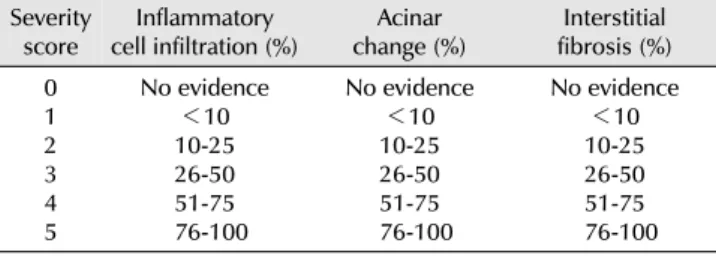
-treated HIP group (n=8), following the regimen of HIP, 60 mg/kg of Seanol was dissolved in 0.3 ml sterile water, and theTable 1. Severity scores of chronic inflammatory cell infiltrations, acinar changes and interstitial fibrosis of prostate tissue
Severity
score Inflammatory
cell infiltration (%) Acinar
change (%) Interstitial fibrosis (%) 01
23 4 5
No evidence
<10 10-25 26-50 51-75 76-100
No evidence
<10 10-25 26-50 51-75 76-100
No evidence
<10 10-25 26-50 51-75 76-100
solution was administered using a gastric tube once a day for 4 weeks; and (5) nonsteroidal anti-inflammatory drug (NSAID)-treated HIP group (n=8), following the regimen of HIP, 5 mg/kg of diclofenac sodium (Valentac; Jeil Pharma, Seoul, Korea) was injected into the thigh muscle of the rat once a day for 4 weeks.
4. Collection of Tissue Specimens
The rats that completed the whole 4 week treatments were anesthetized using ketamine (50 mg/kg) and xylazine (12 mg/kg), and the prostates were exsected. The left lateral lobe was used to measure the malonedialdehyde (MDA), and the right lateral lobe was made into a paraffin block.
The administration of estrogen selectively caused prostatitis in the lateral lobes and thus both lateral lobes of the prostate were used for analysis.
5. Histological Study
Sections were fixed in 10% neutral formalin and stained with hematoxylin and eosin, and two pathologists who were blinded to the experiment groups evaluated the level of chronic prostatitis based on the three criteria: infiltration of chronic inflammatory cells, the change of the acinar, and interstitial fibrosis. According to each category, the level of prostatitis was described by recording samples as follows: without proof 0 score, <10% 1 score, 10-25% 2 score, 26-50% 3 score, 51-75% 4 score, and 76-100% 5 score (Table 1).9
6. Determination of Malonedialdehyde
The concentration of MDA in the prostate tissue was used as an indicator of oxidative damage. This was deter- mined using Bioxytech MDA-586 assay kit (OxisResearch, Portland, OR, USA) following the manufacturer’s protocols.
This assay is based on the reaction of a chromogenic reagent,
N
-methyl-2-phenylindole, with MDA at 45oC, and measuresspecifically MDA and not other lipid peroxidation products.
Briefly, after thawing the tissue samples, blood was removed by rinsing with ice-cold isotonic saline and each sample was weighed and homogenized. Before homogenization, 10 μl of 0.5 M butylated hydroxytoluene in acetonitrile, per ml of tissue homogenate, was added to prevent sample oxidation during homogenization; 0.2 ml of tissue homo- genate was placed in a microcentrifuge tube, to which 10 μl probucol and 640 μl
N
-methyl-2-phenylindole in 75%acetonitrile were added. Samples were acidified with 150 μl of concentrated hydrochloric acid, vortexed thoroughly, and incubated for 60 min in a 45oC water bath. After incubation, the samples were centrifuged at 10,000
g
for 10 min and the absorbance of the clear supernatant was measured at 586 nm. An MDA standard curve was used to determine the absolute concentration of MDA in the samples using the stable MDA precursor tetrametho- xypropane. Sample mean absorbance was converted to μmol MDA using linear regression from the standard curve (y=0.065x+0.04), and results were expressed as μmol MDA/g protein.107. Statistical Analysis
Data were analyzed statistically and expressed as the mean±standard deviation. IBM SPSS Statistics ver. 19.0 (IBM Co., Armonk, NY, USA) was used to evaluate the data. Groups were compared using analysis of variance (ANOVA) followed by Tukey’s test for multiple comparisons. The level of significance was at p<0.05.
RESULTS
1. Histological Data for the Prostate
In the histopathologic examination of the prostate, there were no signs of chronic inflammation in the control group and
E. cava
-fed group. However, in HIP,E. cava
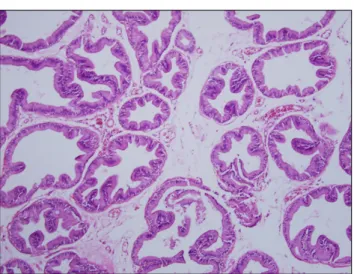
-treated HIP, and NSAID-treated HIP groups, evidences of chronic inflammation were seen. HIP group showed the most severe inflammatory cell infiltration and acinar change, and inter- stitial fibrosis (Fig. 1-3). The degrees of inflammatory cell infiltration in control group,E. cava
-fed group, HIP group,E. cava
-treated HIP group, and NSAID-treated HIP group were 0, 0, 4.13±0.84, 1.88±0.64, and 2.13±0.64, respec- tively; andE. cava
-treated HIP group and NSAID-treated HIP group showed significantly less inflammatory cellFig. 3. Prostate section of Ecklonia cava-treated group. Mild infiltration of chronic inflammatory cells, mildly atrophied acini, and mild interstitial fibrosis are seen (H&E stain, ×100).
Fig. 1. Prostate section of control group. There is no evidence of chronic inflammatory cell infiltration, acinar change and interstitial fibrosis (H&E stain, ×100).
Fig. 2. Prostate section of hormone-induced prostatitis group. Severe chronic inflammatory cell infiltration and interstitial fibrosis are seen.
The acinar structures are severely atrophied (H&E stain, ×100).
Table 2. Severity scores of chronic inflammatory cell infiltrations, acinar changes and interstitial fibrosis in each group
Group (rats no.) Inflammatory
cell infiltration Acinar
change Interstitial fibrosis Control group (n=8)
Ecklonia cava-fed group (n=8) HIP group (n=8)
E. cava-treated HIP group (n=8) NSAID-treated HIP group (n=8)
0 4.13±0.840 1.88±0.64 2.13±0.64
0 4.00±0.760 1.75±0.46 2.00±0.76
0 3.88±0.640 1.63±0.74 1.88±0.84 Value are presented as number only or mean±standard deviation.
HIP: hormone-induced prostatitis, NSAID: nonsteroidal anti-infla- mmatory drug.
infiltration compared with the HIP group (p<0.05). The degrees of acinar change in control group,
E. cava
-fed group, HIP group,E. cava
-treated HIP group, and NSAID-treated HIP group were 0, 0, 4.00±0.76, 1.75±0.46, and 2.00±0.76, respectively; andE. cava
-treated HIP group and NSAID- treated HIP group showed significantly less degrees of acinar change compared with the HIP group (p<0.05). The degrees of interstitial fibrosis in control group,E. cava
-fed group, HIP group,E. cava
-treated HIP group, and NSAID- treated HIP group were 0, 0, 3.88±0.64, 1.63±0.74, and 1.88±0.84, respectively; andE.
cava
-treated HIP group and NSAID-treated HIP group had significantly less degrees of interstitial fibrosis comparedwith the HIP group (p<0.05). There were no statistically significant differences between
E. cava
-treated HIP group and NSAID-treated HIP group in the above-mentioned three parameters (p>0.05) (Table 2; Fig. 4).2. Oxidative Stress Marker
The MDA level in the prostate tissues generated by oxygen free radicals in control group,
E. cava
-fed group, HIP group,E. cava
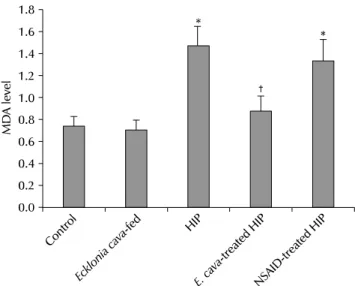
-treated HIP group, and NSAID-treated HIP group were 0.75±0.08, 0.71±0.09, 1.48±0.18, 0.88±0.14, and 1.34±0.20 μmol/g protein, respectively, and were stati- stically significantly increased in HIP group than in control group andE. cava
-fed group. The MDA levels were significantly less inE. cava
-treated HIP group compared with HIP group (p<0.05). The MDA value was lower in NSAID-treated HIP group than in HIP group, however this was not statistically significant (p>0.05; Fig. 5).Fig. 5. Mean malonedialdehyde (MDA) values measured in each group.
*p<0.05 compared with control group; †p<0.05 compared with hormone-induced prostatitis (HIP) group. NSAID: nonsteroidal anti- inflammatory drug.
Fig. 4. Severity scores of chronic inflammatory cell infiltration, acinar changes and interstitial fibrosis in each group. *p<0.05 compared with hormone-induced prostatitis (HIP) group. NSAID: nonsteroidal anti- inflammatory drug.
DISCUSSION
Chronic prostatitis is highly prevalent in society and is a disease that is poorly understood. It can degrade one’s quality of life and treatment has been unsuccessful in the past. It is not a single disease but shows diverse pathological causes of which only 5% accounts as bacterial. Therefore rationale for the use of antibiotics may be inappropriate.
Traditionally, antibiotics, alpha-blockers and anti-inflamma- tory drugs are used as primary chronic prostatitis medica- tions. These days, because of the deficit of traditional antibiotic therapy, the purpose of treatment has changed from complete cure to improvements in quality of life and attention has been paid to phytotherapy. Many researchers have shown that polyphenolic compounds from marine algae have strong antioxidant activities on free radicals.11 The antioxidant activity can be the result of specific scaveng- ing of radicals formed during peroxidation, scavenging of oxygen-containing compounds, or metal-chelating ability.
Phlorotannins purified from
E. cava
are responsible for antioxidant activities and have been shown to provide protective effects against hydrogen peroxide-induced cell damage.12E. cava
is an edible seaweed, which has been recognized as a rich source of bioactive derivatives, mainly phlorotannins and sulphate polysaccharides. These metabolites exhibit various beneficial biological activities such as antioxidant, antimicrobial, anti-inflammatory,anticancer, antidiabetic, anticoagulative, antihypertensive, matrix metalloproteinase enzyme inhibition and antiallergic activities.13 Until now, there has been no research on the effectiveness of phlorotannin against prostatitis. Therefore this study is the first and supports the anti-inflammatory and anti-oxidative effects of phlorotannin on the chronic nonbacterial prostatitis rat model. In this study, it was confirmed that with the administration of phlorotannin, the inflammation in the lateral lobe of the prostate was effectively reduced in
E. cava
-treated HIP group and NSAID-treated HIP group, and the inflammation was inhibited inE. cava
-treated HIP group more than in NSAID-treated HIP group, although this difference was statistically not significant.Estrogen-induced prostatitis is partially connected to the inhibition of dopamine secretion at the hypothalamus, which in turn increases the formation and secretion of prolactin that causes inflammation of the prostate.14 Tangbanluekal and Robinette15 proposed that rats with E2-induced prostatitis were correlated with increased serum prolactin, and elevated pituitary weight, and that the administration of bromocryptine, a dopamine D2 agonist, was effective in suppressing pituitary weight and hyperpro- lactinemia and mitigated the lateral prostate inflammation.
Administration of E2 for 2 weeks results in inflammation of the rat prostate. Injection of testosterone with E2 prevents atrophy of tissue as well as inflammation, however, DHT
maintains the inflammation induced by E2 and prevents atrophy of tissue.16 Therefore, we utilized the modified model of Robinette and Naslund with E2 treatment for 4 weeks and DHT treatment for 2 weeks to induce inflamma- tion in the lateral prostate lobe in noncastrated, adult Wistar male rats, while preventing atrophy of the tissues. With this modified method, we observed chronic inflammation of the lateral lobe of rat prostate. The injected dose of E2 and DHT to induce prostate inflammation was 0.25 mg/kg/day which was the same dose used in the Naslund’s model. In our study, the chronic nonbacterial prostatitis rat model was reproducible and confirmed histologically.
Since the etiology of nonbacterial prostatitis has not yet been established, various factors which may play a role have been reported, including genital viruses, biofilm, stagnation of prostatic secretion, autoimmune diseases, allergies, sex hormone disorders, and psychological factors.17 In the present study, oxidative stress was investigated as a cause of chronic prostatitis. Oxidative stress plays a critical role in the pathogenesis of various diseases including cancer, atherosclerosis, ischaemic injury, infla- mmation and neurodegenerative disorders. Therefore, one of the most critical functions in life is the ability to manage oxidative stress.18 As oxidative stress is an important part of many human diseases, the use of antioxidants in pharmaceuticals and nutraceuticals is intensively studied.
To date antioxidant activity of
E. cava
has been extensively studied and utilized in several industrial applications.19NSAIDs are commonly used analgesics. Diclofenac sodium is a non-selective cyclooxigenase inhibitor NSAID and is analgesic, anti-inflammatory, antirheumatic and antipyretic.20 It has an inhibitory effect on prostaglandin synthesis.21 It was shown in our study that chronic nonbacterial prostatitis caused by estrogen was effectively treated by NSAID.
The exact mechanism of chronic nonbacterial prostatitis is unknown, but recently, oxidative stress has been presumed to play an important role. It is suspected that cells are destroyed in prostatitis because the balance between oxidative stress and its defense mechanism is disturbed. It is said that oxygen free radicals attack the fatty acid of the endothelial cell membrane and cholesterol, and cause the outgrowth of lipid peroxide and prostatitis.
In this manner, the oxidative stress that increases in prostatitis can lead to lipid peroxidation.
To confirm if the anti-oxidative function of phlorotannin is effective in an inflamed prostate, the MDA values of the prostate were measured in our study. The lipid peroxidation response in cell damage by oxygen free radicals is an important damage mechanism. Oxygen free radicals participate in cell damage process by oxidizing the multivalent unsaturated fatty acid in cells and plasma membrane of the organelle within a cell. One of the most widely used methods of evaluating cell damage by oxidation is to quantify the MDA, which is the final product of the lipid peroxidation response. MDA is a low-molecular-weight aldehyde that is generated from the decomposition of the lipid peroxidation response product. It responds specifically to thiobarbituric acid (TBA) and produces a chromophore.
Thus, in this research, the degree of the lipid peroxidation response was evaluated by quantifying the MDA-TBA response product using this principle. In our study, it was confirmed that MDA level in
E. cava
-treated HIP group was significantly lower than in HIP group. When this is considered along with the histological results, oxidative stress seems to play an important role in the pathophysiology of prostatitis. To our best knoeledge, this study is the first attempt to investigate the effects of phlorotannin on nonbacterial prostatitis with rat model.CONCLUSIONS
There is limited literature in the pathophysiology and the management of chronic nonbacterial prostatitis. In our study, we tried to overcome this limitation by experimenting an alternative treatment method using phlorotannin with its anti-inflammatory and anti-oxidative properties. Given encouraging results from this study, phlorotannin could be an adjuvant treatment in the management of prostatitis.
Nevertheless, further research is required to evaluate their full benefits and especially against chronic nonbacterial prostatitis. Furthermore, feasibility into human subjects would need to be considered. Appropriate clinical studies and more efforts to elucidate the exact mechanism of action of phlorotannin will be necessary.
CONFLICT OF INTEREST
No potential conflict of interest relevant to this article was reported.
REFERENCES
1. Nickel JC, Nyberg LM, Hennenfent M. Research guidelines for chronic prostatitis: consensus report from the first National Institutes of Health International Prostatitis Collaborative Network. Urology 1999;54:229-33.
2. Nickel JC, Downey J, Hunter D, Clark J. Prevalence of prostatitis-like symptoms in a population based study using the National Institutes of Health chronic prostatitis symptom index. J Urol 2001;165:842-5.
3. Bahk JY, Hyun JS, Lee JY, Kim J, Cho YH, Lee JH, et al.
Concentration of ofloxacin in canine prostate tissue and prostate fluid after intraprostatic injection of biodegradable sustained-releasing microspheres containing ofloxacin. J Urol 2000;163:1560-4.
4. Faulkner DJ. Marine natural products. Nat Prod Rep 2002;19:
1-48.
5. Wijesinghe WA, Jeon YJ. Exploiting biological activities of brown seaweed Ecklonia cava for potential industrial applications: a review. Int J Food Sci Nutr 2012;63:225-35.
6. Robinette CL. Sex-hormone-induced inflammation and fibro- muscular proliferation in the rat lateral prostate. Prostate 1988;12:271-86.
7. Naslund MJ, Strandberg JD, Coffey DS. The role of androgens and estrogens in the pathogenesis of experimental nonbac- terial prostatitis. J Urol 1988;140:1049-53.
8. Kim DS, Lee EJ, Cho KS, Yoon SJ, Lee YH, Hong SJ. Preventive effects of oligomerized polyphenol on estradiol-induced pro- statitis in rats. Yonsei Med J 2009;50:391-8.
9. Seo SI, Lee SJ, Kim JC, Choi YJ, SW SW, Hwang TK, et al. Effects of androgen deprivation on chronic bacterial prostatitis in a rat model. Int J Urol 2003;10:485-91.
10. Gerard-Monnier D, Erdelmeier I, Regnard K, Moze-Henry N, Yadan JC, Chaudiere J. Reactions of 1-methyl-2-phenylindole with malondialdehyde and 4-hydroxyalkenals. Analytical appli- cations to a colorimetric assay of lipid peroxidation. Chem Res Toxicol 1998;11:1176-83.
11. Kang HS, Chung HY, Jung JH, Son BW, Choi JS. A new
phlorotannin from the brown alga Ecklonia stolonifera. Chem Pharm Bull (Tokyo) 2003;51:1012-4.
12. Kang KA, Lee KH, Chae S, Koh YS, Yoo BS, Kim JH, et al.
Triphlorethol-A from Ecklonia cava protects V79-4 lung fibroblast against hydrogen peroxide induced cell damage. Free Radic Res 2005;39:883-92.
13. Wijesekara I, Yoon NY, Kim SK. Phlorotannins from Ecklonia cava (Phaeophyceae): biological activities and potential health benefits. Biofactors 2010;36:408-14.
14. Shull JD, Gorski J. Regulation of prolactin gene transcription in vivo: interactions between estrogen, pimozide, and alpha-er- gocryptine. Mol Pharmacol 1990;37:215-21.
15. Tangbanluekal L, Robinette CL. Prolactin mediates estradiol-in- duced inflammation in the lateral prostate of Wistar rats.
Endocrinology 1993;132:2407-16.
16. Wilson MJ, Woodson M, Wiehr C, Reddy A, Sinha AA. Matrix metalloproteinases in the pathogenesis of estradiol-induced nonbacterial prostatitis in the lateral prostate lobe of the Wistar rat. Exp Mol Pathol 2004;77:7-17.
17. Arakawa S, Matsui T, Gohji K, Okada H, Kamidono S. Pro- statitis--the Japanese viewpoint. Int J Antimicrob Agents 1999;11:201-3.
18. Maher J, Yamamoto M. The rise of antioxidant signaling--the evolution and hormetic actions of Nrf2. Toxicol Appl Pharmacol 2010;244:4-15.
19. Heo SJ, Park PJ, Park EJ, Kim SK, Jeon YJ. Antioxidant activity of enzymatic extracts from a brown seaweed Ecklonia cava by electron spin resonance spectrometry and comet assay. Eur Food Res Technol 2005;221:41-7.
20. Yasmeen T, Qureshi GS, Perveen S. Adverse effects of diclofenac sodium on renal parenchyma of adult albino rats. J Pak Med Assoc 2007;57:349-51.
21. Van Hecken A, Schwartz JI, Depre M, De Lepeleire I, Dallob A, Tanaka W, et al. Comparative inhibitory activity of rofecoxib, meloxicam, diclofenac, ibuprofen, and naproxen on COX-2 versus COX-1 in healthy volunteers. J Clin Pharmacol 2000;40:
1109-20.