Mortality of Community-Acquired Pneumonia in Korea:
Assessed with the Pneumonia Severity Index and the CURB-65 Score
The pneumonia severity index (PSI) and CURB-65 are widely used tools for the prediction of community-acquired pneumonia (CAP). This study was conducted to evaluate validation of severity scoring system including the PSI and CURB-65 scores of Korean CAP patients. In the prospective CAP cohort (participated in by 14 hospitals in Korea from January 2009 to September 2011), 883 patients aged over 18 yr were studied. The 30-day mortalities of all patients were calculated with their PSI index classes and CURB scores. The overall mortality rate was 4.5% (40/883). The mortality rates per CURB-65 score were as follows: score 0, 2.3% (6/260); score 1, 4.0% (12/300); score 2, 6.0% (13/216); score 3, 5.7% (5/88); score 4, 23.5% (4/17); and score 5, 0% (0/2). Mortality rate with PSI risk class were as follows: I, 2.3% (4/174); II, 2.7% (5/182); III, 2.3% (5/213); IV, 4.5% (11/245); and V, 21.7%
(15/69). The subgroup mortality rate of Korean CAP patients varies based on the severity scores and CURB-65 is more valid for the lower scores, and PSI, for the higher scores.
Thus, these variations must be considered when using PSI and CURB-65 for CAP in Korean patients.
Key Words: Pneumonia; Prognosis; Severity Index Hye In Kim,1 Shin Woo Kim,1
Hyun Ha Chang,1 Seung Ick Cha,2 Jae Hee Lee,2 Hyun Kyun Ki,3 Hae Suk Cheong,3 Kwang Ha Yoo,4 Seong Yeol Ryu,5 Ki Tae Kwon,6 Byung Kee Lee,7 Eun Ju Choo,8 Do Jin Kim,9 Cheol-In Kang,10 Doo Ryeon Chung,10 Kyong Ran Peck,10 Jae Hoon Song,10 Gee Young Suh,11 Tae Sun Shim,12 Young Keun Kim,13 Hyo Youl Kim,13 Chi Sook Moon,14 Hyun Kyung Lee,15 Seong Yeon Park,16 Jin Young Oh,17 Sook In Jung,18 Kyung Hwa Park,18 Na Ra Yun,19 Sung Ho Yoon,20 Kyung Mok Sohn,21 Yeon-Sook Kim,21 and Ki Suck Jung22
Divisions of 1Infectious Diseases, 2Pulmonology, Kyungpook National University Hospital, Daegu;
Departments of 3Infectious Diseases, 4Pulmonology, Konkuk University School of Medicine, Seoul; 5Division of Infectious Diseases, Keimyung University Dongsan Medical Center, Daegu; Divisions of 6Infectious Diseases, 7Pulmonology, Daegu Fatima Hospital, Daegu;
Divisions of 8Infectious Diseases, 9Pulmonology, Soonchunhyang University Bucheon Hospital, Bucheon;
Divisions of 10Infectious Diseases, 11Pulmonology and Critical Care Medicine, Samsung Medical Center, Sungkyunkwan University School of Medicine, Seoul;
12Department of Pulmonology and Critical Care Medicine, University of Ulsan College of Medicine, Seoul; 13Department of Internal Medicine, Yonsei University Wonju College of Medicine, Wonju;
Divisions of 14Infectious Diseases, 15Pulmonology and Critical Care Medicine, Department of Internal Medicine, Inje University Busan Paik Hospital, Busan;
Divisions of 16Infectious Diseases, 17Pulmonology, Dongguk University Ilsan Hospital, Goyang; 18Division of Infectious Diseases, Chonnam National University Hospital, Gwangju; Divisions of 19Infectious Diseases,
20Pulmonology, Chosun University Hospital, Gwangju;
21Division of Infectious Diseases, Chungnam National University Hospital, Daejeon; 22Division of Pulmonology, Allergy and Critical Care Medicine, Hallym University Sacred Heart Hospital, Anyang, Korea
Received: 29 January 2013 Accepted: 18 June 2013 Address for Correspondence:
Shin-Woo Kim, MD
Department of Internal Medicine, Kyungpook National University Hospital, 130 Dongduk-ro, Jung-gu, Daegu 700-721, Korea Tel: +82.53-420-6525, Fax: +82.53-426-2046 E-mail: [email protected]
This study was supported by a grant from the Korea Healthcare Technology R&D Project, Ministry for Health & Welfare, Republic of Korea (A102065).
http://dx.doi.org/10.3346/jkms.2013.28.9.1276 • J Korean Med Sci 2013; 28: 1276-1282 Infectious Diseases, Microbiology & Parasitology
INTRODUCTION
Community-acquired pneumonia (CAP) is the leading cause of death from infectious disease in the world and is a major bur- den on healthcare resources (1, 2). In the assessment and man- agement of CAP, disease severity assessment is crucial because it guides therapeutic options such as the need for hospital or intensive care unit (ICU) admission, the suitability of discharge to the home, the extent of the investigation, and the choice and route of the antimicrobial agent (3, 4). A number of studies sug- gest, however, that routine clinical judgment is often insuffi- cient for assessing the severity of CAP. Clinical judgment alone may underestimate its severity (5) and may lead to variations in the rates of admission to a hospital (6, 7) or ICU (8). In addition, the decision to admit a patient to the ICU based on clinical judg- ment alone has been found to be suboptimal (9).
The Pneumonia Severity Index (PSI) developed by Fine et al.
(10) in the USA provides a means of stratifying groups of pati- ents according to their risk of mortality and features in recently published North American guidelines. Unfortunately, it is diffi- cult to use because it requires computation of a score based on 20 variables. Thus, it may not be practical for routine application in busy hospital emergency departments or in a primary care setting. In addition, it is best validated for assessing patients with a low mortality risk who may be suitable for home management rather than those with severe CAP at the time of their hospital admission (11).
An international study conducted in Europe (5, 12) proposed a new clinical prediction rule, the CURB-65 score (confusion, urea > 7 mM/L [19 mg/dL], respiratory rate ≥ 30/min, systolic blood pressure < 90 mmHg or diastolic blood pressure ≤ 60 mmHg, and age ≥ 65 yr). It uses a six-point scale that ranges from 0 to 5. It has limitations, however. For example, by stratify- ing patients into only two groups (severe or non-severe), it does not identify patients who have a low risk of mortality and who might be suitable for early hospital discharge or home manage- ment (11). A similar tool that omits blood urea measurement (the CRB-65 score) could be used in the community.
This study was conducted to compare the mortality rates of three cohort groups that include Korean cases that were assess- ed using the PSI and CURB-65 scores, and to evaluate the com- patibility of these severity scores with community-acquired pneu- monia.
MATERIALS AND METHODS Study institutions and subjects
In the prospective cohort of CAP (participated in 14 hospitals in Korea from January 2009 to September 2011), consecutive 883 people in over 18-yr-old patients were studied. Thirteen partici- pating study hospitals were teaching centers and one was a se-
condary hospital. The ethical approval was obtained from local hospital ethics committees. In all studies, CAP was defined as an acute respiratory tract illness associated with radiographic shadowing on an admission chest radiograph or computed to- mography in 48 hr after admission and showing new infiltra- tion or consolidation or pleural effusion consistent with pneu- monia. The following exclusion criteria applied: 1) hospital-ac- quired pneumonia, 2) hospitalization over 72 hr previous 14 days, or 3) patients with tuberculosis, 4) secondary pneumonia (e.g., pulmonary seeding from primary bacteremia), 5) condi- tions likely to cause diagnostic confusion or where chest radio- graph changes were equivocal, 6) immunocompromised pa- tients, neutropenia (absolute neutrophil count < 500/μL), leu- kemia, lymphoma, HIV infection, and splenectomy. Co-mor bid illness was defined as the presence of any of the following con- ditions for which the patient was under active medical supervi- sion or was receiving treatment at the time of hospital admis- sion: alcoholism, chronic obstructive lung disease, bronchiec- tasis, obstruction of bronchus, smoking (over 10 pack-years), pulmonary aspiration, deteriorated mental status, influenza, nutritional deficiency, malignancy, cardiac disease (ischemic heart disease, cardiac failure, hypertension, atrial fibrillation), cerebrovascular disease (including previous transient ischemic attacks), diabetes mellitus, chronic liver disease, chronic renal disease. The main outcome measure was 30-day mortality. La- boratory findings were also collected. AST and ALT were docu- mented of their highest value in the clinical course. Severity scor ing system for CAP was performed for all patients including CURB-65, and PSI score. Hospitalized days defined from ad- mission date to discharge date. Admission to an intensive care unit (ICU) was also investigated for outcome estimation. Follow up days defined from admission date to last outpatient date or discharge date in dead patients. For comparing cohort study group for 30-day mortality according to PSI score, we reviewed Medisgroups derivation cohort (10) (n = 14,199) in 1989, Me- disgroups validation cohort (n = 38,039) (13) in 1991, Pneumo- nia PORT validation cohort (n = 2,287) (14) in 1994. For com- paring cohort study group for 30-day mortality according to CURB-65 score, we reviewed Lim et al. (11) derivation cohort (n
= 718) and Lim et al. (11) validation (n = 214) in 2003, Capelas- tegui et al. (12) cohort study (n = 1,776) in 2006.
Statistical analysis
The data were analyzed using SPSS version 18.0 for PASW 18.0 (SPSS Korea Datesolution, Inc., Seoul, Korea). The PSI score was calculated based on 20 criteria and classified into five risk classes (I to V). The CURB-65 scores were calculated based on five criteria (confusion, urea > 7 mM/L [19 mg/dL], respiratory rate ≥ 30/min, systolic blood pressure < 90 mmHg or diastolic blood pressure ≤ 60 mmHg, and age ≥ 65 yr). They used a six- point scale that ranged from 0 to 5. Each potential predictor
variable, each of the components of the CURB score and the PSI score, was analyzed via a frequency test and compared with the previous cohort study groups. A chi-square test and a Stu- dent t-test were performed on the demographic factors and cli- nical characteristics. The results were expressed with P values.
The distributions of the PSI scores, CURB-65 scores, and sub- group mortality rates were analyzed with a chi-square test among the compared study groups. The ICU admission was also ana- lyzed with a chi-square test. A two-tailed P value < 0.05 was con- sidered statistically significant.
Ethics statement
This study was approved by Kyungpook National University Hospital’s institutional review board (KNUH_09-1069) and the institutional review boards of 13 other hospitals. The subjects’
informed consent was waived by the boards due to the obser- vation design of this study.
RESULTS
Patients’ characteristics
A total of 883 patients, 882 inpatients (99.9%) and 1 outpatients (0.1%), were included in this study. Of these, the CURB-65 score and the PSI score was evaluated in all the patients. The com- parison of the patients based on their PSI scores showed that in
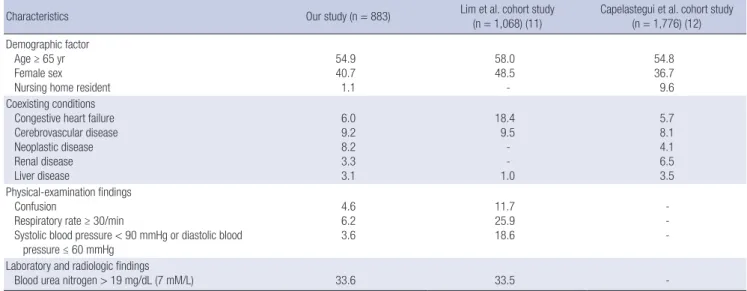
the Medisgroup study (13), the patients were younger in our study and the PORT validation cohort study (14) included more younger than our patients. Nursing-home residents were fewer than in the other two studies. Most of the co-existing conditions had a lower prevalence in our study than in the other two study groups, but neoplastic disease was more prevalent than in the Medisgroup derivation cohort study (10), and liver disease was the highest prevalence of all in our study. There were fewer ab- normal findings in the most of the physical examination in our study than in the Medisgroup cohort study (13) and the PORT validation study (14). The demographic and clinical character- istics of the CAP patients who were compared based on the Pneu- monia Severity Index (PSI) are shown in Table 1. The compari- son of the patients based on their CURB-65 scores showed that the patients in our study, age more than 65 yr and males were intermediate prevalence among three study groups but nursing home residents were less than in the Capelastegui et al. (12) study. There were fewer abnormal physical examination find- ings in this study than in the cohort study of Lim et al. (11). The demographic and clinical characteristics of the CAP patients who were compared with CURB-65 are shown in Table 2.
30-day mortality
The total 30-day mortality of our study patients was 4.5% (40/883) and lowest among PSI study groups (Table 3 and Table 4). The Table 1. Demographic and clinical characteristics of the community acquired pneumonia patients who were compared based on the Pneumonia Severity Index (PSI)
Characteristics Our study
(n = 883)
Medisgroup deriviation cohort study (n = 14,199)
(10)
Medisgroup validation cohort study (n = 38,039)
(13)
Pneumonia PORT validation cohort study (n = 2,287)
(14) Demographic factor
Age < 50 yr Female sex Nursing home resident
20.5 40.7 1.1
16.7 50.8 9.9
15.5 52.3 10.8
42.7 50.0 8.5 Coexisting conditions
Congestive heart failure Cerebrovascular disease Neoplastic disease Renal disease Liver disease
Active use of injection drugs Alcohol abuse
6.0 9.2 8.2 3.3 3.1 - 5.1
28.0 12.5 10.1 3.4 1.1 - -
28.1 15.8 15.3 5.9 1.6 - -
11.1 9.2 5.8 6.7 1.4 1.4 7.9 Physical-examination findings
Altered mental status Pulse ≥ 125/min Respiratory rate ≥ 30/min Systolic blood pressure < 90 mmHg Temperature < 35°C or ≥ 40°C
4.6 6.2 6.2 3.6 0.6
16.3 9.3 29.9 9.3 3.7
10.3 12.5 37.4 11.5 4.0
10.4 8.7 13.3 2.1 1.6 Laboratory and radiologic findings
Blood urea nitrogen ≥ 30 mg/dL (11 mM/L) Glucose ≥ 250 mg/dL (14 mM/L) Hematocrit < 30%
Sodium < 130 mM/L
Partial pressure of arterial oxygen < 60 mmHg or oxygen saturation < 90%
Arterial pH < 7.35
13.9 8.5 9.7 7.7 29.0 4.4
22.3 9.6 10.8 7.7 28.1 7.9
22.3 11.2 11.9 6.5 26.2 8.3
14.3 4.2 6.3 3.9 20.6 3.7
Pleural effusion 25.6 11.6 7.9 8.9
Data are % of patients, unless otherwise indicated.
Table 2. Demographic and clinical characteristics of the community acquiredpneumonia patients who were compared with CURB-65
Characteristics Our study (n = 883) Lim et al. cohort study
(n = 1,068) (11) Capelastegui et al. cohort study (n = 1,776) (12) Demographic factor
Age ≥ 65 yr Female sex Nursing home resident
54.9 40.7 1.1
58.0 48.5 -
54.8 36.7 9.6 Coexisting conditions
Congestive heart failure Cerebrovascular disease Neoplastic disease Renal disease Liver disease
6.0 9.2 8.2 3.3 3.1
18.4 9.5 - - 1.0
5.7 8.1 4.1 6.5 3.5 Physical-examination findings
Confusion
Respiratory rate ≥ 30/min
Systolic blood pressure < 90 mmHg or diastolic blood pressure ≤ 60 mmHg
4.6 6.2 3.6
11.7 25.9 18.6
- - - Laboratory and radiologic findings
Blood urea nitrogen > 19 mg/dL (7 mM/L) 33.6 33.5 -
Data are % of patients, unless otherwize indicated.
Table 3. Distribution of the PSI scores and the subgroup mortality (chi-square test) of the community acquired pneumonia patients
Our study (2012) Medisgroup study (1989)
PORT validation cohort study (1991) (14) Derivation cohort study (10) Validation cohort study (13)
Risk class No. of pts No. of death (%) No. of pts No. of death (%) P value* No. of pts No. of death (%) P value† No. of pts No. of death (%) P value‡
I ( ≤ 50) 174 4 (2.3) 1,372 5 (0.4) 0.012 3,034 3 (0.1) < 0.001 772 1 (0.1) < 0.005
II (51-70) 182 5 (2.7) 2,412 17 (0.7) 0.004 5,778 35 (0.6) < 0.001 477 3 (0.6) 0.044
III (71-90) 213 5 (2.3) 2,632 74 (2.8) 0.831 6,790 190 (2.8) 0.694 326 3 (0.9) 0.275
IV (91-130) 245 11 (4.5) 4,697 399 (8.5) 0.027 13,104 1,075 (8.2) 0.035 486 45 (9.3) 0.021
V (> 130) 69 15 (21.7) 3,086 960 (31.1) 0.096 9,333 2,725 (29.2) 0.174 226 61 (27.0) 0.415
Total 883 40 (4.5) 14,199 1,488 (10.5) < 0.001 38,039 4,032 (10.6) < 0.001 2,287 119 (5.2) 0.436
*The chi-square test was conducted between the Medisgroup (derivation cohort) study and our study for each risk class and total number of death; †The chi-square test was conducted between the Medisgroup (validation cohort) study and our study for each risk class and total number of death; ‡The chi-square test was conducted between the PORT validation cohort study and our study for each risk class and total number of death.
Table 4. Distribution of CURB-65 score and subgroup mortality (chi-square test) of the community acquired pneumonia patients
Our study (2012) Lim et al. study (2003)
Capelastegui et al. study (2006) Derivation cohort study Validation cohort study
Score No. of pts No. of death (%) No. of pts No. of death (%) P value* No. of pts No. of death (%) P value† No. of pts No. of death (%) P value‡
0 260 6 (2.3) 137 1 (0.7) 0.43 36 0 (0) 1.000 629 0 (0) 0.001
1 300 12 (4.0) 187 4 (2.1) 0.307 54 0 (0) 0.226 377 4 (1.1) 0.02
2 216 13 (6.0) 184 17 (9.2) 0.223 60 5 (8.3) 0.497 474 36 (7.6) 0.42
3 88 5 (5.7) 138 20 (14.5) 0.039 42 9 (21.4) 0.007 224 47 (21.0) 0.001
4 17 4 (23.5) 65 26 (40.0) 0.266 19 5 (26.3) 1.0 62 26 (41.9) 0.259
5 2 0 (0) 7 1 (14.3) 1.0 3 1 (33.3) 1.000 10 6 (60.0) 0.455
Total 883 40 (4.5) 718 69 (9.6) < 0.001 214 20 (9.3) 0.005 1,776 119 (6.7) 0.026
*Chi-square test was conducted between the Lim et al. (derivation cohort) study (11) and our study for each risk class and total number of death; †Chi-square test was con- ducted between the Lim et al. (validation cohort) study (11) and our study for each risk class and total number of death; ‡Chi-square test was conducted between the Capelas- tegui et al. study (12) and our study for each risk class and total number of death.
subgroup 30-day mortality had a statistically significant increase with the increase of PSI (P < 0.001) and CURB-65 score (P = 0.002) by linear by linear association in our study. At the PSI risk class I, the 30-day mortality in this study was 2.3%; in the Me- disgroup derivation cohort study (10), 0.4% (P = 0.012); in the Medisgroup validation cohort study (13), 0.1% (P < 0.001); and
in the PORT validation cohort study (14), 0.1% (P = 0.005). At the PSI risk class II, the 30-day mortality in this study was 2.7%;
in the Medisgroup derivation cohort study (10), 0.7% (P = 0.004);
in the Medisgroup validation cohort study (13), 0.6% (P < 0.001);
and in the PORT validation cohort study (14), 0.6% (P = 0.044).
At the PSI risk class IV, the 30-day mortality in this study was
4.5%; in the Medisgroup derivation cohort study (10), 8.5% (P = 0.027); in the Medisgroup validation cohort study (13), 8.2%
(P = 0.035); and in the PORT validation cohort study (14), 9.3%
(P = 0.021). At the PSI risk class III and V, the 30-day mortality showed no statistically significant differences with other group (Table 3).
At the CURB-65 score of 0, the 30-day mortality in this study was 2.3%; 0.7% in the Lim et al. (11) derivation cohort study (P = 0.43); 0% in the Lim et al. (11) validation cohort study (P = 1.0); and 0% in the cohort study of Capelastegui et al. (P = 0.001) (12). At the CURB-65 score 1, the 30-day mortality rate in this study was 4.0%; 2.1% in the Lim et al. (11) derivation cohort study (P = 0.307); 0% in the Lim et al. (11) validation cohort study (P = 0.226); and 1.1% in the Capelastegui et al. (12) (P = 0.02) study. At the CURB-65 score of 3, the 30-day mortality in this study was 5.7%; in the Lim et al. (11) derivation cohort study, 14.5% (P = 0.039); in the Lim et al. (11) validation cohort study, 21.4% (P = 0.007); and in the Capelastegui et al. (12) cohort study, 21.0% (P = 0.001). At the CURB-65 score of 4, 5, there was no statistically significant difference in the 30-day mortality with other studies (Table 4).
The further analysis showed that the causes of the death of 35 of the 40 patients who died were reviewed. Among the four pa- tients at PSI risk class I, one died due to a non-infectious cause, and at PSI risk class II, one died due to a non-infectious cause and another, due to an unknown cause. At the CURB-65 score of 0, one patient died due to a non-infectious cause and two, due to unknown causes. At the CURB-65 score of 1, three died due to non-infectious causes and one, due to an unknown cause.
ICU admission
The admission to the ICU of all the patients and of the PSI sub- group in this study was compared with that in the PORT valida- tion cohort study (14) and with that in the Capelastegui et al.
(12) at the CURB-65 score. Such data could not be acquired in the Medisgroup study (13) and the Lim et al. (11) study. More patients had to be admitted to the ICU, according to the PSI in this study, among all the patients (P < 0.001) than the PORT validation cohort study (14) (Table 5). ICU admission was also more common in this study according to the CURB-65 score, among all the patients (P < 0.001) than Capelastegui et al. (12) (Table 6).
DISCUSSION
Several years have passed since tools for estimating the severity of CAP were devised. Overestimation or underestimation was the common problem with the PSI and CURB-65 scores since they were first devised.
The limitations of the severity scores are next discussed along with recent attempts to improve predictive tools, with the de- velopment of new biomarkers and alternative scoring systems (15). The study of Park et al. (16) was performed to investigate the clinical aspects of patients who satisfy the minor severity criteria of the Infectious Disease Society of America/American Thoracic Society (IDSA/ATS), focusing on their treatment re- sponse to empirical antibiotics. The minor severity criteria (≥ 3) were significantly associated with treatment failure (odds ratio, 2.838; 95% confidence interval, 1.216-6.626) (16). For predicting Table 5. Medical outcomes according to the Pneumonia Severity Index of the community acquired pneumonia patients
Risk class
Our study (2012) PORT validation cohort study (1991) (14)
P value
Medis Group study (1989) No. of patients (%) (10) Admission to intensive care unit Admission to intensive care unit
No. of patients (%) No. of patients (%)
I ( ≤ 50) 9 (5.2) 8 (1.0) < 0.001 No comparable data
II (51-70) 5 (2.7) 10 (2.1) 0.616 No comparable data
III (71-90) 9 (4.2) 15 (4.6) 0.836 No comparable data
IV (91-130) 29 (11.8) 51 (10.5) 0.583 No comparable data
V ( > 130) 28 (40.6) 39 (17.3) < 0.001 No comparable data
Total 80 (9.1) 123 (5.4) < 0.001 No comparable data
Table 6. Medical outcomes according to CURB-65 score of the community acquired pneumonia patients
Risk class
Our study (2012) Capelastegui et al. study (2006) (12)
P value Lim et al. study (2003) (11) No. of patients (%) Admission to intensive care Admission to intensive care unit
No. (%) of patients No. (%) of patients
0 11 (4.2) 1 (0.2) < 0.001 No comparable data
1 17 (5.7) 8 (2.1) 0.015 No comparable data
2 23 (10.6) 21 (4.4) 0.002 No comparable data
3 17 (19.3) 11 (4.9) < 0.001 No comparable data
4 10 (58.8) 3 (4.8) < 0.001 No comparable data
5 2 (100) 1 (10.0) 0.045 No comparable data
Total 80 (9.1) 45 (2.5) < 0.001 No comparable data
the treatment failure, the value of the area under the receiver operating characteristic curve for the minor criteria was 0.731, which was similar to that in other established scoring methods (16). The SEPAR/IDSA guidelines improved the following pro- cess-of-care indicators: appropriateness of treatment, unjusti- fied hospital re-admission (39.4% in 2006 vs 8.5% in 2007 [P <
0.001], and 17.2% in 2008 [P = 0.005]), and early treatment. More- over, the mortality rates of the patients at risk classes IV-V, in which the PSI had been estimated, were lower than those that were measured using the SEQ/ATS guidelines (22.7%; P = 0.003) (17).
This study showed that PSI and CURB-65 score were still con- venient and good predictors of mortality in CAP patients, but the subgroup mortality and pattern were different from the pre- vious studies. Thus, there is a need to develop a more accurate and sensitive scoring system for mild to moderate CAP.
The total 30-day mortality of our study patients was 4.5% (40/
883) and lowest among PSI study groups (our study, Medisgroup Derivation Cohort Study, Medisgroup Validation Cohort Study, and PORT Validation Cohort Study, Table 3). These results have the following implications. First, the improvement of the treat- ment antibiotics and the medical environment might significan- tly decrease the total mortality of community-acquired pneu- monia. And we may assume more improved clinical practice with following formally published guidelines for CAP patients.
Second, nursing-home residents were fewer in our study than in the other studies. Nursing-home residence is a known risk factor of morbidity and mortality (18). Other risk factors related to mortality might have a positive effect on mortality. Co-exist- ing conditions were the criteria for the PSI score and are gener- ally accepted as important risk factors (12). The comparison of the PSI scores showed that most of the co-existing conditions were less prevalent than in the other studies. These fewer rates of nursing-home residents and co-existing conditions might be contributed to the lowest total 30-day mortality. Third, the most laboratory findings were better in our study than in the Medis- group studies (13) but worse than in the PORT validation study (14) in terms of the PSI scores, but the laboratory findings were only truly investigated in this study and used from tables or de- scriptions in other studies, a thorough comparison was not pos- sible. Fewer abnormal findings from the physical examinations showed in our study than the most of the other studies. The low- er prevalence of abnormal findings in the laboratory and physi- cal examinations might be related to the lowest total 30-day mor- tality than in the other studies. This must not be concluded eas- ily, however, because there were slight increases and decreases in each of the factors and study groups.
This study showed a lower 30-day mortality rate than that in the previous study at the PSI risk class IV and CURB-65 scores of 3, but a higher 30-day mortality rate at the PSI risk classes I and II and in some cases of CURB-65 scores 0 and 1. The all- cause mortality rate was calculated when the mortality rate was
analyzed, so the mortality rates of the mild CAP patients might have been higher than those in previous studies. Some of the deaths due to non-infectious and unknown causes were includ- ed in the mild CAP patients, and this might result in higher mor- tality with the mild CAP patients.
The cases of the patients who had to be admitted to the ICU due to poorer medical outcomes were also reviewed (12). In this study, the need for ICU admission was more common than in the previous study, and was found to be an important factor that reflects the medical outcome and the CAP severity. This also means that this study did not have more clinically mild or moderate patients than the previous studies.
This study had some limitations. First, it had fewer patients than the previous study, which means a large-scale study is fur- ther needed. Second, the data from the previous studies were not perfect, and the numbers or percentages that were used were taken from published articles, so there were some difficul- ties in accurately comparing the clinical data. Third, most of the patients were inpatients, and outpatients were nearly not in- cluded. This might be a bias of this study. Fourth, the hospitals in this study were not distributed equally. The study of Chong et al. (19) on the bacterial etiology of CAP in Korea was conduct- ed in secondary and tertiary hospitals and was revealed as rep- resentative of the epidemiology in Korea. Most of the hospitals that participated in this study were tertiary hospitals, and pri- mary physicians were not included in it. Fourth, some of the deaths due to non-infectious and unknown causes were includ- ed in the mild CAP patients, and this might result in higher mor- tality with the mild CAP patients. This study was a multicenter study of community-acquired pneumonia in Korea, and is rep- resentative of the country. The PSI score and CURB-65 score were very useful and sensitive tools for estimating the severity of community-acquired pneumonia, but the appropriateness of their application to Koreans will be further studied.
In summary, the mortalities of CAP in this study, especially of severe CAP, which were obtained by comparing the PSI and CURB-65 scores, were lower than in those previously reported.
However, the subgroup mortality varied in the severity score that was calculated with PSI or CURB 65. There was a more con- sistent trend in the lower scores with CURB-65 and in the high- er scores with PSI in this study. Therefore, the use of PSI and CURB-65 for CAP in Korean patients should be considered.
DISCLOSURE
The authors have no conflicts of interest to disclose.
REFERENCES
1. Mandell LA, Wunderink RG, Anzueto A, Bartlett JG, Campbell GD, Dean NC, Dowell SF, File TM Jr, Musher DM, Niederman MS, et al. Infectious
Diseases Society of America/American Thoracic Society consensus guide- lines on the management of community-acquired pneumonia in adults.
Clin Infect Dis 2007; 44: S27-72.
2. Song JH, Jung KS, Kang MW, Kim DJ, Pai H, Suh GY, Shim TS, Ahn JH, Ahn CM, Woo JH, et al. Treatment guidelines for community-acquired pneumonia in Korea: an evidence-based approach to appropriate anti- microbial therapy. Infect Chemother 2009; 41: 133-53.
3. Bartlett JG, Dowell SF, Mandell LA, File Jr TM, Musher DM, Fine MJ.
Practice guidelines for the management of community-acquired pneu- monia in adults: Infectious Diseases Society of America. Clin Infect Dis 2000; 31: 347-82.
4. Mandell LA, Marrie TJ, Grossman RF, Chow AW, Hyland RH. Canadian guidelines for the initial management of community-acquired pneumo- nia: an evidence-based update by the Canadian Infectious Diseases So- ciety and the Canadian Thoracic Society: the Canadian Community-Ac- quired Pneumonia Working Group. Clin Infect Dis 2000; 31: 383-421.
5. Neill AM, Martin IR, Weir R, Anderson R, Chereshsky A, Epton MJ, Jack- son R, Schousboe M, Frampton C, Hutton S, et al. Community acquired pneumonia: aetiology and usefulness of severity criteria on admission.
Thorax 1996; 51: 1010-6.
6. Woodhead MA, Macfarlane JT, McCracken JS, Rose DH, Finch RG. Pro- spective study of the aetiology and outcome of pneumonia in the com- munity. Lancet 1987; 1: 671-4.
7. Almirall J, Bolíbar I, Vidal J, Sauca G, Coll P, Niklasson B, Bartolomé M, Balanzó X. Epidemiology of community-acquired pneumonia in adults:
a population-based study. Eur Respir J 2000; 15: 757-63.
8. Angus DC, Marrie TJ, Obrosky DS, Clermont G, Dremsizov TT, Coley C, Fine MJ, Singer DE, Kapoor WN. Severe community-acquired pneumo- nia: use of intensive care services and evaluation of American and Brit- ish Thoracic Society Diagnostic criteria. Am J Respir Crit Care Med 2002;
166: 717-23.
9. McQuillan P, Pilkington S, Allan A, Taylor B, Short A, Morgan G, Nielsen M, Barrett D, Smith G, Collins CH. Confidential inquiry into quality of care before admission to intensive care. BMJ 1998; 316: 1853-8.
10. Fine MJ, Auble TE, Yealy DM, Hanusa BH, Weissfeld LA, Singer DE, Coley CM, Marrie TJ, Kapoor WN. A prediction rule to identify low-risk
patients with community-acquired pneumonia. N Engl J Med 1997; 336:
243-50.
11. Lim WS, van der Eerden MM, Laing R, Boersma WG, Karalus N, Town GI, Lewis SA, Macfarlane JT. Defining community acquired pneumonia severity on presentation to hospital: an international derivation and validation study. Thorax 2003; 58: 377-82.
12. Capelastegui A, España PP, Quintana JM, Areitio I, Gorordo I, Egurrola M, Bilbao A. Validation of a predictive rule for the management of com- munity-acquired pneumonia. Eur Respir J 2006; 27: 151-7.
13. Fine MJ, Singer DE, Hanusa BH, Lave JR, Kapoor WN. Validation of a pneumonia prognostic index using the MedisGroups Comparative Hos- pital Database. Am J Med 1993; 94: 153-9.
14. Fine MJ, Stone RA, Singer DE, Coley CM, Marrie TJ, Lave JR, Hough LJ, Obrosky DS, Schulz R, Ricci EM, et al. Processes and outcomes of care for patients with community-acquired pneumonia: results from the Pneu- monia Patient Outcomes Research Team (PORT) Cohort Study. Arch In- tern Med 1999; 159: 970-80.
15. Chalmers JD, Rutherford J. Can we use severity assessment tools to in- crease outpatient management of community-acquired pneumonia?
Eur J Intern Med 2012; 23: 398-406.
16. Park SY, Park S, Lee MG, Kim DG, Suh GY, Kim C, Lee CY, Park YB, Jung KS. Minor criteria of Infectious Disease Society of America/American Thoracic Society for severe community-acquired pneumonia can predict delayed treatment response. J Korean Med Sci 2012; 27: 907-13.
17. Delgado M, Alvarez MM, Carrascosa I, Rodríguez-Velasco M, Barrios JL, Canut A. The routine use of the Pneumonia Severity Index in the emer- gency department: effect on process-of-care indicators and results in com- munity acquired pneumonia. Enferm Infecc Microbiol Clin 2013; 31: 289- 97.
18. Naughton BJ, Mylotte JM. Treatment guideline for nursing home-acquir- ed pneumonia based on community practice. J Am Geriatr Soc 2000; 48:
82-8.
19. Chong YP, Jung KS, Lee KH, Kim MN, Moon SM, Park S, Hur J, Kim DM, Jeon MH, Woo JH. The bacterial etiology of community-acquired pneu- monia in Korea: a nationwide prospective multicenter study. Infect Che- mother 2010; 42: 397-403.