INTRODUCTION
High-dose chemotherapy with stem cell rescue has been shown to improve outcome in patients with high-risk neu- roblastoma (NBL). In previous studies, patients who under- went consolidation chemoradiotherapy and autologous stem cell transplantation showed significantly higher survival than patients who continued chemotherapy (1-5). However, more than 50% of patients relapse after autologous peripheral blood stem cell transplantation (APBSCT), and this is the major cause of treatment failure in NBL. To increase survival, vari- ous efforts have been made, such as tumor purging in the mobilized products during stem cell mobilization, chemo- therapy dose intensification, and various new post-transplan- tation therapies to control minimal residual disease. Some of the therapeutic approaches in combination with 13-cis- retinoic acid (13-cis-RA) have shown promising results in terms of survival improvement. On the other hand, some widely used treatment modalities, such as tandem transplan- tation and IL-2 therapy, are still controversial.
In this study, we analyzed the clinical features and outcomes of stage III and IV NBL patients who underwent APBSCT at Seoul National University Children’s Hospital (SNUCH).
Survival was analyzed according to the APBSCT type, espe- cially with respect to the effect of CD34+selection and trans- plantation number on survival. Various other prognostic fac- tors, such as age, primary mass location, bone marrow metas- tasis, and pre-transplantation disease status, were also analyzed.
MATERIALS AND METHODS Patients
A retrospective analysis was performed on 36 NBL patients who underwent APBSCT between May 1996 and May 2004.
Patients were allocated to three groups according to the AP- BSCT type, i.e., to the CD34+nonselected single APBSCT group (13 patients; the nonselected single group), the CD34+ selected single APBSCT group (14 patients; the selected single group), and to the CD34+selected double APBSCT group (9 patients; the selected double group). One patient in the selected single group underwent APBSCT twice, be- fore and after relapse, and thus 46 transplants were performed in 36 patients. A detailed review of clinical data was perform- ed to ascertain the age at diagnosis, sex, tumor location, extent
Eun Kyung Kim, Hyoung Jin Kang, Jeong Ah Park, Hyoung Soo Choi, Hee Young Shin, Hyo Seop Ahn
Division of Hematology/Oncology, Department of Pediatrics, Cancer Research Institute, Seoul National University College of Medicine, Seoul, Korea
Address for correspondence Hyo Seop Ahn, M.D.
Department of Pediatrics, Cancer Research Institute, College of Medicine, Seoul National University Children’s Hospital, 28 Yeongeon-dong, Jongno-gu, Seoul 110-744, Korea
Tel : +82.2-2072-3625, Fax : +82.2-743-3455 E-mail : [email protected]
*This study was supported by the National R&D Program for Cancer Control, Ministry of Health &
Welfare, Republic of Korea (Grant No. 0220080-2).
S66
Retrospective Analysis of Peripheral Blood Stem Cell Transplantation for the Treatment of High-Risk Neuroblastoma
Disease relapse after autologous peripheral blood stem cell transplantation (APB- SCT) is the main cause of treatment failure in high-risk neuroblastoma (NBL). To reduce relapse, various efforts have been made such as CD34+selection and dou- ble APBSCT. Here the authors reviewed the clinical features and outcomes of high- risk NBL patients and analyzed their survival. The medical records of 36 patients with stage III or IV NBL who underwent APBSCT at Seoul National University Chil- dren’s Hospital between May 1996 and May 2004 were reviewed. Total 46 APB- SCTs were performed in 36 patients. Disease free survival (DFS) and overall sur- vival of all patients were 47.7% and 68.8%, respectively. The patients were allocat- ed to three groups according to the APBSCT type. The DFS of CD34+non-select- ed single APBSCT patients (N=13), CD34+selected single APBSCT patients (N=
14), and CD34+selected double APBSCT patients (N=9) were 55.6%, 40.6%, and 50.0%, respectively, which were not significantly different. Thus the survival was not found to be affected by CD34+selection or transplantation number. To improve long-term survival, various efforts should be made such as chemotherapy dose intensification, more effective tumor purging, and control of minimal residual dis- ease via the use of differentiating and immune-modulating agents.
Key Words : Neuroblastoma; Peripheral Blood Stem Cell Transplantation; Autologous Transplantation
Received : 12 September 2006 Accepted : 8 December 2006
of tumor, stage, N-myc gene copy number, disease status at transplantation, number of APBSCTs, CD34+selection, con- ditioning regimen, number of cells infused, hematopoietic reconstitution, post-transplantation complications, post-trans- plantation therapy, and outcome.
Pre-transplantation treatment
All patients received chemotherapy before APBSCT. After 4 or 5 cycles of chemotherapy, debulking operation was per- formed and local radiotherapy and chemotherapy followed.
The CCG-321-P2 chemotherapy regimen (6) was used in nearly all patients, which consisted of cisplatin, VP-16, dox- orubicin, and cyclophosphamide.
Stem cell collection and CD34+selection
To mobilize stem cells, 10 g/kg of G-CSF was injected subcutaneously (s.c.) from 7 days after the start of mobiliza- tion chemotherapy, which consisted of 1,000 mg/m2cyclo- phosphamide and 150 mg/m2etoposide on days 0, 1, and 2, until the last day of peripheral blood stem cell (PBSC) collec- tion. PBSC collection began from the day when the WBC co- unt exceeded 1,000/ L after a nadir and was continued for 2 or 3 days to obtain ≥6×10⁸/kg of mononuclear cells (MNCs).
In most patients stem cells were collected by apheresis, and bone marrow harvest and apheresis were combined in two APBSCTs. Leukapheresis was performed using CS-3000 Plus (Baxter Healthcare, Deerfield, IL, U.S.A.) or COBE Spectra (COBE Laboratories, Lakewood, CO, U.S.A.). In 23 of 36 patients, CD34+selection was performed using a CliniMACS (Miltenyi Biotec, Bergisch Gladbach, Germany) device to purge tumor cells from mobilized PBSCs.
Conditioning regimen
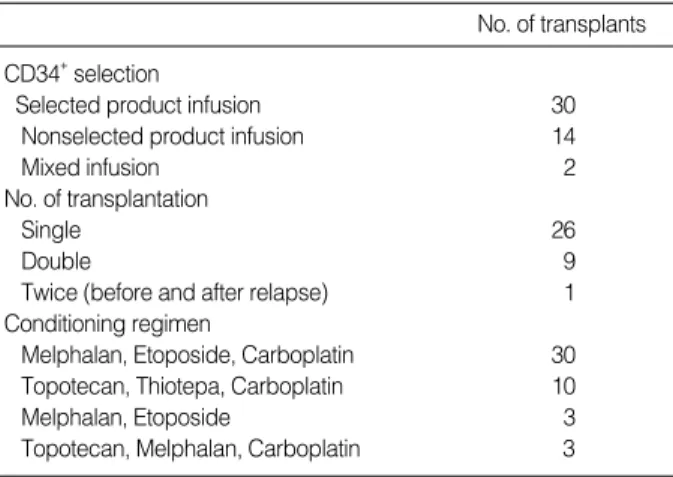
Various conditioning regimens were used and are summa- rized in Table 1. The main conditioning regimen was the
MEC regimen, which consisted of carboplatin 400 mg/m2on days -8 to -5, etoposide 200 mg/m2on days -8 to -5, mel- phalan 140 mg/m2on day -7 and 70 mg/m2on day -6. This regimen was used in 30 transplants. Total body irradiation (TBI) was not performed in any case of APBSCT.
Post-transplantation treatment
All patients received interleukin-2 (IL-2; aldesleukin; Pro- leukin, Chiron, Emeryville, CA, U.S.A.) and 13-cis-RA. Re- combinant IL-2 at 3×10⁶IU/m2was delivered s.c. once daily for 5 consecutive days every other week for 11 weeks (total 30 doses), starting when the absolute neutrophil count (ANC) and the platelet count exceeded 1,000/ L and 50,000/ L, respectively. Patients began to receive 13-cis-RA 100 mg/m2 once daily 28 days after APBSCT, and this was maintained for 1 yr.
Statistical analysis
The numbers of CD34+cells infused in two groups were compared using the Mann-Whitney test. The correlation between infused cell doses and hematopoietic reconstitution was analyzed using Pearson’s correlation coefficients. Dis- ease-free survival (DFS) and overall survival (OS) were esti- mated using the Kaplan-Meier curves, and the curves were compared using the log-rank test. Statistical significance was accepted at the p<0.05 level.
RESULTS Patient characteristics
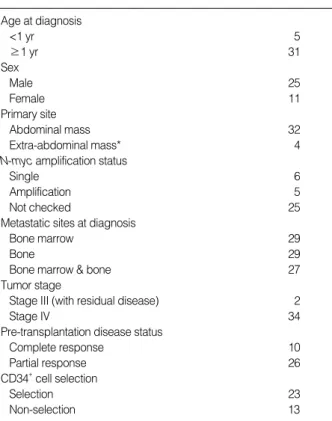
The enrolled patients consisted of 25 males and 11 females with a median age at diagnosis of 3 yr (7 months-10 yr 1 month). Five patients were less than 1 yr old. The N-myc gene amplification test was performed in 11 patients, and 5 patients demonstrated amplification. Of 5 patients, 1 patient belonged to the nonselected group, 3 to the selected single group, and 1 patient to the selected double group. Thirty four patients were in stage IV NBL, and only 2 patients were in stage III NBL. To reduce tumor cell contamination, CD34+ selection was performed in 23 patients. In case who under- went double APBSCT, PBSCs were collected before the first transplantation. The median time from diagnosis to trans- plantation was 10 months (5-46 months), and the median time between the 1st and 2nd transplantation was 3 months (2-3 months). The median follow-up durations from diag- nosis and from APBSCT were 42 months (11-103 months) and 27 months (1-93 months), respectively. Patient charac- teristics are summarized in Table 2.
No. of transplants CD34+selection
Selected product infusion 30
Nonselected product infusion 14
Mixed infusion 2
No. of transplantation
Single 26
Double 9
Twice (before and after relapse) 1
Conditioning regimen
Melphalan, Etoposide, Carboplatin 30
Topotecan, Thiotepa, Carboplatin 10
Melphalan, Etoposide 3
Topotecan, Melphalan, Carboplatin 3
Table 1.CD34+selection and conditioning regimen (N=46)
Hematopoietic reconstitution and post-transplantation complications
Of the 46 transplants, CD34+selected products were used in 30 transplants, and nonselected products were used in 14.
In 2 transplants, selected and nonselected mobilized products were infused together, and thus, the analyses concerning the number of cells infused and hematopoietic reconstitution did not include these two transplants. However, in the survival analysis, one of these patients was included in the selected single group because most cells infused were collected by CD34+selected mobilization. The other patient was includ- ed in the selected double group because half of the cells in- fused in the 1st transplantation and all cells infused in the 2nd transplantation were collected by CD34+selected mobi- lization, although selected and nonselected products were infused together in the 1st transplantation. After selection, the mean purity of the CD34+cell fraction was 92.4% (81.4- 99.5%).
In CD34+selected and nonselected transplants, the medi- an doses of CD34+cells infused were 4.4×10⁶/kg (0.9-45.8
×106/kg) and 14.9×10⁶/kg (3.8-77.1×10⁶/kg), respec- tively, and the CD34+cell dose was significantly higher in the nonselected group (p=0.001). In selected transplants, the me- dian number of days required for an ANC higher than 500/
L, or 1,000/ L and a platelet count of higher than 20,000/
L were 11 days (8-20 days), 12 days (9-25 days), and 17
days (10-219 days), respectively. In nonselected transplants, the median number of days required for the same conditions were 11 days (8-15 days), 11 days (8-16 days), and 18 days (8-99 days), respectively. In 3 patients who belonged to the CD34+selected group, platelet recovery of more than 20,000/
L was not achieved until 100 days after APBSCT. No sig- nificant difference was found between the CD34+selected and nonselected groups, in terms of the number of days re- quired for hematopoietic reconstitution, and infused CD34+ cell doses were not found to be related to hematopoietic recon- stitution (p>0.1).
After APBSCT, fever developed in all patients, and venooc- clusive disease or hemorrhagic complication (gastroinfesti- nal weeding or pulmonary hemorrhage) occurred in 7 and 5 patients, respectively. One patient died of disease progres- sion before the 2nd scheduled APBSCT, and 2 patients died of treatment-related conditions, i.e., acute renal failure and pulmonary hemorrhage in both cases. Most patients experi- enced vomiting, diarrhea, and oral mucositis.
Treatment outcome
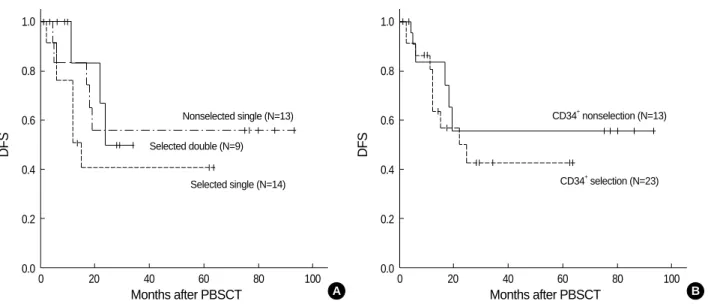
DFS and OS values for all patients were 47.7±9.6% and 68.8±9.1%, respectively (Fig. 1). The DFSs of the nonse- lected single, the selected single, and the selected double groups were 55.6±14.9%, 40.6±14.7%, and 50.0±20.4
%, respectively (Fig. 2A), and OSs of the three groups were 92.3±7.4%, 55.1±13.9%, and 66.7±19.3%, respectively, none of which were significantly different between the three groups. When all patients were dichotomized according to CD34+selection (selection N=23, nonselection N=13), the DFSs of the selected and nonselected groups were 42.6±12.4
% and 55.6±14.9%, respectively (Fig. 2B), and the relapse rates of these two groups were not significantly different (p=
Age at diagnosis
<1 yr 5
≥1 yr 31
Sex
Male 25
Female 11
Primary site
Abdominal mass 32
Extra-abdominal mass* 4
N-myc amplification status
Single 6
Amplification 5
Not checked 25
Metastatic sites at diagnosis
Bone marrow 29
Bone 29
Bone marrow & bone 27
Tumor stage
Stage III (with residual disease) 2
Stage IV 34
Pre-transplantation disease status
Complete response 10
Partial response 26
CD34+cell selection
Selection 23
Non-selection 13
Table 2.Patient characteristics (N=36)
*Extra-abdominal mass included maxillary sinus and mediastinum.
Cumulative survival
1.0
0.8
0.6
0.4
0.2
0.0
0 20 40 60 80 100
Months after PBSCT
DFS OS
Fig. 1.Kaplan-Meier probabilities of DFS and OS for high-risk neuroblastoma patients after APBSCT (N=36). DFS was 47.7± 9.6% and OS 68.8±9.1%. Ticks indicate censored data.
DFS, disease-free survival; OS, overall survival; APBSCT, autolo- gous peripheral blood stem cell transplantation; PBSCT, periph- eral blood stem cell transplantation.
0.536).
Various prognostic factors likely to influence DFS were analyzed. Patients younger than 1 yr had a better prognosis than older patients (p=0.041), but prognosis was not signif- icantly affected by the primary mass location, bone marrow metastasis, or pre-transplantation disease status. Moreover, the DFS of patients who underwent double APBSCT was similar to that of patients who underwent single APBSCT (p=0.499).
DISCUSSION
High-dose chemotherapy with APBSCT has improved the survival of high-risk NBL patients over past decades. How- ever, a large number of patients relapse after APBSCT despite having a complete remission disease status before APBSCT (7-9). Reinfused tumor cells are believed to play an impor- tant role in relapse, particularly in patients with no detectable systemic residual disease (10-13). Moreover, increasing num- bers of studies show that up to 50% of bone marrow and PBSC harvests from patients with bone marrow remission contain tumor cells (1, 14, 15). Because NBL cell contamination of infused PBSCs is strongly correlated with relapse risk after APBSCT, effective tumor purging is essential to improve survival in the high-risk NBL. The most widely used purg- ing method is based on selection for CD34 antigen, which is expressed on hematopoietic stem cells. In many studies, 2-4 logs of tumor cell removal was observed after CD34+selec- tion (14, 16-18). This method has been generally used in NBL patients because NBL cells are believed not to express CD34 antigen. However, Hafer et al. revealed that some NBL cell lines do express CD34 antigen and recommended that cau-
tion should be taken with transplants obtained by CD34+ selection (19). In addition, EFS was not found to be statisti- cally different between CD34+selected and nonselected pa- tients in some reports (4, 7, 8). In the present study, the DFSs of CD34+selected and nonselected groups were not statisti- cally different (p=0.536). Randomized large-scale clinical trials are required to defermine whether NBL patient sur- vival rates can be increased by CD34+selection, and a more effective tumor purging method is required to prevent the tumor contamination of mobilized products.
Chemotherapy dose is also intensified to reduce relapse.
Today, myeloablative therapy has become the standard treat- ment for high-risk NBL since the Children’s Cancer Group reported the result of a randomized trial which compared mye- loablative therapy and autologous bone marrow transplan- tation with chemotherapy alone (2). Three-year event-free survival (EFS) was found to be significantly better in patients randomized to the transplantation arm than in patients ran- domized to continuous chemotherapy alone (34±4% vs.
22±4%, respectively; p=0.034). Moreover, the suggestion that high doses of chemotherapy might improve OS in pa- tients with high-risk NBL has led some investigators to ex- plore tandem transplantation, which is a novel way of increas- ing dose intensity for the treatment of chemosensitive tumors.
The theoretical advantages of this include the exposure of tumors to multiple effective agents at maximum-tolerated doses and the possible modulation of the tumor microenvi- ronment during the first transplantation, thus potentiating cell killing during the second transplantation (20). Tandem transplantation has been studied mainly in adults with breast cancer, lymphoma, and multiple myeloma (21-23), and few studies have been conducted in children. The earliest work used a double harvest/double graft approach with purged
Fig. 2.DFSs of patients according to (A) the type of APBSCT and (B) CD34+selection. Survival curves indicated no statistical differences between the various groups. Ticks indicate censored data.
DFS, disease-free survival; APBSCT, autologous peripheral blood stem cell transplantation; PBSCT, peripheral blood stem cell transplanta- tion.
DFS
1.0
0.8
0.6
0.4
0.2
0.00 20 40 60 80 100
Months after PBSCT A
Nonselected single (N=13) Selected double (N=9)
Selected single (N=14)
DFS
1.0
0.8
0.6
0.4
0.2
0.00 20 40 60 80 100
Months after PBSCT B
CD34+nonselection (N=13)
CD34+selection (N=23)
autologous bone marrow support (24). In this study, OS was encouraging, but when bone marrow was used for stem cell support, delayed engraftment and a high toxic death rate after the second graft were identified as potential major prob- lems. In 2000, Grupp et al. first reported the results of tan- dem transplantation using PBSC in a pediatric cohort (20).
Thirty-three high-risk NBL patients completed two myelo- ablative therapies with stem cell rescue and achieved a 3-yr EFS of 58%. These investigators demonstrated that PBSC- supported tandem transplantation in high-risk NBL is fea- sible with acceptable toxicity and adequate hematopoietic recovery. Subsequently, several investigators found that PBSC- supported double/triple tandem cycles of high-dose chemo- therapy achieved higher EFS than single transplantation (4, 25, 26). Nevertheless, 3- and 5-yr EFSs were still below 60%.
According to our results, DFS is not dependent on the num- ber of transplantations. However, whether tandem (double or triple) transplantations with PBSC support have an impact on long-term EFS in high-risk NBL remains controversial.
A phase III randomized study on the effect of tandem trans- plantation with PBSC rescue in patients with high-risk NBL is currently under way by the Children’s Oncology Group.
The eradication of minimal residual disease by post-trans- plantation therapy is now considered important for the im- provement of survival in the high-risk NBL. Various post- transplantation therapies have been used including IL-2 and 13-cis-RA (isotretinoin), the latter of which is derived from naturally occurring all-trans-retinoic acid (ATRA) by termi- nal carboxyl group modification. When NBL cell lines were exposed to 13-cis-RA in vitro, it was found to decrease pro- liferation and N-myc oncogene expression, and to induce the morphologic differentiation of tumor cells (27-29). In 1995, a phase I study of children with high-risk NBL showed that 13-cis-RA administered after bone marrow transplantation had minimal toxicity and that it cleared NBL cells from bone marrow (30). In 1999, a nationwide phase III trial (CCG- 3891) was conducted, and found that the 3-yr EFS was sig- nificantly better in patients who received 13-cis-RA after transplantation than in those who did not (46±6% vs. 29
±5%, p=0.027) (2). Moreover, the effect of 13-cis-RA was found to be the most pronounced in a setting of truly mini- mal residual disease because the positive benefit of 13-cis-RA was not evident in children with histologically proven residu- al disease. Today, maintenance therapy with 13-cis-RA after myeloablative therapy has become a standard part of high- risk NBL therapy.
Immune system modulation to stimulate an antitumor response is considered a therapeutic alternative, and the potent immunostimulatory cytokine IL-2 has been investigated in this context in a number of tumor models (31, 32). In some clinical trials, an antitumor effect has been demonstrated in children with NBL (33-35), but the effect of IL-2 remains controversial (36, 37). Further studies are needed before IL- 2 is widely used as a standard post-transplantation therapy.
In conclusion, although significant survival improvements have been observed in high-risk NBL patients, high relapse rates after transplantation remain a challenge. It is evident that more complete local tumor control is essential to reduce relapse rates, and that more aggressive surgical resection fol- lowed by more intensive chemotherapy is needed. In addi- tion, the effectiveness of tandem transplantation should be confirmed using intensified regimens with tolerable toxici- ties. During mobilization, much effort should be made to reduce tumor contamination. It is important to develop a more effective tumor purging method as well as to confirm the effectiveness of CD34+selection. In addition, the con- trol of minimal residual disease after transplantation may contribute substantially to long-term survival. Drugs that accelerate NBL cell differentiation and modulate immune response should be developed, and various approaches to im- prove survival are possible by adopting pre- and post-trans- plantation therapies. Our study is limited because the num- ber of patients was small, and risk factors, such as N-myc gene copy number, were not thoroughly examined, which made it difficult to evaluate the true effect of the type of APBSCT on survival. However, it does provide a worthwhile compar- ison of the survival rates of various treatment cohorts accord- ing to the type of APBSCT. A prospective study involving a larger population would provide a better overview of the com- parative effects of treatment modalities.
REFERENCES
1. Wagner LM, Guichard SM, Burger RA, Morton CL, Straign CM, Ashmun RA, Harris LC, Houghton PJ, Potter PM, Danks MK. Effi- cacy and toxicity of a virus-directed enzyme prodrug therapy purg- ing method: preclinical assessment and application to bone marrow samples from neuroblastoma patients. Cancer Res 2002; 62: 5001-7.
2. Matthay KK, Villablanca JG, Seeger RC, Stram DO, Harris RE, Ra- msay NK, Swift P, Shimada H, Black CT, Brodeur GM, Gerbing RB, Reynolds CP. Treatment of high-risk neuroblastoma with intensive chemotherapy, radiotherapy, autologous bone marrow transplanta- tion, and 13-cis-retinoic acid. Children’s Cancer Group. N Engl J Med 1999; 341: 1165-73.
3. Stram DO, Matthay KK, O’Leary M, Reynolds CP, Haase GM, Atkin- son JB, Brodeur GM, Seeger RC. Consolidation chemoradiothera- py and autologous bone marrow transplantation versus continued chemotherapy for metastatic neuroblastoma: a report of two concur- rent Children’s Cancer Group studies. J Clin Oncol 1996; 14: 2417- 26.
4. George RE, Li S, Medeiros-Nancarrow C, Neuberg D, Marcus K, Shamberger RC, Pulsipher M, Grupp SA, Diller L. High-risk neu- roblastoma treated with tandem autologous peripheral-blood stem cell-supported transplantation: long-term survival update. J Clin Oncol 2006; 24: 2891-6.
5. Kim JY, Baek HJ, Han DK, Sung JS, Nam TK, Yoon MS, Kook H, Hwang TJ. Improved survival in neuroblastoma by autologous periph-
eral blood stem cell transplantation: a single institution experience.
Clin Pediatr Hematol-Oncol 2006; 13: 9-21.
6. O’leary MC, Sather HN, Ramsay NK, Harris R, Strandjord S, Ro- mansdy S, Hasse G, Shimada H, Novak L, Siegel S, Hann HW, Bro- deur G, Seeger R. Intensive chemotherapy for poor prognosis neu- roblastoma. Proc Am Assoc Cancer Res 1990; 31: 201.
7. Pole JG, Casper J, Elfenbein G, Gee A, Gross S, Janssen W, Koch P, Marcus R, Pick T, Shuster J, Spruce W, Thomas P, Yeager A. High- dose chemoradiotherapy supported by marrow infusions for advanced neuroblastoma: a Pediatric Oncology Group study. J Clin Oncol 1991; 9: 152-8.
8. Ryu KH, Ahn HS, Koo HH, Kook H, Kim MK, Kim HK, Ghim T, Moon HN, Seo JJ, Sung KW, Shin HY, Yoo ES, Lyu CJ, Lee YH, Lee H, Cho B, Cho HS, Choi HS, Hah JO, Hwang TJ. Autologous stem cell transplantation for the treatment of neuroblastoma in Korea.
J Korean Med Sci 2003; 18: 242-7.
9. Imaizumi M, Watanabe A, Kikuta A, Takano T, Ito E, Shimizu T, Tsuchiya S, Iinuma K, Konno T, Ohi R, Hayashi Y. Improved sur- vival of children with advanced neuroblastoma treated by intensi- fied therapy including myeloablative chemotherapy with stem cell transplantation: a retrospective analysis from the Tohoku Neurob- lastoma Study Group. Tohoku J Exp Med 2001; 195: 73-83.
10. Shimoni A, Korbling M. Tumor cell contamination in re-infused stem cell autografts: does it have clinical significance? Crit Rev Oncol Hematol 2002; 41: 241-50.
11. Rill DR, Santana VM, Roberts WM, Nilson T, Bowman LC, Krance RA, Heslop HE, Moen RC, Ihle JN, Brenner MK. Direct demonst- ration that autologous bone marrow transplantation for solid tumors can return a multiplicity of tumorigenic cells. Blood 1994; 84: 380-3.
12. Moss TJ, Cairo M, Santana VM, Weinthal J, Hurvitz C, Bostrom B.
Clonogenicity of circulating neuroblastoma cells: implications regard- ing peripheral blood stem cell transplantation. Blood 1994; 83: 3085-9.
13. Brenner MK, Rill DR, Moen RC, Krance RA, Mirro J Jr, Anderson WF, Ihle JN. Gene-marking to trace origin of relapse after autolo- gous bone-marrow transplantation. Lancet 1993; 341: 85-6.
14. Handgretinger R, Greil J, Schurmann U, Lang P, Gonzalez-Ramella O, Schmidt I, Fuhrer R, Niethammer D, Klingebiel T. Positive selec- tion and transplantation of peripheral CD34+ progenitor cells: fea- sibility and purging efficacy in pediatric patients with neuroblastoma.
J Hematother 1997; 6: 235-42.
15. Lode HN, Handgretinger R, Schuermann U, Seitz G, Klingebiel T, Niethammer D, Beck J. Detection of neuroblastoma cells in CD34+
selected peripheral stem cells using a combination of tyrosine hydrox- ylase nested RT-PCR and anti-ganglioside GD2 immunocytochem- istry. Eur J Cancer 1997; 33: 2024-30.
16. Donovan J, Temel J, Zuckerman A, Gribben J, Fang J, Pierson G, Ross A, Diller L, Grupp SA. CD34 selection as a stem cell purging strategy for neuroblastoma: preclinical and clinical studies. Med Pediatr Oncol 2000; 35: 677-82.
17. Kanold J, Halle P, Tchirkov A, Berger M, Giarratana MC, Kobari L, Boiret N, Paillard C, Demeocq F, Douay L. Ex vivo expansion of autologous PB CD34+ cells provides a purging effect in children with neuroblastoma. Bone Marrow Transplant 2003; 32: 485-8.
18. Berkahn L. Immunologic methods of purging in autologous stem cell
transplantation. J Hematother Stem Cell Res 2000; 9: 147-59.
19. Hafer R, Voigt A, Gruhn B, Zintl F. Neuroblastoma cells can express the hematopoietic progenitor cell antigen CD34 as detected at sur- face protein and mRNA level. J Neuroimmunol 1999; 96: 201-6.
20. Grupp SA, Stern JW, Bunin N, Nancarrow C, Ross AA, Mogul M, Adams R, Grier HE, Gorlin JB, Shamberger R, Marcus K, Neuberg D, Weinstein HJ, Diller L. Tandem high-dose therapy in rapid sequ- ence for children with high-risk neuroblastoma. J Clin Oncol 2000;
18: 2567-75.
21. Ayash LJ, Elias A, Schwartz G, Wheeler C, Ibrahim J, Teicher BA, Reich E, Warren D, Lynch C, Richardson P, Schnipper L, Frei E 3rd, Antman K. Double dose-intensive chemotherapy with autologous stem-cell support for metastatic breast cancer: no improvement in progression-free survival by the sequence of high-dose melphalan followed by cyclophosphamide, thiotepa, and carboplatin. J Clin Oncol 1996; 14: 2984-92.
22. Fitoussi O, Simon D, Brice P, Makke J, Scrobohaci ML, Bibi Triki T, Hennequin C, Ferme C, Gisselbrecht C. Tandem transplant of periph- eral blood stem cells for patients with poor-prognosis Hodgkins’s disease or non-Hodgkin’s lymphoma. Bone Marrow Transplant 1999;
24: 747-55.
23. Barlogie B, Jagannath S, Vesole DH, Naucke S, Cheson B, Mattox S, Bracy D, Salmon S, Jacobson J, Crowley J, Tricot G. Superiority of tandem autologous transplantation over standard therapy for pre- viously untreated multiple myeloma. Blood 1997; 89: 789-93.
24. Philip T, Ladenstein R, Zucker JM, Pinkerton R, Bouffet E, Louis D, Siegert W, Bernard JL, Frappaz D, Coze C, Wyss M, Beck D, Soul- liet G, Michon J, Philip I, Chauvin F, Favrot M, Biron P. Double me- gatherapy and autologous bone marrow transplantation for advanced neuroblastoma: the LMCE2 study. Br J Cancer 1993; 67: 119-27.
25. Sung KW, Yoo KH, Chung EH, Jung HL, Koo HH, Shin HJ, Lee SK, Lim DH, Kim DW, Park HK, Cho EJ, Kim SW. Successive dou- ble high-dose chemotherapy with peripheral blood stem cell rescue collected during a single leukapheresis round in patients with high- risk pediatric solid tumors: a pilot study in a single center. Bone Marrow Transplant 2003; 31: 447-52.
26. Kletzel M, Katzenstein HM, Haut PR, Yu AL, Morgan E, Reynolds M, Geissler G, Marymount MH, Liu D, Kalapurakal JA, Shore RM, Bardo DM, Schmoldt J, Rademaker AW, Cohn SL. Treatment of high-risk neuroblastoma with triple-tandem high-dose therapy and stem-cell rescue: results of the Chicago Pilot II Study. J Clin Oncol 2002; 20: 2284-92.
27. Sidell N. Retinoic acid-induced growth inhibition and morphologic differentiation of human neuroblastoma cells in vitro. J Natl Cancer Inst 1982; 68: 589-96.
28. Thiele CJ, Reynolds CP, Israel MA. Decreased expression of N-myc precedes retinoic acid-induced morphological differentiation of human neuroblastoma. Nature 1985; 313: 404-6.
29. Abemayor E. The effects of retinoic acid on the in vitro and in vivo growth of neuroblastoma cells. Laryngoscope 1992; 102: 1133-49.
30. Villablanca JG, Khan AA, Avramis VI, Seeger RC, Matthay KK, Ramsay NK, Reynolds CP. Phase I trial of 13-cis-retinoic acid in children with neuroblastoma following bone marrow transplanta- tion. J Clin Oncol 1995; 13: 894-901.
31. Mier JW, Vachino G, van der Meer JW, Numerof RP, Adams S, Can- non JG, Bernheim HA, Atkins MB, Parkinson DR, Dinarello CA.
Induction of circulating tumor necrosis factor (TNF alpha) as the mechanism for the febrile response to interleukin-2 (IL-2) in cancer patients. J Clin Immunol 1988; 8: 426-36.
32. Oppenheim MH, Lotze MT. Interleukin-2: solid-tumor therapy. On- cology 1994; 51: 154-69.
33. Pardo N, Marti F, Fraga G, Illa J, Badell I, Peiro M, Bertran E, Garcia J, Rueda F, Cubells J. High-dose systemic interleukin-2 therapy in stage IV neuroblastoma for one year after autologous bone marrow transplantation: pilot study. Med Pediatr Oncol 1996; 27: 534-9.
34. Toren A, Nagler A, Rozenfeld-Granot G, Levanon M, Davidson J, Bielorai B, Kaplinsky C, Meitar D, Mandel M, Ackerstein A, Ballin A, Attias D, Biniaminov M, Rosenthal E, Brok-Simoni F, Rechavi G, Kaufmann Y. Amplification of immunological functions by subcuta- neous injection of intermediate-high dose interleukin-2 for 2 years after autologous stem cell transplantation in children with stage IV
neuroblastoma. Transplantation 2000; 70: 1100-4.
35. Kim MK, Lyu CJ, Park SH, Cho HS, Yang CH, Kim HM, Kang SH, Kim KY. Effects of low dose interleukin-2 therapy after high dose chemotherapy and autologous PBSCT in childhood AML and stage 4 neuroblastoma. Korean J Pediatr Hematol-Oncol 2000; 7: 82-91.
36. Bauer M, Reaman GH, Hank JA, Cairo MS, Anderson P, Blazar BR, Frierdich S, Sondel PM. A phase II trial of human recombinant inter- leukin-2 administered as a 4-day continuous infusion for children with refractory neuroblastoma, non-Hodgkin's lymphoma, sarcoma, renal cell carcinoma, and malignant melanoma. A Childrens Can- cer Group study. Cancer 1995; 75: 2959-65.
37. Vlk V, Eckschlager T, Kavan P, Kabickova E, Koutecky J, Sobota V, Bubenik J, Pospisilova D. Clinical ineffectiveness of IL-2 and/or IFN alpha administration after autologous PBSC transplantation in pediatric oncological patients. Pediatr Hematol Oncol 2000; 17:
31-44.