1)Visiting Assistant Professor, Department of Psychology, University of Maryland, Baltimore County, USA.
2)Ph.D. Student, Department of Psychology, University of Maryland, Baltimore County.
3)Research Assistant, Department of Psychology, University of Maryland, Baltimore County.
4)Associate Professor, Department of Psychology, University of Maryland, Baltimore County.
Corresponding Author:Ji Youn Shin, Department of Psychology, Culture, Child, & Adolescent Development Laboratory, University of Maryland, Baltimore County, 1000 Hilltop Circle, Baltimore, MD, 21250, U.S.A.
E-mail:[email protected]
The Parenting Practices and Child Social Emotional Outcomes of Korean Immigrant Mothers
with Different Acculturation Strategies
미국 한인 이민어머니의 문화적응 유형에 따른 양육실제와 아동의 사회․정서적 행동
신지연(Ji Youn Shin)1) Sevgi Bayram-Ozdemir2) Janet Lee3) Charissa S. L. Cheah4) ABSTRACT
미국의 한국계 이민가정이 해마다 증가하고 있으나 부모의 문화적응과 자녀양육에 관한 연구는
미흡한 실정이다. 본 연구는 미국 동부지역의 88명의 한인 이민어머니와(M=35.9세 SD=3.77) 2-6세
유아를(M=4.29세 SD=1.06; 49.4% 여아) 대상으로 실시되었다. 어머니의 문화적응 유형에 따라 1) 양육실제에 어떠한 차이가 있는지, 2) 유아의 사회ㆍ정서적 행동에는 어떠한 차이가 있는지, 3) 양 육실제와 아동의 사회ㆍ정서적 행동 간에 어떠한 상관이 있는지를 살펴보았다. 연구결과, 한국과 미국문화를 균형지게 통합한 어머니들이 미국문화에서 고립되거나, 두 문화에서 모두 소외된 어머 니들보다 자녀에게 더욱 긍정적인(애정표현, 합리적 문제해결, 자율성 격려) 양육실제를 사용하였으 며 자녀들 또한 정서적 문제행동은 적은 반면 친사회적 행동은 높은 것으로 나타났다.
Key Words:문화적응(Acculturation), 양육실제(Parenting Practices), 사회ㆍ정서적 행동(Social Emotional Outcomes).
Ⅰ. INTRODUCTION
Parenting has long been recognized as making important contributions to children’s social emotional development. Although there is substantial empirical evidence regarding the importance of proximal factors (e.g., family) in child development, recent research on parenting and child development has began to focus on broader contextual factors, including social cultural variables (Kotchick &
Forehand, 2002). Ogbu (1981) argued that child rearing attitudes and practices are influenced by the ethnic and cultural background where parents’
everyday life takes place. Indeed, immigrant parents undergo the process of reconstructing their parenting values, attitudes, and behaviors while they are adjusting to the host culture. Adjusting to a new culture may be quite a challenging process for immigrant parents due to the demands of balancing the values of their heritage culture with those of the host culture (Bornstein & Cote, 2006).
However, the association between acculturation and immigrant parents’ childrearing practices remains unclear because of the lack of research (Hulei, Zevenbergen, & Jacobs, 2006), especially focusing on Korean immigrant families in the U.S.
despite their increasing numbers (U.S. Bureau of the Census, 2007). Therefore, it is important to increase our understanding of Korean immigrant parents’ acculturation and their children’s social emotional development. Thus, the present study aimed to examine the relations between Korean immigrant parents’ acculturation style (assimilation, integration, separation, and marginalization), their parenting practices, and their preschool aged chil-
dren’s social, emotional and behavioral development.
1. Korean Immigrants in the U.S.
The number of Korean immigrants in U.S. has dramatically increased in recent years. Representing 17.9% of Asian Americans, Korean immigrants comprise one of the fastest growing subgroups in the U.S. population (U.S. Bureau of the Census, 2004; Shim & Schwartz, 2008). This particular ethnic group was the third largest Asian born population in the U.S., after Chinese and Indian immigrants (Bureau, 2002 cited in Kim & Hong, 2007). Interestingly, Korean immigrants are char- acterized as a unique population in that they generally have stronger ethnic attachment and self identity than other Asian immigrant groups (Min, 1995). Unity, oneness, and a collective “we” are traditionally salient themes in Korean families.
Indeed, Korean immigrants generally tend to relocate to U.S. cities with existing Korean enclaves (Hurh, 1998), and they also tend to maintain the Korean language, customs, foods and co-ethnic interactions especially through their affiliation with Korean immigrant Christian churches (Farver & Lee Shin, 2000).
Moreover, Korean immigrants tend to participate in small businesses either as owners or employees of Korean American owned businesses (Min, 1998). Therefore, they may not have many oppor- tunities to interact with individuals in the larger community. These characteristics of the Korean immigration experience may be beneficial for new immigrants in adapting into a new culture as ethnic supports may be more readily available
and the stress of needing to learn a new language may be buffered. On the other hand, the resulting homogeneity and isolation from the larger Amer- ican community may create difficulties for Korean immigrants to achieve bicultural functioning.
2. Korean Parenting and Parent-Child Relationships
With regard to parent child interactions and relationships, Korean immigrant parents may come to the U.S. with very different cultural values from the mainstream culture. Although South Korea has changed rapidly in its socio-cultural and political milieus in the past 5 decades, Korean culture still holds Confucian practices and collectivist values (Kim & Hoppe Graff, 2001; Oh & Lewis, 2008) which are deeply embedded in all facets of Korean society, including the family dynamics (Park &
Cheah, 2005). Therefore, views on parental control, obedience, strict discipline, filial piety, respect for elders, family obligations, maintenance of harmony and emphasis on education are attributed to the influence of Confucianism (Kim & Hong, 2007;
Kim, Park, Kwon, & Koo, 2005; Lin & Fu, 1990;
Park & Cho, 1995). Compared to other Asian forms of Confucianism such as in China, Korean Confucianism focuses more on the family as the fundamental unit of society and emphasizes a hierarchical order of human relationships based on age, gender, and inherited social status (Han, 1989).
Concerning parenting style and practices, in collectivistic cultures such as Korea and China, parenting style has been described as authoritarian
rather than authoritative, characterized by a lack of communication, less expression of affection, and more strict control and harsh discipline (Kim, 1989). On the other hand, in the more individu- alistic American culture, parents generally practice more authoritative styles of parenting (Gray &
Steinberg, 1999) whereby they express their affection and encouragement for a child’s autonomy and self development (Grolnick & Farkas, 2002). Inter- estingly, in their investigations through in depth interviews with 7 Korean immigrant families, Kim and Hong (2007) argued that as Korean immigrant parents adjust to the American culture, they tend to start expressing affection and using more “time out” disciplinary tactics, instead of punishment.
This finding implies that Korean immigrant parents might change their parenting attitudes and behav- iors based on the values of the host culture (Farver & Lee Shin, 2000). However, in spite of these findings, it is not known how parents’
attitudes and practices vary according to their acculturation strategies, and how these practices are related to children’s social, emotional and behavioral functioning.
3. Acculturation
Acculturation has been defined as the changes that individuals encounter when they come into contact with another culture (Williams & Berry, 1991), and may entail changes in their behavioral repertoire, values, attitudes, and identity, or mainte- nance of their culture of origin (Berry, 1984; 2006).
The process of acculturation has been conceptualized using unidimensional, bidimensional, or multidimen-
sional (4 categorical typology) approaches (Berry, 1997). Previously, the unidimensional approach dominated the acculturation field (Farver & Lee Shin, 2000). In this approach, acculturation is considered as a linear progression towards assimi- lation to the host culture, resulting in the loss of the ethnic culture (Gordon, 1964; Farver & Lee Shin, 2000). However, more recent research (e.g., Bond & Yang, 1982; Rueschenberg & Buriel, 1989;
Pawliuk et al., 1996) now view the acculturation process as a more complex and multidimensional one (Berry, Kim, Power, Young, & Bujaki, 1989).
In the bidimensional and multidimensional approaches, both the heritage culture (e.g., Korean orientation) and majority culture (e.g., American orientation) independently coexist. Therefore, increasing identification with one culture does not equal decreasing identification with the other.
Research utilizing the bidimensional approach examines immigrants’ acculturation towards the ethnic and majority cultures separately. The multidimensional approach, however, describes acculturation by considering both dimensions simul- taneously. Berry’s (1984, 1997) 4-categorical acculturation typology or styles identifies four different types of responses based on an immi- grant’s acculturation to both the heritage and majority culture dimensions:(1)assimilation: when an individual participates only in the main- stream society, but rejects the heritage cultural identity; (2)integration:when an individual retains his/her own heritage cultural identity and also par- ticipates in the mainstream culture; (3)separation: when an individual maintains his/her heritage cultural identity, but does not participate in the
mainstream culture; and (4)marginalization: when an individual rejects both his/her heritage cultural identity and participation in the mainstream culture.
In their study on Korean American parents and children, Kim and colleagues (2007) suggested that the use of the bidimensional approach to assess maternal acculturation was one of the limitations of their study, and that future research should utilize the multidimensional approach (4 categorical typol- ogy) to better explain the relation between accul- turation and child development (Kim, Han, &
McCubbin, 2007). Thus, by using the multidimen- sional measure, in this study we aimed to better capture Korean immigrant parenting practices and child developmental outcomes as they are asso- ciated with mothers’ acculturation styles.
Individual modes and strategies of acculturation have been studied with respect to how it might influence immigrant families and children’s early socialization and development (Bornstein & Cote, 2001; Farver & Lee Shin, 2000; Hill, Bush, &
Roosa, 2003 Kim, Han, & McCubbin, 2007;
Rohner, Hahn, & Koehn, 1992). Using the unidi- mensional and bidimensional approaches, research with Indian immigrants in the U.S. revealed that those parents who adopted a more Western per- spective upon exposure to the U.S. culture were most likely to employ Americanized socialization practices such as the use of reasoning and per- suasion (Patel, Power, & Bhavnagri,1996), and Puerto Rican mothers who highly acculturated to the U.S. culture (as indicated by language, media, and ethnic social relations) were found to display more warmth and involvement with their children
(Calzada & Eyberg, 2002). Moreover, in their study with Korean American families, Kim and colleagues (2006) found that parents with a higher American orientation were less controlling with their children and more responsive, whereas parents with a low American orientation were more rejecting of their children, which may lead to social emotional and behavioral difficulties (Kim, Cain, & McCubbin, 2006).
Utilizing the multidimensional approach, research with Asian immigrant parents (born in China, Hong Kong, Vietnam, Cambodia, the Philippines, India and South America) in Canada, Pawliuk and collegues (1996) found that 47% of immigrant parents in their sample had the separation accul- turation style followed by 41% with integration, 9% with assimilation and 3% with the margin- alization style. Moreover, children of assimilated style parents had higher social competence than those of the other acculturation groups, and children of marginalized parents had significantly lower self esteem scores than all the other groups.
Further, when parents accepted the host culture (indicated by the ability to speak the majority culture’s language and the number of Canadian friends), their children scored higher in social competence and lower in internalizing problems.
The authors suggested that parental acceptance of the majority culture may have beneficial effects on children’s healthy psychological functioning through active involvement in social events or organizational activities in the mainstream culture.
Studies suggest that ‘integration,’ or the com- bination of adaptation and cultural maintenance, may be the most adaptive form of acculturation
(Berry, Kim, Minde, & Mok, 1987; Berry &
Sam, 1997). That is, individuals who integrate are regarded as bicultural or competent in both cultures, and experience less acculturative stress, anxiety, and fewer psychological problems than those who are marginalized or separated (Berry & Kim, 1988;
La Fromboise, Colman, & Gerton, 1993). Indeed, Asian Indian American parents who had a separated or marginalized style of acculturation reported higher family conflict than those who had an integrated or assimilated acculturation style (Farver, Narang, & Bhadha, 2002).
As Berry and colleagues (1988) discussed, the acculturation process may be more stressful for some ethnic groups than for others (Berry, Kim,
& Boski, 1988; Keefe & Padilla, 1986). Given that Korean immigrants tend to retain traditional Confucian values regarding child rearing practices, parent child relationships, and child development and behavior (Park & Cho, 1995), it may be more stressful and difficult for Korean immigrant parents to achieve bicultural functioning than other ethnic groups. Indeed, Berry and colleagues (1987) reported that Korean immigrants with sep- aration and marginalization acculturation strategies experienced high levels of stress.
However, very few studies have been conducted on Korean immigrant families’ acculturation and child development, and no study has applied the multidimensional approach in examining the asso- ciations between maternal acculturation and specific parenting practices and preschool aged children’s positive and negative socio-emotional behaviors.
Therefore, the aim of the present study was to
investigate:(1) U.S. Korean immigrant mothers with the 4 acculturation strategies’ parenting prac- tices (physical coercion, verbal hostility, punitive behaviors, warmth, reasoning, and encouragement of autonomous behavior in children); (2) the asso- ciations between maternal acculturation strategies and their children’s socio-emotional and behavioral development (emotional problems, hyperactivity/
inattention, peer problems, and prosocial behav- iors); and (3) the associations between parenting practices and children’s socio-emotional and behavioral outcomes within the different maternal acculturation strategy groups.
Given the findings from the studies reviewed above, it was first hypothesized that assimilated and integrated mothers would report engaging in higher levels of parental warmth, reasoning, and encouragement of autonomy than separated and marginalized mothers. In addition, mothers with assimilated and integrated strategies were predicted to report lower levels of physical coercion, verbal hostility, and punitive behaviors than those who were separated and marginalized. Second, it was expected that the children of mothers with assimilated and integrated strategies would show more prosocial behaviors and less emotional and peer problems than the children of mothers with separated and marginalized acculturation strategies.
Third, because no previous studies have investi- gated the associations between parenting practices and child outcomes of mothers with different acculturation strategies, no specific hypothesis were proposed. Thus, the examination of these asso- ciations was exploratory.
Ⅱ. METHOD
1. Participants
The participants included 88 Korean mothers (M= 35.91 years old, SD= 3.77) with children between 2 to 6 years of age (M= 4.29 years, SD= 1.06 49.4 % female) residing in the state of Maryland. Most of the mothers were highly educated, with 9.8% of mothers reporting a high school degree as their highest degree, 68% with a college degree, and 22% with a graduate or profes- sional degree. The majority of the mothers (80.5
%) had more than one child (M= 2.21, SD= .84).
Fifty three percent of the mothers had been living in the U.S. for less than 10 years, 35% of them had been in the U.S. between 11 to 20 years, and 12% of the mothers had been in the U.S. between 21 to 34 years. Eighty five percent of the pre- schoolers were born in the United States and 13%
were born in Korea. Thirty two percent of the mothers migrated to the U.S. due to their marriage, 30% of them migrated to pursue higher education, and 22% of them moved with their family to the U.S. The rest of the mothers (16%) moved to the U.S. for various other reasons (e.g., for work, better living opportunities, to reunite with their family already residing in the U.S.).
2. Procedures
The participants in the current study were recruited from Korean churches, organizations, and schools in Maryland. After obtaining permission from the authorities in these organizations, presen-
tations were made to the eligible families regarding the study. Mothers who agreed to participate during recruitment provided their contact information to the research assistants who then called them to determine their eligibility and schedule a home visit to conduct the interviews and administer the questionnaire packets. The home visitors were matched based on the mothers’ preferred language (English or Korean).
All written materials used in this study were originally developed in English except for the Strengths and Difficulties Questionnaire which was available in Korean. The English questionnaires were first translated into Korean and then back translated into English by a team of bi lingual Korean students studying in the U.S. Every question was carefully reviewed to ensure that it had the same meaning in both Korean and English.
3. Measures
1) Demographic information
All mother responded to a questionnaire that asked for their demographic information (e.g., parents’age, child age and gender, parents’ marital status, generation status, length of time in the U.S., reasons for migrating).
2) Behavioral acculturation
A revised version of the Chinese Parent Accul- turation Scale (Chen, 1997) was used to assess mother’s behavioral acculturation. The wording of this questionnaire was modified to be applicable to Korean Americans rather than Chinese Americans
(i.e., the term “Chinese” was changed to “Korean”).
This measure includes 27 items which assess different domains of behavioral acculturation (e.g., social activities with Koreans (and Americans), English (and Korean) language proficiency, and engagement in Korean (and American) lifestyle).
For the current study, the two total acculturation scores were used to represent behavioral accultura- tion to the Korean culture and to the American culture independently. The alpha coefficient was α= .84 for behavioral acculturation to American culture and α = .72 for behavioral acculturation to Korean culture. In creating Berry’s four accultura- tion strategies, behavioral acculturation to American culture (BAA) and Korean culture (BAK) scores were subjected to median splits. This analytical procedure has been used to create acculturation strategies in previous studies (Giang & Wittig, 2006; Ward & Rana Deuba, 1999). The median for BAA was 32 and for BAK was 43 on a 5 point scale (ratings from 1 “almost never” to 5
“more than once a week”). Next, the dichotomized groups were combined to formed four acculturation strategies:integration (N = 16, 18.4 %; above the median in both behavioral acculturation to American and Korean cultures), assimilation(N = 27.31 %; above the median in behavioral accul- turation to American culture and below the median in Korean culture), separation (N = 25, 28.7 %;
below the median in behavioral acculturation to American culture and above the median in Korean culture), and marginalization (N = 19, 21.8%;
below the median in both behavioral acculturation to American and Korean cultures).
3) Parenting practices
A modified version of the Parenting Styles Dimensions Questionnaire (Robinson, Mandleco, Olsen, & Hart, 2001; Wu, Robinson, Yang, Hart, Olsen, Porter, Jin, Wo & Wu, 2002) was used.
This scale consists of 41 items that assess the mothers’ endorsement of specific parenting prac- tices. Specifically, the measure assesses 3 positive parenting dimensions and 3 negative parenting dimensions. The positive dimensions included warmth (e.g., “I express affection by hugging, kissing, and holding my child”), reasoning (e.g.,
“I give my child reasons why rules should be obeyed”), and autonomy granting (e.g., “I allow my child to give input into family rules”). The negative parenting dimensions included verbal hostility (e.g., “I yell or shout when my child misbehaves”), physical coercion (e.g., “I slap my child when the child misbehaves”), and punitive behaviors (e.g., “I punish by taking privileges away from my child with little if any expla- nations”). Mothers rated the frequency of their parenting behaviors described in each item on a 5 point scale:“1” (never), “2” (once in a while),
“3” (about half of the time), “4” (very often), to
“5” (always). The alpha coefficients were:α = .79 for warmth, α = .86 for reasoning, α = .74 for autonomy granting, α = .80 for physical coercion, α= .59 for verbal hostility, and α = .61 for punitive behaviors.
4) Children’s social, emotional, and behavioral development
The parent report version of the Strength and Difficulties Questionnaire (Goodman, 1997) was
used to assess mothers’ perception of their child’s social, emotional, and behavioral development.
The scale consists of 27 items, and 25 of these items measure five domains of child development:
emotional problems (e.g., “Often unhappy, depressed or tearful”), peer problems (e.g., “Picked on or bullied by other children”), hyperactivity/inattention (e.g., “Easily distracted, concentration wanders”), conduct problems (e.g., “Often loses temper”), and prosocial behaviors with peers (e.g., “Considerate of other people's feelings”). Each of these domains were measured by five items. Mothers rated on a 3-point scale ranging from “0” (not true) to “2”
(certainly true) in terms of how well the item described their child. Following the guidelines of the developers of this questionnaire(Goodman, 1997; http://www.sdqinfo.com/b1.html), the means of the each subscale were computed. Then, they were rescaled by multiplying with five. The alpha coefficients were:α = .57 for emotional problems, α = .50 for peer problems, α = .68 for hyperactivity, α = .45 for conduct problems and α
= .62 for prosocial behaviors.
Ⅲ. RESULTS
1. Parenting Practices
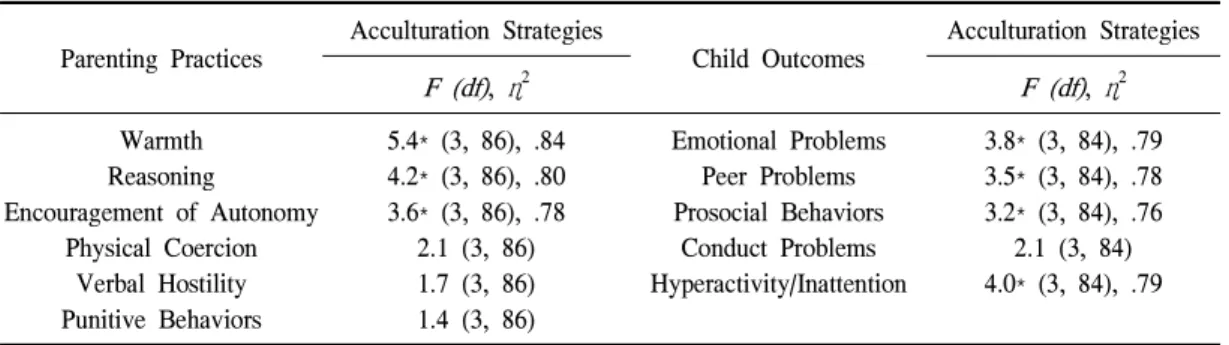
A series of one way ANOVAs were conducted to investigate whether Korean immigrant mothers differed in their use of positive (warmth, reason- ing, and encouragement of autonomous behavior) as well as negative (physical coercion, verbal hostility, punitive behaviors) parenting practices
Parenting Practices Acculturation Strategies
Child Outcomes Acculturation Strategies
F (df), η2 F (df), η2
Warmth Reasoning
Encouragement of Autonomy Physical Coercion
Verbal Hostility Punitive Behaviors
5.4* (3, 86), .84 4.2* (3, 86), .80 3.6* (3, 86), .78
2.1 (3, 86) 1.7 (3, 86) 1.4 (3, 86)
Emotional Problems Peer Problems Prosocial Behaviors
Conduct Problems Hyperactivity/Inattention
3.8* (3, 84), .79 3.5* (3, 84), .78 3.2* (3, 84), .76
2.1 (3, 84) 4.0* (3, 84), .79 Note:* =p<.05
Table 1. One way ANOVA Results for Maternal Ratings of Parenting Practices and Child Outcomes.
based on their acculturation strategies. Linearity, multicollinearity, and homogeneity of variance covariance matrices assumptions were satisfied.
The results showed that mothers significantly differed in their use of warmth, F(3, 86) = 5.4, p<.05, η2= .84, reasoning, F(3, 86) = 4.2,p<.05, η2= .80, and encouragement of autonomy, F(3, 86) = 3.6, p<.05, η2= .78, based on their accul- turation strategy, but not in their endorsement of physical coercion, verbal hostility, and punitive behaviors (see Table 1).
Subsequent Tukey pairwise comparisons on parenting practices across the acculturation strategy groups were then performed. Means and standard deviations for the mothers’ parenting practices for each acculturation groups are presented in Table 2. Tukey results showed that mothers with an integrated acculturation strategy used more warmth and reasoning, and encouraged their children’s autonomous behaviors more than marginalized and separated mothers. Interestingly, there were no differences between integrated and assimilated mothers’ parenting practices.
2. Children’s Social, Emotional, and Behavioral Outcomes
The second aim of the current study was to examine whether Korean immigrant mothers’ per- ception of children developmental outcomes dif- fered by acculturation strategies. Table 3 shows the means and standard deviations of children’s developmental outcomes by maternal acculturation strategies. In order to test this aim, a series of one way ANOVAs were performed. The results showed that children’s developmental outcomes differed based on their mother’s acculturation strategy, specifically, emotional problems, F(3, 84)
= 3.80,p<.05, η2= .79, peer problems F(3, 84) = 3.5, p<.05, η2= .78, attention regulation problems, F(3, 84) = 4.0, p<.05, η2= .79, and prosocial behaviors F(3, 84) = 3.2, p<.05, η2= .76 (see Table 1). Subsequent Tukey pairwise com- parisons of parenting practices among the 4 acculturation strategies showed that children of separated mothers were more likely to have emotional problems than those of assimilated mothers, and showed less prosocial behaviors than those of integrated mothers. Moreover, children of
Parenting Practices Integrated Assimilated Separated Marginalized
M (SD) M (SD) M (SD) M (SD)
Warmth Reasoning
Encouragement of Autonomy Physical Coercion
Verbal Hostility Punitive Behaviors
4.45 (.47) 3.96 (.77) 3.73 (.77) 1.70 (.46) 1.85 (.43) 1.37 (.36)
4.17 (.48) 3.75 (.62) 3.20 (.80) 1.97 (.56) 2.03 (.49) 1.65 (.43)
3.84 (.64) 3.34 (.76) 3.04 (.58) 1.91 (.55) 2.04 (.62) 1.69 (.69)
3.84 (.64) 3.23 (.82) 3.01 (.77) 2.17 (.68) 2.28 (.67) 1.77 (.78) Table 2. Descriptive Statistics for Mother’s Parenting Strategies According to their Acculturation Strategies.
Integrated Assimilated Separated Marginalized
M (SD) M (SD) M (SD) M (SD)
Emotional Problems Peer Problems Prosocial Behaviors Conduct Problems Hyperactivity/Inattention
2.07 (1.81) 1.07 (1.05) 7.57 (1.91) 1.14 (.94) 1.92 (1.59)
1.18 (1.21) 1.51 (1.45) 7.03 (1.97) 1.59 (1.24) 2.74 (1.95)
2.68 (1.77) 2.16 (1.65) 5.88 (1.90) 2.16 (1.54) 3.52 (2.04)
1.89 (1.69) 2.52 (1.50) 6.15 (1.77) 1.58 ( .96) 4.05 (1.92) Table 3. Descriptive Statistics for Children’s Socio emotional and Behavioral Outcomes.
integrated mothers had fewer peer problems and attention regulation problems than those of marginalized mothers.
3. Associations between Parenting and Child Outcomes by Maternal Acculturation Strategies
The final aim of the present study was to examine the relations between mothers’ parenting practices and their children’s socio-emotional and behavioral development for mothers with different acculturation strategies. The results showed that the associations between parenting and children’s developmental outcomes significantly varied based on mothers’ acculturation strategy. Specifically, we found that Korean immigrant mothers’ high encouragement of their children’s autonomous
behaviors were positively associated with prosocial behaviors among mothers with a marginalized acculturation strategy, r= .60, p<.05, whereas it was negatively associated with children’s attention regulation difficulties(hyperactivity/inattention), r
= .40, p<.05, among mothers with a separated acculturation strategy. Moreover, separated mothers’
high endorsement of punitive behaviors and verbal hostility were related to the display of conduct problems in children, r= .44, p<.05 and r= .77, p<.05, respectively, whereas high endorse- ment of physical coercion was related to conduct problems among mothers with an integrated acculturation strategy, r= .69, p<.01. Finally, we also found that assimilated mothers’high use of reasoning was associated with children’s prosocial behaviors, r= .39, p<.05.
Ⅳ. DISCUSSION
The objective of the present study was to examine how Korean immigrant mothers’ accul- turation styles were related to:(1) their own parenting practices (physical coercion, verbal hostility, punitive behaviors, warmth, reasoning, and encouragement of autonomous behavior in children), (2) their children’s social, emotional, and behavioral development (emotional problems, hyperactivity/inattention, peer problems, and prosocial behaviors), and (3) how parenting prac- tices and children’s outcomes were associated within the different maternal acculturation groups.
Consistent with the previous literature (Kim, 1989; Kim, Cain, & McCubbin, 2006; Kim, Han,
& McCubbin, 2007), we found that Korean mothers who were integrated to the American culture used more positive parenting practices such as warmth, reasoning, and encouragement of autonomy compared to mothers who were sepa- rated and marginalized from the American culture.
Conceptually, Berry (1997) argued that integration was the most adaptive acculturation strategy. The integrated mothers in our study appeared to embrace both American and Korean cultures.
Thus, these mothers may have better opportunities to interact with individuals from the mainstream culture, potentially challenging or complementing their child rearing ideas when they are engaged in different social situations such as taking their children to extra curricular activities and attending Parent-Teacher Association meetings (Pawliuk et al., 1996).
These socializing experiences may lead these
mothers to develop a new set of values or modify their existing ones that allow them to function effectively in both cultures (Farver & Lee Shin, 2000). Consequently, they are able to choose more appropriate parenting values and practices to help their children socialize better and successfully adapt in the mainstream culture. Interestingly, we did not find any difference between assimilated and integrated mothers in their parenting practices.
Thus, it appears that regardless of the maintenance of their heritage cultural practices, adoption of the mainstream cultural practice has a positive impact on Korean mothers’ parenting.
It was interesting that there were no significant differences between the acculturation groups in their report of negative parenting practices (i.e., physical coercion, verbal hostility, and punitive behaviors). This finding could indicate that adap- tation to the host culture may enhance parental competence and help mothers to model the salient and positive parenting practices of the host culture. However, having difficulties adapting to the host culture by itself may not be sufficient to explain negative parenting (Berry et al., 1987);
instead, psychological stress resulting from accul- turation may play a larger role in negative parent- ing. Therefore, future research should investigate the role of psychological (e.g., stress and well being) and social factors (e.g., social network characteristics) in the acculturation process in order to understand Korean immigrant mothers’
parenting and their children’s social, emotional and behavioral development.
With regard to maternal acculturation strategies and child outcomes, we found that children of
integrated mothers exhibited fewer peer problems and more prosocial behaviors than the children of separated and marginalized mothers. This finding is consistent with previous research showing that parental participation in the mainstream culture is associated with healthy psychological functioning in children (Barankin, Konstantareas, & Bosset, 1989) and low parental adoption of the host culture is related to their children’s low social competence (Pawliuk et al, 1996). Furthermore, in their research examining the moderating role of Korean American mothers’ acculturation in the association between their parenting style and children’s outcome, Kim and colleagues (2006) found that when Korean immigrant mothers did not adopt the American culture, low maternal warmth was related to children’s low social competence, whereas when mothers adopted American culture, low maternal warmth was not related to children’s’ poor social outcomes. The authors argued that high maternal acculturation to the U.S. culture may buffer the harmful effects of low maternal warmth on chil- dren’s social competence. Thus, participation in the mainstream American culture may help Korean immigrant mothers to be more socially integrated with Americans, which may provide a better “child environment fit” with the mainstream culture within which the child is developing (Kim, Cain, &
McCubbin, 2006).
Moreover, the associations between parenting and children’s social and behavioral outcomes varied based on the type of maternal acculturation strategy in our study. Specifically, among mothers with an assimilated acculturation strategy, high use of reasoning (e.g., gives child reasons why rules
should be obeyed) was associated with children’s prosocial behaviors. The use of reasoning practices is one of the most distinct characteristics of Western parenting that contrasts those of more dictatorial traditional Asian practices (Patel et al., 1996). Assimilated mothers who participate in the American culture more than the Korean culture may have more knowledge about using reasoning with their children, perhaps through observing their American friends or teachers, or reading about it in American parenting books. Thus, these mothers may have better skills to effectively implement reasoning in their parenting.
Although mothers with the different acculturation strategies did not differ in their mean levels of engagement in negative parenting (punitive behav- iors, verbal hostility, and physical coercion), the associations between each of these types of par- enting practices and child outcomes were more significant for mothers with certain acculturation styles. Specifically, among separated mothers who participate mostly in the Korean community and culture, punitive behaviors and verbal hostility were associated with children’s conduct problems, whereas physical coercion was associated with children’s conduct problems among integrated mothers. The main common characteristic of the mothers from these two groups is their participation in the Korean culture and community which is shaped by collectivistic values and Confucian philosophy (Choi & Choi, 1994). In previous studies, collectivistic and Confucian values were found to be related to parents’ use of more author- itarian practices (Oak & Martin, 2000). Thus, the association between authoritarian parenting prac-
tices and children’s outcomes may be more salient in these two groups. It is interesting, however, that these negative practices were more strongly related to poor outcomes in children for the two groups of mothers who maintained participation in their Korean communities. Thus, it appears that the negative effects of punitive behaviors, verbal hostility, and physical coercion are consistent across families from different cultures (Sorkhabi, 2005).
We also found interesting patterns of results in the associations between parenting and child outcomes for the separated and marginalized mothers. Among marginalized mothers, encour- agement of autonomy was positively associated with child prosocial behaviors, and the same parenting practice (i.e., mothers' encouragement of autonomy) was negatively associated with children’s hyperactivity/inattention for children of separated mothers. Even though both groups of mothers participated less in the American culture and promoted autonomy in their children less so than integrated mothers, when theydid engage in such practices, it was associated with more positive outcomes or a decrease in negative outcomes in their children. Therefore, the promotion of auton- omy appears to be particularly important for the children of separated and assimilated mothers.
1. Limitations and future directions
Several limitations of the study need to be addressed. First, the concurrent nature of this data presents at least two issues. As previous researchers argued, acculturation is a long term process which
sometimes takes years, generations and even centuries (Berry, 2006). Moreover, no directions in these associations can be ascertained. Thus, for future research, a longitudinal research design will better capture the dynamic process of acculturation and help to elucidate the direction in the associa- tions among these constructs. Second, all of the data was obtained through maternal reports. That is, mothers provided information on their acculturation strategy, parenting practices, and also their child behaviors which could lead to problems with shared method variance. Thus, future research should obtain more independent assessments of these constructs, perhaps using observations of maternal practices and teacher ratings of child outcomes.
Third, the alpha coefficients for the subscales of SDQ-P were low in the present study. This could be due to two reasons. First, the inter-item reliability coefficient is sensitive to the number of items in a scale. Scales with fewer items tend to yield lower alpha coefficients compared to those with larger number of items. Second, even though SDQ-P was validated in more than ten different countries (http://www.sdqinfo.com/b1.html) and widely used in both community and clinical samples to assess children’s social functioning and adjustment, this measure may not adequately assess some dimensions of social adjustment in Korean immigrant children. Therefore, future studies are needed to validate this questionnaire, or develop child outcome measures that are culturally valid and reliable in a Korean immigrant sample.
Fourth, we were not able to control other important sociodemographic variables that have been shown to be associated with immigration
and parenting, such as social economic status, education level, and age, in our analyses because of our small sample size. Future studies should investigate the associations among acculturation, parenting and child outcomes while considering other potentially confounding factors in a larger sample. Fifth, the mothers in our study were quite highly educated. Education level has been shown to be associated with more authoritative parenting practices (Querido, Warner & Eyberg, 2002). Indeed, in our study, the mean levels of the authoritarian practices were much lower than those of the author- itative ones. In the future, researchers should include families from a wider educational and socioeconomic range.
Finally, we would like to discuss the concept of acculturation that we used in our study, which is behavioral acculturation and suggest the direction of future study. Researchers have investigated dif- ferent types of acculturation; behavioral accul- turation and psychological acculturation. The behavioral dimension of acculturation involves overt and observable characteristics of an indi- vidual’s cultural practices such as language, social activities and lifestyle (Berry, 2006). On the other hand, psychological acculturation indicates an individual’s cultural identity and values (Shim &
Schwartz, 2007). These two types of acculturation might have different implications on parenting practices. Similar to previous studies, in our study we only examined the behavioral dimension of acculturation, which must be considered in our interpretations of the associations between accul- turation and parenting practices. It is possible that immigrant mothers’ values and identity might be
more related to their parenting behaviors and practices than their host culture language ability or participation in mainstream cultural social activities. Therefore, it would be important and interesting for future research to explore how immigrants’ acceptance of values of host culture (psychological dimension of acculturation) is asso- ciated with their parenting practices, in addition to their behavioral acculturation
2. Summary
In spite of these limitations, the present study expanded the knowledge on a quickly growing immigrant group in the U.S. Whereas most of the research on Korean immigrants have focused on the period of adolescence, this study examined immigrant families with preschool aged children who are first in the company of peers from the mainstream culture. The unique contribution of the current study is its examination of the important and complex role of Korean immigrant parents’
acculturation strategies, and its relation with their childrearing practices and children’s development.
The current study is also valuable in that it utilized Berry’s 4 categorical typology of acculturation. The current findings on Korean immigrant parenting practices and child development and the role of maternal acculturation may serve to inform Korean immigrant parents, researchers, policymakers and teachers to facilitate a more culturally sensitive approach to interventions and public policies designed to promote optimal adjustment in immi- grant children in the U.S.
REFERENCES
Barankin, T., Konstantareas, M. M., & Bosset, F.
(1989). Adaption of recent Soviet Jewish immi- grants and their children to Toronto.The Canadian Journal of Psychiatry, 34(6), 512-518.
Berry, J. W. (1984). Multicultural policy in Canada:
A social psychological analysis.Canadian Journal of Behavioral Science, 16, 353-370.
Berry, J. W. (1997). Immigration, acculturation, and adaptation. Applied Psychology:An International Review, 46(1), 4-68.
Berry, J. W. (2006). Acculturation:A conceptual Overview. In M. H. Bornstein, & L. R. Cote (Eds.),Acculturation and Parent Child Relation- ships:Measurement and Development(pp.13-29).
Mahwah, NJ, US:Lawrence Erlbaum Associates Publishers.
Berry, J. W., & Kim, U. (1988). Acculturation and mental health. In P.Dasen, J. W. Berry, & N.
Sartorius(Eds.), Health and cross cultural psy- chology(pp.207-236). Newbury Park, CA:Sage.
Berry, J. W., Kim, U., & Boski, M. (1988). Accul- turation and mental health:A review. In P. Dasen, J.W. Berry, & Satorius (Eds.),Cross cultural psy- chology and health. Newbury Park, CA:Sage.
Berry, J. W., Kim, U., Minde, T., & Mok, D. (1987).
Comparative studies of acculturative stress.Inter- national Migration Review, 21, 491-511.
Berry, J. W., Kim, U., Power, S., Young, M., &
Bujaki, M. (1989). Acculturation attitudes in plural societies. Applied Psychology:An international Review, 38, 185-206.
Berry, J. W., & Sam, D. (1997). Acculturation and adaptation. In J. W. Berry, M. H. Segall, & C.
Kagitcibasi (Eds.), Handbook of cross cultural psychology, Vol. 3, Social behavior and applica- tions (pp.291-326). Boston:Allyn & Bacon.
Bond, M., & Yang, K. (1982). Ethnic affirmation
versus cross cultural accommodation:The variable impact of questionnaire language on Chinese bilinguals in Hong Kong. Journal of Cross Cultural Psychology, 13, 169-185.
Bornstein, M., & Cote, L. R. (2001). Mother-infant interaction and acculturation:I. Behavioral comparisons in Japanese American and South American families. International Journal of Behavioral Development, 25(6), 549-563.
Bornstein, M., & Cote, L. R. (Eds.). (2006).Accultura- tion and parent child relationships:Measurement and development. Mahwah, NJ:Lawrence Erlbaum Associates.
Calzada, E. J., & Eyeberg, S. M. (2002). Normative parenting in a smaple of Dominican and Puerto Rican mothers of young children.
Chen, X., & Lee, B. (1997). Chinese Children's Acculturation Scale. Department of Psychology, University of Western Ontario.
Choi, S. C., & Choi, S. H. (1994). Weness:A Korean discourse of collectivism. In G. Yoon & S. C. Choi (Eds.), Psychology of the Korean people (pp.57- 84). Seoul:Dong A Publishing & Printing Co., Ltd.
Farver, J. M., & Lee Shin, Y. (2000). Acculturation and Korean American children’s social and play behavior. Social Development, 9(3), 316-336.
Farver, J. M., Narang, S. K., & Bhadha, B. R. (2002).
East Meets West:Ethnic identity, acculturation, and conflict in Asian Indian families. Journal of Family Psychology, 16(3), 338-350.
Giang, M. T., & Wittig, M. A. (2006). Implications of adolescents’ acculturation strategies for personal and collective self esteem. Cultural Diversity &
Ethnic Minority Psychology, 12, 725-739.
Goodman, R. (1997). The Strengths and Difficulties Questionnaire:a research note.Journal of Child Psychology and Psychiatry, 38, 581-586.
Gordon, M. (1964).Assimilation in American life.NY:
Oxford Press.
Gray, M. R., & Steinberg, L. (1999). Unpacking Authoritative Parenting:Reassessing a Multidi- mensional Construct. Journal of Marriage and the Family, 61, 574-587.
Grolnick, W. S., & Farkas, M. (2002). Parenting and the development of children’s self regulation. In M. H. Bornstein (Ed.), Handbook of parenting:
Vol.5. Practical issues in parenting (2nd ed., pp.89-110). Mahwah, NJ:Erlbaum.
Han, N. (1989). A study on contemporary Korean family (In Korean). Seoul:Ilji sa.
Hill, N. E., Bush, K.R., & Roosa, M. W. (2003).
Parenting and Family Socialization Strategies and Children’s Mental Health:Low Income Mexican American and Euro American Mothers and Chil- dren. Child Development, 74(1), 189-204.
Hulei, E., Zevenbergen, A. A., & Jacobs, S. C. (2006).
Discipline behaviors of Chinese American and European American mothers.The Journal of Psy- chology, 140(5), 459-475.
Hurh, W. M. (1998).The Korean Americans. Westport, CN:Greenwood Press.
Keefe, S., & Padilla, A. (1986). Chicano ethnicity.
Albuquerque:University of NM press.
Kim, E. (1989) Psychological adjustment in young Korean American adolescents and parental warmth.
Journal of Child and Adolescent Psychiatric Nursing, 21(4), 195-201
Kim, E., & Hong, S. (2007).First generation Korean American parents’ perceptions of discipline.
Journal of Professional Nursing, 23, 60-68.
Kim, E., Cain, K., & McCubbin, M. (2006).Maternal and paternal parenting, acculturation, and young adolescents' psychological adjustment in Korean American families. Journal of Child and Adoles- cent Psychiatric Nursing, 19, 112-129.
Kim, E., Han, G., & McCubbin, M. (2007). Korean American Parental Acceptance Rejection, Accul-
turation and Children’s Social competence.Family community health, 30(25), 533-545
Kim, H. O., & Hoppe Graff, S. (2000).Mothers roles in traditional and modern Korean Families:The consequences for parental practices and adolescent socialization. Asia Pacific Education Review, 2 (1), 85-93.
Kim, U., Park, Y., Kwon, Y., & Koo, J. (2005).Values of children, parent child relationship, and social change in Korea:Indigenous, cultural, and psy- chological analysis.Applied Psychology:An Inter- national Review, 54, 338-354.
Kotchick, B. A., & Forehand, R. (2002). Putting par- enting in perspective:A discussion of the contex- tual factors that shape parenting practices.Journal of Child and Family Studies, 11(3), 255-269.
La Fromboise, T., Colman, H. L. K., & Gerton, S.
(1993). Psychological impact of biculturalism:
Evidence and theory. Psychological Bulletin, 114, 395-412.
Lin, C. C., & Fu, V. R. (1990). A comparison of child rearing practices among Chinese, immigrant Chinese, and Caucasian American parents. Child Development, 61, 429-433.
Min, P. G. (1995). Korean Americans. In P. G. Min (Ed.),Asian Americans:Contemporary trends and issues (199-231). Thousand Oaks, CA:Sage Publications.
Min, P. G. (1998). Changes and conflicts:Korean immigrant families in New York. New York:
Allyn and Bacon.
Oak, S., & Martin, V. (2000). American/Korean con- trast:Patterns and expectations in the US and Korean. Elizabeth, NJ:Hollym.
Oh, S., & Lewis, C. (2008). Korean preschoolers’
advanced inhibitory control and its relation to other executive skills and mental state understanding.
Child Development, 79(1), 80-99.
Ogbu, J. U. (1981). School ethnography:A multilevel
approach. Anthropology and Education Quarterly, 12(1), 3-10.
Park, I. H., & Cho, L. J. (1995). Confucianism and the Korean family. Journal of Comparative Family Studies, 26, 117-134.
Park, S. Y., & Cheah, C. S. L. (2005). Korean mothers’
proactive socialisation beliefs regarding pre- schoolers’ social skills. International Journal of Behavioral Development, 29, 24-34.
Patel, N., Power, T. G., & Bhavnagri, N. P. (1996).
Socialization values and practices of Indian immi- grant parents:correlates of modernity and accul- turation. Child Development, 67(2), 302-313.
Pawliuk, N., Grizenko, N., Chan Yip, A., Gantous, P., Mathew, J., & Nguyen, D. (1996). Acculturation style and psychological functioning in children of immigrants.American Journal of Orthopsychiatry, 66(1), 111-121.
Querido, J. G., Warner, T. D, & Eyeberg, S. M. (2002).
Parenting styles and child behavior in African American families of Preschool Children. Journal of Clinical Child Psychology, 31(2), 272-277.
Robinson, C. C., Mandleco, B., Olsen, S. F., & Hart, C. H. (2001). The parenting styles and dimensions questionnaire (PSDQ). In B. F. Perlmutter, J.
Touliatos, & G. W. Holden (Eds.), Handbook of family measurement techniques:Vol. 3. Instru- ments and index (pp. 319-321). Thousand Oaks, CA:Sage.
Rohner, R., Hahn, B., & Koehn, U. (1992). Occu- pational mobility, length of residence, and per- ceived maternal warmth among Korean American families. Journal of Cross Cultural Psychology, 23, 366-376.
Rueschenberg, E., & Buriel, R. (1989). Mexican American family functioning and acculturation:
A family systems perspective. Hispanic Journal
of Behavioral Sciences, 11, 232-244.
Shim, Y. R., & Schwartz, R. C. (2008). Degree of acculturation and adherence to Asian values as correlated of psychological distress among Korean immigrants. .Journal of Mental Health, 17,607- 617.
Sorkhabi, N. (2005). Applicability of Baumrind’s parent typology to collective cultures:Analysis of cul- tural explanations of parent socialization effects.
International Journal of Behavioral Development, 29, 552-563.
U.S. Census Bureau (2002, 2004, 2007). Selected Population Profile in the United States. Retrieved 2009, Jan. 15 from website:http://factfinder.
census.gov/servlet/IPTable?_bm=y&?geo_id=010 00US&?geo_id=NBSP&?qr_name=ACS_2007_1 YR_G00_S0201&?qr_name=ACS_2007_1YR_G 00_S0201PR&?qr_name=ACS_2007_1YR_G00_
S0201T&?qr_name=ACS_2007_1YR_G00_S020 1TPR&?ds_name=ACS_2007_1YR_G00_&?reg=
ACS_2007_1YR_G00_S0201:042;ACS_2007_1Y R_G00_S0201PR:042;ACS_2007_1YR_G00_S02 01T:042;ACS_2007_1YR_G00_S0201TPR:042&
?_lang=en&?redoLog=false&?format=
Ward, C., & Rana Deuba, A. (1999). Acculturation and adaptation revisited. Journal of Cross Cultural Psychology, 30(4), 422-442.
Williams, C. L., & Berry, J.W. (1991). Primary prevention of acculturative stress among refugees:
Appelication of psychological theory and practice.
American Psychologist, 46, 632-641.
Wu, P., Robinson, C. C., Yang, C., Hart, C. H., Olsen, S. F., Porter, C. L., Jin, S., Wo, J., & Wu, X.
(2002). Similarities and differences in mothers’
parenting of preschoolers in China and the United States. International Journal of Behavioral Devel- opment, 26(6), 481-491.
2009년 10월 31일 투고, 2010년 1월 6일 수정 2010년 1월 7일 채택