Korean J. Mater. Res.
Vol. 26, No. 2 (2016)
79
Hydrogen Reduction of NiO Particles in a Single-Stage Fluidized-Bed Reactor without Sticking
Chang-Sup Oh
1, Hang Goo Kim
2and Yong Ha Kim
2†1Korea Institute of Science and Technology Information, Reseat Program, 245 Daehak-ro, Yuseong-gu, Daejeon 34141, Korea
2Department of Chemical Engineering, Pukyong National University, 365 Sinsun-ro, Nam-gu, Busan 48547 Korea
(Received December 3, 2015 : Revised January 8, 2016 : Accepted January 8, 2016)
Abstract
A commercial NiO (green nickel oxide, 86 wt% Ni) powder was reduced using a batch-type fluidized-bed reactor in a temperature range of 500 to 600oC and in a residence time range of 5 to 90 min. The reduction rate increased with increases in temperature; however, agglomeration and sintering (sticking) of Ni particles noticeably took place at high temperatures above 600oC. An increasing tendency toward sticking was also observed at long residence times. In order to reduce the oxygen content in the powder to a level below 1 % without any sticking problems, which can lead to defluidization, proper temperature and residence time for a stable fluidized-bed operation should be established. In this study, these values were found to be 550oC and 60 min, respectively. Another important condition is the specific gas consumption rate, i.e. the volume amount (Nm3) of hydrogen gas used to reduce 1 ton of Green NiO ore. The optimum gas consumption rate was found to be 5,000 Nm3/ton-NiO for the complete reduction. The Avrami model was applied to this study; experimental data are most closely fitted with an exponent (m) of 0.6 ± 0.01 and with an overall rate constant (k) in the range of 0.35~0.45, depending on the temperature.Key words
hydrogen reduction, NiO particles, fluidized bed, sticking.1. Introduction
The hydrogen reduction of nickel oxides has been studied extensively over past decades and many results of kinetic, mechanistic and thermodynamic analyses have been reported.
1-15)Although some of the numerous investi- gations have reported on the use of a fluidized bed in the hydrogen reduction,
13-15)the data from the literature are thought to be not sufficient for the commercial design and operation of a fluidized-bed reactor of the hydrogen reduction process. In fluidized bed reactors, the heat and mass transfer rates between gas and solid particles are high and the rapid mixing of solid leads to isothermal conditions throughout the reactor.
16)This advantage, how- ever, also leads to nonuniform residence times of solids and thus to nonuniform product at a high conversion level in a continuous operation reactor.
16)Therefore, the average conversion of the product is somewhat different from what can be obtained from the reduction in a fixed
or moving bed. Another problem of the fluidized bed is the agglomeration and sintering(sticking) of Ni particles at a high temperature when the size of particles is very fine. This sticking results in the defluidization of particles, and when this happens the operation should be finally stopped for the cleaning of the reactor. The main ob- jective of this research is to obtain experimental data which could be effectively used in the commercial oper- ation of a fluidized-bed reactor for the hydrogen reduction of nickel oxides. For this purpose, it was tried to find a best kinetic model describing this fluidized-bed reduction by the use of Avrami equation,
2)as well as the optimal operational conditions. The Avrami equation is expressed as follows,
X = 1 − exp (−kt
m) (1)
where “X” is the fractional conversion at time “t”, “k”
is an overall rate constant and “m” is an exponent whose
†Corresponding author
E-Mail : [email protected] (Y.-H. Kim, Pukyong Nat'l Univ.)
©Materials Research Society of Korea, All rights reserved.
This is an Open-Access article distributed under the terms of the Creative Commons Attribution Non-Commercial License (http://creative- commons.org/licenses/by-nc/3.0) which permits unrestricted non-commercial use, distribution, and reproduction in any medium, provided the original work is properly cited.
2. Experimental
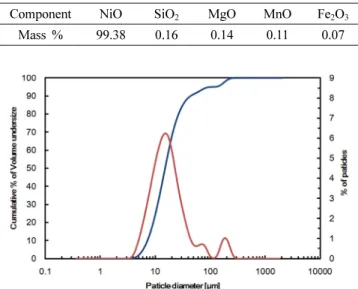
A commercial NiO(green nickel oxide, 86 wt% Ni) powder was used in this study, and the chemical compo- sition and the particle size distribution are given Table 1 and Fig. 1, respectively. The nickel oxide particles are mostly sized in the range between 10 and 30 µm, as can be seen in Fig. 1, and has a bulk density of 2,950 kg/m
3. The nickel oxide powder is made up of NiO, and the total content of other oxides such as SiO
2, MgO, MnO, and Fe
2O
3only counts for less than 0.7 % of the total mass. That is, the oxide sample used in this study is found to be almost pure NiO powder. The NiO powder was reduced by hydrogen gas using a batch-type fluidized- bed reactor in the temperature range from 500 to 600
oC and in the residence time range from 5 to 90 min. The sample amount was 75 g. If the total gas amount used is meaningful as in the calculation of gas consumption rate, the flow rate of hydrogen gas (as a fluidizing medium and a reductant) was varied from 3 to 6 L/min, otherwise it was fixed at 6 L/min, which corresponded to a super- ficial gas velocity of 0.32 Nm/s, about 4 times the minimum fluidizing velocity. The schematic diagram of experimental apparatus is shown in Fig. 2, and the fluidized bed reactor, of which inner diameter is 0.02 m, is made of SUS 310. Ar gas is used as an inert gas until the NiO powder was preheated to a targeted temperature.
After every experiment, the specimen was taken out of
the fluidized bed reactor and then was characterized by X-ray diffraction (XRD, D/Max 2500, Rigaku, Japan) and scanning electron microscopy (SEM, S-2400, HITACHI, Japan). The fractional conversion was identified by EDAX. The composition of Green NiO powder was analyzed by X-Ray Fluorescence Spectrometer (XRF- 1700, SHIMADZU, Japan).
3. Results and Discussion
The experimental results obtained from the hydrogen reduction using the fluidized-bed reactor are shown in Fig. 3 together with Avrami models to which the experi- mental data are most closely fitted. According to previous
Fig. 1. Particle size distribution analysis of Green NiO powder used in the study.Fig. 2. Schematic diagram of experimental apparatus used in the study.
investigations,
7,13)it has been reported that the reaction rate increases with temperature at a low temperature range but decreases at a high temperature range due to particle agglomeration(pore blocking or sintering). This phenomenon was also observed in this study, and the boundary temperature (i.e. the maximum temperature in which NiO particles are completely reduced without ag- glomeration) seems to be about 550
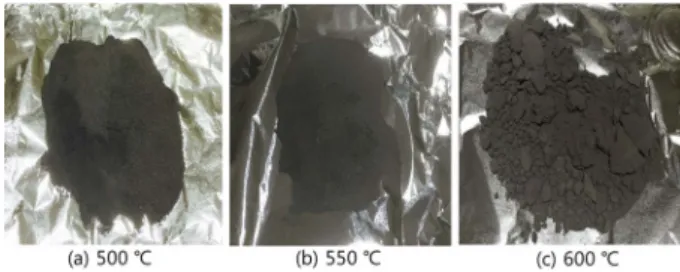
oC, as can be con- firmed from in Figs. 3 and 4. Fig. 4 shows the reduced Green NiO powders after the hydrogen reduction in the fluidized-bed reactor at various temperatures, and as can be seen in Fig. 4, the agglomeration was observed at 600
oC but not at 550
oC. Fig. 5 shows SEM images of Green NiO powder before and after hydrogen reduction
in the fluidized-bed reactor at 500
oC, 550
oC and 600
oC.
The NiO particles are irregular in shape with particles sizes below 10 µm. The raw NiO particles are not porous.
After being reduced at 500
oC~600
oC, a small amount of micro-pores was observed on the surface of the powder.
When the temperature increased to 550
oC, the size and the number of micro-pores greatly increased, indicating a substantive increase in the reduction reactivity. However, when the temperature increased further from 550
oC to 600
oC, the amount of micro-pores rather decreased as shown in Fig. 5(c)-(d). This decrease is ascribable to the sintering of the ultrafine Ni particles as reported in the previous investigation.
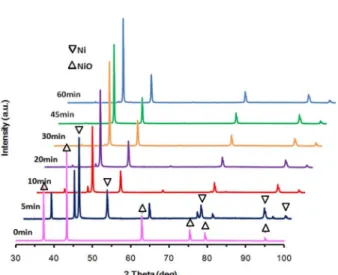
13)Figs. 6 and 7 show the XRD patterns of the product after hydrogen reduction in the fluidized-bed reactor. As can be seen in Fig. 6, NiO could be completely reduced to Ni after more than 60 min at 550
oC. This was also confirmed from the results of the hydrogen reduction at 500
oC and 600
oC as can be seen in Fig. 7.
Several attempts of curve fitting were made to obtain a
Fig. 3. Variation of fractional conversion with time for the hydrogenreduction of Green NiO in the fluidized-bed reactor at various temperatures.
Fig. 5. SEM images of the Green NiO before and after hydrogen reduction in the fluidized- bed reactor at various temperatures.
Fig. 4. Reduced Green NiO powders after the hydrogen reduction in the fluidized-bed reactor at various temperatures.
rate expression suitable for the hydrogen reduction of NiO in the fluidized bed. Unlike the previous investi- gations which were carried out at temperatures lower than 450
oC, the first order Avrami
2)and the chemical reaction control models
14)didn’t give satisfactory and consistent results over the temperature range from 500
oC to 600
oC. The model to which the experimental data are most closely fitted, was found to be the Avrami model, however, of very low value of the exponent “m” of 0.6 ± 0.01(low than 1), as shown in Fig. 3. Although there is no clear physical interpretation of the Avrami exponent
“m”, it was known to be originally held to have a value between 1 and 4 which reflected the nature of the transformation in question.
17)It has become, however, customary to regard it as an adjustable parameter that may be non-integral, and can be less than 1 in certain cases
such as rapid super-cooling
18)and crystallization just on a film.
19)In the fluidized bed, particles move heavily in the reactor, jumping up and falling down. This mixing of concurrent and countercurrent flows can affect the kinetics of the hydrogen reduction behavior of NiO particles. In this study, as can be seen in Figs. 3 and 8, an Avrami exponent value of about 0.6 was found be best fitted for all the three temperatures, and it seems that this value may represent a characteristic of the reaction in this fluidized bed reactor. For the rate constant “k”, it was found to be a value in the range of 0.35~0.45 depending upon the temperature, as shown in Figs. 3 and 9. These values are somewhat lower than what were reported in the previous investigations,
2,5,20)even if the difference in temperature range is considered. The reaction rate con- stant is a function of temperature and can be described by the Arrhenius relation. In principle, the rate constant increases with the temperature, however, in this study the value decreased when the temperature increased from 550
oC to 600
oC. This decrease can be ascribed to the sintering phenomenon which leads to a decrease in the
Fig. 6. Variation of XRD patterns for the products with time of thehydrogen reduction in a fluidized-bed reactor at 550oC.
Fig. 7. XRD patterns of the products after 60 min of hydrogen reduction in a fluidized-bed reactor in the temperature range of 500oC - 600oC.
Fig. 8. Effect of Avrami exponent(m) on the H2 reduction of green nickel oxide at 550oC.
Fig. 9. Effect of rate constant(k) on the H2 reduction of green nickel oxide at 550oC.
area of reactive site in particles. The measurement of the rate constant at 600
oC was affected by this sintering effect, therefore, the value 0.39 cannot be taken as a true one.
Main objective of this research is to obtain optimal operational conditions which could be effectively used in a commercial operation of a fluidized-bed reactor for the hydrogen reduction of nickel oxides. According to the experimental results of this study, it is concluded that 550
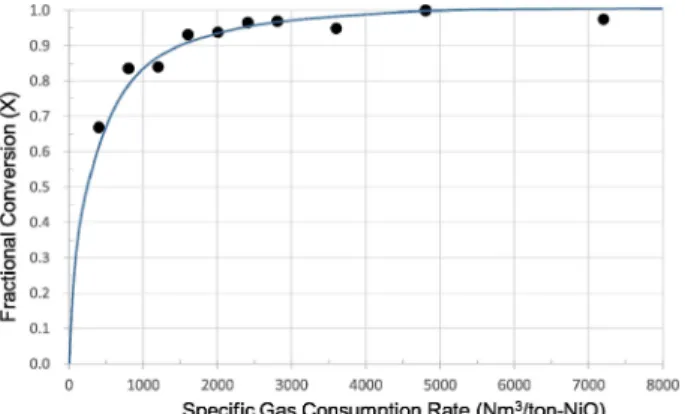
oC is the high limit of temperature and 60 min is the lowest limit of resident time. Another important con- dition is the specific gas consumption rate, i.e. the volume amount(Nm
3) of hydrogen gas used to reduce 1 ton of Green NiO ore powder. The optimum gas con- sumption rate was found to be 5,000 Nm
3/ton-NiO, as can be shown in Fig. 10. The data used in this figure were obtained at all the three temperatures and at different sample amounts and gas flows.
4. Conclusion
The objective of this study is to obtain experimental data which could be effectively used in a commercial operation of a fluidized-bed reactor for the hydrogen reduction of nickel oxides. In this study, it is concluded that 550
oC is the high limit of temperature and 60 min is the lowest limit of resident time. In addition, the specific gas consumption rate needed at minimum for the com- plete reduction was found to be 5,000 Nm
3/ton-NiO.
Avrami model was applied to this study, and the ex- perimental data are most closely fitted with an exponent
‘m’ of 0.6 ± 0.01 and with an overall rate constant “k” in the range of 0.35~0.45, depending upon the temperature.
In the fluidized bed, particles are move heavily in the reactor, jumping up and falling down. This mixing of concurrent and countercurrent flows can affect the kinetics of the hydrogen reduction behavior of NiO particles. This
aspect was observed in this study through the kinetic analysis using Avrami model, although the clear physical interpretation was not possible. Although the usage of the Avrami may be erroneous since “k” and “E(activation energy) are both influenced by “m”, nevertheless in this study it did give a good model to express the hydrogen reduction of NiO powder in the fluidized bed.
Acknowledgments
This work has been financially supported by a Research Grant of Pukyong National University(C-D-2015-0910), Busan, Korea.
References
1. B. V. L’vov and A. K. Galwey, J. Therm. Anal. Calorim., 110, 601 (2012).
2. J. T. Richardson, R. Scates and M. V. Twigg, Appl.
Catal. A, 246, 137 (2003).
3. B. Jankovi , B. Adnadevi and S. Mentus, Chem. Eng.
Sci., 63, 567 (2008).
4. B. Jankoviæ devi and B., J. Phys. Chem. Solids, 68, 2233 (2007).
5. T. A. Utigard, M. Wu, G. Plascencia and T. Marin, Chem.
Eng. Sci., 60, 2061 (2005).
6. G. Plascencia and T. Utigard, Chem. Eng. Sci., 64, 3879 (2009).
7. T. Hidayat, M. A. Rhamdhani, E. Jak and P. C. Hayes, Miner. Eng., 21, 157 (2008).
8. J. Szekely, J. W. Evans and H. Y., Chem. Eng. Sci., 28, 1975 (1973).
9. J. Szekely, J. W. Evans and H. Y. Sohn, Gas-Soid Reactions, Academic Press Inc., New York, Chapter 2 &
4 (1976).
10. A. H. Rashed and Y. K. Rao, Chem. Eng. Comm., 156, 1 (1996).
11. K. D. Kim et al, Rev. Adv. Mater. Sci., 28, 162 (2011).
12. Q. Jeangros, et al., J. Mater Sci., 48, 2893 (2013).
13. J. Li, X. Liu, Q. Zhu and H. Li, Particuology, 19, 27 (2015).
14. J. W. Evans, S. Song and C. E. Sucre, Metall. Trans. B, 7B, 55 (1976).
15. A. Kivnick and A. N. Hixson, Chem. Eng. Prog., 48, 394 (1952).
16. D. Kunii and O. Levnspiel, Fluidization Engineering, Butterworth-Heinemann, Boston, Second edition, 10 (1991).
17. Wikipedia, the free encyclopedia, https://en.wikipedia.
org/wiki/Avrami_equation
18. S. Martini, M. L. Herrera and R. W. Hartel, JAOCS, 79, 1055 (2002).
19. J. Kim, M. S. Kim and B. W. Kim, Korean Chem. Eng.
Res., 49, 611 (2011).
20. Zhi-jie YAN, et al., Trans. Nonferrous Met. Soc. China, 18, 138 (2008).
c′ c′
c′
Fig. 10. Variation of the fractional conversion with specific gas con- sumption rate in the fluidized-bed reduction of Green NiO powder using hydrogen gas at 550oC.