Secretory Expression System of Xylose Reductase (GRE3) for Optimal Production of Xylitol
Hoe-Myung Jung
1, Jae-Woon Kim
2and Yeon-Hee Kim
1,2*
1Department of Smart-Biohealth, Dong-Eui University, Busan 47340, Korea
2Department of Biotechnology and Bioengineering, Dong-Eui University, Busan 47340, Korea Received October 4, 2016 /Revised November 10, 2016 /Accepted November 11, 2016
Xylitol is widely used in the food and medical industry. It is produced by the reduction of xylose (lignocellulosic biomass) in the Saccharomyces cerevisiae strain, which is considered genetically safe. In this study, the expression system of the GRE3 (YHR104W) gene that encodes xylose reductase was constructed to efficiently produce xylitol in the S. cerevisiae strain, and the secretory production of xy- lose reductase was investigated. To select a suitable promoter for the expression of the GRE3 gene, pGMF-GRE3 and pAMF-GRE3 plasmid with GAL10 promoter and ADH1 promoter, respectively, were constructed. The mating factor α (MFα) signal sequence was also connected to each promoter for se- cretory production. Each plasmid was transformed into S. cerevisiae SEY2102△trp1, and SEY2102△
trp1/pGMF- GRE3 and SEY2102△trp1/pAMF-GRE3 transformants were selected. In the SEY2102△
trp1/pGMF-GRE3 strain, the total activity of xylose reductase reached 0.34 unit/mg-protein when NADPH was used as a cofactor; this activity was 1.5 fold higher than that in SEY2102△trp1/
pAMF-GRE3 with ADH1 as the promoter. The secretion efficiency was 91% in both strains, indicating that most of the recombinant xylose reductase was efficiently secreted in the extracellular fraction. In a baffled flask culture of the SEY2102△trp1/pGMF-GRE3 strain, 12.1 g/l of xylitol was produced from 20 g/l of xylose, and ~83% of the consumed xylose was reduced to xylitol.
Key words : Promoter strength, Saccharomyces cerevisiae, secretion production, xylitol productivity,
xylose reductase
*Corresponding author
*Tel : +82-51-890-2281, Fax : +82-504-033-6356
*E-mail : [email protected]
This is an Open-Access article distributed under the terms of the Creative Commons Attribution Non-Commercial License (http://creativecommons.org/licenses/by-nc/3.0) which permits unrestricted non-commercial use, distribution, and reproduction in any medium, provided the original work is properly cited.
Journal of Life Science 2016 Vol. 26. No. 12. 1376~1382 DOI : http://dx.doi.org/10.5352/JLS.2016.26.12.1376
서 론
Xylitol은 5개의 탄소(오탄당)로 이루어진 당 알코올(alditol) 로 제과(껌, 사탕)나 식품, 의약품, 화학 산업 등 다양한 분야에 서 사용되고 있는 물질이다. Xylitol은 무과당제품의 첨가물로 사용되거나 식품감미료로서 그 이용가치가 높으며, 설탕에 비 해 느리게 흡수되며 혈당량을 거의 증가시키기 않아 당뇨병, 고혈압, 고콜레스테롤혈증 환자들에게 도움이 된다. 특히 충 치의 원인이 되는 산을 형성하지 않고 치석 생성을 줄여주기 때문에, 치약이나 구강 위생제에도 첨가된다[19]. 최근에는 xylitol이 암세포의 세포사멸(cell death)을 유도한다는 연구 결 과도 보고되었는데, 다양한 암세포를 대상으로 한 실험에서 xylitol 양의 증가에 따라 세포의 증식 억제 효율이 증가되었 고, 특히 폐암에 대해서는 잠재적인 치료제로서의 기능을 할 수 있다는 보고도 있다[22]. 게다가 xylitol은 xylaric acid나
glycols과 같은 중합체를 제조하는 원료로도 사용되기 때문에 xylitol의 수요는 계속 증가하고 있는 추세이다[2].
Xylitol의 생산은 lignocellulosic biomass에 포함되는 xy- lose의 환원에 의해 제조되거나, 과일이나 채소와 같은 식물에 서 화학적으로 추출되는데 그 농도는 그다지 높지 않다[25].
이러한 제조공정은 xylose에 raney nickel와 같은 금속촉매 처
리와 화학적인 수소가스 첨가에 의한 제조이기 때문에 유해물
질이 첨가될 가능성이 높고, 식물에 포함된 xylitol의 건조중량
은 1% 미만으로 경제적이지 못하기 때문에 효모와 같은 생체
촉매를 이용한 xylitol의 생산이 요구되고 있다[24]. Xylose를
이용해서 xylitol을 생산하는 효소학적 방법으로 xylose re-
ductase (XR)라는 환원 효소를 사용하는 것이 대표적이라고
할 수 있다. Xylose reductase는 xylose utilization pathway의
첫 번째 단계를 촉진하는 효소로 NAD(P)H-dependent re-
action을 촉매하여 xylose를 xylitol로 환원시킨다. 따라서 안
정적이고 선택적으로 xylitol을 대량 생산하기 위해 다양한
source로부터 xylose reductase를 분리하여 특성분석, 재조합
및 생산에 관한 연구들이 보고되고 있다. Candida tenuis로부터
NADH-dependent xylose reductase (CtXR)를 분리하고
Escherichia coli에서 성공적으로 발현시키거나[7], chargedmembrane reactor를 이용한 cofactor regeneration을 통해 높
은 xylose 환원율을 보인 결과도 보고되었다[21]. 또한 Candida
boidinii의 xylose reductase (CbXYL1)를 Saccharomyces cer- evisiae에 도입하여 NADH에 의존적인 xylose reductase의 분
자적 특성을 파악하였고[13], Pichia stipitis의 xylose reductase (PsXR)를 S. cerevisiae에 도입한 재조합 균주의 개발[8], S. cer-
evisiae의 xylose reductase (ScXR) 활성 확인 및 효소활성부위에 대한 연구[4, 5] 등 xylose에서부터 xylitol를 생산하기 위한 많은 연구가 진행되고 있다. S. cerevisiae내에서 xylose reduc- tase (XR)는 HOG (high osmolarity glycerol) pathway를 조절 하는 효소 중의 하나로 GRE3 (YHR104W)유전자에 의해 코드 되며 aldo-keto reductase family에 속하는 효소이다. 특히
GRE3 유전자는 cofactor로 NADPH를 사용하고, polyol를 생산하는 탄소 대사의 환원을 촉매한다고 알려져 있으며, 높은 삼투조건에서 발현이 유도되는데, YPD+2M sorbitol 조건에서
GRE3의 전사가 38배 증가하였다는 보고도 있었다[10].S. cerevisiae는 인체에 비병원성이며 미국 FDA에서 허가한
GRAS (Generally Recognized As Safe) 미생물이기 때문에 식 품 첨가물로 그 이용가치가 높은 xylitol의 생산을 위한 최적의 숙주세포라고 할 수 있으며, 고등생물세포와 유사한 번역 후 수식계가 있어 folding 및 disulfide 결합 등 단백질의 구조와 기능이 천연상태로 생산될 수 있다. 또한 과발현 시키고자 하 는 유전자는 그 유전자의 특성에 따라 발현에 적합한 pro- moter (constitutive or inducible promoter)와 유전자의 com- bination이 달라진다는 결과도 보고되어 있어[15], xylose를 효 율적으로 xylitol로 전환하기 위해서 xylose reductase의 활성 을 높이는 최적의 발현시스템을 선별하는 것이 요구된다. 게 다가 효모는 대장균에 비해 유전자 재조합 단백질을 더욱 효 율적으로 세포 밖으로 분비 생산 할 수 있어 단백질의 분리 정제에 도움을 줄 수 있는데, 생산된 xylose reductase의 효율 적인 정제를 위해서 배지 내로의 분비생산이 필요하고, 효모 로부터 재조합 단백질의 분비생산을 위해서는 효모의 분비서 열을 이용하는 것이 효과적이다[14]. 따라서 본 연구에서는 S.
cerevisiae의 GRE3 유전자를 inducible promoter인 GAL10
(galactose inducible) promoter와 constitutive promoter인
ADH1 (constantly expression) promoter를 이용하여 발현시키고, 효모의 signal sequence를 이용하여 xylose reductase의 분비 및 발현 생산에 가장 적합한 promoter와 유전자 ex- pression system을 구축하고자 하였다.
재료 및 방법
사용 균주 및 plasmids
Plasmid 구축 및 증폭을 위한 E. coli 숙주세포는 DH5α를 사용하였고, 효모 숙주세포는 S. cerevisiae SEY2102 (MATα
ura3-52 leu2-3 leu2-112 his4-519 suc2△9)에 TRP1 (ORF 0.7kb)유전자가 KanMX 유전자로 대체되어 결실된 SEY2102△trp1 균주를 사용하였다. 효모 S. cerevisiae의 GRE3 유전자 발현을
위한 발현 plasmid는 GRE3 유전자의 ORF 상류에 MFα (mating factor α) signal sequence (MFα s.s)를 포함하고 유도 성 promoter인 GAL10 promoter를 가지는 pGMF- GRE3 plas- mid와 구성적 promoter인 ADH1 promoter와 분비서열을 가 지는 pAMF-GRE3 plasmid를 사용하였다. 이들 plasmid는 선 별마커로 URA3 유전자를 함유하고 있어 uracil 영양요구성 변이주 효모세포(ura3-52)를 숙주세포로 사용할 수 있다.
재조합 plasmid 구축 및 형질전환
GAL10 promoter를 이용하여 S. cerevisiae의 GRE3 유전자의
과발현을 위한 plasmid를 구축하기 위해서 pGMFα-XYLP plasmid [14]를 vector로 사용하였고, SEY2102△trp1의 ge- nomic DNA를 주형으로 GRE3-F (5’-AGGTGTTCCTCTAGA TAAGAGATCTTCACTGGTTACT-3’)와 GRE3-R (5‘-TTCGT TCAAGTCGACTCAGGCAAAAGTGGG- 3’) primer를 이용 하여 GRE3 유전자를 증폭하였다. Primer는 각각 XbaI과 SalI 제한효소서열을 포함한 22bp vector서열이 포함하도록 디자 인되었고, pGMFα-XYLP plasmid를 XbaI과 SalI 제한효소로 처리하여 cloning에 사용하였다. Cloning을 위해서 vector와 증폭된 GRE3 유전자의 일부분의 overlap region을 사용하여 fusion시키는 In-fusion cloning (Clonetech)법을 이용하였다.
또한 MFα 분비서열을 이용하여 유전자를 분비 발현시키기 위하여 GRE3 유전자의 ATG 개시코돈을 제거한 서열을 도입 하였고, 구축된 plasmid는 pGMF-GRE3로 명명하였다. ADH1 promoter를 이용하여 GRE3 유전자를 과발현 분비시키기 위 한 plasmid의 구축을 위해서 pVT-103U plasmid [23]를 vector 로 사용하였고, pGMF-GRE3 plasmid를 주형으로 pAMF-F (5‘ -GCTGGATCC TC TA GAAGATTCCC ATCC-3’)와 pAGRE3-R (5‘-TGCTGCAGGCTCGAGTCAGGCAAAAGTG GG-3’) primer를 이용하여 GRE3 유전자를 증폭하였다. pVT- 103U plasmid를 BamHI과 XhoI 제한효소로 처리하여 vector 로 사용하였고, in-fusion cloning 법을 이용하여 pAMF-GRE3 plasmid를 구축하였다. 구축된 재조합 plasmid는 E.coli DH5α 에서 증폭, 추출되었고, S. cerevisiae의 형질전환은 salmon testes 유래의 single-stranded carrier DNA를 사용하는 high efficiency transformation법[6]을 이용하였다.
배지 조성 및 배양조건
S. cerevisiae 균주의 증식배지로는 YPD 배지(1% yeast ex-
tract, 2% peptone, 2% glucose)를 사용하였고, 유전자 발현 유 도 시에는 YPDG 배지(1% yeast extract, 2% peptone, 1% glu- cose, 1% galactose)를 사용하였다. 또한 xylose에서 xylitol로 의 전환율 및 생산성을 측정하기 위하여 YPDGX 배지(1%
yeast extract, 2% peptone, 1% glucose, 1% galactose, 2% xy-
lose)를 사용하였다. 형질전환체의 선별을 위한 배지로는
YNBCAD 배지(0.67% yeast nitrogen base w/o amino acid,
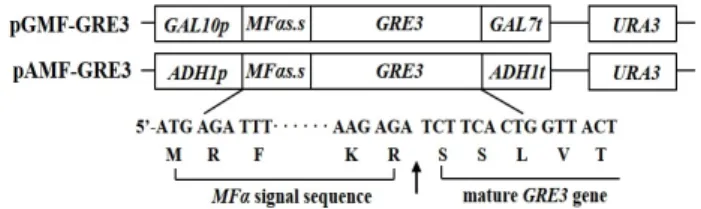
Fig. 1. Schematic of the xylose reductase expression plasmids, pGMF-GRE3 and pAMF-GRE3. The nucleotide sequence and deduced amino acid sequence of the junction site between MF
α
signal sequence and the GRE3 gene are indicated and the endopeptidase cleavage site is de- noted by an arrow.0.5% casamino acid, 2% glucose)를 사용하였다. 재조합 효모 균주는 5 ml YPD 배지에서 16~24시간 동안 전배양 한 후, 10 ml YPDG 배지와 50ml YPDGX 배지에 각각 접종(initial OD
6000.1)하여 30℃, 190 rpm에서 각각 48시간, 72시간 배양하 였다. 효모세포의 optical density (OD)는 spectrophotometer 를 사용하여 660 nm (OD
660)에서 측정하였고, dry cell weight (DCW)는 미리 측정된 conversion factor (0.3 DCW (g/l)/OD) 를 적용하여 산출하였다[11].
Xylose reductase (GRE3)의 효소활성 측정
Xylose reductase의 효소활성 측정을 위하여 48시간 배양한 배양액을 3,000 rpm으로 원심분리하여 균체 침전물을 얻었고, Y-PER (Yeast Protein Extraction Reagent, Thermo Scientific) 를 2 ml 첨가하여 상온에서 20분간 반응 시켰다. 반응액에 균 체와 동량의 glass beads (0.4~0.6mm)를 첨가하여 vortexing 하고 원심분리하여 상등액을 분리 한 다음 현미경으로 관찰하 여 세포 파쇄 여부를 확인하였다. Y-PER와 glass beads를 이용 하여 추출한 cell extract내의 protein 농도는 bradford법[1]으 로 정량하였고, BSA (Bovine Serum Albumin)를 표준물질로 0 mg/ml, 0.2 mg/ml, 0.4 mg/ml, 0.6 mg/ml, 0.8 mg/ml, 1.0 mg/ml의 양만큼 첨가하여 표준적정곡선을 작성하였다.
Xylose reductase의 효소활성 측정은 0.7 ml의 50mM sodium phosphate buffer (pH 6.5), 0.1 ml cell extract, 0.1 ml 2mM NAD(P)H를 포함하는 reaction solution을 1분간 25℃에서 반 응하고, 0.1 ml의 1M xylose의 기질을 첨가한 후 340nm에서의 흡광값의 변화량을 2분간 모니터링하여 측정하였다[16]. 1unit 는 1분간 1μmol NAD(P)H를 전환하는 효소의 양으로 정의하 였다.
재조합 xylose reductase를 이용한 xylitol 생산량 측정 재조합 xylose reductase를 발현하는 형질전환체의 xylitol 생산량을 측정하기 위해 D-xylitol assay kit (Megazyme)를 사용하였다. Xylitol의 생산량을 비교하기 위하여 일정시간마 다 배양액을 sampling하였고, 96 wells plate에 상등액과 kit buffer (pH 8.6), NAD+/INT (iodonitrotetrazolium chloride), diaphorase를 첨가(A
1)하여 상온에서 4분간 반응 후 ELISA reader (Bio-rad imark™ miroplate reader)를 사용하여 A492 nm에서 흡광도를 측정하였다. 흡광값이 안정화되면 즉시 sor- bitol dehydrogenase (SDH) lyophilisate를 첨가(A
2)하여 40분 간 상온에서 반응시킨 후, A492nm에서 흡광도를 측정하고 A
2값과 A
1값의 차이를 계산하여 xylitol 값을 산출하였다. 모든 실 험값은 3회 독립적으로 수행된 실험에서 평균값을 제시하였다.
RT-PCR을 통한 유전자 발현률 조사
SEY2102△trp1 균주와 각각의 형질전환체에서 GRE3 유전 자의 발현률을 비교하기 위하여 RT-PCR을 수행하였다. Trizol
method [9]를 통해 각 효모 균주의 total RNA를 추출하였고, Hyperscript™ First strand synthesis Kit (GeneAll
Ⓡ)를 사용 하여 cDNA를 합성하였다. cDNA합성 조건은 2 μg의 total RNA와 Oligo dT를 첨가한 14 μl를 65℃에서 5분간 반응 후, ice에서 1분간 cooling하고 10x RTase reaction buffer 2 μl, 0.1M DTT 1 μl, Hyperscript™ Reverse Transcriptse (200 U/μ l) 1 μl, ZymAll™ RNase Inhibitor 1 μl를 첨가하여 55℃에서 60분간 반응 후, 85℃에서 5분 반응하여 ice에서 cooling하였 다. 합성된 cDNA는 PCR의 주형으로 사용되었고, GRE3 유전 자의 증폭을 위해 GRE3-F와 GRE3-R primer을 사용하였다.
ACT1 유전자는 internal control로서 ACT1-F (5’-ATCCAAG
AGAGGTATCT-3’)와 ACT1-R (5’-CACACTTCATGATGG AG-3’) primer를 사용하여 증폭하였다.
결과 및 고찰
Xylose reductase 발현 재조합 plasmid의 구축 효모 유래 분비 서열을 이용하여 GRE3 유전자를 유도적, 구성적으로 발현·분비시키기 위하여 GAL10 promoter와 ADH1 promoter 하류에 각각 MFα 분비서열과 GRE3 유전자를 clon- ing하여 pGMF-GRE3 (7.35 kb)와 pAMF-GRE3 (7.36 kb) plas- mid를 구축하였다. 각 유전자의 coding region (GRE3 유전자 의 SSLVTLN로 시작되는 아미노산서열로 시작되는 영역)은 MFα 분비서열(MFαs.s)의 염기성 아미노산 잔기 Lys-Arg (KR) 뒤에 연결되도록 design되었고, 번역 후 분비과정 중 효모세포 내의 KEX2 protease (yeast endopeptidase) [17]에 의해 절단 되어 성숙형(mature form)의 xylitol dehydrogenase가 세포 밖으로 분비될 수 있다(Fig. 1).
Xylose reductase 과발현 및 분비 생산
구축된 pGMF-GRE3와 pAMF-GRE3 plasmid는 uracil 영 양요구성 변이주인 S. cerevisiae SEY2102△trp1 균주에 형질전 환하여, YNBCAD배지에서 1차 선별하였다. SEY2102△trp1/
pGMF-GRE3와 SEY2102△trp1/pAMF-GRE3의 형질전환체
중, 무작위적으로 각 3개의 형질전환체를 선별하여 10 ml
Table 1. Comparison of dry cell weight (g/l) and xylose reductase activity (unit/mg-protein) in host strain SEY2102△trp1, SEY2102△
trp1/pGMF-GRE3 and SEY2102△trp1/pAMF-GRE3 transformants
Strains DCW
(g/l)
Xylose reductase activity (unit/mg-protein)
NADPH NADH
Supernatant Cell extract Supernatant Cell extract SEY2102△trp1
SEY2102△trp1/pGMF-GRE3 SEY2102△trp1/pAMF-GRE3
5.49 6.63 5.88
0.06 0.31 0.19
0.002 0.03 0.02
0.02 0.05 0.04
0.0006 0.0008 0.0005 The activities of extracellular and intracellular xylose reductase were investigated by using NADPH or NADH as cofactor.
*Each strain was cultivated in YPDG medium for 48 hr at 30°C.
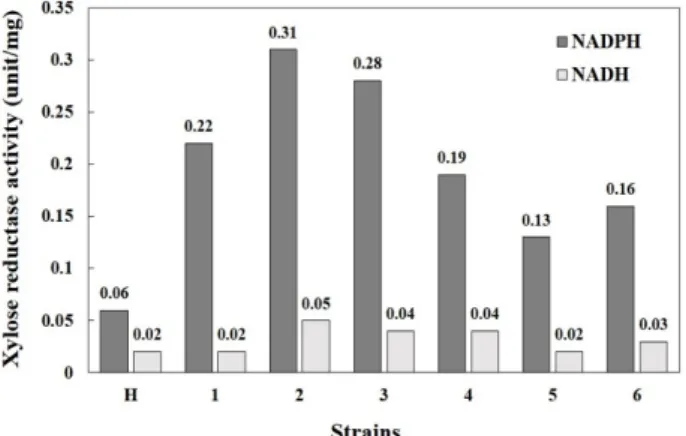
Fig. 2. Comparison of extracellular xylose reductase activity (unit/mg-protein) in host strain SEY2102△trp1, SEY 2102△trp1/pGMF-GRE3 and SEY2102△trp1/pAMF- GRE3 transformants. The activities of xylose reductase were investigated by using NADPH or NADH as co- factor. Lane H: SEY2102△trp1 strain; lane 1-3: SEY2102
△trp1/pGMF-GRE3 transformants No. 1-3; lane 4-6:
SEY2102△trp1/pAMF-GRE3 transformants No. 1-3.
YPDG 배지에서 48시간 배양하여 xylose reductase 활성을 측 정해보았다. 효모의 분비서열에 의해 분비된 xylose reductase (extracellular activity)의 활성만을 비교해 본 결과, SEY2102△
trp1/pGMF-GRE3 균주는 0.22~0.31 unit/mg-protein의 xy- lose reductase 활성을 보였고, SEY2102△trp1/pAMF-GRE3 균주의 경우는 0.13~0.19 unit/mg-protein의 활성을 보임을 확인 할 수 있었다(Fig. 2). 그 중 가장 높은 활성을 가지는 형질 전환 균주를 선별하여 xylose reductase의 분비 효율(secretion efficiency)을 조사해 보았다. 48시간 배양한 균체의 침전물에 Y-PER와 glass beads를 첨가하고 반응시킨 후, cell extract를 추출하여 효소반응에 사용하였으며, 효소반응을 위한 co- factor로 NADPH와 NADH를 사용하였다. 그 결과, NADPH 를 cofactor로 사용하였을 때, 전체적인 xylose reductase의 활 성이 높게 나옴을 확인 할 수 있었고, 분비 효율은 SEY2102△
trp1/pGMF-GRE3 균주와 SEY2102△trp1/pAMF-GRE3 균주 모두 91% 정도로 효율적으로 xylose reductase를 세포 밖으로 분비했음을 알 수 있었다(Table 1). 이것은 MFα 분비서열을 사용한 재조합 endoxylanase의 분비효율(91%)과 같은 수준 [14]으로 다른 효모 분비서열을 사용하여 단백질을 분비 발현 시킨 경우(lipocortin-Ⅰ (80% 분비효율), levansucrase (50% 분 비효율), α
1-antitrypsin (70% 분비효율) 그리고 endoglucanase A (73% 분비효율))에 비해서는 놓은 분비효율을 보임을 알 수 있다[3, 12, 18]. 하지만 NADH를 cofactor로 사용한 경우는 두 균주 모두 효소활성이 NADPH를 cofactor로 사용하였을 때의 15%에서 20% 정도 수준까지 활성이 저하됨을 확인 할 수 있는데(Table 1 and Fig. 2), 이는 S. cerevisiae의 xylose re- ductase가 효소활성을 위한 cofactor로 NADPH를 선호한다는 것을 다시 한번 확인시켜준 결과라고 할 수 있다. 따라서 xy- lose reductase의 분비 생산에는 GAL10 promoter가 ADH1 promoter보다 더 적합한 promoter임을 알 수 있었고, NADPH 를 cofactor로 하여 대부분의 xylose reductase를 세포 밖으로 분비 발현하였음을 확인하였다.
RT-PCR을 통한 xylose reductase 발현율 비교
GRE3 유전자의 과발현에 ADH1 promoter를 사용했을 때보다 Gal10 promoter를 사용했을 때가 xylose reductase의 to-
tal activity가 1.6배 정도 증가되었음을 확인 할 수 있었는데,
이것이 GRE3 유전자의 transcription level의 증가인지 단백질
활성 증가의 영향인지 확인해보기 위해 RT-PCR을 수행하였
다. SEY2102△trp1 균주와 SEY2102△trp1/pGMF-GRE3 균주
및 SEY2102△trp1/pAMF-GRE3 균주로 부터 total RNA를
추출하고, cDNA 합성 후, GRE3 유전자와 ACT1 유전자를 증
폭하는 primer set로 PCR을 수행하였다. 그 결과, 원래 1 copy
의 GRE3 유전자를 가지고 있는 SEY2102△trp1 균주에 비해서
SEY2102△trp1/pGMF-GRE3 균주와 SEY2102△trp1/pAMF-
GRE3 균주의 GRE3 유전자의 transcription level이 증가되었
음을 확인할 수 있었고, SEY2102△trp1/pGMF-GRE3 균주와
SEY2102△trp1/pAMF-GRE3 균주와의 transcription level 차
이는 크지 않았지만, GAL10 promoter를 사용한 경우가 ADH1
promoter를 사용한 경우보다 GRE3 유전자의 transcription
level이 증가되었음을 알 수 있었다(Fig. 3). 따라서 GAL10
promoter에 의해 조절된 GRE3 유전자의 transcription level의
증가로 xylose reductase 활성이 증가되었음을 확인할 수 있었다.
Fig. 3. Analysis of the transcription levels of xylose reductase gene using RT-PCR. Total RNA was isolated from SEY2102△trp1 strain, SEY2102△trp1/pGMF-GRE3 and SEY2102△trp1/pAMF-GRE3 transformants. cDNA was synthesized from total RNA by RT-PCR. The GRE3 and ACT1 (internal control) genes were amplified by PCR using each cDNA as template, and the products were visualized by agarose gel electrophoresis. Lane l: SEY 2102△trp1 strain; lane 2: SEY2102△trp1/pGMF-GRE3 transformant; lane 3: SEY2102△trp1/pAMF-GRE3 trans-
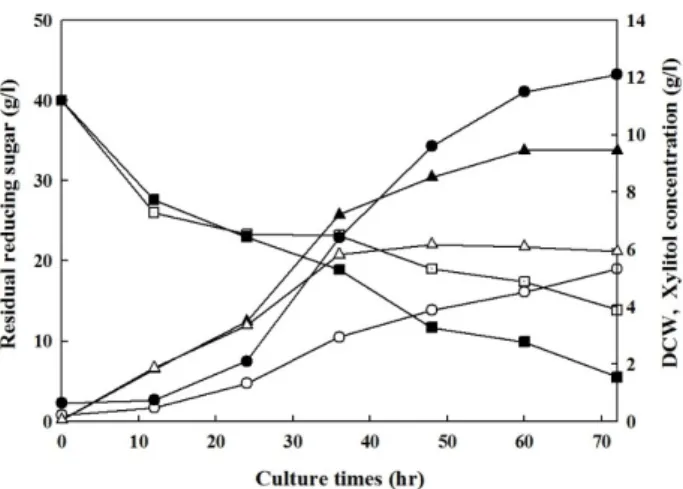
formant. Fig. 4. Reducing sugar, dry cell weight (DCW) and xylitol con-
centration in baffled flask culture of SEY2102△trp1 and SEY2102△trp1/pGMF-GRE3 strains on YPD(1%)G(1%) X(2%) medium. Symbols are denoted as follows: ○, ●, xylitol; △, ▲, DCW; □, ■, reducing sugar. Open sym- bols, SEY2102△trp1 strain; Closed symbols, SEY2102△
trp1/pGMF-GRE3 transformant.
Xylose로부터 xylitol 생산량 측정
SEY2102△trp1/pGMF-GRE3 균주가 분비생산하는 재조합 xylose reductase를 사용하여 배지중의 xylose가 xylitol로 conversion 되는 정도를 조사해보기 위해, SEY2102△trp1균주 와 SEY2102△trp1/pGMF-GRE3 균주를 각각 10 g/l의 glu- cose, 10 g/l의 galactose와 20 g/l의 xylose를 함유한 YP me- dium에서 72시간 동안 baffled flask 배양을 하였다. 그 결과, 두 균주 모두 배양 36시간 이후에는 거의 stationary phase에 들어가 더 이상 증식하지 않음을 알 수 있었고, 배지 중의 당은 배양 12시간째 급격히 감소하였고, 생산된 xylitol의 양은 24시 간 이후 증가되는 생산곡선을 보임을 알 수 있었다. 배지중의 환원당은 glucose 및 xylose를 표준물질로 사용하였을 때, SEY2102△trp1균주의 경우는 13.9g/l, SEY2102△trp1/pGMF- GRE3 균주의 경우는 5.5 g/l 정도 남아있음을 확인하였다.
이는 S. cerevisiae 균주를 YPD(1%)G(1%) 배지에서 48시간 배 양했을 때, glucose와 galactose가 배양 24시간 이후 거의 소모 된다는 결과[14]로부터 남아있는 환원당은 대부분이 xylose로 추정되며, 소모된 xylose는 galactose에 의해 유도 발현된 xy- lose reductase에 의해 xylitol로 전환되었음을 시사한다. 실제 로 각각 균주에서 xylitol 농도를 측정해 본 결과, SEY2102△
trp1균주의 경우는 기존의 xylose reductase에 의해 5.7 g/l의 xylitol을 생산했음을 알 수 있었고, SEY2102△trp1/pGMF- GRE3 균주의 경우는 과발현된 재조합 xylose reductase에 의 해 약 2배 정도 증가한 12.1 g/l의 xylitol을 생산하였다(Fig.
4). 이는 소모된 xylose의 약 83% 정도가 xylitol로 환원되었음 을 의미하고, 초기 농도 20 g/l의 xylose로부터는 SEY2102△
trp1/pGMF-GRE3 균주에서 약 60% 정도의 conversion rate (%)를 보인다고 할 수 있다. 이 결과는 Candida tropicalis 균주 의 경우, 49 g/l의 xylose로부터 15.8 g/l의 xylitol (32% con- version)을 생산한다는 보고[20]와 fed-batch fermentation의 결과로 21g/l의 xylose로부터 12~16.5 g/l의 xylitol을 생산한 보고[11]와 비교하여 baffled flask 배양의 조건에서 배지 중으
로 분비된 xylose reductase의 xylitol 전환 수율은 결코 낮은 수치가 아님을 보여준다.
본 연구에서는 lignocellulosic biomass (xylose)로부터 식품 및 의료산업에 이용가치가 높은 xylitol을 생산하기 위해 xy- lose reductase의 과발현 시스템을 구축하였고, 효율적으로 xylose reductase를 분비 생산하였다. S. cerevisiae에서 구축된 xylose reductase 발현시스템은 xylitol 뿐만 아니라, xylose로 부터 bioethanol의 생산을 위한 관련 단백질(xylitol de- hydrogenase, xylulose kinase)의 발현 분비시스템 구축 및 대 량생산에도 응용될 수 있을 것이라 생각된다.
감사의 글
본 연구는 미래창조과학부 이공분야기초연구사업의 신진 연구자지원사업(과제번호 : 2014R1A1A1003519)에 의해 수행 되었습니다. 연구비 지원에 감사드립니다.
References
1. Bradford, M. M. 1976. Rapid and sensitive method for the quantitation of microgram quantities of protein utilizing the principle of protein-dye binding. Anal. Biochem. 72, 248-254.
2. Clark, J. H. and Deswarte, F. 2011. Introduction to Chemi- cals from Biomass. pp. 344, John Wiley & Sons.
3. Chung, B. H., Nam, S. W., Kim, B. M. and Park, Y. H. 1996.
Highly-dfficient secretion of heterologous protein from Saccharomyces cerevisiae using inulinase signal peptide.
Biotechnol. Bioeng. 49, 473-479.
4. Ford, G. and Ellis, E. M. 2001. Three aldo-keto reductases
of the yeast Saccharomyces cerevisiae. Chem. Biol. Interact 130, 685-698.
5. Garay-Arroyo, A. and Covarrubias, A. A. 1999. Three genes whose expression is induced by stress in Saccharomyces cerevisiae. Yeast 15, 879-892.
6. Gietz, R. D. and Schiestl, R. H. 1995. Transforming yeast with DNA. Methods Mol. Cell Biol. 5, 225-269.
7. Hacker, B., Habenicht, A., Kiess, M. and Mattes, R. 1999.
Xylose utilization: Cloning and characterization of the xy- lose reductase from Candida tenuis. Biological. Chem. 380, 1395-1403.
8. Halborn, J., Walfridsson, M., Airaksinen, U., Ojamo, H., Hahnhagerdal, B., Penttila, M. and Keranen, S. 1991. Xylitol production by recombinant Saccharomyces cerevisiae. Bio Technol. 9, 1090-1095.
9. Hummon, A. B., Lim, S. R., Difilippantonio, M. J. and Ried, T. 2007. Isolation and solubilization of proteins after TRIZOL extraction of RNA and DNA from patient material following prolonged storage. BioTechniques 42, 467-472.
10. Jeong, E. Y., Sopher, C., Kim, I. S. and Lee, H. 2001. Mutatio- nal study of the role of tyrosine-49 in the Saccharomyces cer- evisiae xylose reductase. Yeast 18, 1081-1089.
11. Jo, J. H., Oh, S. Y., Lee, H. S., Park, Y. C. and Seo, J. H.
2015. Dual utilization of NADPH and NADH cofactors en- hances xylitol production in engineered Saccharomyces cerevisiae. Biotechnol. J. 10. 1935-1943.
12. Kang, H. A., Nam, S. W., Kwon, K. S., Chung, B. H. and Yu, M. H. 1996. High-level secretion of human α1-anti- trypsin form Saccharomyces cerevisiae using inulinase signal sequence. J. Biotechnol. 48, 15-24.
13. Kang, M. H., Ni, H. Y. and Jeffries, T. W. 2003. Molecular characterization of a gene for aldose reductase (CbXYL1) from Candida boidinii and its expression in Saccharomyces cerevisiae. Appl. Biochem. Biotechnol. 105. 265-276.
14. Kim, M. J., Kim, B. H., Nam, S. W., Choi, E. S., Shin, D.
H., Cho, H. Y., Son, K. H., Park, H. Y. and Kim, Y. H. 2013.
Efficient secretory expression of recombinant endoxylanase from Bacillus sp. HY-20 in Saccharomyces cerevisiae. J. Life Sci.
23, 863-868.
15. Kim, M. J., Nam, S. W., Tamano, K., Machida, M., Kim, S.
K. and Kim, Y. H. 2011.Optimization for production of exo-
β-1,3-glucanase (laminarinase) from Aspergillus oryzae in Saccharomyces cerevisiae. Kor. J. Microbiol. Biotechnol. 26, 427- 432.
16. Kim, S. R., Kwee, N. R., Kim, H. J. and Jin, Y. S. 2013.
Feasibility of xylose fermentation by engineered Saccharomyces cerevisiae overexpressing endogenous aldose reductase (GRE3), xylitol dehydrogenase (XYL2), and xylulokinase (XYL3) from Scheffersomyces stipitis. FEMS Yeast Res. 13, 312-321.
17. Latchinian-Sadek, L. and Thomas, D. Y. 1993. Expression, purification, and characterization of the yeast KEX1 gene product, a polypeptide precursor processing carboxypeptidase.
J. Biol. Chem. 268, 534-540.
18. Lim, C. K., Kim, Y. K., Kim, K. H., Kim, C. H., Rhee, S. K.
and Nam, S. W. 2004. Expression and secretion of Zymononas mobilis levansucrase in Saccharomyces cerevisiae. J. Life Sci. 14, 429-434.
19. Makinen, K. K. 2011. Sugar alcohol sweeteners as alter- natives to sugar with special consideration of xylitol. Med.
Princ. Pract. 20, 303-320.
20. Mattam, A. J., Kuila, A., Suralikerimath, N., Choudary, N., Rao, P. V. and Velankar, H. R. 2016. Cellulolytic enzyme expression and simultaneous conversion of lignocellulosic sugars into ethanol and xylitol by a new Candida tropicalis strain. Biotechnol. Biofuels 9, 157-169.
21. Nidetzky, B., Neuhauser, W., Haltrich, D. and Kulbe, K. D.
1996. Continuous enzymatic production of xylitol with si- multaneous coenzyme regeneration in a charged membrane reactor. Biotechnol. Bioeng. 52. 387-396.
22. Park, E., Park, M. H., Na, H. S. and Chung, J. 2015. Xylitol induces cell death in lung cancer A549 cells by autophagy.
Biotechnol. Lett. 37, 983-990.
23. Vernet, T., Dignard, D. and Thomas, D. Y. 1987. A family of yeast expression vectors containing the phage f1 inter- genic region. Gene 52, 225-233.
24. Wisniak, J., Hershkowitz, M., Leibowitz, R. and Stein, S.
1974. Hydrogenation of xylose to xylitol. Ind. Eng. Chem.
Res. 13, 75-79.
25. Yadav, M., Mishra, D. K. and Hwang, J. S. 2012. Catalytic hydrogenation of xylose to xylitol using ruthenium catalyst on NiO modified TiO2 support. Appl. Catal., A 425, 110-116.
초록:Xylitol 생산에 최적화된 xylose reductase (
GRE3)의 분비발현 시스템
정회명
1․김재운
2․김연희
1,2*
(1동의대학교 스마트바이오헬스학과, 2동의대학교 생명공학과)