• 검색 결과가 없습니다.

Expression Study on the Scaffold Gene of CRL4 Complex in Rice (Oryza sativa L.)

N/A
N/A
Protected

Academic year: 2021

Share "Expression Study on the Scaffold Gene of CRL4 Complex in Rice (Oryza sativa L.)"

Copied!
8
0
0

로드 중.... (전체 텍스트 보기)

전체 글

(1)

Expression Study on the Scaffold Gene of CRL4 Complex in Rice (Oryza sativa L.)

Yoowon Bae

1

, Hani Kim

1,2

, Sang-Hoon Kim

1

and Jae-Hoon Lee

1

*

1

Department of Biology Education, Pusan National University, Busan 46241, Korea

2

Department of Integrated Biological Science, Pusan National University, Busan 46241, Korea Received June 5, 2018 /Revised August 7, 2018 /Accepted August 21, 2018

The stability of diverse cellular proteins in eukaryotes is regulated via ubiquitination. Moreover, E3 ligase plays a crucial role in determining substrate specificity and transfers ubiquitins into the sub- strates during the ubiquitination process. As a type of multi-subunit E3 ligase, cullin4 (CUL4)-based E3 ligase (CRL4) complex is involved in a variety of cellular processes, such as hormonal and stress responses in plants. In spite of several reports on the versatile roles of CRL4 in various signalings in Arabidopsis, CRL4’s function in rice has been poorly known. To learn about CRL4-mediated cellular processes in rice in more detail, OsCUL4 that exhibits the highest homology with Arabidopsis CUL4 was isolated, and its expression patterns in various tissues and in response to plant hormones and abiotic stresses were monitored. Exogenous application of ABA or cytokinin increased the transcript levels of the OsCUL4 gene. Moreover, OsCUL4 was significantly upregulated in response to drought and salt stresses. These findings imply that OsCUL4 may be functionally related to ABA- and/or cyto- kinin-mediated cellular responses. OsCUL4 directly interacted with OsDDB1, an adaptor protein of CRL4, indicating that OsCUL4 can act as a scaffold protein of CRL4. An expression study on the OsCUL4 gene from this report could be used as a starting point to elucidate cellular responses in which a CRL4-mediated ubiquitination process is involved in rice.

Key words : CRL4, cullin4, hormones, rice, stresses

*Corresponding author

*Tel : +82-51-510-2700, Fax : +82-51-514-8576

*E-mail : [email protected]

This is an Open-Access article distributed under the terms of the Creative Commons Attribution Non-Commercial License (http://creativecommons.org/licenses/by-nc/3.0) which permits unrestricted non-commercial use, distribution, and reproduction in any medium, provided the original work is properly cited.

Journal of Life Science 2018 Vol. 28. No. 10. 1132~1139 DOI : https://doi.org/10.5352/JLS.2018.28.10.1132

Introduction

To properly respond to developmental and environ- mental cues, eukaryotes have developed a specific mecha- nism to control populations of various signaling proteins and enzymes. Ubiquitination, a representative post-transla- tional modification, mediates attachment of ubiquitins to an appropriate target protein (substrate). Since ubiquitinated proteins are eventually degraded via ubiquitin-proteasome system (UPS), ubiquitination process serves as a powerful tool to efficiently control the stability of regulatory proteins [3]. In plants, ubiquitination impinges on a diversity of bio- logical processes such as developments, stress responses and hormone responses [17]. The process is sequentially con- ducted by three kinds of enzymes such as E1 (ubiquitin-acti- vating enzyme), E2 (ubiquitin-conjugating enzyme), and E3

(ubiquitin ligase). Of them, E3 plays a crucial role to de- termine the substrate specificity of ubiquitination [12].

Among several types of E3 ubiquitin ligases, cullin-RING E3 ubiquitin ligase (CRL) is the most prominent one and exists as a complex form. In the case of plants, CRL is largely categorized into CRL1, CRL3 and CRL4, according to the type of cullin proteins as scaffold proteins [10, 11, 17, 24].

All CRLs commonly possesses RBX1, a RING finger protein

for E2 recruitment. CRL1 is associated with CUL1 as a scaf-

fold, SKP1 as an adaptor, and F-box protein (FBP) as a sub-

strate receptor. Unlike CRL1, CRL3 utilizes CUL3 as a scaf-

fold and BTB/POZ protein as a substrate receptor, without

a separate adaptor. On the other hand, CRL4 has CUL4 as

a scaffold, DDB1 as an adaptor, and DCAF as a substrate

receptor. The substrate specificity of CRLs are dependent on

their substrate receptors such as FBPs, BTB/POZ proteins

and DCAF proteins. In Arabidopsis, there are 692 Arabidopsis

FBP, 80 BTB/POZ protein and 119 DCAF proteins [6, 7, 18,

30, 33]. As shown in the report by Lee et al. (2008), rice pos-

sesses 110 putative DCAF proteins as substrate receptors for

CRL4 which shares the conserved WDxR motif within the

WD40 repeats, like Arabidopsis, implying that the structure

and biological role of rice CRL4 is functionally similar with

(2)

that of Arabidopsis CRL4 [18].

Since elucidation of CRL4’s role has been performed fo- cusing on its substrate receptors, the study on CUL4’s bio- logical role has been poorly known in plants. Nevertheless, several reports with loss-of-function mutants of CUL4 in Arabidopsis and tomato enable to predict its function related to various plant signaling pathways and developmental processes [1, 4, 29]. Chen et al. (2006) showed that CUL4 RNAi (cul4i) and CUL4 cosuppression (cul4cs) lines dis- played constitutive photomorphogenesis, along with upre- gulation of light-inducible genes in dark condition, indicat- ing its functional relevance to light signal transduction pathway. Moreover, genetic studies revealed that CUL4 acts together with COP10 and DET1 for repressing photo- morphogenesis [4]. Another report by Bernhardt et al. (2006) also showed that reduced CUL4 expression resulted in de- velopmental changes for lateral roots, vascular tissues and stomata [1]. In the case of tomato, reduced expression of CUL4 led to phenotypic alteration during development of fruit, trichome and flower, and to inhibition of plant stature [29]. Collectively, these results indicate functional versatility of CUL4 during the life cycle of a plant.

To more clarify CRL4-mediated cellular responses in rice, here we investigated rice CUL4’s possible involvement in various events related to phytohormone- and stress-trig- gered processes. In detail, the expression pattern of rice CUL4 gene in response to diverse phytohormones and abio- tic stresses was monitored and analyzed. Furthermore, its expression in various rice tissues was also checked. These researches will serves as a useful base for further studies on understanding the biological function of CUL4 and CRL4 in rice plants.

Materials and Methods

Plant materials and growth conditions

Rice seeds (Oryza sativa L. cv. Dongjin) were incubated for 1 minute with 70% ethanol and subsequently treated with 50% bleach supplemented with 2 drop of Tween 20 for 30 minutes. After rinses with autoclaved distilled water several times, seeds were placed on 1× MS medium supple- mented with 1% sucrose and 0.8% bactoagar (pH 5.8). Seeds were then moved into a plant growth chamber and grown at 28℃. For adult plants, 4-day-old seedlings were moved into soil and kept in a plant growth chamber at 28℃.

Generation of phylogenetic tree

OsCUL4 in Oryza sativa and its homologues from several plant species (Arabidopsis thaliana, Capsicum annuum, Vigna radiata, Zea mays and Glycine max) were aligned with ClustalW in MEGA6.0. A rooted phylogenetic tree was gen- erated with MEGA6.0 by the neighbor-joining method and the p-distance model [27]. The bootstrap method was used to assess statistical significance of the tree using 1,000 replicates.

Yeast two‑hybrid assay

Coding sequence regions of OsDDB1 and OsCUL4 were inserted into pDEST32 and pDEST22 vectors to generate GAL4 DBD- OsDDB1 and GAL4 AD-OsCUL4, respectively (Invitrogen, CA, USA). Yeast two-hybrid assays were con- ducted according to the ProQuest™ Two-Hybrid System manual (Invitrogen, CA, USA). The constructs were inserted into yeast strain MaV203, and then the resulting yeasts were incubated on SD/-Leu/-Trp plates at 30℃ for 7 days.

Interactions were monitored on SD/-Leu/-Trp/-His plates including 25 or 50 mM 3-amino-1,2,4-triazole (3-AT).

Treatments of various phytohormones and abiotic stresses

For hormone treatments, 3-day-old seedlings were kept for 6 hr in MS liquid media including 50 μM abscisic acid (ABA), 10 μM indole-3-acetic acid (IAA), 10 μM 1-amino- cyclopropane-1-carboxylic acid (ACC), 30 μM GA

3

, 50 μM jasmonic acid (JA), 1 μM epibrassinolide (EBL) or 50 μM kinetin. For cold and heat stresses, 4-day-old seedlings were kept at 4℃ and 42℃ for 3 hr, respectively. In the case of UV stress treatment, 4-day-old seedlings were treated with UV-B at 20 μmol m

-2

s

-1

irradiance for 3 hr. For drought stress, 17-day-old plants were kept without water until loss of approximately 10% of total fresh weight. In the case of salt stress, 3-day-old seedlings were incubated for 6 hours in MS liquid media including 250 mM NaCl. The collected samples were then kept at -70℃ for further RNA isolation process.

RNA isolation and real-time qRT-PCR analyses

Total RNA from seedlings and adult plants was retrieved

using TRIsure reagent (Bioline, MA, USA), while total RNA

from seeds was isolated as described by Oñate-Sánchez and

Vicente-Carbajosa (2008)[23], followed by DNase I (Prome-

ga, WI, USA) treatment to eliminate genomic DNA con-

(3)

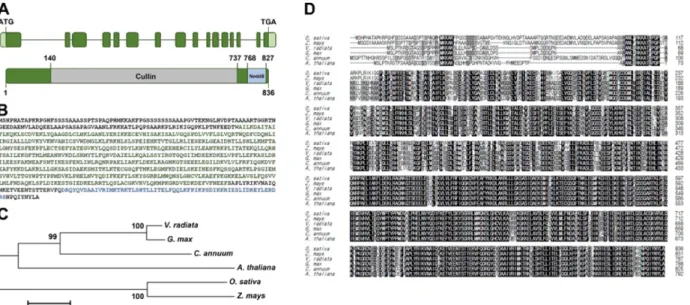
Fig. 1. Identification of rice CUL4 gene. (A) Schematic structure of OsCUL4. Closed boxes represent exons. Light green and dark green boxes indicate UTR (untranslated region) and CDS (coding sequence) regions, respectively. Lines between closed boxes represent introns. ‘Cullin’ and ‘Nedd8’ domains were designated based on the information from the pfam database. (B) Deduced amino acid sequence of OsCUL4. The regions with green and blue letters indicate ‘Cullin’ and ‘Nedd8’ domains, respectively. (C) Phylogenetic tree with OsCUL4 protein and its homologues from other plant species. The tree was generated with OsCUL4 protein and the proteins that displayed the highest homology with OsCUL4 from other species. The selected proteins are as follows: O. sativa CUL4 (XP_015632421.1), Z. mays CUL4 (XP_008644442.1), V. radiata CUL4 (XP_014518580.1), G. max CUL4 (XP_003546083.1), C. annuum CUL4 (XP_016558560.1) and A. thaliana CUL4 (NP_568658.1). Numbers represent the percentage of replicate trees after 1,000 replications. (D) Alignment of OsCUL4 protein and its homologues from (C).

The regions with a high-level of conservation are shown with black shade (100%), a middle-level with dark gray (67~83%) and a low level with light gray (50%).

tamination. The first-strand cDNA was synthesized from 1 μg total RNA using RevertAid H Minus Reverse Transcrip- tase (Thermo Scientific, MA, USA). Real-time qRT-PCR was carried out using a Rotor-Gene SYBR Green PCR Kit (Qiagen, CA, USA) according to the manufacturer’s instructions and the Rotor-Gene Q system (Qiagen, CA, USA). Transcript lev- els of OsCUL4 were determined using the comparative CT method and normalized to that of OsACTIN1 (LOC_Os03g 50885) from the corresponding sample. All experiments were conducted with biological replicates at least three times. The information of OsCUL4 primers used for qPCR analysis are as follows: OsCUL4 forward primer (5’-GGATGCTGCCATA GTTCGAATA-3’), OsCUL4 reverse primer (5’-TCAAGCCA GGTAATTGTAGATCTG-3’). OsACTIN1 primers used for qPCR analysis are the same ones as those from Kim et al.

(2018) [16].

Results and Discussion

Identification of OsCUL4 gene and its deduced protein

For further understanding of CRL4-mediated cellular re- sponses in rice, rice cullin4 (OsCUL4) gene was identified.

To isolate rice putative cullin4, Arabidopsis CUL4 (AtCUL4) was selected as a query to find OsCUL1 using the Rice Genome Annotation Project BLAST Search. One protein (LOC_Os03g57290.1) exhibited 81.9% similarity in amino acid sequences when compared to AtCUL4, based on EMBOSS Pairwise Alignment Algorithms at EMBL-EBI [25].

Since AtCUL4 protein exists as two different forms (CUL4-L and CUL4-S) which generate identical proteins, except that CUL4-L possesses additional 50 amino acids compared to CUL4-S at the N-terminal region, we cannot exclude the pos- sibility that OsCUL4 also exist as multiple isoforms [4].

OsCUL4 gene possesses 16 exons and 15 introns, and its cod-

ing region is composed of 2,508 bp encoding 836 amino

acids. Like other cullin proteins, OsCUL4 has a large ‘Cullin’,

and a ‘Nedd8’ domain that is responsible for neddylation

process at its C-terminal region (Fig. 1A, Fig. 1B). The neddy-

lation (attachment of Nedd8 into cullin) is known to increase

CRL activity by promoting E2 recruitment [10]. OsCUL4 ho-

mologues from several plant species such as Zea mays, Vigna

(4)

Fig. 2. Direct interaction of OsCUL4 with OsDDB1.

Yeast two hybrid assays were performed to check the physical interactions be- tween OsCUL4 and OsDDB1. Combina- tions of empty bait vector-OsCUL4 and OsDDB1-empty prey vector were used as negative controls.

Fig. 3. OsCUL4 expression in various tissues. Seeds, 3-day-old seedlings, and coleoptile, root and leaf tissues from 5- day-old plants were used to monitor OsCUL4 expression patterns. Accumulations of OsCUL4 transcripts were normalized to those of OsACT1 transcripts from the same sample. The average expression value of OsCUL4 in coleoptile tissue was considered to be 1.0. Values are the means ± SD (n=6).

radiata, Glycine max, Capsicum annuum and Arabidopsis thali- ana were selected using the BLAST search of the GenBank database, and their phylogenetic analysis and amino acid alignment were performed with OsCUL4 (Fig. 1C, Fig. 1D).

Homologous proteins from other species displayed more than 81.9% similarity in amino acid sequences when com- pared to OsCUL4. Especially, OsCUL4 showed 94.5% sim- ilarity in amino acid sequences with CUL4 homologue in Zea mays as a monocot, while 81.9-84.8% with those in other dicots. These findings imply that CUL4 proteins have been evolutionarily conserved and CRL4’s biological function is similar among plant species.

Selected OsCUL4 acts as a scaffold protein of CRL4 complex

CUL4 protein has been known to function as a scaffold protein of CRL4 complex. In the complex, CUL4 directly in- teracts with RBX1 as a RING finger domain protein for E2 recruitment, and DDB1 as an adaptor from the complex [10, 11, 21, 28]. To confirm whether the selected OsCUL4 func- tions as a cullin protein in rice CRL4 complex, we performed a yeast two hybrid assay to check the physical interaction between OsCUL4 and OsDDB1 (LOC_Os05g51480.1). As shown in Fig. 2, OsCUL4 strongly interacted with OsDDB1 in the presence of 25 or 50 mM 3-AT, while any meaningful binding activity was not detected in the combinations of empty vector-OsCUL4 and OsDDB1-empty vector as neg- ative controls under the same condition. Collectively, these results show that OsCUL4 plays its role as a scaffold protein of CRL4 complex in rice.

Accumulation pattern of OsCUL4 transcripts in various rice tissues

To understand the biological role of OsCUL4 in detail,

we firstly monitored the expression pattern of OsCUL4 in

various rice tissues such as seeds, whole seedlings, co-

leoptiles, roots and leaves. As compared to its expressions

in seedlings and coleoptiles, those in seeds, roots and leaves

were relatively high (Fig. 3). Relatively high expression of

OsCUL4 in roots and leaves is in collusion with a previous

report that GUS expression was mainly detected in young

leaves of transgenic pCUL4::GUS plants and CUL4 is in-

(5)

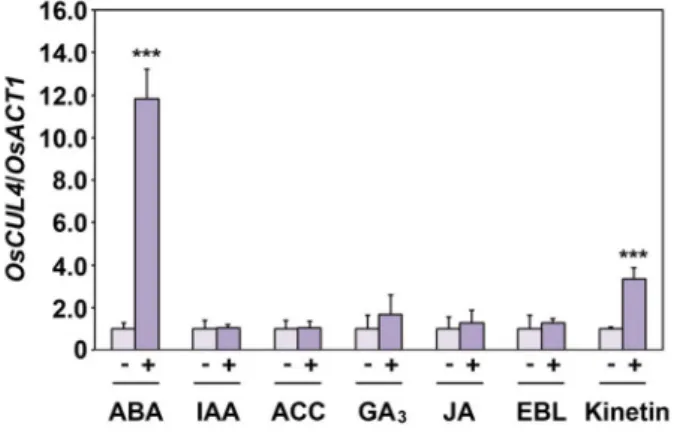
Fig. 4. OsCUL4 expression in response to various phytohor- mones. Three-day-old seedlings were kept for 6 hr in MS liquid media including 50 μM ABA, 10 μM (IAA), 10 μM ACC, 30 μM GA

3

, 50 μM JA, 1 μM EBL or 50 μM kinetin. Accumulations of OsCUL4 transcripts were normalized to those of OsACT1 transcripts from the same sample. The average expression value of OsCUL4 from each mock-treated sample was considered to be 1.0. Values are the means ± SD (n≥6). Significant differ- ences between mock-treated and hormone-treated sam- ples were identified by a Student’s t test; *p<0.05;

***p<0.001.

volved in leaf and root development in Arabidopsis [1]. It has been reported that cul4cs (CUL4 cosuppression line), which possesses reduced levels of CUL4, exhibited hyper- sensitivity to 0.1 μM ABA, indicating CUL4’s role in ABA- mediated cellular responses [4, 18]. This result may explain high expression of OsCUL4 in seeds in which ABA is abun- dant (Fig. 3).

Accumulation pattern of OsCUL4 transcripts by diverse phytohormone treatments

We next investigated the expression pattern of OsCUL4 by the treatment of various phytohormones. In the case of kinetin, a kind of cytokinin, its treatment resulted in marked increase of OsCUL4 transcripts (Fig. 4). The upregulation of OsCUL4 in response to cytokinin is in keeping with the re- sult from Lee et al. (2008) that functional defect of Arabidopsis CUL4 (AtCUL4) led to increased sensitivity in response to cytokinin and hyper-induction of cytokinin-responsive genes, suggesting the functional relationship between AtCUL4 and cytokinin signaling [18]. In agreement with high expression in seeds, OsCUL4 was strongly upregulated by exogenous ABA application (Fig. 4). In Arabidopsis, there have been sev- eral evidences on possible involvement of CRL4 in ABA- mediated processes. A subset of DCAF proteins (substrate receptors of CRL4 complex) such as DWA1, DWA2, DWA3,

ABD1, ASG2 and AtRAE1 were reported as a negative regu- lator in ABA signal transduction pathway [5, 19, 20, 22, 26].

Although CRL4 complex is typically composed of DDB1, RBX1 and DCAF, CUL4 is also able to associate with another type of complex, COP10-DET1-DDB1 (CDD) that has been proposed to promote target recognition by CRL4 [4]. A re- cent report shows that DDA1, a substrate receptor for CRL4- CDD complexes, is responsible for degradation of ABA re- ceptor and therefore, plays a repressive role in ABA signal- ing [13]. Furthermore, OsDET1, an Arabidopsis DET1 homo- log as a component of CRL4-CDD complexes is known to regulates ABA signaling/biosynthesis in rice [31]. Collectively, these reports reveal that a large fraction of CRL4 complexes participates in ABA signaling pathway, reflecting the func- tional connection between CUL4 and ABA response, which is in collusion with OsCUL4 upregulation by ABA in our study (Fig. 4).

Accumulation pattern of OsCUL4 transcripts by diverse abiotic stresses

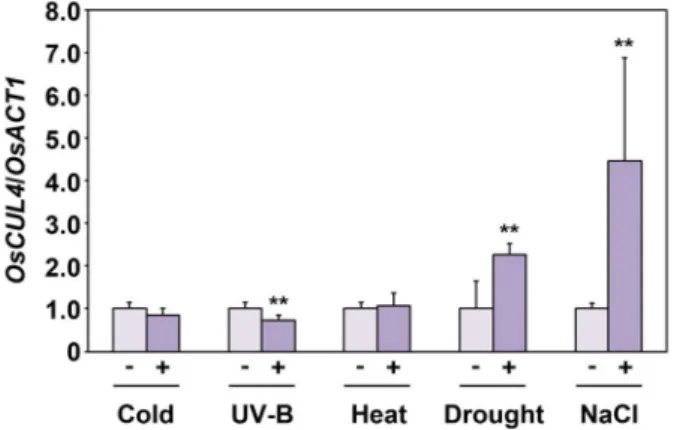
The expression pattern of OsCUL4 in response to various abiotic stresses is also elucidated to further understand its function in rice. As shown in Fig. 5, OsCUL4 was upregu- lated in response to drought and 250 mM NaCl treatments.

Since drought and high salt stresses trigger increase of en- dogenous ABA level, this result confirms ABA-inducibility of OsCUL4 gene. On the other hand, UV-B significantly in- hibits the expression of OsCUL4, suggesting that CUL4- mediated ubiquitination process is involved in UV-B re- sponse as well as ABA (Fig. 5). Similar with the case in ABA signaling, it has been reported that several CRL4 substrate receptors such as RUP1/2, DHU1, CSAat1A/B and DDB2 play their roles in UV-B signaling in Arabidopsis. RUP1 and RUP2 function as negative regulators of the UV-B specific response by repressing UVR8-COP1 interaction via inter- action with UVR8 as UV-B receptor [8, 9]. DHU1 also acts as a negative regulator of UV-B response via possibly se- questering COP1 from the active UVR8-COP1 complex [14, 15]. CSAat1A and CSAat1B proteins form heterotetramers and associate with CRL4 complex to play their role in toler- ance process against UV-B-triggered DNA damage [32].

CSAat1A also acts together with DDB2 for UV-B-triggered

DNA damage repair [2]. Taken together, these results in-

dicate that a part of CUL4-based E3 ligase complexes medi-

ated by a subset of DCAF proteins is important for UV-B

response, which is in collusion with altered expression of

(6)

Fig. 5. OsCUL4 expression by the treatment of various abiotic stresses such as cold, heat, UV-B, drought and salt stresses. Accumulations of OsCUL4 transcripts were nor- malized to those of OsACT1 transcripts from the same sample. The average expression value of OsCUL4 from each mock-treated sample was considered to be 1.0.

Values are the means ± SD (n≥6). Significant differences between mock-treated and stress-treated samples were identified by a Student’s t test; **p<0.01.

OsCUL4 in response to UV-B, in our data (Fig. 5).

Expression analysis of OsCUL4 gene from this study is thought to serve as a jumping-off point to further under- stand CUL4’s detailed action mode and CRL4-mediated cel- lular processes in rice. Based on several reports with loss-of- function mutants of Arabidopsis CUL4 gene, functional defect of OsCUL4 is expected to give rise to alteration of sensitiv- ities in response to diverse hormones and abiotic stresses in rice. Therefore, to elucidate the biological role of rice CUL4 in more detail, a phenotype study using transgenic plants with altered expression level of OsCUL4 gene would be required, which enables to predict the involvement of OsCUL4 in specific hormones and/or abiotic stresses signal- ing.

Acknowledgements

This research was supported by the Basic Science Research Program through the National Research Foundation of Korea (NRF) funded by the Ministry of Education (NRF- 2016R1D1A1B03930213), and by Korea Institute of Planning and Evaluation for Technology in Food, Agriculture, Fores- try and Fisheries (IPET) through Agri-Bio industry Technol- ogy Development Program funded by Ministry of Agricul- ture, Food and Rural Affairs (MAFRA) (115081-2).

References

1. Bernhardt, A., Lechner, E., Hano, P., Schade, V., Dieterle, M., Anders, M., Dubin, M. J., Benvenuto, G., Bowler, C., Genschik, P. and Hellmann, H. 2006. CUL4 associates with DDB1 and DET1 and its downregulation affects diverse as- pects of development in Arabidopsis thaliana. Plant J. 47, 591-603.

2. Biedermann, S. and Hellmann, H. 2010. The DDB1a interact- ing proteins ATCSA-1 and DDB2 are critical factors for UV-B tolerance and genomic integrity in Arabidopsis thaliana.

Plant J. 62, 404-415.

3. Callis, J. 2014. The ubiquitination machinery of the ubiquitin system. Arabidopsis Book 12, e0174.

4. Chen, H., Shen, Y., Tang, X., Yu, L., Wang, J., Guo, L., Zhang, Y., Zhang, H., Feng, S., Strickland, E., Zheng, N. and Deng, X. W. 2006. Arabidopsis CULLIN4 forms an E3 ubiquitin li- gase with RBX1 and the CDD complex in mediating light control of development. Plant Cell 18, 1991-2004.

5. Dutilleul, C., Ribeiro, I., Blanc, N., Nezames, C. D., Deng, X. W., Zglobicki, P., Palacio Barrera, A. M., Atehortùa, L., Courtois, M., Labas, V., Giglioli-Guivarc'h, N. and Ducos, E. 2016. ASG2 is a farnesylated DWD protein that acts as ABA negative regulator in Arabidopsis. Plant Cell Environ.

39, 185-198.

6. Gagne, J. M., Downes, B. P., Shiu, S. H., Durski, A. M. and Vierstra, R. D. 2002. The F-box subunit of the SCF E3 com- plex is encoded by a diverse superfamily of genes in Arabidopsis. Proc. Natl. Acad. Sci. USA. 99, 11519-11524.

7. Gingerich, D. J., Gagne, J. M., Salter, D. W., Hellmann, H., Estelle, M., Ma, L. and Vierstra, R. D. 2005. Cullins 3a and 3b assemble with members of the broad complex/tram- track/bric-a-brac (BTB) protein family to form essential ubiquitin-protein ligases (E3s) in Arabidopsis. J. Biol. Chem.

280, 18810-18821.

8. Gruber, H., Heijde, M., Heller, W., Albert, A., Seidlitz, H.

K. and Ulm, R. 2010. Negative feedback regulation of UV-B-induced photomorphogenesis and stress acclimation in Arabidopsis. Proc. Natl. Acad. Sci. USA. 107, 20132-20137.

9. Heijde, M. and Ulm, R. 2013. Reversion of the Arabidopsis UV-B photoreceptor UVR8 to the homodimeric ground state. Proc. Natl. Acad. Sci. USA. 110, 1113-1118.

10. Hotton, S. K. and Callis, J. 2008. Regulation of cullin RING ligases. Annu. Rev. Plant Biol. 59, 467-489.

11. Hua, Z. and Vierstra, R. D. 2011. The cullin-RING ubiq- uitin-protein ligases. Annu. Rev. Plant Biol. 62, 299-334.

12. Iconomou, M. and Saunders, D. N. 2016. Systematic ap- proaches to identify E3 ligase substrates. Biochem. J. 473, 4083-4101.

13. Irigoyen, M. L., Iniesto, E., Rodriguez, L., Puga, M. I.,

Yanagawa, Y., Pick, E., Strickland, E., Paz-Ares, J., Wei, N.,

De Jaeger, G., Rodriguez, P. L., Deng, X. W. and Rubio,

V. 2014. Targeted degradation of abscisic acid receptors is

mediated by the ubiquitin ligase substrate adaptor DDA1

in Arabidopsis. Plant Cell 26, 712-728.

(7)

14. Kim, S. H., Kim, H., Chung, S. and Lee, J. H. 2017. DHU1 negatively regulates UV-B signaling via its direct interaction with COP1 and RUP1. Biochem. Biophys. Res. Commun. 491, 285-290.

15. Kim, S. H., Kim, H., Seo, K. I., Kim, S. H., Chung, S., Huang, X., Yang, P., Deng, X. W. and Lee, J. H. 2014. DWD HYPERSENSITIVE TO UV-B 1 is negatively involved in UV-B mediated cellular responses in Arabidopsis. Plant Mol.

Biol. 86, 571-583.

16. Kim, S. H., Woo, O. G., Jang, H. S. and Lee, J. H. 2018.

Characterization and comparative expression analysis of CUL1 genes in rice. Genes Genom. 40, 233-241.

17. Lee, J. H. and Kim, W. T. 2011. Regulation of abiotic stress signal transduction by E3 ubiquitin ligases in Arabidopsis.

Mol. Cells 31, 201-208.

18. Lee, J. H., Terzaghi, W., Gusmaroli, G., Charron, J. B., Yoon, H. J., Chen, H., He, Y. J., Xiong, Y. and Deng, X. W. 2008.

Characterization of Arabidopsis and rice DWD proteins and their roles as substrate receptors for CUL4-RING E3 ubiq- uitin ligases. Plant Cell 20, 152-167.

19. Lee, J. H., Terzaghi, W. and Deng, X. W. 2011. DWA3, an Arabidopsis DWD protein, acts as a negative regulator in ABA signal transduction. Plant Sci. 180, 352-357.

20. Lee, J. H., Yoon, H. J., Terzaghi, W., Martinez, C., Dai, M., Li, J., Byun, M. O. and Deng, X. W. 2010. DWA1 and DWA2, two Arabidopsis DWD protein components of CUL4-based E3 ligases, act together as negative regulators in ABA signal transduction. Plant Cell 22, 1716-1732.

21. Lee, J. H. 2016. Structure and biological function of plant CRL4, and its involvement in plant cellular events. J. Life Sci. 26, 364-375.

22. Li, D., Zhang, L., Li, X., Kong, X., Wang, X., Li, Y., Liu, Z., Wang, J., Li, X. and Yang, Y. 2018. AtRAE1 is involved in degradation of ABA receptor RCAR1 and negatively reg- ulates ABA signalling in Arabidopsis. Plant Cell Environ. 41, 231-244.

23. Oñate-Sánchez, L. and Vicente-Carbajosa, J. 2008. DNA-free RNA isolation protocols for Arabidopsis thaliana, including seeds and siliques. BMC Res. Notes 1, 93.

24. Petroski, M. D. and Deshaies, R. J. 2005. Function and regu-

lation of cullin-RING ubiquitin ligases. Nat. Rev. Mol. Cell Biol. 6, 9-20.

25. Rice, P., Longden, I. and Bleasby, A. 2000. EMBOSS: The European Molecular Biology Open Software Suite. Trends Genet. 16, 276-277.

26. Seo, K. I., Lee, J. H., Nezames, C. D., Zhong, S., Song, E., Byun, M. O. and Deng, X. W. 2014. ABD1 is an Arabidopsis DCAF substrate receptor for CUL4-DDB1-based E3 ligases that acts as a negative regulator of abscisic acid signaling.

Plant Cell 26, 695-711.

27. Tamura, K., Stecher, G., Peterson, D., Filipski, A. and Kumar, S. 2013. MEGA6: molecular evolutionary genetics analysis version 6.0. Mol. Biol. Evol. 30, 2725-2729.

28. Vierstra, R. D. 2009. The ubiquitin-26S proteasome system at the nexus of plant biology. Nat. Rev. Mol. Cell Biol. 10, 385-397.

29. Wang, S., Liu, J., Feng, Y., Niu, X., Giovannoni, J. and Liu, Y. 2008. Altered plastid levels and potential for improved fruit nutrient content by downregulation of the tomato DDB1-interacting protein CUL4. Plant J. 55, 89-103.

30. Xu, G., Ma, H., Nei, M. and Kong, H. 2009. Evolution of F-box genes in plants: different modes of sequence di- vergence and their relationships with functional diversifica- tion. Proc. Natl. Acad. Sci. USA. 106, 835-840.

31. Zang, G., Zou, H., Zhang, Y., Xiang, Z., Huang, J., Luo, L., Wang, C., Lei, K., Li, X., Song, D., Din, A. U. and Wang, G. 2016. The De-Etiolated 1 homolog of Arabidopsis modu- lates the ABA signaling pathway and ABA biosynthesis in rice. Plant Physiol. 171, 1259-1276.

32. Zhang, C., Guo, H., Zhang, J., Guo, G., Schumaker, K. S.

and Guo, Y. 2010. Arabidopsis cockayne syndrome A-like proteins 1A and 1B form a complex with CULLIN4 and damage DNA binding protein 1A and regulate the response to UV irradiation. Plant Cell 22, 2353-2369.

33. Zhang, Y., Feng, S., Chen, F., Chen, H., Wang, J., McCall,

C., Xiong, Y. and Deng, X. W. 2008. Arabidopsis DDB1-CUL4

ASSOCIATED FACTOR1 forms a nuclear E3 ubiquitin li-

gase with DDB1 and CUL4 that is involved in multiple plant

developmental processes. Plant Cell 20, 1437-1455.

(8)

초록:벼에 존재하는 CRL4 복합체 scaffold 유전자의 발현 양상에 대한 연구

배유원

1

․김하니

1,2

․김상훈

1

․이재훈

1

*

(

1

부산대학교 생물교육과,

2

부산대학교 일반대학원 생명시스템학과)

진핵생물에서 유비퀴틴화 과정을 통해 단백질 안정성이 조절되며, E3 ligase는 유비퀴틴화 과정 동안 분해 대상

기질의 결정 및 기질로의 유비퀴틴 전달을 위한 주효소로 작용한다. Multi-subunit E3 ligase의 일종인 cullin4

(CUL4)-based E3 ligase (CRL4) 복합체는 식물의 다양한 호르몬, 스트레스와 관련된 세포 내 과정에서 중요한 역

할을 하는 것으로 알려져 있다. 호르몬, 스트레스 신호 전달 과정에서 CRL4의 다양한 역할에 대한 보고가 애기장

대에서 이루어져 왔음에도 불구하고, 주요 식량 작물인 벼에서의 CRL4 기능에 대한 연구는 매우 미흡한 실정이

다. 이에 벼에서 CRL4에 의해 매개되는 세포 내 반응들을 상세히 이해하기 위해, 본 연구에서는 애기장대 cullin4

(CUL4)의 상동 유전자를 벼에서 동정하고, 조직별 벼 CUL4 유전자의 발현 양상과 다양한 식물 호르몬 및 환경

스트레스 처리에 의한 해당 유전자의 발현 양상을 탐색하였다. 벼 CUL4 유전자인 OsCUL4는 앱시스산, 사이토키

닌과 같은 식물 호르몬과 가뭄, 고염 스트레스에 의해 발현량이 급격히 상형 조절되는 양상을 보였는데 이는 해당

단백질이 앱시스산 및 사이토키닌에 의해 매개되는 세포 내 반응과 기능적으로 연계되어 있음을 암시한다. 또한,

OsCUL4는 CRL4 복합체의 어댑터로 작용하는 OsDDB1과 직접적으로 결합하였는데, 이는 본 연구를 통해 동정한

OsCUL4가 벼에서 실질적으로 CRL4의 scaffold 단백질로 기능할 수 있음을 보여준다. 본 연구를 통해 수행된

OsCUL4 유전자의 발현 양상에 대한 연구는, 벼에서 CRL4 매개 유비퀴틴화 과정이 관여하는 세포 내 반응을 규명

하기 위한 시작점으로 활용될 수 있을 것이라 사료된다.

수치

Fig.  1.  Identification  of  rice  CUL4  gene.  (A)  Schematic  structure  of  OsCUL4
Fig.  2.  Direct  interaction  of  OsCUL4  with  OsDDB1.
Fig.  4.  OsCUL4  expression  in  response  to  various  phytohor- phytohor-mones.  Three-day-old  seedlings  were  kept  for  6  hr  in  MS  liquid  media  including  50  μM  ABA,  10  μM  (IAA),  10  μM  ACC,  30  μM  GA 3 ,  50  μM  JA,  1  μM  EBL  or
Fig.  5.  OsCUL4  expression  by  the  treatment  of  various  abiotic  stresses  such  as  cold,  heat,  UV-B,  drought  and  salt  stresses

참조

관련 문서

Ross: As my lawfully wedded wife, in sickness and in health, until

다양한 번역 작품과 번역에 관한 책을 읽는 것은 단순히 다른 시대와 언어, 문화의 교류를 넘어 지구촌이 서로 이해하고 하나가

The index is calculated with the latest 5-year auction data of 400 selected Classic, Modern, and Contemporary Chinese painting artists from major auction houses..

“Challenges and Opportunities for Enhancing Rice Production in Nepal.” Rice Science and Technology in Nepal.. Crop Development Directorate and Agronomy Society

Distribution of Cd in stream sediments, paddy soils, rice stalks and grains from the Kubong

To learn about the necessity of textile art education and tapestry technique, to study the value of tapestry education and to utilize it in art education

This study aims to increase the understanding of textbooks, analyzing the contents that the singing/instrumental music activities in the Expression Area in

Results : The expression of p21 was increased in boderline serous tumor and serous cystadenocarcinoma in contrast to benign serous tumors. The expression of