1. INTRODUCTION
In the past few years, tourism in Vietnam has grown rapidly due to its incredible landscapes, treasured cultural heritage and natural resources (Vietnam Tourism Marketing Strategy to 2020 and Action Plan, 2013). International tourists to Vietnam increased by 10% compared to 2014 to nearly 8 million visi- tors in 2015 accordingly to the Vietnam national admini- stration of tourism.
In Vietnam, besides various attractions, tourism also replies upon local cuisine, which plays a central role in Vietnamese lifestyle. Thus Vietnam focuses on developing tourism to be
related to the social culture of its local delicacies (Responsible Tourism for the F&B Sector in Vietnam, 2013). A significant motivational factor for international tourists to visit Vietnam has been its cuisine, which is based on the variety combi- nation among fresh and delicious ingredients. Hanoi is one of the famous destinations and should be visited because it lies at the heart of Vietnam’s cultural center that has been cultivated over historical sites as well as the intangible cultural heritage (Giang, 2013). In addition to these major magnificent attractions, Hanoi also has a famous reputation for its variety of traditional local cuisine such as Bun Cha, Banh Cuon, Pho and Banh My. Therefore, food tours have been increasing in Information available at the Culinary Society of Korea (http://www.culinary.re.kr/)
Culinary Science & Hospitality Research
Journal & Article Management System: https://cshr.jams.or.kr/
http://dx.doi.org/10.20878/cshr.2017.23.6.008
The Relationships among Food Image, Tourist Satisfactions and Destination Loyalty Intention: A Case of Hanoi Local Cuisine
Minh Tu
1, Kwang-Woo Lee
1and Soo-Han Park
21
Department of Tourism Management, College of Economics and Business Administration, Daegu University
2
Department of Hospitality & Tourism Management, The Graduate School, Sejong University
KEYWORDS ABSTRACT
Food image, Local food, Tourist satisfaction, Destination loyalty intention, Hanoi .
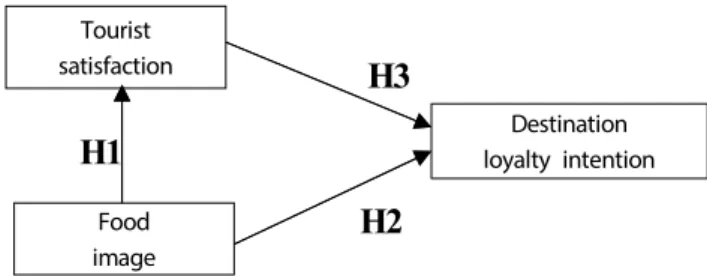
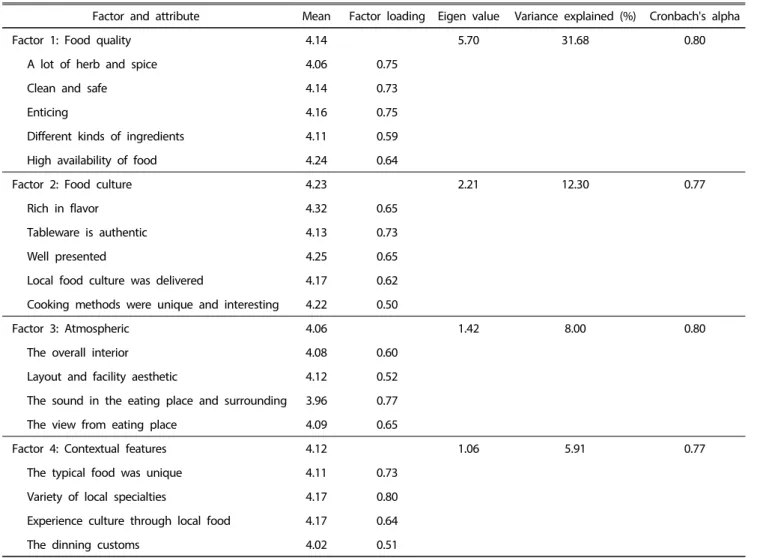
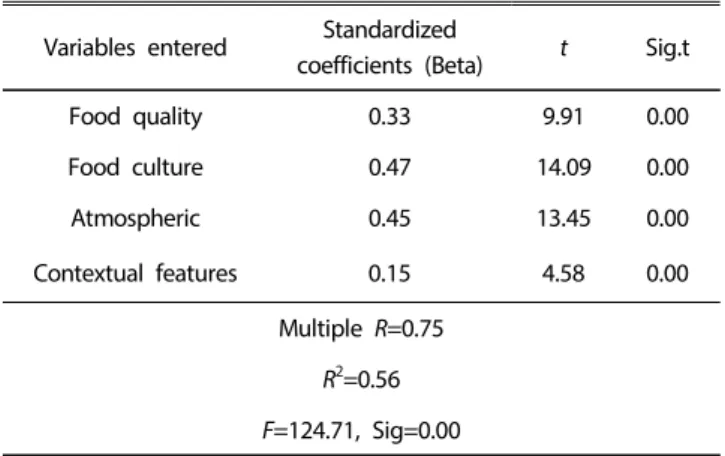
The purpose of this study was to examine tourist satisfaction towards Hanoi local food image as well as examine the relationship between those two variables with tourist destination loyalty inten- tion. A self-administered survey was carried out in Hanoi, Vietnam. Of the distributed 400 question- naires, a total 393 respondents of foreign tourists were used to data analysis by a convenience sampling method. Factor analysis was performed to identify underlying dimensions of what foreign tourists expect most from Hanoi local food image. The results showed that foreign tourist perceived Hanoi local food image as, food quality, food culture, contexture features and atmospheric. The finding showed that Hanoi local food image had a direct effect on foreign tourist’s satisfaction and destination loyalty intention. In addition, tourist satisfaction had a positive influence on destination loyalty intention. At last, considering the results from this study, it is suggested that it is necessary to create and maintain the identity of image by formulating appropriate strategies and it is instrumental to promote local food image based on its distinctiveness and diversity which stands for the unique native culture.
*