KOREAN JOURNAL OF APPLIED ENTOMOLOGY
한응곤지 51(3): 245~253 (2012) ⓒ The Korean Society of Applied Entomology
Kor. J. Appl. Entomol.
DOI: http://dx.doi.org/10.5656/KSAE.2012.06.0.035
벤질리덴아세톤 유도 화합물들의 곤충면역반응 억제와 살균력 비교 분석
서삼열ㆍ천원수ㆍ홍용표
1
ㆍ이영근ㆍ김용균*안동대학교 자연과학대학 생명자원과학과
1안동대학교 자연과학대학 응용화학과
Comparative Analysis of Benzylideneacetone-derived Compounds on Insect Immunosuppressive and Antimicrobial Activities
Samyeol Seo, Wonsu Chun, Yongpyo Hong
1
, Youngkeun Yi and Yonggyun Kim*Department of Bioresource Sciences, Andong National University, Andong 760-749, Korea
1
Department of Applied Chemistry, Andong National University, Andong 760-749, Korea
ABSTRACT: Benzylinedeneacetone (BZA) is a bacterial metabolite which is synthesized by at least two entomopathogenic bacteria, namely Xenorhabdus nematophila and Photorhabdus temperata subsp. temperata. It has been shown to possess inhibitory effects on insect cellular and humoral immune responses as well as antimicrobial activities against various species of bacteria and fungi. However, its relatively high phytotoxicity, and nonsystematic effect have thus far prevented its development into an optimal pesticide. This study screened five different BZA derivatives in order to select an optimal compound, which would have relatively high solubility and low phytotoxicity while retaining sufficient degrees of the immunosuppressive and antimicrobial activities associated with BZA.
Hydroxylation of the benzene ring of BZA was found to significantly suppress its immunosuppressive and antimicrobial activities.
Transformation of the ketone of BZA by carboxylation also suppressed the inhibitory activities. However, a shortening of the aliphatic chain of BZA into acetate form (4-hydroxyphenylacetic acid: HPA) did not decrease the inhibitory activity. HPA also showed much less phytotoxicity against the hot pepper plant Capsicum annuum, when compared to BZA. This study identified an optimal BZA derivative, which exhibited relatively little phytotoxicity, but retained a high degree of inhibitory activity to suppress insect immune responses and antimicrobial activities against plant pathogens.
Key words: Benzylideneacetone, Immune, Antimicrobial activity, Phytotoxicity, Plutella xylostella
초 록:
벤질리덴아세톤(benzylinedeneacetone: BZA)은 두 곤충병원세균인 Xenorhabdus nematophila와 Photorhabdus temperata subsp.
temperata에서 유래된 대사산물의 일종이다. 이 물질은 곤충의 세포성 및 체액성 면역반응을 억제하며 또한 다양한 세균이나 곰팡이에 대해 항생효 과를 갖고 있다. 그러나 이 물질이 갖는 비교적 높은 약해와 낮은 식물체 침투력은 효과적 농약으로 개발하는 데 어려움을 주고 있다. 본 연구에서는 다섯 개의 서로 다른 BZA 유사체를 스크리닝하여 면역억제 및 항균활성을 유지하면서 비교적 용해도가 높고 약해가 낮은 물질을 선발하였다.
BZA 의 벤젠 고리에 수산기가 붙은 유도체는 면역억제 및 항균활성이 뚜렷이 낮아졌다. 또한 BZA의 케톤기를 카르복실기로 변형하면 면역억제 와 항균활성을 잃게 되었다. 그러나 BZA의 탄화수소 사슬을 짧게 하여 형성된 아세테이트 유도체인 4-hydroxyphenylacetic acid (HPA)는 면역 억제와 항균활성을 잃지 않았다. 또한 HPA는 BZA 보다 고추(Capsicum annuum)에 대해 약해가 낮은 것으로 나타났다. 이 연구는 낮은 약해를 유 발하면서 높은 곤충면역억제와 식물병원균에 대해 높은 항균활성을 보이는 BZA 유도체를 선발하였다.
검색어: 벤질리덴아세톤
,면역
,항균력
,약해
,배추좀나방
*Corresponding author: [email protected] Received May 7 2012; Revised June 14 2012 Accepted July 2 2012
공생세균과 종 특이적 공생관계를 갖는 곤충병원선충은 공생 세균과 특이적 병리적 생활환을 갖고 있다(Richards and Goodrich -Blair, 2009). 예를 들어, 곤충병원선충인 Steinernema carpocapsae 는 특이적으로 Xenorhabdus nematophila(Xn)의 공생세균을 갖고 있으며, 이와 비교하여 Heterorhabditis megidis는 Photorhabdus
temperata temperata (Ptt) 공생세균을 특이적으로 갖게 된다 (Akhurst, 1980; Kang et al., 2004). 감염태 선충이 대상 곤충을 찾고 개구부를 통해 혈강으로 침입하게 되면, 선충의 장내에 서 식하는 공생세균은 선충으로부터 나와 곤충 혈강에 자리 잡게 된다. 이때 이 세균은 자신과 선충을 공격하는 곤충의 면역작용 을 억제하게 된다. 면역방어 기작이 억제된 기주 곤충 체내에서 세균은 증식하여 패혈증을 일으켜 곤충을 치사시키고, 치사된 곤충 체내에서 선충이 증식하여 새로운 세대의 감염태 선충을 형성하고 다시 다른 곤충 기주를 찾게 된다. 따라서 곤충을 치 사시키는 궁극적 원인인 패혈증을 일으키는 인자가 세균이라 면, 선충은 이 세균을 운반하는 숙주로서 작용하게 된다. 여기 서 곤충의 면역억제 유도는 이들의 병리 생활환을 이루는 데 필 수적으로 선행되어야 하는 단계이고, 이에 대한 원인으로서 곤 충 면역 중개인자인 아이코사노이드 생합성 억제가 주목받아 왔다(Park and Kim, 2000; Stanley and Kim, 2011).
벤질리덴아세톤(benzylideneacetone: BZA)은 Xn과 Ptt 곤 충병원세균이 합성하여 분비하는 물질이다(Seo et al., 2012).
BZA는 탄소수 10개의 모노터핀 구조의 화합물이며, 다양한 세 균에 대한 항생능력을 지닌 것으로 알려지고 있다(Ji et al., 2004).
특별히 곤충의 면역에 중요한 중개물질인 아이코사노이드의 생합성 억제자로서 알려지면서 해충방제에 응용을 꾀하게 되 었다(Shrestha and Kim, 2008).
BZA가 곤충 면역억제에 작용하는 기작은 이 물질이 아이코 사노이드 생합성의 첫 단계인 아라키노닉산(arachidonic acid) 을 유리하는 인지질분해효소 phospholipase A
2
(PLA2
)를 기질 과 경쟁적으로 활성부위에 작용하여 억제 작용을 발휘하는 데 기인한다(Shrestha and Kim, 2009). 아라키도닉산은 cyclooxygenase 나 lipoxygenase의 효소 작용에 의해 다양한 아이코사노이드류 를 생합성하게 된다. 이러한 아이코사노이드류는 혈구세포의 활착을 유도하여(Miller, 2005), 곤충의 세포성 면역반응인 식 균작용(Shrestha and Kim, 2008), 소낭형성(Miller et al., 1994), 피낭형성(Carton et al., 2002)에 관여하는 것으로 알려졌다. 또 한 체액성 면역작용에 관여하여 항생단백질의 합성을 유도하 였다(Yajima et al., 2003; Shrestha and Kim, 2009).BZA는 다양한 세균과 곰팡이에 대해서 항생능력을 소유하 고 있다(Ji et al., 2004). 특별히 BZA은 탄저병에 대한 억제 능 력을 지니는 것이 실내 및 야외 실험을 통해 입증되었다(Park et al., 2010). 그러나 이 물질은 2,000 ppm 이상의 높은 농도에서 는 식물체에 약해를 보이며 또한 낮은 침투 이행 능력으로 살균 제로서 개발에 어려움을 주고 있다. 이를 보완하기 위해 시도된 연구 전략이 이 화학구조의 변형을 통해 수용성을 높이고 약해 를 줄이는 방안이 검토되었다(Seo et al., 2011). 이때 수산기 또
는 포도당을 BZA의 벤젠고리 또는 사슬기 쪽에 붙이면서 활성 을 조사하였다. 그러나 모두 살충 및 항균 활성을 크게 잃어 목 적을 이루지 못했다. 본 연구는 사슬의 탄소수를 줄이면서 소수 성을 줄이는 방향으로 유도체를 선발하여 약효와 약해를 분석 하는 연구 전략을 세워 물질을 스크리닝하였다. 이러한 결과로 약효를 유지하면서 약해를 낮추는 유도체를 선발하게 되었다.
재료 및 방법
시험 곤충
배추좀나방(Plutella xylostella)은 안동시 송천동에 소재한 배추포장에서 채집한 유충을 약제 처리하지 않고 실내에서 누 대 사육한 것을 사용하였다. 유충은 온도 25±1℃, 광주기 16:8 h (L:D), 상대습도 40~60%의 조건에서 배추를 먹이로 사육하 였다. 성충은 10% 설탕물을 먹이로 공급하고 배추 잎을 이용하 여 산란을 유도하였다. 파밤나방(Spodoptera exigua)은 배추좀 나방과 같은 조건에서 인공사료(Goh et al., 1990)를 이용하여 Seo et al.(2011)의 방법으로 사육하였다.
시험 화합물
PLA
2
효소활성 측정에 사용된 1-hexadecanoyl-2-(1-pyrenedecanoyl) -sn-glycerol-3-phosphatidylcholine은 Molecular Probes(Eugene, OR, USA) 회사에서 구입하였다. 반면에 PLA2
측정에 이용된 다른 화합물인 bovine serum albumin (BSA), phenoloxidase (PO) 활성 측정에 L-3, 4-dihydroxyphenylalanine (DOPA), MTT 검 정에 thiazolyl blue tetrazolium bromide, 그리고 (E)-4-phenylbut -3-en-2-one acetic acid (benzylideneacetone: BZA), p-coumaric acid (PCA), 3-hydroxycinnamic acid (HCA), cinnamic acid(CIA), 3-phenylpropionic acid (PPA) 그리고 3-(p-hydroxyphenyl)-propionic acid (HPA)는 모두 Sigma-Aldrich Korea (Seoul, Korea)에서 구매하여 사용하였다.PLA2 효소활성 및 억제자 분석
PLA
2
효소활성의 측정은 형광물질 pyrene이 부착된 인지질 을 기질로 사용하여 형광분석법으로 측정하였다(Radvanyi et al., 1989). PLA2
효소는 파밤나방 5령충의 혈구세포로부터 추 출되었다. 간략하게, 약 1 mL의 파밤나방 혈림프로부터 혈구 를 분리하고, 400 μL의 인산완충용액(50 mM phosphate buffer saline, 0.7% NaCl, pH 7.4: PBS)으로 현탁액을 만들었다. 이후 초음파분쇄기(Sonopuls GM2070, Bendelin Inc., Berlin, Germany)로 단백질을 추출하였다. 추출된 단백질은 52 μg/mL의 농도를 지녔다. 기질은 99.5% 에탄올을 이용하여 10 mM로 조제하였 다. BSA는 PBS 용액을 이용하여 10%로 조제하였다. Tris 완충 용액(pH 7.0)은 증류수를 이용하여 50 mM로 조제하였다. 염 화칼슘은 증류수로 1 M을 조제하였다. BZA와 유도체는 dimethyl sulfoxide (DMSO)를 이용하여 1 M의 농도로 조제하였다. 반 응용액(2 mL)은 50 mM의 Tris 완충용액 1,900 ㎕, 50 μL의 효 소 추출액, 12 μL의 염화칼슘, 20 μL의 BSA, 그리고 10 ㎕의 억제자로 구성되었다. 억제자인 BZA와 그 유도체들은 0.1~
5,000 mM 농도로 첨가하여 5 분간 25℃에서 반응시켰다. 이후 20 μL기질을 첨가하고 2 분간 반응시켰으며 excitation 345 nm 와 emission 398 nm 조건에서 형광분광광도계(FA 257, Spectronic Instruments, Madison, WI, USA)를 이용하여 효소 반응을 측 정하였다.
PO 효소활성 및 억제자 분석
PO 활성 측정은 DOPA를 기질로 이용하여 측정하였다. 파 밤나방 유충에 Escherichia coli (5×10
4
cfu)와 농도별로 희석한 BZA 또는 그 유도체를 혈강에 주사하여 12 시간 후 혈림프를 채취하였다. 채취된 혈림프(300 μL)는 5,000 rpm 조건(4℃)에 서 10 분간 원심분리하여 혈구와 혈장으로 분리하였다. 분리된 혈구는 300 μL의 PBS로 혼합시킨 후 2 mL의 큐벳에 10 ㎕의 혈구 시료를 넣고 PBS에 용해된 DOPA (1 μg/㎕)를 990 ㎕ 첨 가하였다. 이후 3-5분 반응시간 간격으로 495 nm 조건에서 분 광광도계(Uvikon 930, Kontron, Ales, France)를 이용하여 흡 광도를 측정하였다.식물병원균 억제력 검정
BZA와 그 유도체를 DMSO를 사용하여 1,000 ppm의 농도 로 조제 후 증류수로 250 ppm과 500 ppm으로 희석하였다. 식 물병원성 곰팡이는 농촌진흥청 국립농업과학원 국립농업유전 자원센터(Suwon, Korea)로부터 분양받았으며, potato dextrose agar (PDA, Difco, New jersey, USA)를 이용하여 계대 배양하 였다. BZA와 그 유도체의 최종 농도가 각각 250 μg/mL과 500 μg/mL이 되도록 첨가한 PDA의 중앙에 직경 6 mm 크기의 고 추역병균(Phytophthora capsici)과 탄저병균(Colletotrichum acutatum)을 각각 PDA에 중앙에 직경 6 mm 크기의 병원곰팡 이의 콜로니를 접종한 후 28℃에서 7 일간 배양하였다. BZA와 이 유도체를 각각의 병원균에 3 반복으로 처리하였으며, 배양 된 균주의 직경을 BZA와 그 유도체를 함유하지 않은 PDA에서 배양된 곰팡이의 균주와 직경을 비교하였다.
세포독성 검정
파밤나방 혈구세포를 1×10
3
cell/mL을 96 well에 접종하여 2 일간 배양한 후 BZA와 유도체를 1 M로 조제하여 3~500 μ g/mL의 농도로 처리하였다. 처리 후 24 시간 배양 후, 50 μg/mL 의 thiazolyl blue tetrazolium bromide (MTT, Sigma-Aldrich Korea)가 포함되게 조제한 배지로 교체하여 28℃에서 4 시간 배양 후, 배양액을 제거한 후 1 mL의 DMSO를 첨가하여 분광 광도계(Infinite 200, Tecan, Männedorf, Switzerland)를 이용 하여 570 nm에서 흡광도를 측정하였다.살충력 검정
BZA와 그 유도체는 DMSO를 이용하여 10,000 ppm 으로 희석 후 증류수를 첨가하여 1,000 ppm으로 희석하였다. 생물 농약 Bacillus thuringiensis var. kurstaki (Bt)는 (주) 고려바이 오(Hwasung, Korea)로부터 공급받아 200 ppm의 농도로 첨가 하였다. 이 현탁액에 배춧잎(1 cm
2
)을 10 분간 침지시킨 후 여 과지가 깔려진 용기(직경 9 cm)에서 5 분간 건조시켰다. 각 배 춧잎에 배추좀나방 4령충을 10 마리씩 3 반복으로 처리하였으 며, 24 시간 주기로 5 일 동안 생존수를 계수하였다. 대조구는 Bt 또는 살균수로 상기와 동일하게 처리하였다.약해조사
안동시 남선면에 위치한 비닐하우스에서 3월 10일 정식된 춘금 품종의 배추(Hyundai Seed Inc., Yeoju, Korea)를 이용하 여 BZA 및 유도체들의 약해를 조사하였다. 약제제조 방법은 살충력 검정시 제조된 시약과 동일한 방법이며, 처리 농도는 0, 2,000, 3,000 그리고 4,000 ppm의 농도로 처리하였으며, 처리 후 24 시간마다 확인하였으며, 총 7 일간 조사하였다.
통계분석
모든 살충효과 실험결과는 백분율 자료로서 arsine 변환 후 SAS의 PROC GLM (SAS Institute, 1989)을 이용하여 ANOVA 분석 및 처리 평균 간 비교를 실시하였다.
결 과
BZA 유도체들 특성
수용성을 높이기 위해 BZA에 수산기를 첨가하는 방향으로 유도체를 선발하였다(Fig. 1). trans-cinnamic acid (CIA)는 베
benzylideneacetone (BZA) trans-cinnamic acid (CIA) trans-3-hydroxycinnamic acid (HCA)
p-coumaric acid (PCA) 3-phenylpropionic acid (PPA) 4-hydroxyphenylacetic acid (HPA)
Fig. 1.
Chemical structures of benzylideneacetone derivatives. All derivatives contain a carboxylic functional group. Derivatization is to increase hydrophilic property by adding hydroxyl group or shortening side chain length.
Inhibitor (M)
PL A
2ac tiv ity (pm ol /m in )
0 20 40 60 80 100
BZA PCA HCA CIA PPA HPA
0 10
-810
-710
-610
-510
-410
-3(A)
(B)
Inhibitors IC
50(M)
BZA 7.8 × 10
-5PCA 8.3 × 10
-4HCA 1.6 × 10
-2CIA 9.8 × 10
-3PPA 2.8 × 10
-4HPA 4.3 × 10
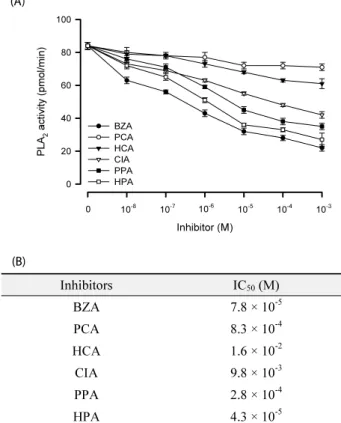
-5Fig. 2.
Inhibitory activities of benzylideneacetone (BZA) and its derivatives on enzyme activity of phospholipase A
2(PLA
2): p-coumaric acid (PCA), 3-hydroxycinnamic acid (HCA), cinnamic acid (CIA), 3-phenyl propionic acid (PPA), and 3-(p-hydroxyphenyl)-propionic acid (HPA). PLA
2was extracted from hemocytes of fifth instar larvae of Spodoptera exigua. (A) Dose-response. Each treatment was replicated three times. Error bars indicate standard deviations.
(B) Estimation of median inhibition concentration (IC
50) of each inhibitor.
이지색 결정이며, 녹는점은 133℃이며, 끓는점은 300℃, 인화 점은 100℃, 밀도는 1,248 g/cm
3
, 분자량은 148.16 g/mol이다.BZA와 비교했을 때 사슬 부위의 탄소하나를 줄이고 케톤기를 카르복실기로 전환된 형태를 지녔다. trans-3-hydroxycinnamic acid (HCA)는 베이지색 분말형태이며 녹는점은 193~195℃
이며, 분자량은 164.16 g/mol이다. 이 유도체는 CIA의 벤젠 고 리 3 번에 수산기를 붙인 것이 특징이다. p-coumaric acid (PCA)는 베이지색 분말 형태이며, 녹는점은 214℃이며, 분자 량은 153.15 g/mol이다. 이 유도체는 HCA의 벤젠 고리에 붙은 수산기를 4 번에 옮긴 형태이다. 3-phenylpropionic acid (PPA) 는 베이지색 결정이며, 녹는점은 45~48℃이며, 끓는점은 28 0℃이며, 인화점은 113℃이며, 분자량은 150.17 g/mol이다. 이 유도체는 CIA 사슬 부위에 있는 이중 결합을 없앤 포화 탄화수 소 구조이다. 4-hydroxyphenylacetic acid (HPA)는 베이지색 분말형태이며, 녹는점은 148~151℃이며, 분자량은 152.15 g/mol이다. 이 유도체는 PPA 보다 사슬 길이가 짧고(1개 탄소), 벤젠 고리 4번 위치에 수산기를 첨가한 형태이다.
BZA 유도체들의 면역 억제 능력 비교
곤충의 면역에 영향을 미치는 PLA
2
효소 활성에 BZA와 그 유도체들의 억제 효과를 분석하였다(Fig. 2). BZA와 모든 유도 체는 PLA2
효소활성을 억제시켰다(Fig. 2A). 이들 유도체들 가 운데 BZA, HPA, PPA, PCA, CIA 그리고 HCA 순으로 PLA2
억제력이 높게 나타났으며, 그 중 HPA의 반수치사농도(IC
50
)(A)
(B)
Inhibitors IC
50(M)
BZA 8.3 × 10
-6PCA 3.4 × 10
-1HCA 1.4 × 10
-2CIA 1.8 × 10
-5PPA 9.8 × 10
-5HPA 6.2 × 10
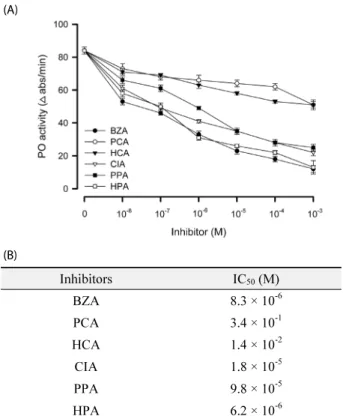
-6Fig. 3.
Inhibitory activities of benzylideneacetone (BZA) and its derivatives on enzyme activity of phenoloxidase (PO): p-coumaric acid (PCA), 3-hydroxycinnamic acid (HCA), cinnamic acid (CIA), 3-phenyl propionic acid (PPA), and 3-(p-hydroxyphenyl)-propionic acid (HPA). PO was extracted from hemocytes of fifth instar larvae of Spodoptera exigua. (A) Dose-response. Each treatment was replicated three times. Error bars indicate standard deviations. (B) Estimation of median inhibition concentration (IC
50) of each inhibitor.
Fig. 4.
Inhibitory activities of benzylideneacetone (BZA) and its derivatives on cellular immunity of fifth instar larvae of Spodoptera exigua: p-coumaric acid (PCA), 3-hydroxycinnamic acid (HCA), cinnamic acid (CIA), 3-phenyl propionic acid (PPA), and 3-(p- hydroxyphenyl)-propionic acid (HPA). (A) Hemocyte nodulation assay. (B) Hemocyte-spreading behavior. Each treatment was replicated three times. Error bars indicate standard deviations.
Different letters above standard deviation bars indicate significant difference among means for Type I error = 0.05 (LSD test).
가 BZA와 차이 없이 높은 억제 능력을 지니는 것으로 나타났다.
파밤나방 유충의 혈구 세포를 이용하여 BZA와 그 유도체들 의 PO 활성을 측정하였다(Fig. 3). BZA와 모든 유도체는 PO 효소활성을 억제시켰다(Fig. 2A). 그러나 이들의 효소 억제력 은 차등을 보여 BZA, HPA, CIA, PPA, HCA 그리고 PCA 순으 로 억제력이 강하게 나타났으며, HPA가 BZA와 유사하게 PO 활성 억제가 높은 것으로 나타났다.
파밤나방 유충의 혈구 세포를 이용하여 BZA와 그 유도체들 의 소낭형성을 측정하였다(Fig. 4A). BZA와 유도체들은 모두 파밤나방의 소낭형성 작용을 현격하게 억제시켰다. 그러나 이들 유도체들 사이에는 억제활성 차이를 보여 BZA, HPA, PPA, CIA, HCA 그리고 PCA 순으로 소낭형성 억제력이 높게 나타났 다. 이 BZA 유도체들 가운데에는 HPA가 가장 높은 억제력을 보 였다. 이러한 경향은 혈구소낭 반응을 유도하는 혈구 활착 반응 분석에서도 유사하게 나타났다(Fig. 4B). 소낭 형성과 마찬가지 로 HPA가 BZA와 유사하게 가장 높은 억제력을 보유하였다.
BZA 유도체들의 세포독성 비교
식물병원균에 대한 BZA와 유도체들의 항균력을 분석하였 다(Fig. 5). BZA와 이들 유도체들은 모두 탄저병균과 고추역병 균에 항균력을 보였다. 그러나 이들 사이에 항균력 차이를 보여 탄저병에 대해서는 HPA가 가장 높은 억제력을 보인 반면, 고 추역병균에 대해서는 CIA가 가장 높은 항균력을 보였다. 그러 나 모든 유도체들은 BZA와 같은 높은 항균을 나타내지 못했다.
파밤나방 혈구세포에 대해 BZA와 그 유도체들의 세포독성 을 검정하였다(Fig. 6). BZA와 모든 유도체들은 높은 세포 독 성을 나타냈다(Fig. 6A). 그러나 이들 사이에 세포독성 차이를 나타내, HPA가 BZA와 유사하게 가장 높은 세포 독성을 보였 다(Fig. 6B).
BZA 유도체들의 살충력 비교
Fig. 5.
Antibiotic activities of benzylideneacetone (BZA) and its derivatives on cellular immunity of fifth instar larvae of Spodoptera exigua: p-coumaric acid (PCA), 3-hydroxycinnamic acid (HCA), cinnamic acid (CIA), 3-phenyl propionic acid (PPA), and 3-(p- hydroxyphenyl)-propionic acid (HPA). All inhibitors were treated at 250 ppm and 500 ppm on PDA plate. (A) Inhibitory effects against hypal growth of Colletotrichum acutatum. (B) Inhibitory effects against hypal growth of Phytophthora capsici. Each treatment was replicated three times. Error bars indicate standard deviations.
Different letters above standard deviation bars indicate significant difference among means for Type I error = 0.05 (LSD test).
(A)
(B)
Inhibitors IC
50(M)
BZA 6.2 × 10
-6PCA 1.7 × 10
-2HCA 2.9 × 10
-1CIA 5.3 × 10
-4PPA 7.1 × 10
-5HPA 3.4 × 10
-6Fig. 6.
Cytotoxicity tests of benzylideneacetone (BZA) and its derivatives on hemocytes of fifth instar larvae of Spodoptera exigua using MTT assay: p-coumaric acid (PCA), 3-hydroxycinnamic acid (HCA), cinnamic acid (CIA), 3-phenyl propionic acid (PPA), and 3-(p-hydroxyphenyl)-propionic acid (HPA). PLA
2was extracted from hemocytes of fifth instar larvae of Spodoptera exigua. (A) Their relative cytotoxicity at 31.25 ppm. Each treatment was replicated three times. Error bars indicate standard deviations.
Different letters above standard deviation bars indicate significant difference among means for Type I error = 0.05 (LSD test). (B) Estimation of median inhibition concentration (IC
50) of each inhibitor.
Fig. 7.
Cooperative activities of benzylideneacetone (BZA) and its derivatives on insecticidal activity of Bacillus thuringiensis subsp.
kurstaki (Bt, 200 ppm) against last instar larvae of Plutella xylostella and Spodoptera exigua using MTT assay: p-coumaric acid (PCA), 3-hydroxycinnamic acid (HCA), cinnamic acid (CIA), 3-phenylpropionic acid (PPA), and 3-(p-hydroxyphenyl)-propionic acid (HPA). Mortality was measured at 2 days after treatment. Each treatment was replicated three times. Error bars indicate standard deviations.
Different letters above standard deviation bars indicate significant difference among means for Type I error = 0.05 (LSD test).
높은 면역 억제 효과를 응용하여 BZA와 그 유도체들의 Bt 살충력의 협력 효과를 배추좀나방 4령 유충을 대상으로 검정하 였다(Fig. 7). Bt (200 ppm) 생물농약 단독으로 처리하면 약 40%의 살충률을 나타냈지만, BZA와 혼합하면 약 70%의 살충 효과를 나타내 뚜렷한 협력 효과를 보였다. 다른 BZA 유도체 들도 이와 같은 Bt 살충력의 상승효과를 나타냈지만, 이 가운데 특별히 HPA와 혼합하여 처리하면 살충력이 BZA 혼합체와 유 사하게 가장 높게 나타났다.
BZA 유도체들의 약해 비교
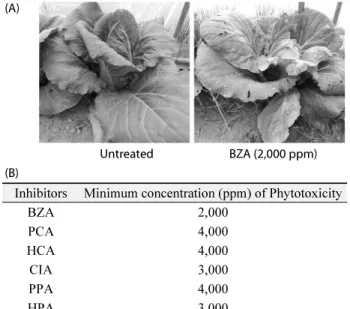
선행 연구(Park et al., 2010)에서 BZA에 대해 배추에 대해 약해가 알려졌다. 이 농도를 기준으로 분석 농도 범위를 정하고 BZA와 이 유도체들의 배추에 대한 약해 분석을 실시하였다 (Fig. 8). BZA는 2,000 ppm 이상의 농도에서 황화 반점 현상이 발생하였다(Fig. 8A). 유도체의 경우도 유사한 약해 증상을 보 였으나 이들의 약해 최저 농도는 BZA 보다 높은 농도에서 나 타났다(Fig. 8B).
(A)
Untreated BZA (2,000 ppm) (B)
Inhibitors Minimum concentration (ppm) of Phytotoxicity
BZA 2,000
PCA 4,000
HCA 4,000
CIA 3,000
PPA 4,000
HPA 3,000
Fig. 8.
Phytotoxicities of benzylideneacetone (BZA) and its derivatives on chinese cabbage: p-coumaric acid (PCA), 3-hydroxycinnamic acid (HCA), cinnamic acid (CIA), 3-phenyl propionic acid (PPA), and 3-(p-hydroxyphenyl)-propionic acid (HPA). Test concentrations used 0, 2,000, 3,000, 4,000, and 5,000 ppm. Each treatment was applied to 9 cabbages. Phytotoxicity was measured at 7 days after treatment. (A) A typical phytotoxic symptom showing yellow spots on leaves. (B) Determination of minimum concentration (ppm) of phytotoxicity of each inhibitor.
고 찰
본 연구는 곤충면역억제 물질인 BZA의 유용성 및 활성을 높 이려는 일련의 연구 과정의 하나로 진행되었다. 이전 연구에서는 BZA 구조를 변형시키지 않고 수산기를 벤젠 고리와 탄화수소 사 슬에 각각 붙이면서 수용성 증가와 면역억제 및 살충력의 증가를 꾀하였으나, 모든 유도체들이 BZA에 비해 현격하게 낮은 활성을 보였다. 본 연구는 다시 수산기를 첨가하는 유도체를 선발하되 BZA의 탄화수소 구조를 변형시키면서 진행하였다. 이러한 전략 으로 유도체들을 스크리닝한 결과 BZA와 유사한 유용 능력을 지 니면서 약해가 낮은 HPA 유도체를 선발하게 되었다.
HPA는 BZA와 유사하게 높은 PLA
2
효소 활성 억제 능력을 보였다. PLA2
억제 활성은 아이코사노이드 생합성 능력을 잃 게 하여 이들 아이코사노이드가 중개하는 면역 반응을 저하시 키게 된다. 아이코사노이드는 혈구활착 행동을 중개하기 때문 에(Miller, 2005; Srikanth et al., 2011) HPA는 BZA와 유사하 게 파밤나방 혈구 활착 반응 크게 억제한 것으로 사료된다. 또 한 아이코사노이드는 혈구응집 및 소낭형성을 중개하기 때문 에(Miller et al., 1994; Merchant et al., 2008) 이 물질의 생합성 을 억제하는 HPA는 혈구소낭 반응을 억제하는 것으로 해석된다. PO 활성은 곤충 혈장에서 세린계 단백질 분해효소의 활성 화로 불활성 전구체인 proPO가 단백질 가수분해를 통해 활성 화된 PO 단백질로 전환되면서 이뤄진다(Jiang and Kanost, 2000).
그러나 이에 앞서 proPO 단백질의 생성 장소인 편도혈구세포 로부터 혈장으로 분비가 이뤄져야 한다. 이 proPO 단백질이 세 포 밖으로 분비되려면 N 말단에 분비신호인 signal peptide가 존재하여야 하는 데 proPO는 이 신호를 가지고 있지 않다. 따라 서 이 단백질이 혈장으로 분비될 수 있는 방법은 편도혈구세포 의 붕괴를 통해 가능할 수 있다. 파밤나방의 경우 이러한 편도 혈구세포 붕괴는 바로 아이코사노이드에 의해 중개된다(Shrestha and Kim, 2008). 최근 이 아이코사노이드가 프로스타글란딘류 이며 이에 대한 G protein-coupled receptor의 세포막 수용체가 편도혈구세포에서 동정되었다(Shrestha et al., 2011). 따라서 HPA의 PO 활성 억제는 궁극적으로 프로스타글란딘류의 생합 성을 억제하는 데서 기인될 수 있다.
BZA의 면역억제 작용과 달리 세포독성에 대한 기작 연구는 거의 알려지지 않았다. 최근 곤충세포주인 Sf9 세포에 대해 BZA 가 약 7.3 μM의 농도에서 반수치사약량을 보였다(Seo et al., 2012). 본 연구는 파밤나방 혈구세포에 대해서 BZA가 6.2 μM에 서 반수치사약량을 보인 것으로 나타나 유사한 치사 약량을 나타 냈다. 유도체 가운데 가장 독성이 높은 HPA도 3.4 μM에서 BZA 와 유사하게 높은 세포독성을 곤충 혈구세포에 보였다. 그러나 이러한 치사작용 기작에 대해서는 아직 알려진 바가 없다. 한편 BZA는 Xn 세균 배양액에서 유래되었고, 이 세균은 혈구세포에 세포자연치사를 유발한다는 보고가 있다(Cho and Kim, 2004).
이 세균 배양액을 누에(Bombyx mori) 유충에서 채취된 혈구에 처리하면, DNA 절편화, 염색사의 응축, 핵막 붕괴 및 세포막 blebbing이 유발되는 전형적 아폽토시스 과정을 유발하게 된다 (Cho and Kim, 2004). 아직 분석되지 않았지만, BZA 및 HPA가 이러한 세포자연치사과정을 유발할 가능성을 제기하고 있다.
HPA는 고추의 주요 병원균인 고추탄저병균과 역병균에 대 해 균사생장을 억제시키는 효과를 나타냈다. 이는 기존의 BZA 의 식물병원세균에 대한 항생효과(Ji et al., 2004)와 연계되는 결과이다. 그러나 이들 물질이 어떠한 기작으로 병원균 성장을 억제하였는지는 아직 밝혀지지 않았다. 역병이 토양전염성 병 해이기 때문에, 지상부에 대한 약제 살포로는 병해방제 효과가 매우 낮아서 고추의 역병 방제는 주로 저항성품종 재배에 의존 하고 있다(Jeon et al., 2012). 하지만 이상의 연구 결과는 BZA 와 그 유도체들에 의해 고추의 역병 발병 후에도 지상부에 처리 하여 병 방제의 가능성을 제시하였다. 또한 BZA를 고추 모종 의 이식 전에 토양에 혼화 처리함으로서 역병의 발병률을 감소 시킬 수 있다는 연구 결과도 보고되었다(Park et al., 2010). 본
연구는 BZA에 비해 수용성이 높은 HPA가 토양에 처리될 경우 뿌리를 통해 식물체의 체내 이동도 높아지리라 추정하고 따라 서 방제 효과도 증가할 것으로 추정하고 있다.
BZA와 유사하게 HPA가 Bt의 병원력을 제고시켰다는 본 연 구의 결과는 HPA가 갖는 상대적 낮은 약해로 그 응용성을 높여 주고 있다. Bt는 그람양성균으로 곤충의 경구로 체내에 들어가 면 Bt의 내독소에 의해 독성이 나타나게 된다. 즉, 중장의 알칼 리 환경에서 용해된 내독소는 단백질 분해에 의해 활성화되고 중장의 미세융모의 세포막소낭에 존재하는 수용체에 결합하게 된다(Hoffman et al., 1988; Jenkins and Dean, 2000). 그로인해 세포막에 구멍을 형성하고 이후 중장마비(Gill et al., 1992) 및 세포치사(Zhang et al., 2008)로 이어지게 된다. 이러한 중장세 포의 치사로 인해 Bt 세균과 중장세균이 곤충의 혈강으로 침입 하게 되고 패혈증을 유발하여 결국 대상곤충을 치사시키게 된 다(Broderick et al., 2006). 이때 면역억제제인 HPA 또는 BZA 는 혈강으로 침입하는 Bt와 소화관내 세균을 방어하는 곤충의 면역을 억제시켜 Bt의 활성을 높여주는 것으로 추정된다(Jung and Kim, 2006).
기존에 HPA는 세균 또는 곰팡이 배양액으로부터 생성되는 것으로 보고되고 있다(Mao et al., 2006). 이 물질은 세포막에 대한 손상 효과로(Russell and Furr, 1996) 식물병원균에 대한 억제 및 살선충 효과가 보고되었다(Ko et al., 2009; Ohtani et al., 2011). 그러나 곤충에 대한 면역억제 효과 및 PLA
2
억제 효 과는 본 연구가 이 물질의 효능으로 최초로 보고되는 자료가 된 다. 이 물질을 이용한 새로운 병해충 방제용 신작물보호제의 개 발이 가능할 것으로 사료된다.사 사
본 연구는 2012년도 농촌진흥청 아젠다 사업(대과제명: 화 학농약 대체기술)으로부터 지원받아 수행하였다. 서삼열과 천 원수는 교육과학기술부 2단계 BK21 사업으로부터 지원받았다.
Literature Cited