2009년 서울지역 유통 한약재의 이산화황 잔류실태 분석
윤용태†·이성득·박애숙·신 영·김화순·김유경·최병현 서울시보건환경연구원
Analysis of Sulfur Dioxide Residue in Commercial Medicinal Herbs in Seoul (2009)
Yong Tae Yoon
†, Sung Deuk Lee, Ae Sook Park, Young Shin, Hwa Soon Kim, Yoo Kyung Kim and Byung Hyun Choi
Seoul Metropolitan Government Research Institute of Public Health and Environment, Gwacheon 427-070, Korea.
ABSTRACT : This study was conducted to investigate the content of sulfur dioxide residues in medicinal herbs in Seoul in 2009. Sulfur dioxide in the samples were determined by Monnier-Williams's modified method. A total of 1,821 samples of 205 different types of herbs were collected from Kyung-Dong Herb markets and Oriental medicine hospitals in Seoul. Of these samples, 642 samples were domestic, and 1,179 samples were imported. Of the 1,821 samples, 61 (3.3%, 31 types) failed to meet the regulations for sulfur dioxide residues of KFDA in medicinal herbs. Among these 61 unsuitable samples, 17 (7 types) were domestic, and 44 samples (26 types) were imported. The content of sulfur dioxide in the domestic medicinal herbs ranged from 0 to 809 ㎎ / ㎏ , while those in imported medicinal herbs ranged from 0 to 4,481 ㎎ / ㎏ . Approximately 84.6% of the samples contained less than 10 ㎎ / ㎏ of sulfur dioxide and about 10.0% of samples contained more than 30 ㎎ / ㎏ of sulfur dioxide.
Key Words : Sulfur Dioxide, Commercial Medicinal Herbs, Modified Monier-Williams Method
서 언
경제발전과 생활수준 향상으로 보다 건강하고 안정된 삶을 위해 질병치료와 더불어 건강증진에 비교적 부작용이 적은 생 약의 사용이 증가하고 있다 . 최근에는 상황버섯 발효식초의 항
암활성 (Chung et al. , 2010), 양마 잎의 항산화 활성 (Jin et
al. , 2010), 발효인삼의 항산화활성 (Doh et al. , 2010) 과 목향 추출물의 항비만 활성효과 (Yoon et al. , 2010) 등 생약의 생 리활성에 관한 보고가 활발하여 생약에 대한 관심이 더욱 높 아지고 있다 . 전통적으로 사용되는 한약재는 자생하는 식물에 서 직접 채취하여 사용하였으나 수요가 증가하면서 인공적으 로 재배하여 사용하게 됨에 따라 장기간의 보관에 관심을 갖 게 되었다 (Kim et al. , 2004). 한약재의 장기간 보존과 외관
품질 향상 및 빠른 건조를 위해 유황훈증 , 연탄건조 등의 방 법이 사용되고 있는데 , 이때 발생하는 아황산가스는 무색으로 자극성 있는 냄새를 가지고 있고 한약재의 변질 , 부패방지 , 표
백 , 갈변방지 및 충해방지 등의 목적으로 사용되고 있다 (Sin
et al. , 2004).
우리나라에서는 식품첨가물공전에는 무수아황산 (sulfur dioxide), 메타중아황산나트륨 (sodium metabisulfite), 메타중아 황산칼륨 (potassium metabisulfite), 산성아황산나트륨 (sodium bisulfite), 아황산나트륨 (sodium sulfite), 무수아황산나트륨
(sodium sulfite anhydrous), 차아황산나트륨 (sodium hydrosulfite) 6 종이 표백제 , 합성보존료 또는 산화방지제로 지정 고시되어
각각의 사용기준이 명시되어 있으며 (KFDA, 2002), 한약재의 경우 ‘ 식품의약품안전청고시 ( 제 2005-44 호 , 제 2008-3 호 , 제
2009-35 호 , 제 2009-104 호 )’ 로서 생약 등의 잔류이산화황 기준 및 시험방법을 제정고시하고 있다 .
아황산염의 표백작용은 시간의 흐름에 따라 환원 작용에 의 하여 복원되므로 일반적으로 과량의 아황산염류를 사용하며 ,
이로써 식품 중에는 다량의 아황산염이 남게 된다 . 아황산염은
생체내에서 빠르게 산화되어 황산염이 되고 아황산을 유리하 여 위장장애를 유발하거나 천식 , 기관지염 , 복부 불쾌감 , 두통 등의 부작용을 일으키는 것으로 알려져 있다 (Kang et al. ,
2001). 따라서 이들을 섭취하게 되면 인체에 유해한 영향을 줄
수 있기 때문에 국제식량농업기구 / 세계보건기구에서는 1 일 섭
†
Corresponding author: (Phone) +82-2-570-3423 (E-mail) [email protected]
Received 2010 August 27 / 1st Revised 2010 October 8 / 2nd Revised 2010 October 15 / Accepted 2010 October 16
(FAO/WHO, 1979), 미국 GRAS (Generally Recognized As Safe) 에서는 아황산염을 10 ppm 이상 함유하는 식품에는 잔류 량의 표시를 의무화하고 있다 (Taylor et al. , 1986).
아황산염의 측정법으로는 산증류 -HPLC 법 , Monier-Williams
변법 , Modified Rankine method, Ion Chromatography 등 여
러 방법들이 보고되고 있다 (Jung et al. , 2003). 국내에서도
한약재의 이산화황의 자연함유량에 관한 연구보고 (Kang et al. , 2001; Lee 2005) 와 잔류이산화황의 실태조사에 대한 연구 가 보고 되었다 (Kim et al ., 2007; Kim et al. , 2000; Kim
et al. , 2000; Kim et al. , 2004; Oh et al. , 2002). 식약청에 서는 2005 년 8 월 1 일 한약재 206 품목에 대하여 생약종류별로
30, 200, 500, 1000 및 1500 ppm 이하의 5 단계로 잔류이산
화황 개별기준을 설정하는 ‘ 생약의 잔류이산화황검사 기준 및
시험방법 ’ 을 제정 고시하여 (KFDA Notification No 2005-44,
2005) 시행하여 왔으나 서로 다른 기준으로 인해 생기는 불량
한약재의 유통이 문제가 되었다 . 생약의 안전성을 확보하기 위 해 2009 년 1 월 8 일부터 식약청에서는 보다 강화된 ‘ 생약의 잔 류이산화황 검사기준 및 시험방법 개정 ’ 에 의하여 한약재 266
품목에 대한 기준을 식품과 같은 30 ㎎ / ㎏ 이하로 통일하여 시행하고 있다 (KFDA Notification No 2008-3, 2008). 또한 , 2009 년 6 월 16 일부터는 ‘ 생약 등의 잔류 , 오염물질 기준 및 시험방법 ’ 에서 생약 등의 중금속 , 잔류농약 , 잔류이산화황 및 곰팡이독소 기준 및 시험방법 등을 정하여 생약 등의 품질관 리를 하고 있다 (KFDA Notification No 2009-35, 2009).
현재 우리나라에서는 건강 증진을 위한 한약재의 사용이 증 가하고 있으므로 유통 한약재의 안전성과 유효성을 확보할 수 있도록 강화된 품질관리가 필요하다 . 따라서 전국 한약재 소
비물량의 70% 이상을 공급하고 있는 경동약령시장과 각 자치
구 소재에서 유통 중인 한약재에 대한 이산화황 잔류량을 측 정하여 보다 품질 좋은 한약재 관리를 위한 기초자료를 제공 하고자 한다 .
재료 및 방법
1. 재료
2009 년 1 월부터 12 월까지 서울지역에서 유통되는 한약재
1,821 건 (205 품목 ) 을 시료로 사용하였다 . 1,821 건의 한약재 원 산지별 검사현황 및 검사건수는 Table 1 및 2 와 같았으며 , 국 내산은 갈근 등 89 품목 642 건으로 35.3% 를 차지하고 있으며 ,
수입산 한약재는 갈화 등 177 품목 1,179 건 64.7% 를 차지하고
있어 수입산 한약재가 더 다양하고 많은 물량이 유통되고 있 었다 . 1,821 건의 검사건수 중 자체수거가 1,492 건이었으며 , 서 울시 25 개 각 구청에서 329 건이 의뢰되었다 .
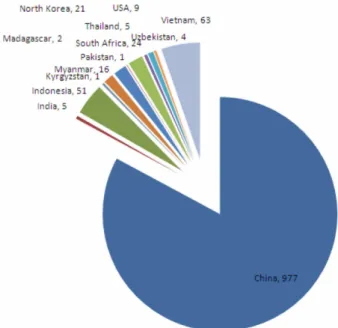
원산지별 검사현황은 모두 14 개국의 한약재가 수거검사 의
뢰 되었으며 , 중국산 한약재가 977 건으로 1,821 건 중 53.7%
를 차지하였고 국내산 한약재는 642 건 (35.3%), 베트남 63 건
(3.5%), 인도네시아 51 건 (2.8%), 남아프리카공화국 24 건
(1.3%) 등이었다 .
2. 시약
분석에 사용된 absolute ethanol, hydrochloric acid, hydrogen peroxide 등은 특급제품을 사용하였고 , 측정용 시약인 0.01N sodium hydroxide 는 Wako (Japan) 제품을 사용하였다 .
3. 기기 및 실험방법
Monier-Williams 변법 장치를 사용하여 한약재에 잔류하는 이산화황을 정량하였다 (KFDA Notification No 2009-35, 2009).
4. 회수율
표준품 아황산수소나트륨 (NaHSO
3) 을 대상으로 실험한 결 과 평균 90% 이상의 높은 결과를 얻었다 .
결과 및 고찰
1. 원산지 및 품목별 이산화황 잔류 실태
대한약전 (KFDA, 2008) 및 약전 외 한약 ( 생약 ) 규격집
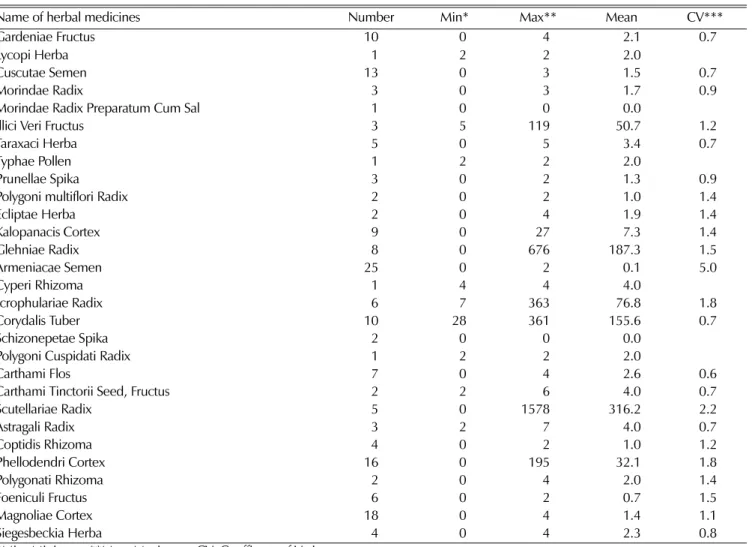
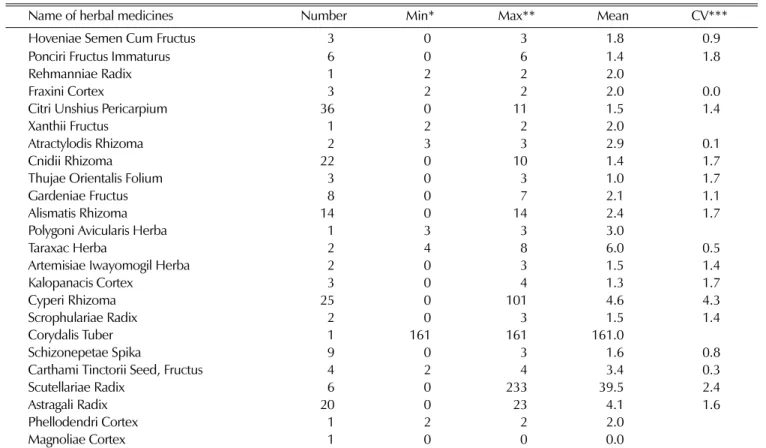
(KFDA, 2005) 에 있는 548 종 중 검사의뢰 된 한약재 1,821 건 에 대한 잔류이산화황 검출결과는 Table 4, 5, 6 과 같았다
국내산 한약재의 잔류이산화황 검출 평균은 산약 (333.2 Domestic/Imported Domestic Imported Total
Number (%) 642 (35.3) 1,179 (64.7) 1,821
Table 2.
Grouping of medicinal herbs for sample information 2 according to the request.
Request SIHE* District office Total Number (%) 1,492 (81.9) 329 (18.1) 1,821
* SIHE : Seoul Metropolitan Government Research Institute of Public Health and Environment.
Table 3.
Result of detection of sulfur dioxide residue in medicinal herb.
Domestic/Imported Not to pass Pass Number
Domestic 17 625 642
Imported 44 1,135 1,179
Total 61 1,760 1,821
Name of herbal medicines Number Min* Max** Mean CV***
Puerariae Radix 16 0 4481 387.0 0.0
Puerariae Flos 3 3 67 28.3 1.2
Chrysanthemi Flos 7 0 4 1.9 1.0
Glycyrrhizae Radix et Rhizoma 37 0 8 1.6 1.2
Glycyrrhizae Radix Preparata 2 2 3 2.5 0.3
Curcumae Longae Rhizoma 8 0 3 0.6 1.9
Sinapis Semen 7 0 23 10.7 0.9
Euryales Semen 2 0 0 0.0
Pharbitidis Semen 2 0 2 1.0 1.4
Cassiae Semen 1 5 5 5.0
Cinnamomi Ramulus 20 0 7 1.7 1.2
Cinnamomi Cortex 20 0 37 4.1 2.2
Spatholobi Caulis 9 0 124 18.7 2.2
Alpiniae Officinari Rhizoma 5 11 187 82.6 1.1
Angelicae Tenuissimae Radix 2 0 0 0.0
Sophorae Radix 9 0 3 0.6 2.0
Caraganae Radix 2 2 4 3.0 0.5
Drynariae Rhizoma 2 0 2 1.0 1.4
Agastachis Herba 4 0 6 3.0 0.8
Trichosanthis Radix 4 1094 2413 1522.3 0.4
Trichosanthis Semen 8 0 8 2.5 1.1
Pogostemonis Herba 7 0 7 3.1 0.9
Allii Tuberosi Semen 3 0 2 1.3 0.9
Cibotii Rhizoma 5 0 4 2.8 0.6
Lonicerae Flos 7 0 87 13.6 2.4
Platycodonis Radix 4 0 95 24.3 1.9
Raphani Semen 12 4 33 22.3 0.3
Salviae Miltiorrhizae Radix 5 5 2032 734.2 1.4
Codonopsis Pilosulae Radix 9 2 303 135.3 0.9
Cirsii Herba 3 0 25 9.7 1.4
Persicae Semen 21 0 2 0.3 2.5
Eucommiae Cortex Preparata Cum Sal 1 5 5 5.0
Ephedrae Herba 10 0 3 1.1 1.1
Viticis Fructus 5 0 2 0.4 2.2
Liriopis Tuber 5 2 2122 647.0 1.4
Hordei Fructus Germinatus 1 2 2 2.0
Gossypii Semen 2 0 0 0.0
Imperatae Rhizoma 2 11 59 35.0 1.0
Moutan Cortex 9 0 803 512.7 0.5
Aucklandiae Radix 18 0 8 2.1 0.9
Menthae Herba 3 2 4 3.3 0.3
Pinelliae Tuber 5 0 291 59.2 2.2
Pinelliae Tuber Cum Zingiberis Rhizoma crudus et Alumen 2 2 155 78.5 1.4
Sinomeni Caulis et Rhizoma 8 0 290 107.9 1.1
Saposhnikoviae Radix 1 2 2 2.0
Bletillae rhizoma 1 4 4 4.0
Amomi Fructus Rotundus 5 0 2 0.4 2.2
Stemonae Radix 1 236 236 236.0
Dictamni Cortex 2 3 24 13.5 1.1
Name of herbal medicines Number Min* Max** Mean CV***
Cynanchi Wilfordii Radix 2 0 18 9.0 1.4
Thujae Semen 8 0 2 0.5 1.9
Angelicae Dahuricae Radix 6 0 3 1.2 1.1
Atractylodis Rhizoma Alba 10 0 6 2.3 0.9
Psoraleae Semen 12 0 7 2.3 0.9
Psoraleae Semen Preparata Cum Sal 3 0 4 2.0 1.0
Poria Sclerotium 36 0 2 0.4 2.3
Rubi Fructus 9 0 4 1.7 0.8
Hoelen Cum Radix 4 0 4 1.0 2.0
Aconiti Lateralis Radix Preparata 5 0 96 20.4 2.1
Eriobotryae Folium 3 0 3 1.7 0.9
Arecae Semen 29 0 104 4.3 4.5
Adenophorae Radix 7 0 16 3.3 1.8
Cnidii Fructus 3 0 2 0.7 1.7
Amomi Fructus 6 0 2 0.3 2.4
Crataegi Fructus 24 0 5 1.1 1.4
Dioscoreae Rhizoma 3 0 769 475.7 0.9
Cremastrae Tuber 1 795 795 795.0
Zizyphi Semen 18 0 11 1.8 1.5
Zanthoxyli Pericarpium 1 2 2 2.0
Sparganii Rhizoma 5 2 187 82.0 1.0
Loranthi Ramulrs 2 0 3 1.5 1.4
Phytolaccae Radix 1 12 12 12.0
Mori Cortex 9 0 439 83.4 1.8
Mori Fructus 2 2 117 59.4 1.4
Acori Gramineri Rhizoma 13 0 145 36.2 1.3
Asiasari Radix et Rhizoma 3 0 9 3.7 1.3
Sennae Folium 1 3 3 3.0
Sappan Lignum 9 0 3 0.3 3.0
Dipsaci Radix 8 0 675 90.6 2.6
Cynomorii Herba 7 0 470 68.1 2.6
Rehmanniae Radix Preparata 32 0 25 3.9 1.5
Cimicifugae Rhizoma 11 0 749 94.5 2.4
Anethi Fructus 6 0 4 0.7 2.4
Bupleuri Radix 16 0 787 180.4 1.6
Massa Medicata Fermentata 9 0 3 1.0 1.2
Magnoliae Flos 10 0 5 1.5 1.2
Curcumae Rhizoma 5 2 251 102.0 1.3
Artemisiae Argyi Folium 3 0 5 1.7 1.7
Houttuynae Herba 1 3 3 3.0
Ligustri Fructus 1 17 17 17.0
Forsythiae Fructus 17 0 4 1.8 0.7
Nelumbinis Semen 16 0 611 40.2 3.8
Acanthopanacis Cortex 8 0 3 1.5 0.9
Mume Fructus 3 0 8 2.7 1.7
Schisandrae Fructus 7 0 2 0.3 2.6
Evodiae Fructus 8 0 5 1.3 1.5
Linderae Radix 4 2 223 81.3 1.2
Gentianae scabrae Radix et Rhizoma 3 0 3 1.0 1.7
Longan Arillus 12 0 358 64.3 1.6
Name of herbal medicines Number Min* Max** Mean CV***
Arctii Fructus 7 0 6 2.4 0.9
Achyranthis Radix 20 0 2171 473.4 1.2
Pruni Nakaii Semen 2 0 405 202.5 1.4
Curcumae Radix 6 0 438 107.7 1.7
Polygalae Radix 14 0 4 1.9 0.7
Polygalae Radix Preparata Cum Glycyrrhizae Darix 1 2 2 2.0
Clematidis Radix 6 0 7 3.0 0.8
Polygonati Odorati Rhizoma 1 0 0 0.0
Ulmi Cortex 4 0 2 1.0 1.2
Myristicae Semen 5 0 2 0.4 2.2
Epimedii Herba 8 0 10 2.6 1.2
Coicis Semen 2 0 0 0.0
Leonuri Herba 1 3 3 3.0
Alpiniae Oxyphyllae Fructus 4 0 19 5.3 1.8
Lonicerae Folium et Caulis 2 0 6 3.0 1.4
Artemisiae Capillaris Herba 2 3 7 5.0 0.6
Lithospermi Radix 3 0 4 2.0 1.0
Perillae Folium 5 0 3 2.0 0.6
Perillae Semen 1 0 0 0.0
Asteris Radix 3 2 23 10.0 1.1
Paeoniae Radix 5 0 68 14.2 2.1
Polyporus 3 0 10 3.3 1.7
Angellicae Decursivae Radix 1 0 0 0.0
Fritillariae Thunbergii Bulbus 5 27 1384 967.0 0.6
Syzygii Flos 4 0 9 2.8 1.6
Remotiflori Radix 1 0 0 0.0
Uncariae Ramulus et Uncus 4 2 129 34.5 1.8
Rhei Undulatai Rhizoma 7 0 18 4.3 1.6
Aurantii Fructus Immaturus 18 0 629 169.8 1.2
Lycii Cortex 2 2 2 2.0 0.0
Hoveniae Semen Cum Fructus 3 3 14 6.7 1.0
Anemarrhenae Rhizoma 17 0 2468 634.2 1.4
Kochiae Fructus 6 0 14 3.5 1.5
Ponciri Fructus Immaturus 5 0 607 122.6 2.2
Sanguisorbae Radix 4 0 5 2.5 0.8
Rehmanniae Radix 5 0 26 7.6 1.4
Gentianae Macrophyllae Radix 5 0 12 3.0 1.7
Tribuli Fructus 2 2 3 2.5 0.3
Plantaginis Semen 12 0 5 1.3 1.2
Xanthii Fructus 8 0 5 1.5 1.4
Atractylodis Rhizoma 11 0 6 1.7 1.3
Arisaematis Rhizoma 3 0 7 2.3 1.7
Meliae Fructus 3 3 15 8.0 0.8
Gastrodiae Rhizoma 4 219 899 479.1 0.6
Asparagi Tuber 4 2 771 334.3 1.0
Citrii Unshius Pericarpium Immaturus 8 0 2 0.5 1.9
Amomi Tsao-ko Fructus 1 0 0 0.0
Alpiniae Katsumadaii Semen 8 2 350 93.9 1.3
Aconiti Ciliare Tuber 1 0 0 0.0
Name of herbal medicines Number Min* Max** Mean CV***
Gardeniae Fructus 10 0 4 2.1 0.7
Lycopi Herba 1 2 2 2.0
Cuscutae Semen 13 0 3 1.5 0.7
Morindae Radix 3 0 3 1.7 0.9
Morindae Radix Preparatum Cum Sal 1 0 0 0.0
Illici Veri Fructus 3 5 119 50.7 1.2
Taraxaci Herba 5 0 5 3.4 0.7
Typhae Pollen 1 2 2 2.0
Prunellae Spika 3 0 2 1.3 0.9
Polygoni multiflori Radix 2 0 2 1.0 1.4
Ecliptae Herba 2 0 4 1.9 1.4
Kalopanacis Cortex 9 0 27 7.3 1.4
Glehniae Radix 8 0 676 187.3 1.5
Armeniacae Semen 25 0 2 0.1 5.0
Cyperi Rhizoma 1 4 4 4.0
scrophulariae Radix 6 7 363 76.8 1.8
Corydalis Tuber 10 28 361 155.6 0.7
Schizonepetae Spika 2 0 0 0.0
Polygoni Cuspidati Radix 1 2 2 2.0
Carthami Flos 7 0 4 2.6 0.6
Carthami Tinctorii Seed, Fructus 2 2 6 4.0 0.7
Scutellariae Radix 5 0 1578 316.2 2.2
Astragali Radix 3 2 7 4.0 0.7
Coptidis Rhizoma 4 0 2 1.0 1.2
Phellodendri Cortex 16 0 195 32.1 1.8
Polygonati Rhizoma 2 0 4 2.0 1.4
Foeniculi Fructus 6 0 2 0.7 1.5
Magnoliae Cortex 18 0 4 1.4 1.1
Siegesbeckia Herba 4 0 4 2.3 0.8
*Min; Minimun, **Max; Maximum. CV; Coeffiente of Variance.
Table 5.
Sulfur dioxide contents in domestic medicinal herbs.
(Unit :
㎎/
㎏)
Name of herbal medicines Number Min* Max** Mean CV***
Puerariae Radix 14 0 118 17.8 2.1
Chrysanthemi Flos 2 2 3 2.3 0.2
Glycyrrhizae Radix et Rhizoma 1 0 0 0.0
Osterici Radix 20 0 5 1.2 1.2
zingiberis Rhizoma 7 0 10 3.0 1.1
Castaneae Semen 15 0 4 0.9 1.4
Cassiae Semen 9 0 2 0.2 3.0
Angelicae Tenuissimae Radix 11 0 2 0.9 1.1
Caraganae Radix 2 0 2 1.0 1.4
Agastachis Herba 9 0 3 1.2 1.0
Trichosanthis Radix 11 0 12 1.9 1.9
Lycii Fructus 2 3 5 4.0 0.4
Chrysanthemi Zawadskii Herba 2 0 3 1.5 1.4
Platycodonis Radix 5 0 14 3.4 1.8
Angelicae Gigantis Radix 27 0 4 1.8 0.8
Zizyphi Fructus 8 0 6 2.9 0.8
Name of herbal medicines Number Min* Max** Mean CV***
Rhei Radix et Rhizoma 1 0 0 0.0
Araliae Continentalis Radix 22 0 413 70.9 1.4
Eucommiae Cortex 9 0 3 1.3 1.0
Eucommiae Cortex Preparata Cum Sal 2 4 6 4.8 0.2
Eucommiae Cortex Carbonisatum 4 0 3 1.2 1.2
Liriopis Tuber 18 0 10 1.8 1.3
Hordei Fructus Germinatus 13 0 3 0.8 1.4
Chaenomelis Fructus 21 0 4 1.4 0.8
Akebiae Caulis 18 0 13 2.9 1.2
Menthae Herba 9 2 20 5.6 1.0
Saposhnikoviae Radix 6 0 2 0.7 1.5
Aconiti Koreani Tuber 1 3 3 3.0
Cynanchi Wilfordii Radix 5 0 3 1.0 1.4
Angelicae Dahuricae Radix 17 0 5 1.5 1.1
Atractylodis Rhizoma Alba 4 2 120 33.0 1.8
Poria Sclerotium 8 0 9 1.7 1.9
Rubi Fructus 3 0 2 1.3 0.9
Luffae Fructus Retinervus 1 5 5 5.0
Adenophorae Radix 3 0 2 0.7 1.7
Crataegi Fructus 3 0 6 2.0 1.7
Corni Fructus 13 0 3 0.9 1.4
Dioscoreae Rhizoma 6 2 809 333.2 1.1
Zanthoxyli Pericarpium 1 3 3 3.0
Loranthi Ramulrs 3 0 2 1.3 0.9
Mori Cortex 3 0 0 0.0
Mori Folium 6 0 10 3.2 1.2
Mori Ramulus 5 0 3 1.8 0.6
Acori Gramineri Rhizoma 1 2 2 2.4
Rehmanniae Radix Preparata 7 0 4 1.3 1.3
Bupleuri Radix 1 2 2 2.2
Peucedani Radix 5 0 0 0.0
Massa Medicata Fermentata 1 4 4 4.0
Artemisiae Argyi Folium 5 0 8 3.0 1.0
Houttuyniae Herba 2 0 3 1.5 1.4
Acanthopanacis Cortex 6 0 4 2.0 0.6
Schisandrae Fructus 7 0 2 0.9 1.2
Maydis Stigma 1 0 0 0.0
Achyranthis Radix 1 6 6 6.0
Curcumae Radix 1 0 0 0.0
Ulmi Cortex 4 0 0 0.0
Epimedii Herba 1 2 2 2.0
Coicis Semen 11 0 3 1.4 0.8
Leonuri Herba 13 0 9 3.3 0.8
Lonicerae Folium et Caulis 4 0 8 3.5 1.0
Artemisiae Capiliaris Herba 7 0 3 1.4 1.0
Perillae Folium 10 0 6 1.9 1.1
Paeoniae Radix 19 0 122 30.5 1.3
Angelicae Decursivae Radix 7 0 4 1.7 1.0
Bambusae Caulis In Taeniam 2 0 2 1.0 1.4
Name of herbal medicines Number Min* Max** Mean CV***
Hoveniae Semen Cum Fructus 3 0 3 1.8 0.9
Ponciri Fructus Immaturus 6 0 6 1.4 1.8
Rehmanniae Radix 1 2 2 2.0
Fraxini Cortex 3 2 2 2.0 0.0
Citri Unshius Pericarpium 36 0 11 1.5 1.4
Xanthii Fructus 1 2 2 2.0
Atractylodis Rhizoma 2 3 3 2.9 0.1
Cnidii Rhizoma 22 0 10 1.4 1.7
Thujae Orientalis Folium 3 0 3 1.0 1.7
Gardeniae Fructus 8 0 7 2.1 1.1
Alismatis Rhizoma 14 0 14 2.4 1.7
Polygoni Avicularis Herba 1 3 3 3.0
Taraxac Herba 2 4 8 6.0 0.5
Artemisiae Iwayomogil Herba 2 0 3 1.5 1.4
Kalopanacis Cortex 3 0 4 1.3 1.7
Cyperi Rhizoma 25 0 101 4.6 4.3
Scrophulariae Radix 2 0 3 1.5 1.4
Corydalis Tuber 1 161 161 161.0
Schizonepetae Spika 9 0 3 1.6 0.8
Carthami Tinctorii Seed, Fructus 4 2 4 3.4 0.3
Scutellariae Radix 6 0 233 39.5 2.4
Astragali Radix 20 0 23 4.1 1.6
Phellodendri Cortex 1 2 2 2.0
Magnoliae Cortex 1 0 0 0.0
*Min; Minimun, **Ma x ; Maximum. CV; Coeffiente of Variance.
Table 6.
Sulfur dioxide contents in medicinal herbs.
(Unit :
㎎/
㎏)
Name of herbal medicines Number Min* Max** Mean CV***
Puerariae Radix 30 0 4481 214.7 3.9
Puerariae Flos 3 3 67 28.3 1.2
Chrysanthemi Flos 9 0 4 2.0 0.8
Glycyrrhizae Radix et Rhizoma 38 0 8 1.6 1.2
Glycyrrhizae Radix Preparata 2 2 3 2.5 0.3
Osterici Radix 20 0 5 1.2 1.2
Curcumae Longae Rhizoma 8 0 3 0.6 1.9
Sinapis Semen 7 0 23 10.7 0.9
zingiberis Rhizoma 7 0 10 3.0 1.1
Castaneae Semen 15 0 4 0.9 1.4
Euryales Semen 2 0 0 0.0
Pharbitidis Semen 2 0 2 1.0 1.4
Cassiae Semen 10 0 5 0.7 2.3
Cinnamomi Ramulus 20 0 7 1.7 1.2
Cinnamomi Cortex 20 0 37 4.1 2.2
Spatholobi Caulis 9 0 124 18.7 2.2
Alpiniae Officinari Rhizoma 5 11 187 82.6 1.1
Angelicae Tenuissimae Radix 13 0 2 0.8 1.3
Sophorae Radix 9 0 3 0.6 2.0
Caraganae Radix 4 0 4 2.0 0.8
Drynariae Rhizoma 2 0 2 1.0 1.4
Name of herbal medicines Number Min* Max** Mean CV***
Agastachis Herba 13 0 6 1.8 1.0
Trichosanthis Radix 15 0 2413 407.3 1.8
Trichosanthis Semen 8 0 8 2.5 1.1
Pogostemonis Herba 7 0 7 3.1 0.9
Lycii Fructus 2 3 5 4.0 0.4
Allii Tuberosi Semen 3 0 2 1.3 0.9
Chrysanthemi Zawadskii Herba 2 0 3 1.5 1.4
Cibotii Rhizoma 5 0 4 2.8 0.6
Lonicerae Flos 7 0 87 13.6 2.4
Platycodonis Radix 9 0 95 12.7 2.5
Raphani Semen 12 4 33 22.3 0.3
Salviae Miltiorrhizae Radix 5 5 2032 734.2 1.4
Angelicae Gigantis Radix 27 0 4 1.8 0.8
Codonopsis Pilosulae Radix 9 2 303 135.3 0.9
Cirsii Herba 3 0 25 9.7 1.4
Zizyphi Fructus 8 0 6 2.9 0.8
Rhei Radix et Rhizoma 1 0 0 0.0
Persicae Semen 21 0 2 0.3 2.5
Araliae Continentalis Radix 22 0 413 70.9 1.4
Eucommiae Cortex 9 0 3 1.3 1.0
Eucommiae Cortex Preparata Cum Sal 3 4 6 4.8 0.2
Eucommiae Cortex Carbonisatum 4 0 3 1.2 1.2
Ephedrae Herba 10 0 3 1.1 1.1
Viticis Fructus 5 0 2 0.4 2.2
Liriopis Tuber 23 0 2122 142.1 3.3
Hordei Fructus Germinatus 14 0 3 0.9 1.2
Gossypii Semen 2 0 0 0.0
Imperatae Rhizoma 2 11 59 35.0 1.0
Chaenomelis Fructus 21 0 4 1.4 0.8
Moutan Cortex 9 0 803 512.7 0.5
Akebiae Caulis 18 0 13 2.9 1.2
Aucklandiae Radix 18 0 8 2.1 0.9
Menthae Herba 12 2 20 5.0 1.0
Pinelliae Tuber 5 0 291 59.2 2.2
Pinelliae Tuber Cum Zingiberis Rhizoma Crudus et Alumen 2 2 155 78.5 1.4
Sinomeni Caulis et Rhizoma 8 0 290 107.9 1.1
Saposhnikoviae Radix 7 0 2 0.9 1.2
Bletillae rhizoma 1 4 4 4.0
Amomi Fructus Rotundus 5 0 2 0.4 2.2
Stemonae Radix 1 236 236 236.0
Aconiti Koreani Tuber 1 3 3 3.0
Dictamni Cortex 2 3 24 13.5 1.1
Cynanchi Wilfordii Radix 7 0 18 3.3 2.0
Thujae Semen 8 0 2 0.5 1.9
Angelicae Dahuricae Radix 23 0 5 1.4 1.1
Atractylodis Rhizoma Alba 14 0 120 11.1 2.8
Psoraleae Semen 12 0 7 2.3 0.9
Psoraleae Semen Preparata Cum Sal 3 0 4 2.0 1.0
Poria Sclerotium 44 0 9 0.6 2.6
Name of herbal medicines Number Min* Max** Mean CV***
Rubi Fructus 12 0 4 1.6 0.8
Hoelen Cum Radix 4 0 4 1.0 2.0
Aconiti Lateralis Radix Preparata 5 0 96 20.4 2.1
Eriobotryae Folium 3 0 3 1.7 0.9
Arecae Semen 29 0 104 4.3 4.5
Luffae Fructus Retinervus 1 5 5 5.0
Adenophorae Radix 10 0 16 2.5 2.0
Cnidii Fructus 3 0 2 0.7 1.7
Amomi Fructus 6 0 2 0.3 2.4
Crataegi Fructus 27 0 6 1.2 1.5
Corni Fructus 13 0 3 0.9 1.4
Dioscoreae Rhizoma 9 0 809 380.7 0.9
Cremastrae Tuber 1 795 795 795.0
Zizyphi Semen 18 0 11 1.8 1.5
Zanthoxyli Pericarpium 2 2 3 2.5 0.3
Sparganii Rhizoma 5 2 187 82.0 1.0
Loranthi Ramulrs 5 0 3 1.4 1.0
Phytolaccae Radix 1 12 12 12.0
Mori Cortex 12 0 439 62.6 2.1
Mori Fructus 2 2 117 59.4 1.4
Mori Folium 6 0 10 3.2 1.2
Mori Ramulus 5 0 3 1.8 0.6
Acori Gramineri Rhizoma 14 0 145 33.8 1.3
Asiasari Radix et Rhizoma 3 0 9 3.7 1.3
Sennae Folium 1 3 3 3.0
Sappan Lignum 9 0 3 0.3 3.0
Dipsaci Radix 8 0 675 90.6 2.6
Cynomorii Herba 7 0 470 68.1 2.6
Rehmanniae Radix Preparata 39 0 25 3.5 1.5
Cimicifugae Rhizoma 11 0 749 94.5 2.4
Anethi Fructus 6 0 4 0.7 2.4
Bupleuri Radix 17 0 787 170.0 1.6
Peucedani Radix 5 0 0 0.0
Massa Medicata Fermentata 10 0 4 1.3 1.1
Magnoliae Flos 10 0 5 1.5 1.2
Curcumae Rhizoma 5 2 251 102.0 1.3
Artemisiae Argyi Folium 8 0 8 2.5 1.1
Houttuyniae Herba 3 0 3 2.0 0.9
Ligustri Fructus 1 17 17 17.0
Forsythiae Fructus 17 0 4 1.8 0.7
Nelumbinis Semen 16 0 611 40.2 3.8
Acanthopanacis Cortex 14 0 4 1.7 0.7
Mume Fructua 3 0 8 2.7 1.7
Schisandrae Fructus 14 0 2 0.6 1.6
Evodiae Fructus 8 0 5 1.3 1.5
Linderae Radix 4 2 223 81.3 1.2
Maydis Stigma 1 0 0 0.0
Gentianae scabrae Radix et Rhizoma 3 0 3 1.0 1.7
Longan Arillus 12 0 358 64.3 1.6
Arctii Fructus 7 0 6 2.4 0.9
Name of herbal medicines Number Min* Max** Mean CV***
Achyranthis Radix 21 0 2171 451.1 1.3
Pruni Nakaii Semen 2 0 405 202.5 1.4
Curcumae Radix 7 0 438 92.3 1.9
Polygalae Radix 14 0 4 1.9 0.7
Polygalae Radix Preparata Cum Glycyrrhizae Darix 1 2 2 2.0
Clematidis Radix 6 0 7 3.0 0.8
Polygonati Odorati Rhizoma 1 0 0 0.0
Ulmi Cortex 8 0 2 0.5 1.9
Myristicae Semen 5 0 2 0.4 2.2
Epimedii Herba 9 0 10 2.6 1.2
Coicis Semen 13 0 3 1.2 1.0
Leonuri Herba 14 0 9 3.3 0.8
Alpiniae Oxyphyllae Fructus 4 0 19 5.3 1.8
Lonicerae Folium et Caulis 6 0 8 3.3 1.0
Artemisiae Capillaris Herba 9 0 7 2.2 1.0
Lithospermi Radix 3 0 4 2.0 1.0
Perillae Folium 15 0 6 1.9 0.9
Perillae Semen 1 0 0 0.0
Asteris Radix 3 2 23 10.0 1.1
Paeoniae Radix 24 0 122 27.1 1.4
Polyporus 3 0 10 3.3 1.7
Angelicae Decursivae Radix 8 0 4 1.5 1.2
Fritillariae Thunbergii Bulbus 5 27 1384 967.0 0.6
Syzygii Flos 4 0 9 2.8 1.6
Remotiflori Radix 1 0 0 0.0
Uncariae Ramulus et Uncus 4 2 129 34.5 1.8
Rhei Undulatai Rhizoma 7 0 18 4.3 1.6
Bambusae Caulis In Taeniam 2 0 2 1.0 1.4
Aurantii Fructus Immaturus 18 0 629 169.8 1.2
Lycii Cortex 2 2 2 2.0 0.0
Hoveniae Semen Cum Fructus 6 0 14 4.2 1.2
Anemarrhenae Rhizoma 17 0 2468 634.2 1.4
Kochiae Fructus 6 0 14 3.5 1.5
Ponciri Fructus Immaturus 11 0 607 56.5 3.2
Sanguisorbae Radix 4 0 5 2.5 0.8
Rehmanniae Radix 6 0 26 6.7 1.5
Gentianae Macrophyllae Radix 5 0 12 3.0 1.7
Fraxini Cortex 3 2 2 2.0 0.0
Citri Unshius Pericarpium 36 0 11 1.5 1.4
Tribuli Fructus 2 2 3 2.5 0.3
Plantaginis Semen 12 0 5 1.3 1.2
Xanthii Fructus 9 0 5 1.6 1.3
Atractylodis Rhizoma 13 0 6 1.9 1.1
Cnidii Rhizoma 22 0 10 1.4 1.7
Arisaematis Rhizoma 3 0 7 2.3 1.7
Meliae Fructus 3 3 15 8.0 0.8
Gastrodiae Rhizoma 4 219 899 479.1 0.6
Asparagi Tuber 4 2 771 334.3 1.0
Citrii Unshius Pericarpium Immaturus 8 0 2 0.5 1.9
㎎ / ㎏ ) 이 가장 높았고 , 현호색 (161.0 ㎎ / ㎏ ), 독활 (70.9 ㎎ / ㎏ ),
황금 (39.5 ㎎ / ㎏ ), 백출 (33.0 ㎎ / ㎏ ), 작약 (30.5 ㎎ / ㎏ ), 갈 근 (17.8 ㎎ / ㎏ ) 의 순으로 검출 평균이 높았으며 감초 , 대황 ,
상백피 , 식방풍 , 옥촉서예 , 울금 , 유백피 , 후박 등은 검출되지 않았다 . 수입산의 경우 잔류이산화황 검출 평균은 괄루근 (1522.3 ㎎ / ㎏ ) 이 가장 높았고 , 절패모 (967.0 ㎎ / ㎏ ), 산자고
(795.0 ㎎ / ㎏ ), 단삼 (734.2 ㎎ / ㎏ ), 맥문동 (647.0 ㎎ / ㎏ ), 지모
(634.2 ㎎ / ㎏ ), 목단피 (512.7 ㎎ / ㎏ ), 천마 (479.1 ㎎ / ㎏ ), 산약
(475.7 ㎎ / ㎏ ), 우슬 (473.4 ㎎ / ㎏ ), 갈근 (387.0 ㎎ / ㎏ ), 천문동
(334.3 ㎎ / ㎏ ), 황금 (316.2 ㎎ / ㎏ ), 백부근 (236.0 ㎎ / ㎏ ), 욱리인
(202.5 ㎎ / ㎏ ), 해방풍 (187.3 ㎎ / ㎏ ), 시호 (180.4 ㎎ / ㎏ ), 지 각 (169.8 ㎎ / ㎏ ), 현호색 (155.6 ㎎ / ㎏ ), 당삼 (135.3 ㎎ / ㎏ ),
지실 (122.6 ㎎ / ㎏ ), 방기 (107.9 ㎎ / ㎏ ), 울금 (107.7 ㎎ / ㎏ ),
아출 (102.0 ㎎ / ㎏ ) 의 순으로 검출 평균이 높았으며 검인 , 고 본 , 면실자 , 위유 , 의이인 , 자소자 , 전호 , 제니 , 초과 , 초오 , 파
극천염자 , 형개 등은 검출되지 않았다 .
한약재별로 나타난 검출 평균은 절패모 (967.0 ㎎ / ㎏ ) 가 가 장 높았고 , 산자고 (795.0 ㎎ / ㎏ ), 단삼 (734.2 ㎎ / ㎏ ), 지모
(634.2 ㎎ / ㎏ ), 목단피 (512.7 ㎎ / ㎏ ), 천마 (479.1 ㎎ / ㎏ ), 우슬
(451.1 ㎎ / ㎏ ), 괄루근 (407.3 ㎎ / ㎏ ), 산약 (380.7 ㎎ / ㎏ ), 천문
Name of herbal medicines Number Min* Max** Mean CV***
Amomi Tsao-ko Fructus 1 0 0 0.0
Alpiniae Katsumadaii Semen 8 2 350 93.9 1.3
Aconiti Ciliare Tuber 1 0 0 0.0
Thujae Orientalis Folium 3 0 3 1.0 1.7
Gardeniae Fructus 18 0 7 2.1 0.9
Lycopi Herba 1 2 2 2.0
Alismatis Rhizoma 14 0 14 2.4 1.7
Cuscutae Semen 13 0 3 1.5 0.7
Morindae Radix 3 0 3 1.7 0.9
Mirindae Radix Preparatum Cum Sal 1 0 0 0.0
Illici Veri Fructus 3 5 119 50.7 1.2
Polygoni Avicularis Herba 1 3 3 3.0
Taraxac Herba 7 0 8 4.1 0.6
Typhae Pollen 1 2 2 2.0
Prunellae Spika 3 0 2 1.3 0.9
Polygoni multiflori Radix 2 0 2 1.0 1.4
Ecliptae Herba 2 0 4 1.9 1.4
Artemisiae Iwayomogii Herba 2 0 3 1.5 1.4
Kalopanacis Cortex 12 0 27 5.8 1.6
Glehniae Radix 8 0 676 187.3 1.5
Armeniacae Semen 25 0 2 0.1 5.0
Cyperi Rhizoma 26 0 101 4.6 4.3
Scrophulariae Radix 8 0 363 58.0 2.1
Corydalis Tuber 11 28 361 156.1 0.6
Schizonepetae Spika 11 0 3 1.3 1.0
Polygoni Cuspidati Radix 1 2 2 2.0
Carthami Flos 7 0 4 2.6 0.6
Carthami Tinctorii Seed, Fructus 6 2 6 3.6 0.4
Scutellariae Radix 11 0 1578 165.3 2.9
Astragali Radix 23 0 23 4.1 1.5
Coptidis Rhizoma 4 0 2 1.0 1.2
Phellodendri Cortex 17 0 195 30.3 1.8
Polygonati Rhizoma 2 0 4 2.0 1.4
Foeniculi Fructus 6 0 2 0.7 1.5
Magnoliae Cortex 19 0 4 1.4 1.1
Siegesbeckia Herba 4 0 4 2.3 0.8
*Min; Minimun, **Max; Maximum. CV; Coeffiente of Variance.
욱리인 (202.5 ㎎ / ㎏ ), 해방풍 (187.3 ㎎ / ㎏ ), 시호 (170.0 ㎎ /
㎏ ), 지각 (169.8 ㎎ / ㎏ ), 황금 (165.3 ㎎ / ㎏ ), 현호색 (156.1
㎎ / ㎏ ), 맥문동 (142.1 ㎎ / ㎏ ), 당삼 (135.3 ㎎ / ㎏ ), 방기 (107.9
㎎ / ㎏ ), 아출 (102.0 ㎎ / ㎏ ) 의 순으로 검출 평균이 높았으며 검 인 , 대황 , 면실자 , 식방풍 , 옥촉서예 , 위유 , 자소자 , 제니 , 초과 ,
초오 , 파극천염자 등은 검출되지 않았다 .
1,821 건의 한약재 중 1,540 건 (84.6%) 이 10 ㎎ / ㎏ 이하 함 유량을 나타냈고 그 중 747 건 (41.0%) 은 전혀 검출되지 않았 으며 , 281 건 (15.4%) 만이 인위적 함유량으로 추정되는 10
㎎ / ㎏을 초과하였다 . Kang (2001) 등과 Lee (2005) 는 한약재 의 이산화황의 자연함유량이 10 ppm 이하로 보고하고 있으며 식품공전에서는 ‘ 아황산 , 차아황산 및 그 염류 ’ 시험법에서 이
2007) 1,821 건 중 1,540 건 (84.6%) 은 이산화황을 전혀 사용하 고 있지 않는 것으로 볼 수 있다 . 10 ㎎ / ㎏을 초과하는 검출 율 15.4% 는 Han (2008) 등이 보고한 1,780 건 중 369 건
(20.7%) 과 비교하였을 때 다소 낮은 결과로 , 이것은 한약재의 기준이 폭넓게 제정되고 주 유통단지인 경동약령시장에서 엄 격한 시험관리가 이루어지고 또한 생산·유통·판매자의 의 식전환이 있었기 때문인 것으로 생각된다 .
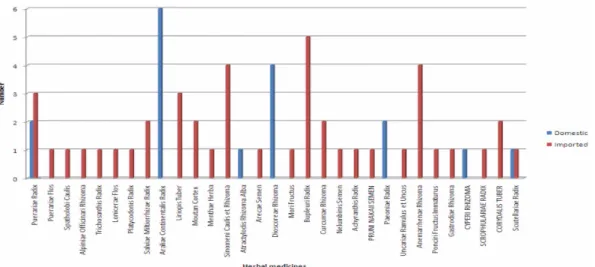
2. 원산지 및 품목별 잔류 이산화황 허용기준 초과실태 국내산 한약재는 642 건 중 17 건 (2.6%) 이 한약재 잔류이산 화황 허용기준을 초과하였으며 , 이산화황 잔류량은 0~809
㎎ / ㎏ 검출범위를 나타냈다 . 수입산 한약재는 1,179 건 중 44
Table 7.
Result of detection of sulfur dioxide among samples not to passed.
Herbal name Total Domestic Imported
Numbers of samples Result (
㎎/
㎏) Numbers of samples Result (
㎎/
㎏)
Puerariae Radix 5 2 93~118 3 740~4481
Puerariae Flos 1 1 67
Spatholobi Caulis 1 1 124
Alpiniae Officinari Rhizoma 1 1 179
Trichosanthis Radix 1 1 2413
Lonicerae Flos 1 1 87
Platycodonis Radix 1 1 95
Salviae Miltiorrhizae Radix 2 2 1611~2032
Araliae Continentalis Radix 6 6 101~413
Liriopis Tuber 3 3 291~2122
Moutan Cortex 2 2 511~659
Menthae Herba 1 1 291
Sinomeni Caulis et Rhizoma 4 4 124~290
Atractylodis Rhizoma Alba 1 1 120
Arecae Semen 1 1 104
Dioscoreae Rhizoma 4 4 181~809
Mori Fructus 1 1 117
Bupleuri Radix 5 5 305~787
Curcumae Rhizoma 2 2 240~251
Nelumbinis Semen 1 1 611
Achyranthis Radix 1 1 2171
Pruni Nakaii Semen 1 1 405
Paeoniae Radix 2 2 108~122
Uncariae Ramulus et Uncus 1 1 129
Anemarrhenae Rhizoma 4 4 1973~2468
Ponciri Fructus Immaturus 1 1 607
Gastrodiae Rhizoma 1 1 899
Cyperi Rhizoma 1 1 101
Scrophulariae Radix 1 1 363
Corydalis Tuber 2 2 183~251
Scutellariae Radix 2 1 233 1 1578
Total 61 17 44
출범위를 나타냈다 . 검사건수 대비 부적합률은 수입산 한약재 가 국내산 한약재에 비하여 높은 것으로 나타났다 .
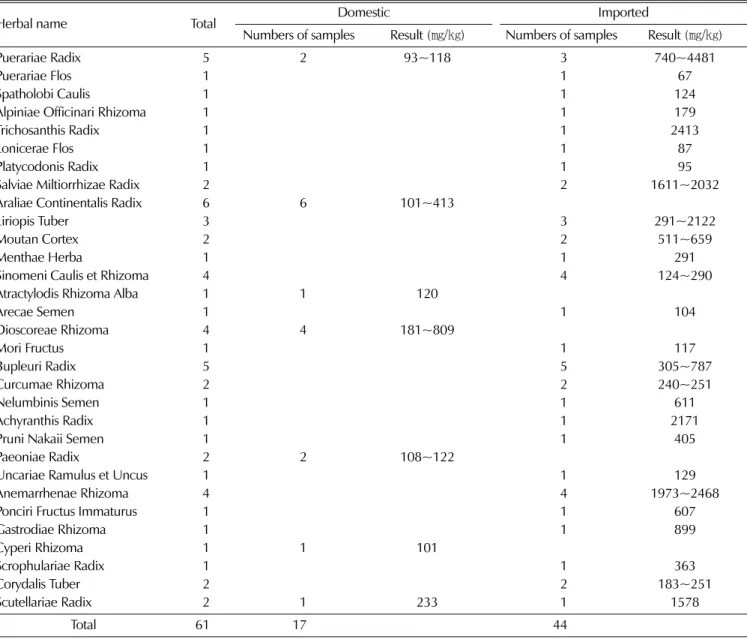
잔류이산화황 허용기준을 초과한 61 건의 한약재에 대한 검 사 건수 , 품목 및 검체별 잔류이산화황 함유량 평균은 Table 7 과 같다 . 국내산 한약재는 갈근 14 건 중 2 건 , 독활 22 건 중 6 건 , 백출 4 건 중 1 건 , 산약 6 건 중 4 건 , 작약 19 건 중 2 건 ,
향부자 25 건 중 1 건 그리고 황금 6 건 중 1 건이 잔류이산화황
기준을 초과 하였다 . Table 6 에서와 같이 산약에서 검사건수
대비 평균 잔류이산화황 함유량이 333 ㎎ / ㎏으로 높은 것으 로 나타났다 . 독활의 경우 부적합 6 건의 결과값이 101 ㎎ / ㎏ , 110 ㎎ / ㎏ , 132 ㎎ / ㎏ , 175 ㎎ / ㎏ , 278 ㎎ / ㎏ , 413 ㎎ / ㎏ 으로 모두가 2009.1.8. 일부터 기준이 500 ㎎ / ㎏에서 30 ㎎ / ㎏으로
강화된 결과이었다 . 작약의 경우도 부적합 2 건의 결과값이 108
㎎ / ㎏ , 122 ㎎ / ㎏ 으로 2009.1.8. 일부터 강화된 기준인 200
㎎ / ㎏에서 30 ㎎ / ㎏에 의한 부적합이었다 . 산약의 경우도 부 적합 4 건의 결과값이 181 ㎎ / ㎏ , 246 ㎎ / ㎏ , 748 ㎎ / ㎏ , 809
㎎ / ㎏으로 2009.1.8. 일부터 강화된 기준인 1,000 ㎎ / ㎏에서 30
㎎ / ㎏에 의한 부적합이었다 . 갈근은 93 ㎎ / ㎏ , 118 ㎎ / ㎏ , 백 출은 120 ㎎ / ㎏ 그리고 향부자의 경우는 101 ㎎ / ㎏로 기존의 기준인 30 ㎎ / ㎏을 초과한 결과였다 .
수입산 한약재는 31 개 품목 44 건이 허용기준을 초과하였으 며 , 갈근 16 건 중 3 건 , 갈화 3 건 중 1 건 , 계혈등 9 건 중 1 건 ,
고량강 5 건 중 1 건 , 괄루근 4 건 중 1 건 , 금은화 7 건 중 1 건 ,
길경 4 건 중 1 건 , 단삼 5 건 중 2 건 , 맥문동 5 건 중 3 건 , 목 단피 9 건 중 2 건 , 반하 5 건 중 1 건 , 방기 8 건 중 4 건 , 빈랑 자 29 건 중 1 건 , 상심자 2 건 중 1 건 , 시호 16 건 중 5 건 , 아
출 5 건 중 2 건 , 연자육 16 건 중 1 건 , 우슬 20 건 중 1 건 , 욱
리인 2 건 중 1 건 , 조구등 4 건 중 1 건 , 지모 17 건 중 4 건 , 지 실 5 건 중 1 건 , 천마 4 건 중 1 건 , 현삼 6 건 중 1 건 , 현호색
10 건 중 2 건 그리고 황금 5 건 중 1 건이 잔류이산화황 기준을 초과 하였다 . 현호색의 경우 부적합 2 건의 결과값이 183
㎎ / ㎏ , 251 ㎎ / ㎏ 으로 모두가 2009.1.8. 일부터 기준이 500
㎎ / ㎏에서 30 ㎎ / ㎏으로 강화된 결과이었다 . 목단피의 경우도 부적합 2 건의 결과값이 511 ㎎ / ㎏ , 659 ㎎ / ㎏으로 2009.1.8. 일
부터 강화된 기준인 1,500 ㎎ / ㎏에서 30 ㎎ / ㎏에 의한 부적합 이었다 . 고량강의 경우도 부적합 1 건의 결과값이 179 ㎎ / ㎏으 로 2009.1.8. 일부터 강화된 기준인 200 ㎎ / ㎏에서 30 ㎎ / ㎏에 의한 부적합이었다 . 갈근의 경우 본 조사에서의 최대 검출량 인 4,481 을 보였는데 , 이는 기준 30 의 약 150 배 정도로 앞으 로도 안전한 한약재관리를 위해 부적합 다발 품목의 지속적인 모니터링이 필요하고 생각한다 .
Fig. 3 에서와 같이 수입산 한약재의 잔류이산화황 원산지별
기준초과 현황을 보면 가장 많은 비중을 차지하고 있는 나라 는 중국으로 977 건 (53.7%) 중 44 건 이었으며 , 베트남 , 인도
네시아 그리고 남아공에서는 각각 63 건 , 51 건 , 24 건이었으나
허용기준을 초과한 한약재는 없었다 .
국내산의 경우 부적합 17 건 중 13 건 (76.5%) 이 2009.1.8. 일 부터 강화된 기준에 의한 부적합이고 , 수입산의 경우 44 건 중
5 건 (11.4%) 이 강화된 기준에 의한 것이었다 . 국내산의 경우 잔류이산화황이 30 ㎎ / ㎏ 이상이 검출된 한약재는 23 건이었으 며 , 이중에서 강화된 기준 미적용으로 적합판정인 것은 6 건이
었다 . 수입산의 경우 한약재 159 건이 잔류이산화황이 30 ㎎ / ㎏
이상이었고 이중 115 건이 기존기준 적용으로 적합이었다 . 이 는 강화된 “ 생약의 잔류이산화황 기준 ” 의 적용시점이 2009.1.8
일이고 보통 한약재의 유통기한이 3 년인 것을 고려하였을 때
2009 년 1 월부터 2009 년 12 월까지 검사된 시료 중 2006 년 ~
2008 년에 제조된 한약재는 강화된 기준이 적용되지 않는데 , 수
입산의 경우 강화된 기준이 적용되지 않는 검체가 많았고 국 내산의 경우 2009 년 1 월 이후에 제조된 한약재가 많아 강화
된 기준이 적용되었기 때문이다 .
서울시내 유통한약재 전체 1,821 건 중 61 건이 부적합으로 부적합률은 3.3% 이다 . 국내산의 경우 642 건 중 17 건이 부적 합으로 부적합률은 2.6% 이며 , 수입산의 경우 1,179 건 중 44 건 이 부적합으로 부적합률은 3.7% 이다 . 강화된 “ 생약의 잔류이 산화황 기준 ” 만으로 보았을 경우 국내산의 경우 642 건 중 23
건이 30 ㎎ / ㎏ 이상의 검출량을 보여 3.6% 가 강화된 기준을
초과하였고 , 수입산의 경우 1,179 건 중 159 건이 30 ㎎ / ㎏ 이
상의 검출량을 보여 13.5% 가 강화된 기준을 초과하는 것으로
나타났다 . 이와 같은 조사 결과로 판단할 때 강화된 기준이 정착하여 안전한 한약재가 유통될 수 있도록 수입통관시 특별
Fig. 1.
Number of samples by the imported countries.
관리가 요구되며 , 보다 적극적인 검사 요주의 품목에 대한 지 속적인 잔류이산화황 모니터링과 관리 강화가 필요할 것으로 생각된다 .
LITERATURE CITED
Chung BH, Seo HS, Kim HS, Woo SH and Cho YG. (2010).
Antioxidant and anticancer effects of fermentation vinegars with
Phellinus linteus, Inonotus obliquus, and Pleurotus ostreatu
s.
Korean Journal of Medicinal Crop Science. 18:113-117.
Doh ES, Chang JP, Lee KH and Seong NS. (2010). Ginsenoside change and antioxidation activity of fermented ginseng. Korean Journal of Medicinal Crop Science. 18:255-265.
FAO/WHO. (1979). Guid to the safe use of food additives. 2nd series.
Han CH, Kim DG, Kwak JE, Han EJ, Jung SJ, Kim BS, Cho TH, Yoon YT, Park AS, Kim EJ, Jung SS, Lee JA, Cho SJ,
Choi BH and Kim MY. (2008). Analysis of sulfur dioxide residue in commercial medicinal herbs. Seoul Metropolitan Government Research Institute of Public Health and Environment Report. 44:99-125.
Jin CW, Eom SH, Park HJ, Amal Kumar Ghimeray, Yu CY and Cho DH. (2010). Antioxidant activity of
Hibiscus cannabinusL. leaves in different growth time. Korean Journal of Medicinal Crop Science. 17:21-25.
Jung SY, Kim IY, Kim SD, Jang MR, Chang MS and Han KY. (2003). Determination of sulfur dioxide in pickles by acid distillation-HPLC method and Monier-Williams modified method.
Korean Journal of Food Science and Technology. 35:1028- 1032.
Kang KJ, Oh GO, Kim HI, Choi YH, Kim YJ and Chung YC.
(2001). Naturally occurring of sulfur dioxide in medicinal herbs (crude drug materials) and its origin. Korean Journal of Food Science and Technology. 33:514-520.
Kim BS, Park AS, Han CH, Kim DG, Shin Y, Kwak JE, Han
Fig. 2.
Comparison of domestic and imported herbal medicines among samples not to passed.
Fig. 3.