Vol.7, No.1, 2006 연구논문(Original Articles)
1. 서 론
1)
- ( ) 100
(Bakelite )
Corresponding author: e-mail: [email protected]
,
,
[1-3]. -
, , ,
, ,
-
윤성봉 ․ 김진우 ․ 조동환†
금오공과대학교 고분자공학과 년 월 일 접수 년 월 일 채택 (2006 2 2 , 2006 3 7 )
Thermal Stability and Cure Behavior of Waterborne Phenol-Formaldehyde Resin
Sung Bong Yoon, Jin Woo Kim, and Donghwan Cho
Polymber/Bio Composites Research Lab, Department of Polymer Science and Engineering, Kumoh National Institute of Technology, Gumi, 730-701, Gyungbuk, Korea
(Received February 2, 2006; Accepted March 7, 2006)
: SMC -
. - 200oC,
400oC 500oC . 750oC 62%
65% . .
120oC 190oC , 165oC 170oC
.
. H2O
100oC 60 . 130oC 120
- , 180oC 60
.
Abstract: In this work, the effect of cure temperature and time on the thermal stability and the exothermic cure reaction peak of a waterborne resol-type phenol-formaldehyde resin, which may be used for preparing phenolic sheet molding compounds (SMC), has been investigated using a thermogravimetric analyzer and a differential scanning calorimeter. The weight loss of waterborne phenol-formaldehyde resin was mainly occurred at three temperature stages: near 200oC, 400oC, and 500oC. The carbon yield at 750oC for the cured resin was about 62% 65%. Their thermal stability increased with increasing cure temperature and time. Upon cure, the exothermic reaction was taken placed in the range of 120oC 190oC and the maximum peak was found in between 165oC and 170oC. The shape and the maximum of the exothermic curves depended on the given cure temperature and time. To remove H2O and volatile components, the uncured resin needed a heat-treatment at 100oC for 60 min at least prior to cure or molding. Curing at 130oC for 120 min made the exothermic peak of waterborne phenol-formaldehyde resin completely disappeared. And, post-curing at 180oC for 60 min further improved the thermal stability of the cured resin.
Keywords:waterborne phenol-formaldehyde resin, thermal stability, cure behavior
수용성 페놀 포름알데히드 수지의 열안정성 및 경화거동- 17
, (wettability)
-
[4-7]. (char)
- -
[8]. ,
. char
, (thermal barrier) .
, -
.
- , ,
, , , ,
[9-13].
.
.
, -
( , , )
,
3
. -
,
.
(Differential scanning calorimetry:
DSC)[14-16], (Fourier transform infrared spec-
troscopy: FT-IR)[17,18], (Dynamic
mechanical analysis: DMA)[10,19], (Fluorescence
spectroscopy)[20-21] .
DSC . -
, -
. ,
(autoclave)
sheet
molding compound (SMC) -
.
SMC -
.
2. 실 험
2.1. 재료 및 시료준비
KPI( )
- (waterborne resol-type phenol- formaldehyde resin) (KC-4100B) .
135oC, 1 75% 77%
, 10% 15%
. 1500 2500 cps .
-
(TGA) (DSC)
, DSC pan
- ,
. pan
TGA DSC
. DSC
90oC, 100oC, 110oC, 120oC 30
, 60 , 90 120 .
TGA 90oC, 120oC, 150oC
(post-cure) 180oC ,
1 , 2 3 . ,
(uncured)
TGA DSC .
2.2. 분석 -
(Thermogravimetric Analyzer,
TGA 951, DuPont) . Low-
speed diamond saw (Buehler Co.) 20 mg
10oC 760oC
80 cc
. -
(Differential Scanning Calorimeter, DSC 910, DuPont) . DSC
7 mg pan
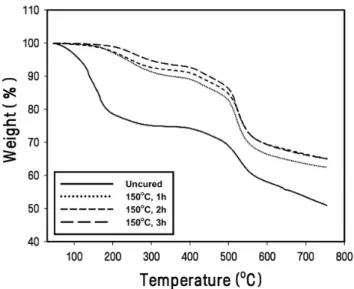
Figure 1. A comparison of the thermal stabilities of uncured and cured phenol-formaldehyde resins showing a cure time effect.
, 10oC 200oC
50 cc .
결과 및 고찰 3.
Figure 1 -
TGA
. -
(uncured) 150oC 1 , 2 , 3
- (cured)
. 200oC -
10% 15% H2O
20%
. -
. - 3
.
, 1 200oC
. 200oC -
H2O . H2O 500oC
[22].
- 100oC 300oC
Figure 2. A comparison of the thermal stabilities of un- cured and cured phenol-formaldehyde resins showing a cure temperature effect.
,
. 400oC 2 2
. 250oC 400oC 1
. (methylol)
(methylene bridge)
. 400oC
,
, ,
[8,23].
. , 400oC
. 500oC 3
. 500oC 700oC
90%
[23].
. . .
- 760oC
49% (residual weight) .
- 49%
수용성 페놀 포름알데히드 수지의 열안정성 및 경화거동- 19
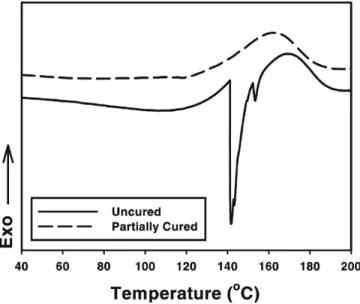
Figure 3. A comparison of the DSC thermograms of un- cured and partially cured (at 90oC for 60 min) phenol-form- aldehyde resins.
.
(carbon yield) 62% 65%
. 150oC
. -
,
2 - 500oC
760oC .
Figure 2 - 90oC 180oC
30oC 1
TGA .
. 760oC
. ,
. 180oC -
150oC 2
3% .
,
quinone methide .
Figure 3 -
thermogram
. 140oC
pan
Figure 4. DSC thermograms of phenol-formaldehyde resins cured at different cure times at 90oC.
pan .
120oC 150oC
. 165oC 170oC
,
10oC 15oC .
90oC 60 (partially cured)
120oC ,
- 120oC
.
Figure 4 -
90oC 30 , 60 , 90
120 DSC
. Figure
, 90oC 2
.
,
120oC . 90oC 120
- ,
.
SMC
. 90oC 30 60
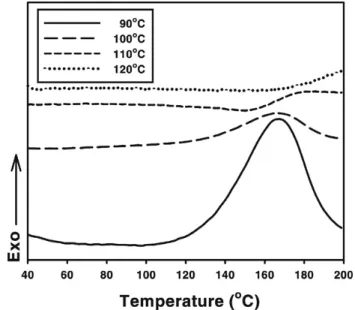
Figure 5. DSC thermograms of phenol-formaldehyde resins cured at various cure temperatures for 60 min.
Figure 6. DSC thermograms of phenol-formaldehyde resins cured at various cure temperatures for 90 min.
.
90oC
60 ,
.
. Figure 5 7 90oC, 100oC, 110oC
120oC 60 , 90 120
- DSC thermogram
Figure 7. DSC thermograms of phenol-formaldehyde resins cured at various cure temperatures for 120 min.
Table 1. A summary of the exothermic peak temperatures occurred during the DSC measurements for waterborne phenol-formaldehyde resin cured at given temperatures and times
Cure Temperature Cure Time (min)
60 90 120
90 100 110 120
165.9 166.5 171.9 179.4
165.9 167.1 174.6 186.3
167.0 168.7 177.0
>195
.
. -
100oC , 110oC
DSC thermogram
. thermogram
120oC 190oC
. . DSC furnace
.
Table 1 Figure 5, 6 7 .
수용성 페놀 포름알데히드 수지의 열안정성 및 경화거동- 21
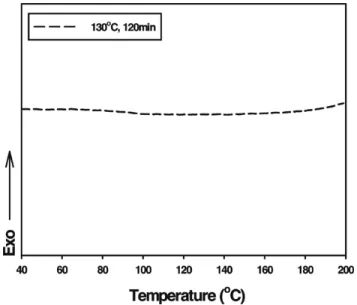
Figure 8. DSC thermogram of phenol-formaldehyde resins measured after curing at 130oC for 120 min.
166oC 200oC .
. 100oC
. 120oC 120
. SMC
- , 120oC 120
.
Figure 8 130oC 120
DSC . 120oC
,
. 130oC, 120 -
. -
130oC 120
. ,
- .
4. 결 론
-
. -
200oC, 400oC 500oC
. 760oC
62 65% .
.
- H2O
90oC 100oC
60 .
120oC 200oC ,
166oC 200oC .
.
,
. -
130oC 120
,
trace -
. 180oC 1 .
감사의 글
.
참 고 문 헌
1. A. Bottcher and L. A. Pilato, SAMPE Journal, 33, 35 (1007).
2. R. L. Geimer and A. W. Christiansen, Forest Prod.
J., 46, 67 (1996).
3. A. B. Strong, Plastics: Materials and Processing, Third Ed., Chapter 9, Prentice Hall, New Jersey (2006).
4. G. S. Learmonth and P. Osborn, J. Appl. Polym. Sci., 12, 1815 (1968).
5. L. Costa, L. R. di Montelera, G. Camino, E. D.
Weil, and E. M. Pearce, Polym. Degra. Stabil., 56, 23 (1997).
6. J. Y. Lee, D. Cho, D. G. Kim, I. S. Park, H. S.
Ha, and B. I. Yoon, Polymer(Korea), 17, 59 (1993).
7. G. A. George, G. A. Cash, T. T. Le, B. G. S.
Goss, B. J. Wood, J. R. Brown, and N. A. St.
John, Polym. Adv. Tech., 7, 345 (1996).
8. , , 12(3), 183 (1997).
9. J.-K. Lee, J.-J. Lee, C.-S. Ha, J.-O. Lee, and W.-J.
Cho, Polymer(Korea), 17, 425 (1993).
10. L. F. Lorenz and A. W. Christiansen, Ind. Eng.
Chem., Res., 34, 4520 (1995).
11. X.-M. Wang, B. Biedl, A. W. Christiansen, and R.
L. Geimer, Wood Sci. Tech., 29, 253 (1995).
12. Y. Hua, Z. Zhang, and Q. Qin, J. Appl. Polym.
Sci., 88, 1410 (2003).
13. K. J. Scariah, K. M. Usha, K. Narayanaswamy, K.
Shanmugam, and K. S. Sastri, J. Appl. Polym. Sci., 90, 2517 (2003).
14. X.-M. Wang, B. Riedl, A. W. Christiansen, and R.
L. Geimer, Polymer, 35, 5685 (1994).
15. D. Cho and L. T. Drzal, J. Appl. Polym. Sci., 75, 1278 (2000).
16. E. S. de Medeiros, J. A. M. Agnelli, K. Joseph, L.
H. De Carvalho, and L. H. C. Mattoso, J. Appl.
Polym. Sci., 90, 1687 (2003).
17. G. E. Myers, A. W. Christiansen, R. L. Geimer, R.
A. Follensbee, and J. A. Koutsky, J. Appl. Polym.
Sci., 43, 237 (1991).
18. D. Cho and L. T. Drzal, J. Appl. Polym. Sci., 76, 190 (2000).
19. D. Cho and L. T. Drzal, Polymer, 41, 4611 (2001).
20. D. Cho, D. S. Kim, and J. K. Lee, Polymer(Korea), 25, 199 (2001).
21. R. Vatanparast, S. Li, K. Hakala, and H. Lemmetyinen, J. Appl. Polym. Sci., 83, 1773 (2002).
22. Y. Yamashita and K. Ouchi, J. Fuel Soc. Jap., 53, 1064 (1974).
23. T.-H. Ko, W.-S. Kuo, and Y.-H. Chang, J. App.
Polym. Sci., 81, 1084 (2001).