Korean Journal of Microbiology (2019) Vol. 55, No. 1, pp. 83-85 pISSN 0440-2413
DOI https://doi.org/10.7845/kjm.2019.9008 eISSN 2383-9902
Copyright ⓒ 2019, The Microbiological Society of Korea
Draft genome sequence of humic substance-degrading Pseudomonas sp. PAMC 29040 from Antarctic tundra soil
Dockyu Kim
1* and Hyoungseok Lee
21
Division of Polar Life Sciences, Korea Polar Research Institute, Incheon 21990, Republic of Korea
2
Unit of Polar Genomics, Korea Polar Research Institute, Incheon 21990, Republic of Korea
천연 복합유기화합물인 부식질을 분해하는 남극 툰드라 토양 Pseudomonas sp. PAMC 29040의 유전체 분석
김덕규
1* ・ 이형석
21
극지연구소 극지생명과학연구부,
2극지연구소 극지유전체사업단
(Received January 17, 2019; Accepted March 11, 2019)
*For correspondence.
E-mail: [email protected];Tel.: +82-32-760-5525; Fax: +82-32-760-5509
Pseudomonas sp. PAMC 29040 was isolated from a maritime tundra soil in Antarctica for its ability to degrade lignin and subsequently confirmed to be able to depolymerize hetero- geneous humic substance (HS), a main component of soil organic matter. The draft genome sequences of PAMC 29040 were analyzed to discover the putative genes for depolymerization of polymeric HS (e.g., dye-decolorizing peroxidase) and catabolic degradation of HS-derived small aromatics (e.g., vanillate O- demethylase). The information on degradative genes will be used to finally propose the HS degradation pathway(s) of soil bacteria inhabiting cold environments.
Keywords: cold-adapted bacteria, degradative enzyme, soil humic substance
Humic substance (HS) is a naturally occurring complex heteropolymer, which is widely distributed in various environ- ments including Arctic and Antarctic tundra soils. HS is composed mainly of aromatic, aliphatic, and phenolic com- ponents, which are covalently bound mostly through various types of C-C and C-O-C bonds (Grinhut et al., 2007). Owing to
its complexity and structural similarity to lignin, HS has been considered as modified lignin and thus to be rather recalcitrant to microbial degradation. Although the information on HS bacterial degradation, such as catalytic enzymes, is not sufficient, a degradative pathway has been proposed based on several previous fragmentary studies (Bugg et al., 2011; Kamimura et al., 2017; Kim et al., 2018). It is assumed that HS is depoly- merized by bacterial extracellular oxidoreductases, such as dye-decolorizing peroxidases and laccases. The resulting HS- derived small aromatic compounds including various biaryls (e.g., β-aryl ether and biphenyl) are generally funneled into a main metabolite, vanillate, which is O-demethylated to produce protocatechuate. As another route, vanillate is decarboxylated into guaiacol, which is subsequently O-demethylated to catechol (Alvarez-Rodriguez et al., 2003). Protocatechuate and catechol are further degraded to TCA cycle intermediates (e.g., acetyl- CoA) through meta- or ortho-cleavage pathway.
A study site (designated KS1) for HS microbial degradation
was selected around Kaya Hill near the Korean Antarctic
Research Station (King Sejong) on the Barton Peninsula of
King George Island on the western Antarctic Peninsula. In
January, 2015, a bacterial strain (PAMC 29040) was isolated
84
∙Kim and Lee미생물학회지 제55권 제1호
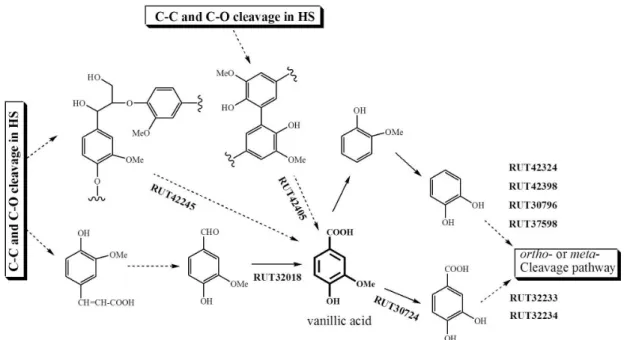
Fig. 1. Proposed HS-degradative pathway by Pseudomonas sp. PAMC 29040. Dotted and solid lines represent multi-step reactions by different enzymes and one-step reactions by one enzyme, respectively. GenBank accession numbers for putative enzymes catalyzing the corresponding reactions are shown next the lines.
from a HS-rich tundra soil (KS1-3) owing to its ability to degrade lignin. PAMC 29040 was confirmed to have a degradative capability for heteropolymeric HS and lignin- derived monoaryls (ferulic acid and guaiacol).
The 16S rRNA gene (GenBank no. MK332581) analysis showed that PAMC 29040 was phylogenetically closest to Pseudomonas weihenstephanensis DSM 29166
T(99.86%
identity) and thus was tentatively named Pseudomonas sp.
PAMC 29040 (= KCTC 72094). Genome sequencing of PAMC 29040 was performed at ChunLab, Inc. using the Illumina Miseq sequencing method and the sequence was assembled de novo into 33 contigs with SPAdes 3.10.1 (Bankevich et al., 2012). The draft genome sequence was approximately 5.3 Mb long with a G+C content of 58.6%. The resulting N
50size of contigs was 400,925 bp and the total coverage over the genome was 385 –fold. Following NCBI GenBank submission, the genes in draft genome sequence were annotated with prokaryotic genome annotation pipeline using best-placed reference protein set; GeneMarkS-2 method (Lomsadze et al., 2018). The genome annotation revealed 4,701 coding sequences (CDSs), 60 tRNA genes, and 11 rRNA genes containing one gene for complete 16S rRNA. In the draft genome, several putative HS-degradative genes were detected and used to propose a degradation pathway
by PAMC 29040 (Fig. 1): dye-decolorizing peroxidase (GenBank no. RUT42245), biphenyl 2,3-dioxygenase (RUT42405), vanillin dehydrogenase (RUT32018), vanillate O-demethylase (RUT 30724), protocatechuate 3,4-dioxygenase for ortho-ring cleavage (RUT32233 and RUT32234), catechol 2,3-dioxygenase for meta-ring cleavage (RUT42324 and RUT42398), and catechol 1,2-dioxygenase for ortho-ring cleavage (RUT30796 and RUT 37598).
Nucleotide sequence accession number
This whole genome shotgun project has been deposited at DBJ/ENA/GenBank under the accession RZAA00000000.
The version described in this paper is version RZAA01000000 and consists of sequences RZAA01000001-RZAA01000033.
적 요
남극 연안 툰드라 토양에서 리그닌 분해능이 있는 Pseudomonas
sp. PAMC 29040 를 분리하였으며, 이후 토양 유기물의 주요
구성성분인 복합유기화합물 부식질 분해능을 확인하였다. 부
식질 초기 저분자화 효소(예, dye-decolorizing peroxidase)와
부식질 유래의 다양한 저분자 분해산물들을 분해하는 효소들
Genome analysis of humic substance-degrading Antarctic bacterium∙
85
Korean Journal of Microbiology, Vol. 55, No. 1 ( 예, vanillate O-demethylase)를 탐색하기 위해 PAMC 29040
게놈 염기서열을 분석하였다. 분석을 통해서 최종 확보한 효 소유전자 정보는 저온환경에 서식하는 토양 세균의 부식질 분 해경로 제안에 활용될 것이다.
Acknowledgements
This work was supported by a grant, modeling responses of terrestrial organisms to environmental changes on King George Island (PE19090), funded by the Korea Polar Research Institute.
References
Alvarez-Rodriguez ML, Belloch C, Villa M, Uruburu F, Larriba G, and Coque JJR. 2003. Degradation of vanillic acid and production of guaiacol by microorganisms isolated from cork samples. FEMS Microbiol. Lett. 220, 49–55.
Bankevich A, Nurk S, Antipov D, Gurevich A, Dvorkin M, Kulikov AS, Lesin V, Nikolenko S, Pham S, Prjibelski A, et al. 2012.
SPAdes: a new genome assembly algorithm and its applications to single-cell sequencing. J. Comput. Biol. 19, 455–477.
Bugg TD, Ahmad M, Hardiman EM, and Rahmanpour R. 2011.
Pathways for degradation of lignin in bacteria and fungi. Nat.
Prod. Rep. 28, 1883–1896.
Grinhut T, Hadar Y, and Chen Y. 2007. Degradation and trans- formation of humic substances by saprotrophic fungi: processes and mechanisms. Fungal Biol. Rev. 21, 179–189.
Kamimura N, Takahashi K, Mori K, Araki T, Fujita M, Higuchi Y, and Masai E. 2017. Bacterial catabolism of lignin-derived aromatics:
New findings in a recent decade: Update on bacterial lignin catabolism. Environ. Microbiol. Rep. 9, 679–705.
Kim D, Park HJ, Sul WJ, and Park H. 2018. Transcriptome analysis of Pseudomonas sp. from subarctic tundra soil: pathway description and gene discovery for humic acids degradation. Folia Microbiol.
(Praha) 63, 315–323.
Lomsadze A, Gemayel K, Tang S, and Borodovsky M. 2018. Modeling leaderless transcription and atypical genes results in more accurate gene prediction in prokaryotes. Genome Res. 28, 1079– 1089.