• 검색 결과가 없습니다.

Fine Needle Aspiration is a Reliable Screening Procedure to Deetct Toxoplasmosis: Four Case Reports

N/A
N/A
Protected

Academic year: 2021

Share "Fine Needle Aspiration is a Reliable Screening Procedure to Deetct Toxoplasmosis: Four Case Reports"

Copied!
6
0
0

로드 중.... (전체 텍스트 보기)

전체 글

(1)

Abstract

Lymphadenitis due to toxoplasma infection is not uncommon and should be considered in the diagnosis of unexplained lymphadenopathy at all sites, especially at the cervical region. We report four cases of toxoplasmosis diagnosed by cytologic, histologic and serologic tests. Fine needle aspiration cytologic diagnosis can help the diagnosis of toxoplasma lymphadenitis and eliminate unnecessary hospitalization or surgery.

Key Words : Aspiration biopsy, Fine-needle, Lymphadenitis, Toxoplasma

Introduction

Toxoplasmosis is a well-known zoonosis.

According to increase number of persons who live with their pets, rate of the toxoplasmosis is increase. Most cases are asymptomatic, but in the symptomatic cases, cervical lymphadenitis could be present [1]. Fine needle aspiration (FNA) is easily performed first line investigative technique for evaluate the enlarged cervical lymph nodes.

H e r e i n , w e r e p o r t f o u r F N A c a s e s o f toxoplasmosis which verified by lymph node biopsy.

Case Reports

Case 1:

A 41-year-old man visited to Keimyung University Dong San Hospital with a two week history of gradually increasing palpable mass in his neck. He visited a horse farm one month ago.

He did not have any pet including a cat. Physical examination of the cervical area revealed enlarged lymph nodes of the left postauricular area. He underwent FNA, excisional biopsy, and serologic tests.

Corresponding Author:
Hye Ra Jung, M.D., Department of Pathology, Keimyung University School of Medicine 1095 Dalgubeol-daero, Dalseo-gu, Daegu 704-701, Korea

Tel : +82-52-580-3826 E-mail : [email protected]

Departments of Pathology and Otolaryngology—Head and Neck Surgery

1

, Keimyung University School of Medicine, Daegu, Korea

Hye Ra Jung, M.D., Yu Na Kang, M.D., Chang Ki Yeo

1

, M.D.

Fine Needle Aspiration is a Reliable Screening Procedure to Detect

Toxoplasmosis: Four Case Reports

(2)

Case 2:

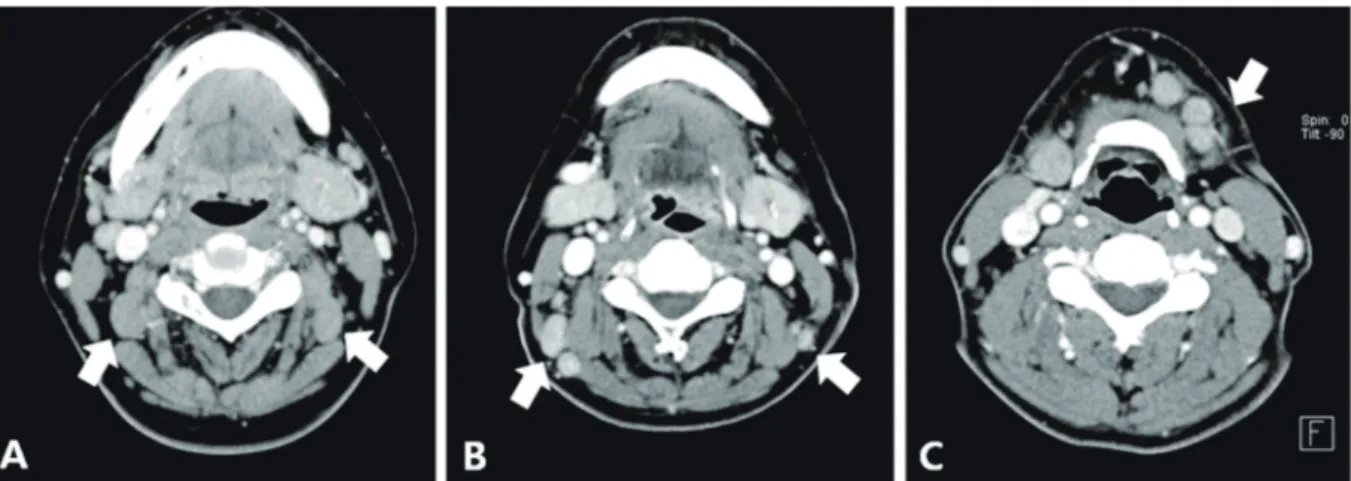
A 42-year-old woman visited due to palpable neck mass. The mass developed two weeks ago. It increased gradually. On physical examination, there were non-tender palpable lymph nodes at left level V region. Neck computed tomography (CT) showed multiple enlarged lymph nodes at both level II, left level III, both level VB, right supraclavicular region, right anterior chest wall deep to the pectoralis muscle, and right paratracheal region (Fig. 1A). She did not have any pet. She said that she did not like animals. After FNA cytology, the lymph node was removed. The patient was diagnosed as toxoplasmosis by serologic tests.

Case 3:

A 69-year-old woman visited to the hospital with palpable neck mass for a month. She found the mass incidentally. Tenderness or skin erythematous change was absent. The CT revealed multiple enlarged lymph nodes at both level II and VA area (Fig. 1B). She did not have any specific history.

She was diagnosed as toxoplasmsis by cytologic, histologic and serologic tests. After septrin therapy, enlarged lymph nodes were nearly absent.

Case 4:

A 48-year-old man was transferred to present hospital due to incidentally found multiple neck masses. Physical examination revealed enlarged left submandibular lymph nodes. The CT revealed three left submandibular enlarged lymph nodes (Fig. 1C). He did not have any pet. He lived in rural area. His occupation was a cleaning man. The FNA findings were suspected for toxoplasmosis.

Without excisional biopsy, he was diagnosed as toxoplasmosis by serologic tests alone.

Cytologic and histologic findings and serologic tests

All patients underwent fine needle aspiration and excisional biopsy. Fine needle aspiration smears showed presence of groups of epithelioid c e l l s (m i c r o g r a n u l o m a) a n d p r e s e n c e o f monocytoid histiocytes with a polymorphous

Fig. 1. Neck computed tomography of the toxoplasmosis patients show multiple enlarged lymph nodes (arrows).

A: Multiple enlarged lymph nodes are present at both level II region (Case 2). B: The CT revealed round to oval

enlarged lymph nodes at both level II area (case 3). C: There are three left submandibular enlarged lymph nodes

(Case 4).

(3)

population of small inactive or large activated lymphocytes (Fig. 2A, 2B). Histologically, the lymph node showed enlarged follicles with prominent germinal center. The follicles exhibited an unusual variation in size and shape. Irregular clusters of 10-15 polygonal epithelioid histiocytes (microgranulomas) were located in the cortical and paracortical zones. The monocytoid B cell proliferation was also found nearby lymphoid follicles and trabecular sinuses (Fig. 3). The bradyzoites of Toxoplasma gondii were demonstrated with immunohistochemical stain (Fig. 3, right upper inset). Increased IgG and IgM toxoplasma antibodies were detected by serologic test (Table 1).

Discussion

Toxoplasmosis is a common zoonosis transferred by a cat [2]. The intermediate hosts including human and other mammals are infected throungh contaminated food or soli [3].

Acute toxoplasmic lymphadenitis is an important cause of cervical lymphadenopathies. In Korea, 3-5% of healthy adults have positive serologic findings [4,5]. In healthy adult, most cases are asymptomatic or present with a flu-like or infectious mononucleosis-like picture associated with mild fever and myalgia [1]. The most common symptom of toxoplasmosis is a localized lymph node enlargement. The posterior cervical lymph Fig. 2. Fine needle aspiration cytology shows a microgranuloma in a polymorphous lymphoid background. The microgranuloma consists of small aggregates of epithelioid histiocytes with abundant, pale-staining homogenous cytoplasm and oval nuclei. A: Diff-Quick stain. B: Papanicolau stain. × 400.

A B

(4)

nodes are the most commonly involved [6].

The involved lymph nodes have intact capsule and show follicular hyperplasia pattern. The

lymphoid follicles are markedly enlarged. The germinal center shows prominent tangible body macrophages and penetrated epithelioid cells.

Table 1. Characteristics of the patients who developed palpable cervical lymph nodes

Age Sex Number Location IgG

(IU/mL) IgM

(S/CO) Residence Animal contact

Case 1 41 M Multiple Postauricular 126 0.86 Urban Horse farm

Case 2 43 F Multiple Bilateral level II, level VB,

right supraclavicular region

205 1.41 Urban Absent

Case 3 69 F Multiple Bilateral level II and VA >300 0.69 Urban Absent

Case 4 48 M Three Left submandibular 229.8 2.3 Rural Absent

Fig. 3. Lymphoid follicles with reactive germinal center, area of monocytoid cells surrounding blood vessels

(asterisk), the germinal center and scattered clusters of epithelioid cells (microgranulomas,) are present (H&E ×

40). The microgranuloma consists of 5-10 round to oval epithelioid cells with abundant cytoplasm (right lower

inlet, H&E × 400). Immunohistochemical stain for T. gondii shows bradyzoit of the toxoplasma in the cytoplasm

of a lymphocyte (right upper inlet, × 1,000).

(5)

Monomorphic monocytoid B-cell proliferation is noted nearby the enlarged lymphoid follicle. It surrounds blood vessel in interfollicular area. The epithelioid cells are scattered throughout the cortex and paracortex. The epithelioid cells do not make well-formed granuloma [7].

Several reports describe the cytologic features of toxoplasmic lymphadenitis. In some of them the authors highlight the presence of microgranulomas as the main cytologic feature. Viguer et al . [8]

reviewed 11 cytologic specimens of toxoplasmosis.

They considered epithelioid microgranulomas as main diagnostic features. The microgranulomas consist of small clusters (usually of <10-15 cells) of monomorphous, polygonal, epithelioid to oval cells with moderated to abundant, homogenous eosinophilic cytoplasm and oval, eccentric nuclei.

A few lymphocytes can be mixed with the epithelioid cells. Usually monocytoid B-cell hyperplasia is not detected in the smears.

Because of presence of microgranulomas, it can be described as granulomatous inflammation.

Cytologic differential diagnosis of toxoplasmosis includes tuberculosis, sarcoidosis, malignant lymphomas, and other infectious diseases. In t u b e r c u l o s i s, d e f i n i t e g r a n u l o m a s a n d multinucleated giant cells are present. Frequently necrotic background is associated. The results of PCR for Mycobacterium tuberculosis and AFB stain are positive. In sarcoidosis, the granulomas are small and thightly organized. In contrast to sarcoidosis, the histiocytes in toxoplasmosis are more diffuse, and the granulomas are less well circumscribed, not as organized and lack multinucleated giant cells [9]. Multinucleated giant cells can be noted. Hodgkin lymphoma associated with polygonal epithlioid cell is characterized by typical Hodgkin cells or Reed-Sternberg cells and polymorphous background containing eosinophils.

Lennert lymphoma shows scattered epithelioid cells

in aspiration cytology. However, reactive background with tangible macrophages is not found. The lymph nodes in cat-scratch disease and brucellosis generally do not have dif fuse histiocytosis and often display prominent focal necrosis that is not seen in toxoplasmosis [9].

FNAC is highly cost effective and accurate as a first line investigative technique with differential diagnoses including reactive hyperplasia/

inflammatory conditions, granulomatous disorders and malignancy, stratifying cases requiring further investigations, surgical intervention or clinical follow-up [10].

Toxoplasmosis may occur lymphadenitis in the general population. Although histologic findings are consistent with toxoplasmosis, a tentative histologic diagnosis of toxoplasmosis must be confrmed by serologic tests. The cytologic diagnosis of toxoplasmosis can be also easily confirmed with serologic studies. A combination of FNA features with positive serological test gives the diagnosis of toxoplasmosis and thus avoids unnecessary surgical excision.

Conflict of Interest

The authors report no conflict of interest in this work.

References

1. McCabe RE, Brooks RG, Dorfman RF, Remington JS.

Clinical spectrum in 107 cases of toxoplasmic lymphadenopathy. Rev Infect Dis 1987;9:754-74.

2. Remington JS, Jacobs L, Kaufman HE. Toxoplasmosis in the Adult. N Engl J Med 1960;262:180-6.

3. Krick JA, Remington JS. Toxoplasmosis in the adult-an

overview. N Engl J Med 1978;298:550-3.

(6)

4. Yang H-J, Jin K-N, Park Y-K, Hong S-C, Bae J-M, Lee S-H, et al. Seroprevalence of toxoplasmosis in the residents of Cheju island, Korea. Korean J Parasitol 2000;38:91-3.

5. Lee Y-H, Noh H-J, Hwang O-S, Lee S-K, Shin D-W.

Seroepidemiological study of Toxoplasma gondii infection in the rural area Okcheon-gun, Korea. Korean J Parasitol 2000;38:251-6.

6. Gray GF, Jr., Kimball AC, Kean BH. The posterior cervical lymph node in toxoplasmosis. Am J Pathol 1972;69:349-58.

7. Ioachim HL, Medeiros LJ, Ioachim HL. Ioachim's Lymph Node Pathology. 4th ed. Philadelphia: Wolters

Kluwer/Lippincott Williams & Wilkins; 2009.

8. Viguer JM, Jimenez-Heffernan JA, Lopez-Ferrer P, Gonzalez-Peramato P, Vicandi B. Fine needle aspiration of toxoplasmic (Piringer-Kuchinka) lymphadenitis: a cytohistologic correlation study. Acta Cytol 2005;49:139-43.

9. Suh YJ, Kim W, Park W-B, Chun CS. Cervical lymphadenitis caused by Toxoplasma gondii. J Korean Surg Soc 2002;62:271-3.

10. Koo V, Lioe TF, Spence RA. Fine needle aspiration

cytology (FNAC) in the diagnosis of granulomatous

lymphadenitis. Ulster Med J 2006;75:59-64.

수치

Fig. 1.  Neck computed tomography of the toxoplasmosis patients show multiple enlarged lymph nodes (arrows)
Fig. 3.  Lymphoid follicles with reactive germinal center, area of monocytoid cells surrounding blood vessels  (asterisk), the germinal center and scattered clusters of epithelioid cells (microgranulomas,) are present (H&amp;E ×  40)

참조

관련 문서

- They are usually used to model a new logic gate circuit at switch

Results after 4 weeks showed that both deep neck bending muscle exercise+general neck strengthening exercise group showed decreased pain and improved functional status

 In the present study, as a preliminary study, a LACC-based Compton CT was developed to estimate the activity of the spot inside the radioactive waste drum. To

Understanding assembly code and how it relates to the original C code is a key step in understanding how computers execute

In addition, cross-level analysis is used to empirically verify the effects of learning organization and organizational ambidexterity on organizational

activation(electroencephalolgram: left alpha wave, right alpha wave, left sensory motor rhythm, right sensory motor rhythm, right mid-beta wave, left attention concentration

The NL-20 incorporates a memory which can be used to store measurement data (sound level, L eq and other processed values, measurement parameters such as frequency

 Construction procedure greatly affects performance.. ② Excavate to first strut level with the margin of working area. ③ Place wales and struts. ④ Excavate to second