pISSN 1738-6640 eISSN 2234-4020 http://dx.doi.org/10.6114/jkood.2016.29.1.131
Original Article / 원저
알레르기성 비염 동물모델에서 한약제재 경구투여에 대한 국내 연구보고 고찰
조형래·황보민
대구한의대학교 한의과대학 안이비인후피부과학 교실
Oral administration of the Herbal Medicines in animal models for treatment of Allergic Rhinitis: a Review of Animal Study Reports Published in Korea
Hyung-Rae Jo·Min Hwangbo
Dep. of Oriental Ophthalmology and Otolaryngology and Dermatology, Daegu Hanny University
Abstract
Objective : This study is to review the effect of herbal medicines on treatment of Allergic Rhinitis in animal models reported in Korean domestic journals.
Methods : The Databases(NDSL, Koreantk, OASIS, KISS) are searched with terms as Allergic Rhinitis. among them, only animal study reports were reviewed. Animal model, intervention, and observation methods of measuring indicators were extracted.
Results : 27 articles were reviewed. All studies used OVA to induce Allergic Rhinitis. 7 studies used simple herbal medicines, 20 studies used complex herbal medicines, To evaluate the effect of the Herbal medicines, 23 studies used immunological examination, 18 studies used histological examination, 16 studies used hematologic examination, 3 studies used macroscopy The evidences of 5 studies is insufficient to show that Herbal medicines are effective for treatment of Allergic Rhinitis.
Key words : Allergic Rhinitis; Herbal medicine; Experimental article; Review
ⓒ 2016 the Society of Korean Medicine Ophthalmology & Otolaryngology & Dermatology
This is an Open Access journal distributed under the terms of the Creative Commons Attribution Non-Commercial License (http://creativecommons.org/license/by-nc/3.0/) which permits unrestricted non-commercial use, distribution, and reproduction in any medium, provided the original work is properly cited.
Ⅰ. 서 론
알레르기 비염은 비강내 점막에서 원인물질에 노출 된 후 원인물질에 대한 IgE에 의해서 유발되는 염증 반응으로 콧물, 코막힘, 비강 내 소양감, 재채기의 증 상을 보이는 질환으로 이상 4가지의 증상 중 2가지 이상의 증상이 하루에 1시간 이상 일반적으로 나타날 때 의심할 수 있다1). 최근 보고에 따르면 국내 알레르 기 비염의 유병률은 17.42%이며, 계속해서 증가하는 추세로 알레르기 질환 중 가장 많은 비율을 차지한다
2).
서양 의학에서는 알레르기 비염의 치료를 위해 회 피요법, 약물요법, 면역 치료 등을 이용한다. 회피요 법은 가장 안전한 방법이지만 현실적으로 적용하기에 다양한 제약이 따르며 준수율이 낮은 방법이다. 비강 내 스테로이드 분무요법이나 항히스타민제, 항류코트 리엔제 복용과 같은 약물요법은 단순히 알레르기비염 의 증상만 호전시킬 뿐, 질환의 경과에는 영향을 미치 지 않는다는 단점이 있다. 면역 치료는 항원에 의한 탈감작을 유도하여 알레르기반응을 변형시켜 질환의 자연 경과를 바꾸는 치료 방법이지만 3년 이상 정기 적으로 외래를 내원하여 치료를 받아야 한다는 번거 로움과 과민성 쇼크와 같은 심각한 전신적인 합병증 을 유발할 수 있다는 위험성이 있다3,4). 따라서 이러 한 문제점을 보완하기 위한 한의학적 처방 및 본초자 원을 이용한 알레르기 비염 치료제 개발이 요구되고 있다.
알레르기 비염에 대하여 한의학적 연구는 계속해서 활발하게 이루어지고 있었으나, 아직까지 국내 한의 학 학술지에 게재되었던 알레르기 비염에 대하여 실 험 논문들을 비교, 분석한 논문은 없었다. 이에 저자 는 국내에서 발표된 알레르기 비염 유발 모델에 한약
제재를 경구투여한 실험연구 논문들을 고찰하여 향후 알레르기 비염의 한방치료제 개발 연구에 도움이 되 도록 하였다.
Ⅱ. 재료와 방법
1. 검색방법
관련문헌 검색 사이트는 국가과학기술정보센터 (http://scholar.ndsl.kr), 한국전통지식포탈(http://www.
koreantk.com), 전통의학정보포털(http://oasis.kiom.
re.kr), KISS (http://kiss.kstudy.com). 이상 4개의 데이터베이스를 이용하였다. 각 데이터베이스의 자료 는 기간제한 없이 국내학술지를 대상으로 하였으며, 검색어는 ‘알레르기 비염’으로 하되 각 사이트의 검색 전략을 이용하였다. 검색 범위는 제목 및 키워드로 하 였다.
2. 자료 추출
국내에서 발간되었으며, 알레르기 비염에 대하여 한약 및 한약재를 이용한 동물실험연구를 대상으로 하였다. 자료 추출은 1명의 저자(조)에 의해 수행되었 으며, 검색된 논문의 초록을 읽고 검토하였다. 다만 초록이 누락되어 있거나 내용이 모호한 경우 원문을 읽고 분석하였다. 자료추출의 선정기준과 배제기준은 다음과 같다.
1) 선정 기준
① 동물을 대상으로 한 실험연구
② 알레르기 비염의 효과가 예상되는 한약, 한약재, 천연추출물의 소재를 이용한 경우
③ 치료 효능에 대한 지표를 측정한 경우 2) 배제 기준
① 실험연구가 아닌 경우
② 대상이 사람이거나 in vitro인 경우
Corresponding author : Min Hwangbo, School of Oriental Medicine, Daegu Hanny University, 165, Sang-dong, Suseong-gu, Daegu, Korea.
(Tel : 010-4433-1075, E-mail : [email protected])
∙Recieved 2016/1/14 ∙Revised 2016/1/27 ∙Accepted 2016/2/3
③ 대상이 알레르기 비염이 주 증상이 아닌 경우 ④ 알레르기 비염에 대한 약물 투여방법이 경구투
여가 아닌 경우
⑤ 투여한 약물의 구성이 불명확한 경우
Ⅲ. 결 과
1. 자료추출 결과
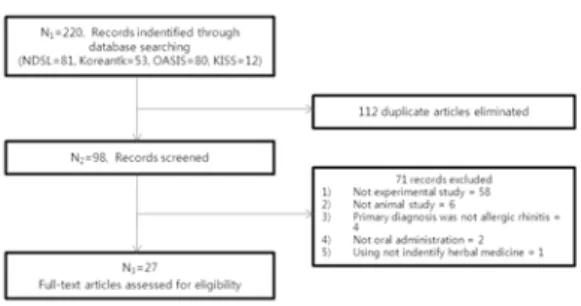
4개의 데이터베이스에서 검색된 논문은 총 609편 이었으며, 한의학과 관련되지 않은 논문과 원문확인 이 되지 않는 논문을 제외한 후 220편이 남았다. 이 중 중복된 논문을 제외하여 총 98편의 논문이 남았다.
98편의 논문을 선정기준과 배제기준을 바탕으로 추출 한 결과 71편의 논문이 탈락되고 최종 27편의 논문이 선정되었다(Fig. 1).
Fig. 1. Flow chart for searching strategy
2. 실험 동물 및 유도약물에 대한 분석
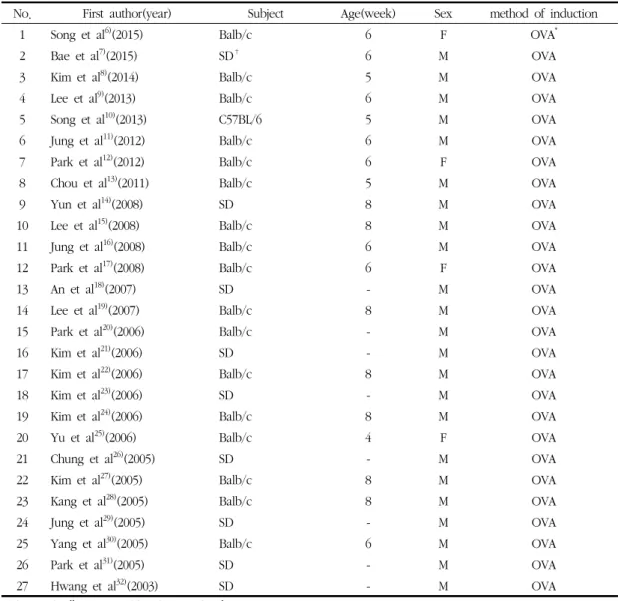
선정된 논문에서 연구대상으로 삼은 실험동물은 mouse를 이용한 논문이 18편이었으며 그 중 Balb/c 를 대상으로 한 논문이 17편, C57BL/6을 대상으로 한 논문이 1편이었다. 9편은 rat을 이용하였으며 종은 Spargue-Dawley(SD)를 이용하였다. mouse는 4-8주 령이 주로 사용되었으며 수컷을 사용한 경우는 27편 중 23편으로 암컷보다 수컷을 선호하였다. 모든 연구 에서 알레르기 비염의 유발을 위해 Levine & Vaz5)의 방법을 응용하여 Ovalbumin(OVA)을 항원으로 사용
하였다(Table 1).
3. 중재내용 분석
중재내용은 약물의 구성 및 재료, 중재기간을 조사 하였다(Table 2).
시약으로 인해 알레르기 비염을 유발시킨 대상모델 에게 경구투여된 한약제재는 단일약물을 이용한 논문 이 7편, 혼합제재(처방)를 이용한 논문이 20편으로 분 석되어 그간의 연구가 단일약물 보다는 처방을 위주 로 진행됨을 알 수 있었다. 처방 중에서는 通竅湯
15,25,29)
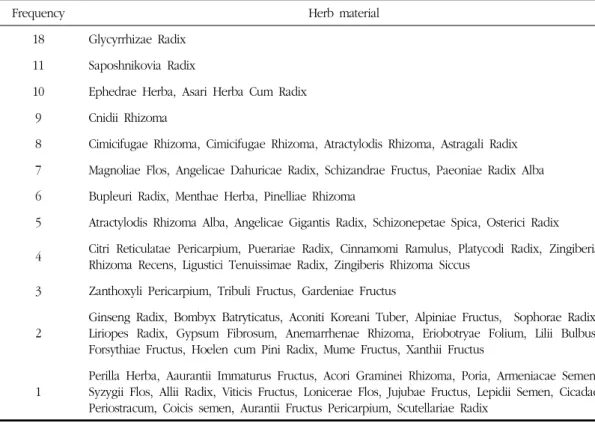
이 3회로 가장 많이 연구되었으며 通關散19,20), 辛荑淸肺飮21,28), 去痰補肺湯26,30)이 2회로 그 뒤를 이 었다. 알레르기 비염 치료효능의 소재로 쓰인 한약재 의 종류는 총 59가지였다. 사용된 용량이나 일수를 배제하고 물질별 사용 빈도수만을 보면 甘草가 18회 로 가장 많고 다음으로 防風 11회, 麻黃, 細辛 10회 등의 순서였다(Table 3).
중재기간은 짧게는 7일을 제공한 논문에서부터 길 게는 63일까지었으며 평균적으로 25.4일의 약물 투여 기간을 가졌다.
4. 약물효과의 측정 및 결과분석
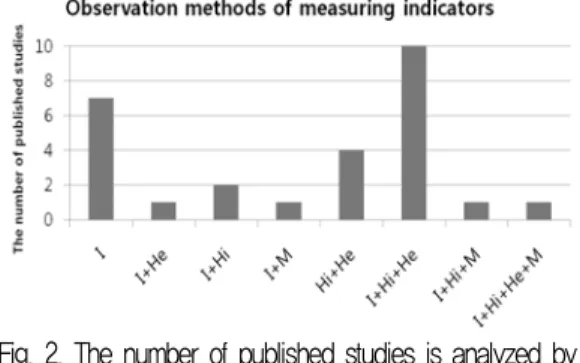
동물모델에서 알레르기 비염을 회복시키는 약물을 중재로 제공한 후 효과를 평가하는 방법으로는 크게 면역학적 관찰(immunological examination), 조직학 적 관찰(histological examination), 혈액학적 검사 (hematologic examination), 육안적 관찰 (macroscopy)으로 나뉘었다. 면역학적 관찰만 사용한 논문은 7편, 면역학적 관찰과 혈액학적 관찰을 함께 사용한 논문은 1편, 면역학적 관찰과 조직학적 관찰을 함께 사용한 논문은 2편이었다. 또한 면역학적 관찰 과 육안적 관찰을 함께 사용한 논문은 1편, 혈액학적 검사와 조직학적 관찰을 함께 사용한 논문은 4편이었 으며 면역학적 관찰, 조직학적 관찰, 혈액학적 검사를 함께 본 논문은 10편이었다. 그리고 면역학적 관찰,
조직학적 관찰 육안적 관찰을 함께 사용한 논문은 1 편이었고, 4가지 평가법 모두 사용한 논문은 1편이었 다(Fig 2). 육안적 관찰에는 body weight loss, nasal rubbing이 사용되었고, 조직학적 관찰은 광학현미경 을 이용한 Histological observation을 통해 비점막의 형태학적 변화를 보았다. 면역학적 관찰은 알레르기 에 관여하는 cytokine 및 효소 등을 분석하였는데 이 중 interlukin(IL)-4, IL-5, immunoglobulin E(IgE),
No. First author(year) Subject Age(week) Sex method of induction
1 Song et al6)(2015) Balb/c 6 F OVA*
2 Bae et al7)(2015) SD† 6 M OVA
3 Kim et al8)(2014) Balb/c 5 M OVA
4 Lee et al9)(2013) Balb/c 6 M OVA
5 Song et al10)(2013) C57BL/6 5 M OVA
6 Jung et al11)(2012) Balb/c 6 M OVA
7 Park et al12)(2012) Balb/c 6 F OVA
8 Chou et al13)(2011) Balb/c 5 M OVA
9 Yun et al14)(2008) SD 8 M OVA
10 Lee et al15)(2008) Balb/c 8 M OVA
11 Jung et al16)(2008) Balb/c 6 M OVA
12 Park et al17)(2008) Balb/c 6 F OVA
13 An et al18)(2007) SD - M OVA
14 Lee et al19)(2007) Balb/c 8 M OVA
15 Park et al20)(2006) Balb/c - M OVA
16 Kim et al21)(2006) SD - M OVA
17 Kim et al22)(2006) Balb/c 8 M OVA
18 Kim et al23)(2006) SD - M OVA
19 Kim et al24)(2006) Balb/c 8 M OVA
20 Yu et al25)(2006) Balb/c 4 F OVA
21 Chung et al26)(2005) SD - M OVA
22 Kim et al27)(2005) Balb/c 8 M OVA
23 Kang et al28)(2005) Balb/c 8 M OVA
24 Jung et al29)(2005) SD - M OVA
25 Yang et al30)(2005) Balb/c 6 M OVA
26 Park et al31)(2005) SD - M OVA
27 Hwang et al32)(2003) SD - M OVA
*OVA : Ovalbumin †SD : Spargue-Dawley
Table 1. Summary of Animal Model in Studies
interferon-γ(IFN-γ)가 많이 사용되었으며 혈액학적 검사에는 red blood cell(RBC), white blood cell(WBC), Neutrophil, Lymphocyte 등이 주로 평가 되었으며 투여한 한약제제에 의한 간손상 여부를 파 악하기 위해 aspartate transaminase(AST), alanine transaminase(ALT)를 검사한 연구도 9편 있었다. 평 가방법의 구체적인 항목은 Table 4와 같다.
No. Simple,
Complex Herb material Period
(day)
16) Simple Schizonepetae Spica 10
27) Complex
Shinchlusan(Atractylodis Rhizoma, Osterici Radix, Cnidii Rhizoma, Angelicae Dahuricae Radix, Asari Herba Cum Radix, Ligustici Tenuissimae Radix, Glycyrrhizae Radix)
28
38) Complex
So-Cheong-Ryong-Tang(Asari Herba Cum Radix, Cinnamomi Ramulus, Ephedrae Herba, Schizandrae Fructus, Glycyrrhizae Radix, Pinelliae Rhizoma, Paeoniae Radix Alba, Zingiberis Rhizoma Siccus)
14
49) Simple Coicis semen 28
510) Simple Magnoliae Flos 63
611) Simple Saposhnikovia Radix 7
712) Complex
Hyunggaeyungyo-tang(Schizonepetae Spica, Forsythiae Fructus, Saposhnikovia Radix, Angelicae Gigantis Radix, Cnidii Rhizoma, Paeoniae Radix Alba, Bupleuri Radix, Aurantii Fructus Pericarpium, Scutellariae Radix, Gardeniae Fructus, Angelicae Dahuricae Radix, Platycodi Radix, Glycyrrhizae Radix)
7
813) Simplex Tribuli Fructus 28
914) Complex
Bojungikgitang-gamibang(Astragali Radix, Ginseng Radix, Atractylodis Rhizoma Alba, Glycyrrhizae Radix, Angelicae Gigantis Radix, Citri Reticulatae Pericarpium, Cimicifugae Rhizoma, Bupleuri Radix, Cnidii Rhizoma, Saposhnikovia Radix, Schizonepetae Spica, Perilla Herba, Menthae Herba) &
Mahwangshingungsan(Ephedrae Herba, Magnoliae Flos, Aaurantii Immaturus Fructus, Cnidii Rhizoma, Menthae Herba)
28
1015) Complex
Tongqiao-tang(Astragali Radix, Angelicae Dahuricae Radix, Atractylodis Rhizoma, Glycyrrhizae Radix, Xanthii Fructus, Saposhnikovia Radix, Osterici Radix, Ligustici Tenuissimae Radix, Cimicifugae Rhizoma, Puerariae Radix, Cnidii Rhizoma, Ephedrae Herba, Zanthoxyli Pericarpium, Magnoliae Flos, Asari Herba Cum Radix, Menthae Herba
26
1116) Simplex Acori Graminei Rhizoma 28
1217) Compex
Yonggamgangmisingayin-tang(Poria, Pinelliae Rhizoma, Armeniacae Semen, Glycyrrhizae Radix, Zingiberis Rhizoma Siccus, Asari Herba Cum Radix, Schizandrae Fructus)
7
1318) Complex
Onpye-tang(Ephedrae Herba, Astragali Radix, Cimicifugae Rhizoma, Saposhnikovia Radix, Puerariae Radix, Osterici Radix, Glycyrrhizae Radix, Syzygii Flos, Allii Radix)
28
1419) Complex Tonkwansan(Bombyx Batryticatus, Aconiti Koreani Tuber, Alpiniae Fructus,
Menthae Herba, Tribuli Fructus, Sophorae Radix) 28
1520) Complex Tonkwansan(Bombyx Batryticatus, Aconiti Koreani Tuber, Alpiniae Fructus,
Menthae Herba, Tribuli Fructus, Sophorae Radix) 28
1621) Complex
Sinichengpae-um(Magnoliae Flos, Liriopes Radix, Gypsum Fibrosum, Anemarrhenae Rhizoma, Gardeniae Fructus, Eriobotryae Folium, Lilii Bulbus, Cimicifugae Rhizoma, Glycyrrhizae Radix)
28
1722) Complex
Okbyeongpung-san plus Socheongryong-tang(Ephedrae Herba, Paeoniae Radix Alba, Schizandrae Fructus, Pinelliae Rhizoma, Asari Herba Cum Radix, Zingiberis Rhizoma Siccus, Cinnamomi Ramulus, Glycyrrhizae Radix, Astragali Radix, Atractylodis Rhizoma Alba, Saposhnikovia Radix
28 Table 2. Summary of Intervention in Study
No. Simple,
Complex Herb material Period
(day)
1823) Complex
Sochungyoug-tang plus Okbyeongpung-san(Ephedrae Herba, Paeoniae Radix Alba, Schizandrae Fructus, Pinelliae Rhizoma, Asari Herba Cum Radix, Zingiberis Rhizoma Siccus, Glycyrrhizae Radix, Astragali Radix, Atractylodis Rhizoma Alba, Saposhnikovia Radix)
28
1924) Simplex Viticis Fructus & Bupleuri Radix 28
2025) Complex
Gamitongkyutang(Saposhnikovia Radix, Osterici Radix, Ligustici Tenuissimae Radix, Cimicifugae Rhizoma, Puerariae Radix, Cnidii Rhizoma, Atractylodis Rhizoma, Angelicae Dahuricae Radix, Ephedrae Herba, Zanthoxyli Pericarpium, Asari Herba Cum Radix, Glycyrrhizae Radix, Platycodi Radix, Forsythiae Fructus, Lonicerae Flos, Zingiberis Rhizoma Recens)
21
2126) Complex
Gudambope-tang(Paeoniae Radix Alba, Cinnamomi Ramulus, Angelicae Gigantis Radix, Platycodi Radix, Cnidii Rhizoma, Pinelliae Rhizoma, Citri Reticulatae Pericarpium, Angelicae Dahuricae Radix, Schizonepetae Spica, Ephedrae Herba, Hoelen cum Pini Radix, Asari Herba Cum Radix, Schizandrae Fructus, Glycyrrhizae Radix, Zingiberis Rhizoma Recens)
28
2227) Complex
Bojungikgi-tang(Astragali Radix, Ginseng Radix, Atractylodis Rhizoma Alba, Glycyrrhizae Radix, Angelicae Gigantis Radix, Citri Reticulatae Pericarpium, Cimicifugae Rhizoma, Bupleuri Radix)
28
2328) Complex
Sinichengpae-um(Magnoliae Flos, Liriopes Radix, Gypsum Fibrosum, Anemarrhenae Rhizoma, Gardeniae Fructus, Eriobotryae Folium, Lilii Bulbus, Cimicifugae Rhizoma, Glycyrrhizae Radix)
28
2429) Complex
Tongkyu-tang(Astragali Radix, Angelicae Dahuricae Radix, Atractylodis Rhizoma, Glycyrrhizae Radix, Xanthii Fructus, Saposhnikovia Radix, Osterici Radix, Ligustici Tenuissimae Radix, Cimicifugae Rhizoma, Puerariae Radix, Cnidii Rhizoma, Ephedrae Herba, Zanthoxyli Pericarpium, Magnoliae Flos, Asari Herba Cum Radix, Menthae Herba)
28
2530) Complex
Gudambopae-Tang(Paeoniae Radix Alba, Cinnamomi Ramulus, Angelicae Gigantis Radix, Platycodi Radix, Cnidii Rhizoma, Pinelliae Rhizoma, Citri Reticulatae Pericarpium, Angelicae Dahuricae Radix, Schizonepetae Spica, Ephedrae Herba, Hoelen cum Pini Radix, Asari Herba Cum Radix, Schizandrae Fructus, Glycyrrhizae Radix, Zingiberis Rhizoma Recens)
28
2631) Complex
Gamigyejitang(Cinnamomi Ramulus, Paeoniae Radix Alba, Glycyrrhizae Radix, Zingiberis Rhizoma Recens, Jujubae Fructus, Mume Fructus, Lepidii Semen, Cicadae Periostracum, Magnoliae Flos, Saposhnikovia Radix)
28
2732) Complex Jeulminmilmae-tang(Mume Fructus, Saposhnikovia Radix, Bupleuri Radix,
Schizandrae Fructus, Glycyrrhizae Radix) 28
average of period : 25.4 Table 2. (계속)
Frequency Herb material 18 Glycyrrhizae Radix
11 Saposhnikovia Radix
10 Ephedrae Herba, Asari Herba Cum Radix 9 Cnidii Rhizoma
8 Cimicifugae Rhizoma, Cimicifugae Rhizoma, Atractylodis Rhizoma, Astragali Radix 7 Magnoliae Flos, Angelicae Dahuricae Radix, Schizandrae Fructus, Paeoniae Radix Alba 6 Bupleuri Radix, Menthae Herba, Pinelliae Rhizoma
5 Atractylodis Rhizoma Alba, Angelicae Gigantis Radix, Schizonepetae Spica, Osterici Radix 4 Citri Reticulatae Pericarpium, Puerariae Radix, Cinnamomi Ramulus, Platycodi Radix, Zingiberis
Rhizoma Recens, Ligustici Tenuissimae Radix, Zingiberis Rhizoma Siccus 3 Zanthoxyli Pericarpium, Tribuli Fructus, Gardeniae Fructus
2
Ginseng Radix, Bombyx Batryticatus, Aconiti Koreani Tuber, Alpiniae Fructus, Sophorae Radix, Liriopes Radix, Gypsum Fibrosum, Anemarrhenae Rhizoma, Eriobotryae Folium, Lilii Bulbus, Forsythiae Fructus, Hoelen cum Pini Radix, Mume Fructus, Xanthii Fructus
1
Perilla Herba, Aaurantii Immaturus Fructus, Acori Graminei Rhizoma, Poria, Armeniacae Semen, Syzygii Flos, Allii Radix, Viticis Fructus, Lonicerae Flos, Jujubae Fructus, Lepidii Semen, Cicadae Periostracum, Coicis semen, Aurantii Fructus Pericarpium, Scutellariae Radix
Table 3. Frequency of Herbal Materials for Inhibitory Effect on Allergic Rhinitis
No. Measuring indicators
16) nasal rubbing, sneezing, IgE, OVA-specific IgE, IL-1β, IL-10, TNF-α, MIP-2, Histological observation 27) RBC, WBC, Neutrophil, Eosinophil, Monocyte, Lymphocyte, Total IgE, AST, ALT, IL-4
38) chege in body weigt and food intake, IL-6, RAW265.7 cels vialbility, splenocyte viability, Histological observation
49) IgE, TNF-α, IFN-γ, IL-1β, IL-13 510)
body weight loss, polyphenol production, scavenging of DPPH radical, inhibition of nitrite production, RBC, hemoglobin, HCT, eosinophil, neutrophil, lymphocyte, monocyte, platelet, OVA-specific IgE production, nasal rubbing, Histological observation
611) histamine, IgE, IL-4, IFN-γ, Histological observation 712) eosinophil, Histological observation, NF-κB, iNOS 813) Total IgE, nasal rubbing
914) RBC, WBC, neutrophil, eosinophil, monocyte, lymphocyte, Total IgE, AST, ALT, Histological observation
1015) IFN-γ, IL-4, IL-5, total IgE, OVA-specific IgE 1116) IL-4, IFN-γ, AST, ALT, Histological observation
1217) eosinophil, Histological observation, ZO-1, MIP-2, COX-2, IL-4 Table 4. Summary of the Measuring Indicators and Results
No. Measuring indicators
1318) RBC, WBC, Neutrophil, Lymphocyte, Monocyte, Eosinophil, Total IgE, AST, ALT, Histological observation
1419) IFN-γ, IL-4, IL-5, Total IgE, OVA-specific IgE
1520) Leukocyte, Erythrocyte, Neutrophil, Lymphocyte, Monocyte, Eosinophil, IL-4, IFN-γ, AST, ALT, Histological observation
1621) Leukocyte, Erythrocyte, Neutrophil, Lymphocyte, GOT, GPT, Histological observation 1722) Total IgE, IL-4, IL-5, IFN-γ
1823) Leukocyte, Erythrocyte, Neutrophil, Lymphocyte, GOT, GPT, Histological observation 1924) WBC, Neutrophil, Lymphocyte, Monocyte, IFN-γ, IL-4, Histological observation 2025) Histological observation, MIP-2, IL-3, STAT6, iNOS, NF-κB, AST, ALT
2126) RBC, WBC, Neutrophil, Lymphocyte, Monocyte, Total IgE, AST, ALT, Histological observation 2227) IL-4, IL-5, IFN-γ, Total IgE, OVA specific IgE
2328) Total IgE, IL-4, IL-5, IFN-γ
2429) WBC, RBC, Neutrophil, Lymphocyte, AST, ALT, Total IgE, Histological observation 2530) IL-4, IL-5, IFN-γ, Total IgE, OVA specific IgE
2631) Histological observation, Neutrophil, eosinophil
2732) Neutrophil, Eosinophil, Lymphocyte, Monocyte, AST, ALT, Histological observation
*TNF-α : tumor necrosis factor-α. †DPPH : 1,1-Diphenyl-2-picrylhydrazy. ‡HCT : hematocrit.
§NF-κB : nuclear factor κB. ∥iNOS : induce nitric oxide syntase. ¶ZO : zonula occludin.
**MIP : macrophage inflammatory protein. ‡COX : cyclooxygenase.
‡GOT : glutamic oxaloacetic transaminase. ‡GPT : glutamate-pyruvate transaminase.
‡STAT6 : Signal transducer and activator of transcription 6
Table 4. 계속
Fig. 2. The number of published studies is analyzed by the observation methods of measuring indicators
*I : immunological examination †Hi : histological examination
‡He : hematologic examination §M : Macroscopy
Ⅳ. 고 찰
알레르기 비염은 인체에 흡입된 알레르겐과 type 2 helper T(Th2) cells에 의해 유발된 비점막 염증세포 에 대한 IgE 매개반응으로 발생하며 대표적인 증상으 로는 재채기, 비강 내 소양감, 코막힘, 맑은 비루가 있 다. 알레르기 비염을 일으키는 주요한 알레르겐은 꽃 가루, 집먼지 진드기, 애완동물, 해충 등이 있다3). 국내 알레르기 비염의 유병률에 대하여 Korea Statistical Information Sevice(KOSIS)에 따르면 2001년 2.7%에서 2007년 12%, 2013년 15.1%로 계 속해서 증가하는 추세이다. 이와 같은 알레르기 질환
의 증가는 도시지역의 자동차나 공장에 의한 공기오 염, 주거환경의 변화 등과 밀접한 관계가 있는 것으로 알려져 있다33).
서양의학에서는 알레르기 비염의 치료를 위해 증상 에 따라 코르티코스테로이드제, 항히스타민제, 충혈 완화제, 크로몰린, 항콜린제, 류코트리엔 수용체 길항 제 등의 약물요법을 사용하며 이에 반응하지 않을 경 우 면역요법이 고려된다34). 하지만 약물요법은 단순히 알레르기비염의 증상만 호전할 뿐, 질환의 경과에는 영향을 미치지 않는다는 단점이 있으며, 면역요법은 중등도의 환자에게 적용되는 치료법으로 증상개선과 삶의 질 향상에 효과적이지만 3년 이상의 장기간 치 료를 해야되며 고비용이라는 단점이 있다4,34). 따라서 이러한 문제점을 보완하기 위해 한의학적 처방 및 본 초자원을 이용한 알레르기 비염 치료제 개발이 요구 되고 있다. 이에 저자는 국내에서 발표된 알레르기 비 염을 유발한 동물모델에 한약제재를 경구투여한 실험 연구 논문들을 고찰하여 향후 임상에 활용 가능한 한 방치료제 연구에 도움이 되도록 하였다.
본 연구는 알레르기 비염에 사용하여 치료효과가 예상되는 약물들을 탐색하여 그 효능을 관찰한 논문 들을 분석하였다. 동물을 대상으로 하여 한약제재를 중재로 삼고, 알레르기 비염 치료에 적절한 평가도구 를 사용한 논문 27편을 선정하고 실험동물, 중재내용, 평가법, 측정지표 및 주요 결과를 분석하였다.
알레르기 비염 치료 효과를 평가하기 위한 연구대 상은 Balb/c mouse가 주로 이용되었다. Balb/c mouse는 근교계로서 현재 가장 많이 사용되고 있는 mouse로 면역학적 연구와 암연구에 널리 사용된다35). 알레르기 비염을 유발하기 위해 모든 연구에서 Ovalbumin(OVA : chicken egg albumin )를 항원으 로 사용하였다. 이는 Levine & Vaz36)가 고안한 방법 으로 OVA 1 ㎎을 phosphate buffered saline(PBS) 과 수산화알루미늄 겔(Al(OH)3gel)을 1:1로 한 용액 1
㎖에 혼합하여 마우스의 복강 내 주사함으로써 알레 르기 면역반응을 유도하는 방법이다.
단일제재의 효능을 알아 본 연구는 총 7편으로 荊 芥6), 薏苡仁 추출물9), 유산균 발효 辛夷10), 防風11), 白 蒺藜13), 石菖蒲16), 蔓荊子와 柴胡24)의 효능을 분석하 였다. 혼합제재의 효능을 알아 본 연구는 총 20편으 로 神朮散7), 小靑龍湯8), 荊芥蓮翹湯12), 補中益氣湯加 味方 合 麻黃辛夷散14), 通竅湯15,25,29), 苓甘薑味辛夏仁 湯17), 溫肺湯18), 通關散19,20), 辛夷淸肺飮21,28), 玉屛風 散 合 小靑龍湯22,23), 去痰補肺湯26,30), 補中益氣湯27), 加味桂枝湯31), 截敏蜜梅湯32)의 효능을 분석하였다. 모 든 연구에서 사용된 중재약물로 쓰인 소재는 총 59가 지였으며, 많은 연구에서 다용된 약제는 총 18회의 연 구에서 사용된 甘草, 11회의 연구에서 사용된 防風, 10회의 연구에서 사용된 麻黃, 細辛 순이었다.
이 중 甘草는 이 등19), 박 등20)의 通關散의 효능을 알아 본 연구를 제외하고 모든 처방에 포함되었다. 이 는 대부분의 처방에 甘草가 調和諸藥의 의미로 사용 되었기 때문에 높은 빈도를 차지한 것으로 보이며, 甘 草 자체의 알레르기 비염에 대한 효능평가를 위해서 는 단일약물 실험이 필요할 것이다.
防風의 경우는 荊芥蓮翹湯12), 補中益氣湯加味方 合 麻黃辛夷散14), 通竅湯15,25,29), 溫肺湯18), 玉屛風散 合
小靑龍湯22,23), 加味桂枝湯31), 截敏蜜梅湯32)에 구성약
물로 포함되어 알레르기 비염에 유효한 효과를 보였 으며, 정 등11)의 연구에서 防風 단독약물 실험에서도 그 효능이 입증되었다. 따라서 향후 알레르기 비염 치 료제의 개발에 활용될 수 있을 것으로 생각된다.
麻黃, 細辛의 경우 小靑龍湯8), 通竅湯15,25,29), 玉屛 風散 合 小靑龍湯22,23), 去痰補肺湯26,30)에 구성약물로 함께 포함되었으며, 補中益氣湯加味方 合 麻黃辛夷散
14), 溫肺湯18)에는 麻黃, 神朮散7), 苓甘薑味辛夏仁湯17) 에는 細辛만 따로 포함되었다. 많은 처방에서 사용된 약재이지만 단일약물 실험이 아직 없기 때문에 향후 단일제재 실험을 시행 할 때 우선적으로 고려해 볼 수 있는 약물로 볼 수 있다.
실험평가를 위한 방법은 크게 면역학적 관찰, 조직 학적 관찰, 혈액학적 검사, 육안적 관찰로 나눌 수 있
었다. 면역학적 관찰은 알레르기 비염을 일으키는데 관여하는 cytokine 및 효소 등을 분석하였는데 IL-4, IL-5, IgE, IFN-γ 등을 주로 분석하였다. 알레르기 비염의 증상 완화를 판단하기 위해 면역학적 관찰을 사용한 연구는 27편 중 23편이었다.
송 등6), 이 등9)은 TNF-α를 분석하였다. 알레르기 비염 환자의 코점막 섬유아세포와 상피세포에서 Thymus and Activation-Regulated Chemokine (TARC)가 생산되고 발현되는데 Th2 cytokine과 TNF-α에 의해 TARC 생산이 증가된다37). 따라서 cytokine의 조절능력을 파악하기 위하여 TNF-α를 분석한 것으로 보인다.
박 등12), 유 등25)은 중재약물들이 NF-κB 활성조 절을 통해 INOS 생성억제로 항염증작용을 일으켜 결 론적으로 점막 손상이 완화되는 것을 확인하기 위해12) NF-κB와 iNOS를 분석하였는데 두 연구 모두 실험 군에서 NF-κB와 iNOS가 감소하는 유의한 결과를 얻어냈다.
박 등17)은 ZO-1, COX-2를 연구 중 유일하게 분석 하였다. 폐쇄이음 단백질의 하나인 ZO-1은 세포 최외 부의 세포간 결합인 치밀이음부 관련 단백으로, 상피 세포의 극성을 유지하며 세포외 환경을 세포내 신호 경로로 연결하고 세포골격을 유지하는데 중요한 단백
이다38,39). COX-2는 염증인자로서 다양한 염증성 질
환에 관여한다. 연구 결과 苓甘薑味辛夏仁湯이 ZO-1 억제, COX-2의 생성 감소를 통해 알레르기성 비염의 염증 상황을 개선하는 것이 확인되었다.
조직학적 관찰은 광학현미경을 이용하여 비점막의 형태학적 변화를 관찰하였으며, 총 27개연구 중 18개 의 연구에서 시행하였다.
혈액학적 관찰은 RBC, WBC, Neutophil, Lymphocyte 등이 주로 평가되었으며, 총 27개의 논 문 중 16개의 연구에서 시행하였다. 이 중 神朮散7), 補中益氣湯加味方 合 麻黃辛夷散14), 石菖蒲16), 溫肺湯
18), 通關散20), 通竅湯25,29), 去痰補肺湯26), 補中益氣湯
27), 截敏蜜梅湯32)의 9편의 연구에서는 ALT와 AST를
분석하여 중재약물의 간독성 여부도 함께 평가하였는 데, 이들 연구에 사용된 중재약물 모두 간손상을 일으 키지 않는 것으로 확인되었다.
송 등10)은 연구 중 유일하게 혈소판을 측정하였다.
혈소판은 면역반응에서 내재면역에 관여하는 세포로 항원 등에 의해 활성화되어서 염증반응을 유도하는 역할을 한다40). 송 등10)은 연구를 통해 유산균 발효 辛夷가 혈소판 관련 유해 반응에 대해 효과적이라는 점을 밝혔다.
육안적 관찰은 송 등6), 송 등10), 주 등13)의 세 편의 연구에서 시행하였다. 송 등6)은 코를 비비는 횟수와 재채기 횟수를 파악하여 荊芥가 임상증상을 감소시키 는 것을 확인했다. 송 등10)은 체중 변화와 코를 비비 는 횟수를 측정하였는데 체중 변화는 실험군과 대조 군 사이에 유의한 변화가 없었으나 코를 비비는 횟수 는 辛夷 투여군이 대조군에 비해 현저하게 감소하는 것을 확인하였다. 주 등13) 역시 코를 비비는 횟수를 측정하였으며, 연구결과 白蒺藜를 투여한 실험군이 대조군에 비해 코를 긁는 행동 횟수가 유의하게 감소 되는 것을 확인하였다.
전체 연구 중 이 등9), 정 등16), 이 등19), 박 등20), 김 등24)은 각각의 중재약물인 薏苡仁, 石菖蒲, 通關散, 蔓荊子 및 柴胡가 알레르기 비염에 효과적이라는 점 을 입증하지 못하였다.
이 등9)은 薏苡仁이 알레르기 비염 동물의 cytokine 에 미치는 영향을 알아보기 위하여 혈중 IgE, TNF- α, IFN-γ, IL-1β 및 IL-3의 농도 변화를 관찰한 바 의미있는 결과를 얻지 못하였다.
정 등16)은 石菖蒲 추출물이 알레르기성 비염 및 혈 관운동성 비염에 미치는 효과를 관찰하기 위해 혈중 IL-4, IFN-γ의 농도와 비점막의 형태학적 변화를 살 펴본 바 IL-4, IFN-γ의 농도 변화는 유의한 차이가 없었지만 비점막의 염증 소견은 완화된 것을 관찰할 수 있었다. 이를 바탕으로 石菖蒲는 일반적인 면역학 적 기전을 조절하여 알레르기 비염에 효과를 나타낸 다고 보기 어렵다고 결론을 내렸다.
이 등19)과 박 등20)은 通關散이 알레르기성 비염에 미치는 효과를 관찰하였는데, 이 등19)의 연구에서는 通關散 경구투여군이 대조군에 비하여 IL-4, IL-5은 증가하였으나 IFN-γ, Total IgE, OVA-specific IgE 의 변화는 유의성이 없었고, 박 등20)의 연구에서는 通 關散 투여군이 대조군에 비하여 백혈구, 적혈구, 호중 구, 림프구, 단핵구, 호산구, IL-4, IFN-γ의 변화가 유의성이 없었지만 비점막의 형태학적 변화상 대조군 에 비해 상피층이 거의 손상되지 않고 부종소견이 보 이지 않았다. 이러한 결과를 토대로 두 연구 모두 通 關散이 면역학적인 기전을 조절하여 알레르기성 비염 에 효과를 나타내긴 어려우며, 혈관운동성 비염에는 어느 정도 효과가 있을 것이라는 결론을 내렸다.
김 등24)은 蔓荊子와 柴胡를 경구 투여한 후 WBC, neutrophil, monocyte, lymphocyte, IL-4, IFN-γ의 변화를 측정한 결과 모두 큰 차이가 없었으며, 따라서 蔓荊子와 柴胡는 알레르기 비염에 큰 영향을 끼치지 못한다고 결론을 내렸다.
총 27편의 논문 중 이상 5편의 논문을 제외한 22편 의 논문은 각각 연구에 사용된 중재약물이 알레르기 비염에 효과가 있다고 결론을 내렸으나 김 등21)의 辛 夷淸肺飮, 김 등23)의 小靑龍湯 合 玉屛風散, 박 등31) 의 加味桂枝湯, 황 등32)의 截敏蜜梅湯의 효능을 분석 한 연구는 알레르기 비염 유발에 관여하는 cytokine 을 분석하는 면역학적 관찰을 하지 않았다. 이 중 辛 夷淸肺飮은 김 등21)의 연구 이전에 강 등28)의 연구에 서 Total IgE, IL-4, IL-5의 유의한 억제 효과를 확인 하였고, 小靑龍湯 合 玉屛風散은 김 등22)의 추가 연구 에 의해 IL-4, IL-5, IFN-γ를 유의성 있게 감소시킨 다는 것을 확인하여 두 처방이 면역학적 기전에 관여 한다는 것이 밝혀졌지만, 加味桂枝湯, 截敏蜜梅湯은 해당 처방들이 알레르기 비염의 면역학적 기전을 조 절하여 알레르기성 비염에 효과가 있는지 알아보기 위해서는 추가적인 연구가 필요할 것으로 생각된다.
이상의 결과를 종합하였을 때, 단일약물 중 荊芥6), 辛夷10), 防風11), 白蒺藜13)의 알레르기 비염에 대한 효
능이 확인되었고, 처방 중 神朮散7), 小靑龍湯8), 荊芥 蓮翹湯12), 補中益氣湯加味方 合 麻黃辛夷散14), 通竅湯
15,25,29)
, 苓甘薑味辛夏仁湯17), 溫肺湯18), 辛夷淸肺飮
21,28), 玉屛風散 合 小靑龍湯22,23), 去痰補肺湯26,30), 補
中益氣湯27)의 효과가 확인되었다.
이와 같이 기존의 국내 한의학 학술지에 발표되었 던 알레르기성 비염에 관련된 실험 논문들을 분석하 였다. 알레르기성 비염은 T세포의 분화과정에서 우위 를 점한 Th2 cell이 IgE 및 cytokine을 생산하면서 발생한다. 따라서 향후 알레르기성 비염의 실험연구 에서는 중재약물이 이러한 기전에 영향을 미치는지 알아보기 위해 IL-4, IL-5, IgE 등을 측정하는 면역학 적 관찰을 필수적으로 시행해야 될 것으로 생각된다.
또한 총 27편의 연구 중 3편의 연구에서 쥐가 육안적 관찰을 하였는데, 이는 면역학적 관찰, 혈액학적 관 찰, 조직학적 관찰에서는 할 수 없는 알레르기성 비염 의 증상에 대한 완화 여부를 살펴보려 했다는 점에서 큰 의의가 있다고 볼 수 있다. 따라서 이러한 육안적 관찰을 다각화하여 앞으로 적극적으로 활용할 필요가 있다고 생각된다.
이번 알레르기성 비염 실험 논문 분석을 통하여 향 후 시행될 알레르기성 비염 실험연구에 참고가 되고, 나아가 향후 임상에 활용 가능한 한방치료제 개발에 도움이 되었으면 한다.
Ⅴ. 결 론
국내의 한의학 학술지에 게재된 알레르기 비염 유 발 모델에 한약제재를 경구투여한 실험연구 논문 25 편을 분석하여 다음과 같은 결론을 얻었다.
1. 실험동물은 Balb/C mouse를 사용한 연구가 17편 으로 가장 많았으며, 모든 논문에서 알레르기 비염 을 유발하기 위해 OVA를 사용하였다.
2. 중재약물은 단일약물을 이용한 논문이 7편, 혼합
제재를 이용한 논문이 20편이었다. 높은 빈도로 사용된 한약제재는 通竅湯 3회, 通關散, 辛荑淸肺 飮, 去痰補肺湯 2회였다.
3. 연구에서 다용된 약제는 甘草 18회, 防風 11회, 麻 黃, 細辛 10회 순이었다. 이 중 防風만 단일약물 실험을 통해 단일약물로써의 효과가 입증되었다.
4. 효능 평가방법으로 면역학적 관찰을 한 논문은 23 편, 조직학적 관찰을 한 논문은 18편, 혈액학적 관 찰을 한 논문은 16편, 육안적 관찰을 한 논문은 3 편이었다.
5. 神朮散, 補中益氣湯加味方 合 麻黃辛夷散, 石菖蒲, 溫肺湯, 通關散, 通竅湯, 去痰補肺湯, 補中益氣湯, 截敏蜜梅湯를 사용한 연구는 해당 약물이 간에 미 치는 영향을 함께 분석한 결과 해당 약물 모두 간 독성은 없는 것으로 나타났다.
6. 논문 중 薏苡仁, 石菖蒲, 通關散, 蔓荊子 및 柴胡을 사용한 연구 5편은 이들 약물이 알레르기 비염에 효과적이라는 점을 입증하지 못하였다.
7. 논문 중 加味桂枝湯, 截敏蜜梅湯의 효능을 알아본 연구는 면역학적 관찰을 하지 않았으므로 해당 처 방들이 면역학적 기전에 관여하여 알레르기 비염 을 완화시키는지 알아보기 위하여 추가적인 연구 가 필요하다.
8. 단일약물 중 荊芥, 辛夷, 防風, 白蒺藜와 처방 중 神朮散, 小靑龍湯, 荊芥蓮翹湯, 補中益氣湯加味方 合 麻黃辛夷散, 通竅湯, 苓甘薑味辛夏仁湯, 溫肺 湯, 辛夷淸肺飮, 玉屛風散 合 小靑龍湯, 去痰補肺 湯, 補中益氣湯의 알레르기 비염에 대한 효과가 확 인되었다.
9. 알레르기 비염의 발병기전 상 면역학적 관찰은 필 수적인 것으로 생각되며, 증상 평가를 위해 육안적 관찰을 적극적으로 활용하는 등의 보완이 필요할 것으로 생각된다.
References
1. Current principles and clinical practice of Otolaryngology Head & Neck Surgery.
Department of Otorhinolaryngology Collage of Medicine The Catholic University of Korea.
2011:211-8.
2. Hwang SH, Jung SY, Lim DH, Son BK, Kim JH, Oh IB, et al. Epidemiology of allergic rhinitis in Korean Children. Allergy Asthma Respir Dis. 2013;1(4):321-32.
3. Lisa MW, Alkis T. Allergic Rhinitis. N Engl J Med. 2015;372(5):456-63.
4. Jung SY, Kim SW. Sublingual immunotherapy for allergic rhinitis. Allergy Asthma Repir Dis. 2014;2(2):91-6.
5. Levin BB, Vaz NM. A potential mouse model for immune aspects of human atopic allergy.
Int Arch Allergy. 1970;39(2-3):156-71.
6. Song DU, Heo J, Lee SY, Kim JH, Lee B, Min JH, et al. Effects of Schizonepeta Spica water extract on the OVA-induced BALB/c mice model of allergic rhinitis. Kor J Herbol.
2015;30(6):39-46.
7. Bae HJ, Jo GW, Heo ES, Hwang CY. The Effect of Shinchulsan on the Rat Model with Allergic Rhinitis. J Korean Med Opthalmol Otolaryngol Dematol. 2015;28(3):76-87.
8. Kim I, Ku J, Hur H, Na C, Jang BH, Shin YC, et al. Anti-allergic effects of So- Cheong-Ryong-Tang in ovalbumin-induced allergic rhinitis model. J of Society of Preventive Korean Med. 2014;18(3):69-80.
9. Lee SJ, Kim YB. The Effects of Coisis semen extract on blood serum cytokine of Allergic Rhinitis Mice model. J Korean Med
Ophthalmol Otolaryngol Dermatol. 2013;26 (2):58-67.
10. Song MK, Hong SU. The Effects of Probiotics-Fermented Magnolia Denudata in Ovalbumin Induced Allergic Rhinitis Animal Model. J Korean Med Ophthalmol Otolaryngol Dermatol. 2013;26(1):35-49.
11. Jung JK, Park YK. Effects of Saposhnikoviae Radix on allergic responses in OVA-induced Allergic Rhinitis mice. Kor J Herbology.
2012;27(5):85-91.
12. Park JH, Hong SU. The Effects of Hyunggaetungyo-tang of Suppression of iNOS Production on Mice with Allergic Rhinitis. J Korean Med Ophthalmol Otolaryngol Dermatol. 2012;25(1):12-21.
13. Chou CY, Kim YB. The Effects of Tribulus terrestris on Medel of Allergic Rhinitis. J Korean Med Ophthalmol Otolaryngol Dermatol. 2011;24(2):28-34.
14. Yun CS, Hong SH, Park MC, Hwang CY.
The Effects of Bojungikgitang-gamibang Administration along with Mahwang- shigungsan on the Rat Model with Allergic Rhinitis. J Korean Med Ophthalmol Otolaryngol Dermatol. 2008;21(3):111-23.
15. Lee KJ, Nam HJ, Kim TB. Effects of Tongqiao-tang on OVA Induced Allergic Rhinitis Mouse Model. J Korean Med.
2008;29(5):96-103.
16. Jung ER, Kim YB. The Effects of Acorus gramineus on Changes of Nasal Tissue in Allergic Rhinitis Model. J Korean Med Ophthalmol Otolaryngol Dermatol. 2008;21 (1):16-25.
17. Park SE, Hong SU. The Treatment Effect of
Younggamgangmisinhayin-tang through Control of Th 2 cell Differentiation in Allergic Rhinitis. J Korean Med Ophthalmol Otolaryngol Dermatol. 2008;21(1):83-95.
18. An CG, Zo ZK, Hong SH, Hwang CY. The Effect of Onpye-tang on the Rat Model with Allergic Rhinitis. J Korean Med Ophthalmol Otolaryngol Dermatol. 2007;20(3):29-42.
19. Lee SJ, Kim WB. The Effects of Tongkwansan on the Changes of Total IgE and Specific IgE in Allergic Thinitis Mouse Model. J Korean Med Ophthalmol Otolaryngol Dermatol. 2007;20(1):16-26.
20. Park JW, Kim YB, Nam HJ. The Effects on Tongkwansan on the Changes of Granulocytes and Nasal Tissue in Allergic Rhinitis Mouse Model. J Korean Med Ophthalmol Otolaryngol Dermatol. 2006;19(3):75-89.
21. Kim UH, Kim KJ. The Effects of Sinichengpae-um in Allergic Rhinitis Model Rats. J Korean Med Ophthalmol Otolaryngol Dermatol. 2006;19(3):60-7.
22. Kim SS, Kim KJ. The Effects of the Okbyeongpung-san Plus Socheongyong-tang on the Rat Model with Ovalbumin-induced Allergic Rhinitis. J Korean Med Ophthalmol Otolaryngol Dermatol. 2006;19(2):88-98.
23. Kim BR, Kim KJ. The Effects of Sochungyong-tang plus Okbyeong-san Extract on Allergic Rhinitis of Rats. J Korean Med Ophthalmol Otolaryngol Dermatol. 2006;19 (2):50-8.
24. Kim YB, Nam HJ, Park OS, Kim HJ, Kim KS, Cha JH. The Effects of Victicis Fructus &
Bupleuri Radix on the Allergic Rhinitis. J Korean Med Ophthalmol Otolaryngol
Dermatol. 2006;19(2):40-9.
25. Yu HJ, Choi IH. The Effects of Gamitongkyungtang Distillate in Mice with Allergic Rhinitis. J Korean Med. 2006;27 (2):196-210.
26. Chung SY, Kim YB. The Effects of Gudambope-tang on the Rat Model with Allergic Rhinitis. J Korean Med Ophthalmol Otolaryngol Dermatol. 2005;18(3):55-65.
27. Kim SM, Sim SY, Byung HS, Kim KJ. The Effects of the Bojungikgi-tang in a Mouse Model of Allergic Rhinitis. J Korean Med Ophthalmol Otolaryngol Dermatol. 2005;18 (3):26-36.
28. Kang SH, Sim SY, Byun HS, Kim KJ. The Experimental Study on the Anti-Allergic Rhinitis Effects of the Sinichenpae-um. J Korean Med Ophthalmol Otolaryngol Dermatol. 2005;18(3):18-25.
29. Jung JY, Kim YB. The Effects of Tongkyu-tang on the Ovalbumin-inhalation Rat Model with Allergic Rhinitis. J Korean Med Ophthalmol Otolaryngol Dermatol.
2005;18(2):36-50.
30. Yang HY, Kim YB. The Effects of Gudambopae-Tang on Changes of Cytokines in Allergic Rhinitis Model. J Korean Med Ophthalmol Otolaryngol Dermatol. 2005;18 (2):28-35.
31. Park JM, Sim SY, Byun HS, Kim KJ. The Study on the Anti-Allergic Rhinitis Effects of Gamigyejitang(focus on histological changes).
J Korean Med Ophthalmol Otolaryngol Dermatol. 2005;18(1):234-40.
32. Hwang HS, Choi IH. Therapeutic Effects of Jeulminmilmae-tang on an Animal Model
with Allergic Rhinitis. J Korean Med Ophthalmol Otolaryngol Dermatol. 2003;16 (3):116-28.
33. Kim YK. Epidemiological Investigation of Allergic Rhinitis. Allergy Asthma &
Immunology RE. 1999;19(3):440-1.
34. Denis K, Stephanie S. Treatment of Allergic Rhinitis. American Family Physician. 2010;
12(81):1440-6.
35. Cho KH, Yang SD, Song CW, Han SS. Basic Data for physiology and biochemistry of BALB/c Mice. Korean Association for Laboratory Animal Science. 1998.
36. Levin BB, Vaz NM. Effect of combinations of inbred stain, antigen and antigen dose on immune responsiveness and reagin production in the mouse. Int Arch Allergy. 1970;39:
156-71.
37. Pyo SY. Expression of TARC in nasal epithelial cells and nasal fibroblasts by IL-4/IL-13 and TNF-α in allergic rhinitis.
Kyung Hee University. 2007:1-26.
38. Valda MS, Mater K. The tight junction protein ZO-1 and an interaction transcription factor regulate erb-2 expression. EUr Mol Biol Org. 2000;19:2024-33.
39. Jeong YK, Lee MJ, Lim SC. Kee KH, Jeon HJ, Suh CH. Expression of osteoponin, ZO-1 and E-cadherin in adenoma and adeno- carcinoma of the colon. Kor J Pathol.
2005;39:242-50.
40. Pitchford SC. Defining a role for platelets in allergic inflammation. Biochem Soc Trans.
2007;35(5):1104-8.