• 검색 결과가 없습니다.

Six New Recorded Species of Macrofungi on Gayasan National Park in Korea

N/A
N/A
Protected

Academic year: 2021

Share "Six New Recorded Species of Macrofungi on Gayasan National Park in Korea"

Copied!
8
0
0

로드 중.... (전체 텍스트 보기)

전체 글

(1)

This is an Open Access ar ticle distributed under the terms of the Creative Commons Attribution Non-Commercial License (http:

//creativecommons.org/licenses/by-nc/4.0/) which permits unrestricted non-commercial use, distribution, and reproduction in any medium, provided the original work is properly cited.

© 2021 THE KOREAN SOCIETY OF MYCOLOGY.

Accepted: September 13, 2021 Revised: September 08, 2021 Received: August 30, 2021 https://doi.org/10.4489/KJM.20210035 Kor. J. Mycol. 2021 September , 49(3): 385-392

OPEN ACCESS pISSN : 0253-651X eISSN : 2383-5249

RESEARCH NOTE

Six New Recorded Species of Macrofungi on Gayasan National Park in Korea

Nam Kyu Kim

1,†

, Minkyeong Kim

2,†,

Jin Sung Lee

3

, Jae Young Park

4

, and Changmu Kim

5,*

1

CatholicKwandong University, Gangneung 25601, Korea

2

Microorganism Resources Division, National Institute of Biological Resources, Incheon 22689, Korea

3

Yurim Mushrooms, Asan 31582, Korea

4

Qmyco, Seoul 08793, Korea

5

Biological and Genetic Resources Assessment Division, National Institute of Biological Resources, Incheon 22689, Korea

These authors have contributed equally to this work.

*
Corresponding author: [email protected]

ABSTRACT

The fungi play important roles in maintaining the balance and homeostasis of natural ecosystems. We investigated fungal specimens indigenous to the Gayasan National Park located in the deep inlands of southeastern Korea from 2017-2020. Six fungal species in the Korean macromycota–Chiua olivaceoreticulata, Entoloma conchatum, Galerina sulciceps, Hebeloma radicosoides, Spongiporus gloeoporus, and Tricholoma sinoacerbum–were identified based on morphological characteristics and rDNA sequences. The six fungal speices were newly revealed on the Korean Peninsula, and it supports that the continuous investigaton is the best way to realize the mycosis.

Keywords: Gayasan National Park, Macrofungal flora, Unrecorded species

Gayasan National Park is located in the deep inlands of southeastern Korea and covers an area of

77 km

2

. It borders on Hapcheon-gun and Geochang-gun of Gyeongsangnam-do, and Seongju-gun of

Gyeongsangbuk-do. The National Institute of Biological Resources surveyed the Gayasan National Park

31 times over 4 years from 2017 to 2020 and collected about 1,000 mushroom specimens. Initially, we

referred to published descriptions to identify each specimen on the basis of its macroscopic and microscopic

features [1-10]. Measurements and drawings were made using a Nikon eclipse 80i microscope (Nikon,

Tokyo, Japan). Moreover, from each specimen 20 basidiospores and basidia were randomly evaluated

(Fig. 1). To identify the specimens at the molecular level, total DNA was extracted from dried specimens

using an AccuPrep Genomic DNA Extraction Kit (Bioneer, Daejeon, Korea). Subsequently, DNA was

amplified and sequenced at the DNA Synthesis and Sequencing Facility, Macrogen (Seoul, Korea), using

primers specific for the internal transcribed spacers (ITS) ITS1F and ITS4B [11]. The sequenced DNA

were edited using the MEGA 5 software [12] and deposited at GenBank (accession numbers: MZ854164-

MZ854166, Z854348-MZ854353). Identities of the fungal species were confirmed by comparing their

(2)

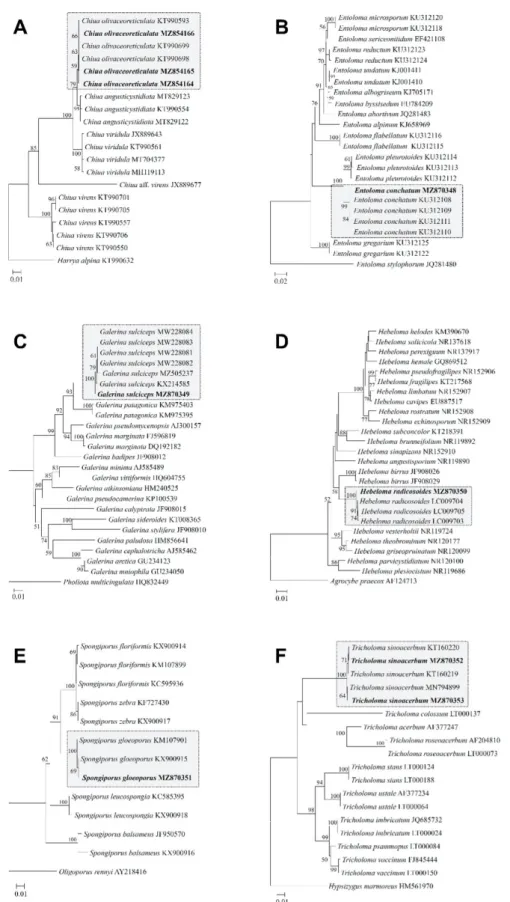
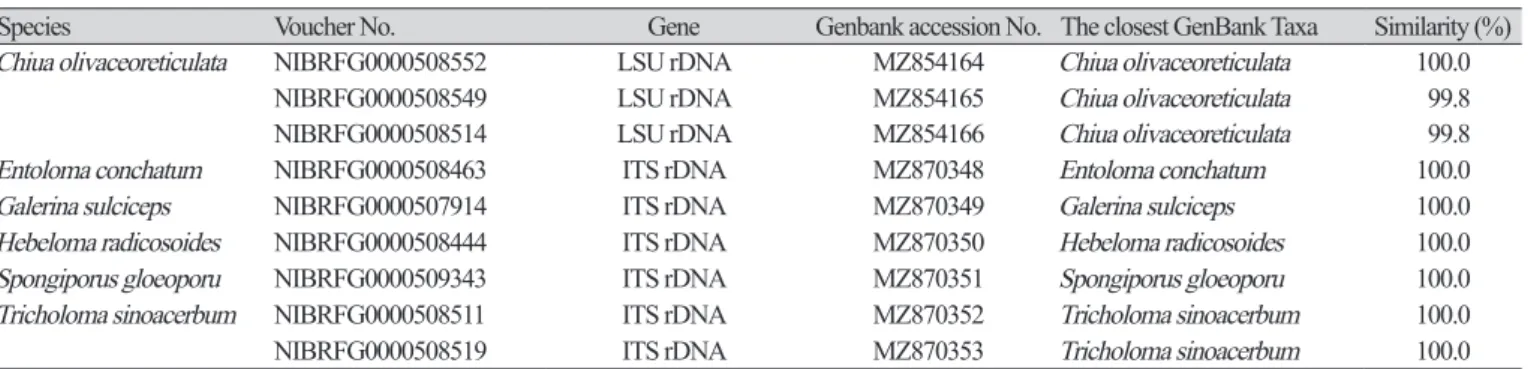
sequences with GenBank reference sequences using BLASTn (Table 1). A neighbor-joining phylogenetic tree was constructed using the MEGA 5 software with Jukes-Cantor correction. Additionally, the robustness of inferred neighbor-joining topologies was tested with 1,000 bootstrap replicates (Fig. 2). Subsequently, all fungal species were enumerated and taxonomically classified by morphological and phylogenetic analyses.

The Mycobank database (http://www. mycobank.org/) was used to classify the species into taxa and assign them a nomenclature.

Table 1. Closest GenBank matches of 6 undescribed species in this study.

Species Voucher No. Gene Genbank accession No. The closest GenBank Taxa Similarity (%) Chiua olivaceoreticulata NIBRFG0000508552 LSU rDNA MZ854164 Chiua olivaceoreticulata 100.0

NIBRFG0000508549 LSU rDNA MZ854165 Chiua olivaceoreticulata 99.8 NIBRFG0000508514 LSU rDNA MZ854166 Chiua olivaceoreticulata 99.8

Entoloma conchatum NIBRFG0000508463 ITS rDNA MZ870348 Entoloma conchatum 100.0

Galerina sulciceps NIBRFG0000507914 ITS rDNA MZ870349 Galerina sulciceps 100.0

Hebeloma radicosoides NIBRFG0000508444 ITS rDNA MZ870350 Hebeloma radicosoides 100.0 Spongiporus gloeoporu NIBRFG0000509343 ITS rDNA MZ870351 Spongiporus gloeoporu 100.0 Tricholoma sinoacerbum NIBRFG0000508511 ITS rDNA MZ870352 Tricholoma sinoacerbum 100.0

NIBRFG0000508519 ITS rDNA MZ870353 Tricholoma sinoacerbum 100.0

LSU, large subunit ; ITS, internal transcribed spacers.

Fig. 1. Fruiting bodies and microscopic features of (A) Chiua olivaceoreticulata, (B) Entoloma conchatum, (C) Galerina sulciceps, (D) Hebeloma

radicosoides, (E) Spongiporus gloeoporus, and (F) Tricholoma sinoacerbum. Scale bar: 1 cm. a, basidiospores; b, basidiaand basidioles; c,

cystidia; d, gelatinous hyphae. Scale bar: 10 μm.

(3)

Fig. 2. Neighbor-joining tree of 6 unrecorded species constructed using (A) LSU rDNA and (B-F) internal transcribed spacer sequences.

Bootstrap scores of >50 are presented at the nodes. The scale bar indicates the number of nucleotide substitutions per site. Samples from the

(4)

We collected 267 macrofungal species from the Gayasan National Park and classified them into 2 phyla, 5 classes, 19 orders, 59 families, and 146 genera. Among them, 112 species belonged to the order Agaricales;

17 species, including Amanita caesareoides, were the most diverse species belonging to the genus Amanita.

In addition, our paper reports six species that have never been reported in Korea: Chiua olivaceoreticulata, Entoloma conchatum, Galerina sulciceps, Hebeloma radicosoides, Spongiporus gloeoporus, and Tricholoma sinoacerbum. The boletoid specimen was identified using the nuclear large subunit (nLSU) rDNA sequence analysis, while other specimens were identified using the ITS sequence analysis (Fig. 2). Three specimens (NIBRFG0000508514, NIBRFG0000508549, and NIBRFG0000508552) formed a monophyletic clade with Chiua olivaceorediculata (bootstrap=59%; sequence similarity: 99.8- 100%). Moreover, they showed 99.2–99.4% sequence similarity with C. angusticystidiata and 98.1- 98.2% with C. viridula (Fig. 2A). Whereas, NIBRFG0000508463 formed a monophyletic clade with E.

conchatum (bootstrap=99%; sequence similarity: 100%) and had 97.2-97.7% sequence similarity with E. pleurotoides (Fig. 2B). The specimen NIBRFG0000507914 formed a monophyletic clade with G.

sulciceps (bootstrap=100%; sequence similarity: 99.8-100%) and had a 95.7% sequence similarity with G. patagonica (Fig. 2C). On the other hand, NIBRFG0000508444 formed a monophyletic clade with H. radicosoides (bootstrap=100%; sequence similarity: 99.8-100%) and exhibited 96.7-96.9% sequence similarity with H. birrus (Fig. 2D). Furthermore, NIBRFG0000509343 formed a monophyletic clade with S. gloeoporus (bootstrap support=100%; sequence similarity, 99.8-100.0%). It exhibited 95.4-96.0%

sequence similarity with S. floriformis and 95.6% sequence similarity with S. zebra (Fig. 2E). Additionally, the two specimens NIBRFG0000508511 and NIBRFG0000508519 formed a monophyletic clade with T.

sinoacerbum (bootstrap support=100%; sequence similarity: 99.8-100.0%; Fig. 2F).

Lee et al. (2020) reported 17 unrecorded species such as Crepidotus crocophyllus from Gayasan National Park [13]. Although there is a lack of research in Gayasan National Park, it is thought that intensive research has increased the possibility to find new species. Fungi have a very limited basidiocarp forming period, making it difficult to collect and observe. The best way to overcome this is to conduct a collection survey over a long period of time for the specified research place. Among the collected specimens, there are still some that have caused confusion in identification, and if identification is completed, additional discovery of new or unrecorded species is possible.

Taxonomy

Basidiomycota R.T. Moore Agaricomycetes Doweld

Boletales E.-J. Gilbert Boletaceae Chevall.

1. Chiua olivaceoreticulata Yan C. Li & Zhu L. Yang, Fungal Diversity 81: 78 (2016)

(Jin-No-Ran-Gue-Mul-Beo-Seot, 진노란그물버섯)

(5)

Pileus hemispherical when young, becoming plane when mature, 40-85 mm diam. Upper surface dark green to yellowish green, paler towards margin, with fibrillose to tomentose. Pore surface depressed around apex of stipe, white when young, pinkish with age. Pores angular, 2-3 per mm, without discoloration when bruised. Stipe subcylindrical to narrow clavate, 50-80×15-25 mm, reddish pink in the upper part, yellow to bright yellow downward.

Basidia clavate, 30-45×8-10 μm, with 4-sterigmata. Basidiospores subfusiform, 10.5-12.5×4-5.5 μ m, colorless, smooth. Pleuro and cheilo-cystidia cylindrical to subcylidrical, 30-45 ×4-7 μm, colorless, smooth.

Remarks: Chiua is the genus first reported in Korea from this study. C. olivaceoreticulata is characterised by dark green to yellowish green pileus and white to pinkish pore surface.

Specimen examined: Korea. Gyeongsangnam-do Hapcheon-gun, Gayasan National Park, 20 Aug 2020, NIBRFG0000508552 (GenBank accession no. MZ854164), NIBRFG0000508549 (GenBank accession no. MZ854165), NIBRFG0000508514 (GenBank accession no. MZ854166).

Agaricales Underw.

Entolomatacea Kotl. & Pouzar

2. Entoloma conchatum Xiao L. He & E. Horak, MycoKeys 61: 5 (2019) (So-Ra-Oe-Dae-Beo-Seot, 소라외대버섯)

Pileus conchate in ventral view, broadly convex in side view, 7-15 mm diam. Upper surface white when young, becoming orange-white when mature, with tomentose. Lamellae adnexed, subdistant, white at first, becoming pinkish when mature. Context white, tine. Stipe absent or sometimes slightly developed, white fibrils, base with white mycelium.

Basidia subclavate, 30-35 ×10-12 µm, 4-sterigmata. Basidiospores polygonal (5-6 angled), 8-10.5×

6-8 μm, with apiculus.

Remarks: E. conchatum is characterised by small size pileus, pinkish lamellae, polygonal (5-6 angled) basidiospores.

Specimen examined: Korea. Gyeongsangnam-do Hapcheon-gun, Gayasan National Park, 6 Aug 2020, NIBRNIBRFG0000508463 (GenBank accession no. MZ870348).

Hymenogastraceae Vittad

3. Galerina sulciceps (Berk.) Boedijn, Sydowia 5 (3-6): 224 (1951) (Jeok-Gal-Saek-E-Mil-Jong- Beo-Seot, 적갈색에밀종버섯)

Pileus convex at first, becoming slightly depressed in the center when mature, 20-30 mm diam. Upper

surface dark rusty to dark vinaceous brown, smooth, subgelatinous. Lamellae distant, broadly adnate to

slightly decurrent, concolorous with upper surface, with lamellulae. Stipe subcylindrical, 10-25 ×2-3 mm,

concolorous with pileus or darker, solid.

(6)

Basidia cylindrical to slightly club-shaped, 32-44 ×5-6 µm with 4-sterigmata. Basidiospores ellipsoid to almond-shaped, 7.0-9.5×4.5-5.5 µm, yellowish brown.

Remarks: G. sulciceps is characterised by dark rusty to dark vinaceous brown, subgelatinous pileus, ellipsoid to almond-shape basidiospores.

Specimen examined: Korea. Gyeongsangnam-do Hapcheon-gun, Gayasan National Park, 8 Jul 2020, NIBRNIBRFG0000507914 (GenBank accession no. MZ870349).

Strophariaceae Singer & A.H. Sm.

4. Hebeloma radicosoides Sagara, Hongo & Y. Murak., Mycol. Res. 104(8): 1017 (2000) (Ppu-Ri- Ja-Gal-Beo-Seot-Bu-Chi, 뿌리자갈버섯부치)

Pileus hemispherical with incurved margin when young, becoming broadly convex or plane with obtusely umbonate when mature 50-70 mm diam. Upper surface pale yellow, light yellow, with brown scales, viscid to glutinous when wet. Lamellae adnexed, crowded, whitish when young, becoming light brown when mature. Stipe slightly tapering toward apex with swollen base and pseudorhiza, 60-100×10- 15 mm, white, squamulose, solid to stuffed. Annulus membranous, brown, movable.

Basidia clavate to subclavate, 20-25×5-8µm, with 4-sterigmata. Basidiospores subamygdaliform, 8.5- 11.0 ×4.5-5.5 µm, finely punctate.

Remarks: H. radicosoides is characterised by pale yellow, light yellow, with brown scales pileus, swollen base with pseudorhiza stipe, movable annulus.

Specimen examined: Korea. Gyeongsangnam-do Hapcheon-gun, Gayasan National Park, 9 Jul 2020, NIBRFG0000508444 (GenBank accession no. MZ870350).

Polyporales Gäum.

Dacryobolaceae Jülich

5. Spongiporus gloeoporus (L.L. Shen, B.K. Cui & Y.C. Dai) B.K. Cui, L.L. Shen & Y.C. Dai, Persoonia 42: 122 (2018)

(Kkeun-Jeok-Hae-Myeon-Gu-Meong-Beo-Seot, 끈적해면구멍버섯)

Basidiocarp annual, sessile. Pileus flabelliform, 50×80 mm and 10 mm thick at base. Upper surface velutinate, sinuous, white colored when young, becoming cream to greyish when wet, margin concolorous with pileal surface. Pore surface white when fresh, becoming buff when dry, pores angular, 3-4 per mm, glue pores when dry. Context white to cream, up to 5 mm thick, corky. Tubes concolorous with pore surface, up to 2 mm long.

Hyphal system monomitic; generative hyphae with clamp connections, hyaline, 3-5 µm in diam.

Basidia clavate, 12-18×4-5 μm, with 4-sterigmata. Basidiospores ellipsoid, 3.5-4.5×2-2.5 μm, hyaline, thin-walled, smooth.

Remarks: Spongiporus is the genus first reported in Korea from this study. S. gloeoporus is characterized

by flabelliform and white to cream color pileus, glue pores when dry.

(7)

Specimen examined: Korea. Gyeongsangnam-do Hapcheon-gun, Gayasan National Park, 8 Jul 2020, NIBRFG0000509343 (GenBank accession no. MZ870351).

Agaricales Underw.

Tricholomataceae R. Heim ex Pouzar

6. Tricholoma sinoacerbum T.H. Li, Iqbal Hosen & Ting Li, Mycoscience 57 (4): 234 (2016) (Gub- Eun-Sseun-Song-I, 굽은쓴송이)

Pileus hemispherical to convex when young, becoming plano-convex, with slightly incurved margin, 50- 110 mm diam. Upper surface cream-colored to pale yellow at margin and brownish buff at center, smooth, slightly viscid when wet. Context white, solid, 5-10 mm thick. Lamellae adnate, crowded, white to yellowish white. Stipe cylindrical to slightly tapering toward apex, slightly curve, 70-120 ×12-18 mm, dull white with whitish mycelium at base.

Basidia clavate to narrowly clavate, 18-23 ×5-7 μm, hyaline, thin-walled, with 4-sterigmata.

Basidiospores globose to subglubose, 3.0-5.5×3.5-4.0 μm, thin-walled, pale yellowish, smooth, with apiculus.

Remarks: T. sinoacerbum is characterized by cream-colored to pale yellow pileus, basidiospores globose to subglubose.

Specimen examined: Korea. Gyeongsangnam-do Hapcheon-gun, Gayasan National Park, 20 Aug 2020, NIBRFG0000508511 (GenBank accession no. MZ870352), NIBRFG0000508519 (GenBank accession no. MZ870353).

ACKNOWLEDGMENTS

This study was supported by a grant from the National Institute of Biological Resources (NIBR), funded by the Ministry of Environment (MOE) of the Republic of Korea [NIBR202102107].

REFERENCES

1. Breitenbach J, Kränzlin F. The fungi of Switzerland. Vols. 1-5. Lucerne: Verlag Mykologia;

1984-2000.

2. Gilbertson RL, Ryvarden L. North American polypores. Vol. 1. Abortiporus-Lindtneria. Oslo:

Fungiflora; 1986.

3. Hongo T, Izawa M. Yama-Kei field book. No. 10. Fungi. Tokyo: Yama-Kei Publishers; 1994.

4. Imazeki R, Otani Y, Hongo T, Izawa M, Mizuno N. Fungi of Japan. Tokyo: Yama-Kei Publishers; 1988.

5. Kränzlin F. Fungi of Switzerland. Vol. 6. Russulaceae: Lactarius, Russula. Lucerne: Verlag Mykologia; 2005.

6. Largent DL, Thiers HD. How to identify mushrooms to genus II: Field identification of genera.

Eureka: Mad River Press; 1977.

(8)

7. Lim YW, Lee JS, Jung HS. Fungal flora of Korea. Vol. 1. No. 1. Wood rotting fungi. Incheon:

National Institute of Biological Resources; 2010.

8. Park WH, Lee JH. New wild fungi of Korea. Seoul: Kyo-Hak Publishing Co.; 2011.

9. Ryvarden L. Genera of polypores: Nomenclature and taxonomy. Synopsis Fungi 1991;5:1-363.

10. White TJ, Bruns T, Lee S, Taylor J. Amplification and direct sequencing of fungal ribosomal RNA genes for phylogenetics. PCR protocols. Amsterdam: Elsevier; 1990. p. 315-22.

11. Gardes M, Bruns TD. ITS primers with enhanced specificity for basidiomycetes: application to the identification of mycorrhizae and rusts. Mol Ecol 1993;2:113-8.

12. Tamura K, Peterson D, Peterson N, Stecher G, Nei M, Kumar S. MEGA5: Molecular evolutionary genetics analysis using maximum likelihood, evolutionary distance, and maximum parsimony methods. Mol Biol Evol 2011;28:2731-9.

13. Lee H, Park MS, Park JH, Cho HJ, Park KH, Yoo S, Lee JW, Kim NK, Lee JS, Park JY,

et al. Seventeen unrecorded species from Gayasan National Park in Korea. Mycobiology

2020;48:184-94.

수치

Table 1. Closest GenBank matches of 6 undescribed species in this study.
Fig. 2. Neighbor-joining tree of 6 unrecorded species constructed using (A) LSU rDNA and (B-F) internal transcribed spacer sequences

참조

관련 문서

Taylor Series

This paper is written to find answers of the research question that the 'Meeting First, Key-issue Agreement Later" approach of the US and South Korea

Objective: This study was conducted to identify the association between vitamin D and osteosarcopenia among all adults in Korea using data from the Korea National Health

Therefore, this research is trying to deal with investigation on color status and problem of usage of color status on street furnitures installed in city

The concerned study is now believed to make a contribution to protecting the seniors in Korea from committing a suicide and to reduce the suicidal

The Presidents Cup 2015 is just around the corner. The venue is The Jack Nicklaus Golf Club Korea located in the Incheon Songdo International City, and this is the first time

In his remarks, Ambassador Park expressed his deep gratitude to Norwegian Korean War veterans for helping Korea in overcoming the crisis of war as well as achieving the

The Dusky Lory ( Pseudeos fuscata ) is a monotypic species of parrot in the Psittaculidae family, and the only species of the genus Pseudeos... platyrhynchos