- 29 - 대한두경부종양학회지, 제37권 제1호, 2021. pp.29-32
Korean Journal of Head & Neck Oncology, Vol.37, No.1
https://doi.org/10.21593/kjhno/2021.37.1.29 ISSN 1229-5183(Print) / ISSN 2586-2553(Online)
악하선 절제술 후 발생한 역설적 아랫 입술 경련
유지섭⋅홍용태
전북대학교 의과대학 이비인후과학교실
Paradoxical Lower Lip Twitching after Removal of the Submandibular Gland
Ji Seob Yoo, MD, Yong Tae Hong, MD
Department of Otolaryngology-HNS, Research Institute for Clinical Medicine of Jeonbuk National University, Biomedical Research Institute of Jeonbuk National University Hospital, Jeonbuk, Korea
= Abstract =
Benign submandibular gland tumor is a common disease in the head and neck region and can be completely removed by transcervical approach. Typical submandibular gland resection can lead to neurological complications.
The most common complications are damage to the marginal mandibular branch of the facial nerve and weakening of the lower lip. We report a case of ipsilateral lower lip twitching occurring 3 months after surgery. There was no difficulty during the operation, and there were no neurologic complications immediate after surgery. However, in the present case, the patient experienced lower lip twitching paradoxically after surgery which has not been reported in the literature yet. Therefore, we reported this case with a review of relevant literature.
Key Words : Lip twitching⋅Submandibular gland
Received R e v i s e d Accepted
: November 3, 2020
: March 22, 2021(1차) / April 5, 2021(2차) : April 6, 2021
+Corresponding author: Yong Tae Hong, MD
Department of Otolaryngology-HNS, Research Institute for Clinical Medicine of Jeonbuk National University- Biomedical Research Institute of Jeonbuk National University Hospital, Jeonbuk, 560-182, Korea
Tel: +82-63-250-1990, Fax: +82-63-250-1986 E-mail: [email protected]
Introduction
Benign tumors of the submandibular gland are common head and neck region tumors and they should be treated primarily by removal of the involved submandibular gland.
Recurrence rate after surgery is very low. Generally, benign tumors of the submandibular gland are removed transcervically.
This approach has a few complications, such as a neck scar and neurologic injury to the marginal mandibular, and hypo- glossal nerves.1)
Lip twitching is caused by involuntary muscle con- tractions in or around the lips. These contractions can result from irritation of the affected nerves in the lips. Injuries to the nerves can also result in twitching and sometimes the nerves in the face do not function normally, causing the muscles in the lips to contract. When a lip twitches, the muscles in or around the area contract, which is evident to the patient as quivering of the lip.2,3) If the twitching occurs rapidly, the lip may not appear to be twitching to observers. In some cases, it may be an initial presentation of a degenerative condition of nerve. Muscle contraction in this region of the face can also be triggered by intense emotions of anger, fear, joy, and amusement, and can reflect extreme fatigue, stress, and anxiety.4-6)
We describe a case of a patient who presented with twitching of the lower lip while speaking and other facial expression changes after transcervical removal of the sub- mandibular gland. We report this paradoxical movement of
- 30 - A
B
Fig. 1. Computed tomography of the neck (A) shows homogenous hypodense mass (red arrow) in the submandibular gland, and scar (white arrow) on the left submandibular area (B).
A B C
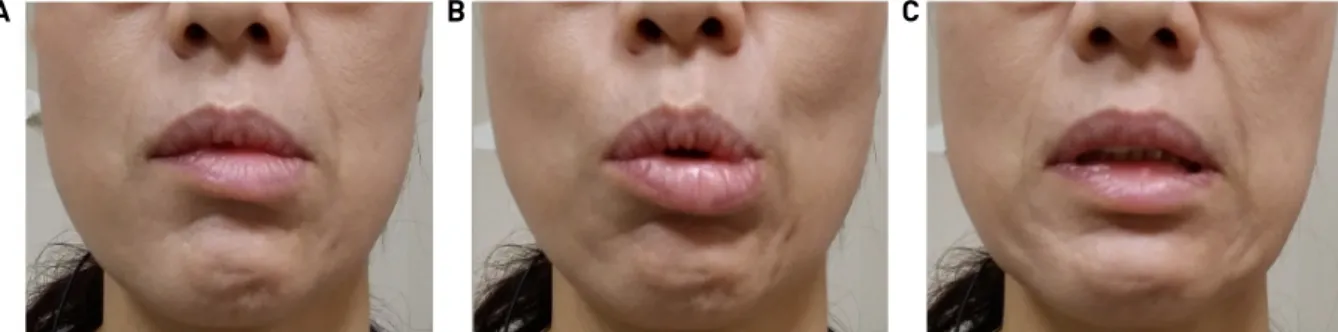
Fig. 2. The photography of 3 months after the surgery. Mild lower lip deviation at resting (A), typical lip twitching at whistling (B) and lip widening (C).
the lower lip with a review of relevant literature.
Case Report
A 43-year-old female presented with a chief complaint of an enlarging left-submandibular mass during the previous 6 months. Her past history was not significant, with no his- tory of surgery or use of tobacco or alcohol. Physical exami- nation revealed a firm, mobile, and tender 3-4 cm size mass on the left submandibular area. No lesion was evident in the oral cavity, oropharynx, and other head and neck regions.
The mandible, maxilla, and tooth were normal. A computed tomography (CT) scan with contrast showed a homogenous 3-4 cm size mass on level II of the left upper neck. The mass was evident as an intraglandular mass of the sub- mandibular gland with no invasion to surrounding structures (Fig. 1). Radiologically, the mass was suspected of being
a benign tumor. The patient underwent needle aspiration (FNA) of the suspect benign pleomorphic tumor. The pa- tient was scheduled for excision of submandibular gland.
The mass was soft and well demarcated, with no severe adhesion to surrounding structures. We did not identify the marginal mandibular nerve to preserve the nerve intact. The submandibular gland was easily removed without any injury of the lingual and hypoglossal nerves. After surgery there were no complications, such as lower lip weakness, and lingual and hypoglossal nerve injury. Histologically, the be- nign mass was confirmed as pleomorphic adenoma.
Three months after surgery, the patient complained of left lower lip twitching when speaking and a changed facial expression (Fig. 2). There were neither palpable mass in the neck nor paralysis of the facial nerve suggesting no recurrence. The patient was observed for 6 months after s urgery. The lower lip twitching did not improved. We rec-
- 31 - ommended a Botox injection on the left lower lip. The pa- tient denied this option and has been followed-up without any management.
Discussion
Benign tumors of the submandibular gland are usually identified as painless masses and can be present for many years. Surgical excision is generally accepted as the man- agement treatment of choice. Removal of a submandibular mixed tumor is commonly done using a transcervical approach.
The procedure is relatively simple. The submandibular gland tissue can be removed without difficulty and without alteration of the salivary system. But, neurological compli- cations can occur; injury of the mandibular branch of the facial nerve is common complication in the transcervical approach. On study reported an 18% incidence of damage to the marginal mandibular nerve, with damage being per- manent in 7% of cases.1) The damage us ually involves tempo- rary paralysis due to a compression and /or stretching injury, which typically resolves spontaneously within 3 months.1)
Normally muscles contract when stimulated by the nerves and relax once this stimulation ceases. The strength of the contraction depends on the strength of nerve signals. However, in twitching the muscle contractions are sudden and rapid, imparting the sensation and/or appearance of lip trembling.3) Lip twitching is caused by involuntary, sudden muscle con- tractions in or around the lips. The visual symptoms of low- er lip twitching can be very evident. A slight tremor can radiate to the involved lip following the muscle contractions.
The main reasons are irritation of the facial nerve due to trauma or injury, and stimulation of the nerve endings that is present in the muscles. Injuries to the nerves can result in twitching; sometimes the nerves in the face function ab- normally, causing the muscles in the lips to contract. When a lip twitches, the muscles in or around the area contract, making the lip feel like it is quivering.4) If the twitching is fast, the lip may not appear to be twitching to observers, but it may still be felt. Some conditions make the con- tractions more noticeable to others and may be accompanied by other symptoms. Other symptoms are mild palpita- tion-like movements, a feeling of frozen lips or numbness, and a curling sensation of the edges of lower lip. Twitching can occur repeatedly after an interval of several minutes.
Other suspected reasons are withdrawal from alcohol, drugs, or cigarettes, and venting of emotions like anger, excite- ment, fear, anxiety, or nervousness.
Delayed onset facial nerve complication, such as Bell’s palsy or after parotidectomy, are major causes of abnormal facial movements. Bell's palsy is a transient condition of irritation or damage to facial nerve. Most people with Bell’s palsy develop difficulty in talking, closing eye lids, and pursing lips due to muscular weakness. After recovery of long-term injury of facial nerve, synkinesis of facial nerves is possible. Synkinesis is the development of linked or un- wanted facial movements.7) It is common and occurs in the majority of people who are recovering from prolonged facial palsy. Only the affected side of the face develops synkinesis.
Synkinesis may be apparent in various ways. The recovering facial nerve is poorly insulated, resulting in messages to move one particular muscle being picked up by another muscle. The effect of this is more than one muscle moving at the same time (for example, an eye closing when smil- ing).8) Over time these linked movements become habitual and remain despite nerve recovery. Sometimes other mus- cles pull against the right muscles in a ‘tug of war’, which can result in a lack of movement. Synkinesis also often results in twitching movement, associated with aberrant re- generation following facial nerve injury.9) The mos t com- monly used treatment for involuntary muscle contractions is local injections of botulinum toxin. Botulinum toxin in- hibits the release of the neurotransmitter acetylcholine from axon endings at the neuromuscular junction resulting in lo- cal chemical denervation and loss of neuronal activity in the targeted organ. This markedly alleviates twitching mov- ment, even though the abnormal muscle contraction does not completely disappear and electrophysiological signs of hyperexcitability remain.10)
Conclusion
Lower lip weakness can occur in patients with excision of submandibular gland transcervically. However, in the present case, the patient experienced lower lip twitching par- adoxically after surgery.
- 32 -
Acknowledgement
This paper was supported by Fund of Biomedical Research Institute of Jeonbuk National University Hospital.
References
1) Leonardo BA, Cosme GE. Morbidity associated with removal of the submandibular gland. J Cranio-maxillo-facial Surg. 1992;20:
216-219.
2) Jannetta PJ. Typical or atypical hemifacial spasm. J Neurosurg.
1998;89:346-347.
3) Zappia JJ, Wiet RJ, Chouhan A, Zhao JC. Pitfalls in the diagnosis of hemifacial spasm. Laryngoscope. 1997;107:461-465.
4) Lorentz IT. Treatment of hemifacial spasm with botulinum toxin.
J Clin Neurosci. 1995;2:132-135.
5) Wang A, Jankovic J. Hemifacial spasm: clinical findings and treatment. Muscle Nerve. 1998;21:1740-1747.
6) Colosimo C, Bologna M, Lamberti S. A comparative study of pri- mary and secondary hemifacial spasm. Arch Neurol. 2006;63:
441-444.
7) Yamamoto E, Nishimura H, Hirono Y. Occurrence of sequelae in Bell’s palsy. Acta Otolaryngol. 1987;446:93-96.
8) Celik M, Forta H, Vural C. The development of synkinesis after facial nerve paralysis. European Neurology. 2000;43:147-151.
9) Jankovic J. Peripherally induced movement disorders. Neurol Clin. 2009;27:821-832.
10) Valls-Solé J, Tolosa E, Ribera G. Blink reflex studies of patients with blepharospasm before and after treatment with botulinum toxin. J Neurol Neurosurg Psychiatry. 1991;54:310-313.