1. Introduction
The circulation of the Japan/East Sea (JES) is characterized by significant temporal and spatial variability due to such factors as seasonal fluctuations in the warm inflow through Tsushima Strait, branching of the Tsushima Warm Current (TWC), and the formation of mesoscale eddies along these branches. Thermal contrasts are usually associated with the warm and cold currents, eddies and upwelling. Indented coastal line and sharp slope of shelf rising from the Ulleung Basin at 1000-2000 m
up to 50 m just 20-50 km off the coast are also contribute to complicated water dynamics. Interaction of currents with underwater relief and islands generates fronts, vortices and internal waves.
Although the main features of the JES circulation are reasonably well known, a detailed description of even dominant currents like the Tsushima Warm Current (TWC), East Korean Warm Current (EKWC), etc.
still eludes oceanographers. They are constantly changing and must be measured repeatedly to estimate their mean flux.
While the sampling capabilities of visible and
ERS SAR Observations of the Korean Coastal Waters
Hong-Joo Yoon
†*, Leonid M. Mitnik**, Heung-Soon Kang*, and Han-Keun Cho*
* Pukyong National University
** V.I. Il’ichev Pacific Oceanological Institute FEB RAS, Russia
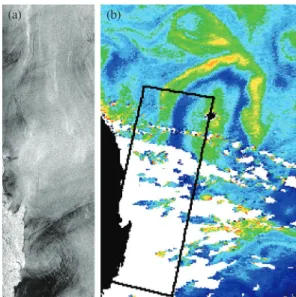
Abstract : The processes of regional scales in the East Korean coastal waters were investigated by analysis of the Synthetic Aperture Radar (SAR) images taken by the European Research Satellites ERS-1, ERS-2 and Envisat. More than 500 quick look frames taken in 1991-2003 were examined to detect the frames with clearly surface expressions of oceanic phenomena. 26 ERS-1/2 SAR and 11 Envisat wide swath Advanced SAR (ASAR) frames were selected and obtained from the European Space Agency in a form of the precision high-resolution images. The following oceanic phenomena and processes were evident in the radar imagery through the Korean costal waters: fronts, currents, eddies, internal waves, island and ship wakes, oil pollution, etc. They manifested themselves in the field of sea surface roughness, their scale ranged from several tens meters to about 100 km. The most common morphology of these phenomena was a series of contrast dark or light curvilinear lines and bands. The joint analysis of the discussed SAR images with other satellite and in situ data supported and enhanced our interpretation of SAR signatures.
Key Words : ERS SAR, EKWC, eddies, internal waves.
Korean Journal of Remote Sensing, Vol.23, No.1, 2007, pp.65~69
Received 16 January 2007; Accepted 20 February 2007.
†