Introduction
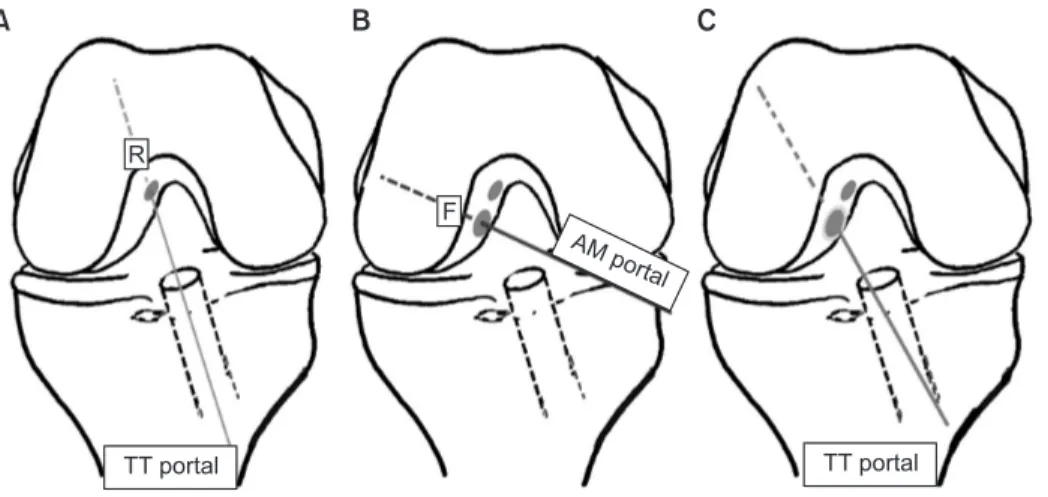
Various techniques for anterior cruciate ligament (ACL) recon- struction have been recently introduced. There are approaches to femoral tunnel placement in arthroscopic ACL reconstruction:
the tibial tunnel-dependent approach (transtibial technique) and the tibial tunnel-independent approach (anteromedial [AM] and outside-in techniques). Femoral tunnel placement using the trans-
tibial technique is a common and relatively easy procedure in single-bundle (SB) ACL reconstruction. However, recent reports and emphasis on anatomic tunnel placement have generated the need to reconsider the application of the transtibial approach.
Some authors reported that the femoral tunnels created using the transtibial approach are non-anatomic
1-3). So, there have been some efforts to modify the transtibial technique by positioning the starting point of the tibial tunnel more medial and proximal for a more oblique trajectory of the femoral tunnel
2). However, this has led to other problems such as a shorter tibial tunnel and widening of the intra-articular aperture of the tibial tunnel
3.4). Therefore, a transition to creation of a femoral tunnel indepen- dent of the tibial tunnel is recommended to achieve anatomic femoral tunnel placement
5). Techniques for creating anatomical femoral footprint in SB reconstruction have been reported, such as the trans-AM portal technique
6,7)and the outside-in tech- nique
8). However, disadvantages such as insufficient femoral tun- nel length, posterior wall breakage and a bent graft would limit
Anatomical Single-bundle Anterior Cruciate Ligament Reconstruction Using a Freehand Transtibial Technique
Kyung-Wook Nha, MD 1 , Jae-Hwi Han, MD 1 , Jae-Ho Kwon, MD 2 , Kyung-Woon Kang, MD 1 , Hyung-Joon Park, MD 1 , and Jae-Gwang Song, MD 1
1