• 검색 결과가 없습니다.

An unusual presentation of non-specific cystic degeneration of craniofacial fibrous dysplasia: a case report and review of literature

N/A
N/A
Protected

Academic year: 2021

Share "An unusual presentation of non-specific cystic degeneration of craniofacial fibrous dysplasia: a case report and review of literature"

Copied!
7
0
0

로드 중.... (전체 텍스트 보기)

전체 글

(1)

C A S E R E P O R T Open Access

An unusual presentation of non-specific cystic degeneration of craniofacial fibrous dysplasia: a case report and review of

literature

Inseok Hong 1,2 , Dong Cheol Kang 1,2 , Dae-Ho Leem 1,2 , Jin-A Baek 1,2 and Seung-O Ko 1,2*

Abstract

Background: Fibrous dysplasia (FD) is a rare, sporadic, and benign congenital condition in which normal cancellous bone is replaced by fibro-osseous tissue with immature osteogenesis. FD localized in the cranial and facial bones is called craniofacial fibrous dysplasia (CFD). Cystic degeneration in CFD cases is rare; cystic degeneration appearing in both the maxilla and the mandible FD lesion is even rarer. The aim of this article was to report a case of fibrous dysplasia of the mandible and maxilla complicated by nonspecific cystic degeneration.

Case presentation: A 30-year-old woman presented with a rare case of non-specific cystic degeneration in a mandible and maxilla FD lesion that occurred 11 years after surgery. She was diagnosed with polyostotic CFD and underwent maxillary and mandibular bone contouring. Cyst enucleation under general anesthesia was performed in the mandibular region due to pain and discomfort.

Conclusions: In cases involving non-aggressive and non-invasive FD cystic degeneration in focal areas, conservative treatment is recommended. However, if cystic degeneration of FD develops rapidly and causes discomfort, pain, or dysfunction, surgical treatment should be considered.

Keywords: Craniofacial fibrous dysplasia, Cystic degeneration, Cyst enucleation, Fibrous dysplasia, Mandible, Maxilla, Polyostotic fibrous dysplasia

Background

Fibrous dysplasia (FD) is a benign disorder characterized by the replacement of normal bone tissue with prolifera- tive fibrous connective tissues [1]. Somatic mutations in the Gs-alpha gene on chromosome 20 can lead to endo- crine tumors, FD, and McCune–Albright syndrome (MAS) [2]. FD occurs in two forms: the monostotic form affecting one bone (approximately 70% of cases), and the polyostotic form affecting at least two bones

(approximately 30% of cases) [3]. FD that appears in the cranial and facial bones is called craniofacial fibrous dys- plasia (CFD). The prevalence of polyostotic and mono- stotic CFD is 71–91% and 10–29%, respectively [4, 5]. In the jaw bone, FD is approximately twofold more preva- lent in the maxilla and usually occurs unilaterally [1].

Non-epithelial-lined cysts sometimes occur in associ- ation with various benign and malignant bone lesions, including FD, giant cell tumors, chondroblastoma, ossi- fying fibroma, benign osteoblastoma, cemento-osseous dysplasia, fibrous histiocytoma, fibrosarcoma, and osteo- sarcoma. These cysts show various patterns and can ap- pear as aneurysmal bone cysts, simple bone cysts, or non-specific cystic degenerations [6].

© The Author(s). 2020 Open Access This article is licensed under a Creative Commons Attribution 4.0 International License, which permits use, sharing, adaptation, distribution and reproduction in any medium or format, as long as you give appropriate credit to the original author(s) and the source, provide a link to the Creative Commons licence, and indicate if changes were made. The images or other third party material in this article are included in the article's Creative Commons licence, unless indicated otherwise in a credit line to the material. If material is not included in the article's Creative Commons licence and your intended use is not permitted by statutory regulation or exceeds the permitted use, you will need to obtain permission directly from the copyright holder. To view a copy of this licence, visit http://creativecommons.org/licenses/by/4.0/.

* Correspondence: [email protected]

1

Department of Oral and Maxillofacial Surgery, School of Dentistry, Chonbuk National University Dental Hospital, 20, Geonji-ro, Deokjin-gu, Jeonju-si, Jeollabuk-do, Republic of Korea

2

Research Institute of Clinical Medicine-Biomedical Research Institute,

Chonbuk National University Hospital, 20, Geonji-ro, Deokjin-gu, Jeonju-si,

Jeollabuk-do, Republic of Korea

(2)

Cystic degeneration in CFD cases is rare; cystic degen- eration appearing in both the maxilla and the mandible is even rarer. A PubMed search from 1946–2019 (using the search terms “fibrous dysplasia” [Ti] OR “McCune–

Albright” [Ti] OR “Jaffe–Lichtenstein” [Ti] OR “Mazab- raud” [Ti] AND (cyst [Ti] OR cystic [Ti]) initially identi- fied 78 articles. After screening and manual review, a total of seven articles on the occurrence of cystic degen- eration in maxillary or mandibular FD were identified [6–12].

Case presentation

In November 2018, a 30-year-old woman presented to the Department of Oral and Maxillofacial Surgery of Chonbuk National University Hospital with a complaint of pain and swelling in the left mandible that had ap- peared 10 days earlier. Eleven years ago, she was diag- nosed with CFD (Fig. 1a, b) and had received bone contouring in the left zygomaticomaxillary complex and left mandibular region under general anesthesia in the same department (Fig. 2a, b). Postoperative healing was uneventful and 18 months postoperatively, there was no specific problem with the lesion (Fig. 1c). The patient had subsequently been lost to follow-up until November 2018.

A review of medical history prior to November 2018 confirmed that she had not received any dental treat- ment or suffered trauma to the painful left mandible area in recent months. Her pain intensity rating was 4 points on the numeric pain rating scale. Clinical examin- ation revealed slight swelling in the left midface and left submandibular areas, along with bony expansion from the posterior of the left mandibular angle to the inferior aspect of the #34 tooth. The patient did not complain of hypoesthesia or pain when pressure was applied to the area. During an intraoral observation, the swelling was found from the distal aspect of #33 to the mesial vesti- bule area in relation to #36. During the endodontic examination, tooth mobility and percussion reactions were not observed in #34, 35, and 36. Moreover, the electric pulp test (EPT) showed normal response from #34, 35, and 36. No evidence of gum inflammation, such as peri- odontal pockets or gingival sulcus swelling and bleeding, was found during the periodontal examination. Further- more, in the panoramic view, the dental origin with the possible infection source was not observed (Fig. 1d).

A well-defined multilocular radiolucent lesion in the left posterior mandibular region was identified on the panoramic radiograph, and the location of the lesion overlapped with the existing FD. In addition, amorphous calcified foci were observed inside the lesion (Fig. 1d).

Cone-beam computed tomography (CBCT) showed an expansive bone lesion with a ground-glass appearance spanning the left frontotemporal bone, crista galli,

orbital wall, ethmoid bone, sphenoid bone, zygoma, pter- ygoid plate, and maxilla regions (Fig. 3a). An ill-defined (partially well-defined) irregular osteolytic lesion was ob- served inside the left mandibular lesion, and cortical thinning, buccolingual expansion, and cortical destruc- tion were also identified (Fig. 3a).

A decision to perform a marsupialization procedure was made to first control edema and pain, and second to take a biopsy. The marsupialization procedure was per- formed after an intraoral incisional biopsy of the area surrounding the #34 and #35 teeth, followed by root canal treatments on these teeth. The biopsy results re- vealed some evidence of chronic inflammation and that the lesion may be a bony lesion with inflammatory reac- tion rather than FD. During a 3-week observational period, the size of the lesion was unchanged according to clinical and radiological findings (Fig. 3b). Eventually, we decided that cyst enucleation under general anesthesia should be performed in the mandibular re- gion. However, in the maxilla region, since there was no pain or discomfort, we decided to follow-up without any surgical treatment.

Surgical note

At the time of surgery, the lesion had expanded from the inferior aspect of the #34 tooth to the mesial root of the #36 tooth, with fibrotic tissue scattered within the le- sion. Subsequently, the soft tissue lesion was removed by cyst enucleation. The perilesional bone and the roots of the #34, 35 teeth, and the mesial root of the #36 tooth were ground. Electrocautery was applied to the interior of the lesion and a thorough curettage was performed (Fig. 4).

Pathological note

The lesions removed by cyst enucleation were sent for tissue biopsy. The largest lesion was approximately 3 × 2

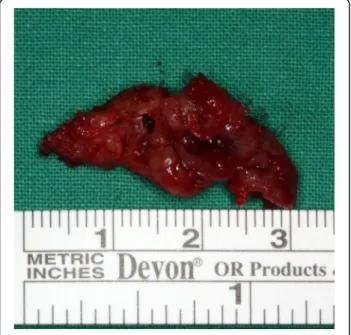
× 1.5 cm and was lined by a thick, fibrotic tissue layer (Fig. 5).

Hematoxylin and eosin (H and E) stained sections showed dense collagenous tissue surrounding the osse- ous trabeculae, and peritrabecular clefting was present (Fig. 6a). Mitosis or atypia was not seen (Fig. 6b). The bi- opsy result revealed active nonspecific chronic inflam- mation with fibrosis.

In view of the radiographical and intraoperative find- ings, the absence of any history of trauma, a low prob- ability of dental infection being the cause (as per endodontic and periodontal examinations), absence of evidence of malignant transformation (confirmed by histological findings) [13–15], the researchers confirmed that the case involved non-specific cystic degeneration in the CFD site. Postoperative healing was uneventful (Figs. 1e and 3c), as was the postsurgical follow-up over

Hong et al. Maxillofacial Plastic and Reconstructive Surgery (2020) 42:31 Page 2 of 7

(3)

a 6-month period (Figs. 1f and 3d). Thereafter, the pa- tient was lost to follow-up.

Discussion

The FD cysts with nonepithelial lining have different histological characteristics, in which some are aneurysmal bone cysts, whereas others are simple bone cysts or nonspecific cyst degenerations [6]. The former

two entities are characterized by cavities in bones filled with blood and lined by a layer of thick fibrous tissue [8]. Aneurysmal and simple bone cysts are sometimes considered as secondary phenomena of many benign and malignant bone tumors and tumor-like lesions. On the other hand, a lesion that does not have histological features of either an aneurysmal or a simple bone cyst is regarded as nonspecific cyst degeneration [8].

Fig. 1 Radiographic images of the patient ’s jaw and skull. a Panoramic view of the jaw at baseline taken at the first visit to the out-patient department (2007.5). b Posteroanterior projection (PA) view of the skull at baseline taken at the first visit to the out-patient department (2007.5). c Postoperative panoramic view of the jaw taken 18 months post-surgery (2008.11). d Panoramic view of the jaw taken at the out-patient

department (2018.11). e Panoramic view of the jaw after cyst enucleation of the left mandibular lesion. f Postoperative panoramic view of the jaw

6 months after the surgery in November 2018 (2019.5)

(4)

Cystic degeneration of CFD is most often found in the sphenoid and frontal bones of patients with FD. Pressure from the cysts on the optic nerves can cause acute optic nerve compression in patients with acute cystic degener- ation (ACD) of CFD [16]. Cysts tend to show a more

aggressive course, which may be due to their association with several potential mechanisms, rather than being de- termined by a single pathogenetic event. Some cysts are thought to be caused by disruption of venous diploic channels, while it has also been suggested that bone

Fig. 2 Contrast-enhanced facial computed tomography (CECT) images of the patient. a CECT image taken at the first visit to the out-patient department (2007.5). b CECT image taken 3 months postoperatively (2007.8). c CECT image after incisional biopsy and marsupialization (2018.11).

d Postoperative CECT image after cyst enucleation on the left mandible in November 2018

Fig. 3 Cone-beam computed tomography (CBCT) images of the patient. a CBCT image taken at the out-patient department in November 2018.

b CBCT image 3 weeks after marsupialization on the left mandible. c Postoperative CBCT image after cyst enucleation on the left mandible in November 2018. d CBCT image taken 6 months after the surgery in November 2018 (2019.5)

Hong et al. Maxillofacial Plastic and Reconstructive Surgery (2020) 42:31 Page 4 of 7

(5)

cysts may occur due to an intraosseous vascular defect causing intramedullary hemorrhage [17]. Cysts may ex- pand rapidly depending on the site of onset, and can present with a variety of symptoms [8]. Sudden expan- sion due to the development of cystic degeneration may lead to sudden deterioration of vision [17]. The patient in our case report also presented with cystic degener- ation of FD in the maxilla, but did not complain of vi- sion deterioration.

According to the National Institutes of Health cohort study (unpublished observations), cystic degeneration occurred in approximately 5% of all patients with FD [17], whereas Bahk et al. reported that it occurred in ap- proximately 8% of all patients [18]. Ferretti et al.

estimated that cystic degeneration of FD covers the spectrum between a simple bone cyst and an aneurysmal bone cyst [6]. The important clinical feature of cystic de- generation of FD is a rapid increase in cyst size. This may be misdiagnosed clinically as an aneurysmal bone cyst, a simple cyst, or even a sarcomatous change of a pre-existing benign bony tumor. Therefore, a high index of suspicion is needed when there is a rapid increase in cyst size, as it may be caused by cystic degeneration in patients with FD [19]. Cystic areas within the involved bone are depicted on computed tomography (CT) scans as hypointensity. Therefore, CT scans should be ob- tained regularly every year until the lesion is stabilized [17]. Radiation therapy is not recommended for FD cysts due to a high potential for malignant transformation (up to 44%) [20].

Cystic degeneration of FD may exhibit a rapid increase in size, which could be misdiagnosed as a malignant transformation. If FD shows a clear lytic appearance or a

Fig. 4 Intraoperative photograph of the left mandibular lesion after cyst enucleation

Fig. 5 Photograph of the main mass

Fig. 6 Histologic features of the mass. a Dense collagenous tissue

surrounds the osseous trabeculae and peritrabecular clefting is

present (H and E stain, original magnification: × 100). b Mitosis or

atypia is not seen (H and E stain, original magnification: × 200)

(6)

rapid increase in size, the possibility of cystic degen- eration or malignant transformation should be consid- ered. Cystic degeneration of FD that shows an aggressive pattern on radiological findings tends to have poorly defined borders, osteolytic changes, and erosion of the cortex with periosteal reaction. This pattern is similar to that of the malignant transform- ation of FD [21], making it difficult to differentiate between cystic degeneration and malignant transform- ation of FD based on radiological findings alone [22].

To avoid unnecessary surgery, a preoperative biopsy should always be conducted [23].

Surgical treatment for FD is limited to cases involv- ing esthetic or functional problems. It is recom- mended when FD poses a threat to important anatomical structures, such as the eyes or the optic nerves, causes significant esthetic deformities, or if se- vere pain is clearly associated with the FD process [24]. In some cases, cosmetic trimming of excess bone may be required [11, 25]. Some studies that have reported on surgical treatments for cystic degen- eration of CFD are presented in Table 1.

In this case, our patient had a rare case of cystic de- generation simultaneously in the maxillary and man- dibular FD. The mandibular lesion showed discomfort and pain, and cyst enucleation was performed. However, follow-up was decided on the maxillary lesions because of the absence of pain or discomfort in that region. We found no noticeable differences in maxillary lesions on CBCT at 6 months follow-up (Fig. 3d). The postopera- tive site in the left mandible showed progressive bony healing without evidence of recurrence or an increase in lesion size (Figs. 1f and 3d). However, this was a short- term follow-up. Continuous follow-up is required for judgment of prognosis in the long term.

Conclusions

Cystic degeneration in CFD cases is rare; cystic degener- ation appearing in both the maxilla and mandible is even rarer. In this case, our patient had a rare case of nonspe- cific cystic degeneration simultaneously in the maxillary and mandibular FD. The mandibular lesion caused dis- comfort and pain, and cyst enucleation was performed.

Continuous follow-up is required for long-term predic- tion of prognosis.

Abbreviations

ACD: Acute cystic degeneration; CBCT: Cone beam computed tomography;

CECT: Contrast-enhanced computed tomography; CFD: Craniofacial fibrous dysplasia; CT: Computed tomography; EPT: Electric pulp test; FD: Fibrous dysplasia; MAS: McCune –Albright syndrome

Acknowledgements

We would like to thank Editage (www.editage.co.kr) for English language editing.

Authors ’ contributions

ISH wrote the manuscript. DCK, DHL, and BJA helped in the drafting of the manuscript. SOK contributed to the direction and design of the research and contributed to the review of the paper. All authors read and approved the final manuscript.

Funding

This research received no specific grant from any funding agency in the public, commercial, or not-for-profit sectors.

Availability of data and materials Not applicable

Ethics approval and consent to participate

This study was approved by the Institutional Review Board of Chonbuk National University Hospital (IRB No. CUH 2019-11-043).

Consent for publication

Written informed consent was obtained from the patient for the publication of this report and any accompanying images.

Competing interests

The authors declare that they have no competing interests.

Table 1 Studies that have reported on surgical treatments for cystic degeneration of craniofacial fibrous dysplasia (CFD)

Author Onset age

(years), sex

Location of cystic degeneration of CFD

Symptom Surgical

treatment

Pathology

Ferretti et al. [6] 12, M Right mandible Swelling Enucleation Benign fibro-osseous lesion

Muraoka et al. [7] 25, F Left maxillary sinus Swelling Decompression Fibrous dysplasia Diah et al. [8] 12, M Right frontal, Sphenoid,

Occipital bone

Swelling Resection Aneurysmal bone cyst

Diah et al. [8] 22, F Right sphenoid Pain, swelling, visual deterioration

Resection Walled, with chronic inflammation and hemorrhage

Nadaf et al. [9] 40, F Both mandible Swelling Resection Fibro-osseous lesion

Oostenbroek- Bisschop et al. [10]

40, F Right mandibular condyle Pain Resection Fibrous dysplasia with cystic

degeneration Saxena et al. [11] 9, M Left ethmoid air cells area Swelling, left nasal blockage

and bleeding

Resection Fibrous dysplasia with hemorrhagic cystic change Holl et al. [12] 16, F Left sphenoid Visual deterioration Decompression Aneurysmal bone cyst Bowers et al. [26] 24, F Sphenoid Visual deterioration Decompression Data does not exist

Hong et al. Maxillofacial Plastic and Reconstructive Surgery (2020) 42:31 Page 6 of 7

(7)

Received: 4 February 2020 Accepted: 30 August 2020

References

1. Menon S, Venkatswamy S, Ramu V, Banu K, Ehtaih S, Kashyap VM (2013) Craniofacial fibrous dysplasia: surgery and literature review. Ann Maxillofac Surg 3:66 –71. https://doi.org/10.4103/2231-0746.110088

2. Weinstein LS, Chen M, Liu J (2002) Gs(alpha) mutations and imprinting defects in human disease. Ann N Y Acad Sci 968:173 –197. https://doi.org/10.

1111/j.1749-6632.2002.tb04335.x

3. Feller L, Wood NH, Khammissa RA, Lemmer J, Raubenheimer EJ (2009) The nature of fibrous dysplasia. Head Face Med 5:22. https://doi.org/10.1186/

1746-160X-5-22

4. Panda NK, Parida PK, Sharma R, Jain A, Bapuraj JR (2007) A clinicoradiologic analysis of symptomatic craniofacial fibro-osseous lesions. Otolaryngol Head Neck Surg 136:928 –933. https://doi.org/10.1016/j.otohns.2007.01.031 5. Lustig LR, Holliday MJ, McCarthy EF, Nager GT (2001) Fibrous dysplasia

involving the skull base and temporal bone. Arch Otolaryngol Head Neck Surg 127:1239 –1247. https://doi.org/10.1001/archotol.127.10.1239 6. Ferretti C, Coleman H, Dent M, Altini M (1999) Cystic degeneration in

fibrous dysplasia of the jaws: a case report. Oral Surg Oral Med Oral Pathol Oral Radiol Endod 88:337 –342. https://doi.org/10.1016/s1079-2104(99)70039- 9

7. Muraoka H, Ishihara A, Kumagai J (2001) Fibrous dysplasia with cystic appearance in maxillary sinus. Auris Nasus Larynx 28:103 –105. https://doi.

org/10.1016/s0385-8146(00)00077-8

8. Diah E, Morris DE, Lo LJ, Chen YR (2007) Cyst degeneration in craniofacial fibrous dysplasia: clinical presentation and management. J Neurosurg 107:

504 –508. https://doi.org/10.3171/JNS-07/09/0504

9. Nadaf A, Radhika M, Paremala K, Srinath N (2013) Monostostic fibrous dysplasia with nonspecific cystic degeneration: a case report and review of literature. J Oral Maxillofac Pathol 17:274 –280. https://doi.org/10.4103/0973- 029X.119765

10. Oostenbroek-Bisschop JSLI, Verweij JP, van Merkesteyn JPR (2016) Custom made replacement of the mandibular condyle in a case of fibrous dysplasia with cystic degeneration: a case report. Dent J (Basel) 4:42. https://doi.org/

10.3390/dj4040042

11. Saxena RK, Varshney S, Singh J, Kaushal A, Bishnu PP (2001) Haemorrhagic cystic sino-nasal fibrous dysplasia. Indian J Otolaryngol Head Neck Surg 53:

154 –157. https://doi.org/10.1007/BF02991515

12. Holl DC, Hardillo JAU, Dammers R, van der Schroeff MP, van der Lugt A (2018) Cystic degeneration of craniofacial fibrous dysplasia. World Neurosurg 120:159 –162. https://doi.org/10.1016/j.wneu.2018.08.175 13. Prado Ribeiro AC, Carlos R, Speight PM, Hunter KD, Santos-Silva AR, de

Almeida OP, Vargas PA (2012) Peritrabecular clefting in fibrous dysplasia of the jaws: an important histopathologic feature for differentiating fibrous dysplasia from central ossifying fibroma. Oral Surg Oral Med Oral Pathol Oral Radiol 114:503 –508. https://doi.org/10.1016/j.oooo.2012.06.014 14. Bavle RM (2014) Mitosis at a glance. J Oral Maxillofac Pathol 18:S2 –S5.

https://doi.org/10.4103/0973-029X.141175

15. Matsuda Y, Aida J, Ishikawa N, Takubo K, Ishiwata T, Arai T (2017) Morphological markers of chromosomal instability. In: Larramendy ML and Soloneski S (ed) Chromosomal abnormalities - A hallmark manifestation of genomic instability. InTech, Croatia, p17-25. doi:https://doi.org/10.5772/

67416

16. Papadopoulos MC, Casey AT, Powell M (1998) Craniofacial fibrous dysplasia complicated by acute, reversible visual loss: report of two cases. Br J Neurosurg 12:159 –161. https://doi.org/10.1080/02688699845320

17. Li P, Zhang ZR, Jiang Y, Xia XD, Wang D, Li XF (2009) MR and CT findings of cyst degeneration of sphenoid bone in McCune-Albright syndrome: a case report. Cases J 2:9376. https://doi.org/10.1186/1757-1626-2-9376 18. Bahk WJ, Kang YK, Rhee SK, Chung YG, Lee AH, Bahk YW (2007) Cystic

fibrous dysplasia in the long bone. Orthopedics 30:871 –873. https://doi.org/

10.3928/01477447-20071001-05

19. Gupta A, Mehta VS, Sarkar C (2003) Large cystic fibrous dysplasia of the temporal bone: case report and review of literature. J Clin Neurosci 10:364 – 367. https://doi.org/10.1016/s0967-5868(03)00032-8

20. Slow IN, Friedman EW (1971) Osteogenic sarcoma arising in a preexisting fibrous dysplasia: report of case. J Oral Surg 29(2):126 –129

21. Ruggieri P, Sim FH, Bond JR, Unni KK (1994) Malignancies in fibrous dysplasia. Cancer 73:1411 –1424. https://doi.org/10.1002/1097- 0142(19940301)73:5<1411::aid-cncr2820730516>3.0.co;2-t

22. Okada K, Yoshida S, Okane K, Sageshima M (2000) Cystic fibrous dysplasia mimicking giant cell tumor: MRI appearance. Skelet Radiol 29:45 –48. https://

doi.org/10.1007/s002560050008

23. De Iure F, Campanacci L (1995) Clinical and radiographic progression of fibrous dysplasia: cystic change or sarcoma? Description of a clinical case and review of the literature. Chir Organi Mov 80:85 –89

24. Udayakumar SIV, Paeng JY, Choi SY, Shin HI, Lee ST, Kwon TG (2018) Orthognathic surgery for patients with fibrous dysplasia involved with dentition. Maxillofac Plast Reconstr Surg 40:37. https://doi.org/10.1186/

s40902-018-0176-y

25. Kang M, Jee YJ, Lee DW, Jung SP, Kim SW, Yang S, Ryu DM (2018) Midfacial degloving approach for management of the maxillary fibrous dysplasia: a case report. Maxillofac Plast Reconstr Surg 40:38. https://doi.org/10.1186/

s40902-018-0177-x

26. Bowers CA, Altay T, Shah L, Couldwell WT (2012) Pregnancy-induced cystic degeneration of fibrous dysplasia. Can J Neurol Sci 39:828 –829. https://doi.

org/10.1017/s0317167100015687

Publisher ’s Note

Springer Nature remains neutral with regard to jurisdictional claims in

published maps and institutional affiliations.

수치

Fig. 1 Radiographic images of the patient ’s jaw and skull. a Panoramic view of the jaw at baseline taken at the first visit to the out-patient department (2007.5)
Fig. 3 Cone-beam computed tomography (CBCT) images of the patient. a CBCT image taken at the out-patient department in November 2018.
Fig. 6 Histologic features of the mass. a Dense collagenous tissue surrounds the osseous trabeculae and peritrabecular clefting is present (H and E stain, original magnification: × 100)
Table 1 Studies that have reported on surgical treatments for cystic degeneration of craniofacial fibrous dysplasia (CFD)

참조

관련 문서

The case study of Samsung’s first CDMA (2G) mobile phone development shows that the dynamic combination mode and the functional combination mode are

Since every classical or virtual knot is equivalent to the unknot via a sequence of the extended Reidmeister moves together with the forbidden moves, illustrated in Section 2,

3) A comparison of the stoichiometric equation with the experimental kinetic expression can suggest whether or not we are dealing with an elementary reaction. 4) If one

A suspension of platinum black and carbon powder in ethanol-water solutions serves to optimize the uniformity of the coating, electrical conductivity, and in the case of

It considers the energy use of the different components that are involved in the distribution and viewing of video content: data centres and content delivery networks

After first field tests, we expect electric passenger drones or eVTOL aircraft (short for electric vertical take-off and landing) to start providing commercial mobility

1 John Owen, Justification by Faith Alone, in The Works of John Owen, ed. John Bolt, trans. Scott Clark, &#34;Do This and Live: Christ's Active Obedience as the

The purpose of this case study was to find comparison of sports related physical fitness and anaerobic power changes of college hockey players and