활나물 잎 추출물의 분획별 항산화 활성
김태수1․고상범2․박춘근3․성하정4․강명화1†
1호서대학교 식품영양학과, 2한국화학시험연구원 안전성 평가본부, 3농촌진흥청 국립원예특작과학원, 4호서대학교 융합기술연구소
Antioxidant Effects of Crotalaria sessiliflora L. Leaf Extracts Fractionated from Each Solvent
Tae-Su Kim1, Sang-Beom Ko2, Chun-Geon Park3, Ha-Jeong Seong4 and Myung-Hwa Kang1†
1Dept. of Food Science and Nutrition, Hoseo University, Asan 336-795, Korea
2 Safety Assesment Center, Korea Testing and Research Institute for Chemical Industry, Gimpo 415-871, Korea
3National Institute of Horticultural and Herbal Science, Rural Development Administration, Umsong 369-873, Korea
4Institute of Fusion Technology, Hoseo University, Asan 336-795, Korea
Abstract
In this study, Crotalaria sessiliflora L., leaf was extracted with a solvent mixture of CH2Cl2 and CH2OH (3:1). In order to draw or separate effective components from the leaf extract with high activity, a 1:1 solvent mixture of water and butanol was used after removal of the sugar and fat from the extract. From the decompressed and concentrated butanol layer, 10 small fractions (Fr1, Fr2, Fr3, Fr4, Fr5, Fr6, Fr7, Fr8, Fr9, and Fr10) were obtained using a chromatography column filled with sephadex LH-20. The activity of each fraction was measured by the same method as that used to measure the antioxidant effect of each part(p< 0.05). The Fr1, Fr4, and Fr6 fractions showed the highest activity levels(p< 0.05). The vital unknown material that vitality exists in the strong butanol fractions of F1, F4 and F6 will be isolated and identified. Currently, we are performing for a single compound from an unknown peak by instrumental analysis.
Key words : Crotalaria sessiliflora L., antioxidant activity, column chromatography, Sephadex LH-20.
†Corresponding author : Myung Hwa Kang, Tel : +82-41-540- 5973, Fax : +82-41-548-0670, E-mail : [email protected]
서 론
활나물(Crotalaria sessiliflora L.)은 두과식물로 종양, 식도 암, 직장암, 폐암, 위암 및 만성기관지염에 이르기까지 각종 질환들을 치료하거나 해독제로 민간요법에서 널리 이용되어 왔다. 일년생 초본으로 높이 20~70 cm이고, 표면을 제외한 전체에 긴 갈색 털이 나 있고 황무지의 잡초 밭에서 자생하 며, 우리나라 전국에 널리 분포한다(Shin et al 1999). 활나물 은 pyrrolizidine alkaloids(PAS)계인 monocrotaline을 생합성 하며(Anon R 1975), PAS는 마우스육종 180, 백혈병 L615, Wal- ker 암 256 등의 치료에 외용, 내복 및 주사제로 이용되며, 중국에서는 민간약으로써 피부암, 자궁경부암, 음경암, 유선 암, 위암, 간암, 식도암, 폐암, 만성기관지염 등의 치료에 이 용되고 있다(Atal & Sawhney 1973, Scbaeffer et al 1989). 활나 물에는 monocrotaline이라는 특정 성분이 항암 효과를 나타내 는 것으로 알려지면서, monocrotaline 성분의 항암 효과에 대
한 연구가 시작되었으나 아직 초기 단계에 불과하다(Lee &
Lin 1988). 활나물에는 monocrotaline이 전초에 0.02%, 종자 에 0.4%가 함유되어 있고, 또 다른 alkaloid 계통의 물질이 함유되어 있어 이들 성분들에 의해 다양한 생리활성 효과가 나타난다고 한다(Kang et al 2001). 그러나 활나물은 종자발 아율이 매우 부진하고 타 작물의 발아를 억제하는 것으로 알 려져 자원화 하기에 상당한 어려움이 있었으나, 최근 활나물 종자의 휴면 타파를 위해 저온 처리 방법, 저온 대체 효과가 있는 것으로 알려진 gibberellin(GA3)이 종자의 수분 상태를 조절하는 KNO3와 경실종자의 종실 연화 처리가 휴면을 타 파하여 발아율을 높이는 방법이 개발되어 활나물의 대량 증 식이 가능하게 되었다(Kang et al 2001).
최근 급속한 경제 발전에 따른 생활 수준의 향상으로 노 령인구가 증가하고 식생활의 서구화로 인하여 과거의 감염성 질환의 발병율이 감소한 반면, 심장질환이나 동맥경화, 고혈 압 및 당뇨와 같은 만성퇴행성 질환의 발병율이 점차적으로 증가하고 있는 추세이다. 이에 따라 건강식품에 대한 관심이 높아지면서 성인병, 강장 및 노화와 관련된 식품들의 수요가
꾸준히 늘고 있다. 최근에 와서는 우리나라 약용식물에 대한 연구, 개발 차원에서 그것의 가치가 더해 가고 있고, 과일과 채소에 함유된 천연 물질 등에 대한 연구가 활발히 이루어지 고 있다. 또한, 가공식품과 인스턴트식품의 이용이 높아지면 서 이들 식품의 장기 보존을 위해 천연의 항산화제, 보존제 등의 중요성과 함께 개발의 필요성이 더욱 대두되고 있다.
특히 생리활성에 관련된 연구가 매우 활발하게 진행되고 있 는 실정이다(Leibovitz & Siegel 1980). 이들 유용 성분 중 항 산화 물질은 유지의 자동 산화 과정의 연쇄 반응을 억제시키 는 radical scavenger나 LDL 산화에 의한 동맥경화, 심장병 예 방, 노화 억제 등의 효과가 있는 것으로 알려져 있다(Monach et al 1998, Rice et al 1996). 각 부위별 활나물 에탄올 추출물의 항산화 효과와 활나물 부위별 항산화 활성을 비교한 결과 추 출수율이 높았던 잎에서 활성도 높게 나타났다(Kang et al 2002, Woo et al 2005). 따라서 본 연구는 자생하고 있는 식 물자원의 하나인 활나물을 부위별 항산화 활성을 토대로 활 성이 가장 강한 잎 부위를 분획 추출하여 활나물의 분획별 항산화 활성 효과를 규명하고 추출물중 활성이 강한 butanol fraction에 존재하는 미지의 물질을 구조․동정하여 천연물의 항산화 활성과 천연 첨가물로서의 사용 가능성, 기능성 식품 신소재로서 개발의 기초 연구 자료로 제공하고자 한다.
Fig. 1. Scheme of extraction and solvent fractionation of n-butanol extract from Crotalaria sessiliflora L. leaf.
재료 및 방법
1. 실험 재료
본 실험에 사용된 활나물은 농촌진흥청 작물과학원 약용 작물 시험 포장에서 2002년 재배된 것을 수확한 후 잎을 분 류하여 세척한 후 그늘에서 자연 건조하여 공시 재료로 각종 분석에 이용하였다. 실험에 사용된 시약은 천연 항산화제로 tocopherol, sesamol(Sigma Co, U.S.A)을 각각 사용하였으며, 특급 chloroform, ethanol을 추출 용매로 사용하였다.
2. 추출 방법
활나물의 잎 부위를 에탄올과 메틸렌 클로라이드 혼합용 매(3:1)로 추출한 후 여과지에 거른 후 감압 농축하였고 ro- tary evaporator(EYELA N-1000, Lab corporation. Japan)를 이 용하여 용매를 완전히 제거시킨 후 동결 건조기(FD 8508 il- shin Lab Co., Ltd. Korea)를 이용하여 건조 후 각종 실험에 사 용하였다. 활성이 높은 잎 추출물에서 유효 성분을 추출 및 분 리하기 위해서 당과 지방 성분을 제거하고, water와 n-butanol 용매를 1:1 비율로 혼합하여 분획 추출하였다. n-butanol층 은 감압․농축 후, Sephadex LH-20이 충진된 column chro- matography를 이용하여 Fr1-Fr10의 소 분획물을 얻었다(Fig. 1).
1) 활나물 잎 추출물의 Sephadex LH-20 에 의한 분획 물 제조
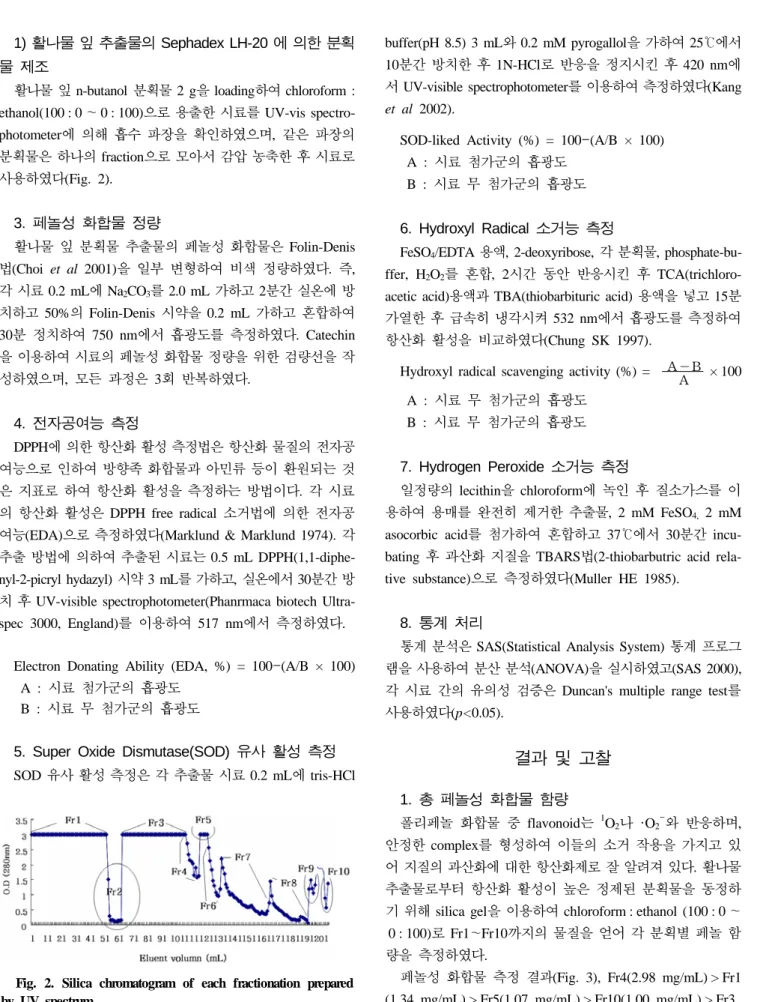
활나물 잎 n-butanol 분획물 2 g을 loading하여 chloroform : ethanol(100 : 0~ 0 : 100)으로 용출한 시료를 UV-vis spectro- photometer에 의해 흡수 파장을 확인하였으며, 같은 파장의 분획물은 하나의 fraction으로 모아서 감압 농축한 후 시료로 사용하였다(Fig. 2).
3. 페놀성 화합물 정량
활나물 잎 분획물 추출물의 페놀성 화합물은 Folin-Denis 법(Choi et al 2001)을 일부 변형하여 비색 정량하였다. 즉, 각 시료 0.2 mL에 Na2CO3를 2.0 mL 가하고 2분간 실온에 방 치하고 50%의 Folin-Denis 시약을 0.2 mL 가하고 혼합하여 30분 정치하여 750 nm에서 흡광도를 측정하였다. Catechin 을 이용하여 시료의 페놀성 화합물 정량을 위한 검량선을 작 성하였으며, 모든 과정은 3회 반복하였다.
4. 전자공여능 측정
DPPH에 의한 항산화 활성 측정법은 항산화 물질의 전자공 여능으로 인하여 방향족 화합물과 아민류 등이 환원되는 것 은 지표로 하여 항산화 활성을 측정하는 방법이다. 각 시료 의 항산화 활성은 DPPH free radical 소거법에 의한 전자공 여능(EDA)으로 측정하였다(Marklund & Marklund 1974). 각 추출 방법에 의하여 추출된 시료는 0.5 mL DPPH(1,1-diphe- nyl-2-picryl hydazyl) 시약 3 mL를 가하고, 실온에서 30분간 방 치 후 UV-visible spectrophotometer(Phanrmaca biotech Ultra- spec 3000, England)를 이용하여 517 nm에서 측정하였다.
Electron Donating Ability (EDA, %) = 100-(A/B × 100) A : 시료 첨가군의 흡광도
B : 시료 무 첨가군의 흡광도
5. Super Oxide Dismutase(SOD) 유사 활성 측정 SOD 유사 활성 측정은 각 추출물 시료 0.2 mL에 tris-HCl
Fig. 2. Silica chromatogram of each fractionation prepared by UV spectrum.
buffer(pH 8.5) 3 mL와 0.2 mM pyrogallol을 가하여 25℃에서 10분간 방치한 후 1N-HCl로 반응을 정지시킨 후 420 nm에 서 UV-visible spectrophotometer를 이용하여 측정하였다(Kang et al 2002).
SOD-liked Activity (%) = 100-(A/B × 100) A : 시료 첨가군의 흡광도
B : 시료 무 첨가군의 흡광도
6. Hydroxyl Radical 소거능 측정
FeSO4/EDTA 용액, 2-deoxyribose, 각 분획물, phosphate-bu- ffer, H2O2를 혼합, 2시간 동안 반응시킨 후 TCA(trichloro- acetic acid)용액과 TBA(thiobarbituric acid) 용액을 넣고 15분 가열한 후 급속히 냉각시켜 532 nm에서 흡광도를 측정하여 항산화 활성을 비교하였다(Chung SK 1997).
Hydroxyl radical scavenging activity (%) = A-B A × 100 A : 시료 무 첨가군의 흡광도
B : 시료 무 첨가군의 흡광도
7. Hydrogen Peroxide 소거능 측정
일정량의 lecithin을 chloroform에 녹인 후 질소가스를 이 용하여 용매를 완전히 제거한 추출물, 2 mM FeSO4, 2 mM asocorbic acid를 첨가하여 혼합하고 37℃에서 30분간 incu- bating 후 과산화 지질을 TBARS법(2-thiobarbutric acid rela- tive substance)으로 측정하였다(Muller HE 1985).
8. 통계 처리
통계 분석은 SAS(Statistical Analysis System) 통계 프로그 램을 사용하여 분산 분석(ANOVA)을 실시하였고(SAS 2000), 각 시료 간의 유의성 검증은 Duncan's multiple range test를 사용하였다(p<0.05).
결과 및 고찰
1. 총 페놀성 화합물 함량
폴리페놀 화합물 중 flavonoid는 1O2나 ·O2
-와 반응하며, 안정한 complex를 형성하여 이들의 소거 작용을 가지고 있 어 지질의 과산화에 대한 항산화제로 잘 알려져 있다. 활나물 추출물로부터 항산화 활성이 높은 정제된 분획물을 동정하 기 위해 silica gel을 이용하여 chloroform : ethanol (100 : 0 ~ 0 : 100)로 Fr1~Fr10까지의 물질을 얻어 각 분획별 페놀 함 량을 측정하였다.
페놀성 화합물 측정 결과(Fig. 3), Fr4(2.98 mg/mL) > Fr1 (1.34 mg/mL) > Fr5(1.07 mg/mL) > Fr10(1.00 mg/mL) > Fr3
Fig. 3. Total phenolic acids contents of each fractions pu- rified from glass column chromatogram in Crotalaria sessi- liflora L. leaf
Values with different alphabets are significantly different among the groups by Duncan's multiple range test(p<0.05).
(0.97 mg/mL) > Fr7(0.93 mg/mL) > Fr8(0.91 mg/mL) > Fr6(0.86 mg/mL) > Fr9(0.74 mg/mL) > Fr2(0.68 mg/mL)의 함량을 보 였다. Fr4에서 대조군인 sesamol(4.55 mg/mL)보다는 낮은 함 량을 나타내었으나, tocopherol(2.24 mg/mL)보다는 유의적으 로 높은 함량을 나타냈다. 이러한 결과는 Ahn & Cho(1999)의 결과와 비교하였을 때 높은 값이었다. Kang et al(2007) 은 보리잎차와 녹차 침출액의 총 수용성 페놀 함량을 분석한 결 과, 보리잎차와 녹차 모두 총 수용성 페놀 함량은 추출 온도 가 높을수록 많이 용출되었다고 하였고, Lee et al(2005) 등 의 실험에서 울릉도산 산채류 추출물의 총 페놀 함량을 측정 한 결과 물엉컹퀴 잎과 섬 고사리 잎 추출물에 각각 130.2와 130.7 μL/mg으로 높은 폴리페놀 함량이 측정되었다. 이러한 결과는 추출 방법과 물질의 정제에 따른 차이라고 생각되어 진다. 페놀 화합물은 식물자원에 함유되어 있는 천연물질로 써 다양한 구조와 생리활성 기능을 가지고 있다. 페놀 화합 물의 함량과 항산화 효과와는 밀접한 관계가 있다는 Ra et al(1997)의 보고에서와 같이 본 실험에서도 총 페놀 화합물 의 함량이 높은 것이 뛰어난 항산화 효과를 가지고 있을 것 으로 예상된다.
2. 전자공여능
전자공여능의 측정은 DPPH(1,1-diphenyl-2-picryl hydrazil) radical 소거법으로 측정하는데 DPPH는 분자 내 radical을 함 유하고 있다. 토코페롤, 아스코르빈산, polyhydroxy 방향족 화합물, 방향족 아민류에 의해 환원, radical이 소거되어 짙은 자색이 탈색되는데, 이 정도를 항산화 물질의 전자공여능으로 측정하는 방법이다(Blois MS 1954). 이때 DPPH 분자의 움직 임은 hydroxyl radical과 유사하여 free radical 소거 실험에 활 용된다(Kang et al 2001). DPPH와 활나물 잎 추출물의 분획 물을 반응시켜 DPPH scavenger 활성을 측정한 결과(Fig. 4),
Fig. 4. Electron donating ability of each fractions purified from glass column chromatogram in Crotalaria sessiliflora L.
leaf.
Values with different alphabets are significantly different among the groups by Duncan's multiple range test(p<0.05).
Fr4(69.15%) > Fr1(31.56%) > Fr10(31.33%) > Fr3(26.96%) >
Fr5(25.67%) > Fr8(22.25%) > Fr6(20.73%) > Fr7(19.67%) >
Fr9(18.42%) > Fr2(12.88%) >순으로 Fr4에서 가장 높게 나타 났다. 대조군인 sesamol(39.71%), tocopherol(32.83%)보다 유의 적으로 높은 활성을 나타내었다. Kang et al (2007)은 보리잎 차와 녹차 침출액의 DPPH 라디칼 소거능을 비교한 결과 녹 차는 50.56%였으며, 보리잎차는 11.06%로 녹차에 비해 5배 정도 낮은 값을 나타내었다. 또한, 밤꽃 추출물의 전자공여능 을 비교한 결과 17.22%이었다고 한다(Kang et al 2002). Blois MS(1954)의 덩굴 잎 추출물과 비교하였을 때 Fr4에서 다른 잎 추출물보다 활성이 높거나 비슷한 전자공여능을 보였다.
한국 약용 및 식물 자원의 항산화성 식물탐색에 대한 결과를 보면 식물자원이 20% 미만의 활성을 보고한 Choi et al(2003) 에 의하면 활나물 잎 분획물은 높은 전자공여능을 나타내었 다.
3. Super Oxide Dismutase(SOD) 유사 활성
Superoxide anion의 활성을 억제시킬 수 있는 유사 물질의 활성능을 측정한 결과 silica gel 분획물의 SOD 유사 활성 측 정 결과(Fig. 5), Fr4(94.18%) > Fr1(92.79%) > Fr2(87.30%) >
Fr8(79.34%) > Fr10(79.33%) > Fr3(78.44%) > Fr5(72.22%) >
Fr7(70.93%) > Fr6(65.76%) > Fr9(64.76%) >순으로 총 페놀 함량과 전자 공여능이 높았던 Fr4에서 높은 SOD 유사 활성을 보였다. 대조군인 tocopherol(97.34%)보다는 낮은 활성을 나 타내었으나, sesamol(24.26%)보다는 활나물의 모든 분획물이 매우 높게 측정되었다. Kim & Chung (2002)은 녹차 열수 추 출물이 85.3%로 팽이버섯, 마늘, 하수오, 오미자, 행인 및 솔 잎 추출물에 비해 높다고 하였다. 이러한 결과와 비교할 때 할 때 활나물 분획물은 아주 높은 전자공여능을 나타냈고, su-
Fig. 5. SOD-liked activities of each fractions purified from glass column chromatogram in Crotalaria sessiliflora L. leaf.
Values with different alphabets are significantly different among the groups by Duncan's multiple range test(p<0.05).
peroxide anion 제거능이 높은 물질을 함유하고 있음을 예상 할 수 있다.
4. Hydroxyl Radical 소거능
Hydroxyl radical(․OH) 소거능은 2-deoxyribose oxidation method에 의해 측정하였다. Hydroxy radical은 활성산소 중에 서 반응성이 강하여 생체 산화에 중요한 역할을 하는 것으로 알려져 있다. 활나물 잎 추출물을 Sephadex LH-20에 의해 분 리한 분획물의 hydroxyl radical 소거 활성을 측정한 결과(Fig.
6), Fr6(94.08%) > Fr8(93.99%) > Fr7(93.90%) > Fr10 (93.77%) >
Fr9, Fr5(93.70%) > Fr3(93.66%) > Fr2(93.04%) > Fr1(92.97%) >
Fr4(92.15%) 순으로 대조군인 tocopherol(94.12%), sesamol (92.19%)과 비교하여 유의적으로 비슷하거나 높은 활성을 나타내었다. Jang & Han(2002) 등의 한국산 약초 잎에 대한 연구 결과와 Yoo et al (2004)의 포도 부산물 결과와 비교하
Fig. 6. Hydroxyl radical scavenging activity of each frac- tions purified from glass column chromatogram in Crotalaria sessiliflora L. leaf.
Values with different alphabets are significantly different among the groups by Duncan's multiple range test(p<0.05).
여 볼 때 활나물 잎 추출물의 분획물이 높은 수준의 hydroxy radical 소거 활성을 보이는 것으로 보아 활나물에는 항산화 활성이 높은 물질이 다량 함유되어 있을 것으로 사료된다.
5. Hydrogen Peroxide 소거능
H2O2는 과산화지질의 생성을 촉진하는 것으로 알려져 있 으며, 과산화지질은 동맥경화, 뇌졸중 등과 같은 성인병의 원인이 되고, 간장의 세포막에 과산화지질을 증가시켜 세포 의 기능이 저하되어 염증이 유발되며, 그 결과 간경화, 간염 등을 초래한다고 보고되고 있다(Halliwell & Gutteridge 1999a, 1999b).
Hydrogen radical 소거활성은 SOD에 의해 생성된 과산화 수소를 peroxidase를 첨가하여 물과 산소분자로 환원시켜 최 종적으로 산패를 억제시켜주는 능력을 측정하는 것으로 본 실험 결과(Fig. 7), Fr6(63.51%) > Fr5(60.71%) > Fr4(57.82%)
> Fr10(54.93%) > Fr3(49.74%) > Fr8(42.60%) > Fr9(42%) >
Fr7(41.32%) > Fr2(41.23%) > Fr1(37.58%) 순으로 Fr6 분획물 이 대조군인 sesamol(65.73%)보다는 낮은 활성을 나타내었 으나, tocopherol(63.26%)과 유사한 hydrogen radical 소거능 을 가지고 있음을 확인하였다. Yoo et al (2004)의 포도 과 피의 항산화 활성이 55.6~66.6%로 활나물 분획물과 유사한 결과를 보여 활나물은 천연물로서의 항산화 소재로 개발 가 능할 것으로 여겨진다.
요 약
활나물 잎을 에탄올과 메틸렌 클로라이드 혼합용매(3:1)로 추출하였다. 이중 가장 활성이 높은 유효성분을 추출 및 분리 하기 위해서 당과 지방 성분을 제거하고, water와 n-butanol 용매를 1:1 비율로 혼합하여 분획 추출하였다. n-butanol층
Fig. 7. Hydrogen radical scavenging activities of each frac- tions on the peroxidation of egg yolk lecithin.
Values with different alphabets are significantly different among the groups by Duncan's multiple range test(p<0.05).
은 감압․농축 후, Sephadex LH-20이 충진된 column chroma- tography를 이용하여 10개(Fr1, Fr2, Fr3, Fr4, Fr5, Fr6, Fr7, Fr8, Fr9, Fr10)의 소 분획물을 얻었다. 분획물의 각종 항산화 활성 결과 Fr1, Fr4, Fr6에서 높은 항산화 활성을 나타내었다 (p<0.05). 분획물중 활성이 강한 F1, F4 및 F6에서 미지의 물 질을 발견하였으므로 각종 기기분석을 통해 그물질을 동정 중에 있다.
감사의 글
본 논문은 2002 년도 농림부 농림기술센터의 연구비 지원 에 의해 수행된 연구 결과의 일부이며, 이에 감사드립니다.
문 헌
Ahn MS, Cho HS (1999) Antioxidative effect of phenolic acids in defatted perilla flour on soybean oil. Korean J Food Cookery Sci 15: 55-61.
Anon R (1975) Group Shan Dong province. Res Chin Mat Med 6: 95.
Atal CK, Sawhney RS (1973) The pyrrolizidine alkaloids from Indian Crotalarias. Indian J Pharm 35: 1-12.
Blois MS (1954) Antioxidant determination by the use of a stable free radical. Nature 26: 1199-1204.
Choi CS, Song ES, Kim JS, Kang MH (2003) Antioxidative activities of Castanea crenata Flos. methanol extracts. Ko- rean J Food Sci Technol 35: 1216-1220.
Choi YH, Kim MJ, Lee HS, Yun BS, Hu C, Kwak SS (2001) Antioxidative compounds in aerial parts of Potentilla fra- gariodes. Korean J Pharmacogn 29: 79-85.
Chung SK (1997) Hydroxy radical scavenging effects of speices and scavengers from brown mustard. Biosci Bio- tech Biochem 61: 118-123.
Halliwell B, Gutteridge JNC (1999a) Hydrogen peroxide. In:
Halliwell B, Gutteridge J.N.C.(Eds.), Free Radicals in Bio- logy and Medicine. Oxford University Press, Oxford, pp.
82-83.
Halliwell B, Gutteridge JNC (1999b) Mechanism of damage of cellular targets by oxidative stress: lipid peroxidation.
In: Halliwell B, Gutteridge J.N.C.(Eds.), Free Radicals in Biology and Medicine. Oxford University Press, Oxford, pp 284-313.
Jang JK, Han JY (2002) The antioxidant ability of grape seed extracted. Korean J Food Sci Technol 34: 524-528.
Kang JH, Kim YJ, Jeon BS (2001) Effect of presown cold
stratification, G.A3, KNO3 and acetone treatment on germi- nation of Crotalaria sessiliflora L. Korean J Medicinal Crop Sci 9: 124-129.
Kang MH, Choi CS, Kim JS, Chung HK, Min KS, Park CK, Park HW (2002) Antioxidative activities of ethanol extract prepared from leaves, seed, branch and aerial part of Crota- laria sessiliflora L. Korean J Food Sci Technol 34: 1098- 1102.
Kang MH, Park CG, Cha MS, Seong NS, Chung HK, Lee JB (2001) Component characteristics of each extract prepared by different extract methods from by-products of Glycyrr- hizia uralensis. J Korean Soc Food Sci Nutr 30: 138-142.
Kang MJ, Shin SR, Kim KS (2002) Antioxdative and free radical scavenging activity of water extract from dandelion Taraxacum officinale. Korean J Food Preser 9: 253-259.
Kang OJ, Jang JH, Choi HS, Cheong HS (2007) A compa- rison of the antioxidant activity of barley leaf tea and green tea according to leaching conditions in distilled water.
Korean J Food Cookery Sci 23: 165-172.
Kim YC, Chung SK (2002) Relative oxygen radical species scavenging effects of Korean medicinal plant leaves. Food Sci Biotechnol 11: 407-411.
Lee H, Lin JY (1988) Antimutagenic activity of extracts from anticancer drugs in Chinese medicine. Mutation Res 204:
229-234.
Lee SO, HJ, Yu MH, Im HG, Lee IS (2005) Total polyphenol contents and antioxidant activities of methanol extracts from vegetables produced in Ullung Island. Korean J Food Sci Technol 37: 233-240.
Leibovitz BE, Siegel B (1980) V. Aspects of free radical reactions in biological systems. Aging J Gerontology 35:
45-56.
Marklund S, Marklund G (1974) Involvement of superoxide anion radical in the oxidation of pyrogallol and convenient assay for superoxide dismmutase. Eur J Biochem 47: 469- 474.
Monach C, Morand C, Crespy V, Demigne C, Taxier O, Re- gerat F, Remesy C (1998) Quercetin is recovered in human plasma as conjugated derivative which retain antioxidnat properties. FEBS Lett 426: 331-336.
Muller HE (1985) Detection of hydrogen peroxide produced by microorganisms on an ABTS peroxidase medium. ZBl Bakt Hyg 259: 151-155.
Ra KS, Suh HJ, Chung SH, Son JY (1997) Antioxidant acti- vity of solvent extract onion skin. Korean J Food Sci Te-
chnol 29: 595-600.
Rice ECA, Miller NJ, Paganga G (1996) Structure antioxidant activity relationship of flavonoid and phenolic acid. Free Radic Biol Med 20: 933-956.
SAS (2000) User's guide. SAS Institute, Cary, NC, USA.
Scbaeffer ST, Zalkow LH, Teja AS (1989) Extraction of mo- nocrotaline from Crotalaria spectabilis using supercritical carbon dioxide and carbon dioxide-ethanol mixtures. Bio- technol. Bioeng 34: 1357-1365.
Shin MK, Song HJ, Kang YS, Ryu, HS, Han DS, Kang KU, Baek SH (1999) Development of anticancer agents from
46 Korean medicinal plants. Part 13. Studies on the cyto- toxicity and antitumir activity of Herba Crotalaria sessi- liflora L. Korean J Pharmacogn 30: 130-136.
Woo NRY, Kim TS, Park CG, Seong HJ, Ko SB, Jung JW, Kang MH (2005) Comparison of antioxidative activities of Crotalaria sessiliflora L.. J Korean Soc Food Sci Nutr 34:
1297-1301.
Yoo MA, Chung HK, Kang MH (2004) Optimal extract me- thods of antioxidant compounds from coat of grape dreg.
Korean J Food Sci Technol 36: 134-140.
(2008년 12월 23일 접수, 2009년 3월 17일 채택)