a) Multimedia Research Team, DMC R&D Center, Samsung Electronics
‡Corresponding Author : Jaemoon Kim
E-mail: [email protected] Tel: +82-10-5096-7815
・ Manuscript received August 28, 2013 Revised November 11, 2013 Accepted November 14, 2013
초고화질 영상처리를 위한 HEVC 표준에 적합한 고속 및 저복잡도 움직임 예측기에 대한 연구
김 성 오a), 박 찬 식a), 전 형 주a), 김 재 문a)‡
A Fast and Low-complexity Motion Estimation for UHD HEVC
Sungoh Kima), Chansik Parka), Hyungju Chuna), and Jaemoon Kima)‡
요 약
본 논문은 초고화질 영상처리를 위한 HEVC 표준에 적합한 고속 및 저복잡도 움직임 예측기 알고리즘을 제안하였다. 움직임 예측 기는 HEVC 내의 연산양의 77~81%를 차지하고 있다. 결국 비디오 코덱 구현의 핵심은 이러한 움직임 예측기의 고속 및 저복잡도 알 고리즘을 찾는 것이다. 본 논문에서는 기존의 움직임 예측기 알고리즘을 분석하였고 일반적인 움직임 탐색 점을 줄이는 방식이 아닌 움직임 벡터 예측과 선택적으로 움직임 탐색 점 개수를 조정하는 등의 HEVC 표준에 적합한 3가지 방식을 제안하였다. 이 제안된 알 고리즘은 full search 알고리즘에 비교하여 0.36%의 연산양만을 사용하면서도 그 성능 열화는 1.1%에 불과하였다.
Abstract
In this paper, we propose a novel fast and low-complexity Motion Estimation (ME) algorithm for Ultra High Definition (UHD) High Efficiency Video Coding (HEVC). Motion estimation occupies 77~81% of the amount of computation in HEVC. After all, the main key of video codec implementation is to find a fast and low-complexity motion estimation algorithm and architecture. We analyze the previous motion estimation algorithms and propose three optimal algorithm to reduce the computation proportion for HEVC. The proposed algorithm uses only 0.36% of the amount of operations compared to full search algorithm while maintaining compression performance with slight loss of 1.1%.
Keyword : HEVC, Motion Estimation, Low-power, Low-complexity, Fast Algorithm
Ⅰ. Introduction
High Efficiency Video Coding (HEVC) is a new video
compression standard providing about 50% coding gain over H.264/AVC [1]. HEVC was finalized by the Joint Collaborative Team on Video Coding (JCT-VC) estab- lished by ISO-IEC/MPEG and ITU-T/VCEG in Jan. 2013 [2]. In order to achieve this coding gain, it includes an en- larged coding unit (called as tree block) of 64x64 and an increased interpolation filter taps of 8 and 4 for luma and chroma data, respectively. The most noticeable differences 특집논문 (Special Paper)
방송공학회논문지 제18권 제6호, 2013년 11월 (JBE Vol. 18, No. 6, November 2013) http://dx.doi.org/10.5909/JBE.2013.18.6.808
ISSN 2287-9137 (Online) ISSN 1226-7953 (Print)
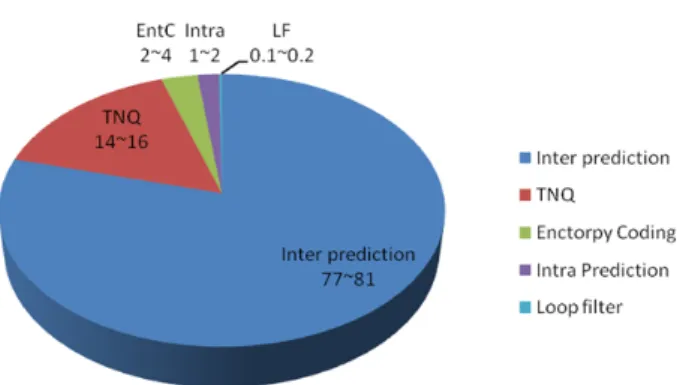
Fig. 1. The run-time portion of each tool in HEVC
from the previous codec are coding unit size (e.g., 16x16 to 64x64) and a variety of hierarchical block partitioning.
Consequently, the complexity of motion estimation (ME) of HEVC increases more than 3-4 times than that of H.264/AVC.
Fig. 1 shows the run-time portion of each tool in HEVC.
Motion estimation named by inter prediction occupies 77-81% of the amount of computation. After all, the main key of video codec implementation into a hardware is to find a fast and low-power motion estimation algorithm and architecture, which spends the most time in codec.
Fast motion estimation algorithms have been studied for a long time from MPEG-2 to H.264; Significant reductions in search positions, simplification of matching criterion, bit-depth reduction, predictive search, hierarchical search and fast full search approach. First, significant reduction methods in search positions include Three Step Search (TSS) [3], Two-dimensional Logarithmic Search (TLS) [4], orthogonal search and Diamond Search (DS) [5-8]. Second, simplification techniques of matching criterion are pixel se- lection pattern in Chan's scheme, pixel difference classi- fication (PDC) [9] and minimax criterion [10]. Third, pre- dictive search method is the way to search the surrounding Motion Vector Predictor (MVP). Finally, Hierarchical search uses sub-sampled domain search. In addition, there are the algorithm combining predictive search and hier-
optimized scheme for HEVC.
This paper is organized as follows. In Section II, our pro- posed algorithm is presented. Experimental results are pre- sented in Section III. and concluding remarks are given in Section IV.
Ⅱ. Proposed Algorithm
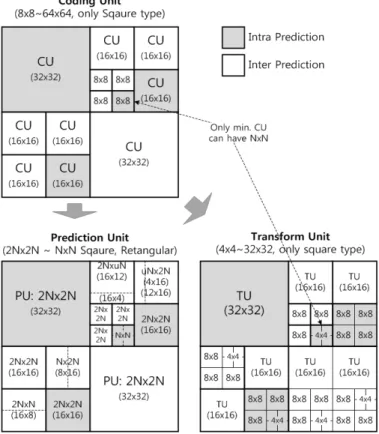
Fig. 2 illustrates example of the partition units in HEVC.
Each frame is divided into square blocks called Coding Units (CUs) with maximum size of 64x64 and recursively subdivided into square blocks up to 8x8. The CUs are as- signed to a quad-tree where each CU is sub-divided into quad-tree based prediction blocks called Prediction Units (PUs) with intra or inter type. Each PU is again partitioned into quad-tree based transform blocks called Transform Units (TUs) specifying transform size [13]. Because of a variety of block sizes and partition types in HEVC, the complexity of ME can be extremely increased. Therefore, a new fast algorithm is required for HEVC.
To develop a new ME algorithm for HEVC, we analyzed encode bitstream. Fig. 3 shows the screen shot of the ana- lyzer, which consists of block partition information, motion vector information, prediction mode distribution, the total bit amount of CU, distortion and cost. This tool should be useful to find the optimum algorithm easily.
그림 2. HEVC 내의 CU, PU, TU 파티션 분포 예제 Fig. 2. Example of the partition units in HEVC
그림 3. 자체 개발한 HEVC 스트림 분석기의 스크린 캡쳐 화면 Fig. 3. The screen shot of the our analyzer
We propose three fast motion estimation techniques; 1) motion vector estimation method of large block types 2) adaptive multi-resolution and multi-candidates (AMRMCS) 3) SAD calculation using bit-depth reduction.
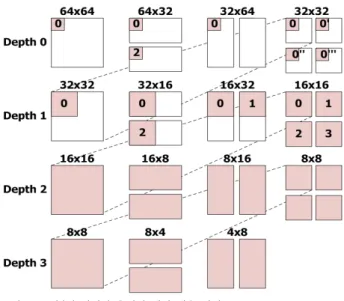
Firstly, This method predicts the best motion vectors of large block types; 16x16 to 64x64, as discussed in Fig. 4.
The top-left best motion vector (MV) of 16x16 block type is used by the best MVs of large block types. The funda- mental idea is based on the fact, statistically proven, that the MVs of the small block types are similar to those of the large block types. Fig. 5 shows the best MV in 16x16 block type. Fig. 6 also depicts the best MV in 64x64 block type. As can be seen, two MVs may be alike. From this
그림 4. 큰 블럭 타입의 움직임 벡터 예측 방법
Fig. 4. Motion vector estimation method of large block types
(a) Reference frame (b) Current frame 그림 5. 16x16 블록 타입의 선택된 움직임 벡터
Fig. 5. Best Motion Vector in 16x16 block type
(a) Reference frame (b) Current frame 그림 6. 64x64 블록 타입의 선택된 움직임 벡터
Fig. 6. Best Motion Vector in 64x64 block type
perspective, we find the best motion vector only up to16x16 block type and predict the best MVs of large blocks. This method can reduce 60-70% of computation with slight loss.
points for the lower level (level 0). And it is divided into eight areas of 4:1 sub-sampled domain and search the best candidates at each division first and get some of them whose numbers are flexible by image resolution, bandwidth and configuration to avoid local minimum problem in level 2. After that, we can get the minimum SAD candidates in 4:1 global search range of [±128, ±64]. We find final MV by executing refinement search again in local search range (X-axis: [-8, 7], Y-axis: [-7, 7]), which uses the best MVs of sub-sampled domain and MV of the left neighbor (MVA), MV of the top neighbor (MVB) and motion vector predictor (MVP). This predictor is calculated by using the median value of the MVs of the three adjacent, on the left, top, and top-right (or top-left if top-right is not available)
그림 7. AMRMCS의 컨셉 그림 Fig. 7. Concept of AMRMCS
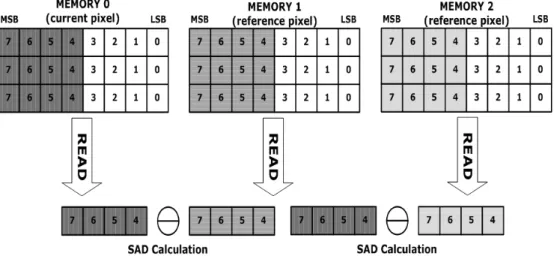
그림 9. Bit-depth 감소 방식을 사용한 SAD 계산 형태 Fig. 9. SAD calculation using bit-depth reduction
그림 8. Bit-Depth 수에 따른 평균 BDBR 비교
Fig. 8. Comparison of average BDBR by bit-depth reduction
blocks to the current block.
Finally, bit-depth reduction is a way of using truncated ref- erence and current pixel data. Fig. 8 shows comparison of average bjøntegaard delta bit rate (BDBR) [14] by bit-depth reduction. The x-axis represents the number of bit-depth and the y-axis shows a set of measures such as BDBR.
As this experimental result, even though bit-depth is re- duced from 8 to 4-bit, the performance degradation is only less than 0.5 % (BDBR). Therefore, our proposed algo- rithm uses the 4-bit pixel data for motion estimation
computation. Then, the SAD is calculated by only MSB-part (4-bit) as in Fig. 9. Using this algorithm, we can reduce the hardware by half and power consumption significantly.
Fig. 10 shows the amount of computational complexity for each algorithm. It means the combined proportion be- tween the number of search points and the quantity of SAD calculation. As a result of this figure, our proposed algorithm uses only 0.36% of the amount of operations compared to the general full search algorithm.
그림 10. 제안한 각 알고리즘에 대한 계산 양
Fig. 10. The amount of computation of each algorithm
Ⅲ. Experimental Result
We used video test sequences, including UHD crop (2560x1600), FHD (1920x1080) and so on.
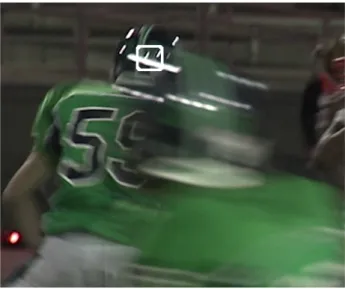
The test sequence depicted in Fig. 11, 1920x1080 size
그림 11. 테스트 시퀀스: QuarterBackSneak_1920x1080x30p Fig. 11. Test sequence: QuarterBackSneak_1920x1080x30p
with 30 frame-per-second, has various moving objects along with global motion (e.g., camera zoom in/out and ob- ject tracking). Fig. 12 illustrates difference of MVs be- tween full search algorithm and our proposed algorithm.
The 64x64 coding unit position of white thick square is (11, 5) and the coding unit size (yellow thick square) is 8x8 type. Then, the best MV of the two algorithm is equal
(a) Full Search (b) Proposed Algorithm 그림 12. LCU(11,5) 에서의 움직임 벡터 비교
Fig. 12. Comparison of Motion Vectors in LCU (11, 5)
to (-7, 13). Therefore, it can be confirmed that our pro- posed algorithm has a similar performance compared to full search algorithm which cab be the most complex.
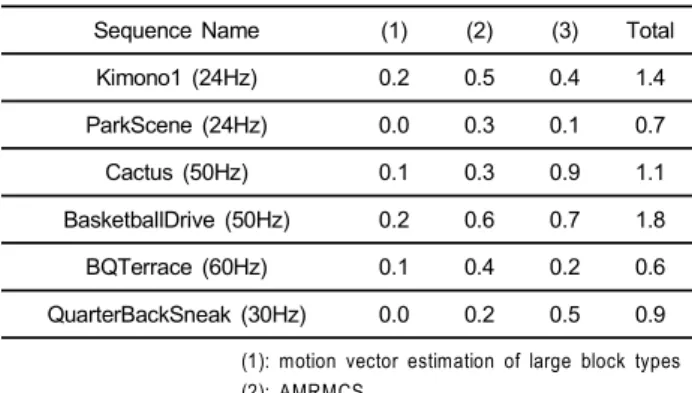
Table I and II show comparison with the full search al- gorithm in HM10.0. The proposed algorithm achieved far superior performance in speed, power and cost than any legacy codecs while maintaining visual quality with loss of a bit coding efficiency.
Sequence Name (1) (2) (3) Total
Kimono1 (24Hz) 0.2 0.5 0.4 1.4
ParkScene (24Hz) 0.0 0.3 0.1 0.7
Cactus (50Hz) 0.1 0.3 0.9 1.1
BasketballDrive (50Hz) 0.2 0.6 0.7 1.8 BQTerrace (60Hz) 0.1 0.4 0.2 0.6 QuarterBackSneak (30Hz) 0.0 0.2 0.5 0.9 Table 1. Comparison with Full Search Algorithm in HM10.0[15]
(Only FHD Sequence)
Anchor: Full Search (in HM: TZS Off) Unit: BDBR[%]
(1): motion vector estimation of large block types (2): AMRMCS
(3): SAD Calculation using bit-depth reduction
Our Algorithm
Total Average 1.1
Table 2. Comparison with Full Search Algorithm in HM10.0 (Total sequence included FHD, UHD, VGA etc)
Anchor: Full Search (in HM: TZS Off) Unit: BDBR[%]
Ⅳ. Conclusion
Our proposed motion estimation uses only 0.36% of the amount of operations compared to the general full search algorithm while maintaining compression performance.
And we represented that our motion estimation is definitely superior to previous scheme. Finally, the proposed motion
estimation algorithm will help you to have the smallest hardware size and the lowest power consumption among existing motion estimation engines for HEVC.
References
[1] Sullivan G. J. et al. Overview of the High Efficiency Video Coding (HEVC) Standard. IEEE TCSVT 22, 1649-1668 (2012)
[2] B. Bross, et al, “High Efficiency Video Coding (HEVC) text specifica- tion draft 10 (for FDIS & Last Call)”, ITU-T SG 16 WP 3 and ISO/IEC JTC 1/SC 29/WG Doc. JCTVC-L1003 (2013)
[3] T. Koga, et al, “Motion compensated inter-frame coding for video con- ferencing,” in Proc. Nat. Telecommun. Conf., C9.6.1–C9.6.5 (1981) [4] J. Jain and A. Jain, “Displacement Measurement and its Application in
Internal Image Coding,” IEEE Trans. Commun., vol.COM-29, no. 12, 1799–1808 (1981)
[5] J.Y. Tham, et al, “A Novel Unrestricted Center-biased Diamond Search Algorithm for Block Motion Estimation,” IEEE Trans. Circuits Syst.
Video Technol., vol. 8, no. 4, 369–377 (1998)
[6] S. Zhu and K.K. Ma, “A New Diamond Search Algorithm for Fast Block-matching Motion Estimation,” IEEE Trans. Image Processing, vol. 9, no. 2, pp. 287–290 (2000)
[7] A.M. Tourapis, et al,“Optimizing the mpeg-4 Encoder - advanced Diamond Zonal search,” in Proc. of IEEE Int. Symp. Circuits Syst.
(ISCAS’00), 674–677 (2000)
[8] A.M. Tourapis, O.C. Au, and M.L. Liu, “Highly Efficient Predictive Zonal Algorithms for Fast Block-matching Motion Estimation,” IEEE Trans. Circuits Syst. Video Technol., vol. 12, no. 10, 934–947 (2002) [9] H. Gharavi and M. Mills, “Block Matching Motion Estimation
Algorithms - New Results,” IEEE Trans. Circuits Syst., vol. 37, no. 5, 649–651 (1990)
[10] M.J. Chen, et al, “A New Block-matching Criterion for Motion Estimation and its Implementation,” IEEE Trans. Circuits Syst. Video Technol., vol. 5, no. 3, 231–236 (1995)
[11] Lee, J. H. et al, “A fast multi-resolution block matching algorithm and its LSI architecture for low bit-rate video coding”Circuits and Systems for Video Technology, IEEE Transactions on Vol. 11, 1289-1301 (2001)
[12] N.Purnachand et al, “Improvements to TZ search motion estimation al- gorithm for multiview video coding”, IEEE IWSSIP 2012, Vienna (2012).
[13] Purnachand, et al, “Fast Motion Estimation Algorithm for HEVC”, (ICCE-Berlin), 34 – 37 (2012)
[14] G. Bjontegaard, "Calculation of Average PSNR Differences Between RD-curves," document VCEG-M33, ITU-T Video Coding Experts Group (VCEG) Meeting, Austin, TX (2001)
[15] JVC-VT HEVC reference software HM 11.0, https://hevc.hhi.
fraunhofer.de/svn/svn_HEVCSoftware/tags/HM-11.0 (2013).
- 2002년 ~ 현재 : 삼성전자 DMC 연구소 Multimedia 연구팀 책임 연구원 - 주관심분야 : 비디오 코덱, 신호처리
전 형 주
- 2008년 ~ 현재 : 삼성전자 DMC 연구소 Multimedia 연구팀 선임 연구원 - 주관심분야 : 비디오 코덱, 신호처리
김 재 문
- 2010년 ~ 현재 : 삼성전자 DMC 연구소 Multimedia 연구팀 책임 연구원 - 주관심분야 : 비디오 코덱, 신호처리