Comparison of Ultrasonic Velocities between Direct and Indirect Methods on 30 mm × 30 mm Spruce Lumber 1
Sei Chang OH 2,†
ABSTRACT
1)This study investigates the relationship between ultrasonic velocity and density in the direct method, the effect of distance between transducers in the indirect method, and the difference between the direct and indirect methods with transducers placed at a distance of 200 mm in nondestructive ultrasonic testing of spruce lumber. The direct method using 54 kHz ultrasonic transducers was applied to two planes, namely, radial section (LR) and tangential section (LT) of samples. The indirect method measurements were taken using the same transducers. Two velocities were measured at the top and bottom of the LT plane and at the two sides of the LR plane; the two values for each plane were averaged. The relationship between density and ultrasound velocity in the direct method demonstrated a positive correlation between the two variables. The difference between the two planes, LT and LR, was not statistically significant. Moreover, the distance between the transducers in the indirect method affected ultrasound velocity, with the ultrasonic velocity increasing as the distance between the transducers became larger. A transducer distance of 200 mm yielded a close approximation of the direct method results with a ratio of 0.87. Finally, no statistical evidence of a difference between the two planes in the indirect method was found. If the direct method, which requires access to two surfaces, is impractical, the indirect method can be applied.
Keywords: ultrasonic velocity, direct method, indirect method, density, spruce, distance between transducers
1. INTRODUCTION
Ultrasonic method is a nondestructive technique measuring the speed of sound through materials in or- der to calculate elastic modulus and/or detect presence of internal flaws such as cracking, voids, decay and other damage (Sutan and Meganathan, 2003). This ul- trasonic method is widely used to predict the mechan- ical properties of wood and detect wood defects. The mechanical properties of wood are affected by in-
herent characteristics like knots, slope of grain, re- action wood, anisotropy and physical properties like density, moisture content and service conditions. This ultrasonic test was used to determine the anisotropy of domestic lumber through measuring the ultrasonic velocity (Oh, 2017) and compare with destructive test- ing for bamboo oriented strand board (Sena Maulana et al., 2019).
The structural performance of timber construction is affected by materials strength and the safety of the
1
Date Received March 25, 2020, Date Accepted June 25, 2020
2
Department of Forest Resources, Daegu University, Gyeongsan 38453, Republic of Korea
†
Corresponding author: Sei Chang OH (e-mail: [email protected], ORCID: 0000-0001-6747-5527)
Original Article
timber structure is mainly based on the timber strength in service. The strength of timber in service is not pos- sible to measure directly using destructive methods, so non-destructive method is needed for the inspection of the timber strength. The domestic timber con- struction market is growing since 1980s, and around 15,000 houses built per year. From now on, it seems that the proper inspection of timber construction is needed for the structural safety. The inspection of tim- ber construction in service should be started to meas- ure the strength of timber and this information will be useful to confirm the safety of construction. The ultrasonic test is frequently used to evaluate the timber strength nondestructively. It is possible to make meas- urement of pulse velocity by placing on opposite face (direct method), on adjacent face (semi direct method), on the same face (indirect method) in ultrasonic test- ing (Nobile and Nobile, 2015). Under service con- dition, only one face of timber is exposed, therefore standard direct method (longitudinal wave propagation between ends of elements) is not applicable (Machado et al., 2009). Because of this condition, indirect meth- od is introduced in concrete (Savaliya et al., 2014) and wood. They compared ultrasonic velocities of simple cement concrete along direct, semi-direct and indirect method and pointed out that ultrasonic velocities af- fected by path length and small path length cause wrong results. Indirect method was applied to domes- tic lumber (Park and Hong, 2008) and wooden deck materials in service (Oh, 2015). The effect of density was studied with on nondestructive moisture meters and showed the density affected moisture content (Pang and Jeong, 2019). In spite of several research on measuring method, there is a lot of controversy on the effect of density, path length and plane of wood on the ultrasonic velocity.
The purpose of this study is to verify the effect of density on the ultrasonic velocities of wood, and dis- tance between transducers and plane of wood through
comparison between direct and indirect method.
2. MATERIALS and METHODS 2.1. Materials
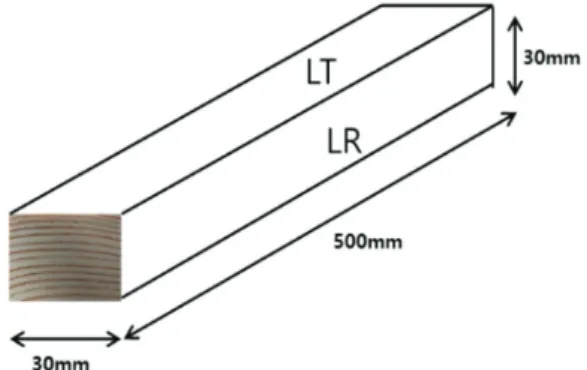
30 pieces of spruce lumber with 35 × 35 × 3600 mm were purchased from local lumber supply company. Each sample used in this study was prepared as dried condition and processed with 30 × 30 × 500 mm. Total defect free 10 samples with flat sawn grain were prepared and classified two categories as tangen- tial (LT) and radial section (LR) as shown Fig. 1. The test samples were conditioned in humidity chamber at 20 ℃ ± 2℃ temperature and 65% ± 5 % relative hu- midity before testing. Prior to testing, the test samples were weighed and their dimensions were measured to get the density according to KS F 2198. After testing, moisture contents were measured using electric resist- ance type moisture meter. The average density of sam- ples was 445 ± 41.8 kg/m
3and moisture content was 9.0 ± 0.2%.
Fig. 1. Dimension and plane of test sample.
2.2. Methods
Ultrasonic test was carried out with two methods
as direct and indirect method using Pundit Lab Plus
test equipment. The pair of corn type (exponential)
(A) Direct method (B) Indirect method Fig. 2. Direct and Indirect ultrasonic test method in each plane.
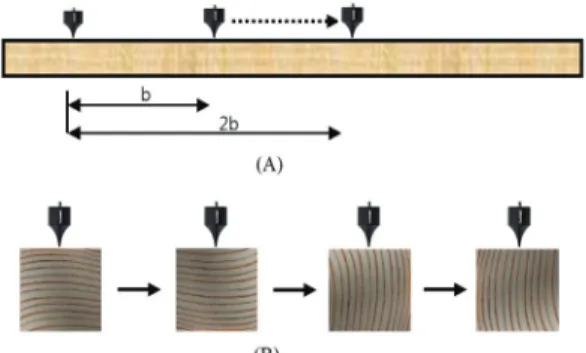
Fig. 3. Measurement process (A) and order of mea- surement (B) in indirect method.
transducers with 54 kHz were used as transmitter and receiver. The direct method was conducted as shown in Fig. 2(A). At first ultrasonic coupling agent gel (pundit lab plus) was used and sample positioned LT plane as top and test was conducted. After that, the sample was rotated 90 degree and positioned LR plane as top and test was conducted, respectively, as shown Fig. 2(A). Measurement were repeated twice at each point and average was calculated. Second, indirect method was applied to the surface, LT and LR plane of same test samples as shown in Fig. 2(B), respectively.
Transducers were kept on the same plane and meas- urement were also repeated twice at each point for cal- culating the average. The measurement process and or- der of measurement in indirect method was presented in Fig. 3(A) and (B). The distances between trans- ducers (b) in indirect method were 50, 100, 150, 200 mm, respectively as shown in Fig. 3(A) and time t1 measured in first position of transducers. After this,
time t
2was measured in second position 2b and sur- face velocity was measured. The ultrasonic velocity was calculated automatically by inputting the distance between two transducers.
3. RESULTS and DISCUSSION 3.1. Effect of density in direct method
The average density of tested samples was 445 kg/m
3and ranged from 393 kg/m
3to 529 kg/m
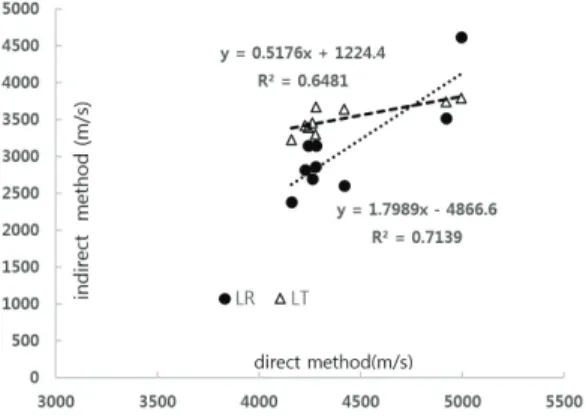
3. The measured ultrasonic velocity by direct method was ranged from 4160 m/s to 5081 m/s and average value was 4518 m/s in LT plane. The measured ultrasonic velocity in LR plane was ranged from 4028 m/s to 5123 m/s andaverage value was 4539 m/s. Linear re- gression models between wood densities and ultra- sonic propagation velocities are shown Fig. 4. It was observed that good relationship between wood den- sities and ultrasonic propagation velocities and the co- efficients of determination (R
2) were found to be 0.75 in LT plane and 0.52 in LR plane. Bucur (1988) point- ed out that the variations in density have a correspond- ing variation in ultrasonic velocity associated with it.
Oliveira and Sales (2008) reported that the relationship
Fig. 4. Relationship between density and ultrasonic
velocity in two planes.
between density and ultrasonic velocity was sig- nificant and the coefficients of determination (R
2) were 0.80 - 0.88 for Brazilian tropical woods includ- ing one softwood and four hardwood species. In con- trast to this paper, Barr et al. (2012) pointed out that ultrasound velocity variation due to change in density was not confirmed for any species. Other research confirms that the strong relationship was found be- tween wood density and ultrasonic velocity, and the coefficients of determination (R
2) were 0.78 - 0.94 for three softwood and one hardwood (Aydin and Aydin, 2018). From the test results, it was possibly concluded that the ultrasonic velocity tended to increase as the density of the wood increased and their relationship was positively correlated. The effect of wood plane on the ultrasonic velocity was analyzed statistically in LR and LT plane of wood. Analysis showed that the ultrasonic velocities in two planes were quite similar and statistically insignificant. This tendency was also found in another research paper (Ringger et al., 2003).
3.2. Effect of distance between transducers in indirect method
If the direct method which accesses to two surfaces is not legible, indirect method test is applied to surface transmission. The indirect method is least satisfactory upon sensitivity and defined path length, but it is more commonly used since direct method is not possible to use at most of time (Sutan and Meganathan, 2003).
Surface transmission length (distance between trans-
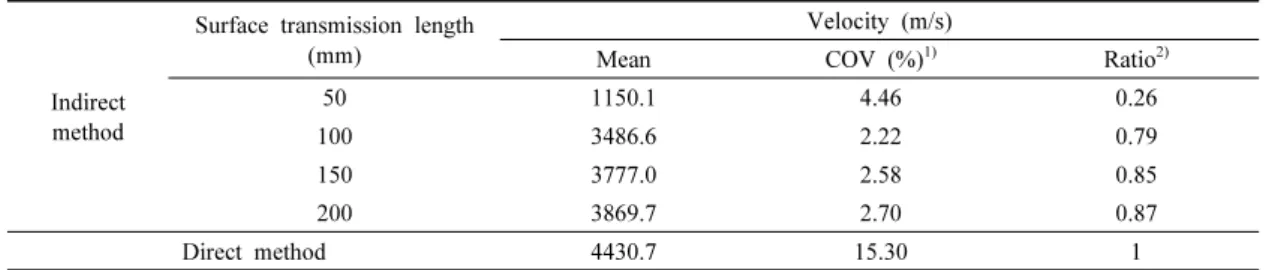
ducers), mean, coefficient of variation and ratios to test methods of ultrasonic velocity were presented in Table 1. As shown in the Table 1, the ultrasonic veloc- ity was increased with increasing the distance between transducers. Also, the coefficients of variation were 4.46, 2.22, 2.58, 2.70 % according to the distance, respectively. The ratios between direct and indirect method to ultrasonic velocity were also increased with increasing the distance between transducers and the highest value was 0.87 in 200mm length. Machado et al. (2009) compared the ultrasonic velocity between direct and indirect method and presented that the rela- tive difference became lower as the distance between transducers was increased. This tendency was also found in this study. Senalik et al. (2014) pointed out that the specimen is thin, the traveling wave can re- flect from the far side of the specimen and return to the sensor before the mechanical element in the sensor has come to rest. In this case, the reflected signal will be contaminated by element motion still present from the initial pulse. This means that the transducer dis- tance in indirect method can affect the ultrasound ve- locity, and it is difficult to get the meaningful data in case of short distance between two transducers.
Also, Savalita et al. (2014) insisted that small path wavelength in indirect method can’t go through depth so results may be faulty in concrete. From the test re- sults and related studies, it is considered that the short distance between transducers is difficult to get the reli- able data.
Indirect method
Surface transmission length (mm)
Velocity (m/s)
Mean COV (%)
1)Ratio
2)50 1150.1 4.46 0.26
100 3486.6 2.22 0.79
150 3777.0 2.58 0.85
200 3869.7 2.70 0.87
Direct method 4430.7 15.30 1
Table 1. Ultrasonic velocity and ratios according to distance between transducers
1)