• 검색 결과가 없습니다.

A Study on the Mechanism of Immunomodulating Effects of Moxifloxacin in Oleic Acid-Induced Acute Lung Injury

N/A
N/A
Protected

Academic year: 2021

Share "A Study on the Mechanism of Immunomodulating Effects of Moxifloxacin in Oleic Acid-Induced Acute Lung Injury"

Copied!
9
0
0

로드 중.... (전체 텍스트 보기)

전체 글

(1)

Tuberc Respir Dis 2011;71:97-105

CopyrightⒸ2011. The Korean Academy of Tuberculosis and Respiratory Diseases. All rights reserved.

A Study on the Mechanism of Immunomodulating Effects of Moxifloxacin in Oleic Acid-Induced Acute Lung Injury

Young Man Lee, M.D.

Department of Physiology, The Catholic University of Daegu School of Medicine, Daegu, Korea

Background: It was hypothesized that the immunomodulating effects of moxifloxacin contribute to ameliorate oleic acid (OA)-induced acute lung injury (ALI) by suppression of cytosolic phospholipase A2 (cPLA2). This was based on observations from experiments on rats associated with neutrophilic respiratory burst, cPLA2 activity, and expressions of cPLA2, TNFα, and COX-II in the lung.

Methods: ALI was induced by intravenous injection of OA in male Sprague-Dawley rats. Five hours after OA injection, protein content in bronchoalveolar lavage (BAL), lung myeloperoxidase (MPO) activity, and numbers of BAL neutrophils were measured. As an index of oxidative stress-induced lung injury, the content of malondial- dehyde (MDA) in lung tissues was also determined. Lung histology, immunohistochemistry and determination of activity of cPLA2 in lung tissues were carried out. In addition, Western blotting of TNFα and COX-II in lung tissues was performed.

Results: The accumulation of neutrophils in the lungs was observed after OA injection. BAL protein was increased along with neutrophilic infiltration and migration by OA. Moxifloxacin decreased all of these parameters of ALI and ameliorated ALI histologically. The increased malondialdehyde (MDA) in the lung by OA was also decreased by moxifloxacin. Moxifloxacin not only suppressed cPLA2 expression in the lungs and neutrophils but also decreased cPLA2 activity in lung tissues of rats given OA. The enhanced expressions of TNFα and COX-2 in the lung tissues of rats given OA were also suppressed by moxifloxacin.

Conclusion: Moxifloxacin inhibited cPLA2 and down-regulated TNFα and COX-2 in the lungs of rats given OA, which resulted in the attenuation of inflammatory lung injury.

Key Words: Moxifloxacin; Oleic Acid; Neutrophils; Acute Lung Injury

Address for correspondence: Young Man Lee, M.D.

Department of Physiology, Daegu Catholic University Hospital, The Catholic University of Daegu School of Medicine, 3056-6, Daemyeong 4-dong, Nam-gu, Daegu 705-718, Korea

Phone: 82-53-650-4472, Fax: 82-53-621-4106 E-mail: [email protected]

Received: Mar. 25, 2011 Accepted: Jun. 3, 2011

Introduction

 Acute lung injury (ALI) and its severe form of acute respiratory syndrome (ARDS) are characterized by acute hypoxemic respiratory failure, low pressure pulmonary edema, and massive neutrophilic infiltration in the lung

1

. The fundamental pathogenesis that initiates and intensifies this intractable inflammatory process has not

been elucidated. Phospholipase A

2

(PLA

2

) has long been known to participate in ALI, and various studies have been carried out to develop new therapeutic mo- dalities for acute lung injury

2,3

. Until now, however, the results are discouraging and the heterogeneity of etiol- ogies increases the difficulties to explain the exact pathogenesis of ALI

4

.

 Fat embolism syndrome (FES) is one of the etiologies causing ALI and oleic acid in the bone marrow or other part of the body is the main source of acute in- flammatory lung injury in the FES

5

. OA not only directly injures endothelial cells of the lung

6

, but also initiates inflammatory reaction through the activation of PLA

27

.

 In spite of the unsuccessful outcome to develop new

therapeutic drugs against ALI, the recent discovery of

new types of PLA

2

s and the novel knowledge on these

(2)

new PLA

2

s have prompted studies on PLA

2

expecting to discover new therapeutic modalities of ALI.

 Though PLA

2

s have been studied widely in con- junction with ALI

8

and its new therapy, the efforts have been in vain still. However, in FES-induced ALI, cyto- solic PLA

2

(cPLA

2

) might play a crucial role for the ini- tiation of acute inflammation in the lung, as cPLA

2

s are abundant in the lung and mononuclear phagocytes are enriched with cPLA

29

. Besides, cPLA

2

mediates arach- idonic acid-induced tissue injury which comprises the activation of NADPH oxidase and inflammatory reaction irrespective of free radicals

10

. In OA-induced ALI, neu- trophils play a crucial role along with its accumulation and migration to the lung provoking epithelial and en- dothelial injury by oxidative stress and release of pro- teases

11

.

 Recently, fluoroquinolones were discovered to have immunomodulatory functions, especially anti-inflamma- tory effects

12,13

by suppressing the migration of phag- ocytes in some clinical conditions. Considering the pos- sibility that moxofloxacin's immunomodulating effects are linked to cPLA

2

activity, effects of moxifloxacin on OA-induced ALI were tested in conjunction with the cPLA

2

-activated neutrophilic oxidative stress and the ac- tivation of TNFα and COX-II in the lung.

Materials and Methods 1. Experimental animals and reagents

 Male Sprague-Dawley rats were purchased from Sasco Company (Sasco Korea, pathogen free, 250∼300 g). Goat anti-human cPLA

2

polyclonal antibody and an- ti-COX-II antibody were purchased from Santa Cruz Biochem (Santa Cruz, CA, USA). Anti-TNF-α-polyclo- nal antibody was obtained from Cell Signaling (Danvers, MA, USA). L-α-dipalmitoyl-[2-palmitoyl-9,10-

3

H(N)- phosphatidylcholine was obtained from Dupont NEN Research Products (Boston, MA, USA). Moxifloxacin hy- drochloride was graciously provided by Bayer (Bayer Leverkusen, Germany). Not otherwise mentioned, all other reagents were purchased from Sigma Aldrich Company (St. Louise, MO, USA).

2. Induction of ALI

 Animals were fed ad libitum standard chow and wa- ter till 24 hours before experiments. ALI was induced in rats by being given oleic acid intravenously (30μL of oleic acid with 270μL of 10% bovine serum albu- min) as previously described

11,14

.

3. Treatments

 Rats were divided into three treatment groups 1) Sham group: rats were given 300μL of 10% bo- vine serum albumin intravenously via femoral vein; 2) Oleic acid control group (OA group): rats were given 30μL of oleic acid with 270μL of 10% bovine serum albumin intravenously; 3) Moxifloxacin group (MO group): rats were given moxifloxacin hydrochloride (100 mg/kg) with 30μL of oleic acid in 270μL of 10%

bovine serum albumin. Moxifloxacin hydrochloride was given intraperitoneally just after the injection of oleic acid.

4. Bronchoalveolr lavage (BAL)

 BAL was performed 5 hours after oleic acid injection.

The rats were anesthetized with enflurane and tracheo- tomized and cannulated. BAL was performed with 8.0 mL of PBS for each rat and approximately 6.0 mL of BAL was recovered. BAL fluid was collected into 10 mL sterile tubes, centrifuged to collect cell free supernatant and stored at −20

o

C for protein assay. The sediments were resuspended with PBS for counting of leucocytes.

5. BAL protein

 Determination of BAL protein was performed as pre- viously described by Brown et al.

15

with modification.

Stored BAL supernatant was used for protein assay.

6. BAL neutrophil count

 TenμL of resuspended sediment solution was ap- plied on hemocytometer and leukocytes were counted.

Around 100μL of BAL suspension was cytospinned and

slides were prepared before Wright staining. Percentage

of neutrophils was calculated by differential count and

(3)

total numbers of neutrophils were calculated.

7. Lung myeloperoxidase (MPO) assay

 The MPO activity (U/g of wet lung) was determined to estimate the accumulation of neutrophils in the lung.

The assay was performed as described by Goldblum et al.

16

with modification. Lungs were weighed and homo- genized with Polytron homogenizer (Polytron, Switzerland) in 4.0 mL of 20 mM PBS at pH 7.4. An aliquot was mixed with an equal volume of 1% hexadecytrimethyl ammonium bromide in PBS and rehomogenized for 90 s in ice cold water. Then it was centrifuged 15,000 g for 5 minutes at 4

o

C. The supernatant (0.1 mL) was add- ed to 2.9 mL of PBS (50 mM potassium phosphate, pH 6.0) containing 0.0005% H

2

O

2

and 0.168 g/L of o-diani- sidine. The samples were analyzed for change in ab- sorbance on spectrophtometer at 460 nm over 3 minutes. MPO activity was expressed as U/g of wet lung by multiplying 13.5 to the changes of absorbance/min/g of wet weight tissue.

8. Determination of lung malondialdehyde (MDA);

thiobarbituric acid reactive substance (TBARS) assay

 TBARS assay was carried out as described pre- viously

17

to measure lipid peroxidation as a marker of ALI. The same supernatant used for MPO assay was used. Aliquots of supernatant were mixed with equal volume of 3.5% sodium dodecyl sulfate (SDS) and 0.13 mL of 100% acetic acid in 15 mL-glass centrifuge tubes.

The pH was adjusted to 3.5 with 1 N NaOH. Five mL of 0.6% thiobarbituric acid was added to each tube and they were heated in boiling water bath at 95

o

C for 30 minutes. After cooling, 1.5 mL of n-butanol/pyrimidine (15:1) mixture was added to each tube and vortexed vigrously for 30 s followed by centrifugation at 4,000 rpm for 10 minutes. The absorbance of top layer of each sample was measured by spectrophotometer at 525 nm.

9. Determination of cPLA

2

activity

 cPLA

2

activity was determined by the hydrolysis of

radioactively labelled phospholipid (

3

H-dipalmitoyl- phosphatidylcholine,

3

H-DPPC) as previously described by Katsumata et al.

18

with modification. Lung tissues were homogenized in a polytron in ice-cold buffer (1:

5, wt/vol) containing Tris- HCl (pH 7.6), EDTA (1 mM), EGTA (1 mM) and DTT (5 mM) to abolish sPLA

2

activity. The phospholipid substrate solution (pH 9.0) was composed of

3

H-DPPC, lecithin (0.1 mM), glycine (100 mM), deoxycholate (2.5 mM), BSA (10 g/L) and 1.75 mM ethanol. The reaction was initiated by the ad- dition of 100μL of lung homogenate to the phospholi- pid substrate solution and incubated at 37

o

C in a shak- ing water bath for 60 minutes. Crotalus adamanteus PLA

2

was used as a positive control. The reaction was stopped by adding 200μL of 5% Triton X-100 contain- ing 200 mM EDTA and 5 g of anhydrous Na

2

SO

4

. For the extraction of hydrolysis product, 5.0 mL of 0.1% gla- cial acetic acid-hexane was added to each sample. The extract was scanned with β-scintillation counter. 1 unit of PLA

2

activity was defined as 1μM production of fatty acid per minute.

10. Lung histological preparations

 Lungs were fixed by inflation with paraformaldehyde (pH 7.4, 4%) at pressure of 20 cm H

2

O and sliced be- fore putting into paraformaldehyde, then degassing and fixed. Tissue slices were stained with hematoxylin-eosin for examination of lung histology.

11. Immunohistochemistry of cPLA

2

in rat lung tissue  Microtomer sections were subjected to staining for fluorescence and diaminobenzidine (DAB) for cPLA

2

in rat lung tissues. Goat anti-human-cPLA

2

polyclonal was used as first antibody. The antibody complex was vi- sualized by propidium iodide (fluorescense) and DAB staining.

12. Protein expression of TNFα and COX-2

 Proteins of TNFα and COX-2 were identified in ho-

mogenized lung tissue (100μg of protein) using stand-

ard western blotting. Specific polyclonal antibodies, an-

ti-TNF and anti-COX-II were diluted 1:1,000 (Tris buf-

(4)

Table 2. Effect of moxifloxacin on the infiltration and mi- gration of neutrophils in the lungs of oleic acid given rats

Sham OA OA+MO

Lung MPO, 2.5±0.4 34.7±2.4* 13.9±1.3

U/g of lung (n=8) (n=14) (n=8)

BAL PMNs, 0.2±0.1 9.1±2.5

1.6±0.4

§

millions/two lungs (n=12) (n=9) (n=8) Values are given as mean±SE.

*p<0.001; Sham vs. OA,

p<0.001; OA vs. OA+MO,

p

<0.001; Sham vs. OA,

§

p<0.001; OA vs. OA+MO.

MPO: myeloperoxidase; OA: oleic acid; MO: moxifloxacin; BAL:

bronchoalveolar lavage fluid; PMN: polymorpho nuclear neu- trophil; SE: standard error.

Table 1. Effect of moxifloxacin on lung leak in the OA-in- duced acute lung injury in rats

Sham (n=13) OA (n=7) OA+MO (n=7) BAL protein, 1.9±0.3 6.3±0.5* 3.3±0.2

mg/two lungs

Values are given as mean±SE.

*p<0.001; Sham vs. OA,

p<0.01; OA vs. OA+MO.

BAL: bronchoalveolar lavage; OA: oleic acid; MO: moxifloxacin;

SE: standard error.

Table 4. Effect of moxifloxacin on the cytosolic PLA

2

activ- ity in the lungs of oleic acid given rats

Sham (n=10) OA (n=9) OA+MO (n=8) cPLA

2

activity, 15.1±5.3 30.2±14.1* 12.4±4.2

mU/g of lung

Values are given as mean±SE.

*p<0.001; Sham vs. OA,

p<0.05; OA vs. OA+MO.

cPLA

2

: cytosolic phospholipase A

2

; OA: oleic acid; MO: moxi- floxacin; SE: standard error.

Table 3. Effect of moxifloxacin on the MDA content in the lung reflecting oxidative lung injury

Sham (n=7) OA (n=9) OA+MO (n=7) MDA content, 141.6±15.1 370.9±21.5* 241.2±30.9

nmol/g of lung

Values are given as mean±SE.

*p<0.001; Sham vs. OA,

p<0.001; OA vs. OA+MO.

OA: oleic acid; MDA: malondialdehyde; MO: moxifloxacin; SE:

standard error.

fer, Saline Tween 20 [TBST] buffer with 0.1% BSA).

13. Statistical analyses

 Data were expressed as mean±standard error (SE).

Data were analyzed using a one-way analysis of var- iance with Tukey-Kramer multiple comparisons test. A p-value of <0.05 was considered statistically significant.

Results

1. Effects of moxifloxacin on lung leak

 The assay of BAL protein revealed the protective ef- fect of moxifloxacin on lung leak in rats. As shown in Table 1, OA had increased the protein content (mg/two lungs) in BAL of rats given OA, as compared with that of sham-treated rats (p<0.001). Moxifloxacin had de- creased the protein content in BAL of rats given OA (p

<0.01).

2. Effects of moxifloxacin on the accumulation and migration of neutrophils in the lungs of rats given the OA

 As noted in Table 2, moxifloxacin reduced the accu- mulation of neutrophils in the interstitium of the lung and suppressed the migration of neutrophils into the al- veoli of the OA group (p<0.001). As expected, the OA caused dramatic mobilization of neutrophils manifested by the drastic increase of lung MPO (p<0.001). The accumulation of neutrophils in the lung interstitium caused the migration of neutrophils into the alveoli as a process of alveolar flooding. Moxifloxacin was effec- tive to decrease the effects of OA on the mobilization of neutrophils (p<0.001).

3. Estimation of protective effects of moxifloxacin by TBARS assay

 As an index of lung injury, the TBARS in the lung

was measured. The MDA content (nmol/g of lung) was

higher in the lungs of OA given rats compared with that

of sham treated rats (p<0.001). The MDA content in

(5)

Figure 1. Effects of moxifloxacin on histopathology in the lung. (A) Patent alveoli and normal septa of alveoli were well preserved and no phagocyte was found in sham- treated rats (H&E stain, ×40). (B) In contrast, in rats given OA, phagocytes, mainly neutrophils, and red blood cells were present in alveoli. Perivascular cuffing, hyaline mem- brane, and edematous alveolar septa were evident (H&E stain, ×100). (C) By the administration of moxifloxacin, these pathological findings were mitigated. Even if slight migration of phagocytes was noted, neutrophils were diffi- cult to find. Alveoli were relatively patent and septal ede- ma was not prominent compared with that of rats given OA (H&E stain, ×100). OA: oleic acid.

the lungs of moxifloxacin given to rats was lower than that of the rats given OA reflecting the protective effect of moxifloxacin (p<0.001) (Table 3).

4. cPLA

2

activity in the lung tissue

 As shown in Table 4, the cPLA

2

activity was higher in the lungs of OA-treated rats compared with that of sham-treated rats (p<0.001). The cPLA

2

activity was lowered in the lung tissue by moxifloxacin in OA-treat- ed rats (p<0.05).

5. Lung histology and cPLA

2

immunohistochemistry of lung tissue

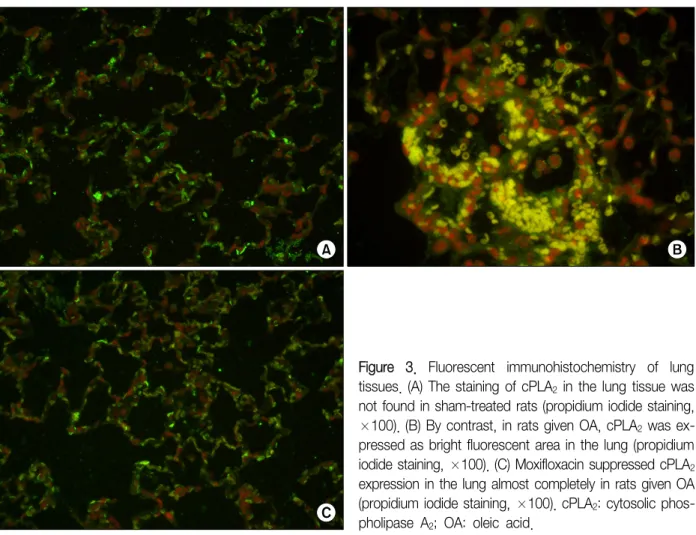
 While examining the histopathology of the lung of rats given OA, many phagocytes, mainly neutrophils, were observed. Perivascular cuffing and alveolar flood-

ing were also observed, as these were the results of the

OA injection (Figure 1A and B). Moxifloxacin amelio-

rated these inflammatory reactions dramatically, even if

the remnants of migrated phagocytes, mainly alveolar

monocyte/macrophages remained (Figure 1C). Along

with these histopathological changes, the immunohisto-

chemistry revealed the inhibitory effects of moxifloxacin

on cPLA

2

in the lung. The DAB and fluorescent staining

of cPLA

2

in the lung demonstrated the diminished ex-

pression of cPLA

2

by moxifloxacin (Figures 2, 3). Note

the deep staining of cPLA

2

in the intra-alveolar neu-

trophils with DAB in the OA-treated rats. Interestingly,

this phenomenon disappeared by moxifloxacin almost

completely. In the lung tissue, the fluorescent staining

of the alveolar septa was shown in OA-treated rats, and

again, moxifloxacin suppressed this phenomenon

(6)

Figure 2. Immunohistochemical staining of cPLA

2

in the lung. (A) Note the absence of phagocytic cells in alveoli in sham-treated rats (DAB staining, ×100). (B) By con- trast, in rats given OA, DAB-stained neutrophils and mon- ocytes were present in alveoli. In the cytoplasm of neu- trophils, cPLA

2

s were well stained and visualized (DAB staining, ×200). (C) In moxifloxacin-treated rats, there was almost no difference in cPLA

2

expression comparing with that of sham-treated rats (DAB staining, ×200). cPLA

2

: cytosolic phospholipase A

2

; OA: oleic acid.

(Figure 3).

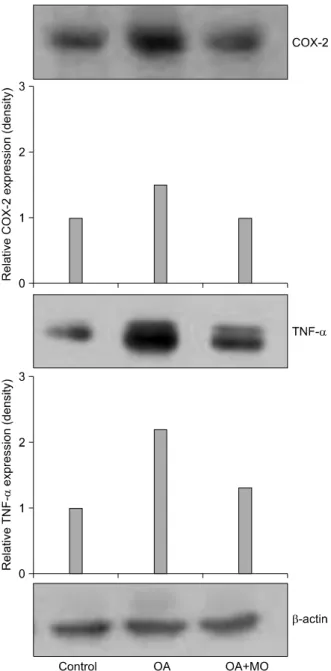
6. Western blotting of TNFα and COX-2 in the lung tissue

 The immunoprecipitation of TNFα and COX-2 was carried out to estimate the anti-inflammatory effects of moxifloxacin associated with the pro-inflammatory cyto- kine and rate-limiting enzyme of inflammation. The OA increased the expression of TNFa and COX-2, which was normalized by moxifloxacin (Figure 4).

Discussion

 Moxifloxacin is a fluoroquinolone that acts against gram positive and gram negative bacteria

19

. It has a dual role of antimicrobial and protective anti-inflammatory effects in clinical conditions

20

.

 In the present study, the property of immunomodu-

lating effect of moxifloxacin was evaluated on OA-in- duced ALI in terms of protection from neutrophilic in- flammatory reaction. As expected, moxifloxacin was shown to exert a protective effect on OA-induced lung leak and to suppress the accumulation and migration of neutrophils in the lung.

 The OA is one of the derivatives of fatty acids and

is responsible for acute inflammatory injury of the lung

in FES, that is, OA induces lung leak, accumulation of

neutrophils, and oxidative stress leading to ALI in ex-

perimental animals and human beings

21

. Moxifloxacin

was effective to suppress lung leak by the decrease of

neutrophilic oxidative stress or neutrophil-induced tis-

sue injury evidenced by reducing lung MPO, number

of BAL neutrophils, MDA content in the lung of rats giv-

en OA. Specifically, the lower content of MDA in the

lung by moxifloxacin signifies the anti-oxidative stress

effect of moxifloxacin.

(7)

Figure 3. Fluorescent immunohistochemistry of lung tissues. (A) The staining of cPLA

2

in the lung tissue was not found in sham-treated rats (propidium iodide staining,

×100). (B) By contrast, in rats given OA, cPLA

2

was ex- pressed as bright fluorescent area in the lung (propidium iodide staining, ×100). (C) Moxifloxacin suppressed cPLA

2

expression in the lung almost completely in rats given OA (propidium iodide staining, ×100). cPLA

2

: cytosolic phos- pholipase A

2

; OA: oleic acid.

 According to Shalit and associates

13

, moxifloxacin was effective to inhibit the migration of neutrophils on endothelial cells resulted in the decrease of cellular injury. The results in this experiment are consistent with their report.

 In addition, moxifloxacin's anti-inflammatory effects were demonstrated prominently in lung histology.

Although the mechanism is obscure, the decreased ac- tivity of cPLA

2

and the expression in the lung might be one of the clues to understand the anti-inflammatory property of moxifloxacin.

 Until recently, the relationship between the role of PLA

2

and the immunoregulatory effect of moxifloxacin has not been elucidated. Since the role of cPLA

2

on ALI is predominant in provoking acute pulmonary edema, the decrease of the pulmonary edema by moxifloxacin might be originated from the down regulation of cPLA

2

. Because the activation of cPLA

2

by OA was evident and

the activation of cPLA

2

would be followed by the syn- thesis of pro-inflammatory lipid molecules

22

, it is natural to envisage that the moxifloxacin's anti-inflammatory ef- fect was derived from the inhibition of cPLA

2

.

 In western blot analysis, the expression of TNFα was stimulated by OA, and moxifloxacin depressed the increased expression of TNFα by OA. According to the classical process of the inflammation, the activation of cPLA

2

could be initiated by the increased expression of TNFα, one of the pro-inflammatory cytokines which induced inflammatory reaction in ALI

23

. The decreased expression of TNFα by moxifloxacin might subse- quently decreased the cPLA

2

activity in the lung and suppressed the expression of cPLA

2

in the lung and neutrophils.

 One more interesting result was that the OA in-

creased expression of COX-2, one of the rate-limiting

enzymes of inflammation. The increased expression of

(8)

Figure 4. Western blot of TNFα and COX-2 in the lung tissue. The OA increased the expression of TNFα and COX-2. Moxifloxacin effectively suppressed the ex- pression of TNFα and COX-2 which had been upregu- lated by OA. OA: oleic acid; MO: moxifloxacin.

COX-2 by OA was lowered by moxifloxacin, which im- plied the anti-inflammatory property of moxifloxacin in ALI. Moxifloxacin seemed to block the downstream of the inflammatory process by disintegration of positive feedback loop of neutrophilic oxidative stress

24

.  In other words, moxifloxacin suppressed secretion of TNFα from phagocytes which down regulated cPLA

2

and was followed by the decreased expression of COX- 2. From the inflammatory reaction's point of view, the block or suppression of pro-inflammatory cytokine pre- sumed to lower the cPLA

2

activity in the lung by moxi- floxacin.

 Conclusively, though further studies are to be desired to understand the precise mechanism of the effects of moxifloxacin on FES-induced ALI, based on the present study, I would like to suggest that the suppression of cPLA

2

by moxifloxacin might be protective against in- jurious neutrophilic oxidative stress in rats.

References

1. Ashbaugh DG, Bigelow DB, Petty TL, Levine BE. Acute respiratory distress in adults. Lancet 1967;2:319-23.

2. Kim DK, Fukuda T, Thompson BT, Cockrill B, Hales C, Bonventre JV. Bronchoalveolar lavage fluid phos- pholipase A2 activities are increased in human adult respiratory distress syndrome. Am J Physiol 1995;269(1 Pt 1):L109-18.

3. Magrioti V, Kokotos G. Phospholipase A2 inhibitors as potential therapeutic agents for the treatment of in- flammatory diseases. Expert Opin Ther Pat 2010;20:1- 18.

4. Ware LB, Matthay MA. The acute respiratory distress syndrome. N Engl J Med 2000;342:1334-49.

5. Sherr S, Montemurno R, Raffer P. Lipids of recovered pulmonary fat emboli following trauma. J Trauma 1974;14:242-6.

6. Julien M, Hoeffel JM, Flick MR. Oleic acid lung injury in sheep. J Appl Physiol 1986;60:433-40.

7. Karagiorga G, Nakos G, Galiatsou E, Lekka ME. Bio- chemical parameters of bronchoalveolar lavage fluid in fat embolism. Intensive Care Med 2006;32:116-23.

8. Nagase T, Uozumi N, Ishii S, Kume K, Izumi T, Ouchi Y, et al. Acute lung injury by sepsis and acid aspira- tion: a key role for cytosolic phospholipase A2. Nat Immunol 2000;1:42-6.

9. Leslie CC. Properties and regulation of cytosolic phos- pholipase A2. J Biol Chem 1997;272:16709-12.

10. Ishitsuka Y, Moriuchi H, Hatamoto K, Yang C, Takase

J, Golbidi S, et al. Involvement of thromboxane A2

(TXA2) in the early stages of oleic acid-induced lung

injury and the preventive effect of ozagrel, a TXA2 syn-

thase inhibitor, in guinea-pigs. J Pharm Pharmacol

2004;56:513-20.

(9)

11. Ito K, Mizutani A, Kira S, Mori M, Iwasaka H, Noguchi T. Effect of Ulinastatin, a human urinary trypsin in- hibitor, on the oleic acid-induced acute lung injury in rats via the inhibition of activated leukocytes. Injury 2005;36:387-94.

12. Dalhoff A, Shalit I. Immunomodulatory effects of quinolones. Lancet Infect Dis 2003;3:359-71.

13. Shalit I, Horev-Azaria L, Fabian I, Blau H, Kariv N, Shechtman I, et al. Immunomodulatory and protective effects of moxifloxacin against Candida albicans-in- duced bronchopneumonia in mice injected with cyclo- phosphamide. Antimicrob Agents Chemother 2002;46:

2442-9.

14. Derks CM, Jacobovitz-Derks D. Embolic pneumopathy induced by oleic acid. A systematic morphologic study.

Am J Pathol 1977;87:143-58.

15. Brown RE, Jarvis KL, Hyland KJ. Protein measurement using bicinchoninic acid: elimination of interfering substances. Anal Biochem 1989;180:136-9.

16. Goldblum SE, Wu KM, Jay M. Lung myeloperoxidase as a measure of pulmonary leukostasis in rabbits. J Appl Physiol 1985;59:1978-85.

17. Carraway MS, Piantadosi CA, Jenkinson CP, Huang YC.

Differential expression of arginase and iNOS in the lung in sepsis. Exp Lung Res 1998;24:253-68.

18. Katsumata M, Gupta C, Goldman AS. A rapid assay for activity of phospholipase A2 using radioactive sub-

strate. Anal Biochem 1986;154:676-81.

19. Fischer S, Adam D. Effects of moxifloxacin on neu- trophil phagocytosis, burst production, and killing as determined by a whole-blood cytofluorometric method.

Antimicrob Agents Chemother 2001;45:2668-9.

20. Donnarumma G, Paoletti I, Buommino E, Iovene MR, Tudisco L, Cozza V, et al. Anti-inflammatory effects of moxifloxacin and human beta-defensin 2 association in human lung epithelial cell line (A549) stimulated with lipopolysaccharide. Peptides 2007;28:2286-92.

21. Furue S, Kuwabara K, Mikawa K, Nishina K, Shiga M, Maekawa N, et al. Crucial role of group IIA phospholi- pase A(2) in oleic acid-induced acute lung injury in rabbits. Am J Respir Crit Care Med 1999;160:1292-302.

22. Levy R. The role of cytosolic phospholipase A2-alfa in regulation of phagocytic functions. Biochim Biophys Acta 2006;1761:1323-34.

23. Shalit I, Halperin D, Haite D, Levitov A, Romano J, Osherov N, et al. Anti-inflammatory effects of moxi- floxacin on IL-8, IL-1beta and TNF-alpha secretion and NFkappaB and MAP-kinase activation in human mono- cytes stimulated with Aspergillus fumigatus. J Antimi- crob Chemother 2006;57:230-5.

24. Kwon YS, Hyun DS, Lee YM. Cytosolic phospholipase

A2 activity in neutrophilic oxidative stress of plate-

let-activating factor-induced acute lung injury. Tuberc

Respir Dis 2007;63:497-506.

수치

Table 4. Effect of moxifloxacin on the cytosolic PLA 2  activ- activ-ity  in  the  lungs  of  oleic  acid  given  rats
Figure 1. Effects of moxifloxacin on histopathology in the  lung.  (A)  Patent  alveoli  and  normal  septa  of  alveoli  were  well  preserved  and  no  phagocyte  was  found  in  sham-  treated rats (H&E stain, ×40)
Figure  2.  Immunohistochemical  staining  of  cPLA 2   in  the  lung.  (A)  Note  the  absence  of  phagocytic  cells  in  alveoli  in  sham-treated  rats  (DAB  staining,  ×100)
Figure  3.  Fluorescent  immunohistochemistry  of  lung  tissues.  (A)  The  staining  of  cPLA 2   in  the  lung  tissue  was  not found in sham-treated rats (propidium iodide staining,
+2

참조

관련 문서

Furthermore, diosmetin significantly increased the expression of Nrf2 along with its target gene HO-1 and blocked the activation of NLRP3 inflammasome in the lung tissues,

Protein extracts of Crassostrea gigas alle- viate CCl 4 -induced hepatic fibrosis in rats by reducing the expression of CTGF, TGF-β1 and NF-κB in liver tissues. Hepatopro-

Although the inhibition of NADPH oxidase in isolated neutrophils by apocynin decreased the generation of free radicals significantly, the oxidative stress in the lung

The O 2 -induced neutrophilic oxidative stress was identified by confirming of the increase in lung myeloperoxidase, BAL neutrophils, malondialdehyde (MDA),

In contrast, pretreatment of diltiazem before endotoxin charge had decreased (P<0.001) the migration of neutrophils into alveolar lumen denoted in the decreased

Conclusion: Because there was no significant difference for the extent of lung injury induced by oleic acid be- tween the group treated with high dose methyl prednisolone

The following parameters caused by LPS treatment were observed ; body weights, lung weights, pulmonary transcapillary albumin transit, arterial gas parameters

(B) Effects of NAC on OA-induced PCNA expression. Data are presented as representative Western blot.. Linoleic acid and oleic acid increase the endothelin-1 binding and action