• 검색 결과가 없습니다.

Rapid Screening of Sulfur Amino Acids in Human Plasma by Ultra Performance Liquid Chromatography-tandem Mass Spectrometry for Diagnosis of Metabolic Disorder

N/A
N/A
Protected

Academic year: 2021

Share "Rapid Screening of Sulfur Amino Acids in Human Plasma by Ultra Performance Liquid Chromatography-tandem Mass Spectrometry for Diagnosis of Metabolic Disorder"

Copied!
7
0
0

로드 중.... (전체 텍스트 보기)

전체 글

(1)

DOI 10.17480/psk.2018.62.1.7

Rapid Screening of Sulfur Amino Acids in Human Plasma by

Ultra Performance Liquid Chromatography-tandem Mass Spectrometry for Diagnosis of Metabolic Disorder

Maheshwor Thapa and Hye-Ran Yoon

#

Biomedical & Pharmaceutical Analysis Lab, College of Pharmacy, Duksung Women’s University, Seoul 01369, Republic of Korea (Received December 23, 2017; Revised January 28, 2018; Accepted February 1, 2018)

Abstract — A rapid and simple screening method was developed for the simultaneous analysis of 6 sulfur-containing amino acids from human plasma at ng level. The procedure involves simple protein precipitation followed by direct analysis using UPLC-MS/MS. Calibration curves showed an excellent linear relationship with coefficients of determination (r

2

) of 0.9989- 0.9998. LOD and LOQ were between 1-50 ng/mL and 10-100 ng/mL, respectively. When sulfur amino acids spiked into plasma sample, excellent linearity of detection response was demonstrated over the range between 10-10,000 ng/mL. This new analytical method is suitable for simultaneous screening of large number of samples in clinical application and metab- olomics research.

Keywords Sulfur containing amino acids, ultra-performance liquid chromatography-tandem mass spectrometry, metabolic disorders

Introduction

Sulfur-containing amino acids serve numerous vital func- tions in cellular biology, biochemistry and pharmacology. They contribute to the maintenance and integrity of cellular sys- tems by influencing cellular redox state and cellular capacity to detoxify toxic compounds, free radicals and reactive oxygen species.

1)

Most of the sulfur amino acids undergo oxidative coupling reactions to form disulfides. Methionine undergoes oxidation to form methionine sulfoxide or methionine sulfone, while homocysteine forms homocystine. Simultaneous detec- tion and identification of these amino acids is important for the metabolic disease screening, as well as for the controlling of various adult metabolic diseases. Studies have demonstrated that sulfur amino acids are involved in the pathogenesis cardio- vascular disease and those related to oxidative stress.

2,3)

Excess methionine leads to hypermethioninemia, whereas insufficiency

of this leads to lipid peroxidation. The ability to detect high homocysteine levels in serum and urine is a valuable tool for the diagnosis of homocystinuria and cystathionine- β-synthase deficiency. Cystathionine- α-lyase deficiency (or cystathioninuria) is characterized by increased cystathionine levels in serum and urine.

4, 5)

Total homocysteine and cystathionine levels are also typically high in cobalamin and folate deficiency disorders.

6)

Sulfur amino acids are considered very important biological markers for inherited metabolic disorders such as methionin- emia, cystathioninemia and homocystinuria etc. In addition, for human adult disease such as cardiac infarction, rapid and fully- validated method is required for the prevention of those dis- eases.

The literature reported the application using a variety of analytical instrument as below. These were capillary electro- phoresis (CE),

7-9)

high-performance liquid chromatography (HPLC) using UV-Vis detector,

10)

HPLC coupled with coulo- metric electrochemical detection,

11-12)

capillary electrophoresis with reverse pulse ampherometric detector,

13)

ion exchange chromatography,

14)

gas chromatography mass spectrometry (GC-MS),

15,16)

HPLC-fourier-transform mass spectrometry (HPLC-FTMS),

17)

and liquid chromatography-tandem mass spectrometry (LC-MS/MS).

18)

It has been extensively reported

#

Corresponding Author Hye-Ran Yoon

College of Pharmacy Duksung Women’s University, #312 Phar- macy Bd, 33 Samyangro 144-gil, Dobong-gu, seoul 132-714 Tel.: 02-901-8387 Fax.: 02-901-8387

E-mail: [email protected]

Short Report

종설

(2)

as one of the analytical tools which could simultaneously screen several amino acids.

19-22)

The major advantage of our method is without any SPE or derivatization as sample preparation step from small amounts of biological samples. So far, the screening method for simulta- neous detection and quantification of sulfur containing amino acids especially for methionine sulfone and methionine sulfox- ide has not reported yet.

This study used ultra-performance liquid chromatography-tan- dem mass spectrometry (UPLC-MS/MS) for the determination of six plasma sulfur amino acids (methionine, methionine sul- fone, methionine sulfoxide, homocysteine, homocystine, and cys- tathionine) in order to apply for future screening of sulfur amino acids relating metabolic disorders and chronic disease (cardiac infarction).

Experiment

Reagents and materials

Methionine (Met), homocysteine (Hcy), methionine sulfoxide (Met(O)), methionine sulfone (Met(O

2

)), homocystine (Hcy- Cys), and cystathionine (Cysta)) were purchased from TCI Co.

(Tokyo, Japan). All chemicals and organic solvents including methanol, acetonitrile, and formic acid were of analytical-reagent grade and were purchased from Duksan Chemicals (Seoul, Korea). The internal standard (I.S.), methionine-d3, was also purchased from TCI Co. The chemical structures of all com- pounds investigated are shown in Fig. 1. Double distilled water (DDW) was prepared using a Milli QTM (Millipore, MA, USA).

A shaker (TAITEC, Tokyo, Japan) and a centrifuge (Eppendorf model 5424, Hamburg, Germany) were used for mixing and cen- trifuging the specimens in different steps.

Specimen collection

Plasma specimens from healthy volunteers were collected in polyethylene tubes. They were immediately stored at −20

o

C until analysis. Three plasma samples from hypermethioninemia patients were obtained from Seoul Clinical Laboratory, Seoul. All samples underwent the same diagnostic procedure at the same facility.

Preparation of standard solution

Stock solutions of 6 sulfur amino acids and internal standard were prepared by dissolution in 70% methanol (1 mg/mL) and stored at −20

o

C. Each stock solution was further diluted to 1- 10 μg/mL with 70% methanol as a working solution.

Sample preparation

A hundred μL of plasma specimen and 50 μL of methionine-d3 (100 ng/mL, IS) were placed in an Eppendorf tube. Then, 800 μL of acetonitrile (for protein precipitation) was added and the mix- ture was vortexed, followed by centrifugation at 12,500 rpm for 5 min. After this, 100 μL of supernatant was carefully transferred to the injection vial and 1 μL was injected into the MS/MS sys- tem source.

UPLC-MS/MS

LC-MSMS-8040 (Shimadzu, Japan) was used for our experi- ment. The MS system consisted of an electrospray ionization interface (ESI) and triple quadrupole (QqQ) mass analyzer.

The UPLC system comprised of a quaternary pump, an online degasser, a column heater and an autosampler. Separa- tion of AAs were accomplished on a Kinetex column (C18, 2.6 μm *50 mm *2.1 mm ID). Compositions of mobile phase were 2% formic acid in water (mobile phase A) and 0.1% for-

Fig. 1 − Chemical structures of six sulfur amino acids.

(3)

mic acid in acetonitrile (mobile phase B) at a flow rate of 0.4 mL/min. A gradient programme was used: 95% A and 5%

B; linear gradient to 20% B in 0.5 min, return to 5% B in 1 min at flow rate of 0.4 mL/min. Column temperature was set at 40

o

C and the injection volume was 1 μL. Data was collected and analyzed by Lab Solution (Shimadzu, Japan).

The MS/MS parameters were as follows ; Interface voltage was set at 4.5 kV. Desolvation line (DL) temperature was maintained at 250

o

C while heat block temperature at 400

o

C.

N

2

gas was used for nebulizing gas and drying gas. Argon was used for collision gas at a pressure of 230 kPa. Detector volt- age was 1.88 kV. Quantitation was performed in multiple-reac- tion monitoring (MRM) mode. The specific MRM transition ions are listed in Table I.

Analytical method validation

The developed method was validated according to the Food and Drug (FDA) bioanalytical method validation guidelines, which are based on linearity, accuracy, precision, and limit of detection, limit of quantitation, and stability test (FDA, 2001).

Calibration standard solutions were prepared based on seven levels of each sulfur amino acid standard solution (i.e. 0.01, 0.05, 0.1, 0.5, 1, 5 and 10 μg/mL) spiked in normal plasma and were measured in five replicates. Linearity was evaluated using the least square regression method with weighted data.

The calibration curve was constructed by the plotting of peak area ratio to concentration ratio at seven concentration levels.

The selectivity of the method was evaluated by injecting a blank, a blank sample with the internal standard and a blank sample spiked with the standard sulfur amino solution. In terms of sensitivity, LOD and LOQ were determined at signal to noise ratio (S/N) of 3 and 10, respectively.

The accuracy of the method was calculated by performing a

standard spiked experiment using five replicates at low (0.1 and 0.5 μg/mL), medium (0.8 μg/mL) and high (8 μg/mL) con- centrations. The accuracy was measured using the following equation: [measured concentration–apparent concentration] / [apparent concentration] × 100%. Precision for the intra-day and inter-day assay was determined as relative standard devia- tion (RSD) of five replicates. Recovery test was performed by comparing quantitative result of extracted and non-extracted spiked plasmas after fortified with low, medium and high stan- dard concentration of the compounds investigated. The experi- ments were performed five replicates for each control level.

Carry-over effect carried out by measuring blank water sam- ple immediately after analysis of the highest calibration stan- dard solution (10 μg/mL). If peak response in the carryover blank exceeded 20% of the LOQ response, carryover consid- ered significant.

Stability of SAAs were observed by preparing fresh stan- dards at three different concentrations with three replicates each. For freeze and thaw cycles, different concentrations were stored at −20

o

C and thawed unassisted at room temperature.

This cycle was repeated twice and analysis occurred during the third cycle. For the sample stability test, the processed sample was stored at 4

o

C in an auto sampler for 24 h and then evaluated.

Results

Optimization of chromatographic conditions

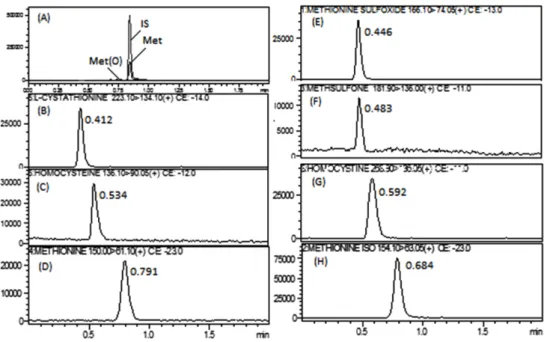
The UPLC conditions were optimized in order to obtain a chromatogram within a short analysis run time of 2 min with better resolution. The individual chromatograms for all six sul- fur amino acids were presented in Fig. 2 (A-H). The effects of the mobile phase on the resolution of all SAAs were investi- gated with variation of concentrations of formic acid in water and ammonium acetate. Formic acid (0.2%) in water as sol- vent A and 0.1% formic acid in acetonitrile as solvent B were used as the optimal mobile phase condition. A flow rate of 0.3 to 0.6 mL/min and injection volume of 1 to 3 μL was observed;

a 0.4 mL/min flow rate and 1- μL injection volume were selected as the optimal chromatographic conditions for high resolution and identification of SAAs.

Mass spectrometry conditions were optimized based on sen- sitivity comparison between positive and negative ion modes (Table I). Electrospray ionization in positive ion mode pro- Table I − Optimization of mass spectrometric parameters

Compounds MRM transition Q1 Pre Bias

(V) CE Q3 Pre Bias (V)

Met(O) 166.0 → 74.05 -11 -13 -28

Met(O2) 181.9 → 136.0 -12 -11 -23

Met 150.0 → 61.10 -10 -23 -22

Cysta 223.1 → 134.10 -14 -14 -22

Hcy 136.0 → 90.05 -13 -12 15

Hcy-Cys 268.9 → 136.05 -18 -11 -23

Met-d3 154.0 → 63.05 -10 -23 -23

(4)

vided the best detection for all SAAs investigated. [M+H]

+

ions were observed for all SAAs. For MRM chromatograms, the product ions of [M+H]

+

ions were selected in their MS/

MS spectra. The most specific and high intensity ion were monitored and included in the MRM profile. The MRM transi- tion ions are summarized in Table I. The standard solutions of the all SAA mixture could be sensitively and selectively detected in their MRM chromatograms.

Analytical method validation

Linearity was evaluated based on 6 calibration standards into normal plasma with 5 replicates. Met(O), Cysta, and Hcy-Cys were found to be linear from 0.01-10 μg/mL. The linear range for Met, and Hcy was 0.05-10 μg/mL and for Met(O2) was 0.1- 10 μg/mL. The coefficients of determination (r

2

) for all SAAs were above 0.999 (Table II).

No interference peak was detected in the MRM chromato- grams of blank samples, indicating the absence of false-posi- tive peaks introduced by internal standards. Also, no other interference peaks were observed in blanks or in the internal standard solution. For sensitivity, the LOD, which was calcu- lated at S/N=3, was found to be 1 ng/mL for Met (O), Cysta and Hcy-Cys, 10 ng/mL for Met and Hcy and 50 ng/mL for Met (O

2

) (Table II). LOQ was calculated at S/N=10 and found to be 10 for Met (O) and Cysta, 50 for Met, Hcy, and Hcy-Cys and 100 for Met (O

2

) (Table II).

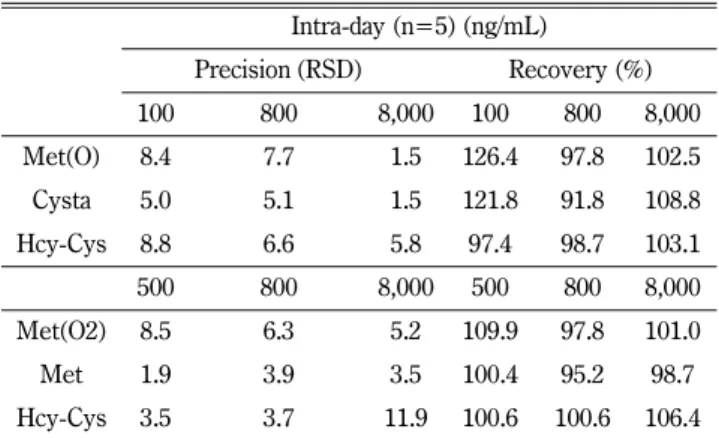
Accuracy of the developed method was presented in Table III and IV which shows an accuracy range from 91-126% for the intra-day assay and 91-125% for the inter-day assay. The precision of the assay based on the relative standard deviation (RSD) at low, medium and high quality control levels was found to be in the range of 1.5-11.9 for the intra-day assay and Fig. 2 − LC-MS/MS chromatogram of TIC. (A) hypermethioninemia plasma, (B) cystathionine, (C) homocysteine, (D) methionine,

(E)methionine sulfoxide, (F) methionine sulfone, (G) homocysteine, and (H) methionine-d

3

.

Table II − Method validation of SAAs with respect to calibration curve, linear range, LOD and LOQ

No Compound Linear range (ng/mL) Equation Coefficient of determination (r

2

) LOD (ng/mL) LOQ (ng/mL)

1 Met(O) 50-10,000 Y=0.0336X + 0.4535 0.9995 1 10

2 Met(O2) 100-10,000 Y=0.0087X - 0.0098 0.9990 50 100

3 Met 100-10,000 Y=0.0731X + 0.0135 0.9989 10 50

4 Cysta 50-10,000 Y=0.0229X - 0.0061 0.9996 1 10

5 Hcy 100-10,000 Y=0.0240X - 0.0389 0.9994 10 50

6 H 50-10,000 Y=0.0635X + 0.0246 0.9998 1 50

(5)

in the range of 1.5-11.9 for the inter-day assay. Recovery was found between 97.4-136.4% during intra-day and 91.6-125.4%

during inter-day assay.

Blank samples were run after analysis of the highest calibra- tion amino acid standard solution. No significant interference peak was observed in the blank water samples.

The stability of the SAA standard solutions was assessed by analyzing three freeze and thaw cycles. RSD between 1.7 and 10.0% was observed. The variations between the sample before freeze-thaw and after freeze-thaw were below 15%.

Furthermore, processed sample stability testing was con- ducted after storing the samples in a vial injection rack at 4

o

C for 24 hrs. RSD between 1 and 9% was obtained and the varia-

tions were below 20% except for homocysteine (21.8%) at 8 μg/mL.

Application to biological sample

The developed method for sulfur amino acids was applied to the normal healthy plasma (20 males and 20 females) and 3 hypermethioninemia patient’s plasma (Table V). Analysis time was significantly shortened to 2 minutes. Total ion chromato- gram of hypermethioninemia plasma is shown in Fig. 2(A).

Methionine was found relatively higher in all three plasma samples (10.10, 34.00, and 18.90 μg/mL) from hypermethionin- emia patients compared to normal. Levels of individual SAAs were determined by normalization to the internal standard and using calibration curves. Quantification result for normal plasma is illustrated in Table V. Student’s t-test was used to compare statistical significance of data (Microsoft excel 2007).

P-value of methionine sulfoxide was 0.5155 (p-value > 0.05, sta- tistically not significant) P-value of methionine was 0.0019 (p- value < 0.05, statistically significant).

Discussion

A simple, rapid, and reliable quantitative method for the analysis of sulfur amino acids in human plasma was devel- oped, validated and implemented using reverse phase column coupled with tandem mass spectrometry. Analysis time could be significantly shortened within 2 minutes compared to any other instrumental analysis such as LC and GC-MS.

Currently available methods for the determination of SAAs have some limitations in terms of complexity, sample process- ing time, run times, or validation parameters assessed. Ultravi- olet detection suffers poor sensitivity and specificity

19)

and electrochemical detection exhibit high oxidation potential.

20, 21)

Our newly developed method overcomes most of the draw- backs of previous report. Excellent selectivity of the method was observed without any interference ion when compared calibration standard with blank, and zero blank. The absence of interference ion in internal standard and blank samples signi- Table III − Intra-day (n=5, µg/mL) accuracy, precision, and recovery

of 6 sulfur amino acids

Intra-day (n=5) (ng/mL)

Precision (RSD) Recovery (%)

100 800 8,000 100 800 8,000

Met(O) 8.4 7.7 1.5 126.4 97.8 102.5

Cysta 5.0 5.1 1.5 121.8 91.8 108.8

Hcy-Cys 8.8 6.6 5.8 97.4 98.7 103.1

500 800 8,000 500 800 8,000

Met(O2) 8.5 6.3 5.2 109.9 97.8 101.0

Met 1.9 3.9 3.5 100.4 95.2 98.7

Hcy-Cys 3.5 3.7 11.9 100.6 100.6 106.4

Table IV − Inter-day (n=10, µg/mL) accuracy, precision, and recovery of 6 sulfur amino acids

Inter-day (n=10) (ng/mL)

Precision (RSD) Recovery (%)

100 800 8,000 100 800 8,000

Met(O) 8.4 3.0 1.5 125.4 94.9 101.2

Cysta 5.1 5.1 1.5 120.4 91.9 106.3

Hcy-Cys 8.1 6.7 5.9 105.2 97.1 101.5

500 800 8,000 500 800 8,000

Met(O2) 8.9 6.4 5.2 104.9 96.6 102.0

Met 1.8 3.8 3.6 103.3 97.6 97.0

Hcy-Cys 3.5 3.7 11.9 98.6 99.5 106.6

Table V − Normal range (ng/mL) of 6 SAAs detected in Korean male (n=20) and female (n=20) plasmas

(ng/mL) Methionine sulfoxide Methionine sulfone Methionine Cysta-thionine Homocysteine Homocystine

Male 125-464 ND 232-480 BLOQ BLOQ ND

Female 148-274 ND 196-418 BLOQ BLOQ ND

N.D.; not detected, BLOQ ; below limit of quantification

(6)

fies the selectivity of the method.

Among 6 sulfur amino acids, methionine sulfoxide and methionine were successfully quantified in normal plasma sam- ples whereas and homocysteine, homocysteine, cystathionine and methionine sulfone were below the quantitation limit (Table II). These compounds are not detected in normal plasma except for specific disease status or metabolic disorder.

Homocysteine is present in different forms: 80-90% as pro- tein bound, 10-20% as homocysteine-cysteine mixed disulfide and homocystine (dimer of homocysteine) and less than 1% as free reduced form. We have not used any reducing agent to convert all homocysteine into free form. The homocysteine in our case is the free form present in plasma excluding protein bound form and mixed disulfide form.

Excessive methionine, homocysteine and its metabolites accumulate in blood and urine in certain diseases like homo- cystinuria. Homocysteine levels in homocystinuria patients range from 50-400 μmol/L. The LOD from our method is sen- sitive enough to detect homocysteine and methionine levels in diseased patients.

Cystathionuria is an autosomal recessive metabolic disorder characterized by deficiency of the cystathionase gamma-lyase (CTH) gene that is involved in the cleavage of cystathionine.

This results in increased cystathionine in plasma and urine.

Espin’os et al. (2010) found the cystathionine levels in three cystathionuric patients to be 1611, 750, and 1916 μmol/L.

1)

Stabler et al. found higher concentration of cystathionine in cobalamin and folate deficient patients. In patient with clini- cally conformed cobalamin deficiency, values for cystathionine ranged from 48.40 ng/mL to 651.45 ng/mL. Stabler also mea- sured cystathionine in folate deficient patients and found in the range from 30.78 ng/mL to 925.86 ng/mL.

22)

Our newly devel- oped method is sensitive enough to measure cystathionine within above ranges.

Until now, there is no report on simultaneous quantification of Met (O), Met (O

2

), Met, Cysta, Hcy, and Hcy-Cys in human plasma published.

Conclusion

We developed a simple, fast, and sensitive analytical method for the quantification of sulfur amino acids and its oxidized forms. Oxidized form of methionine i.e. methionine sulfoxide was successfully determined. This method can also be applied

for the monitoring of another oxidized form of methionine (methionine sulfone) and disulfide form of homocysteine i.e.

homocystine in different disorders where these metabolites are expected to be either increased or decreased.

Collectively, the results suggest that this method could be for a useful tool for rapid screening of patients for SAA-related metabolic disorders (homocystinuria, methionine adenosyl- transferase deficiency, and methionine synthase deficiency) and chronic disease (cardiac infarction) with high sensitivity and rapidity.

Acknowledgement

This study was supported by a research grant 2016 from Duksung Women’s University, Seoul, Korea. I acknowledge Hyunsu Jeong for his assistance of experiment.

Conflict of Interest

The author has no potential conflicts of interest relevant to this article to report.

References

1) Espin´os C, García-Cazorla A, Martínez-Rubio D, Martínez- Martínez E, Vilaseca MA, P´erez-Due˜nas B, Ko ˇ zich V, Palau F, Artuch R Ancient origin of the CTH alelle carrying the c.200C>T (p.T67I) variant in patients with cystathioninuria.

Clin. Genet. 78, 554 (2010).

2) Flower B Homocysteine: overview of biochemistry, molecular biology, and role in disease processes. Semin. Vasc. Med. 5, 77 (2005).

3) Hackam DG, Anand SS Emerging risk factors for atherosclerotic vascular disease . Clin .Card. 290, 932 (2003).

4) Nina AJ, Neil DW Metabolic abnormalities detected in a survey of mentally backward individuals in Northern Ireland. Arch.

Dis. Child 37, 505 (1962).

5) Mashima R, Nakanishi-Ueda T, Yamamotoa Y Simultaneous determination of methionine sulfoxide and methionine in blood plasma using gas chromatography-mass spectrometry. Anal.

Biochem. 313, 28 (2003)

6) Stabler SP, Lindenbaum J, Savage DG, Allen RH Elevation of serum cystathionine levels in patients with cobalamin and folate deficiency. Blood 81, 3404 (1993).

7) Stamler JS, Loscalzo J Capillary zone electrophoretic detection

of biological thiols and their S-nitrosated derivatives. Anal.

(7)

Chem. 64, 779 (1992).

8) Russell J, Rubenstein DL Speciation and Quantitation of Underivatized and Ellman’s Derivatized Biological Thiols and Disulfides by Capillary Electrophoresis. Anal. Biochem. 242, 136 (1996).

9) Jaworska M, Szuli ska G, Wilk M, Tautt J Capillary electrophoretic separation of N-acetylcysteine and its impurities as a method for quality control of pharmaceuticals. J Chromatogr.

A. 853, 479 (1999).

10) Bald E, Glowacki R, Drzewoski J Determination by liquid chromatography of free and total cysteine in human urine in the form of its S-quinolinium derivative. J. Chromatogr. A. 913, 319 (2001).

11) Melnyk S, Pogribna M, Pogribny I, Hine RJ, James SJ A new HPLC method for the simultaneous determination of oxidized and reduced plasma aminothiols using coulometric electrochemical detection. J. Nutr. Biochem. 10, 490 (1999).

12) Wayne A, Kleinman P, John P, Richie J Status of Glutathione and Other Thiols and Disulfides in Human Plasma. Biochem.

Pharmacol. 60, 19 (2000).

13) His TS, Chuang MY Preliminary Study on Reverse Pulse Amperometric Detection in Capillary Electrophoresis for Simultaneous Determination of Cysteine and Cystine. J. Chin Chem. Soc 45, 827 (1998).

14) Briddon A Total plasma homocysteine as part of the routine aminogram by ion-exchange chromatography. Amino Acids 15, 235 (1998).

15) Sigit JI, Hages M, Brensing KA, Frotscher U, Pietrzik K, Bergmann KV, Lutjohann D Total Plasma Homocysteine and

Related Amino Acids in End-Stage Renal Disease (ESRD) Patients Measured by Gas Chromatography-Mass Spectrometry–

Comparison with the Abbott IMx Homocysteine Assay and the HPLC Method. Clin. Chem. Lab. Med. 39, 681 (2005) 16) Svagera Z, Hanzlíkova D, Simek P, Husek P Study of disulfide

reduction and alkyl chloroformate derivatization of plasma sulfur amino acids using gas chromatography–mass spectrometry. Anal.

Bioanal. Chem. 402, 2953 (2012).

17) Johnson JM, Strobel FH, Reed M, Pohl J, Jones DP A rapid LC- FTMS method for analysis of cysteine, cysteine and cysteine/

cysteine steady-stateredox potential in human plasma. Clinica Chimica Acta 396, 43 (2008).

18) Weaving G, Rocks BF, Iversen SA, Titheradge MA Simultaneous quantificatioin of homocysteine, cysteine and methionine in plasma and urine by liquid chromatography-tandem mass spectrometry. Ann. Clin. Biochem. 43, 474 (2006).

19) Camera E, Picardo M Analytical methods to investigate glutathione and related compounds in biological and pathological processes. J. Chromatogr. B 781, 181 (2002).

20) Ducros V, Demuth D, Sauvant M.P, Quillard M, Causse E, Candito M, Read M.H, Drai J, Garcia I, Gerhardt M.F Methods for homocysteine analysis and biological relevance of the results.

J. Chromatogr. B 781, 207 (2002).

21) Pastore A, Federici G, Bertini E, Piemonte F Analysis of glutathione: implication in redox and detoxification. Clinical.

Chimica Acta 333, 19 (2003).

22) Stabler SP, Lindenbaum J, Savage DG, Allen RH Elevation of serum cystathionine levels in patients with cobalamin and folate deficiency. Blood 81, 3404 (1993).

n ó

수치

Fig. 1 − Chemical structures of six sulfur amino acids.
Table II − Method validation of SAAs with respect to calibration curve, linear range, LOD and LOQ
Table IV − Inter-day (n=10, µg/mL) accuracy, precision, and recovery of 6 sulfur amino acids

참조

관련 문서

After first field tests, we expect electric passenger drones or eVTOL aircraft (short for electric vertical take-off and landing) to start providing commercial mobility

1 John Owen, Justification by Faith Alone, in The Works of John Owen, ed. John Bolt, trans. Scott Clark, &#34;Do This and Live: Christ's Active Obedience as the

I=0 for incompressible fluid III=0 for simple shear flow.. limitations

I n the present study, DBD plasma actuator with an electrically floating electrode was designed. The effects of the floating electrode configuration on

Hwa Jung Kim, Bon-Cheol Ku, Jae Kwan Lee “Use of Pyrolyzed Amino Acids as Versatile Dopants for Synthesis of Heteroatoms-doped

for a future of work that does not yet exist, careers that have not yet been invented, an economy that prizes things not yet created, and that puts STEAM into the

 mutual exclusion and complementary  application similar to IR.  sensitive to local environment and

crystal phase Isotropic liquid organic compound. 3 degrees of order 1 degree of order 0 degrees