1서울대학교 의과대학 미생물학교실 및 암연구소, 2의학연구원 감염병연구소, 3서울대학병원 임상의학연구소,
4대한결핵협회 결핵연구원
림해화1, 김희연1, 윤여준1, 박찬근1, 김범준1,2,3, 박영길4, 국윤호1,2,3
Mutations of katG and inhA in MDR M. tuberculosis
Hai Hua Lin, M.D.1, Hee-Youn Kim, M.D.1, Yeo-Jun Yun, M.D.1, Chan Geun Park, M.D.1, Bum-Joon Kim, M.D.1,2,3, Young-Gil Park, M.D.4, Yoon-Hoh Kook, M.D.1,2,3
1Department of Microbiology and Cancer Research Institute, 2Institute of Endemic Diseases, SNUMRC, Seoul National University College of Medicine, and 3Clinical Research Institute, Seoul National University Hospital, Seoul, Korea, 4The Korean Institute of Tuberculosis, The Korean National Tuberculosis Association, Korea
Backgrounds: Mutations of katG and inhA (ORF and promoter) are known to be related to isoniazid (INH) resistance of Mycobacterium tuberculosis. Because reports on these mutations in Korean isolates are limited (i.e. only the frequency of katG codon 463 was evaluated.), we tried to know the kinds of mutations of two genes and their frequencies in INH resistant Korean M. tuberculosis strains.
Methods: PCR was performed to amplify katG (2,223 bp), inhA ORF (-77~897, 975 bp), and inhA promoter (-168~80, 248 bp) from 29 multidrug resistant M. tuberculosis (MDR-TB) DNAs prepared by bead beater-phenol method. Their sequences were determined and analyzed by ABI PRISM 3730 XL Analyzer and MegAlign package program, respectively.
Results: All of the isolates had more than one mutation in katG or inhA gene. Twenty seven (93%) of 29 tested strains had katG mutations, which suggests that katG is a critical gene determining INH resistance of M. tuberculosis. Amino acid substitutions, such as Arg463Leu and Ser315Thr, due to point mutations of the katG were the most frequent (62.1% and 55.2%) mutations. In addition, deletion of the katG gene was frequently observed (17.2%). Analyzed Korean MDR-TB isolates also had variable inhA mutations. Point mutation of inhA promoter region, such as -15 (C→T) was frequently found. Substitution of amino acid (Lsy8Asn) due to point mutation (AAA→AAC) of inhA ORF was found in 1 isolate. Interestingly, 14 point mutated types that were not previously reported were newly found. While four types resulted in amino acid change, the others were silent mutations.
Conclusions: Although it is not clear that the relationship of these newly found mutations with INH resistance, they show marked diversity in Korean MDR-TB strains. It also suggests their feasibility as a molecular target to supplement determining the INH resistance of clinical isolates because of the possible existence of low-level INH resistant strains.
(Tuberc Respir Dis 2007; 63: 128-138)
Key Words: M. tuberculosis, MDR-TB, INH, katG, inhA, Mutation.
Address for correspondence: Yoon-Hoh Kook, M.D., Ph.D.
Department of Microbiology, Seoul National University College of Medicine, Yongon-dong, Chongno-gu, Seoul, 110-799, Korea
Phone: 82-2-740-8306, Fax: 82-2-743-0881 E-mail: [email protected]
Received: Jul. 9. 2007 Accepted: Jul. 26. 2007
서 론
알려진 바로는 전 세계 61억 인구 중 약 20억 명이 결핵균에 이미 감염되어 있고, 매년 전 세계 인구의 약 1%가 새로 결핵균에 감염되어 결핵 감염자군으로 유입되는 상태에 있다고 한다. 또한 이들 감염자 중에
서 매년 7-8백만 명 이상이 신환자로 새롭게 발생하 고, 2백만 명 이상의 환자가 결핵으로 사망한다고 알 려져 있다1. 한국은 현재 17만 명에 이르는 활동성 결 핵 환자가 있고, 해마다 2만 명 이상의 도말양성인 신 환자가 발생하며 사망자도 한 해 3천 명 이상이 발생 하고 있어서, 결핵이 여전히 매우 중요한 보건 문제의 하나로 남아있다2.
Multidrug-resistant Mycobacterium tuberculosis (MDR-TB)는 결핵 치료에 가장 기본적인 약제인 isoniazid(INH)와 rifampin(RFP)을 포함하여 2가지 이상 항결핵제에 내성인 결핵균을 말한다3. 세계적으 로 MDR-TB에 감염된 사람은 5,000만 내외일 것으로 추정하며4, 2002년 보고 된 바로는 2.3% 정도로 추산
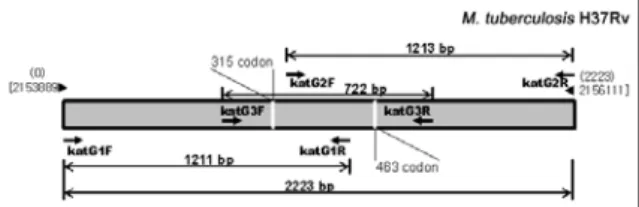
Figure 1. Location of the primers on the katG gene 하였다7. INH 내성은 주로 katG의 특정 부위(47-58%
빈도)와 inhA의 특정 부위(21-24% 빈도)의 변이와 관련 된다고 알려져 있다. M. tuberculosis의 KatG는 KatG 즉, catalase-peroxidase를 부호화하여 비활성 INH를 활성화 INH로 전환시킨다8. Zhang 등은 많은 INH 내성 MDR-TB 분리주들의 catalase 활성이 낮 아졌다는 것을 발견하였으며, 그 중에서 고도 내성 (MIC>50 ug/ml)인 분리주는 catalase 음성, 즉 katG 결실이 있다는 것을 발견하였다9. 이어 katG를 INH에 내성인 M. smegmatis 유전자에 접합시켜 INH 감수 성(8-32 ug/ml)을 얻음으로써 katG가 MDR-TB의 INH 내성과 연관성이 있음을 입증하였다9,10. katG 완 전결실 발생률은 INH 내성 임상 분리주의 20% 이내 이며, 대부분의 INH 내성 임상 분리주는 여전히 katG 를 갖고 있는데 이는 MDR-TB INH 내성 기전 중, katG 완전결실 외에도, 기타 변화가 있다는 것을 의미 하는 것이다. 최근 보고에 의하면, MDR-TB의 INH 내성 원인으로는 katG 점 돌연변이가 완전결실보다 더 흔하며, 그 가운데서 코돈 463(CGG→CTG)의 점 돌연변이가 가장 빈번하다고 한다11,12. 한편, Banerjee 등은 INH의 표적 유전자로서 inhA를 제시하고 inhA 의 Ser94Ala 변이에 의한 INH 내성을 증명한 바 있다
13. 활성화 된 INH의 중요한 표적은 InhA 즉, NADH-dependent enoyl-ACP reductase로서 inhA가 부호화 하며14, inhA open reading frame(ORF)13,15-17 혹은 inhA promoter16-22 변이가 INH 내성과 관련된다 는 것이다. 또한 PCR-SSCP로 INH 내성 결핵균주의 약 78%에서 katG와 inhA의 결실 혹은 점 돌연변이가 발견됨을 확인한 보고도 있었으며23, 기타 산화억제 작용을 하는 환원효소인 alkyl hydroperoxide reductase를 부호화 하는 ahpC24,25, kasA(ketoacyl- ACP synthetase)와 ndh(NADH dehydrogenase) 등 도 INH 내성과 연관이 있다고 발표된 바 있다26,27.
국내에서도 MDR-TB의 INH 내성 관련 유전자에 대한 연구보고가 있었다5,6. 그러나 국내의 높은 결핵 감염률과 항결핵제 내성균 발현율 등 제반 여건을 고 려할 때, 이들 유전자의 다양한 변이가 있을 것으로 예상됨에도 불구하고, 이 보고들은 외국에서 이미 확 인된 유전자의 특정 부위의 변이여부에 대한 연구결
과들이었다. 따라서 본 연구에서는 국내 임상검체로 부터 배양-동정된 다제 내성 결핵균의 katG와 inhA ORF의 전체 염기서열 및 inhA promoter의 부분 염기 서열을 확인하여, 아직도 비교적 높은 항결핵제 내성 률을 보이는 국내 분리 균주들이 갖는 각 유전자 변이 의 다양성과 그 빈도를 분석하고자 하였다.
대상 및 방법 1. 균 주
2004년 1월과 2월 사이에 대한결핵협회 결핵연구원 에서 약제감수성 검사결과, MDR-TB로 판명된(전부 INH 내성균주) 결핵균 29주를 제공받아 사용하였다.
2. 핵산 추출 및 중합효소 연쇄반응
배양균주의 핵산 추출은 bead beater-phenol 추출 법을 이용하였다28. 2.0 ml의 screw-cap microcen- trifuge tube에 각 배양균을 200 ul TEN 완충액(10 mM Tris-HCl, 1 mM EDTA, 100 mM NaCl; pH 8.0) 에 부유시키고 200 ul glass beads(직경, 0.1 mm;
Biospec Products; Bartlesville, Okla)와 200 ul phenol-chloroform-isopropyl alcohol(50:49:1)을 넣어 Mini-Bead Beater(Biospec Products)로 1 분간 진탕 한 후, 13,000 rpm에서 1분간 원심분리 하였다. 상층 액을 깨끗한 새 tube에 옮기고 냉각 에탄올 250 ul와 3M sodium acetate 10 ul를 넣고, -70℃에 10분간 방 치하였다가 13,000 rpm에서 15분간 원심분리 하였다.
DNA 침전물은 70% 에탄올로 세정하고 말린 후, 60 ul TE 완충액(10 mM Tris-HCl, 1 mM EDTA; pH 8.0)에 용해시켜 핵산증폭의 주형으로 이용하였다.
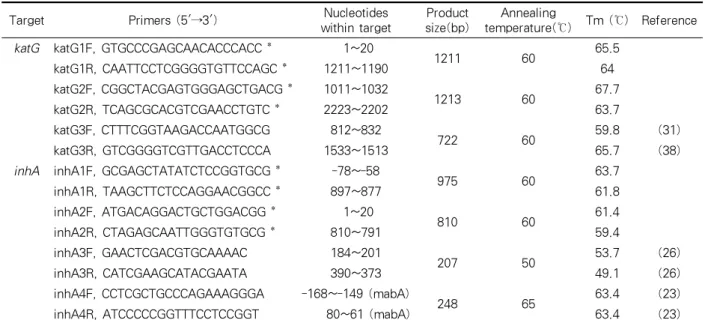
Target Primers (5'→3') Nucleotides within target
Product size(bp)
Annealing
temperature(℃) Tm (℃) Reference katG katG1F, GTGCCCGAGCAACACCCACC * 1~20
1211 60 65.5
katG1R, CAATTCCTCGGGGTGTTCCAGC * 1211~1190 64
katG2F, CGGCTACGAGTGGGAGCTGACG * 1011~1032
1213 60 67.7
katG2R, TCAGCGCACGTCGAACCTGTC * 2223~2202 63.7
katG3F, CTTTCGGTAAGACCAATGGCG 812~832
722 60 59.8 (31)
katG3R, GTCGGGGTCGTTGACCTCCCA 1533~1513 65.7 (38)
inhA inhA1F, GCGAGCTATATCTCCGGTGCG * -78~-58
975 60 63.7
inhA1R, TAAGCTTCTCCAGGAACGGCC * 897~877 61.8
inhA2F, ATGACAGGACTGCTGGACGG * 1~20
810 60 61.4
inhA2R, CTAGAGCAATTGGGTGTGCG * 810~791 59.4
inhA3F, GAACTCGACGTGCAAAAC 184~201
207 50 53.7 (26)
inhA3R, CATCGAAGCATACGAATA 390~373 49.1 (26)
inhA4F, CCTCGCTGCCCAGAAAGGGA -168~-149 (mabA)
248 65 63.4 (23)
inhA4R, ATCCCCCGGTTTCCTCCGGT 80~61 (mabA) 63.4 (23)
*The primer coordinates refer to the positions in the M. tuberculosis H37Rv genome (GenBank accession number, NC 000962).
Table 1. Primers used for the amplification of katG and inhA DNA
Figure 2. Location of the primers on the inhA gene 1) katG 유전자 증폭
① 2,223 bp인 katG를 두 부분으로 나누어 증폭하 였다(Figure 1). 앞부분은 M. tuberculosis H37Rv 염 기서열(GenBank accession number, NC 000962, katG)을 기준으로 1~20번째 염기부위(katG1F)와 1211~1190번째 염기부위(katG1R)를 primer로 사용 하였고, 뒷부분은 1011~1032번째 염기부위(katG2F) 와 2223~2202번째 염기부위(katG2R)를 primer로 사 용하였다(Table 1). 총 20 ul의 반응액에 50 ng 핵산 과 10 pmol의 각 primer(Genotech, Daejeon, Korea) 를 PCR premix(Bioneer, Daejeon, Korea)에 첨가하 여 PCR을 시행하였다(95℃, 5분간 변성; 95℃, 30초;
60℃, 30초; 72℃, 45초; 35회, 최종 신장은 72℃, 5분).
② 증폭산물이 없는 검체는 M. tuberculosis H37Rv 염기서열(GenBank accession number, NC 000962, katG)에 근거하여 812~832번째 염기부위(katG3F)와 1533~1513번째 염기부위 (katG3R)를 primer로 사용 하여 추가 PCR을 수행하여 완전결실 여부를 최종적 으로 확인하였다(Table 1). 총 20 ul의 반응액에 50 ng 핵산과 10 pmol의 각 primer(Genotech, Daejeon, Korea)를 PCR premix(Bioneer, Seoul, Korea)에 첨가 하여 시행하였다(95℃, 5분간 변성; 95℃, 30초; 60℃, 30초; 72℃, 45초; 35회, 최종 신장은 72℃, 5분). 모든
PCR 산물은 1% 아가로즈 젤에서 100 V로 25분간 전 기영동 하여 확인하였다.
2) inhA 유전자 증폭
inhA ORF 전체 부위와 inhA promoter 부분적 부 위를 증폭하였다. inhA ORF를 증폭하기 위하여 유전 자 바깥 부위를 primer를 사용하여 증폭하였고, 이때 증폭되지 않는 검체만 다시 inhA ORF 앞뒤 부분을 참고하여 만든 다른 primer들로 증폭하였다(Figure 2).
(1) inhA ORF 유전자 증폭
① M. tuberculosis H37Rv 염기서열(GenBank accession number, NC 000962, inhA)을 기준으로 -77~-57 번째 염기부위 (inhA1F)와 897~877 번째
21/29 (72.4%)
4/29 (13.8%) 1/29
(3.4%)
1/29 (3.4%) 0/29
(0%) 1/29
(3.4%) 1/29 (3.4%)
katG
inhA ORF
inhA promoter
21/29 (72.4%)
4/29 (13.8%) 1/29
(3.4%)
1/29 (3.4%) 0/29
(0%) 1/29
(3.4%) 1/29 (3.4%)
katG
inhA ORF
inhA promoter
Figure 3. Diagram showing the distribution of mutant strains and their frequencies
염기부위(inhA1R)를 primer로 사용하였다(Table 1).
총 20 ul의 반응액에 50 ng 핵산과 10 pmol의 각 primer(Genotech, Daejeon, Korea)를 PCR premix (Bioneer, Seoul, Korea)에 첨가하여 PCR을 시행하였 다(95℃, 5분 변성; 95℃, 30초; 60℃, 30초; 72℃, 45초;
35회, 최종 신장은 72℃, 5분).
② 상술한 inhA 증폭과정에서 증폭산물이 없었던 검체는 M. tuberculosis H37Rv 염기서열(GenBank accession number, NC 000962, inhA)을 기준으로 1~20번째 염기부위(inhA2F)와 810~791번째 염기부 위 (inhA2R)를 primer로 하는 추가 PCR를 시행하여 위음성 여부를 최종적으로 확인하였다(Table 1). 총 20 ul의 반응액에 50 ng 핵산과 10 pmol의 각 primer (Genotech, Daejeon, Korea)를 PCR premix(Bioneer, Seoul, Korea)에 첨가하여 PCR을 시행하였다(95℃, 5 분 변성; 95℃, 30초; 60℃, 30초; 72℃, 45초; 35회, 최 종 신장은 72℃, 5분).
③ 상술 증폭과정에서 증폭산물이 없었던 검체는 다시 M. tuberculosis H37Rv 염기서열(GenBank accession number, NC 000962, inhA)을 기준으로 184~201번째 염기부위(inhA3F)와 390~373 번째 염 기부위(inhA3R)를 primer로 하는 추가 PCR를 진행 하여 확인하였다(Table 1)25. 총 20 ul의 반응액에 50 ng 핵산과 10 pmol의 각 primer(Genotech, Daejeon, Korea)를 PCR premix(Bioneer, Seoul, Korea)에 첨가 하여 PCR을 시행하였다 (95℃, 5분 변성; 95℃, 30초;
50℃, 30초; 72℃, 45초; 35회, 최종 신장은 72℃, 5분).
(2) inhA promoter 부분적 유전자 증폭
M. tuberculosis H37Rv 염기서열(GenBank acce- ssion number, NC 000962, Rv1482c와 mabA)을 기준 으로 -168~-149번째 염기부위 (inhA4F)와 80~61번 째 염기부위(inhA4R)를 primer로 사용하였다(Table 1)22. 총 20 ul의 반응액에 50 ng 핵산과 10 pmol의 각 primer(Genotech, Daejeon, Korea)를 PCR premix (Bioneer, Seoul, Korea)에 첨가하여 PCR을 시행하였 다(95℃, 5분 변성; 95℃, 30초; 65℃, 30초; 72℃, 45초;
35회, 최종 신장은 72℃, 5분). 모든 PCR 산물은 1.5%
아가로즈 젤에서 100 V로 25 분간 전기영동 하여 확 인하였다.
3. 염기서열 결정 및 분석
PCR 산물은 QIAEX Ⅱ gel extraction kit(Qiagen, Hilden, Germany)를 이용하여 정제하고28 ABI PRISM BigDye™ Terminator Cycle Sequencing Kits(Applied Biosystems)을 이용하여 염기서열을 결정하였다.
PTC-225 Peltier Thermal Cycler(MJ Research)를 사용하여 핵산 증폭 반응을 진행하고, 에탄올을 이용 하여 반응에 사용되지 않은 dNTP와 반응물을 분리해 내었으며, 정제된 PCR 산물은 3차 증류수에 다시 녹 여 ABI PRISM 3730 XL Analyzer로 분석하였다. 염 기서열은 MegAlign package (Windows version 3.12e;
DNASTAR, Madison, Wis.)의 multiple-alignment algorithm을 이용하여 정렬하였으며, GenBank의 M.
tuberculosis 표준균주 염기서열과 비교하여 변이 부 위를 확인하였다28.
결 과 1. 변이 빈도
사용한 모든 MDR-TB 균주들은 분석 표적인 세 유전자들(katG, inhA ORF, 및 inhA promoter) 중에 서 적어도 한 개 유전자 부위에 변이가 있었다. katG
Isolate No.
katG inhA ORF inhA
promoter
katG 1 katG 2 katG 3 inhA 1 inhA 2 inhA 3 inhA 4
1~1211* 1011~2223* 812~1533* -77~-897* 1~810* 184~390* -168~80*
1 + + + +
2 - - - +
3 + + + +
4 + + + +
5 + + + +
6 + + + +
7 + + + +
8 + + + +
9 + + + +
10 + + + +
11 + + + +
12 + + - + +
13 + + + +
14 + + - + +
15 - - + + +
16 + + - + +
17 - - + + +
18 - - - +
19 + + - + +
20 + + - + +
21 + + + +
22 - - - - + +
23 + + + +
24 + + + +
25 - - - + +
26 - - + + +
27 + + + +
28 + + + +
29 - - - + +
*Number of nucleotides in each gene.
Table.2. Results of PCR to amplify katG, inhA ORF, and inhA promoter in Korean multidrug resistant M.
tuberculosis isolates.
의 변이(결실 포함)는 93.1%(27/29)이고, inhA(inhA ORF와 promoter 포함)의 변이(증폭되지 않은 2개 검 체 포함)는 27.6%(8/29)였다. 그 중 katG 변이만 있는 경우는 72.4%(21/29)였으며, inhA 변이만 가진 경우 는 6.9%(2/29)였다. katG와 inhA 두 부위에 모두 변이 가 있는 것은 20.7%(6/29)에 달하였다(Figure 3).
inhA의 경우 ORF와 promoter를 구분하여 보면, 7.1%(2/29)가 katG와 inhA ORF 두 부위에 변이가 있 었고, 17.5%(5/29)가 katG와 inhA promoter 두 부위 에 변이가 있었으며, 그 중 한 주는 세 부위에 전부 변 이가 있음을 알 수 있었다. inhA promoter -15(C→T) 점 돌연 변이가 있는 7개 분리주 중에서 71.4%(5/7)가 katG의 결실이 있거나 아미노산 서열 변이가 있었다
(Table 5).
2. katG 유전자 변이
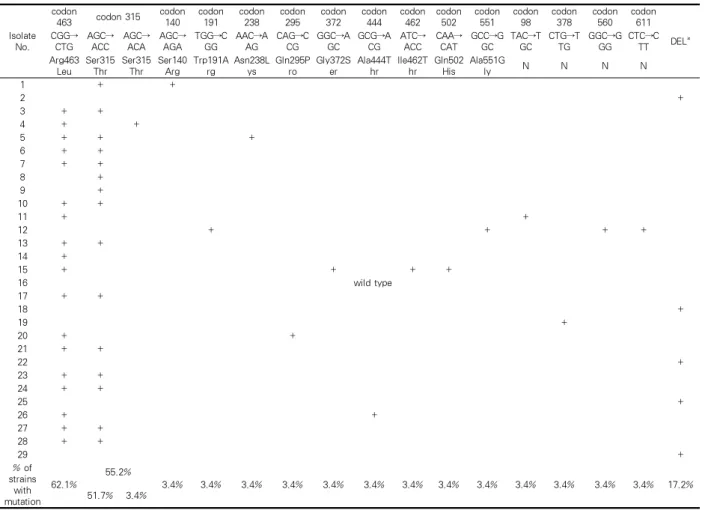
katG PCR(1∼2,223 nucleotide) 결과 실험에 사용 한 M. tuberculosis 29 주 가운데 8주에서는 증폭되지 않았으며, 추가 증폭과정(812~1,533 nucleotide)에 의 해 이들 중 5주 (5/29, 17.2%)는 완전결실임을 확인할 수 있었다(Table 2). 증폭된 24 주 katG 염기서열에서 는 모두 12곳에서 아미노산 변화를 초래하는 여러 돌 연변이들을 확인하였다. 가장 흔한 것은 Arg463Leu 변화를 유발한 CGG→CTG 변이로서 62.1%(18/29)를 차지하였다. 그 다음은, Ser315Thr로 55.2%(16/29)였
Isolate No.
codon
463 codon 315 codon 140
codon 191
codon 238
codon 295
codon 372
codon 444
codon 462
codon 502
codon 551
codon 98
codon 378
codon 560
codon 611 CGG→ DEL*
CTG AGC→
ACC AGC→
ACA AGC→
AGA TGG→C
GG
AAC→A AG
CAG→C CG
GGC→A GC
GCG→A CG
ATC→
ACC CAA→
CAT GCC→G
GC TAC→T
GC CTG→T
TG
GGC→G GG
CTC→C TT Arg463
Leu Ser315
Thr Ser315
Thr Ser140
Arg Trp191A
rg
Asn238L ys
Gln295P ro
Gly372S er
Ala444T hr
Ile462T hr
Gln502 His
Ala551G
ly N N N N
1 + +
2 +
3 + +
4 + +
5 + + +
6 + +
7 + +
8 +
9 +
10 + +
11 + +
12 + + + +
13 + +
14 +
15 + + + +
16 wild type
17 + +
18 +
19 +
20 + +
21 + +
22 +
23 + +
24 + +
25 +
26 + +
27 + +
28 + +
29 +
% of strains
with mutation
62.1%
55.2%
3.4% 3.4% 3.4% 3.4% 3.4% 3.4% 3.4% 3.4% 3.4% 3.4% 3.4% 3.4% 3.4% 17.2%
51.7% 3.4%
*Deletion.
Table 3. The mutations found in the katG of Korean multidrug resistant M. tuberculosis isolates.
는데, AGC→ACC 점 돌연변이는 51.7%(15/29)이고, AGC→ACA 점 돌연변이는 3.4%(1/29)였다. 그 외의 코돈에서 발견된 점 돌연변이들로는 코돈 140(AGC
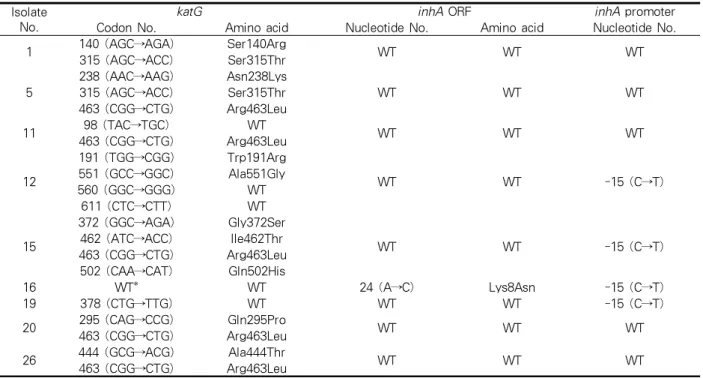
→AGA), 191(TGG→CGG), 238(AAC→AAG), 295 (CAG→CCG), 372(GGC→AGC), 444(GCG→ACG), 462(ATC→ACC), 502(CAA→CAT), 551(GCC→GGC) 등이 있었으며, 이들은 각각 아미노산 변화를 초래하 였다(Table 6). 한편, 코돈 98(TAC→TGC), 378(CTG
→TTG), 560(GGC→GGG), 611(CTC→CTT) 등에서 점 돌연변이가 각각 하나씩 있었지만 이들은 모두 아 미노산 변화가 없는 침묵 돌연변이였다(Table 3).
이 katG 변이들 가운데 아미노산 변이를 초래하는 9개 코돈(140, 191, 238, 295, 372, 444, 462, 502, 551)의 점 돌연변이 및 4개 코돈(98, 378, 560, 611)의 침묵 돌 연변이 등, 13종류의 변이들은 본 연구를 통해 처음
확인된 것들이다.
3. inhA ORF 유전자 변이
inhA 의 ORF(810 bp)를 증폭한 결과, 총 29주 중에 서 8주는 증폭되지 않았다. 이들의 전체 inhA 부위(1
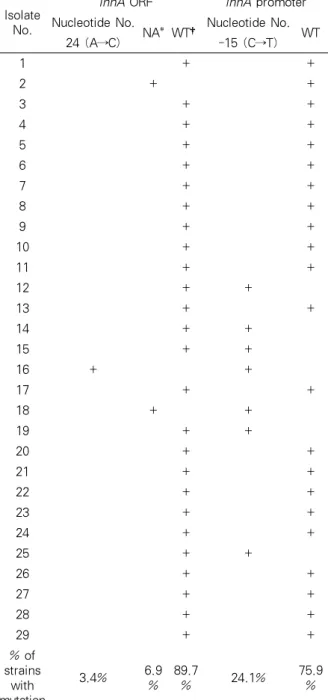
∼810 nucleotide)를 직접 증폭한 결과 6주에서는 증 폭 되었지만 나머지 2주는 역시 증폭되지 않았다. 이 2주는 추가 증폭과정(184∼390 nucleotide)에서도 증 폭산물이 없었다. 증폭된 inhA DNA 염기서열들을 확 인한 결과, 26주(89.7%)는 변이가 없었으나, 1주 (3.4%)는 24(A→C) 변이 즉, 아미노산 서열로는 Lys 8Asn(AAA→AAC) 변화를 나타냈다(Table 4). 이 변 이는 inhA ORF 부위에서 이전에는 보고 된 적 없는 것이다.
Isolate No.
inhA ORF inhA promoter Nucleotide No.
NA* WT†Nucleotide No.
24 (A→C) -15 (C→T) WT
1 + +
2 + +
3 + +
4 + +
5 + +
6 + +
7 + +
8 + +
9 + +
10 + +
11 + +
12 + +
13 + +
14 + +
15 + +
16 + +
17 + +
18 + +
19 + +
20 + +
21 + +
22 + +
23 + +
24 + +
25 + +
26 + +
27 + +
28 + +
29 + +
% of strains
with mutation
3.4% 6.9
% 89.7
% 24.1% 75.9
%
*Not applicable, †Wild type.
Table 4. The mutations found in the inhA of Korean multidrug resistant M. tuberculosis isolates
4. inhA promoter 유전자 변이
inhA promoter 부위를 증폭한 결과 29주 전부 산물 이 있었으며(Table 2), 이 가운데 24.1%(7/29)는 염기 서열 -15 위치 염기의 변이(C→T)가 있었다(Table 4).
고 찰
INH는 1950년대 초부터 항결핵 치료에 사용되기 시작하였으나 얼마 지나지 않아 내성 M. tuber- culosis 균주가 나타났다. INH의 완전한 활성모드와 내성기전은 지금까지 명확히 밝혀지지 않은 상황이지 만 몇 가지 유전자가 관련된 것으로 알려져 있다8-27,29. 이들 중 katG는 catalase-peroxidase를 부호화하여, INH 항결핵 작용기전에서 결정적인 역할을 하고29, 특정 부위의 변이가 다른 부위들보다 빈번하게 나타 나고 있다는 것이 확인된 바 있다19-21,31-34
. 그간 국내 균주들에 대한 INH 내성 관련 유전자 연구 보고가5,6 있었으나, 모두 가장 흔하다는 변이를 확인하는 단계 로 그쳤고 국내 분리 균주에서 볼 수 있는 변이 양상 과 빈도에 대한 결과가 보고된 것은 없어 이에 대한 자료를 얻고자 본 연구를 시행하였다. 그 결과 사용한 균주의 93.1%(27/29)에서 아미노산 서열상에 변이(결 실 포함)가 있음을 확인하였다. 이는 이미 발표된 결 과들보다 현저히 높은 빈도이다. 또한 변이 양상도 상 당히 다양한 것을 확인하였다. 국내 INH 내성 분리균 들도 역시 katG의 Arg463Leu와 Ser315Thr 변이가 가장 흔하게 관찰되었다. 그러나 이들의 빈도는 모두 외국의 보고보다 훨씬(>18%) 높았지만, 국내 타 논문 결과와는 비슷한 수준이었다5,6,36. 한편 katG 완전결실 도 17.2%나 되어 완전결실의 내성 연관성도 무시할 수 없을 것으로 보이며, 또 다른 성과는 katG의 9부위 에서 새로운 변이(Ser140Arg, Trp191Arg, Asn238Lys, Gln295Pro, Gly372Ser, Ala444Thr, Ile462Thr, Gln502 His, Ala551Gly)를 발견한 것이라 할 수 있다(Table 6). 이들은 보고 된 적이 없던 것들이나, INH 내성과 직접 연관되어있는가의 여부는 현재로선 알 수 없고 관련 실험을 추가로 진행하여 확인해야 할 것으로 사 료된다.
INH 내성에 관련된 것으로 알려진 또 다른 유전자 로는 inhA가 있다13-26,28. inhA ORF 변이는 katG와는 달리 특정 부위의 점 돌연변이가 주도적인 역할을 하 는 것이 아니라, 전체 유전자 부위에 걸쳐 임의의 부 위에 나타나며19,20, Ser94Ala 변이에 의한 INH 내성이
Isolate No. Amino acid Nucleotide No.
katG inhA ORF inhA promoter
1 Ser140Arg
WT WT
Ser315Thr
2 DEL* NA‡ WT
3 Ser315Thr
WT WT
Arg463Leu
4 Ser315Thr
WT WT
Arg463Leu
5
Asn238Lys
WT WT
Ser315Thr Arg463Leu
6 Ser315Thr
WT WT
Arg463Leu
7 Ser315Thr
WT WT
Arg463Leu
8 Ser315Thr WT WT
9 Ser315Thr WT WT
10 Ser315Thr
WT WT
Arg463Leu
11 Arg463Leu WT WT
12 Trp191Arg
WT -15 (C→T)
Ala551Gly
13 Ser315Thr
WT WT
Arg463Leu
14 Arg463Leu WT -15 (C→T)
15
Gly372Ser
WT -15 (C→T)
Ile462Thr Arg463Leu Gln502His
16 WT† Lys8Asn -15 (C→T)
17 Ser315Thr
WT WT
Arg463Leu
18 DEL NA -15 (C→T)
19 WT WT -15 (C→T)
20 Gln295Pro
WT WT
Arg463Leu
21 Ser315Thr
WT WT
Arg463Leu
22 DEL WT WT
23 Ser315Thr
WT WT
Arg463Leu
24 Ser315Thr
WT WT
Arg463Leu
25 DEL WT -15 (C→T)
26 Ala444Thr
WT WT
Arg463Leu
27 Ser315Thr
WT WT
Arg463Leu
28 Ser315Thr
WT WT
Arg463Leu
29 DEL WT WT
% of strains with mutation
93.10% 10.30% 24.10%
27.60%
*Deletion, †Wild type, ‡Not applicable.
Table 5. The mutations found in katG, inhA ORF and inhA promoter region in Korean multidrug resistant M. tuberculosis isolates
증명된 바 있다13. 본 연구에서 분석한 국내 균주들 가 운데는 Ser94Ala 변화를 보인 균주는 없었으나 Lsy8Asn의 변이가 3.4%에서 발견되었다. 이 변이와 INH 내성의 확실한 연관성을 설명할 수 없고 inhA ORF 유전자 변이의 우세 변이 유무는 확인할 수 없 었지만, 확실한 것은 6.9%가 inhA ORF의 증폭산물이 아예 없을 정도로 사용한 각 primer 부위에 심각한 염 기서열 변화가 있음을 짐작할 수 있었다. 한편, inhA promoter 부위에서는 -15(C→T) 점 돌연 변이가 24.1%로서 13.5%인 리투아니아35나 4.3%인 스페인36 에 비하여 높았다. 이로서 국내 MDR 균주들의 INH 내성과 inhA promoter -15(C→T) 점 돌연 변이사이 에 밀접한 연관 가능성을 예상해 볼 수 있었다.
또한 사용한 모든 INH 내성 균주가 katG 혹은 inhA promoter 부위에 변이가 있었고, inhA promoter -15(C→T) 점 돌연변이가 있는 8개 분리주 중에서 71.4%(5/7)가 katG 부위의 결실이 있거나 아미노산 서열 변이가 있었던 것으로 미루어보아 INH 내성은 katG 혹은 inhA promoter 부위의 변이와 확실한 연관 성이 있는 듯하며, katG 변이와 inhA promoter 변이 는 동시 발생할 가능성이 높음을 알 수 있다. 그 외, 본 연구에서 새로이 발견한 14 종류의 변이들은 RFP 저 농도 내성균에 드물게 나타나는 rpoB 변이가 존재 하듯이38-41, INH 저 농도 내성균에 존재할 가능성이 있으므로 염기서열 분석에 의한 INH 내성 여부 판단 에 기존 알려진 변이 외에 보조 자료로 사용할 수 있 을 것으로 생각한다.
요 약
연구배경: INH 내성은 katG 와 inhA(ORF와 pro- moter)의 변이에 의한 것으로 알려져 있다. 유전자 변 이는 지역적으로 종류와 빈도가 다르게 나타날 수 있 는데 기존 국내의 연구보고들은 흔하다고 알려진 katG의 463 코돈만을 추적한 것들이었다. 따라서 본 연구는 국내에서 분리된 INH 내성균들의 두 유전자 에서 나타날 수 있는 변이의 종류와 빈도를 확인하고 자 하였다.
연구방법: 대한결핵협회 결핵연구원에서 MDR-
Isolate No.
katG inhA ORF inhA promoter
Codon No. Amino acid Nucleotide No. Amino acid Nucleotide No.
1 140 (AGC→AGA) Ser140Arg
WT WT WT
315 (AGC→ACC) Ser315Thr 5
238 (AAC→AAG) Asn238Lys
WT WT WT
315 (AGC→ACC) Ser315Thr 463 (CGG→CTG) Arg463Leu
11 98 (TAC→TGC) WT
WT WT WT
463 (CGG→CTG) Arg463Leu
12
191 (TGG→CGG) Trp191Arg
WT WT -15 (C→T)
551 (GCC→GGC) Ala551Gly
560 (GGC→GGG) WT
611 (CTC→CTT) WT
15
372 (GGC→AGA) Gly372Ser
WT WT -15 (C→T)
462 (ATC→ACC) Ile462Thr 463 (CGG→CTG) Arg463Leu 502 (CAA→CAT) Gln502His
16 WT* WT 24 (A→C) Lys8Asn -15 (C→T)
19 378 (CTG→TTG) WT WT WT -15 (C→T)
20 295 (CAG→CCG) Gln295Pro
WT WT WT
463 (CGG→CTG) Arg463Leu 26 444 (GCG→ACG) Ala444Thr
WT WT WT
463 (CGG→CTG) Arg463Leu
*Wild type.
Table 6. Mutations newly found in this study
TB로 판명된 INH 내성 결핵균 29주로부터 bead beater-phenol법으로 DNA를 추출하여 katG(2,223 bp), inhA ORF(-77∼897, 975 bp) 및 inhA pro- moter(-168∼80, 248 bp) 염기서열 결정 및 분석은 ABI PRISM 3730 XL Analyzer 및 MegAlign package를 사용하였다.
결 과: 모든 균주들은 분석 표적으로 사용한 세 유 전자 부위 중에서 적어도 한 개 이상의 유전자 부위에 변이가 있었다. INH 내성균은 거의 대부분(>93%) katG의 변이를 갖고 inhA 유전자 변이만 있는 경우는 드물어 INH 내성을 결정하는 중요한 요인은 katG의 변이 인 것을 확인할 수 있었다. katG 부위에서 Arg463Leu 변이와 Ser315Thr 변이가 높은 빈도 (62.1% 및 55.2%)로 발견되었고, katG 완전결실과 inhA promoter-15(C→T) 변이도 일정한 빈도로 나타 남을 볼 수 있었다. 그 외 inhA ORF 변이도 1주에서 1종류의 변이가 발견되었다.
결 론: 기존 연구결과에서는 보고되지 않고 본 연 구에서 처음으로 확인된 변이들도 14 종류나 있어서, INH 내성은 주로 katG 혹은 일부 inhA 특정 부위의 변이가 주도하지만 이들 외에도 다양한 변이가 존재
한다는 것을 알 수 있었다. 이들 새로이 확인된 변이 들은 염기서열 분석에 의한 INH 내성 여부 판단 시, 기존 알려진 변이 외에 보조 자료로 사용할 수 있을 것으로 생각한다.
감사의 글
본 연구는 보건복지부 보건의료기술연구개발사업 의 지원에 의하여 이루어진 것임. (01-PJ10-PG6-01 GM03-0002)
참 고 문 헌
1. Dye C, Scheele S, Dolin P, Pathania V, Raviglione MC. Consensus statement. Global burden of tuber- culosis: estimated incidence, prevalence, and mortality by country. WHO Global Surveillance and Monitoring Project. JAMA 1999;282:677-86.
2. Bai GH. Anti-tuberculosis drug resistance in Korea.
Communicable Diseases Monthly Report 2005;16:
101-7.
3. Crofton J, Chaulet P, Maher D, Grosset J, Harris W, Norman H, et al. Guidelines for the management of
drug-resistant tuberculosis. Geneva: World Health Organization; 1997.
4. World Health Organization. Anti-tuberculosis drug resistance in the world: the WHO/IUATLD global project on antituberculosis drug resistance surveil- lance 1994–1997. Geneva: World Health Organi- zation;1997.
5. Kim SY, Lee JY, Ryu SR, Kim SJ, Bai GH. Rapid diagnosis of isoniazid resistance by detection of mutations in katG and inhA of Mycobacterium tuber- culosis in Korea. J Bacteriol Virol 1997;32:569-76.
6. Park YK, Shim MS, Cho SH, Bai GH, Kim SJ. The relationship between isoniazid resistance and 463 codon mutation of katG gene in Mycobacterium tuberculosis. Tuberc Respir Dis 1996;43:8-13.
7. Dye C, Espinal MA, Watt CJ, Mbiaga C, Williams BG.
Worldwide incidence of multidrug-resistant tuber- culosis. J Infect Dis 2002;185:1197-202.
8. Morlock GP, Metchock B, Sikes D, Crawford JT, Cooksey RC. ethA, inhA, and katG loci of ethio- namide-resistant clinical Mycobacterium tuberculosis isolates. Antimicrob Agents Chemother 2003;47:3799- 805.
9. Zhang Y, Heym B, Allen B, Young D, Cole S. The catalase- peroxidase gene and isoniazid resistance of Mycobacterium tuberculosis. Nature 1992;358:591-3.
10. Heym B, Zhang Y, Poulet S, Young D, Cole ST.
Characterization of the katG gene encoding a catalase-peroxidase required for the isoniazid sus- ceptibility of Mycobacterium tuberculosis. J Bacteriol 1993;175:4255-9.
11. O'Brien KL, Dietz HC, Romagnoli M, Eiden J.
Evaluation of inhA gene and catalase-peroxidase gene among isoniazid-sensitive and resistant Mycobac- terium tuberculosis isolates. Mol Cell Probes 1996;
10:1-6.
12. Lee AS, Tang LL, Lim IH, Ling ML, Tay L, Wong SY.
Lack of clinical significance for the common arginine- to-leucine substitution at codon 463 of the katG gene in isoniazid-resistant Mycobacterium tuberculosis in Singapore. J Infect Dis 1997;176:1125-7.
13. Banerjee A, Dubnau E, Quemard A, Balasubramanian V, Um KS, Wilson T, et al. InhA, a gene encoding a target for isoniazid and ethionamide in Mycobac- terium tuberculosis. Science 1994;263:227- 30.
14. Larsen MH, Vilcheze C, Kremer L, Besra GS, Parsons L, Salfinger M, et al. Overexpression of inhA, but not kasA, confers resistance to isoniazid and ethionamide in Mycobacterium smegmatis, M. bovis BCG and M.
tuberculosis. Mol Microbiol 2002;46:453-66.
15. Basso LA, Zheng R, Musser JM, Jacobs WR, Blanchard JS. Mechanisms of isoniazid resistance in
Mycobacterium tuberculosis: enzymatic characteriza- tion of enoyl reductase mutants identified in isoniazid resistant clinical isolates. J Infect Dis 1998;178:
769-75.
16. Kapur V, Li LL, Hamrick MR, Plikaytis BB, Shinnick TM, Telenti A, et al. Rapid Mycobacterium species assignment and unambiguous identification of muta- tions associated with antimicrobial resistance in Mycobacterium tuberculosis by automated DNA sequencing. Arch Pathol Lab Med 1995;119:131-8.
17. Ristow M, Möhlig M, Rifai M, Schatz H, Feldmann K, Pfeiffer A. New isoniazid/ethionamide resistance gene mutation and screening for multidrug-resistant Myco- bacterium tuberculosis strains. Lancet 1995;346:
502-3.
18. Lee H, Cho SN, Bang HE, Lee JH, Bai GH, Kim SJ, et al. Exclusive mutations related to isoniazid and ethionamide resistance among Mycobacterium tuber- culosis isolates from Korea. Int J Lung Dis 2000;4:
441-7.
19. Morris S, Bai GH, Suffys P, Portillo-Gomez L, Fairchok M, Rouse D. Molecular mechanisms of multiple drug resistance in clinical isolates of Mycobacterium tuberculosis. J Infect Dis 1995;
171:954-60.
20. Musser JM, Kapur V, Williams DL, Kreiswirth BN, van Soolingen D, van Embden JD. Characterization of the catalase-peroxidase gene (katG) and inhA locus in isoniazid-resistant and isoniazid-susceptible strains of Mycobacterium tuberculosis by automated DNA sequencing: restricted array of mutations associated with drug resistance. J Infect Dis 1996;173:196-202.
21. Rouse DA, Li Z, Bai GH, Morris SL. Characterization of the katG and inhA genes of isoniazid-resistant clinical isolates of Mycobacterium tuberculosis. Anti- microb Agents Chemother 1995;39:2472-7.
22. Gonzalez N, Torres MJ, Aznar J, Palomares JC.
Molecular analysis of rifampin and isoniazid resis- tance of Mycobacterium tuberculosis clinical isolates in Seville, Spain. Tuber Lung Dis 1999;79:187-90.
23. Heym B, Honore N, Truffot-Pernot C, Banerjee A, Schurra C, Jacobs WR, et al. Implications of multi-drug resistance for the future short-course chemotherapy of tuberculosis: a molecular study.
Lancet 1994;344:293-8.
24. Rinder H, Thomschke A, Rüsch-Gerdes S, Bretzel G, Feldmann K, Rifai M, et al. Significance of ahpC promoter mutations for the prediction of isoniazid resistance in Mycobacterium tuberculosis. Eur J Clin Microbiol Infect Dis 1998;17:508-11.
25. Silva MS, Senna SG, Ribeiro MO, Valim AR, Telles MA, Kritski A, et al. Mutations in katG, inhA, and
ahpC genes of Brazilian isoniazid-resistant isolates of Mycobacterium tuberculosis. J Clin Microbiol 2003;
41:4471-4.
26. Lee AS, Lim IH, Tang LL, Telenti A, Wong SY.
Contribution of kasA analysis to detection of isoniazid-resistant Mycobacterium tuberculosis in Singapore. Antimicrob Agents Chemother 1999;43:
2087-9.
27. Lee AS, Teo AS, Wong SY. Novel mutations in ndh in isoniazid-resistant Mycobacterium tuberculosis isolates.
Antimicrob Agents Chemother 2001;45:2157-9.
28. Kim BJ, Lee SH, Lyu MA, Kim SJ, Bai GH, Chae GT, et al. Identification of mycobacterial species by comparative sequence analysis of the RNA poly- merase gene (rpoB). J Clin Microbiol 1999;37:1714-20.
29. Shim TS, Yoo CG, Han SK, Shim YS, Kim YW.
Isoniazid resistance and the point mutation of codon 463 of katG gene of Mycobacterium tuberculosis. J Korean Med Sci 1997;12:92-8.
30. Marttila HJ, Soini H, Huovinen P, Viljanen MK. katG mutations in isoniazid-resistant Mycobacterium tuberculosis isolates recovered from Finnish patients.
Antimicrob Agents Chemother 1996;40:2187-9.
31. Altamirano M, Marostenmaki J, Wong A, FitzGerald M, Black WA, Smith JA. Mutations in the catalase- mperoxidase gene from isoniazid resistant Mycobac- terium tuberculosis isolates. J Infect Dis 1994;169:
1162-5.
32. Cockerill FR 3rd, Uhl JR, Temesgen Z, Zhang Y, Stockman L, Roberts GD, et al. Rapid identification of a point mutation of the Mycobacterium tuberculosis catalase-peroxidase (katG) gene associated with isoniazid resistance. J Infect Dis 1995;171:240-5.
33. Heym B, Alzari PM, Honore N, Cole ST. Missense mutations in the catalase-peroxidase gene, katG, are associated with isoniazid resistance in Mycobacterium tuberculosis. Mol Microbiol 1995;15:235-45.
34. Rouse DA, Morris SL. Molecular mechanisms of isoniazid resistance in Mycobacterium tuberculosis and Mycobacterium bovis. Infect Immun 1995;63:
1427-33.
35. Bakonyte D, Baranauskaite A, Cicenaite J, Sosnovs- kaja A, Stakenas P. Molecular characterization of isoniazid-resistant Mycobacterium tuberculosis clinical isolates in Lithuania. Antimicrob Agents Chemother 2003;47:2009-11.
36. Torres MJ, Criado A, Gónzalez N, Palomares JC, Aznar J. Rifampin and isoniazid resistance associated mutations in Mycobacterium tuberculosis clinical isolates in Seville, Spain. Int J Tuberc Lung Dis 2002;6:160-3.
37. Pretorius GS, van Helden PD, Sirgel F, Eisenach KD, Victor TC. Mutations in katG gene sequences in isoniazid-resistant clinical isolates of Mycobacterium tuberculosis are rare. Antimicrob Agents Chemother 1995;39:2276-81.
38. Bobadilla-del-Valle M, Ponce-de-Leon A, Arenas- Huertero C, Vargas-Alarcon G, Kato-Maeda M, Small PM, et al. rpoB gene mutations in rifampin-resistant Mycobacterium tuberculosis identified by polymerase chain reaction single-stranded conformational poly- morphism. Emerg Infect Dis 2001;7:1010-3.
39. Moghazeh SL, Pan X, Arain T, Stover CK, Musser JM, Kreiswirth BN. Comparative antimycobacterial activities of rifampin, rifapentine, and KRM-1648 against a collection of rifampin-resistant Mycobac- terium tuberculosis isolates with known rpoB mutations. Antimicrob Agents Chemother 1996;40:
2655-7.
40. Williams DL, Spring L, Collins L, Miller LP, Heifets LB, Gangadharam PR, et al. Contribution of rpoB mutations to development of rifamycin cross-resis- tance in Mycobacterium tuberculosis. Antimicrob Agents Chemother 1998;42:1853–7.
41. Bodmer T, Zürcher G, Imboden P, Telenti A. Mutation position and type of substitution in the ß-subunit of the RNA polymerase influence in-vitro activity of rifamycins in rifampicin-resistant Mycobacterium tuberculosis. J Antimicrob Chemother 1995;35:345-8.