Journal of Mushrooms
한 국 버 섯 학 회 지70
Research Article
This is an Open-Access article distributed under the terms of the Creative Commons Attribution Non-Commercial License (http://
creativecommons.org/licenses/by-nc/3.0) which permits unrestricted non-commercial use, distribution, and reproduction in any medium, provided the original work is properly cited.
J. Mushrooms 2018 June, 16(2): 70-73 http://dx.doi.org/10.14480/JM.2018.16.2. 70 Print ISSN 1738-0294, Online ISSN 2288-8853
© The Korean Society of Mushroom Science
*Corresponding author E-mail : [email protected]
Tel : +82-31-229-6126, Fax : +82-31-229-6139 Received May 10, 2018
Revised June 15, 2018 Accepted June 27, 2018
느타리버섯 수확후 배지를 이용한 표고 배지 개발
김정한* · 강영주 · 백일선 · 정윤경 · 이용선 · 이영순
경기도농업기술원 버섯연구소
Application of spent oyster mushroom substrate for bag cultivation of Lentinula edodes
Jeong-Han Kim*, Young-Ju Kang, Il-Sun Baek, Yun-Kyeoung Jeoung, Yong-Seon Lee, and Young-Soon Lee
Mushroom Research Institute, Gyeonggi-do Agricultural Research & Extension Services, Gwangju 12805, Korea
ABSTRACT:
To determine the optimum amount of spent oyster mushroom substrate (SOMS) for use in cultivation of Lentinula edodes, the chemical properties of the substrate and culture conditions of Lentinula edodes were investigated. Replacing 20–50%
of a sawdust substrate with SOMS yielded a C/N ratio of 62–76. In case of substrates containing SOMS, the total nitrogen and phenolic contents of were higher, whereas fructose and organic acid contents were lower than those of the control substrate.
Cultivation tests showed that the 3-cycle yield of 20% SOMS treatment was 286.7 g, similar to that of the control, while 50%
SOMS treatment significantly decreased the yield. In conclusion, development of oak mushroom substrate using SOMS would recycle waste products and decrease material costs.
KEYWORDS: Lentinula edodes, Spent oyster mushroom substrate, Sawdust substrate, Yield
서 론
국내 표고 생산량은 2016년 24,014MT이고 생산액은 2,379억원으로 버섯 가운데 단일품목으로는 가장 높다 (Ministry of agriculture, food and rural affairs, 2016). 표 고는 국내시장에서 수요대비 공급이 부족하여 중국으로부 터 종균이 접종된 톱밥배지가 43,904톤이 수입되어 여기 에서 생산된 생버섯의 국내 점유율은 43.9%에 이른다. 따 라서 표고버섯의 자급률을 높이기 위해서는 생산효율 향 상과 기반 확충이 시급한 실정이다.
느타리버섯은 우리나라에서 가장 많이 생산되는 재배버 섯으로 연간 58,784MT 생산되고 있으며 여기에서 발생 된 수확 후 배지는 버섯 생산량의 약2.1배가량 배출된다 고 가정할 때, 연간 약123,446MT 배출되는 것으로 추정 하고 있다. 한편, 느타리버섯 수확후 배지는 톱밥의 비중 이 팽이, 큰느타리버섯에 비해 상대적으로 높아 가축 사 료로 활용되지 못하고 있고, 주로 퇴비 및 유기질 비료의 원료로 사용되어 왔다(Kim et al., 2014). 최근 수확후 배 지는 수요 대비 공급량이 많아 유기질 비료 업체 등에서 수거를 기피하는 바람에 농가의 문제점으로 대두되었다.
Kim et al.(2016)은 느타리버섯 접종 전 배지와 수확후 배 지의 성분분석 결과, 버섯균의 영양생장 과정에서 셀룰로 오스 6.7%, glucan 10.1%, xylan 5.2%, arabinan 1.1%
등 일부가 이용되고, 그 수확후 배지에는 셀룰로오스가 59.7%, 리그닌 21.5%, 단백질 10.4%, 회분 4.7%, 에테르 추출물 0.7% 등의 성분이 있어 활용가치가 있을것으로 판단하였다.
느타리버섯 수확후 배지의 활용을 위한 연구로는 풀버 섯 배지 개발(Lee et al., 2011), 수확후 배지의 재활용 효 과(Cheoung et al., 2012), 가축 사료화를 위한 영양원 연 구(Kim et al., 2011), 바이오매스 활용을 위한 당화 연구 (Kim et al., 2016) 등이 보고되어 있으나 아직까지 수확
71
김정한 · 강영주 · 백일선 · 정윤경 · 이용선 · 이영순
후 배지의 재활용율은 낮은 실정이다. 따라서 본 연구는 느타리버섯 수확후 배지의 표고 톱밥배지로의 개발을 통 해 재활용율을 높이고 아울러 버섯 농가의 소득증대에 기 여하고자 수행하였다.재료 및 방법
시험균주 및 종균제조
본 연구에 사용된 표고 버섯균주는 ‘산조701호’로 Potato Dextrose Agar(PDA) 배지에 증식시키면서, 톱밥배지용 접종원으로 사용하였다. 종균용 톱밥배지의 조성은 참나 무톱밥과 미강을 80:20(v/v)으로 제조하였으며 수분함량 은 60%로 조정하고 121oC에서 90분간 멸균한 후 약30일 간 배양하여 고체종균으로 사용하였다.
배지 및 시험처리
배지재료는 참나무톱밥과 미강을 85:15(v/v)를 기본 배 지조성으로 하고, 여기에 느타리버섯 수확후 배지를 톱밥 첨가량의 20, 25, 30, 50%로 대체하여 첨가하였다(Table 1). 이때 수확후 배지 50% 처리구는 C/N율(60~80)을 고 려하여 미강을 첨가하지 않았다. 수분 함량은 55~60%로 조절하고 내열성 Polypropylene 봉지에 배지를 1.2 kg씩 담아 121oC에서 90분간 살균하였다. 접종은 배지 품온이 15oC 이하로 냉각된 후 고체종균을 이용하여 봉지당 약 10~15 g씩 접종하였다.
배양, 갈변, 버섯발생 및 생육관리
종균 접종이 완료된 배지는 배양실로 옮겨 21±1oC의 온도에서 소량의 환기를 시켜가면서 봉지의 하단까지 균 사가 배양 될 때까지 실시하였다. 배양이 완료된 배지는 20oC의 갈변실로 옮겨 배지에 200lux 이상의 빛을 조사 하여 갈변을 유도하였다. 갈변이 완료되면 생육실로 옮 겨 버섯 발생을 유도하는데 1주기 생육은 배지 자체 수 분을 이용하여 버섯 발생을 유도하였고, 2주기 3주기 생 육은 침수를 통하여 버섯 배지 내부에 수분을 충분히 보 충한 뒤 버섯 발생을 유도하였다. 발생이 이루어진 다음 에 자실체에 직접적인 관수는 피하고 재배사 바닥이 마 르지 않도록 관수하고 환기를 시켜가면서 생육 관리 하 였다.
배지 분석
배지 재료 및 혼합배지의 수분함량은 105oC 건조중량법 으로, pH는 건조 배지재료와 증류수를 1:10의 무게비로 혼합하여 1시간 동안 정치한 후 pH meter(Mettler toledo) 로 측정하였다. 수집된 배지재료들에 대한 성분분석을 위 해 시료를 건조하여 분쇄해서 총탄소는 회화법으로, 총질 소 함량은 단백질 자동분석기(Buchi K-370)를 이용한 Kjeldahl법으로 정량분석하였다. 또한 조지방 함량은 자동 분석기(Behr E6)를 이용하여 Soxhlet법으로 분석하였다.
페놀성 화합물은 Folin-ciocaleau법으로 분석하고, 유기산 은 시료를 0.45 µm membrane filter를 사용하여 여과한 후 HPLC(Agilent 1100 series UV/VIS detector, Folsom, CA, USA)로 분석하였다. 유기산의 분석용 column으로는 Aminex Hpx-87H (Bio-rad, Hercules, CA, USA)를 사용 하였으며 검출파장은 210 nm, 오븐온도는 35oC], 유속은 0.6 mL/min 조건에서 분석하였다.
결과 및 고찰
배지 이화학성 분석
배지 원재료 이화학성 결과는 Table 2와 같다. 참나무톱 밥의 수분함량은 34.2%, 수확후 배지의 수분 함량은 59.8%, 미강은 9.7%로 나타났다. pH는 수확후 배지가 4.67이었고 미강은 6.54로 나타났다. 질소함량은 미강이 2.47%로 가장 높고, 수확후 배지 1.61%로 참나무톱밥 0.11%에 비해 높은 것으로 나타났다.
수확후 배지 첨가량에 따른 혼합배지의 화학적 특성은
Table 2. Chemical properties of experiment materials for substrate formulation
Materials Moisture(%) pH Total carbon(%) Total nitrogen(%) C/N ratio
Oak sawdust 34.2 5.55 54.8 0.11 498.2
Rice bran 9.7 6.54 51.0 2.47 20.6
Spent oyster mushroom substrate(SOMS) 59.8 4.67 52.8 1.61 32.9
Table 1. Substrates formulation with various levels of spent
oyster mushroom substrates(SOMS) as a main material for the production of Lentinula edodes(volume/volume)Treatment
Major substrate ingredients(%)
Nutrient supplement(%)
Oak sawdust
Spent oyster mushroom substrate(SOMS)
Rice bran
SOMS-20% 68.0 17.0 15
SOMS-25% 63.7 21.3 15
SOMS-30% 59.5 25.5 15
SOMS-50% 42.5 42.5 -
Control 85.0 - 15
느타리버섯 수확후 배지를 이용한 표고 배지 개발
72Table 3과 같다. pH는 대조구가 4.5, 수확후 배지 50% 첨 가구 4.8, 20~30% 첨가구는 5.1~5.4로 나타났다. 질소 함 량은 대조구가 0.71%로 수확후 배지 20% 첨가구가 0.72%로 비슷하였으며, 25%, 30% 첨가구는 질소함량이 다소 증가하여 0.86%로 나타났다. 그러나, 50% 첨가구는 질소함량이 0.72%로 증가하지 않았는데, 이는 다른 처리 구와 질소함량을 맞추기 위해 영양원인 미강을 첨가하지 않았기 때문이다. C/N율은 수확후 배지 25, 30% 첨가구 가 62.1~62.8이었으며, 20%는 74.6, 50%와 대조구는 76.0으로 나타났다. Yoon(2003)은 참나무 수종별 톱밥 제 조시 C/N율이 약60~70으로 보고 했는데 본 연구결과는 62.1~76.0으로 나타났다. 페놀성 화합물 함량은 혼합배지 100 g당 대조구가 161.4 mg이었는데, 수확후 배지가 첨가 됨에 따라 다소 증가하였다. 그러나 50% 첨가구는 페놀 성 화합물 함량이 다소 감소하였는데, 이는 미강이 첨가 되지 않은 결과로, Jung et al.(2010)은 미강에는 ferulic acid, p-coumaric acid, sinapic acid, vanillic acid, syringic acid 등의 페놀산이 다량 존재하며 강력한 항산 화기능을 한다고 보고하고 있다. 조지방 함량은 대조구가 4.12 g으로 가장 높고 미강이 첨가되지 않은 수확후 배지 50% 첨가구가 3.02%로 가장 낮았다. 과당 함량은 수확후 배지 첨가량이 첨가할수록 감소하여 50% 첨가구는 8.0 g 까지 낮아졌다.
수확후 배지 첨가에 따른 혼합배지의 유기산 함량은 Table 4와 같다. 유기산 함량은 전반적으로 대조구가 수확 후 배지 첨가구보다 높았다. 수확후 배지 50% 첨가구는
호박산을 제외한 구연산, 사과산, 아세트산이 다른 처리구 에 비해 현저하게 낮았는데 이는 미강과 관계가 있을것으 로 추측된다.
수확후 배지 첨가에 따른 표고버섯 재배적 특성
수확후 배지 첨가에 따른 표고 재배특성은 Table 5와 같다. 배양기간은 처리간의 차이가 없었으나 갈변기간은 수확후 배지 30% 첨가구가 1일, 50% 첨가구가 2일 단축 되었다. 초발이 기간은 20%, 25% 첨가구가 7일로 대조구 와 같았으며, 30% 첨가구는 6일, 50% 첨가구는 11일로 대조에 비해 각각 1일, 4일 지연되었다. 한편, 수확후 배 지 50% 처리구는 1주기 생육기간이 7일로 다른 처리구에 비해 4일 지연되었고, 2주기부터 버섯 발생도 이루어지지 않았다.
Table 3. Chemical properties of various substrate formulations with spent oyster mushroom substrate for the production of Lentinula edodes
Treatment Moisture
(%) pH Total carbon
(%)
Total nitrogen (%)
C/N ratio
Total phenolics (mg/100g)
Crude fat (g/100g)
Fructose (g/100g)
SOMS-20% 56.6 5.1 53.9 0.72 74.6 190.8 3.95 11.2
SOMS-25% 54.2 5.1 53.8 0.86 62.8 230.4 4.00 9.8
SOMS-30% 55.2 5.4 53.6 0.86 62.1 227.0 3.45 9.6
SOMS-50% 59.4 4.8 54.2 0.72 76.0 185.7 3.02 8.0
Control 55.7 4.5 53.8 0.71 76.0 161.4 4.12 12.2
Table 4. Organic acid contents of various substrate
formulations with spent oyster mushroom substrate for the production of Lentinula edodesTreatment Citric acid (mg/100g)
Malic acid (mg/100g)
Succinic acid (mg/100g)
Acetic acid (mg/100g)
SOMS-20% 7.3 104.5 372.7 1022.5
SOMS-25% 12.2 123.3 425.5 1337.7
SOMS-30% 11.6 143.4 371.1 1245.7
SOMS-50% 0.8 50.7 609.8 450.5
Control 24.6 142.8 598.6 1552.5
Table 5. Cultural characteristics of Lentinula edodes on the sawdust substrates with various levels of spent oyster mushroom
substratesTreatment Spawn running (days)
Browning period (days)
Primordia development
(days)
Fruiting body development(days)
1st 2nd 3rd
SOMS-20% 40 45 7 3 4 5
SOMS-25% 40 45 7 3 4 6
SOMS-30% 40 44 6 3 4 6
SOMS-50% 40 43 11 7 - -
Control 40 45 7 3 4 5
73
김정한 · 강영주 · 백일선 · 정윤경 · 이용선 · 이영순
수확후 배지 첨가에 따른 자실체 특성
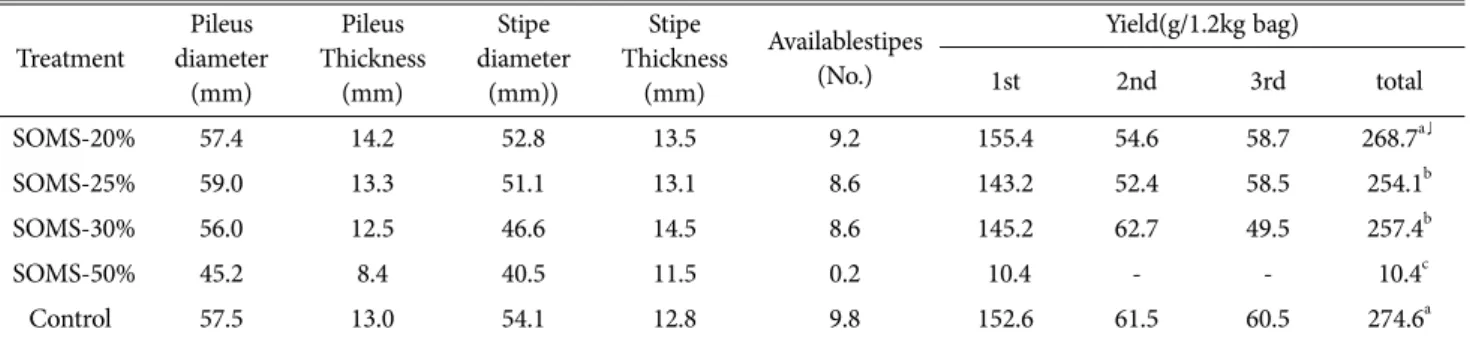
수확후 배지 첨가에 따른 표고 자실체 특성 및 수량을 나타낸 결과는 Table 6과 같다. 수확후 배지 20% 첨가구 의 3주기 수량은 268.7 g으로 대조구의 274.6 g과 유의적 으로 대등하였다. 25% 이상 첨가구부터 대조구에 비해 수량이 낮아졌으며, 50% 첨가구에서는 버섯 발생률이 현 저하게 낮아 봉지당 수량이 10.4 g으로 떨어졌다. 이는 혼 합배지의 분석결과(Table 2~4)에서 나타나듯이 50% 첨가 구에 미강이 첨가되지 않아 버섯균이 필요로 하는 유리당, 유기산 등의 미량 성분이 원활하게 공급되지 않아 버섯 발생이 이루어지지 않았을 것으로 추측된다.
수확후 배지 20% 처리구는 C/N, 페놀성 화합물, 유리 당, 조지방 함량 등의 화학성이 대조구와 가장 유사하였 으며, 이에 따라 버섯 수량도 대조구와 대등하게 나온 것 으로 판단된다.
적 요
느타리버섯 수확후 배지를 이용하여 표고 톱밥배지로 활용하기 위한 연구 수행결과 다음과 같다. 느타리버섯 수확후 배지를 톱밥 첨가량의 20~50%로 4처리로 혼합 하여 분석한 결과 C/N은 62~76으로 나타났다. 느타리버 섯 수확후 배지 첨가구는 대조구에 비해 질소와 폴리페 놀 함량은 상대적으로 높고, 과당과 유기산 함량은 낮은 경향이었다. 특히, 미강이 첨가되지 않은 50% 처리구는 과당, 유기산 함량이 현저하게 낮았다. 초발이기간은 20, 25%가 7일로 대조구와 같았으나 30%와 50%는 각각 6 일, 11일로 대조에 비해 각각 1, 4일 지연되었다. 표고버 섯 3주기 수량은 20% 처리구가 268.7 g으로 대조와 비 슷하였으나 첨가수준이 높을수록 감소하여 특히, 50%
첨가구에서는 버섯 발생이 거의 이루어지지 않았다. 따 라서 느타리버섯 수확후 배지를 표고 배지로 이용하기 위해서는 톱밥 첨가량의 20% 수준이 바람직할 것으로 생각된다.
감사의 글
본 논문은 농림축산식품부의 재원으로 농림수산식품기 술기획평가원의 기술사업화지원사업의 지원을 받아 연구 되었으며(816008-02-2-HD020) 이에 감사드립니다.
References