• 검색 결과가 없습니다.

Performances of Various AGC Algorithms for IEEE802.11p WAVE

N/A
N/A
Protected

Academic year: 2021

Share "Performances of Various AGC Algorithms for IEEE802.11p WAVE"

Copied!
7
0
0

로드 중.... (전체 텍스트 보기)

전체 글

(1)

Seong-Keun Jin , Sang-Hun Yoon , Dae-Kyo Shin

Abstract

This paper has reviewed the performances of various AGCs which can be adopted in IEEE802.11p modems.

IEEE802.11p, a high speed mobile communication standard for vehicles, requires high performance signal detector since the channel impulse responses are varied rapidly in time. In order to select the optimal signal detector, we simulated the performances of three detection methods. One is using RSSI signal, the other is using RSSI signal and I/Q signal, and the third is using I/Q signal through the Monte Carlo simulation. We evaluated the performances of the algorithms using our own system based on MAX 2829 transceiver(MAXIM Integrated

TM

) in a real vehicular environment. As a result, the experiment using Fully I/Q signal derives the most excellent performance with the lowest minimum receiver sensitivity, packet error rate (PER) and false alarm rate (FAR).

Key words: IEEE802.11p, WAVE, AGC, Automatic Gain Control, Detecion

* Korea Electronics Technology Institute

Corresponding author

[email protected], 031-739-7422

※ Acknowledgment

This research was supported by a grant from Construction Technology Innovation Program (CTIP) funded by Ministry of Land, Transportation and Maritime Affairs (MLTM) of Korean government.

(SMART Highway Project, Unit Research 2) Manuscript received Nov. 14, 2014; revised Nov. 21,

I. INTRODUCTION

Intelligent Transportation System (ITS) has been creating new services by combining vehicles and wireless communication technologies. These services can support vehicle safety related applications. These applications can be realized via vehicle-to-vehicle (V2V) communications and vehicle-to-infrastructure (V2I) communications.

Recently, a standard for V2V and V2I communications has been adopted by IEEE, which is commonly referred as Wireless Access in Vehicular Environments (WAVE, IEEE802.11p)[1, 10]. The WAVE specified the standard for ITS in 5.9 GHz band (5.855~5.925GHz), and ETSI ITS and

ISO also follow the most of physical layer/Medium access control layer (PHY/MAC) structure of the WAVE[10].

The WAVE enables high-speed data links up to 27 Mb/s[1]. However, one of the main disadvantages of WAVE is its high peak-to-average-power ratio. The transmitters, therefore, require very linear output amplifiers with wide dynamic range. In addition, multipath is another problem peculiar to mobile communication.

Multipath causes frequency selective distortion in the receive signal. The distortion increases the packet error rate and, therefore, reduces the data rate for communication[11, 12].

Although the vehicular communications can provide various applications, the most important application is a public safety. To guarantee reliable safety related applications, the following requirements have to be satisfied[10]:

Latency: Less than 100 msec Networking: V2V/V2I

Communication: Broadcasting, Unicasting Mobility: Up to 200km/h

Communication range: 1km

Among the above requirements, the latency is the

most critical factor especially in the safety

(2)

Fig. 1. OFDM packet structure application. For short latency, it is necessary to

stabilize the received signal rapidly and precisely.

In wireless communications, the input signal of Radio Frequency (RF) at the front end of the communication module varies with wide dynamic range, and this variation becomes severe especially in high mobility. It is reported that the fluctuation of signal is sharp in vehicular environments. Some properties of 5.9GHz signals have been reported in [2, 3]. To compensate the input signal variation, and maintain reliable communication links, it is necessary to provide stable signals at the input device of the communication module. To satisfy this requirement, it is necessary to implement automatic gain control (AGC) in the communication systems[10]. Several AGC algorithms for wireless local area network (WLAN) and long term evolution (LTE) system are investigated in [4-7, 11], where all of them use receive signal strength indicator (RSSI) signal and analog-to-digital converter (ADC) signal for adjusting the received signal[10, 11, 14].

II. PREVIOUS WORK

The mandatory signal format in the IEEE standard for WAVE is 10 MHz signal bandwidth.

Notice that all time parameters are doubled to adapt high mobility compared with 20MHz Orthogonal Frequency-Division Multiplexing (OFDM) signal in IEEE802.11a. Based on practical measurements, it is reported that 10MHz OFDM signal is suitable for vehicular environments[3]. Fig.

1 represents the packet structure of an OFDM signal[8]. The OFDM signal contains preamble, signal field and data field. The preamble consists of short training and long training sequences. The

short training sequence has 10 repetitive symbol patterns, and these symbol patterns are used for signal detection, AGC, frequency offset estimation and time synchronization. Since there is limited time in short training sequences, signal detection and AGC operation should be stabilized in fast and accurately[10].

1. CONVENTIONAL AGC APPROACH USING RSSI SIGNAL ONLY

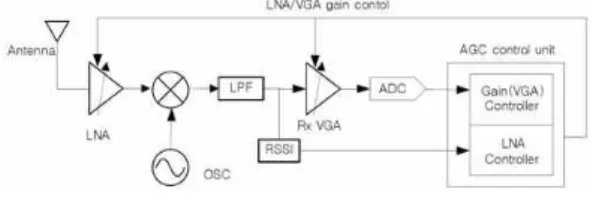
An IEEE802.11 receiver should receive signals whose dynamic range is over 50 dB. To correctly receive these wide dynamic range signals, an A/D converter with large bit width is needed. Because of cost and power dissipation, however, an A/D converter with adequate bits is used in combination with a gain control circuit. To adjust the receiver amplifier’s gain, an analog RSSI circuit is used conventionally as shown in Fig. 2[11].

Fig. 2. Conventional AGC approach using RSSI signal only

One problem of the analog RSSI circuit is that it

does not provide precise outputs. To precisely

(3)

processes. When the receive signal strength is measured twice for antenna diversity selection, AGC and antenna selection should be conducted twice within 5μs. For these reasons, it is necessary to conduct precise AGC within 2μs[11]. In case of WAVE, it is necessary to conduct precise AGC within 4μs.

2. CONVENTIONAL AGC APPROACH USING RSSI AND BASEBAND SIGNAL

Fig. 3. The block diagram of conventional AGC using RSSI and baseband signal

To guarantee stable AGC operating, two signals, i.e., RSSI and ADC signal which samples the analog signal, are used for gain control.

Conventional schemes usually use only one signal to control gain [4-7,9]. However, the ADC requires a long processing time to prevent overflow at the RF front end, and the RSSI may cause resolution problems depending on the measured RSSI range.

To overcome these drawbacks and provide constant signal strength to communication systems, RSSI and ADC, two control signals are used. The AGC control unit adjusts the gain of two devices, i.e., Low Noise Amplifier (LNA) and receiver variable gain amplifier (Rx VGA). The RSSI and ADC signals control the gain of LNA and Rx VGA, respectively. LNA is used for adjusting coarse gain by setting three different levels of gain such as High, Medium, and Low. Whereas, Rx VGA is

III. PROPOSED AGC ALGORITHM

Recently, there are some transceivers[12] which don't support external RSSI signals because of their problems described in Section II.1 and the chip costs. In this paper, we propose a baseband signal based AGC algorithm which can control VGA/LNA within 6.4μs.

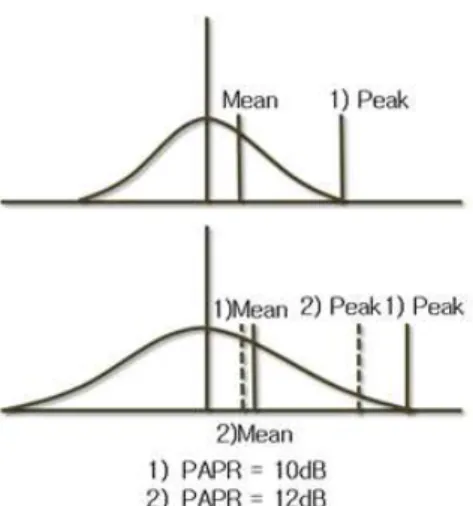
Since the analog-to-digital converted digital samples can be easily saturated when high power signals are received, the received signal power cannot be estimated directly by using the sampled signal. In order to adjust the VGA/LNA within an appropriate time with only sampled baseband signal, we need to estimate the precise received signal power with the saturated digital data. To solve the estimation problem efficiently, we assumed that the OFDM signals are Gaussian distributed. Fig. 4 shows the Gaussian distributed received signals and ADC dynamic. The Peak means the maximum value of ADC dynamic range and the Mean is an average value of the received signals. Although most of the signals are not saturated when the Peak-to-Average Power Ratio (PAPR) is 10dB, the high power signals (PAPR 12dB) can be saturated to the Peak value. In the equation (1), the mp, pp, and mpd is the mean power of the received signal, the peak power, and the mean power of digital signal, respectively.

As we can see in Table 1, the mpd is not the

same as the mp. Fig. 5 shows the real received

signal power, the calculated AD quantized signal

power using real digital samples, and the measured

signal powers according to the equation (2), and

the last two powers are almost same. So we can

estimate the unquantized signal powers by using

the inverse of the equation (2) with the quantized

ones. Fig. 6 shows the state diagram of the

proposed AGC algorithm based on the equation (2).

(4)

Fig. 6. State diagram of the proposed AGC algorithm Figure 4. Gaussian Distributed received signal and ADC

dynamic

Figure 5. Measured and calculated signal power

(5)

PAPR 2.0412 0.2802 -0.9691 -1.9382 -4.9485 RX Power(mp) 100 225 400 625 2500

PeakPower 16 16 16 16 16

Measured

Power(mpd) 12.6417 13.7347 14.2887 14.6217 15.2792

(1)

(2)

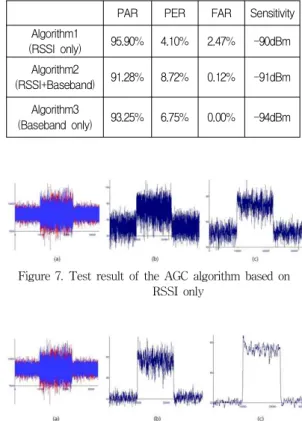
IV. EXPERIMENTAL RESULTS In this paper, three types of AGC algorithms are compared. Fig. 7(a) is a received OFDM baseband signals, and Fig. 7(b, c) is an RSSI signal and a low-pass filtered RSSI signal for RSSI based algorithm. As we can see in Fig. 7, the RSSI signal is not stable and not precise as we commented in Section II.1. Fig. 8(a, b, c) is for the RSSI and the baseband signal based algorithm. Fig.

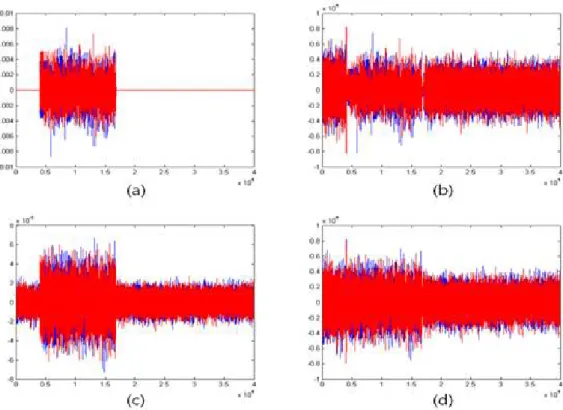
8(a) is a received signal, and Fig. 8(b, c) is a baseband signal power and a low-pass filtered baseband signal power. Fig. 8 shows that baseband signal power is more stable. They also show that the RSSI is not suitable for the precise estimation

transmitted signal at -50dBm and Fig. 9(b) is adjusted received signal. Fig. 9(c) is transmitted signal at -90dBm and Fig. 9(d) is adjusted received signal.

Table 2 shows the performances of three types of AGC algorithms. Those algorithms are implemented on WAVE communication development platform based on FPGA, 14-bit ADC and DAC, and MAX2829 transceiver. The IQ View(Lite Point

TM

) test equipment is used for transmitting WAVE signal.

Table 2. The performances of three types of AGC algorithms

  PAR PER FAR Sensitivity

Algorithm1

(RSSI only) 95.90% 4.10% 2.47% -90dBm Algorithm2

(RSSI+Baseband) 91.28% 8.72% 0.12% -91dBm Algorithm3

(Baseband only) 93.25% 6.75% 0.00% -94dBm

Figure 7. Test result of the AGC algorithm based on RSSI only

Figure 8. Test result of the AGC algorithm based on

RSSI and baseband

(6)

Fig. 9. Test result of the proposed AGC algorithm based on baseband only

References

[1] IEEE Std 802.11pTM-2010, IEEE standard for information technology-telecommunications and information exchange between systems-local and metropolitan area networks-specific requirements, Part 11, Amendment 6: Wireless Access in Vehicular Environments, Jul. 2010.

[2] Acosta-Marum, G. and Ingram, M. A, “Six time-and frequency-selective empirical channel models for vehicular wireless LANs,” IEEE Vehicular Technology Magazine, vol. 2, no. 4, pp.4-11, Dec.

2007.

[3] Cheng, L., Henty, B. E., Cooper, R., Stancil, D. D.

and Bai, F., “A measurement study of time-scaled 802.11a waveforms over the mobile-to-mobile vehicular channel at 5.9GHz,” IEEE Communications Magazine, vol. 46, no. 5, pp.84-91, May 2008.

[4] Lee, Y. S. and Park, Y. O., “BER performance of AGC in high-speed portable internet system,” Proc.

of VTC-Fall, vol. 7, pp.4794-4797, Sep. 2004.

[5] Jang, J. H. and Choi, H. J., “A fast automatic gain control scheme for 3GPP LTE TDD system,”

Proc. of VTC-Fall, pp.1-5, Sep. 2010.

[6] Percls, D., Burg, A., Haene, S., Felber, N. and Fichtner, W., “An automatic gain controller for MIMO-OFDM WLAN systems,” Proc. of European Conference on Circuits and Systems for Communications, pp.246-251, Jul. 2008.

[7] Lee, I., Son, J., Choi, E. and Lee, S., “Fast automatic gain control employing two compensation loop for high throughput MIMO-OFDM receivers,”

Proc. of Int. Symposium on circuits and systems, pp.01-04, May 2006.

[8] IEEE Std 802.11 2007, IEEE standard for information technology-telecommunications and information exchange between systems-local and metropolitan area networks-specific requirements, Part 11, Jun. 2007.

[9] Mileti´c, E., Krsti´c, M., Piz, M. and Methfessel,

(7)

Environments", The journal of the Korea institute of intelligent transport systems, VOL.10, NO.4, pp.100-106.

[11] Toshio, F., Jun, H., Koji, T., Tatsuo, S., Tetsuya, F., Toshitada, S., and Yasuo, U., "A Single-Chip 802.11a MAC/PHY With a 32-b RISC Processor", IEEE JOURNAL OF SOLID-STATE CIRCUITS, VOL. 38, NO. 11., pp2001-2009, Nov.

2003.

[12] "AL5230S 5GHz RF Transceiver", http://www.airoha.com/webe/html/pro/index.aspx?kind

=38&num=50&lv=2.

[13] Shin, Dongyeob, Kim, Chulwoo, Park, Jongsun,

“A Low-complexity Mixed QR Decomposition Architecture for MIMO Detector”, Journal of IKEEE, vol.18, no.1, pp.165-171, 2014

[14] Yun, Gi-Ho, “Tx/Rx Isolation enhancement of the Planar Patch Antenna at 5.8GHz ISM band”, Journal of IKEEE, vol.17, no.3, pp.385-392, 2013

BIOGRAPHY

Seongkeun Jin (Member)

2008 : BS degree in Computer Science Engineering, Hankuk University of Foreign Studies.

2010 : MS degree in Electronic Engineering, Hanyang University.

2010~ : Researcher, Korea Electronics Technology Institute.

Hanyang University.

2012~ : Senior Researcher, Korea Electronics Engineering.

Daegyo Shin (Member)

1998 : BS degree in Electronic Engineering, Ajou University 2000 : MS degree in Electronic Engineering, Ajou University 2000~2003 : Research Engineer, eMDT

2003~ : Managerial Researcher,

KETI

수치

Fig. 1. OFDM packet structure application. For short latency, it is necessary to
Fig. 3. The block diagram of conventional AGC using RSSI and baseband signal
Fig. 6. State diagram of the proposed AGC algorithmFigure 4. Gaussian Distributed received signal and ADC
Figure 7. Test result of the AGC algorithm based on RSSI only
+2

참조

관련 문서

According to the results of this study, the biggest visual effect that can be achieved by introducing a fusion collage technique using various media into

If the desired part of the molding material can be heated to a desired degree by using the high frequency induction heating device, it will contribute

The power plant industries are manufacturing the main pressure item using the small tubes is intended to supply the high speed GTAW process conditions by testing and

‘the special law for digital switchover’ states that is the general planning for vitalization of digital switchover, the program schedule of digital broadcast

It is used when a movement or an event of the following clause has to be done before the movement or the event of the preceding clause.. The tense marker cannot be used

 Euler buckling strength of long column cannot be improved by higher- strength material since it is due to the instability of the column as a whole.  For a column

 Digital 정보를 Analog 신호로 변조하여 전송함..

S국은 국내법에 따라 과세할 권리를 기지고 있 지 않기 때문에 , 그리고 조세조약에 따라 소득이 귀속될 S국에 있는 Tco가 S국에 고정사업장을 가지고 있지