• 검색 결과가 없습니다.

Implementation of Wireless Power Transfer Circuit by Using Magnetic Resonant Coupling Method

N/A
N/A
Protected

Academic year: 2021

Share "Implementation of Wireless Power Transfer Circuit by Using Magnetic Resonant Coupling Method"

Copied!
4
0
0

로드 중.... (전체 텍스트 보기)

전체 글

(1)

(306)

Implementation of Wireless Power Transfer Circuit by Using Magnetic Resonant Coupling Method

Young-Hwan Lho

*

Abstract

Wireless charging is a technology of transmitting power through an air gap to an electrical load for the purpose of energy dissemination. Compared to traditional charging with code, wireless power charging has many benefits of avoiding the hassle from connecting cables, rendering the design and fabrication of much smaller devices without the attachment of batteries, providing flexibility for devices, and enhancing energy efficiency, etc. A transmitting coil and a receiving coil for inductive coupling or magnetic resonant coupling methods are available for the near field techniques, but are not for the far field one. In this paper, the wireless power transfer (WPT) circuit by using magnetic resonant coupling method with a resonant frequency of 13.45 Mhz for the low power system is implemented to measure the power transmission efficiency in terms of mutual distance and omnidirectional angles of receiver.

Key words:power transmission efficiency, magnetic resonant coupling, inductive coupling, wireless power transfer, wearable device

* Dept. of Railroad Electrical System Engineering, Woosong University

★ Corresponding author

E-mail:[email protected], Tel:+82-42-629-6731

※ Acknowledgment: This research is based on the support of 2019 Woosong University Academic Research Funding . Manuscript received Mar. 4, 2019; revised Mar. 21, 2019; accepted Mar. 22, 2019.

This is an Open-Access article distributed under the terms of the Creative Commons Attribution Non-Commercial License (http://creativecommons.org/licenses/by-nc/3.0) which permits unrestricted non-commercial use, distribution, and reproduction in any medium, provided the original work is properly cited.

Ⅰ. Introduction

Wireless power transfer (WPT) [1, 2] has induced researchers to pay attention to the applications for portable electronic devices and electric vehicle.

Nikola Tesla [3] first introduced the concept of WPT more than 1 century ago. Transmission methods depend on mutual distances between transmitter and receiver. Compared to inductive coupling method applicable for near field distance, magnetic resonant coupling one is suitable for mid-range distance and microwave is for a long distance.

Magnetic resonant coupling technology was first studied Kurs [4] at the Massachusetts Institute of Technology (MIT). The transmission efficiency

of magnetic resonant coupling method can only be obtained when the angle of the receiver is normal to one of transmitter in the same axis.

The advantage is that the receiver can be freely located toward the direction of transmitter, having relatively low transmission efficiency.

Recently, researchers have concentrated much efforts to achieve the development of a three dimensional magnetic resonant coupling technology.

In this research, the transmission efficiency is measured and compared after the implementation of the hardware. One case for the receiver with 4 Schottky diodes is orthogonally to the transmitter at the direction of a two dimensional X-Y plane and another for the receiver is changed at the ISSN:1226-7244 (Print)

ISSN:2288-243X (Online) j.inst.Korean.electr.electron.eng.Vol.23,No.1,306∼309,March 2019

논문번호 19-01-44 http://dx.doi.org/10.7471/ikeee.2019.23.1.306

306

(2)

Implementation of Wireless Power Transfer Circuit by Using Magnetic Resonant Coupling Method 307

(307) angle 0

o

to 315

o

by 45

o

difference to the transmitter.

Ⅱ. Design of Magnetic Resonant Coupling Circuit

The structure of magnetic resonant circuit has the additional resonant coil with capacitor to the original inductive one as shown in Fig. 1 [5].

Fig. 1. A scheme for magnetic resonant coupling circuit.

In Fig. 2, there are four coils of magnetic resonant circuit in wireless power transmission system. The regulator of LM7805 at the input terminal generates the constant output of 5 V, the capacitor is attached to the input and the output to prevent abrupt power consumption, the oscillator of LTC1799 is operated in the range of 2.7 V to 5.5 V, and the output is applied to the gate terminal of MOSFET.

Fig. 2. The circuit for magnetic resonant coupling board.

The coupling coefficient is computed by two inductances of corresponding inductors and mutual inductance between two coils as eq. (1).

(1)

where the value of kxy is ranged from 0 to 1.

The voltage across each terminal and current flowing at each node are shown in Fig. 3, which are met with the theoretical aspects.

Fig. 3. The voltage and current at each node for magnetic resonant coupling circuit.

The power transmission efficiency of S

21

is obtained as eq. (2).

(2)

where V

L

represents the load voltage, V

S

the source voltage, R

S

the source resistance, and R

L

the load resistance, respectively.

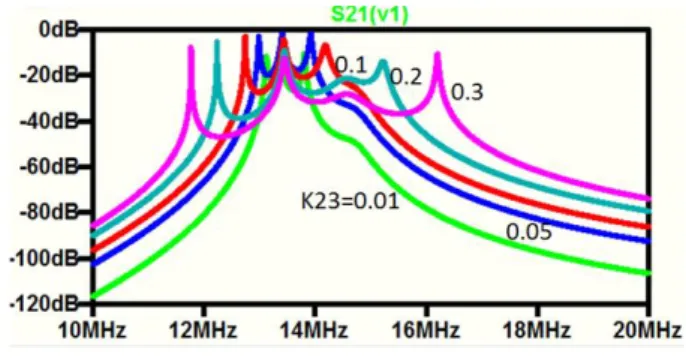
As simulated in Fig. 4, the split occurs for the coupling coefficient with greater than 0.01.

Fig. 4. Transmission parameter S

21

vs. freqeuncy and coupling coefficent of k.

The magnitude of transmission efficiency depends on the coupling coefficient of k

23

and the frequency.

The mutual inductance decreases as the distance increases.

The power transmission efficiency [6] using

(3)

308 j.inst.Korean.electr.electron.eng.Vol.23,No.1,306∼309,March 2019

(308) the S-parameters is acquired by eq. (3).

η      





 



×  (3)

Ⅲ. Implementation

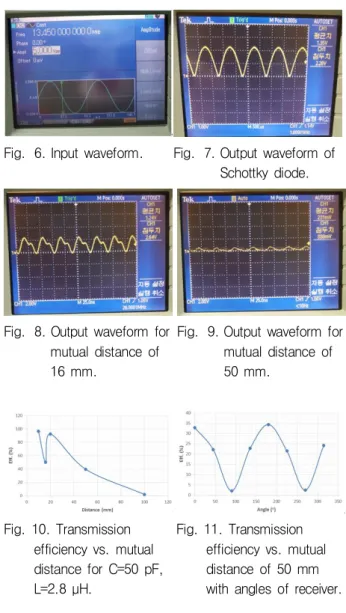
The source voltage of 5 V and 1.4 V in the transmission part is applied and transmitted to the receiving part after passing through the resonant circuit located in the left bottom as shown in Fig. 2 and the circuit is implemented as Fig. 5. The output waveform for the input sine curve of Fig. 6 is shown in the right upper monitor after flowing 4 Schottky diodes, which generate the full waveform in Fig. 7. In resonant circuit with capacitance of 50 pF and inductance of 2.8 uH, the resonant frequency of 13.45 Mhz is made and the power transmission efficiency is measured as shown in Fig. 8 and 9. The output average voltages of for mutual distances of 16 mm and 50 mm are 1.24 V and 231 mV, respectively.

In Fig. 10, the efficiency generally decreases as the mutual distance increases up to 100 mm except the split occurs due to strongly coupled.

Here, the split occurs at the distance of 16 mm and the maximum efficiency is reached to 92.5%

at the mutual distance of 20 mm. In Fig. 11, the transmission efficiency has the same value at 45

o

, 135

o

, 225

o

, and 315

o

, the minimum at 90

o

and 270

o

, and the maximum at 0

o

and 180

o

, which are consistent with the theory.

Fig. 5. The implementation of transmitting, resonant and receiving part with resonant frequency of 13.45 Mhz.

Fig. 6. Input waveform. Fig. 7. Output waveform of Schottky diode.

Fig. 8. Output waveform for mutual distance of 16 mm.

Fig. 9. Output waveform for mutual distance of 50 mm.

Fig. 10. Transmission efficiency vs. mutual distance for C=50 pF, L=2.8 µH.

Fig. 11. Transmission efficiency vs. mutual distance of 50 mm with angles of receiver.

Ⅳ. Conclusions

The WPT circuit is successfully designed, and the relationship between the coupling coefficient and the power transmission efficiencies at different angles are analyzed. The hardware implementation for applying WPT system in real time is successfully accomplished.

References

[1] Homepage of Wireless Power Consortium, http://www.wirelesspowerconsortium.com.

[2] W. C. Brown, “The history of power transmission

by radio waves,” IEEE Transaction on Microwave

Theory and Techniques, vol. 32, no, 9, pp. 1230-

242, 1984. DOI: 10.1109/TMTT.1984.1132833

(4)

Implementation of Wireless Power Transfer Circuit by Using Magnetic Resonant Coupling Method 309

(309) [3] N. Tesla, “Apparatus for transmitting electrical energy,” U.S. patent, 1914

[4] A. Kurs, A. Karalis, et. al. “Wireless power transfer via strongly coupled magnetic resonances,”

Science, vol. 317, no. 5834, pp. 83-86, 2007.

DOI: 10.1126/science.1143254

[5] Junfeng Chen et al, “Metamaterial- Based High-Efficiency Wireless Power Transfer System at 13.56 MHz for Low Power Applications,”

Progress In Electromagnetics Research B, Vol.

72, 17-30, 2017. DOI: 10.2528/PIERB16071509 [6] Donggeon Kim and Chulhun Seo, “Omnidirectional Resonator in X-Y Plane Using a Crisscross Structure for Wireless Power Transfer,” Journal of Electromagnetic Engineering and Science, vol.

15, no. 3, pp. 194-198, 2015.

DOI: 10.5515/JKIEES.2015.15.3.194

수치

Fig. 3. The  voltage  and  current  at  each  node  for  magnetic  resonant  coupling  circuit.
Fig. 5. The implementation  of  transmitting,  resonant  and  receiving part with resonant frequency of 13.45 Mhz.

참조

관련 문서

Key words : multi-resonant-circuit, resonant frequency, series circuit type, half-bridge, DC-DC power conversion.. * Department of Electronic Information Engineering,

The proposed multi-mode WPT system consist of outer loop module which can operate at two different frequency bands including 6.78 MHz magnetic resonance WPT mode and 13.56

Soljacic, "Wireless power transfer via strongly coupled magnetic resonances", Science express, Vol.. Wheeler, “Simple Inductance Formulas For Radio

The current wireless power charge technologies are based on induction coupling, magnetic resonant coupling, electromagnetic wave, etc.. However, the current wireless

Keywords : inductive coupling method, wireless power transfer, loading distribution method, current density, finite

[5] Masaki Kato, Takehiro Imura, Yoichi Hori, "Study on Maximize Efficiency by Secondary Side Control Using DC-DC Converter in Wireless Power Transfer via Magnetic

In this paper, the single port dual-band resonator for magnetic resonance wireless power transfer is proposed.. The two sides of the matching circuit are

In this paper, we propose enhanced wireless power transfer system based on magnetic resonance for portable electronic device charging.. Resonators were designed