A Study on Change of Pleats Shape and Fabric Properties:
Interactive Shape-folding E-textile with ArduinoLee Euna ∙ Kim Jongjun+
Dept. of Clothing and Textiles, Ewha Womans University
Abstract
The aim of this study is to create smart wear that brings out the perspective person’s individuality and creativity wearing these garments through various interactions. It is intended to build a prototype for a "Shape-folding Dress", which is length-adjustable skirt that responses with the environment of the wearer. In this process, four basic physical properties can be identified with fabric samples selected which are relatively stiff, including fusible interlining, organdy, silk, and ramie. In addition, two types of folding pattern specimens, "Basic Pattern" and "Diamond Pattern", and heat-steam were used to make the specimens so that the correlation could be calculated by recovery rate among flexing, stiffness and tensile properties. As a result, compared to other fabrics, the silk showed low stress to repeat folding and unfolding process, and its recovery rate of elongation deformation was stable without being affected by the different folding types and twice repeated process. In this study, forming a circuit using an Arduino, illuminance sensor, motors, and pulley, the prototype was created with a silk fabric.
Key words : Arduino, recovery rate, Shape-folding, stiffness, tensile properties
I. Introduction
Thanks to today’s rapid exchange of information and the development of technology and materials, the boundary of each area has become unclear and mutually influential (Choi, Kim, & Song, 2012; Kim & Kim, 2013; Ko &
Kim, 2013; Lee & Kim, 2011). Smart textiles,
Corresponding author: Kim Jongjun, Tel. +82-2-3277-3102, Fax. +82-2-3277-3079 E-mail: [email protected]
This research was presented at the 2013 Fall Conference of The Korean Society of Fashion Business.
especially wearable electronics, have become a dominant trend in future textile development, and a growing number of designers and researchers have been delving into electric textiles (Buechley
& Eisenberg, 2009). There has been some discussion on how these materials could be used to create foldable items of clothing (Perovich, Mothersill, & Farah, 2014; Seymour,
2009). But there has been little discussion on how the subsequent interactions might influence user performance and preference. Interaction is, by necessity, a field with interdisciplinary concerns, since its essence is interaction that includes people, machines, computers, and a diverse array of objects and behaviors (Hallnäs
& Redström, 2006).
The kinds of materials people are willing to wear is important to the interactive design.
Having this in mind, the design should focus on identifying users’ needs as well as designing usable, useful, and enjoyable. For example, creating an interactive tight skirt that could change to fit comfortably when it inhibits the ability to walk properly. Folding technique as an art form deformation is folded without stretching, tearing, or cutting and could be built from a 3-D structure or a 2-D structure. Various folding techniques can be found in many fields, such as industrial design, architecture, interior design, textile industry, and fashion (McCarty &
McQuaid, 1998). Furthermore, a range folding techniques has been extended to e-textile due to its useful characteristics (Singh et al., 2012).
The aim of this study is to interact with its wearers, to create a dress with adjustable length that is both aesthetic and functional as part of our vision of future design for transformable clothing. In that sense, the experiment in this study is to produce the prototype of the e-textile by investigating the various folding patterns. The experiment also allows observers to examine the basic characteristics and physical properties of the fabric and the behavior changes during fold deformation and the recovery process as well as to identify the correlations between stiffness and recovery rate.
In general, material that is flat and stiff similar to paper is usually more effective in the folding
technique. Thus, this study selects the fabrics that have relatively stiff characteristics of materials similar to paper.
The pleats finishing process employs either a special chemical treatment or heat-setting method commonly used in the fashion industry.
The fabric becomes soft when the heat is applied to it and then eventually becomes hardened and fixed after the heat cools down.
This method is used to create a thermoplastic object. Polyester has such qualities which makes it a great thermoplastic (Kim & Choi, 2007). In addition, it has unique resilience, providing good pleats retention and crease recovery. On the contrary, ramie and silk can be treated with chemical modification, post-processing, as well as change of crosslink in order to achieve dimensional stability or to alter surface properties. This is due to their low wrinkle recovery. Also, ramie has adequate stiffness and coolness properties (Kang & Kwon, 2010).
Therefore, the selected fabric samples in this study were based on their characteristics of stiffness, including fusible interlining, organdy, silk, and ramie.
Apart from the properties of the fabric, the physical factors such as weight and thickness, also influenced the fold. When folding lightweight fabric versus a more heavier fabric, its crease would look different. The thick fabrics are, by their nature, less susceptible to creasing than thin fabrics even when the angle of the fold is the same (Hu, 2004). That is, thick and heavy fabric will create fewer creases and recover easier. However, it must not be overlooked that these results would be changed when steam-pressing is introduced. Thus, polyester organza (a relatively thin and light weight type) and fusible interlining that is made of polyester-cotton blend (a thick and heavy
weight type) was added to the fabric sample in order to obtain various types of fabric samples with different weight and thickness in this study.
As a result, this study selected four types of fabric samples depending on properties and weight after investigation.
This study selected properly designed fold technique pattern to build the prototype of the length-changing dress. The folding patterns have two types: (1) "Basic Pattern", which is the most basic structure of folding, and (2) "Diamond Pattern", which considers the human body curve and dress shape such as an arch. Therefore, four types of different fabrics with two sets of folds applied to each fabric allows for a total of eight fabric samples in this experiment. This process analyzes the dimensions, stress-strain deformation behavior, and recovery factors according to the various properties of fabrics when folding and unfolding processes occur. These results would establish a baseline by which this prototype will be developed.
The prototype for adjustable-length dress has the fabric-folding process starts at the front of the dress. Usually the dress remains long, but it is designed to be shorten the length of the dress when the wearer’s surrounding becomes dark, as a motor spins the pulley. This can be all controlled with the use of an illumination sensor, the pulley, and Arduino controller.
This study uses the term "Shape-folding" dress as this research conceptualizes the relation of folding technique and e-textile. This
"Shape-folding" is a new type of fabric that will show the process of creating an interactive wearable computer combining the folding technique and electronic technology. This study will act as a bridge between art aesthetics, fashionable technologies, and informative material properties, and the effort will be a small first step
from static dynamic fashion to dynamic interactive fashion.
II. Review of the Previous Works
1. Pleats
Numerous studies have been published treating various aspects of the recovery of fabrics from imposed stiffness (Prevorsek, Butler, & Lamb, 1975). These studies utilized the constituent yarns and single filaments to identify the responses of the fabrics. However, this study method is not about the fundamental fabric or fiber mechanics but about the testing of folding. Regarding the studies of pleats testing, there are studies that looked into embedding and sectioning techniques developed to examine deformations of fabrics and illustrated their application, the examination of the effects of pleats, treatment and washing procedures (Holdaway, 1960; Katz, 1966). However, that has been studied in wool fabric. On the other hand, the silk is studied for pleating focusing on aesthetic and permanent pleats (Kearney, 1992;
Sparks, 2004). Polyester reveals unique resilience which gives excellent pleats retention and wrinkle recovery. On the contrary ramie and silk can be treated with chemical modification, post-processing as well as change of crosslink in order to alter surface properties or obtain dimensional stability.
This is due to low wrinkle recovery. Also ramie has adequate stiffness and coolness properties (Kim & Csiszár, 2005).
2. Folding Technique in Fashion
A folding technique is an art culture with over a thousand years of history. It has never been out of season as there are lots of enthusiasts who
are willing to contribute their time and effort for making new design with folding technique concepts. The various techniques used in the art of paper folding could be built from a 3-D structure or a 2-D structure. The properties of final folding technique structures depends on the material and the fabrics used. Therefore, to achieve the desired functionality of final folding technique structure, a careful utilization of folding pattern properties as well as the creation process is needed. The initial stages of research on the folding technique in fashion has been about the application of the art (McCarty &
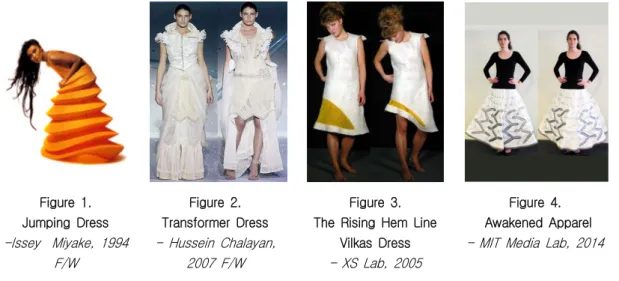
McQuaid, 1998). Issey Miyake is a leading fashion designer attempting to use pleats folding with different materials concerning formativeness and functionality (Figure 1).
3. Dress with Shape-folding
Hussein Chalayan is a high-end clothing transformer designer. He uses embedded technology to enhance the aesthetics of clothing and to challenge the idea of clothing as a static artifact. He performed a simple application of
Figure 1.
Jumping Dress -Issey Miyake, 1994
F/W
Figure 2.
Transformer Dress - Hussein Chalayan,
2007 F/W
Figure 3.
The Rising Hem Line Vilkas Dress – XS Lab, 2005
Figure 4.
Awakened Apparel – MIT Media Lab, 2014 the folding technique’s structural characteristics.
Figure 2 shows his Transformer Dress. The dress begins to twitch, and reconfigure. The long Victorian dress hemline contracts into a flapper style dress.
Figure 3 shows the Vilkas, a dress with a kinetic hemline that rises on the right side at an interval of 30 seconds to reveal the knee and lower thigh. It is constructed of two contrasting elements:
a heavy hand-made felt and light yellow cotton.
The hand-stitched Nitinol wires were used here as well. Once heated, the Nitinol easily pulls the cloth together, creating a wrinkling effect. This movement is slowly countered by gravity and the weight of the felt (Seymour, 2009).
Recently, MIT Media Lab developed a skirt called Awakened Apparel with fully embedded, pneumatically folding, shape-changing elements which is an early example of transformable fashion (Perovich et al., 2014). The skirt embeds soft actuators folding technique, incorporated with heat-fused laminated Mylar channels. Pneumatic actuation operates through a foot-pump and depends on manual intervention by the user (Figure 4).
Ⅲ. Method and Procedure
1. Selection Process of Fold Patterns
In this study, a "Basic Pattern" was selected to investigate the characteristics of fold. In general, "Basic Pattern" pleats uses vertical direction to crease which is done according to the design of clothing. However, here we designed it parallel to the weft and crease line to make it easier to use since the ultimate goal is to build the prototype of shape changing fold through the contraction of the fold. All things considered, the "Diamond Pattern’s" arch shape, which wraps around human body, was selected for the second type of fold pattern.
1) Basic Pattern Specimen
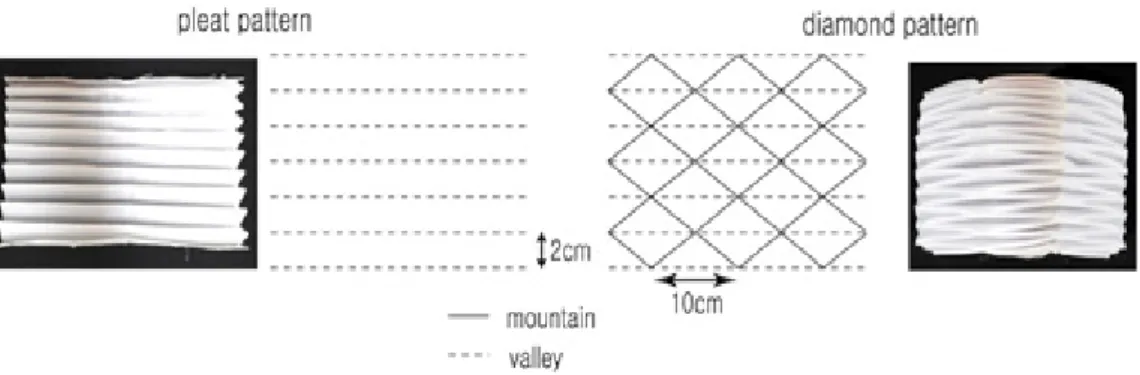
This is called the "Accordion" or "Pleated Pattern". It is designed with three-dimensional folding structure involving parallel folds and reverse folds (Jackson, 2011). Shown in Figure 5, the fold sample has repeated mountains and valleys of 2 ㎝ in height with equally spaced folds.
Figure 5. Type of the Fold Specimens
2) Diamond Pattern Specimen
The basis of this pattern is its diagonal lines fold as diamond shape. Within a "Diamond Pattern" all parallel diagonal lines are folded as valley folds, and the edges are folded as mountain folds to create an arch shape (Jackson, 2011). The result is a hexagonal pattern formed by symmetrical trapezoids. The configuration fold was created as shown in Figure 5.
2. Fold Specimen Forming Process
In order to use a Tensile Tester (Universal Tensile Tester, Model Micro 350, Testometric Co.
Ltd., U.K.), selected size of the pleats pattern specimen for fold form was adjusted to 23 ㎝ X 34 ㎝ and that of "Diamond Pattern" specimen was 30 ㎝ X 34 ㎝. The fabric sample was inserted between two sets of graph paper, and then heat-steamed and pressed for 20 minutes (Figure 6).
3. Test of the Stiffness
The stiffness was tested with cantilever testing according to Standard KSL ISO4604: 2013.
Sample sizes of 2.5 ㎝ X 15 ㎝ were prepared by cutting the fabric into strips along the warp, weft, and bias direction. The stiffness o f samples, including inner and outer surface, was measured three times.
The stiffness was calculated with the following formula: Drape Stiffness, C, is half of L (1).
C(㎝) =
(1)
C: Drape Stiffness (㎝)
L: The length of the plushed specimen (㎝)
Flex Stiffness can be calculated as (2).
Sf (gf · ㎝) = C³ x W (2) Sf: Flex Stiffness (gf·㎝)
W: Weight per unit area (gf/㎠) 4. Test of the Tensile Properties
Part of this process is to ensure adequate fold recovery and to measure force when the specimen of the fabric fold is put in tensile tester. In addition, this process tried to measure the force required by dynamic formation
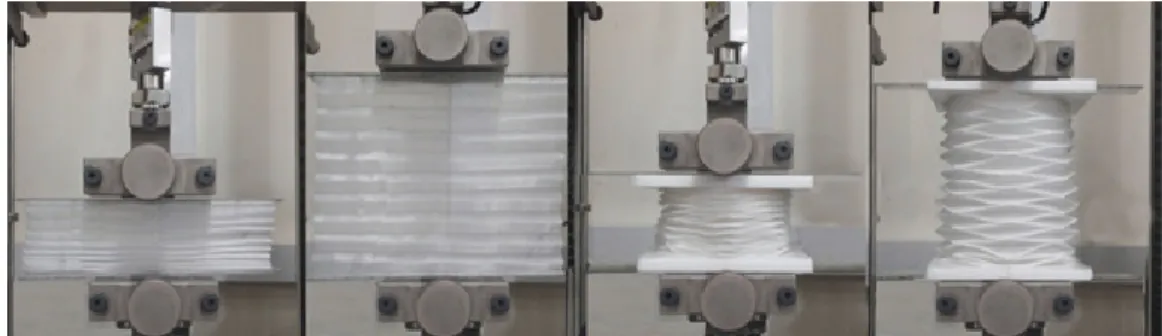
Figure 6. Tensile Properties of the Folding Specimens
mechanisms (e.g., motor, reduction gear) with a range of tensile stress standards on each folding specimen. The recovery rate of the folding specimens can be examined more objectively as the tensile properties tests were repeated twice. It revealed similar results in its range of the folding recovery as in the real garments.
1) Tensile Properties of the Fabric Samples
The sample size of 5 ㎝ X 25 ㎝, was used to made up the direction of warp, weft and bias.
In the tensile test, the fabric sample was stretched along the direction of the weft. Pulling the fabric conformed to the standard. The cross-head speed was 0.5 ㎜ /sec. The length started from 200.0 ㎜ height, and load was 2%
gf/㎝ in the elongation.
2) Tensile Properties of the Folding Specimens
The specimen size of 23 ㎝ × 34 ㎝, was only tested in the warp due to the grain line.
"Basic Pleats" pattern specimen of 8 ㎝ could be pulled and stretched to 15 ㎝ more which brings the length to a total of 23 ㎝. On the other hand, the "Diamond Pattern" specimen started out at 10 ㎝ height, which was affixed to two pairs of
auxiliary plates that were 1 ㎝ in height in order to set the fixed-arch shape.
It was stretched to an additional 10 ㎝, which extended to a total of 20 ㎝. The Load was 2%
gf/㎝ in elongation. The tensile extension-recovery cycle was repeated twice in a tensile tester (Figure 6).
5. Prototype
In this study, there was an attempt to create a more efficient “Shape-folding Dress” through folded fabrics and embedded system. Moreover, it described some of the techniques used to build circuits from fabrics, Arduino, illuminance sensor, motor, and pulley. Initial Prototype was conducted on the simple apparatus shown schematically in Figure 7.
Figure 7. Diagram of the Prototype
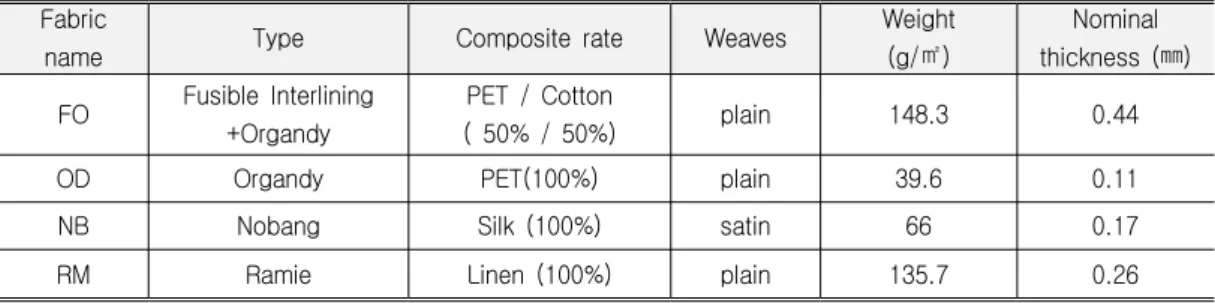
Table 1. Characteristics of the Fabric Samples Fabric
name Type Composite rate Weaves Weight
(g/㎡)
Nominal thickness (㎜) FO Fusible Interlining
+Organdy
PET / Cotton
( 50% / 50%) plain 148.3 0.44
OD Organdy PET(100%) plain 39.6 0.11
NB Nobang Silk (100%) satin 66 0.17
RM Ramie Linen (100%) plain 135.7 0.26
Ⅳ. Results and Discussion
1. Characteristics of the Fabric Samples
Fabric sample FO was designed to have two different types of seamlessly blending into one.
One was a fusible interlining which was mixed with 50% a sample OD. It is the thickest and heaviest fabric sample. Fabric sample OD, 100%
organdy, was the thinnest and most lightweight.
Fabric sample NB, 100% raw silk, without removing the sericin, had a relatively medium thickness and weight. Lastly, fabric sample RM, 100% ramie, was relatively thick and heavy.
From Table 1, displays the variations of weight and thickness among FO> RM> NB> OD.
2. Stiffness
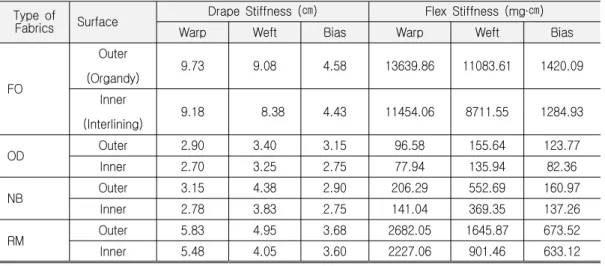
The measured results and the calculated stiffness are given in Table 2. The results indicated that the fabrics chosen for the experiment had different degrees of the stiffness. The values of stiffness: FO> RM> NB>
OD. Taking a closer look, the values showed different results depending on the direction of the fabric samples. FO and RM had the largest values in the warp direction, while OD and NB had the largest values in the weft direction.
When dividing outer and inner sides, FO using an outer side for organdy had the larger values while the rest had larger values for outer inner side. Future research is needed to measure both fabrics after removing the adhesive to observe variations in stiffness.
3. Tensile Properties
1) Tensile Properties of the Fabric Samples
Fabric behavior during stretching depends on the direction of the warp, weft and bias. In addition,
Table 2. Stiffness of the Fabric Samples Type of
Fabrics Surface Drape Stiffness (㎝) Flex Stiffness (mg∙㎝)
Warp Weft Bias Warp Weft Bias
FO
Outer
(Organdy) 9.73 9.08 4.58 13639.86 11083.61 1420.09
Inner
(Interlining) 9.18 8.38 4.43 11454.06 8711.55 1284.93
OD Outer 2.90 3.40 3.15 96.58 155.64 123.77
Inner 2.70 3.25 2.75 77.94 135.94 82.36
NB Outer 3.15 4.38 2.90 206.29 552.69 160.97
Inner 2.78 3.83 2.75 141.04 369.35 137.26
RM Outer 5.83 4.95 3.68 2682.05 1645.87 673.52
Inner 5.48 4.05 3.60 2227.06 901.46 633.12
the higher the stress during extension, the more the fabric can be stretched.
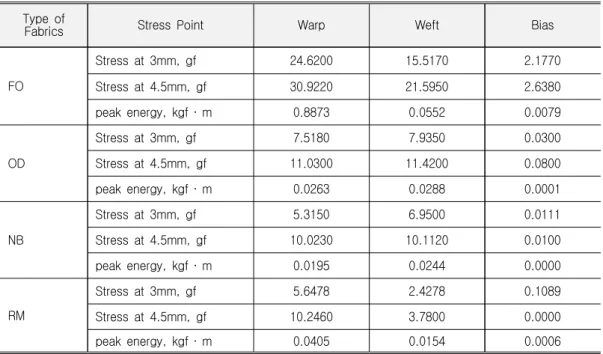
Table 4, the measured stress of FO shows the highest stress values in the tensile properties.
Except for FO, tensile properties resulted in similar values both in the warp and in the weft directions. This is because the FO is not well stretched due to the characteristic of the fusible interlining. The fact that the warp had a higher value than the weft in tensile strength may suggests the possibility of the string being cut off if it is too stiff.
2) Rate Equation of the Recovery Rate
The "Basic pattern" and "Diamond Pattern" fold tests were developed to measure the change in folding recovery properties of fabrics according to thickness and/or weight. It was designed primarily for testing four types of stiffness in fabrics and was expected to give clear distinctions among various fabrics. The complete folding behavior is given by two cycles, the percentage of fold recovery at a specified time (usually 20 min) and the recovery rate.
Table 3. Tensile Properties of the Fabric Samples Type of
Fabrics Stress Point Warp Weft Bias
FO
Stress at 3mm, gf 24.6200 15.5170 2.1770
Stress at 4.5mm, gf 30.9220 21.5950 2.6380
peak energy, kgf ․ m 0.8873 0.0552 0.0079
OD
Stress at 3mm, gf 7.5180 7.9350 0.0300
Stress at 4.5mm, gf 11.0300 11.4200 0.0800
peak energy, kgf ․ m 0.0263 0.0288 0.0001
NB
Stress at 3mm, gf 5.3150 6.9500 0.0111
Stress at 4.5mm, gf 10.0230 10.1120 0.0100
peak energy, kgf ․ m 0.0195 0.0244 0.0000
RM
Stress at 3mm, gf 5.6478 2.4278 0.1089
Stress at 4.5mm, gf 10.2460 3.7800 0.0000
peak energy, kgf ․ m 0.0405 0.0154 0.0006
Length=200.0 ㎜
Figure 8. Rate Equation of the Recovery
A1 in Figure 8 shows the work during the first extensional deformation. The area, A1, under the deformation curve represents the resistance of the fold specimen to the extensional deformation. The recovery work, A1’, is the measure of the recovery of folded fabric.
The recovery rate, A1 and A1’, of the first part of the Figure 8, during unfolding and folding against the force, is calculated. It can be calculated as:
Recovery Rate from the 1st Elongation Deformation can be calculated as:
RR1 =
′
(3)
Also, Recovery Rate from the 2nd Elongation Deformation from the same calculation, A2 and A2’, is named. It can be calculated as:
RR2 =
′
(4)
The Rate of Elongation Energy can be calculated as:
RR21 =
(5)
Folding type Type of
fabric RR1 RR2 RR21
1st Elongation deformation @
peak
Basic Pattern
FO OD NB RM
0.89 1.02 0.97 0.79
1.00 1.01 0.94 1.03
0.89 1.09 1.01 0.69
85.61 43.39 59.98 84.11
Diamond Pattern
FO OD NB RM
0.77 0.90 0.97 0.84
0.90 1.09 0.94 0.94
0.92 0.93 1.01 0.91
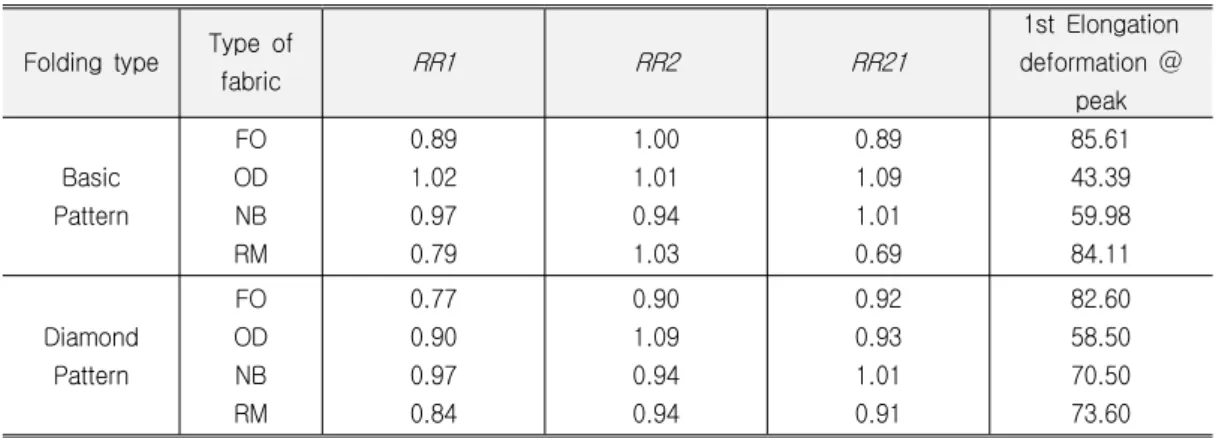
82.60 58.50 70.50 73.60 Table 4. Recovery Rate of the Folding Pattern Specimen
"Pleat Pattern" Length=230.0 ㎜ / "Diamond Pattern" Length=200.0 ㎜
Table 5. Correlation in the "Basic Pattern" Specimen Fabric
Name 1st Elongation deformation @ peak Warp mean of the flex stiffness (mg∙㎝)
FO 85.61 12546.96
OD 43.39 87.26
NB 59.98 173.66
RM 84.11 2454.56
correlation coefficient 0.70
Table 6. Correlation in the "Diamond Pattern" Specimen Fabric
Name
1st Elongation deformation
@ peak
Warp and bias mean of the flex stiffness(mg∙㎝)
FO 82.6 6949.73
OD 58.5 95.16
NB 70.5 161.39
RM 73.6 1553.94
correlation coefficient 0.83
Table 4 shows the behavior of each specimen when the pleats and "Diamond Pattern" were inserted. OD had the best recovery rate.
However, it showed that the pleats pattern obtained the best recovery rate for the first elongation deformation while the "Diamond Pattern" obtained the best recovery rate for the second elongation deformation. It is easy to
observe that NB had identical recovery rate in both first and second elongation deformations, which has a more uniformed structure. This was probably due to silk’s weaker recovery rate. OD is comprised of lightweight thermoplastic polyester filament yarns. But it was determined that the elongation had a significant influence when the length of the sample folding pattern
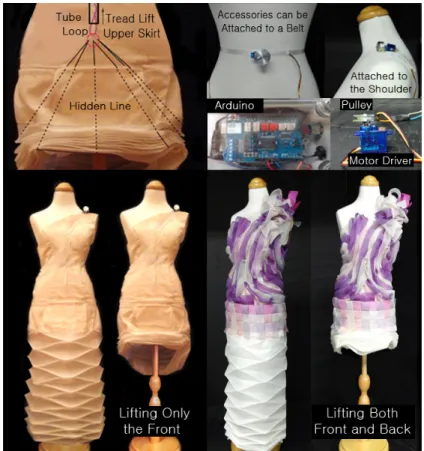
Figure 9. The Finished Prototype of the Shape–folding Dress
extended as the specimen of folding pattern increased or decreased.
4. Correlation of the Fold Specimen with Flex Stiffness of Fabrics
Table 5 shows elongation deformation characteristics of fold specimens (Basic Pattern), and the mean values of flex stiffness of fabric specimens. Table 6 shows elongation deformation characteristics of fold specimens (Diamond Pattern), and the mean values of flex stiffness of fabric specimens.
It should be noted that the flex stiffness shows a good correlation with the deformation
characteristics of the pleat patterns specimen.
The correlation coefficient ranged from 0.70 to 0.83 according to the pattern types.
5. Prototype
The sensing part of the "Shape-folding" dress captures ambient light levels with illuminance sensor and executes a time-based concatenation using an Arduino. The illuminance sensor used in conjunction with an Arduino uno 7.5V microprocessor integrated into a custom board which operates the controllers and output. It has built-in electronic circuits made entirely out of Arduino data. In addition, the flexible fabric
surface should be built with embedded actuators indicating where the pulley is located. Proper selection of the location of the pulley is very important; since problems of thread tangling may occur during the winding or releasing cycle. The process of "Shape-folding" dress can be seen in depicted in Figure 9. However, from the aesthetic or practical points of view, further study on the application of the additional motors of smaller sizes to fit within the prototype dress would be necessary.
Ⅴ. Conclusion
In this study, the aim was to combine scientific applications and principles as well as artistic creativity. In other words, it explores both the characteristics of the fabrics using analytical methods and engineering and scientific know-how that reacts to the wearer's environment. Furthermore, it could be proposed as a visual aid that expresses the wearer's creativity to develop a "Shape-folding" dress.
The experiment of this study was to investigate the basic characteristics and physical properties of the fabrics and the behavioral correlations and changes during fold contraction and recovery process in order to produce the prototype.
The results were as follows:
1. According to the weight, thickness, and stiffness, the values, ranked in descending, were: FO> RM> NB> OD. The results indicated that all the fabrics, FO used in garment for special function and RM, NB and OD used in a Hanbok, could be characterized as stiff as they were thicker and heavier.
2. The fabric samples had different degrees of
the stiffness depending on the direction of the fabric samples. FO and RM had the largest value in the warp direction, while OD and NB had the largest value in the weft direction. This may be due to the processing with the adhesive or glue that caused higher stiffness of the warp for FO and RM.
3. Since FO is a fused specimen of organdy and interlining fabrics, the outer and inner sides behave differently. Outer side of the FO shows the highest stiffness value.
4. Except for FO, tensile properties resulted in similar values both in the warp and in the weft directions.
5. OD had the best recovery rate. This was measured from the second elongation deformation of the "Diamond Pattern." However, NB had identical recovery rate in both first and second elongation deformations, which is a more stable and uniform structure.
6. The flex stiffness had a correlation with the direction of pleat pattern specimen in the warp direction. The "Diamond Pattern" specimen had significant correlation with the warp and bias directions. Thus, folding composition should consider the directions of the fabric according to the folding technique.
Based on the experiment’s results among fabric samples’ physical properties silk was chosen for the prototype.
Usually the prototype dress stays long, but it is designed to become shorter when the wearer's surroundings becomes dark. When the illuminance sensor cannot detect light, the pulley pulls the hemline in the front up to the lower thigh. As a means of visual communications or expression of the wearer's mood, activation of the pulley may be adjusted according to the wearer’s discretion.
The advantage of the "Shape-folding" dress
compared to a traditional static dress is transforming shape occurs immediately by means of visual communication. The developed prototype can be used for consumer entertainment in stage performances. The wearer can present fantasies and engage in stage performances because the shape can be changed, read, and sent to each garment according to the environment.
One of the disadvantages of the experiment was the limited use of the fabric samples. In future experiments, a variety of fabrics should be measured. The other was suitable. The actuators, wire and pulley, should be placed along the surface of the flexible fabric. If the pulley is not located at the center of gravity, it would be entangled or remain unconnected, opposed to the intention. Thus, a specific layout should be designed for the pulley to make it suitable for hanging garments.
As further studies indicate, more considerations should be given to the selection of proper motors that should be smaller in size for aesthetic and practical reasons. There should also be an additional process for building a smaller and lighter pulley that is compatible to wearable garments. A variety of silk fabrics ought to be experimented using different folding techniques. In order to meet the practical needs of people who will wear such clothing, systematic studies on the factors such as fabric folding speed, balance during the lifting or releasing cycles, appearance, and comfort would also be needed.
The significance of this study will provide valuable theoretical and practical contributions to the high fashion field/industry, fashion education, and applied research in wearable electronics by developing practical concept development and physical prototyping of
wearable technologies in creating high value fashion design.
References
Buri, H., & Weinand, Y. (2008). ORIGAMI-Folded plate structures, architecture. Proceedings of 10th World Conference on Timber Engineering, Miyazaki, Japan.
Buechley, L., & Eisenberg, M. (2009). Fabric PCBs, electronic sequins, and socket buttons:
Techniques for e-textile craft. Personal Ubiquitous Comput., 13(2), 133-150.
Choi, K., Kim, J., & Song, N. (2012). A study on the analysis of 3D scanning of knit stitches and modeling system-jersey, rib, and cable stitches. Journal of Fashion Business, 16(3), 125-135.
Hallnäs, L., & Redström, J. (2006). Interaction design: Foundations, Experiments. Borås, Sweden: The Interactive Institute Publishing, Ltd.
Holdaway, H. (1960). Behavior of sample pleated strips of wool fabric in an extensometer part II: Modifications due to pleat curvature and other second order effects. Textile Research Journal, 30(6), 456-461.
Hu, J. (2004). Structure and mechanics of woven fabrics. Cambridge UK: Woodhead Publishing, Ltd.
Jackson, P. (2011). Folding techniques for designers: From sheet to form. NY: Laurence King Publishing, Ltd.
Kang, M., & Kwon, Y. (2010). Improvement of wrinkle recovery and functional properties in linen fabrics. Journal of the Korean Society of Clothing and Textiles, 34(11), 1859-1869.
Katz, H. (1966). Wrinkling behavior of wool
fabrics part I: A multiple-pleat test. Textile Research Journal, 36(10), 874-887.
Kearney, K. (1992). Mariano fortuny's delphos robe: Some possible methods of pleating and the permanence of the pleats. Clothing and Textiles Research Journal, 10(3), 86-91.
Kim, E., & Csiszár, E. (2005). Chemical finishing of linen and ramie fabrics. Journal of Natural Fibers, 2(3), 39-52.
Kim, J., & Choi, J. (2007). 고감성 텍스타일 [High sensitivity textile expression technique].
Seoul: Ewha Womans University Press.
Kim, M., & Kim, J. (2013). A study on three-dimensional effects and deformation of textile fabrics: Dynamic deformations of silk fabrics. Journal of Fashion Business, 17(6), 28-43.
Ko, Y., & Kim, J. (2013). Effect of fabric properties used for the loop type decorative elements on the 3-dimensional shape. Journal of Fashion Business, 17(3), 30-47.
Lee, Y., & Kim, J. (2011). A study on the drape profile analysis of the apparel textiles and 3D virtual textiles using a 3D digital clothing software. Journal of Fashion Business, 15(5), 103-114.
McCarty, C., & McQuaid, M. (1998). Structure and surface: Contemporary Japanese textiles. NY: The Museum of Modern Art.
Perovich, L., Mothersill, P., & Farah, J. B.
(2014). Awakened apparel: Embedded soft actuators for expressive fashion and functional garments. Proceedings of the 8th International Conference on Tangible, Embedded and Embodied Interaction, 77-80.
Prevorsek, D., Butler, R., & Lamb, G. (1975).
Influence of fiber properties on wrinkling behavior of fabrics part I: Procedures and apparatus. Textile Research Journal, 45(1), 60-67.
Seymour, S. (2008). Fashionable Technology, The Intersection of Design, Fashion, Science, and Technology. NY: Springer Vienna Publishing, Ltd.
Singh, A. V., Rahman, A., Sudhir Kumar, N., Aditi, A., Galluzzi, M., Bovio, S., Parazzoli, D.
(2012). Bio-inspired approaches to design smart fabrics. Materials & Design, 36, 829-839.
Sparks, D. (2004). Explorations in pleated fabric garment structures. Clothing and Textiles Research Journal, 22(1-2), 38-43.
Received (July 1, 2014) Revised (July 15, 2014) Accepted (July 18, 2014)